


INTRODUCTION
Since China joined the World Trade Organization in 2001, it has become the primary trading partner of many countries. Currently, China is the world's largest exporter and second largest importer.Footnote 1 In 2013 China launched the Belt and Road Initiative (BRI), aiming at consolidating trade and cultural links with neighboring countries. The plan has brought huge amounts of investment, most of which focuses on building basic infrastructure in China's partner countries.
Despite increasing economic integration with China, China's neighbors have been wary of the country's underlying political intentions. The “China threat” argument has been growing significantly in the public sphere and in academia since the tension over the South China Sea issue arose (e.g., Thayer Reference Thayer2011; Song and Yuan Reference Song and Yuan2012; Liang Reference Liang2018). In 2018 Sri Lanka handed over the Hambantota Port to China, as a result of its inability to make payment on the debt created under the BRI, allowing China to gain a foothold along a strategic waterway against its main rival, India (Shah Reference Shah2019). A recent report by Mun et al. (Reference Mun, Moe Thuzar, Termsak Chalermpalanupap and Qian2019) shows that more than 50 percent of the experts in ASEAN countries do not have confidence China will positively contribute to “global peace, security, prosperity and governance.” On economic relations, in the same report, 70 percent of the respondents worry about the financial debt crisis resulting from trade deals with China. It has become clear that although China is the main trading partner for many Asian countries, its neighbors have also become cautious about over-dependence on China (Pavlićević and Kratz Reference Pavlićević and Kratz2018; Shah Reference Shah2019). Questions worthy of further exploration are: Do people view trading with China differently? and What factors into individual preferences regarding trading with China?
This article experimentally tests whether a nationally representative sample of Taiwanese respondents sees trade with China through a different lens than trade with other countries. Taiwan has been particularly exposed to pressure from Beijing on its international space for decades. By assigning subjects to a trade policy that either benefits or costs them personally and is either with China, Japan, or Malaysia, we are able to establish a causal effect of trading partner on support for trade. By randomly assigning subjects to information about their personal income increasing or decreasing as a consequence of the trade deal, we are able to assess the extent to which economic information on economic interest (pocketbook) affects support for the trade agreement.
Our empirical results show that support for trade in Taiwan depends on the trade partner; and Taiwanese do view trading with China differently. In general, they are responsive to information on economic interest, but such information becomes ineffective when the proposed trade partner is China. Moreover, further exploration of the heterogenous treatment effect shows that the low support for trade with China is driven by national pride—how attached one is to his/her Taiwanese identity. The stronger such identification, the more caution about trade with China.
We argue that such empirical results can be best explained by Social Identity Theory, which conceptualizes countries as ingroups, to which other countries are outgroups. Outgroups, such as China, can be seen positively or negatively, primarily based on the level of political externality they impose on the ingroup country. Trading with an outgroup that generates higher negative political externalities will be viewed more negatively overall by ingroup members relative to trade with outgroups that pose no political costs.Footnote 2 Those who are most attached to the ingroup, proxied by national pride, are most opposed to trade with an outgroup that endangers national political interests, regardless of personal economic interest.
This article contributes to the large trade preference literature by bringing in the political context of specific trade deals. The article also identifies national attachment—which is neither a proxy for political identification nor a proxy for national chauvinism—as an important factor shaping Taiwan citizens’ trade preferences toward China. The article shows that people's support for trade can be manipulated by supplying them with information on their material interest. However, such information may not be as useful when the trading partner is China. While the political tension between China and Taiwan is unique, we believe that the findings are generalizable. As China's trade relations in the Asia-Pacific deepen, other countries will increasingly face similar considerations: whether they perceive Chinese trade through an economic or nationalist lens. The relationship should hold in any setting in which strongly identified nationalists see risks from engaging with China as a hostile outsider.
EXISTING LITERATURE ON TRADE PREFERENCE FORMATION
Two primary political economy theories have built on the concept of self-interest to explain individual support for trade. Factor endowment theory—based on the Heckscher-Ohlin and Stolper-Samuelson models—argues that a country's primary factor endowment defines who wins or loses within a country. The abundant factor owner or producers should be in favor of trade openness since they benefit from exporting factor-abundant products. For instance, lower (higher) skilled workers living in a skill-abundant country will experience real income declines (increases) from freer trade and support (oppose) protectionism over free trade (Blonigen Reference Blonigen2011). By contrast, the industry specific theory (or the Ricardo-Viner model) argues that the competitiveness of a given industry determines its workers’ trade preferences. People's preferences toward trade policy are tied to a specific sector regardless of whether individuals have abundant or scarce factors in the country because workers are immobile across industries (Frieden Reference Frieden1991). Recent studies have shown that both factor mobility and factor specificity arguments are valid (Beaulieu Reference Beaulieu2002; Hiscox Reference Hiscox2002; Mayda and Rodrik Reference Mayda and Rodrik2005). Also, personal interests are often highly associated with interests of a group in which individuals have close ties (Fordham and Kleinberg Reference Fordham and Kleinberg2012).
The material self-interest argument rests on two assumptions. First, it assumes that people can correctly evaluate the extent to which they benefit from trade. Second, it also implies that people can directly associate their personal interests with government policies, including trade agreements. However, the ability and motivation of people to actually make these connections in evaluating real policies is questionable. As new studies cast doubt on the role of material self-interest in trade attitudes, the refutation of these two assumptions becomes the point of departure for the other-regarding arguments (Mansfield and Mutz Reference Mansfield and Mutz2009; Rankin Reference Rankin2001).
Responding to the first assumption, considerable research has already found that information about national-level impacts of a trade deal matters for individual-level support (Hiscox 2006). For instance, when respondents are primed to link trade to increases in unemployment or rising income inequality within an industry, they are significantly less likely to be supportive, while the knowledge about trade-related compensation policies for job loss increases support for trade (Lü, Scheve, and Slaughter Reference Lü, Scheve and Slaughter2012; Davidson, Matusz, and Nelson Reference Davidson, Matusz and Nelson2012; Ehrlich and Hearn Reference Ehrlich and Hearn2014). Recent research finds that individuals are concerned about consumer gains, regulation standards, and cultural proximity with the trade partner (Spilker, Bernauer, and Umaña Reference Spilker, Bernauer and Umaña2016). Overall, evidence suggests that the specifics of a trade agreement help determine its public support, and these specifics are not necessarily associated with how individuals benefit economically. However, it is unclear whether individuals focus on the national-level information because they value it over the individual-level, or because they use the sociotropic effects of a policy as a cue to how they personally will be affected.Footnote 3 A recent study by Jamal and Milner (Reference Jamal and Milner2019) shows that economic self-interest is prevailing over socio-tropical factors, while the debate is still ongoing.
Besides the economic self-interest, emerging scholarship investigating how non-economic factors affect individual trade preferences has taken a huge step in revealing the role of nationalism. In short, the way people view their own group and its relationships with other nations affects the degree to which they respond to pocketbook consideration. For example, scholars using cross-national observational survey data have found that greater nationalism correlates with more negative attitudes towards trade in general (Hooghe and Marks Reference Hooghe and Marks2004; Mayda and Rodrik Reference Mayda and Rodrik2005; O'Rourke and Sinnott Reference O'Rourke, Sinnott, Collins and Rodrik2001; Rankin Reference Rankin2001). Specifically, Mansfield and Mutz (Reference Mansfield and Mutz2009) had the crucial insight that ingroup–outgroup dynamics determine trade preferences among Americans, showing how ethnocentrism specifically undergirds mass attitudes towards trade instead of material self-interest. Mutz and Kim (Reference Mutz and Kim2017) further show that people prefer a policy that is beneficial to one's own group only, while information on gains of other groups makes the policy less popular. They found that this effect is stronger when individuals perceive that there is a high level of intergroup competition.Footnote 4 Sabet (Reference Sabet2016) further illustrates that individual evaluation of the impacts of foreign cultural exchange on one's country serves as an information cue for trade preference formation. In other words, material self-interest factors in most when people have weak or neutral opinions of foreign cultural influences.
This literature on intergroup relationships illustrates that one cannot overlook the political contexts of specific agreements, even if they are economic agreements. Recently, several studies further illustrate the salience of trade partners and political contexts. Herrmann, Tetlock, and Diascro (Reference Herrmann, Tetlock and Diascro2001), one of the pioneer studies to employ an experimental design on this topic, finds that trade partners matter for individuals’ trade preferences. Spilker, Bernauer, and Umaña (Reference Spilker, Bernauer and Umaña2016) similarly uses experimental designs to specify various factors that matter for selecting preferential trade agreement partners. They find that individuals prefer trade exchanges with culturally and politically similar partner countries. Even more directly, Spilker, Bernauer, and Umaña (Reference Spilker, Bernauer and Umaña2018), using an experimental design, find that individual sympathy or antipathy toward countries significantly shapes trade preferences. The logic behind these studies is the “treaty partner heuristic” (Steiner Reference Steiner2018). When signing a trade deal with another country, people evaluate not only the deal itself but also the countries involved. Specifically, they evaluate benefits and risks from other partners (Gray and Hicks Reference Gray and Hicks2014) and the multiple dimensions of a trade agreement (Steiner Reference Steiner2018). In sum, the context of a specific trade deal, including trade partner, contents of an agreement, has an impact on preference formation (Jungherr et al. Reference Jungherr, Mader, Schoen and Wuttke2018).
DESIGN AND DATA
SURVEY EXPERIMENT IN TAIWAN
Taiwan has a range of political and economic relationships with its neighbors that allow for optimal clarity when comparing reactions to different outgroups. Over 40 percent of Taiwanese exports and outward investment go to China; yet trading with China can be seen as trading with the enemy, since China still claims that Taiwan is a renegade province (see e.g. Cabestan and deLisle Reference Cabestan and deLisle2014; Lin Reference Lin2016; Achen and Wang Reference Achen and Wang2017). China's military threat and its diplomatic isolation of Taiwan mean that there is a large political externality to trade with China. According to the Taiwan National Security Studies Surveys (2002–2015), more than two thirds of the Taiwanese people agree with the statement that “Taiwan's economy is over-dependent on Mainland China, and China will take advantage of it and force Taiwan to make certain political concessions in the future.”Footnote 5 In the 2013 Asian Barometer Survey, 40 percent of the Taiwanese respondents said China is doing more harm than good in Asia, and 53 percent said China exerts negative influence on Taiwan specifically (Chu, Kang, and Huang Reference Chu, Kang and Huang2015; Huang and Chu Reference Huang and Chu2015). All in all, even though Taiwan retains an active trading relationship with China, China imposes a clear political externality on Taiwan.
This dynamic is not unique to Taiwan. For many Asian countries China is their main trading partner, but its increasing military strength is viewed with alarm, especially in countries with territorial disputes or historical connections with China (Chu, Kang, and Huang Reference Chu, Kang and Huang2015; Huang and Chu Reference Huang and Chu2015; Pew Research Center 2015). For example, in South Korea, 89 percent of people view the Chinese military as a bad thing for their country while 80 percent of Japanese share that view (Chu, Kang, and Huang Reference Chu, Kang and Huang2015). For Southeast Asian countries, China is also the largest trading partner,Footnote 6 but a clear majority of people in the Philippines, Vietnam, and India say that they are very concerned about a possible military confrontation with China (Pew Research Center 2015). Thus, even though the China–Taiwan situation poses exceptionally high levels of political costs to Taiwan's trade deals with China, concern about China's political influence through economic interdependence is also pressing for many other countries.
In order to test whether and how Taiwanese people respond differently to China than to other trading partners, we employ a survey experiment with a nationally representative sample of Taiwanese respondents. Survey data without an experimental component prohibit researchers from testing some basic assumptions, such as whether individuals can correctly evaluate their gains/losses under a trade deal. Similarly, survey data may be tainted by endogenous relationships between perceptions of how trade affects the nation and how it affects the individual. For example, individuals may use their expectation of the effect on the country in general as a proxy for how a policy will affect them personally, making self-interest and national interest difficult to separate. Given the complexity of trade issues, it is difficult to disentangle the correct measure or proxy for the correct variable with survey data. For instance, recent studies have already found that education, which is the long-assumed proxy for self-interest, might be a proxy for other non-economic factors (i.e., ethnocentrism or exposure to information) (Mansfield and Mutz Reference Mansfield and Mutz2009; Hainmueller and Hiscox Reference Hainmueller and Hiscox2006). In this article, we adopt an experimental approach to overcome these issues.
The advantage of an experimental design is that it allows us to exogenously manipulate or control the factors from both the economic and non-economic literatures. As a result, we run a 2 × 3 survey experiment, where we directly manipulate self-interest through income changes, and operationalize the presence or absence of political externality via trading partner.
Our first treatment manipulates the level of political externality through trading partners. Respondents are randomly assigned to one of three countries for Taiwan to sign a trade deal with: China, Japan, or Malaysia. We expect that China's explicit claims to control Taiwan trigger protective instincts in respondents, translating into opposition to trade with China, and the level of opposition depends on their attachment to the ingroup. In other words, China serves as the high political externality treatment in our experiment. In contrast to China, we chose Malaysia as another trading partner because the trade conditions of Malaysia relative to Taiwan are similar to the trade conditions between China and Taiwan, yet without the same political externality. Malaysia and China share similar levels of economic development and are each endowed with an abundant labor force. They are both major trading partners of Taiwan and share extensive socio-economic exchanges with Taiwan.Footnote 7 Furthermore, 25 percent of the population in Malaysia is ethnic Chinese. Thus, if respondents were using trading partner as a cue for economic consequences or increases in immigration, then Malaysia would have the same effect as China.
Japan is added as a third and final country for two reasons. On the one hand, people might argue that the effect of China is a result of China being a great political and economic power in the region rather than China being hostile to Taiwan's nationhood. We add Japan to exclude this possibility. Like China, Japan is also a dominant political and economic power in East Asia. On the other hand, if individual trade attitudes are influenced by the strength of the trading country, China and Japan should have similar effects. Japan remains as one of Taiwan's largest trade partners, and it is the nation with which Taiwan has the greatest trade deficit. This deficit results from the fact that many of Taiwan's industries (particularly high-tech industries) rely on Japan to supply manufacturing components and technology. However, Japan does not have aggressive military or sovereignty claims over Taiwan and thus should pose much less externality compared to China. Therefore, any effect of China in comparison to Japan and Malaysia can be attributed to the specific threat that China poses to Taiwan as a nation.
The second major treatment is individuals’ income changes. Within each trade partner treatment group, half of the respondents are told they would gain income from the proposed trade deal, and the other half that they would lose income from the deal. Previous research has noted the difficulty individuals are likely to have in attempting to calculate the effect any given policy will have on them personally. Randomly telling our subjects that their monthly salary will increase or decrease by 3 percent if the proposed policy passes enables us to discern the exogenous effect of economic self-interest, divorced from the national economic consequences of trade.Footnote 8 We choose percentage because it is less responsive to different levels of income, such that both low and high earners would be expected to react similarly. We expect individuals benefiting from the deal to be more supportive, as long as China is not the trade partner.
We control for the sociotropic economic perceptions that may shape individual attitudes toward trade policy by explicitly stating in all treatment conditions that if the trade agreement were passed, the overall GDP of Taiwan would be expected to increase by 3–4 percent, exports by 2–5 percent, and inequality would be unaffected. We chose positive figures because Taiwan is an island economy which tends to benefit from trade openness. We also wanted to make sure that the national economic effect of the policy was positive so that any negative effects on support for the trade policy could be attributed to the trade partner. Finally, we wanted to show that even when the nation benefits economically, the trade partner can still induce negative political externalities, and cooperation may still be opposed.
Part of the power of our study stems from the fact that we hold benefit to the national economy constant, and directly manipulate the effect of the policy on individual income. In doing so, we separate the respondents’ individual- and national-level economic interests and obviate the need to use one as a cue for the other. This enables us to better estimate the exogenous effect of economic self-interest on support for a trade policy. Furthermore, because we have explicitly separated the economic effects of the policy on the individual and on the nation, when we see no effect of economic self-interest, it is not because of collinearity or endogeneity issues. Similarly, we wanted to show that even when the nation benefits economically, the trade partner can still pose negative political externalities, and cooperation may still be opposed. We expect that support for trade should depend in part on the trading partner. Specifically, we expect that support for a trade agreement with a country that poses a significant political externality, in this case China, should be significantly lower, independent of economic self-interest.
DATA COLLECTION AND SAMPLE
In our online survey, every respondent was first asked questions about demographics, national pride (10-point scale), national chauvinism, general attitudes towards trade, and so forth. The question wordings can be found in Appendix A in the supplementary material. Then respondents read a passage about a potential trade deal which they are randomly told will either increase or decrease their income, and that it is either with China, Japan, or Malaysia. The passage reads as follows:
The Taiwanese government is contemplating signing a trade agreement with [China/Malaysia/Japan]. A study by Taiwan Institute of Economic Research predicts that this agreement will increase export by 2–5% and overall national GDP growth by 3–4%. Inequality is not expected to change as a result of this agreement, although some economic sectors will be affected more than others.
The World Trade Organization has devised software to determine how individuals will be affected by this trade agreement. Please select the industry and occupation in which you are employed from the list below, as well as your personal annual income. We will calculate how you are expected to be affected by the new trade agreement, if it passes. If you are currently not in the labor market (e.g.: student, housewives, retired people … etc.), please provide the information of the breadwinner in the family.
(After the respondent selects his/her occupation, industry and income level, they see the second treatment as below)
According to the World Trade Organization, your monthly salary is expected to [increase/decrease] by 3% under this trade agreement.’’Footnote 9
For our dependent variable, at the end of the survey respondents were asked whether they would support or oppose the agreement on a 7-point scale, where 4 represents neutrality.
We included three manipulation check questions to ensure that respondents were actually absorbing the economic self-interest, national economic interest and trading partner information given in the treatments. Respondents often skim surveys very quickly when taking them online, so it is important to know which participants were paying attention. These checks allow for greater internal validity, because they ensure that those who pass them have the information on which we expect them to base their responses. Second, the treatments were purposely very subtle. Nothing verbally or visually drew special attention to the treatments, which were only mentioned once in the process of explaining a relatively dry policy. It was designed this way to decrease demand effects, where respondents might respond to the dependent variable differently based on the assumption that the researcher wants them to answer a certain way. Subtlety also makes the experiment more in tune with real policies and news stories about them, increasing our ecological validity. Having the manipulation checks allows us to separate the respondents who understood and remembered the information in our treatments from those who did not.
The subtle vignette design and manipulation checks inevitably led to participants who paid less attention or had worse recall for detailed information dropping out, potentially making the findings less generalizable to the less educated or less interested. 40–47 percent of respondents in each of the six cells of our experiment passed all three checks. Simple t-tests between the full and reduced sample on a number of demographic attributes show that respondents in the reduced sample are slightly older, more educated, and richer. The two samples are not significantly different on measures of nationalism, including levels of national pride and chauvinism. For basic descriptive statistics of the two samples, please see Appendix B in the supplementary material. To make sure that respondents who drop out of our sample are balanced across treatment groups and to show that we are not dropping responses strategically, we perform tests of balance and selection into the reduced sample. We regress a dummy for having passed the three checks on treatments, national pride and on demographic variables. The results show that 1) the selection into treatment is balanced across all treatment groups; 2) pride is not predictive of passing; and 3) less educated and younger people are more likely to fail at least one of the checks. Together, our tests indicate that we can treat missingness as if random in regard to our estimates of treatment effects and the interaction of pride with treatments. For more detail on the t-test, balance test, and the selection regression, see Appendix C in the supplementary material. Our results are basically the same regardless of whether we use the full or reduced sample. We begin our analysis by focusing only on respondents who correctly answered the manipulation check questions and then will show the results of the full sample.
The survey experiment was administrated through Pollcracy Lab (PL) hosted by the Election Study Center at the National Cheng-chi University in Taiwan from September 30 to October 8, 2014. The Election Study Center (ESC) is one of the leading agencies conducting public opinion surveys in Taiwan. The ESC relies on a Computer Assisted Telephone Interviewing (CATI) system to conduct their surveys. Starting from 2006, the ESC has started to construct their online panel through random digit dialing (RDD), the same method as telephone interviewing. Hence, it is a probability-based panel, covering the Taiwanese population aged 20 years and older consisting of more than 10,000 panelists. For our study, a total of 831 respondents were collected in the span of 9 days.
EMPIRICAL FINDINGS
IS TRADING WITH CHINA DIFFERENT?
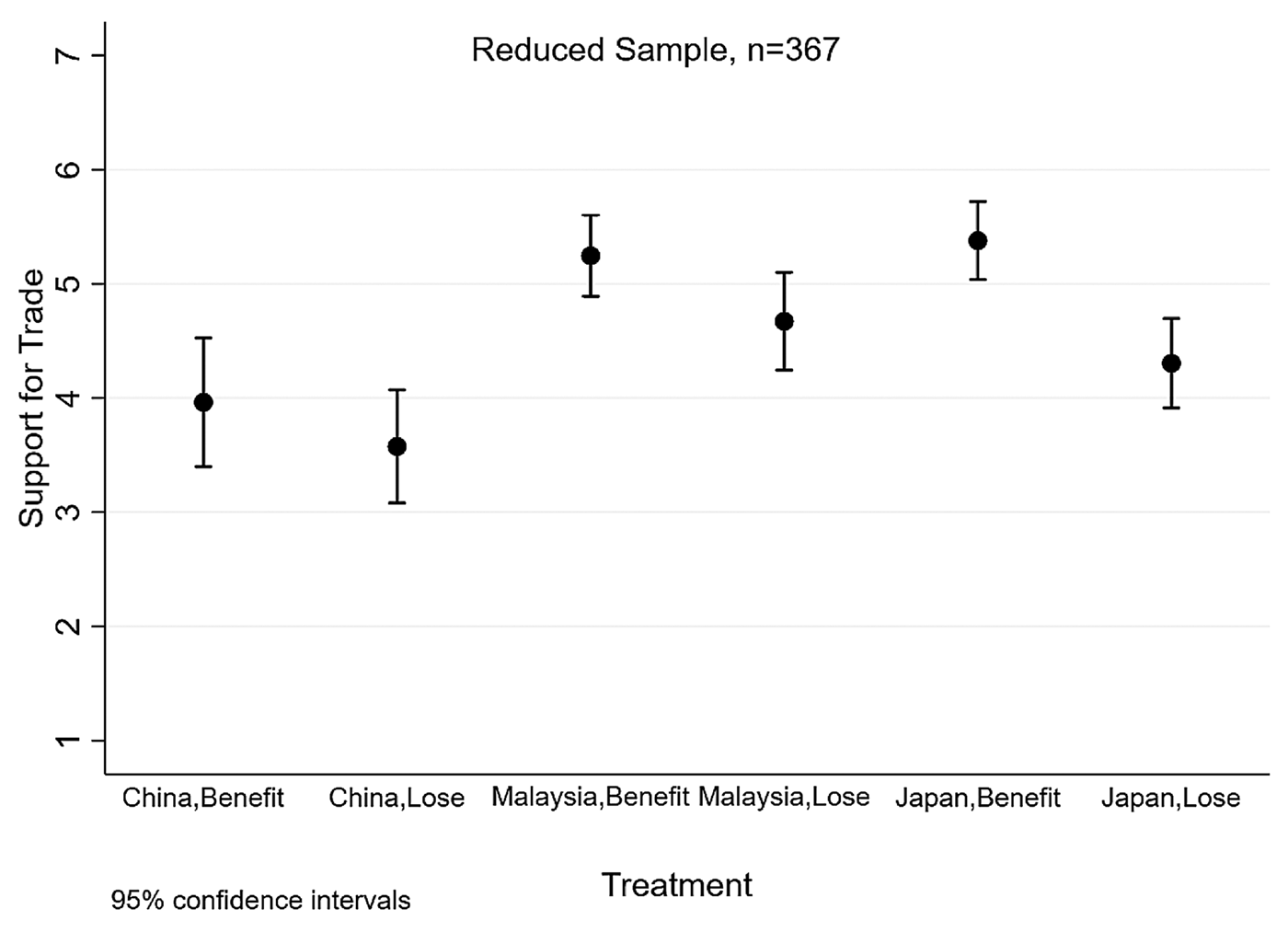
Do Taiwanese view trading with China differently? Since we are using an experiment, we can estimate the effects of our treatments simply by comparing the differences in means between any two of the six treatment groups. In Figure 1 we see the means of the dependent variable, support for the trade policy, split up by treatment group with 95 percent confidence intervals. The results show that support for trade with China is much lower than support for trade with Japan or Malaysia. Moreover, Figure 1 shows that respondents were significantly more supportive of trade with either Malaysia or Japan when it would increase their personal incomes. However, given China as the trading partner, the difference between gaining and losing 3% of one's income becomes insignificant. In other words, the information on economic interest that was powerful enough to affect support for trade with Japan and Malaysia was powerless in the China treatment groups.
Raw Mean Support for Trade by Treatment Group

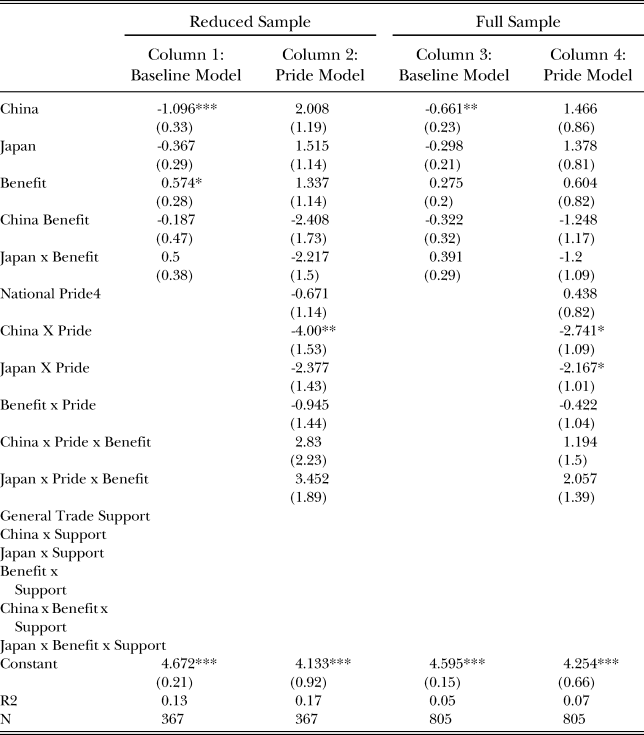
Turning to results from our regression models, the first column in Table 1 shows that when the dependent variable is regressed on just the treatments, China is the negative and substantively and statistically significant. Thus, when benefit is held at zero, meaning the respondent was told they would lose income, support for trade is significantly lower if the trading partner is China than when it is Malaysia, the omitted category. Similarly, when benefit is held at 1, meaning the respondent gains income, then the difference between support for trade with Malaysia or Japan versus China is even greater, just as we also saw in Figure 1. Our experiment makes it very clear that China has an exogenous effect on support for a given trade policy. Because the effects on the national economy were held constant, the effect of China cannot be attributed to anticipated national economic benefits or dangers. Moreover, inferences the respondents could make from the national level to their personal economic interests are also held constant by making both the sociotropic and pocketbook economic effects explicit. It is clear that there is something negative about China that makes people less willing to sign a trade agreement with it.
Regression Results for Support for Trade

Robust standard errors
*p < 0.05; ** < 0.01; ***p < 0.001
WHAT EXPLAINS TRADE PREFERENCE TOWARD CHINA: A SOCIAL IDENTITY EXPLANATION
It is not surprising to find that Taiwanese view China differently. The more interesting question is what individual attributes drive the lower trade support toward China. In other words, what accounts for the heterogeneous treatment effects across different trading countries?
In this article, we argue that one explanatory factor, drawing from Social Identity Theory, should be one's attachment level to their country. Social Identity Theory was built on the minimal group paradigm, in which subjects randomly assigned to groups show ingroup bias when distributing benefits to the ingroup versus an outgroup. The theory is that the more an individual identifies with a group, such as a nation, the more invested she is in the benefit of the group, even beyond benefit to herself. This finding has been consistently replicated over forty years of Social Identity Theory research; holds even when individuals’ personal gain is explicitly independent of that of their group, and endures even when individuals know that their group assignments are random (Tajfel et al. Reference Tajfel, Billig, Bundy and Flament1971).
Within Social Identity Theory there are two often overlooked facets that are worthy of further clarification: the difference between ingroup love and outgroup hate, and the differentiation of outgroups. First, ingroup attachment does not equate with negativity towards outgroups (Roccas and Brewer, Reference Roccas and Brewer2002). In other words, individuals who are strongly attached to their ingroup do not automatically feel hostile towards outgroups. While many other studies have equated ingroup positivity with superiority or antagonism towards outgroups, experiments have shown that these concepts are separate. For example, in the context of national ingroups, Herrmann, Tetlock, and Diascro (Reference Herrmann, Isernia and Segatti2009, 746) showed that national chauvinism and national attachment can be separated, and that “attachment to the nation is not the cause of militarist and conflictive dispositions.” Consequently, we conceptualize nationalism as positivity towards the national ingroup—i.e. pride—as opposed to negativity or superiority towards outgroups—i.e. national chauvinism, xenophobia, or ethnocentrism. In the online appendies, we show that national chauvinism is unrelated to support for the trade agreement in all of our treatment groups.
Second, outgroups are not necessarily viewed the same way; rather, attitudes towards outgroups are constructed separately (Lee and Fiske Reference Lee and Fiske2006). The crucial difference between outgroups being viewed as positive or negative in Social Identity Theory is the cost paid by the ingroup for interacting with the outgroup (Miller, Maner, and Becker Reference Miller, Maner and Vaughn Becker2010). If one group poses a threat to the existence or value of the ingroup, high identifiers will oppose interaction with it. In the lab, this has been shown consistently (Branscombe, Schmitt, and Harvey Reference Branscombe, Schmitt and Harvey1999; Leach, Snider, and Iyer Reference Leach, Snider, Iyer, Smith and Walker2002). Similarly, attitudes towards such outgroups have been found to be considerably more negative than those towards non-threatening outgroups in the real world as well (Riek, Mania, and Gaertner Reference Riek, Mania and Gaertner2006). Furthermore, ingroup identifiers prefer to avoid interactions with negative outgroups (Cottrell and Neuberg Reference Cottrell and Neuberg2005).
In the case of national ingroups and trade, we expect that variation in attachment to the national group will determine the extent to which an individual is willing to take the national political externality of a particular trade partner into account when deciding to support a trade agreement. A potential trading partner (i.e., the outgroup) with high political negativity should, overall, gain lower support from citizens of the home country (i.e., the ingroup). Specifically, those more attached to the national ingroup will be most opposed to interaction with outgroups that pose a negative political externality, even when personal economic self-interest is at stake. Such negative reactions from the national ingroup should occur only when there is negative political externality attached to the specified trade deal. On the other hand, when the outgroup poses little to no political externality, willingness to trade would depend solely on the economic consequences of the agreement and would not be moderated by national pride. To sum up, those who are most attached to the nation should be most concerned about the politically negative externality posed by a potential trading partner.
If those who are most attached to Taiwan are most responsive to the political externality China poses, then it should show up in the interaction term of trading partner with national pride. The second column of Table 1 shows that the interaction between pride and China is negative, substantively large, and statistically significant, meaning that national pride indeed moderates the response to the China treatment. In fact, the constitutive effect of China completely disappears with the incorporation of national pride. In other words, those who were very low on pride, such that pride equals zero, did not oppose trade with China, but those who were highest on pride, (pride = 1) were statistically and substantively significantly opposed to trade with China. Thus, the negative reaction to China was driven by those most attached to Taiwan.
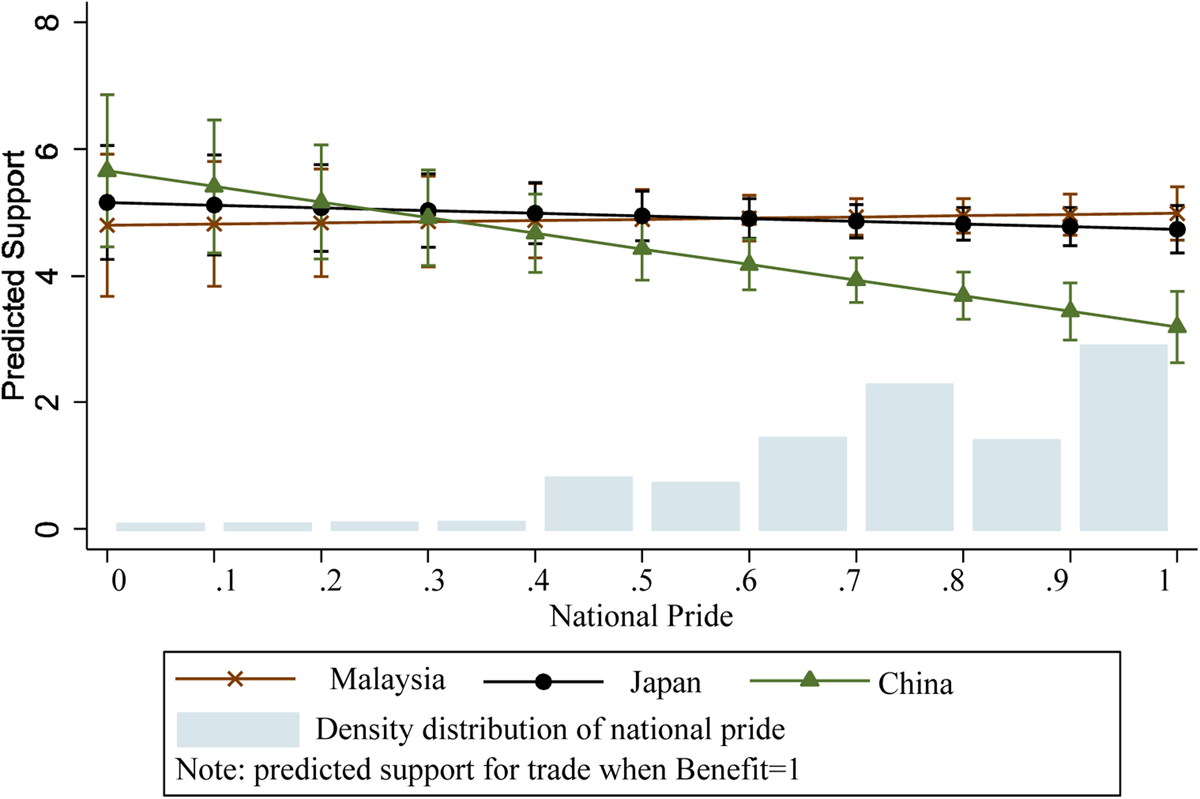
This effect is illustrated in Figure 2. Figure 2 holds the self-interest treatment constant as increasing (benefit = 1) and plots the relationship between the dependent variable and national pride contingent on the trading partner. It shows that the relationship between support for trade and national pride varies by country. Even among the trade beneficiaries, as national pride increases from its minimum to its maximum, support for trade with China plummets from about a 5.6 to 3.2, on a scale from 1 to 7, a 34 percent decrease in support. By contrast, the relationships between pride and support for trade with Japan and Malaysia are essentially flat.
Predicted Support for Trade over National Pride by Country

ROBUSTNESS CHECKS
Given the significant number of respondents dropped after the manipulation checks, it is important to show that they were not dropped strategically, and that our findings are robust to choices of sample. To be clear, the exact statistical meanings of these estimators are different, but they are equally valid. The full sample unbiasedly estimates the intention to treat (ITT), and the reduced sample estimates the average treatment effect (ATT) on the subsample of people who processed the information as intended.Footnote 10 The ITT provides a conservative estimate, and so it is biased against supporting our hypotheses (Dunning Reference Dunning2008).
In Column 3 and 4 of Table 1, we show the models with and without pride run on the full sample. If we compare the results of full sample size with that of the reduced sample, we see similar results. The only difference is that the interaction Japan x Pride is significant in the full sample model, indicating that people's support for trading with Japan decreases as national attachment increases as well. That said, further investigation shows that the support in both the Malaysia and Japan treatment groups remains overlapped across National Pride, despite the significant Japan x Pride interaction term. Only respondents in the China treatment groups have a substantial drop in support as National Pride increases. These are both reasonable conceptualizations of causal effects, and the greater point of showing a causal effect of China on support for trade is legitimated by the similarity of the results. In comparing the baseline models in column 1 and 3, we can see that the treatment effect of China is consistent, whether we estimate ITT or the reduced sample treatment effect. Similarly, the interaction of national pride with China is significant in both the full and reduced samples, meaning that the moderating effect of pride on the China treatment effect holds when we estimate the ITT.
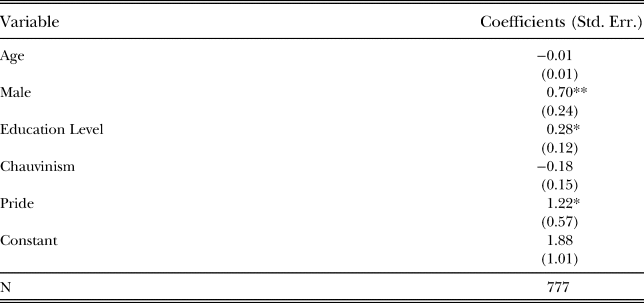
In order to make sure that national pride only factors into individual trade preferences under specific political contexts and does not make Taiwanese people less supportive of trade in general, we specify a model in which overall support for trade is the dependent variable. It is coded as a dummy variable with 1 indicating support for free trade (increasing exports). Table 2 shows the result. When support for trade in general is the dependent variable, national pride has a statistically significant and positive coefficient, meaning that as an individual is more attached to the country, he is more likely to be supportive of trade in general. Thus, our measure of national pride is not capturing a blanket opposition to trade. Together these results show that national attachment is not associated with less support for trade itself, but does predict decreased support for trade with a partner that poses a negative externality to the national ingroup.
Modeling General Support for Trade with National Pride

Robust standard error
*p < 0.05; ** < 0.01; ***p < 0.001
To sum up, we find that China induces significantly more opposition to a trade agreement that would otherwise benefit Taiwan economically, compared to Japan and Malaysia. In keeping with expectations from the economic literature on trade, respondents who were told they would personally benefit from the trade agreement were more supportive, unless the trading partner was China. Those most attached to the ingroup, that is, most proud to be from Taiwan, were most responsive to the political externalities of trading with China. These respondents were willing to forego economic gain to avoid greater interdependence with China.
DISCUSSION AND CONCLUSION
This article shifts away from analyzing general support for trade and focus on specific trade deals that may come with different levels of political costs. In particular, this article tests whether Taiwanese citizens view trading with China differently due to its contentious relationship with China. Through a survey experiment that assigns subjects to different trade deals—which either benefits or costs them personally and is either with China, Japan, or Malaysia—this article finds the following empirical results. First, we have shown that different trade partners cause a given policy to have higher or lower average support among Taiwanese people. Secondly, we were able to show that information on economic interest does matter on individual preferences. However, the pocketbook information can be ineffective if the trade partner comes with political externalities. Third, we built on Social Identity Theory to show that national pride moderates the relationship between trade partner and support for trade. While general dispositions towards trade are important, we show that general support for trade does not predict universal support for all specific trade deals.
All in all, rather than arguing that economic or non-economic factors dominate trade preference formation, we have shown that both factors can matter, but the influence of each factor depends on the political context, a previously overlooked aspect of trade agreements. This article calls for greater attention to be paid to the role of political context in trade preference formation. We think that trade partners matter, and each trade deal should be evaluated in its own right. The usual survey item on “general support for trade” is too abstract to assess people's underlying trade preferences toward specific trade deals for two reasons. First, being supportive toward trade in general does not always lead to support for every trade agreement. We have shown that support will be suppressed if the trading partner brings negative political costs, for example. Second, the general support for trade survey question may tap into various concepts (e.g. openness toward the world), to the point that it may be too contaminated to be analytically useful. Therefore, building on our article, we suggest shifting from general trade attitudes to the study of support for trade (or any form of engagement) with specific partners in the future. Ideally future research will introduce other contextual factors of trade agreements and utilize experiments and other methods to gain causal purchase on the key determinants of trade support in various realistic contexts. The relationship between mass support or opposition to trade agreements and their actual enactment is another direction worthy of further investigation.
We understand that the tension between China and Taiwan is unique and further research employing various levels of negative political externality operationalized in different ways is needed to enhance the external validity of our argument. While empirical tests of different contexts of warranted, we see no reason to assume that our argument would not be applicable outside of the Taiwan–China context. While political externalities of trade deals have generally been omitted from the literature, it is not difficult to see that many countries see at least one other as posing a negative externality, and thus would be hesitant to engage with it through trade or other forms of cooperation. This hostile relationship may come in the form of plans for annexation, as in the case of Russia and Crimea, or any form of dominance or devaluing of the home country. For instance, in 2015, in the midst of political tension with Russia, almost 50 percent of Ukrainians considered Russia a major military threat to its neighboring countries and 89 percent of Ukrainians opposed joining the Eurasian Economic Union with Russia. Similarly, after the annexation of Crimea, the public in Russia's neighboring countries felt threatened, despite being economically tied to Russia (Simmons, Stokes, and Poushter Reference Simmons, Stokes and Poushter2015). Even in the Americas political costs exist in trade deals. In Panama, the political externality imposed by a free trade deal with the US makes opposition to it a popular issue platform for candidates.11 Panama's history has been shadowed by the US's control of the Panama Canal and the US's 1989 invasion. However, the US is its principal trade partner and accounts for about one-third of its commodity imports and exports.12 Similarly, the seemingly irrational recent Brexit vote can be seen as a response to a perceived political externality imposed on the UK by the EU among many Britons. The recent power expansion of China has also caused many of its neighboring countries and even the US to be wary about trading with China. It is thus of importance to start theorizing and testing the impacts of political contexts on trade preference formation.
SUPPLEMENTARY MATERIAL
The supplementary material for this article can be found at https://doi.org/10.1017/jea.2020.29.
ACKNOWLEDGEMENT
We are grateful to the financial support from the Behavior Decision Making Student Grant at The Ohio State University. We also appreciate the comments received at the Comparative Politics Research Workshop at The Ohio State University, the Midwest Political Science Association Annual Meeting, University of California Berkeley Research Forum, and the Taiwan and Asia Program.
DECLARATION OF CONFLICTING INTERESTS
The authors declare that they have no conflict of interest.