Introduction
The diamondback moth (DBM), Plutella xylostella (L.) (Lepidoptera: Plutellidae), is one of the most destructive insect pests of Brassica vegetable and oilseed crops worldwide (Zalucki et al., Reference Zalucki, Shabbir, Silva, Adamson, Liu and Furlong2012; Furlong et al., Reference Furlong, Wright and Dosdall2013). It is particularly problematical in parts of China (Li et al., Reference Li, Zalucki, Bao, Chen, Hu, Zhang, Lin, Yin, Wang and Feng2012, Reference Li, Zalucki, Yonow, Kriticos, Bao, Chen, Hu, Feng and Furlong2016a, Reference Li, Feng, Liu, You and Furlongb) where control has relied heavily on insecticides. DBM resistance to these compounds has evolved rapidly in China (Feng et al., Reference Feng, Li, Chen, Wu, Chen, Wu, Hou, He, Li, Xie, Zhang, Fu, Ma, Srinivasan, Shelton and Collins2011; Li et al., Reference Li, Zalucki, Yonow, Kriticos, Bao, Chen, Hu, Feng and Furlong2016a, Reference Li, Feng, Liu, You and Furlongb) and elsewhere (Heckel, Reference Heckel, Endersby and Ridland2004; Furlong et al., Reference Furlong, Wright and Dosdall2013).
Using DYMEX modelling software (Maywald et al., Reference Maywald, Kriticos, Sutherst and Bottomley2007), we built a cohort-based discrete-time model, driven by daily maximum and minimum temperatures and rainfall, that captured the age-structured population dynamics of DBM at representative locations, with year-round cropping and threshold-based insecticide applications throughout China (Li et al., Reference Li, Zalucki, Yonow, Kriticos, Bao, Chen, Hu, Feng and Furlong2016a; Zhu et al., Reference Zhu, Li, Zhang, Xu, Zhang, Zalucki, Wu and Yin2018). DBM population dynamics showed strong climatic effects; the species was, on average, more common in southern locations than in northern locations, reflecting the time available for population increase (Zalucki & Furlong, Reference Zalucki, Furlong, Shelton, Collins, Zhang and Wu2008, Reference Zalucki, Furlong, Srinivasan, Shelton and Collins2011; Li et al., Reference Li, Zalucki, Bao, Chen, Hu, Zhang, Lin, Yin, Wang and Feng2012). The species’ phenology was consistent in different regions. In southern and central locations, the model simulated the usual decline during hot summer months when typical conditions are unsuitable for population growth, while in northern locations, the model simulated the species persistence in only the warmer months, following presumed migrations from the south in the spring. The scale of the simulated pest problem depended on cropping practices, which accord well with local experience. Local crop production breaks, for example, between June and September in Linchang (Yang et al., Reference Yang, Li, Wei, Xu, Hu, Yang and Chen2011), and strict post-harvest crop hygiene, as occurs on commercial scale organic farms (Li et al., Reference Li, Chen, Bao, Hu, Yin, Lin, Zhou, Wu, Chen, Wu, Hou, He, Li, Xie, Zhang, Fu, Ma and Feng2016c), are associated with lower DBM populations. Biological control greatly improves the management of DBM, as has been found by many studies (Furlong et al., Reference Furlong, Shi, Liu, Guo, Lü, Liu and Zalucki2004a, Reference Furlong, Shi, Liu and Zaluckib, Reference Furlong, Kim, Pak, Jo, Ri and Zalucki2008; Liu et al., Reference Liu, Shi, Guo, Chen, Zhang, Lu, Wang, Deuter, Zalucki, Endersby and Ridland2004, Reference Liu, Shi, Zalucki and Liu2014). A non-threshold-based application of insecticides with reduced spray efficacy (due to poor application or resistance) was an ineffective approach to management, whereas a classic Integrated Pest Management (IPM) approach of sample and spray on threshold was effective (Zalucki et al., Reference Zalucki, Adamson and Furlong2009). Such management approaches have been extensively documented for this pest (Furlong et al., Reference Furlong, Wright and Dosdall2013).
In Guangzhou, large-scale commercial Brassica vegetable crops are planted in the autumn following a summer production break and production is then continuous from October to May the following year. Individual crop fields are invariably planted sequentially, and at any given time, there is a considerable overlap between crop ages among fields. Crop (=plant) age can affect all aspects of insect performance and consequently population dynamics, particularly via adult colonization and movement. Plant age affects oviposition (Ang et al., Reference Ang, Zalucki and Furlong2016; Moreira et al., Reference Moreira, Teixeira, Santos, Valim, Mauricio, Guedes, Oliveira and Campos2016), survival (Soufbaf et al., Reference Soufbaf, Fathipour, Karimzadeh and Zalucki2010a, Reference Soufbaf, Fathipour, Karimzadeh and Zaluckib) and colonization (Campos et al., Reference Campos, Schoereder and Sperber2004). In general, moths are more likely to colonize young plants and tend to leave mature crops (Mo et al., Reference Mo, Baker, Keller and Roush2003; Campos et al., Reference Campos, Schoereder and Sperber2004; Schellhorn et al., Reference Schellhorn, Bellati, Paull and Maratos2008a). There are thus both plant resource, or bottom-up, effects (Soufbaf et al., Reference Soufbaf, Fathipour, Karimzadeh and Zalucki2014) and top-down, or natural enemy, effects on DBM population dynamics (Furlong et al., Reference Furlong, Shi, Liu, Guo, Lü, Liu and Zalucki2004a, Reference Furlong, Shi, Liu and Zaluckib, Reference Furlong, Kim, Pak, Jo, Ri and Zalucki2008) with implications for management.
The initialization of the model was important. The timing and level of movement into the crop were associated with how quickly DBM became a problem (Li et al., Reference Li, Zalucki, Yonow, Kriticos, Bao, Chen, Hu, Feng and Furlong2016a). To better capture the effects of cropping practices and local movement of both DBM and natural enemies between crops, here we incorporate ‘demes’ into our model; essentially sub-populations that interact. We use demes to capture serially planted Brassica crops in an intensive seasonal vegetable cropping system that is typical of production in Guangdong (Li et al., Reference Li, Zalucki, Bao, Chen, Hu, Zhang, Lin, Yin, Wang and Feng2012, Reference Li, Zalucki, Yonow, Kriticos, Bao, Chen, Hu, Feng and Furlong2016a) and elsewhere (Furlong et al., Reference Furlong, Shi, Liu, Guo, Lü, Liu and Zalucki2004a, Reference Furlong, Shi, Liu and Zaluckib). We are interested in the degree or timing of crop overlap, the effect of postharvest crop hygiene (the amount of crop residue and for how long it remains) and the timing of management intervention, with and without natural enemies. We explore these factors and interactions here by initializing the models appropriately – the initialization and parameter values of the model define the scenario being simulated. All of these can be varied in our DYMEX model.
Methods
The model was described in Li et al. (Reference Li, Zalucki, Yonow, Kriticos, Bao, Chen, Hu, Feng and Furlong2016a). Here we use the deme feature in DYMEX to model two interacting sub-populations. Essentially each ‘deme’ is our previously described population model with the following modules:
1. A notional crop that is planted and harvested and that influences egg laying and the survival of different DBM life history stages;
2. A DBM life cycle where the key processes of development, survival and fecundity are influenced by temperature, rainfall, the notional parasitoid and application of insecticide;
3. A notional parasitoid life cycle based on the life history of Diadegma semiclausum Hellén (Hymenoptera: Ichneumonidae); and
4. Additional management modules, simulating insecticide application events that can target immature stages of DBM.
Each of these key modules and their parameterization (based on data from the literature) was described in Li et al. (Reference Li, Zalucki, Yonow, Kriticos, Bao, Chen, Hu, Feng and Furlong2016a). Each has to be initialized to capture various management scenarios. Here we use climate data for Guangzhou (E113.23, N23.16); daily minimum and maximum temperatures (°C) and rainfall (mm) sourced from China Meteorological Data Sharing Service System for the period 2000–2012. To capture the general population dynamics, we generate an average daily climate data set by simply averaging over the 13 years of record for the Autumn to Spring growing period – the period when Brassica vegetables are typically planted in Guangdong. To remove some of this climate effect, we run all simulations with constant yearly average daily maximum and minimum temperature and no rainfall for comparison.
The crop module: The parameter values describe a short season crop, flowering Chinese cabbage (Brassica rapa (=campestris) L. spp. chinensis var. utilis). Under Guangzhou conditions, plants take 30–50 days to mature, depending on the season (Chen et al., Reference Chen, Lü, Zhuang, Chen, Liu, Zheng, Gao and Li2014). A crop is planted in each deme sequentially. We vary the degree of overlap between crops from close overlap (deme 1 planted at the start and deme 2 planted 1 week later), to intermediate overlap (deme 2 planted 2 weeks after deme 1) to distant overlap (deme 2 planted 3 weeks after deme 1). Harvest is an effective source of mortality that operates by removing from the deme population the same proportion of all immature stages present in a crop. Crop residues that harbour immature stages can remain after harvesting. To investigate crop hygiene and harvest effects, we vary the level of harvest (high (90%) and low (70%)), and with each harvest level, we vary the period of time that the residue remains available (from strict hygiene (3 days and then clean-up and replanting) to lax hygiene (13 days and then clean-up and replanting)). Replanting is determined by the hygiene and residue clean-up regime and occurs the day after clean-up.
DBM lifecycle module: The DBM lifecycle module contains all of the developmental, mortality and reproductive functions that define the way in which the DBM life stages interact with their environment. The lifecycle consists of seven stages: an egg stage; first instar (L1), second and third instars combined (L2–3), fourth instar (L4); pre-pupae, pupae and adults. Development, survival and reproduction processes are as described in Li et al. (Reference Li, Zalucki, Yonow, Kriticos, Bao, Chen, Hu, Feng and Furlong2016a).
We initialize the first deme by setting up a source population in the first planted crop with an age structure indicative of the local area (Ko & Fang, Reference Ko and Fang1979). Subsequent dispersal timing and level is determined by adult age and crop stage. Female age influences reproduction and timing of movement (Shirai, Reference Shirai1995; Fu et al., Reference Fu, Xing, Liu, Ali and Wu2014). After a specified pre-oviposition period (0.2 of adult physiological age completed, to allow for egg maturation and mating), the realized egg production rate is at a maximum and then declines with the physiological age of the adult.
DBM adult female dispersal: timing and mixing
As the model now consists of sub-populations, adult females can disperse from one crop to another. Female movement and dispersal is determined by two functions: (i) only 1-day-old females can move between crops, and (ii) the likelihood of movement depends on crop age (the older the crop, the more likely a female is to leave). With the default settings, 10% of females disperse if the crop has a physiological age <0.6 (approximately 2/3 mature); once the crop is older than this, 80% of females will disperse. As with any parameter in a model, the user may alter the values.
The proportion of females dispersing from a home/natal crop or deme to an away crop (deme) depends upon the absolute difference of the minimum physiological age of the ‘away’ crop and the ‘home’ crop. The greater the difference in physiological ages between the two (i.e. the older or more mature the home crop is by comparison to the away crop), the greater the proportion of females that will disperse. This effectively means that more females will disperse to younger crops than to older crops.
For simulations, we start with a mixed age structure; eggs (465), L1 (400), L2–L3 larvae (350), L4 (310), pupae (300) and adults (150 of each sex). The relative abundance of the various stages is based on Ko & Fang (Reference Ko and Fang1979).
Diadegma module: To simulate biological control, we include a larval parasitoid that parasitizes L2–L3 stage DBM larvae and is loosely modelled on D. semiclausum as described in Li et al. (Reference Li, Zalucki, Yonow, Kriticos, Bao, Chen, Hu, Feng and Furlong2016a). Diadegma moves between demes in the same manner as DBM (Schellhorn et al., Reference Schellhorn, Bellati, Paull and Maratos2008a), i.e. both parasitoid age and relative crop age determine movement between demes.
We ran simulations with and without the parasitoid present. When parasitoids were present, we initiated the first deme with adult parasitoids only at the start of the simulation (50 adult females on two consecutive days), subsequent adults move to and colonize the other deme. We model source-sink dynamics for parasitoids by leaving deme 1 untreated with insecticides (source) and treat deme 2 with insecticides on a farmer practice basis (sink) when the crop is present in one set of simulations.
Insecticide application: The insecticide management option can be based on a threshold density of large (L2–L3 plus L4 larvae per plant) or small larvae (L1 larvae) per plant, or on a time-scheduled basis. Spraying on L1 intervenes early but is unlikely to be realistic for farmers, as most do not see DBM or the damage they cause until larvae are larger. However, here we use L1 threshold spraying (L1 > 10 per plant) as the reference standard for classic IPM. All other sprays are based on timed or date interventions that represent standard famer practice of spraying about once per week (Mazlan & Mumford, Reference Mazlan and Mumford2005). Post-harvest crop residues are not sprayed.
We can represent how well insecticides are applied (coverage, formulation, application, resistance, etc.) and hence the likely effect of the treatment by varying the parameters that govern spray-induced mortality. Insecticide application and the remaining residue that kills larvae are based on three parameters that determine the number of days the insecticide effect lasts once an event is triggered: the number of days that the insecticide is maximally effective (2 days), an exponential decay rate (−2) and a scaling factor that determines the maximum effect (85%). These parameters represent a moderately effective spray application. Insecticide resistance can be captured by making sprays less effective as in Li et al. (Reference Li, Zalucki, Yonow, Kriticos, Bao, Chen, Hu, Feng and Furlong2016a).
Management scenarios: We generated cropping regimes that represent good (crop residue cleaned up rapidly) and poor farm practice (crop residue remains for a long period). Each had two levels of harvest (70 and 90%) and successive crop plantings were either close (demes 1 and 2 within a week) or staggered, with deme 2 within 2 or 3 weeks of deme 1 planting. Biological control was either present (Diadegma module initiated) or absent. If present, we ran a source-sink scenario wherein deme 1 was unmanaged for DBM but deme 2 was treated with insecticide on a scheduled basis; Diadegma could move from deme 1 to 2 and back again through the season. For ‘good farming’ practice, we included a L1 threshold-based approach to managing the farm. We did this for poor farm cropping practice as well but included standard farmer practice of weekly spraying each deme for comparison. We used average L4 larval abundance over the season in each deme (not for source-sink) as a measure of how effective the management was. A notional level of one L4 larva per plant on average indicated pest population below an economic threshold and ‘good’ or an acceptable management result. Simulations were run with average climate conditions varying daily (including rainfall) as well as with constant daily maximum and minimum set to the average and no rainfall for comparison (Appendix 1).
Results
Crop (host) plant dynamics
The planting, harvest and residue management regimes generated complex crop, or host plant, availability (fig. 1) for DBM oviposition and subsequent larval dynamics. The longer the time between planting in demes 1 and 2, the more ‘even’ the availability of host plants. In extremis if both demes were planted simultaneously, there would be an effective production break and the local population would be greatly reduced, depending on harvest level and the time to next planting. Leaving residue for longer before replanting provides an unmanaged source of DBM with dramatic effects (see below).
Plants available in deme 1 (solid line) and deme 2 (grey stippled line) for the first part of the cropping season. Deme 2 is planted 1 (top), 2 (middle) or 3 (bottom) weeks after deme 1. Left-hand panels show 70% harvest and 3-day residue before clean-up. Right-hand panels show 90% harvest and 13-day residue before clean-up. For display purposes, deme 2 is shown with a maximum of 900 plants, whereas in the simulation, there are 1000 plants.

With 3-day residues, five crops could be grown and harvested during the growing season, vs. four crops completed with a 13-day residue before replanting with variable daily weather. With constant climate, 6–7 crops were completed and, not surprisingly, DBM populations were generally higher (fig. A1).
DBM model simulations
The effect of cropping practice
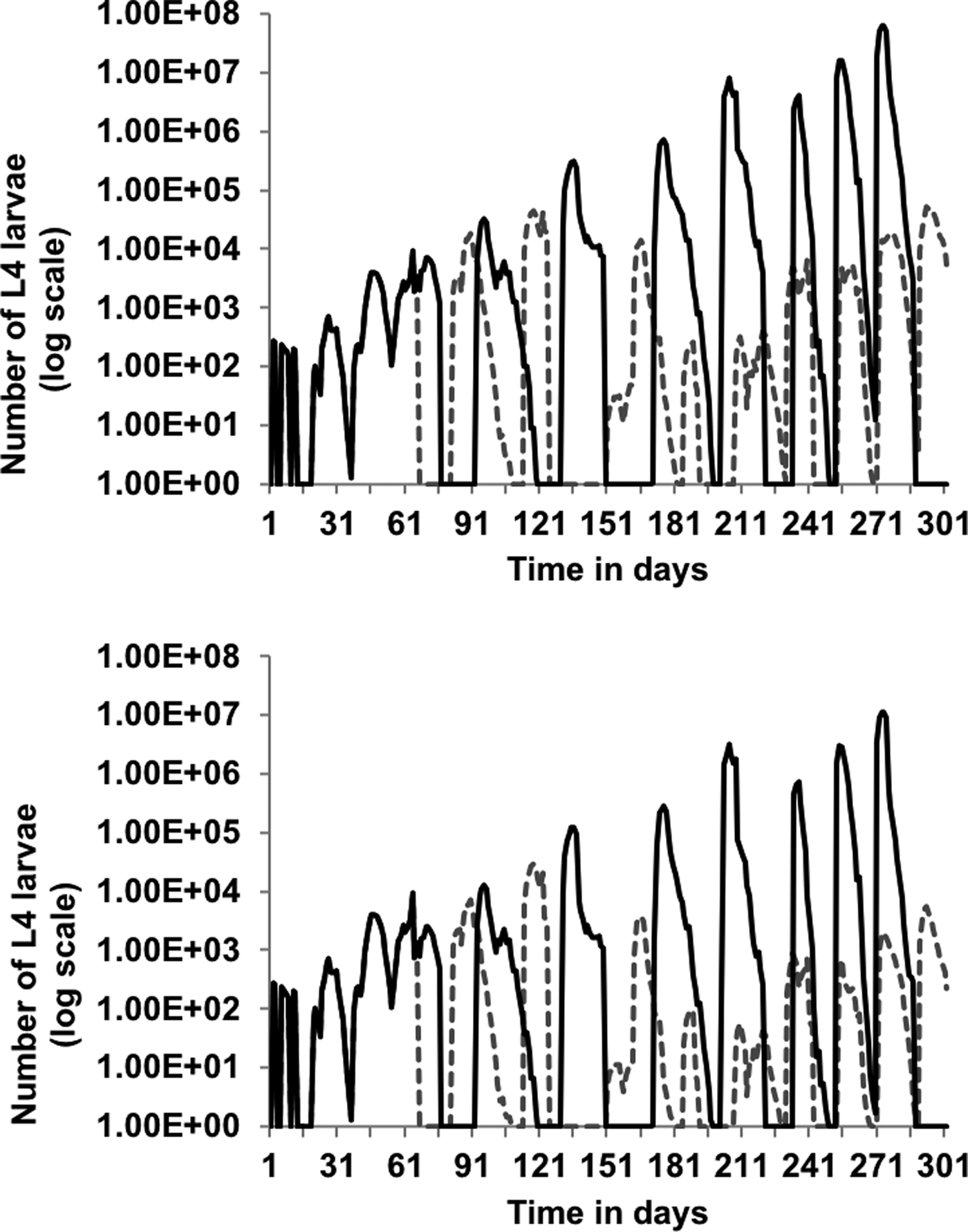
The DBM population could grow exponentially if unchecked over the cropping season, reflecting the suitable climatic conditions for DBM development, survival and fecundity in Guangzhou, particularly during Autumn and Spring. We illustrate the complex effect for a few cropping regimes on L4 larval abundance (fig. 2); ca 9 population peaks are indicated in deme 1. Populations grew exponentially with poor crop hygiene (13-day residue) but rapid crop residue clean-up (3-day residue) lead to an almost stable population (fig. 2). As expected, higher proportions of crop harvest (i.e. reduced residue in fields) resulted in lower DBM numbers overall (fig. 2).
Log number of L4 larvae for deme 1 for 3-day residue (light dashed line) and 13-day residue (solid line) for 70% (left-hand panel) and 90% harvest (right-hand panel) for a 1-week planting interval. Season starts on 1 October.

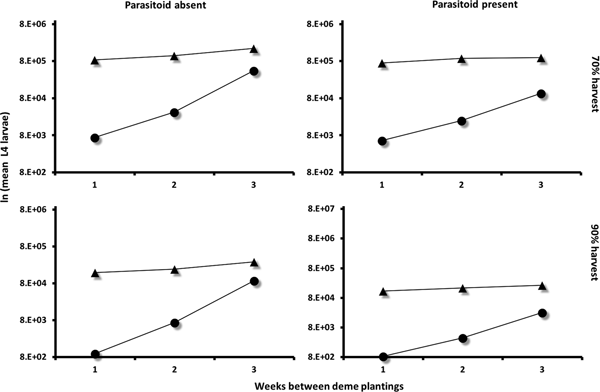
The longer the time to planting the second crop (the longer residue remains), the greater the DBM problem (fig. 3). In general, DBM was most abundant (mean L4 of demes 1 and 2) when farming practices were poor (i.e. residues remained in the field for 13 days), Diadegma was absent and crop harvest was low (70%) (range of mean DBM L4 numbers 867,577–1,751,841). Conversely, DBM was least abundant when farming practices were good (i.e. residues were removed 3 days after harvest), Diadegma was present and crop harvest was high (90%) (857–25,494) (fig. 3).
Effect of crop residue of 3 days (solid circle) and 13 days (solid triangle), three planting dates between demes (1, 2 and 3 weeks), two harvest levels; 70% (top panels) and 90% (bottom panels) without (left-hand panels) and with (right-hand panels) Diadegma on the ln mean abundance of L4 larvae in two demes across the crop growing season.

The effect of biological control and spraying
Without additional controls, the size of the DBM population in each deme was out of control (fig. 2). With additional controls (natural enemies and effective spraying), the numbers become indicative of field population.
In our simulations, Diadegma could not persist for the whole season if crops were planted within a week of each other. When good farming practice was employed, Diadegma was driven to local extinction after 129 days even without spraying, but when crop residues were not removed quickly, it persisted for longer and was not driven to local extinction until 161 days had passed. The parasitoid persisted throughout the season with both harvest levels, and residue retention times for plantings 2 and 3 weeks later (fig. 4a). Parasitoids moved readily between demes (fig. 4b).
Top panel: ln Diadegma adults over the season for 70% harvest, 3-day residue for 1-week (black solid line), 2-week (grey solid line) and 3-week (dashed line) planting regime. Middle panel: ln Diadegma adults over the season for 90% harvest, 3-day residue for deme 1 (black solid line) and deme 2 (grey dashed line). Bottom panel: ln Diadegma adults over the season for 70% harvest, 13-day residue and 3-week planting regime for sink (black solid line) and source (grey dashed line) scenario.

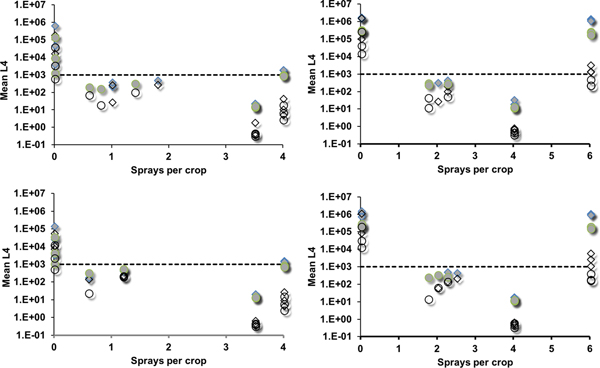
The parasitoid persisted in source-sink simulations (e.g. fig. 4c), and for good farming practice scenarios, DBM was managed to below threshold level (fig. 5). This was not the case for poor farmer practice for source-sink dynamics. In this situation, six sprays per crop could not control DBM even though Diadegma persisted (essentially emigrating from the source).
Log mean abundance of L4 larvae in deme 1 (solid symbols) and deme 2 (open symbols) for 70% (diamonds) and 90% harvest (circles) without (top panels) and with Diadegma parasitoids (bottom panels) for ‘good’ crop management (left-hand panels) and ‘poor’ crop management (right-hand panels). Note the far right set of points in each graph are the source-sink simulations, except for ‘good’ crop management, the sprays per crop were set to 3.5 for source-sink display as they were all ca 4 sprays.

A classic IPM approach to management, using a threshold-based spray decision process, achieved populations below our notional damaging level for all cropping regimes (fig. 5). What differed was the average number of sprays/crop needed to achieve this outcome; for 3-day residue without biological control ca 0.75–2 sprays/crop, reducing to 0.75–1.25 sprays/crop with biological control (fig. 5). For 13-day residues, the number of sprays was around 1.75–2.5 for both biological control scenarios (fig. 5).
Farmer spraying practice produced the lowest L4 density, but averaged four sprays per crop over the season, more than twice the number used in IPM practice.
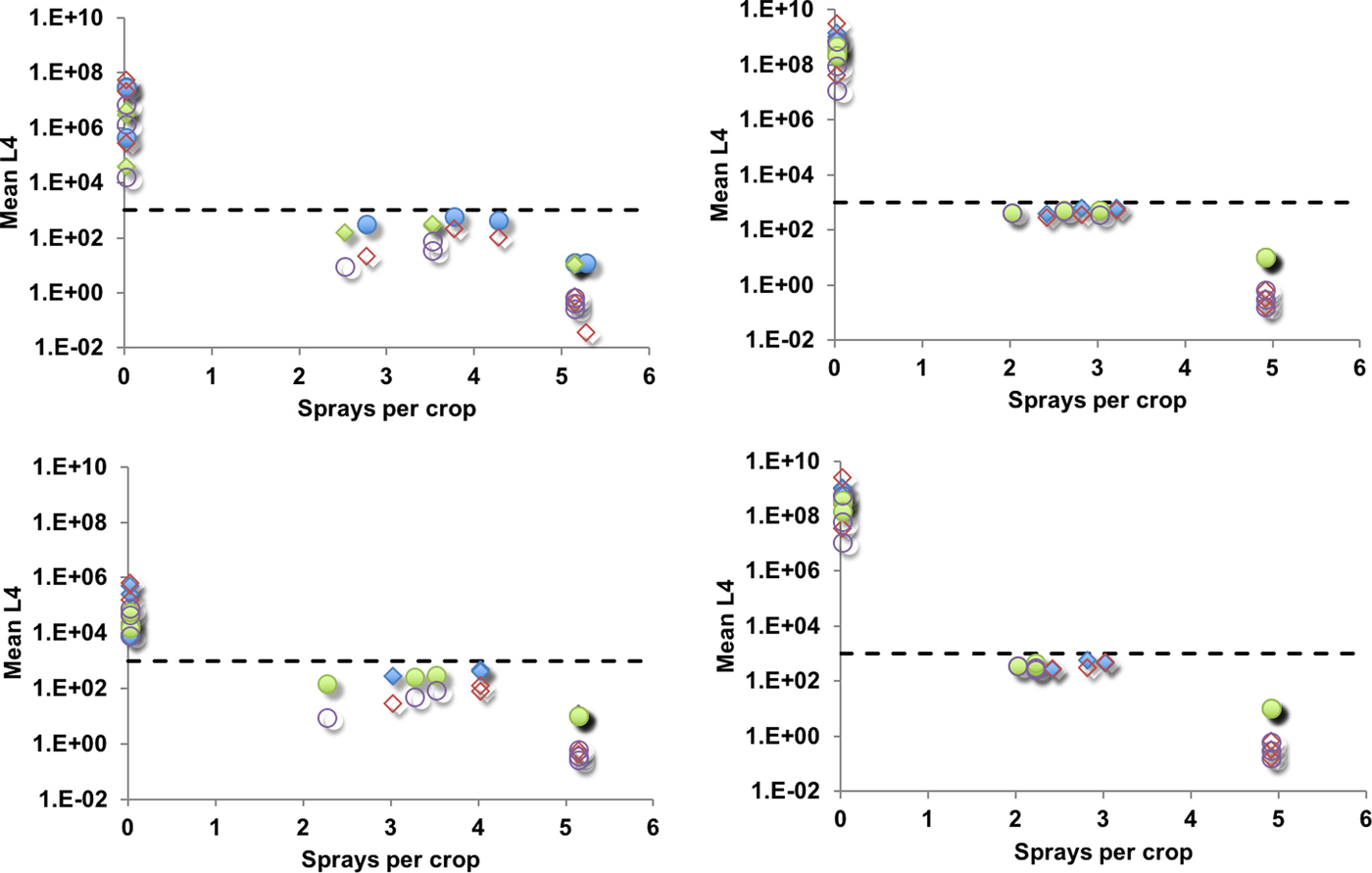
Simulations with constant climate and no rainfall generally followed the same pattern as above (Appendix 1 presents the equivalent of fig. 5), but populations were much higher for situations with no control (ideal temperatures and no rainfall mortality effects), and in general, more sprays were required to achieve the same result than with a variable climate.
Discussion
Both bottom-up and top-down processes interact to influence DBM population dynamics and the scale of the pest problem confronting managers and farmers. The pattern of Brassica crop or resource availability for this insect strongly influences population build-up when climate is optimal, as occurs in Guangdong particularly in Autumn and Spring. A more even availability of host plant resources (staggered planting, 2–3 weeks apart) leads to higher population sizes but also enables natural enemies, such as Diadegma, to persist. When crops are planted close together in time (e.g. 1 week apart) and this pattern persists over the season, there are effectively mini-production breaks and DBM populations do not build-up as high, but in our simulations, Diadegma could not persist. High levels of crop harvest and rapid removal of crop residues greatly ameliorate DBM population build-up. Nevertheless, populations would still exceed threshold and require management even when Diadegma was present, although a constant source of Diadegma (as in the source-sink simulations; fig. 5) did keep DBM on average around threshold levels. Augmentative biological control would be an optional strategy (Biever et al., Reference Biever, Hostetter and Kern1994). The parasitoid persisted in source-sink simulations (e.g. fig. 4c), and for good farming practice scenarios, DBM was managed to below threshold level (fig. 5). This was not the case for poor farmer practice for source-sink dynamics. In this situation, six sprays per crop could not control DBM even though Diadegma persisted. This strongly suggests that DBM is an induced pest and potentially manageable if conditions can be improved for natural enemies, as has often been suggested (Furlong et al., Reference Furlong, Shi, Liu, Guo, Lü, Liu and Zalucki2004a, Reference Furlong, Shi, Liu and Zaluckib, Reference Furlong, Kim, Pak, Jo, Ri and Zalucki2008; Schellhorn et al., Reference Schellhorn, Macfadyen, Bianchi, Williams and Zalucki2008b; Heimoana et al., Reference Heimoana, Pilkington, Raman, Mitchell, Nicol, Johnson and Gurr2017).
As in Li et al. (Reference Li, Zalucki, Yonow, Kriticos, Bao, Chen, Hu, Feng and Furlong2016a), the simulations capture the dynamics of the DBM pest management problem in Guangdong. In large-scale organic farms (e.g. Zengcheng) that practice strict hygiene and short residue times, DBM numbers are low and do not require constant intervention (Li et al., Reference Li, Zalucki, Bao, Chen, Hu, Zhang, Lin, Yin, Wang and Feng2012). Farmers that have long residue times and who spray regularly (i.e. destroy natural enemies), as is ‘normal’ for many commercial operations in Guangdong (Feng et al., Reference Feng, Li, Chen, Wu, Chen, Wu, Hou, He, Li, Xie, Zhang, Fu, Ma, Srinivasan, Shelton and Collins2011), have much larger DBM populations to contend with (Li et al., Reference Li, Zalucki, Bao, Chen, Hu, Zhang, Lin, Yin, Wang and Feng2012) and they essentially have to keep spraying! However, a strict IPM approach (of only spraying on threshold) can greatly reduce the number of sprays required, as has been found repeatedly in other parts of China (Liu et al., Reference Liu, Shi, Guo, Chen, Zhang, Lu, Wang, Deuter, Zalucki, Endersby and Ridland2004), Australia (Zalucki et al., Reference Zalucki, Adamson and Furlong2009), Democratic People's Republic of Korea (Furlong et al., Reference Furlong, Kim, Pak, Jo, Ri and Zalucki2008) and the South Pacific (Furlong, Reference Furlong2016). The extra labour cost of sampling can reduce spraying by up to half – providing both economic and environmental benefits (Zalucki et al., Reference Zalucki, Shabbir, Silva, Adamson, Liu and Furlong2012).
The economics of crop production dictate continuous planting and therefore high resource availability for the pest. However, even the simple management practice of harvesting and rapidly removing residues can greatly reduce pest problems. Apart from the extra production cycle with short crop turn-around, long periods with unmanaged crop residue can lead to an unmanageable DBM population and fewer crops. The simple take home message from our modelling is that crop residues should be cleaned up quickly. It can make a difference to DBM management, as does a production break, but the feasibility of the latter is likely to be determined by the economics of production.
The model captures the salient features of crop–DBM–natural enemy dynamics. Such models can be used to make general statements about management strategies, as we have done here. An obvious elaboration to the model would be the inclusion of a realistic predation mortality module. This would enable better assessment of the contribution of conservation and augmentative biological control to the management of DBM, and indeed pest Lepidoptera in general (Furlong & Zalucki, Reference Furlong and Zalucki2010). To be useful in tactical decisions for management, the model will need to capture the contribution of additional sources of variation to insect population dynamics. For example, we have not yet varied crop characters to investigate the effects of host plant resistance on population dynamics. Nor have we explicitly included plant age effects on DBM oviposition, development, survival and reproduction. Above all the interaction between crop age and DBM movement warrant analysis, as does the source and timing of immigration to population build-up. We recently showed using our deme model that immigration and hence the initial population size could account for observed population changes and phenology in northern China (Zhu et al., Reference Zhu, Li, Zhang, Xu, Zhang, Zalucki, Wu and Yin2018). Including better descriptions of plant–insect interactions into the deme framework may better capture the details of local population changes at an individual field scale. All are possible within a DYMEX modelling framework.
Acknowledgements
The project was funded by the National Key Project of Research and Development Plan (2017YFD0201204), Science and Technology Planning Project of Guangdong Province (2015|A020209112and 2013B050800019) and National Natural Science Foundation of China (31701819). The authors thank Ai-Dong Chen, Qing-Jun Wu, Jin-Ming Zhang and Sheng-Hua Xie for the data of population dynamics in the field and two anonymous referees for their comments and suggestions.
Appendix 1
See fig. A1.
Equivalent to fig. 5 in the text. Log mean abundance of L4 larvae in deme 1 (solid symbols) and deme 2 (open symbols) for 70% (diamonds) and 90% (circles) harvest without (top panels) and with Diadegma parasitoids (bottom panels) for ‘good’ crop management (left-hand panels) and ‘poor’ crop management (right-hand panels). Climate was constant max–min temperatures and no rainfall. No source-sink simulations were done.