Introduction
The COVID-19 pandemic brought about widespread worries related to health and access to essential resources, along with feelings of loss, frustration, and resentment as lives and communities were unexpectedly disrupted worldwide. Such COVID-19-related experiences (Jiang et al., Reference Jiang, Feldman, Koire, Ma, Mittal, Lin, Erdei, Roffman and Liu2024) are thought to accompany the marked rise in mental health issues globally, particularly experiences of depression and anxiety (Clemente-Suárez et al., Reference Clemente-Suárez, Navarro-Jiménez, Jimenez, Hormeño-Holgado, Martinez-Gonzalez, Benitez-Agudelo, Perez-Palencia, Laborde-Cárdenas and Tornero-Aguilera2021; Kerker et al., Reference Kerker, Willheim and Weis2023; Kola, Reference Kola2020; Liu et al., Reference Liu, Wong, Hyun and Hahm2022; Penna et al., Reference Penna, de Aquino, Pinheiro, Do Nascimento, Farias-Antúnez, Araújo and Castro2023).
Expectant or new mothers around the world – a population already vulnerable to emotional difficulties – faced specific uncertainties during the pandemic. Qualitative studies revealed high concerns around their health and that of the fetus or infant, fears of lacking support during labor and delivery, worries about holding their baby due to potential contagion, and increased emotional distress (Abu Sabbah et al., Reference Abu Sabbah, Eqylan, Al-Maharma, Thekrallah and Safadi2022; Cruz-Ramos et al., Reference Cruz-Ramos, Resurrección and Hernández-Albújar2023; Wigert et al., Reference Wigert, Nilsson, Dencker, Begley, Jangsten, Sparud-Lundin, Mollberg and Patel2020). These experiences likely contributed to increased rates of anxiety and depression among expectant and new mothers during this period, as reported in prior quantitative studies (Mateus et al., Reference Mateus, Cruz, Costa, Mesquita, Christoforou, Wilson, Vousoura, Dikmen-Yildiz, Bina, Dominguez-Salas, Contreras-García, Motrico and Osório2022; Sun et al., Reference Sun, Wang, Lin, Li, Yang, Liu, Peng, Wang, Yang, Ren, Yang and Cheng2020, Reference Sun, Zhu, Tao, Ma and Jin2021) and meta-analyses (Adrianto et al., Reference Adrianto, Caesarlia and Pajala2022; Ahmad & Vismara, Reference Ahmad and Vismara2021; Fan et al., Reference Fan, Guan, Cao, Wang, Zhao, Chen and Yan2021). However, prior studies mostly adopted cross-sectional designs. Without capturing symptoms longitudinally, it is unknown whether the pandemic impacts have been limited to the short term only. Furthermore, there is a notable gap in research examining the potential risk and protective factors influencing the relationship between COVID-19-related experiences and women’s mental health. Yet identifying what contributes to potential long-term effects is essential for creating interventions that support both mothers and children beyond the pandemic’s immediate aftermath.
Although risk factors for peripartum mental health during the pandemic have been identified (i.e., low income, age >35, and pre-existing pathologies) (Liu et al., Reference Liu, Erdei and Mittal2021a; Motrico et al., Reference Motrico, Bina, Domínguez-Salas, Mateus, Contreras-García, Carrasco-Portiño, Ajaz, Apter, Christoforou, Dikmen-Yildiz, Felice, Hancheva, Vousoura, Wilson, Buhagiar, Cadarso-Suárez, Costa, Devouche, Ganho-Ávila and Gómez-Baya2021; Shuman et al., Reference Shuman, Peahl, Pareddy, Morgan, Chiangong, Veliz and Dalton2022; Usmani et al., Reference Usmani, Greca, Javed, Sharath, Sarfraz, Sarfraz, Salari, Hussaini, Mohammadi, Chellapuram, Cabrera and Ferrer2021), prior studies on mental health have overlooked salient risk factors emanating from the pandemic. The experience of post-acute sequelae of SARS-CoV-2 infection, otherwise known as long COVID, refers to the prolonged and often debilitating symptoms experienced by individuals after the acute phase of COVID-19 infection (Callard & Perego, Reference Callard and Perego2021; Rastogi et al., Reference Rastogi, Cerda, Ibrahim, Chen, Stevens and Liu2023). Symptoms such as fatigue, shortness of breath, cognitive dysfunction, sensory deficits, and sleep disturbances can persist for months, significantly impairing daily functioning. The literature primarily focuses on the physical consequences of long COVID (e.g., Muñoz-Chápuli Gutiérrez et al., Reference Muñoz-Chápuli Gutiérrez, Prat, Vila, Claverol, Martínez, Recarte, Benéitez, García, Muñoz, Navarro, Navarro, Álvarez-Mon, Ortega and De León-Luís2024; Raveendran et al., Reference Raveendran, Jayadevan and Sashidharan2021; Vásconez-González et al., Reference Vásconez-González, Fernandez-Naranjo, Izquierdo-Condoy, Delgado-Moreira, Cordovez, Tello-De-la-Torre, Paz, Castillo, Izquierdo-Condoy, Carrington and Ortiz-Prado2023); however, studies examining the effects of long COVID on mental health have been limited. To our knowledge, no studies have explored the impact of long COVID on peripartum mental health experiences. Yet for perinatal women and new mothers, long COVID may present a dual challenge, as they must navigate both the physical demands of pregnancy and postpartum recovery as well as the lasting sequelae of the viral infection. Aside from mental health impacts, the chronic nature of this condition, combined with the uncertainty surrounding its duration and prognosis, and the physical symptoms of long COVID (i.e., fatigue, sensory or cognitive difficulties) may hinder the ability to care for a young child, compounding the psychological burden on mothers. Consequently, it is plausible to hypothesize that long COVID may contribute directly or indirectly to an increased risk of later depression and anxiety.
Among pandemic-based studies on perinatal women, partner support and maternal self-efficacy have also been overlooked as psychological factors relevant to perinatal mental health. Partner support (the tangible and emotional support perceived or received from the partner) and maternal self-efficacy (the mother’s belief in her ability to care for her infant) (Coleman & Karraker, Reference Coleman and Karraker2003) are crucial for mitigating women’s depression and anxiety (Albanese et al., Reference Albanese, Russo and Geller2019; Goodman et al., Reference Goodman, Simon, McCarthy, Ziegler and Ceballos2022; Leahy-Warren et al., Reference Leahy-Warren, McCarthy and Corcoran2012; Milgrom et al., Reference Milgrom, Hirshler, Reece, Holt and Gemmill2019; Razurel et al., Reference Razurel, Kaiser, Antonietti, Epiney and Sellenet2017), and both partner support and maternal self-efficacy were impacted by the pandemic. Both quantitative (Datye et al., Reference Datye, Smiljanic, Shetti, MacRae-Miller, van Teijlingen, Vinayakarao and Conrad2024; Li et al., Reference Li, Tang, Song, Wang, Qunshan, Xu, Geng, Wu, He and Cao2020; Liu et al., Reference Liu, Koire, Erdei and Mittal2021b) and qualitative (Goyal et al., Reference Goyal, Rosa, Mittal, Erdei and Liu2022) studies show decreased partner support during the pandemic. Many partners were unable to attend prenatal appointments, labor, and delivery or provide the essential caregiving and assistance needed in the early postpartum days due to physical distancing measures and restrictions on hospital visitation policies. This lack of tangible and emotional support during such a critical time increased feelings of isolation for new mothers and led to fewer shared parenting experiences. Similarly, maternal self-efficacy was negatively affected by the pandemic. For instance, Jiang et al. (Reference Jiang, Feldman, Koire, Ma, Mittal, Lin, Erdei, Roffman and Liu2024) found a negative association between pandemic experiences and maternal self-efficacy. Parent self-efficacy was lower among mothers who gave birth during the lockdown compared to parent self-efficacy levels of other parents who reported before and after the lockdown (Xue et al., Reference Xue, Oros, La Marca-Ghaemmaghami, Scholkmann, Righini-Grunder, Natalucci, Karen, Bassler and Restin2021). Hence, in addition to exploring the direct long-term and moderating effects of long COVID, we also sought to capture the impacts of partner support and maternal self-efficacy.
The current study
To address the methodological gaps and to account for relevant factors to the perinatal mental health experience during the pandemic, we sought to investigate the relationships between COVID-19-related experiences and mental health across time when the parent was either pregnant or in the immediate postpartum period from May 21, 2020, to September 15, 2021 (Time point 1) and when they were 27–36 months postpartum between December 14, 2022, and February 14, 2024 (Time point 2). Based on prior work, we anticipated a positive relationship between COVID-19-related experiences (i.e., health worries, risk worries, resource worries, and grief) and later maternal depression and anxiety. Acknowledging that not all individuals are equally vulnerable to these risks, we sought to determine whether these risks would be exacerbated by the presence of long COVID or buffered by higher levels of partner support and maternal self-efficacy.
Methods
Participants
Data for this study were drawn from the PEACE project, a longitudinal multi-rater research aimed at understanding the impact of the COVID-19 pandemic on women during the pregnancy and postpartum period (https://www.peacestudy2020.com/).
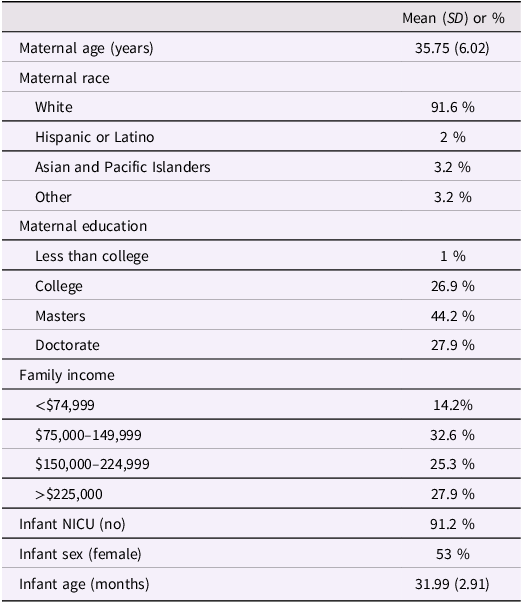
In this study, we restricted our analytic sample to only those who completed the target measures at both waves, resulting in a final sample size of 190 women. Participants were recruited through email listservs, social media, and word of mouth, based on the following criteria: pregnant (after the second trimester) or postpartum (6 months or less after childbirth) status, at least the age of 18 years, residency in the United States, and complete English proficiency to access the online questionnaires independently. Demographic information about the analytic sample is displayed in Table 1.
Participants’ sociodemographic characteristics from T2 of the PEACE project (N = 190)

Procedure
An online survey lasting 30–40 min was administered through REDCap from May 21, 2020, to September 15, 2021 (T1), and between December 14, 2022, and February 14, 2024 (T2). Women’s COVID-19-related experiences were assessed at T1, while mothers’ depression and anxiety symptoms, long COVID symptoms, perceived partner support, and maternal self-efficacy were measured at T2, alongside sociodemographics. Life events were measured at T1 and in a midpoint between T1 and T2. The study was approved by the Institutional Review Board at Mass General Brigham. All participants provided their informed consent for their participation in the study.
Measures
Predictors
COVID-19-related experiences. We evaluated four dimensions of COVID-19-related experiences: health worries, risk worries, resource worries, and grief using the COVID-19-related experiences questionnaire (Jiang et al., Reference Jiang, Feldman, Koire, Ma, Mittal, Lin, Erdei, Roffman and Liu2024; Lin et al., Reference Lin, Zehnah, Koire, Mittal, Erdei and Liu2022). Health worries items (n = 4; e.g., “During the past 2 weeks, how worried have you been about being infected?”), rated on a 5-point Likert scale from “Not at all” to “Extremely,” measured participants’ concerns about contracting the virus, the health of their loved ones, and the effects of COVID-19 on their physical and mental health. Risk worries items (n = 4; e.g., “COVID-19 is a life-threatening disease for me”), rated on a 5-point Likert scale from “Strongly Disagree” to “Strongly Agree,” captured participants’ concerns about infection from COVID-19. Resource worries (n = 10; e.g., “I am worried I might become very sick, and I won’t have another trusted family member or friend to care for my baby if that happens”), rated on a 5-point Likert scale from “Not worry at all” to “Very Worried,” gauged participants’ anxieties about obtaining essential resources during the pandemic. Grief items (n = 7; e.g., “I feel bitter that COVID-19 caused me to experience loss in my routines and activities”), rated on a 5-point Likert scale from “Strongly Disagree” to “Strongly Agree,” captured grief and feelings of missing out on important moments during the pandemic. The total scores for each dimension were summed to form a composite score reflecting overall COVID-19-related challenges, with higher scores indicating more severe difficulties. In this study, the items demonstrated strong reliability, with a Cronbach’s alpha of 0.88.
Long COVID symptoms. Long COVID was assessed with the question: “Did you experience Post-COVID conditions, also known as long COVID? Long COVID conditions are defined as a range of new or ongoing symptoms that can last weeks or months after being infected by the virus that causes COVID-19.” Response options were No, Yes, and I don’t know. A binary variable was created, differentiating individuals reporting long COVID symptoms from all others.
Perceived partner support. Partner support was assessed with the question: “In general, how often do you feel your partner has been supportive since the birth of your child?” Responses were rated on a 7-point Likert scale, ranging from 1 (“never”) to 7 (“always”), with higher scores reflecting greater levels of partner support.
Maternal self-efficacy. Participants’ maternal self-efficacy was measured through the Self-Efficacy for Parenting Tasks Index-Toddler Scale (Coleman et al., Reference Coleman and Karraker2003). The 13-item scale used in this study measured two key domains of maternal self-efficacy: nurturance (7 items; e.g., “I definitely fulfill my parental duties when it comes to providing emotional support for my child”) and discipline (6 items; e.g., “Setting limits for my toddler is relatively easy for me”). Each item is rated on a 6-point Likert scale, with response options ranging from “Strongly Agree” to “Strongly Disagree.” A total sum score was calculated, with higher scores indicating stronger parenting self-efficacy. This scale demonstrated a good Cronbach’s alpha in this study, with a value of 0.82.
Outcomes
Depressive symptoms. Depression symptoms were assessed using the Center for Epidemiological Studies – Depression scale (Radloff, Reference Radloff1977), a 20-item self-report measure assessing feelings of hopelessness, worthlessness, low mood, and neurovegetative symptoms experienced in the past week. Participants responded on a 4-point scale, indicating how often they experienced each symptom, ranging from “Rarely or none of the time (less than 1 day)” to “Most or all of the time (5–7 days).” A sum score was computed, with higher scores reflecting more severe symptoms. The Center for Epidemiological Studies – Depression scale demonstrated acceptable reliability in this study, with a Cronbach’s alpha of 0.72.
Anxiety symptoms. Participants’ anxiety was measured using the Generalized Anxiety Disorder Scale-7 (Spitzer et al., Reference Spitzer, Kroenke, Williams and Löwe2006), a 7-item self-report measure assessing symptoms such as worry, irritability, restlessness, and feelings of dread experienced over the past 2 weeks. Participants rated the frequency of these symptoms on a 4-point Likert scale from “Not at all” to “Nearly every day.” A sum score was computed, with higher scores reflecting more severe symptoms. The Generalized Anxiety Disorder Scale-7 demonstrated strong reliability in this study, with a Cronbach’s alpha of 0.85.
Covariates
Sociodemographic data. We collected data on child prematurity, age, sex, and NICU, as well as maternal age, education, and household income.
Life events. The life events measure (Shulman et al., Reference Shulman, D’Angelo, Harrison, Smith and Warner2018) assessed participant experiences within the last 6 months at T1 and in a midpoint between T1 and T2 (T1–T2), encompassing 13 events with binary “yes” or “no” responses. Examples of events included deployment, divorce, incarceration, and homelessness, providing insight into significant life changes and challenges encountered by participants. A sum score was calculated, with higher values indicating a greater number of life events experienced.
Mental health diagnosis before and during pregnancy. Depressive and anxiety diagnoses before and during pregnancy were evaluated based on self-reports from participants in the baseline survey. Participants were inquired about depressive disorder and generalized anxiety disorder, with four response options: “Yes, diagnosed and treated,” “Yes, diagnosed but not treated,” “Suspected, but not diagnosed,” and “No.” For each condition, a binary variable was established, categorizing individuals diagnosed with the condition into one group, regardless of their treatment status, while all other participants were placed in a separate group. Diagnoses were not considered mutually exclusive.
Analytical strategy
Analyses were performed using SPSS 28. First, we conducted descriptive statistics and normality analyses for the key study variables. We also checked heteroscedasticity and collinearity and calculated correlations between the control and study variables. Second, we performed moderation analyses using the SPSS PROCESS macro, Model 1 (Hayes, Reference Hayes2022), to examine whether the relationship between COVID-19-related experiences (T1) and maternal depression (T2) and anxiety (T2) was moderated by mothers’ long COVID symptoms (T2), perceived partner support (T2), and self-efficacy (T2).
Finally, a simple slope analysis was conducted to examine the relationship between COVID-19-related experiences and maternal mental health (depression and anxiety) at different levels of moderators (long COVID symptoms, partner support, and maternal self-efficacy).
Results
Preliminary analysis
Sociodemographic characteristics are reported in Table 1. Most mothers (Mage = 35.75 years, SDage = 6.02) identified as white (91.6%), with a significant portion holding master’s degrees (44.2%) and reporting household incomes exceeding $225,000 (27.9 %). Among the infants (Mage = 31.99 months, SDage = 2.91), 53% were females.
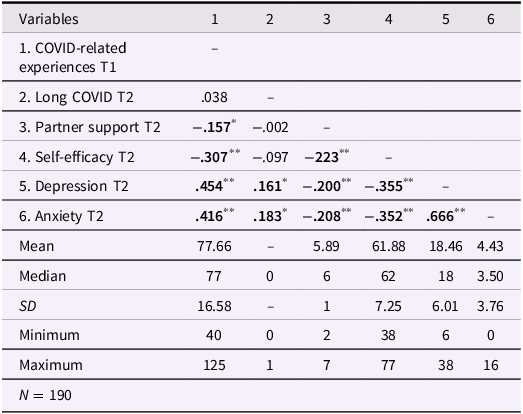
Table 2 displays descriptive statistics and correlations of the key variables of our study. For the mothers included in this cohort, the average score for depression was 18.46 (SD = 6.01), 4.43 (SD = 3.76) for anxiety, and 77.67 (SD = 16.61) for COVID-19-related experience. The average score for partner support was 5.89 (SD = 1), and for self-efficacy, it was 5.89 (SD = 1). At T2, 9.5 % reported long COVID symptoms.
Descriptive statistics and correlations between key variables of the study

Note. *p < .05, **p < .001.
1. COVID-related experiences T1 were assessed using a 25-item, 5-point Likert scale (max = 125), with higher scores indicating greater difficulties.
2. Long COVID T2 was a single binary item (0 = No/Don’t know, 1 = Yes).
3. Partner support T2 was a single item on a 7-point Likert scale (1 = Never, 7 = Always).
4. Self-efficacy T2 was a 13-item, 6-point Likert scale (max = 78), with higher scores indicating stronger parenting self-efficacy.
5. Depression T2 was a 20-item, 4-point Likert scale (max = 60), with higher scores reflecting greater symptom severity
6. Anxiety T2 was a 7-item, 4-point Likert scale (max = 21), with higher scores reflecting greater symptom severity.
Skewness and kurtosis analyses indicated that all the study variables followed a normal distribution, except for life events T1, which was squared-root transformed before analysis. We used Spearman’s r to test correlations among the key variables of our study (Table 2). We also tested potential correlations between key variables and sociodemographics (i.e., child prematurity, age, sex, and NICU; maternal age, education, and income), life events, and prior diagnosis (before and during pregnancy). We found that life events and prior diagnosis were associated with the key variables of the study (all p < .05) and thus included as covariates in the final analyses.
The Koenker test for heteroscedasticity yielded a value of 9.9672 (p = .35) for depression and 7.5791 (p = .58) for anxiety, suggesting that the assumption of homoscedasticity was not violated.
Predictors and covariates indicated acceptable levels of collinearity (VIF <3).
Main analysis
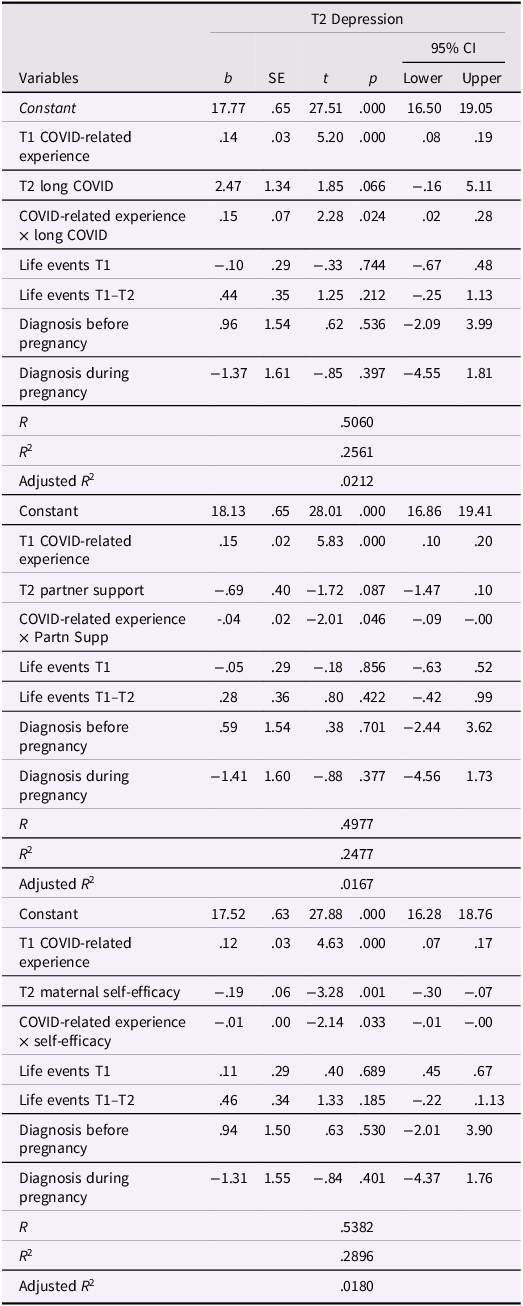
In SPSS, the PROCESS macro method developed by Hayes (Reference Hayes2022) was adopted. Regression results for determining the moderator effect of mothers’ long COVID symptoms, perceived partner support, and self-efficacy on the effect of COVID-related experience T1 on depression T2 are presented in Table 3.
Summary of moderated regression analysis predicting T2 depression

As shown in Table 3, the COVID-related experience at T1 was positively (b = .14, SE = 0.03, p = .000) associated with depression at T2 after controlling for other variables. Maternal self-efficacy was negatively (b = −0.19, SE = 0.06, p = 0.001) associated with depression at T2 after controlling for other variables. Furthermore, the findings reveal that the interaction effects of the moderator terms long COVID symptoms at T2, partner support at T2, and self-efficacy at T2 on women’s depression are significant (b = .15, SE = .07, p = .024; b = −.04, SE = .02, p = .046; b = −.01, SE = .00, p = .033, respectively).
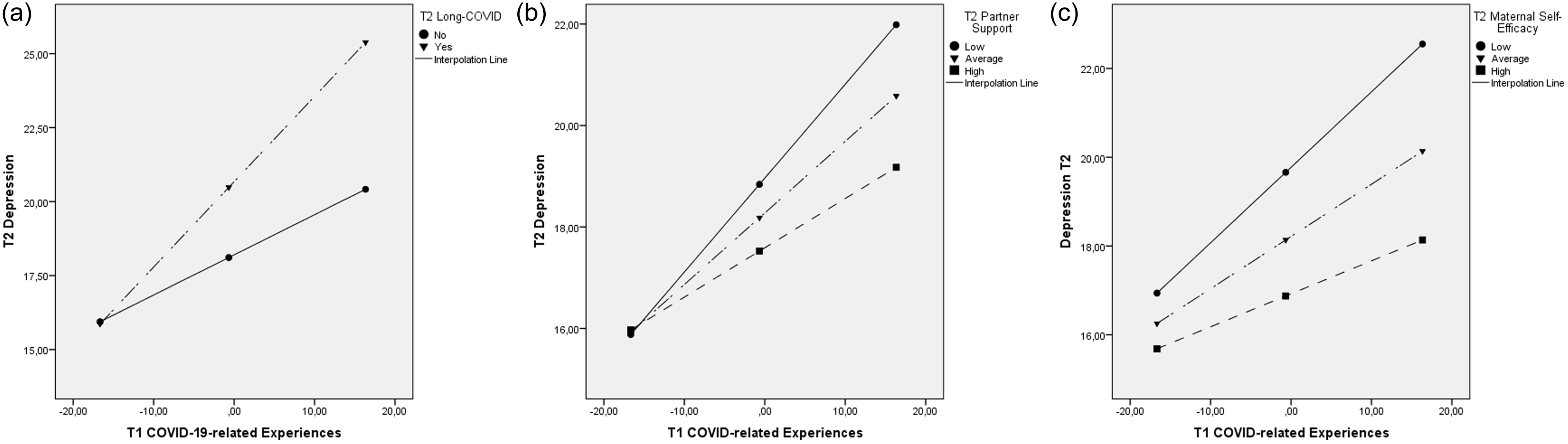
Simple slope tests revealed that when women reported long COVID symptoms (b = .29, SE = .06, p = .000) the association between COVID-19-related experiences and depression was stronger than when women reported no long COVID symptoms (b = .14, SE = .03, p = .000). When women reported moderate (b = .14, SE = .03, p = .000) or high (b = .10, SE = .04, p = .010) partner support and moderate (b = .12, SE = .03, p = .000) or high (b = .07, SE = .04, p = .036) maternal self-efficacy, the association between COVID-19-related experiences and depression was weaker than when women reported low partner support (b = .19, SE = .03, p = .000) and low maternal self-efficacy (b = .17, SE = .03, p = .000) (Figure 1).
Slope graphs: conditional effects of the focal predictor (T1 COVID-19-related experiences) at values of the significant moderators (long COVID symptoms, partner support, and maternal self-efficacy) on depression.

Regression results for determining the moderator effect of long COVID symptoms, perceived partner support, and self-efficacy on the effect of COVID-related experience T1 on anxiety T2 are presented in Table 4.
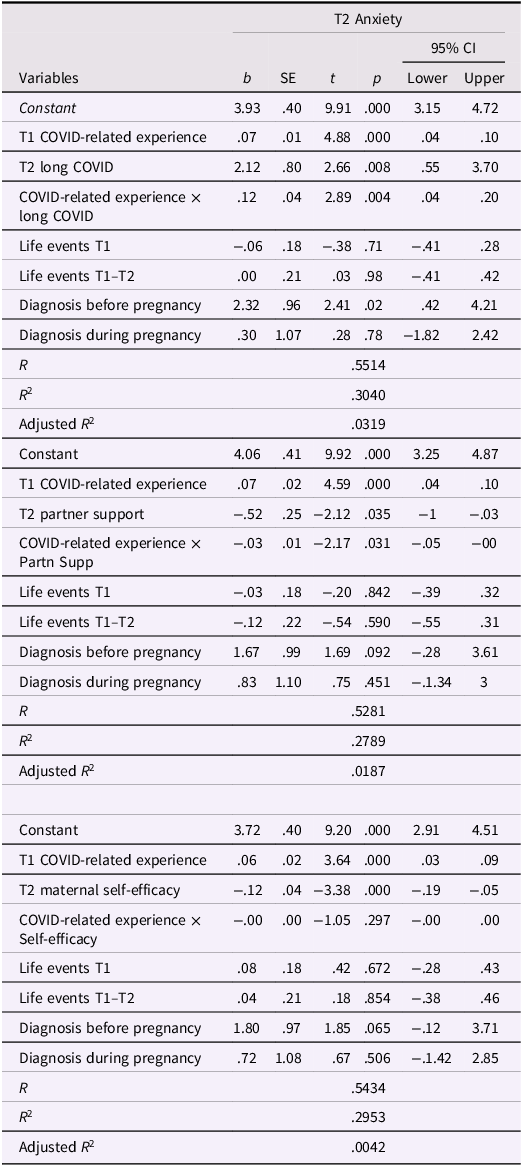
Summary of moderated regression analysis predicting T2 anxiety

As shown in Table 4, the COVID-related experience at T1 and long COVID were positively (b = .07, SE = 0.01, p = .000; b = 2.12, SE = 0.80, p = 0.008, respectively) associated with anxiety at T2, while partner support at T2 and maternal self-efficacy at T2 was negatively associated with anxiety symptoms (b = −.52, SE = 0.25, p = 0.035; b = −.12, SE = 0.04, p = .000, respectively) after controlling for other variables. Furthermore, the findings reveal that the interaction effects of the moderator terms long COVID symptoms at T2 and partner support at T2 on women’s anxiety were significant (b = .12, SE = .04, p = .004; b = -−.03, SE = .01, p = .031, respectively).
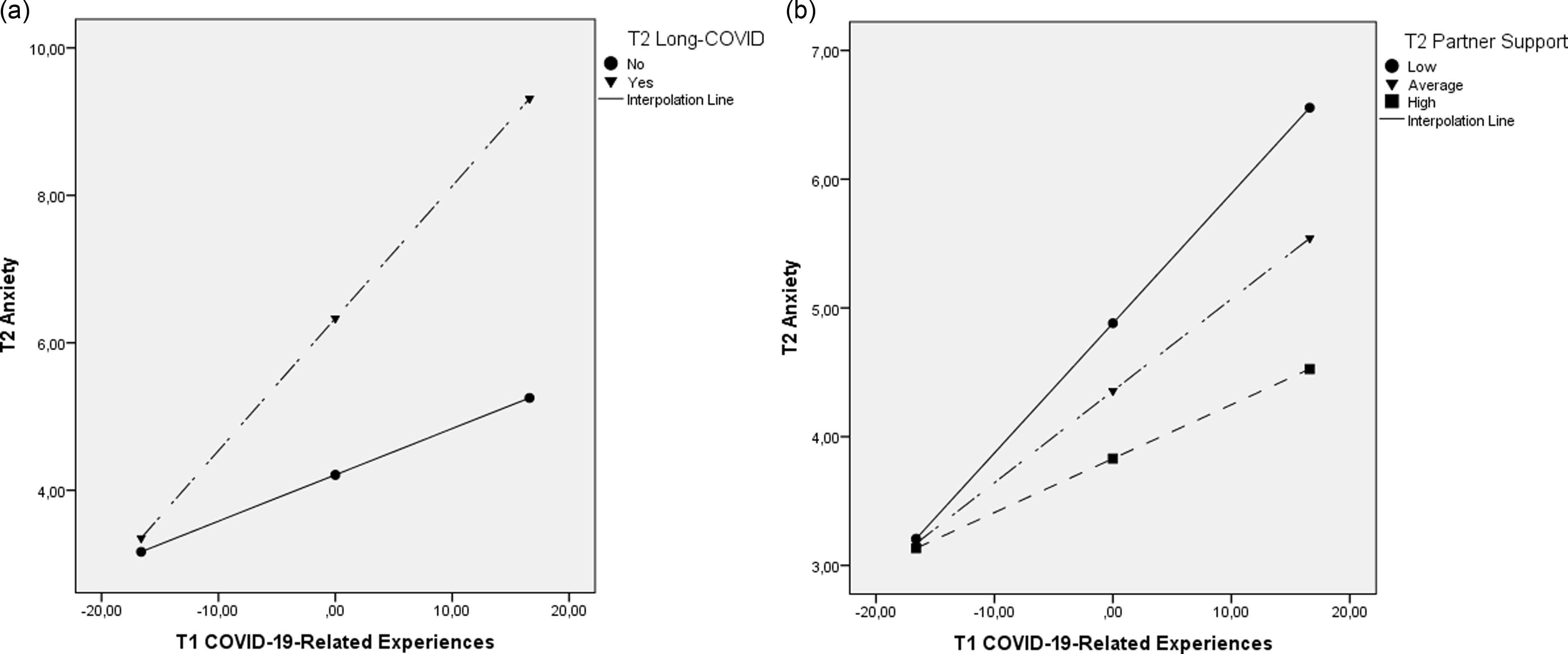
Simple slope tests revealed that when women reported long COVID symptoms (b = .18, SE = .04, p = .000) and low partner support (b = .10, SE = .02, p = .000), the association between COVID-19-related experiences and anxiety levels was stronger than when women reported no long COVID symptoms (b = .06, SE = .02, p = .000) and moderate (b = .07, SE = .02, p = .000) partner support (Figure 2). When partner support was high, the COVID-19-related experiences did not show an impact on anxiety symptoms (b = .04, SE = .02, p = .059).
Slope graphs: conditional effects of the focal predictor (T1 COVID-19-related experiences) at values of the significant moderators (long COVID symptoms and partner support) on T2 anxiety.
Note. The moderation effect of partner support was significant at low and moderate levels but not at high levels.

The moderation analysis also revealed that maternal self-efficacy at T2 was negatively associated with anxiety (b = −.12, SE = .04, p = .001) after controlling for other variables. However, maternal self-efficacy did not reveal an impact on the relationship between COVID-19-related experiences and anxiety symptoms (b = −.01, SE = .01, p = ns).
Discussion
This longitudinal study aimed to investigate the relationships between COVID-19-related experiences during the peripartum period (when the mother was either pregnant or within 6 months postpartum) and later maternal depression and anxiety (at 27–36 months postpartum), alongside the moderating role of long COVID, partner support, and maternal self-efficacy. We found that more COVID-19-related experiences (i.e., health worries, risk worries, resource worries, and grief) during the peripartum were associated with greater depression and anxiety later on, with long COVID and partner support acting as risk and protective factors, respectively. Maternal self-efficacy buffered the association between COVID-19-related experiences and women’s later depression but not anxiety.
Key findings
The finding of a longitudinal positive association between COVID-19-related experiences and maternal mental health is not surprising, given the profound stress associated with both childbirth and the pandemic (Silletti, Reference Silletti2023). The peripartum period is inherently vulnerable for many women due to the physical, emotional, and hormonal changes they undergo. The additional stressors related to the COVID-19 pandemic – such as heightened concerns about personal and loved ones’ health, financial stress, and experiences of grief – create unprecedented challenges that may exacerbate already existing perinatal difficulties. The positive links found between the COVID-19-related experiences during the peripartum and subsequent depression and anxiety are consistent with previous cross-sectional studies on perinatal mental health during the pandemic (Liu et al., Reference Liu, Erdei and Mittal2021a; Shuman et al., Reference Shuman, Peahl, Pareddy, Morgan, Chiangong, Veliz and Dalton2022). This study adds to the existing literature by demonstrating that the effects of the pandemic persist even almost 3 years later and that experiencing a pandemic during the peripartum period can have long-term mental health implications for mothers. By adopting a longitudinal design, our study further corroborates the causal link between COVID-19-related experiences and maternal mental health.
In testing long COVID as a risk factor and moderator to these associations, we observed a main effect of long COVID on anxiety, as well as a moderating effect on both depression and anxiety. As to the first result, the chronic nature of long COVID, coupled with the uncertainty regarding its duration and prognosis, may contribute to heightened feelings of worry, hopelessness, and emotional distress among affected women, thereby increasing their anxiety levels. Furthermore, we found long COVID to exacerbate the associations between COVID-19-related experiences and subsequent maternal depression and anxiety. Higher levels of these symptoms were reported by those who experienced more pandemic challenges (as indicated by a greater endorsement of COVID-19-related experiences) and who had long COVID. It may be that mothers experiencing prolonged physical symptoms of the virus – such as fatigue, brain fog, and chronic pain – face additional challenges in their daily functioning and in caring for a young child, potentially compounding the existing psychological burden of adverse pandemic experiences and further worsening their mental health. The depression and anxiety experienced by women affected by long COVID may also arise from the disparity between their expectations and the reality of their health and functioning. The peripartum period is often imagined as an idyllic time when mothers embrace their roles and care for their newborns. In contrast, long COVID has predominantly been framed as a “disease of the elderly” (Rastogi et al., Reference Rastogi, Cerda, Ibrahim, Chen, Stevens and Liu2023). As a result, perinatal women already burdened by COVID-19-related experiences may feel a greater sense of inadequacy, failure, and concern when confronted with postpartum challenges and the long-term health complications of long COVID. This disconnect between expectations and lived reality may exacerbate the mental health issues associated with COVID-19-related experiences, as observed in this study. Critically, our findings expand on prior research by indicating that long COVID affects not only the physical health of perinatal women (e.g., Muñoz-Chápuli Gutiérrez et al., Reference Muñoz-Chápuli Gutiérrez, Prat, Vila, Claverol, Martínez, Recarte, Benéitez, García, Muñoz, Navarro, Navarro, Álvarez-Mon, Ortega and De León-Luís2024) but also their psychological well-being.
While long COVID serves as a risk factor that exacerbates the relationship between COVID-19-related experiences and both depression and anxiety, partner support and maternal self-efficacy act as protective factors that buffer these associations. Particularly, we found a main effect of partner support on anxiety, as well as a moderating effect on both depression and anxiety. Partner support likely helps mothers feel less isolated, more secure, and better equipped to manage COVID-related stress during the peripartum – an inherently challenging time – resulting in lower levels of subsequent anxiety. We also found that greater partner support significantly buffered the relationship between COVID-19-related experiences and subsequent depression and anxiety. Greater partner support may provide emotional, practical, and psychological resources that foster mothers’ coping capacity, thereby helping to mitigate stress related to COVID-19 experiences. By offering reassurance and practical assistance, partners may help mothers manage their emotional responses to stressors more effectively, preventing these stressors from escalating into more severe anxiety or depression. Interestingly, moderate levels of partner support, rather than high, moderated the link between COVID-19-related experiences and later anxiety. We speculate that at elevated levels of support, mothers may become overly dependent on their partners, which could undermine their personal coping mechanisms, or that high levels of partner support might lead mothers to feel overwhelmed rather than supported, ultimately failing to assist them in managing stressors associated with COVID-19 and negating any buffering effect between these experiences and later anxiety. However, further evaluation is needed to determine this as a mechanism. Overall, our finding aligns with previous research indicating that having partners who provide emotional, practical, or psychological support (e.g., Leahy-Warren et al., Reference Leahy-Warren, McCarthy and Corcoran2012) can mitigate the risk of mental health issues but suggest the possible need for balanced support.
Our hypotheses regarding maternal self-efficacy were partially supported. We observed that self-efficacy was negatively associated with depression and anxiety. However, it buffered only the effect of COVID-19-related experiences on depression, but not anxiety. Maternal self-efficacy fosters a sense of control and mastery that can help counter feelings of hopelessness and low mood linked to depression, as well as fears and worries linked to anxiety, thereby resulting in fewer maternal mental health issues. This finding aligns with previous research indicating that a self-perception of competence in the maternal role (Albanese et al., Reference Albanese, Russo and Geller2019; Goodman et al., Reference Goodman, Simon, McCarthy, Ziegler and Ceballos2022) can mitigate the risk of mental health issues among mothers. Importantly, our study adds to the prior literature by examining the interaction between COVID-19-related experiences and maternal self-efficacy in predicting women’s subsequent mental health. Specifically, our findings indicate that maternal self-efficacy serves as a protective factor, with greater confidence in parenting skills buffering the impact of adverse COVID-19-related experiences on maternal depression. Perceiving themselves as good mothers, capable of effectively caring, nurturing, and disciplining their children, may help these women maintain higher self-esteem and a positive mood. Consequently, this positive self-perception in their maternal role may counterbalance the low moods associated with the experiences of grief, health concerns, and resource limitations brought about by the pandemic. However, we did not find maternal self-efficacy to buffer the effect of COVID-19-related pandemic experiences on anxiety. Anxiety often arises from heightened fears and worries about future events, driven by uncertainty and uncontrollable situations. As a result, even confident mothers may still experience anxiety regarding the unpredictable aspects of the pandemic that affect both themselves and their children, which diminishes any potential buffering effect.
Strengths and implications
This study has important theoretical, research, and practical implications. To our knowledge, it is the first to demonstrate longitudinal associations between peripartum COVID experience and subsequent maternal depression and anxiety, while controlling for life events unrelated to the pandemic and prior diagnosis. The exceptional nature of the pandemic has offered a unique opportunity to examine how external environmental stressors impact mental health during the peripartum period and beyond, extending our understanding beyond the usual challenges encountered during pregnancy and postpartum. The findings confirm that partner support and maternal self-efficacy are crucial protective factors, even within the context of the pandemic, albeit with slight differences in their effects on depression and anxiety. Notably, this study adds to prior literature by showing that long COVID symptoms affect not only the physical health but also the psychological well-being of perinatal women.
From a research perspective, the findings motivate further investigation into the long-term impacts of the pandemic to identify and assist vulnerable populations effectively. Recognizing additional risk and resilience factors is essential for guiding healthcare providers and informing policymakers. Pandemics typically follow a pattern of panic and neglect, with intense efforts during the immediate crisis followed by oblivion once the threat fades (Board, Reference Board2019). This study highlights how detrimental this cycle can be. Millions of people worldwide continue to suffer from COVID-19 and its long-term sequelae (Bach, Reference Bach2022), and this study suggests that perinatal women and new mothers can represent a vulnerable section of the population requiring assistance. Public health experts have labeled the pandemic as one of the greatest “mass disabling events” in recent history (Ducharme, Reference Ducharme2022) and warned of the high risk of future pandemics. It is estimated that over 700,000 as-yet-unknown viruses may infect humans (IPBES, 2020), and additional hibernating viruses may reactivate due to glaciers melting (Lemieux et al., Reference Lemieux, Colby, Poulain and Aris-Brosou2022). Thus, further research in this area is compelling to better support people in need today and to prepare for future crises.
Furthermore, the study holds significant practical implications for health providers, policymakers, and family members. Healthcare professionals should closely monitor and support women who experienced the pandemic during the peripartum period, as they may face long-term psychological effects. Strengthening partner relationships and encouraging active partner involvement during the perinatal and postpartum period can help establish a supportive network for perinatal women (Prime et al., Reference Prime, Walsh and Masten2023). However, balanced partner support should be encouraged, as moderate levels of support have a positive effect on mothers’ anxiety. Prior research has shown that fathers, as well as mothers, experience psychosocial distress during the pandemic, with implications for child development and the well-being of the entire family unit (e.g., van den Heuvel et al., Reference Van Den Heuvel, Vacaru, Boekhorst, Cloin, Van Bakel, Riem and Beijers2022). Interventions that target both parents individually and their relationship may be beneficial for promoting the long-term well-being and functioning of both the child and the family. Additionally, psychoeducational interventions should enhance maternal self-efficacy (Mohammadi et al., Reference Mohammadi, Kohan, Farzi, Khosravi and Heidari2021; Zhang et al., Reference Zhang, Zhu, Li, Huang, Fang and Zheng2023) to reduce the risk of depression.
These findings are also crucial for policymakers. While perinatal women have always required assistance, the post-COVID landscape offers an opportunity to restructure support systems. This includes preventing mental health issues by fostering resilience and coping strategies (e.g., enhancing partner support and maternal self-efficacy) and improving the coverage and effectiveness of perinatal care and mental health services (Silletti, Reference Silletti2023). Given that maternal mental health impacts both the mother’s well-being and the child’s physical, emotional, cognitive, and behavioral development (Buthmann et al., Reference Buthmann, Miller and Gotlib2024; Genova et al., Reference Genova, Renata and Marzilli2023; Perren et al., Reference Perren, Von Wyl, Bürgin, Simoni and Von Klitzing2005; Sacchi et al., Reference Sacchi, De Carli, Gregorini, Monk and Simonelli2024; Stein et al., Reference Stein, Pearson, Goodman, Rapa, Rahman, McCallum, Howard and Pariante2014), addressing these issues should be a public health priority.
Limitations and future directions
We acknowledge several limitations. First, the generalizability of the findings is limited to white, urban, and well-educated parents. This affects the representativeness of the study and limits the applicability of findings to more diverse populations. The homogeneity of the sample was due in part to challenges in engaging underrepresentative samples for survey research at the beginning of the pandemic, with underrepresentative groups being perhaps more overwhelmed by taking part in an online survey. Investments are needed to establish a research infrastructure that better facilitates engagement across populations of different backgrounds, to ensure representation of data during major societal upheaval. Furthermore, only 9.5% of participants reported long COVID symptoms, which may limit the power of subgroup analyses and warrants caution in generalizing the findings. Also, our investigation focused only on a select set of risk and protective factors, while exploring others could provide additional valuable insights into other influences on maternal mental health. For instance, exploring moderators such as social support from friends and extended family, access to mental health services, and employment status or financial stability could provide a more comprehensive understanding of the protective factors contributing to maternal mental health. Moreover, our study relied on self-reported data, which may be subject to response bias; future research should consider using a multi-method approach to enhance data validity. Lastly, the use of only two time points limits insights into temporal trends or changes over time and restricts the ability to understand how factors such as partner support and self-efficacy may have evolved, as well as their long-term influence on maternal mental health. A longitudinal investigation with repeated measures would better clarify the observed association and help establish causal relationships between the variables.
Conclusion
This study provides new insight into the longitudinal impact of the pandemic on mothers’ mental health (depression and anxiety), highlighting how these effects extend well beyond the immediate crisis. Notably, this is the first study to examine long COVID as a moderator of mental health outcomes in perinatal women, identifying it as a significant risk factor that amplifies the effects of COVID-19-related experiences, underscoring the need for targeted interventions. In contrast, perceived partner support and maternal self-efficacy emerged as key resources that buffer these effects, demonstrating that a combination of external and internal resources can help mitigate the mental health challenges associated with COVID-19-related experiences during the peripartum.
Healthcare providers should encourage balanced partner involvement during the perinatal and postpartum periods to establish a supportive, healthy network for mothers as well as promote psychoeducational interventions to enhance maternal self-efficacy, thereby reducing the risk of psychopathology. Policymakers must seize the opportunity presented by the post-COVID landscape to restructure support systems, improving the coverage and effectiveness of perinatal care and mental health services to support both maternal well-being and child development.
Future research is needed to identify other potential risk and protective factors, especially for vulnerable populations (Buthmann et al., Reference Buthmann, Miller and Gotlib2024), and to strengthen public health preparedness for potential crises, including future pandemics (Lemieux et al., Reference Lemieux, Colby, Poulain and Aris-Brosou2022; Prime et al., Reference Prime, Walsh and Masten2023).
Funding statement
Support for this manuscript was provided through the Mary A. Tynan Faculty Fellowship, Weinberg and Barton families, and the Family Health and Resiliency Fund (to C.H.L.).
Competing interests
There are no potential conflicts of interest for any author.