Spatial models are a major paradigm for scholars analyzing political competition. Based on Hotelling’s (Reference Hotelling1929) spatial model of market competition, Downs (Reference Downs1957) argues that parties and candidates choose positions in an ideological “policy space”. Parties thus compete in an electoral market by choosing and adapting policy positions that maximize their vote-, office- or policy-seeking goals. Researchers have built on this model to study how political actors adapt their political views in response to electoral incentives and changes in their environment (e.g., Kollman, Miller and Page Reference Kollman, Miller and Page1992; Harmel and Janda Reference Harmel and Janda1994; Janda et al. Reference Janda, Harmel, Edens and Goff1995; Adams et al. Reference Adams, Clark, Ezrow and Glasgow2004; Laver Reference Laver2005; Meguid Reference Meguid2005; Adams et al. Reference Adams, Clark, Ezrow and Glasgow2006; Somer-Topcu Reference Somer-Topcu2009; Budge, Ezrow and McDonald Reference Budge and Laver2010; Adams Reference Adams2012).
However, this research often gives little consideration to how parties and candidates alter their policy platforms. Implicitly, these policy shifts are often treated as changes in specific policy opinions expressed by a political actor. For example, a party could move to the right on the economic dimension by changing its stance on the minimum wage or on tax rates on businesses. On a law and order dimension, a party could move to the right by promising more lenient gun control and tougher sentencing laws. Hence, political actors can change their position on an overall issue dimension by altering their stances on individual policy issues that fall within that dimension. Such opinion-based policy change is arguably the predominant, yet mostly implicit, understanding of policy change.
In this paper, we highlight another way in which political actors can move on an issue dimension: by altering the emphasis they put on different issues within the dimension (emphasis-based policy change). To move right on a dimension, they can simply talk more about specific policy issues where they have a relatively right-wing stance and less about issues where they have a left-wing stance; the opposite is true if actors wish to move left. This is the type of policy shift implied by Budge’s claim that “[p]olicy change consists in de-emphasizing previous priorities and taking up new ones” (Reference Budge, Ezrow and McDonald1994, 454; see also Robertson Reference Robertson1976; Budge and Farlie Reference Budge1977).Footnote 1 For example, political actors who want to be seen as more pro-business can talk more about economic topics where they already take a free-market stance, such as specific regulations and tax measures. They could also move to the right on a law and order dimension by talking less about their positions on civil rights, gun control and prison reform and more about their already tough positions on tougher sentencing laws and police numbers. Hence, parties can create the appearance of substantive policy change at higher-level issue dimensions by rearranging the relative emphasis they place on different issues that are part of that dimension. Put simply: if voters focus on higher-level issue dimensions, it will sound like political actors are moving, even if the underlying positions of the political actor remain unchanged.
One recent real-world example of such emphasis-based policy change is Mitt Romney’s strategy in 2012. The Economist noted: “Since clinching the nomination, Mr Romney has moved back to the center in some respects. He has spent most of his time and advertising budget talking about the economy, rather than the more polarising social issues that often arose in the primaries” (emphasis added).Footnote 2 Similarly, van der Brug (Reference Van der Brug2004, 226) argues that several European social democratic parties managed to move to the right on the overall left-right dimension by placing greater emphasis on already conservative positions, for example, on law and order: “The Dutch PvdA, the British Labour Party and the German SPD […] have moved to the political center by stressing topics that were formerly ‘owned’ by centrist parties” (emphasis added).
By adding emphasis-based to opinion-based policy change, we show that it is possible to integrate the key rival to the Downsian perspective, the salience model of political competition (Budge and Farlie Reference Budge and Farlie1983), into a more comprehensive model of position change (Budge Reference Budge, Ezrow and McDonald1994): altering issue emphasis on lower-level policy issues can be used to shift positions on an aggregated issue dimension. Modifying policy agendas can therefore lead to policy shifts if parties stress those issues more where they already have liberal (or conservative) views. Salience shifts and agenda manipulation are not just strategies that complement policy change (see e.g., Meguid Reference Meguid2005), they are also essential components of positional accounts of issue competition.
The distinction between the two sources of policy shifts is also important because each mechanism of position change has unique costs and benefits to political actors. Opinion-based policy shifts can be an effective mechanism if actors want to reach the public as such change may be noticed even by inattentive citizens. At the same time, this mechanism carries political risks as it may alienate supporters and dilute a party’s brand (Lupu Reference Lupu2014) and signal a lack of ideological principles and conviction (Enelow and Hinich Reference Enelow and Hinich1984; Tomz and van Houweling Reference Tomz and van Houweling2012). However, political actors may be able to use emphasis-based policy change to minimize these risks: they can shift their stance without changing their views on any issues, avoiding the potential costs of “flip-flopping” (Jones Reference Jones1994). Yet, emphasis-based policy change may be less likely to be noticed by many voters, potentially reducing its electoral benefits.
We argue that the way parties weight these costs and benefits vary based on party organization, in particular the relative power of leaders and activists (Lehrer Reference Lehrer2012; Schumacher, de Vries and Vis Reference Schumacher, de Vries and Vis2013; Meyer and Wagner 2014). Leader-dominated parties face fewer risks in terms of alienating supporters and activists, so they should be more likely to embrace opinion-based policy change. In contrast, activist-dominated parties will pay closer heed to their core supporters and members, increasing the costs of shifting positions. As a result, activist-dominated parties will be more likely to use emphasis-based policy change.
Below, we first describe emphasis-based policy change and then present an integrated empirical modeling approach, building on Lowe (Reference Lowe2013), that separates the two types of policy shifts. Next, we implement this modeling approach using the Comparative Manifesto Project (CMP/MARPOR) data (Volkens et al. Reference Volkens, Lehmann, Matthieß, Merz, Regel and Werner2015). Our empirical application examines how leader- and activist-dominated parties in ten countries use both types of policy change on economic policies. We find that leader-dominated parties are more likely to engage in opinion-based policy change than activist-dominated parties, while there is no statistically significant difference between leader- and activist-dominated parties in the overall tendency to engage in emphasis-based policy change. We also consider how parties react to party system policy change on economic policies (Adams and Somer-Topcu Reference Adams, Haupt and Stoll2009; Williams Reference Williams2015). We find that leader-dominated parties are more likely to react by engaging in opinion-based policy change, while activist-dominated parties tend to adapt their policy stances by using emphasis-based policy change. These results highlight the limits of our current understanding of how political actors adapt their policy positions. We discuss some potential routes to overcoming these limitations in future research in the concluding section.
POLICY STATEMENTS AND POSITIONS ON ISSUE AREAS
Our approach to understanding how parties and candidates alter their policy platforms is based on three assumptions. First, we assume that the way in which the policy program of political actors becomes visible is through public statements: as Grimmer and Stewart (Reference Green2013, 291) note, “nearly all political actors speak” (see also Laver Reference Laver2014, 215 f.).Footnote 3 Making statements about policy is a possibility open to incumbents and challengers, government and opposition, and actors within and outside of parliament. The political text containing these statements is a natural by-product of actors’ activities (Lowe et al. Reference Lowe, Benoit, Mikhaylov and Laver2011).Footnote 4
Second, we assume that policy positions can be summarized using a two-level approach. At the higher level, there is an aggregate issue dimension, and at the lower level are more specific issues. The higher-level dimension can be very abstract such as the left-right dimension (Budge and Laver Reference Budge and Farlie1992) or well-known two-dimensional spaces (e.g., Kitschelt Reference Kitschelt1994; Hooghe, Marks and Wilson Reference Hooghe, Marks and Wilson.2002); in this case, the lower-level issues can themselves be quite broad, such as environmental, foreign or economic policy. However, we can also think of a single issue area as the higher-level dimension, with more specific issues at the lower level. For instance, researchers who aim to measure party policy positions on economic policy often record specific party stances on issues such as individual taxes, welfare state spending or trade agreements. Policy positions on issue areas are therefore generally recovered from policy positions on specific policies within that issue area.
Third, we assume that the higher-level issue dimension is one-dimensional.Footnote 5 In particular, this implies that the higher-issue area has two poles, so there are differences and disagreements concerning the goal to be achieved, making policy change fundamentally possible. In other words, the higher-level issue areas we consider are not valence issues. However, it is consistent with our theory if a lower-level issue is a one-sided valence issue, with only positive or negative statements feasible.Footnote 6 Positions on individual policies (e.g., for or against certain taxes) are assigned to one of the poles of the broader, higher-level issue area scale (e.g., economic policy).Footnote 7
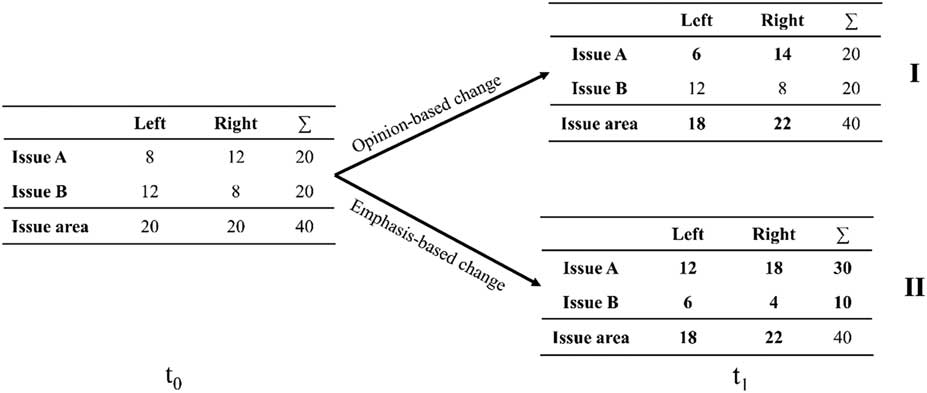
To illustrate how opinion-based and emphasis-based policy change can take place within this framework, consider the hypothetical example in Figure 1. The panel on the left in Figure 1 shows policy stances for an issue area with 40 statements. These statements are made on two specific issues, A and B, where the policy position is somewhat to the right on issue A (i.e., more right than left statements) and somewhat to the left on issue B (i.e., more left than right statements). The policy position on the issue area is centrist, based on 20 left and 20 right statements; note that we assume that the only relevant information about each statement is whether it is right or left, so statements are treated as fundamentally exchangeable apart from their R or L content (Lowe et al. Reference Lowe, Benoit, Mikhaylov and Laver2011, 126).
Example: party statements on an issue area made up of two issues Note: Changes in the number of statements between t 0 and t 1 are highlighted in bold.

Scenarios I and II on the right of Figure 1 exemplify the two types of policy change in an ideal-typical way. The key point here is that the overall policy shift on the issue area is identical (i.e., a slight change to the right), while the nature of this policy shift is fundamentally different in the two scenarios.
Panel I in Figure 1 exemplifies opinion-based policy change. It occurs when a political actor changes the relative number of R and L statements on a specific policy issue. Compared to the situation at t 0, the party or candidate now makes 14 right statements on issue A, two more than before. The political actor now also makes two fewer left statements on issue A, leaving a total of six left statements. The overall position has moved slightly to the right, with 22 right and 18 left statements. The change therefore occurs in the columns, while the row totals are maintained.
Emphasis-based policy change occurs when a political actor changes the proportion of statements on the different issues. In terms of our example (Figure 1, Panel II), the change now occurs in the row totals, so in how attention is divided between the different issues that make up the issue area. The party or candidate increases emphasis on issue A by ten statements and decreases emphasis on issue B by ten statements. Note that the position on each individual issue, measured as the relative emphasis of left and right statements, remains the same. Overall, as with opinion-based change the party moves slightly to the right, now simply by changing emphases over issues. However, the extent of effort in terms of sentences that need to be changed for a policy shift with similar magnitude is far greater than for opinion-based change.Footnote 8
PARTY ORGANIZATION AND TYPES OF POLICY CHANGE
The preceding section naturally raises the question of why parties choose one type of policy change over the other. We suggest that party organization is an important predictor of this decision. Party organization can generally explain variation in party strategies (Lehrer Reference Lehrer2012; Schumacher, de Vries and Vis Reference Schumacher, de Vries and Vis2013; Wagner and Meyer Reference Wagner and Meyer2014), with the key distinction being whether parties are dominated by their leaders or by their activists (Panebianco Reference Panebianco1988). Parties with significant activist control are less likely to be vote-maximizing, office-seeking outfits (Ezrow et al. Reference Ezrow, De Vries, Steenbergen and Edwards2011; Pedersen Reference Pedersen2012). Activists are less likely to sacrifice policy positions in the pursuit of office, and greater activist influence also increases the number of potential veto points in pursuing policy change (Giger and Schumacher Reference Giger and Schumachern.d.). Moreover, parties dominated by members may be more likely to choose party leaders that themselves value policy over votes. Hence, standard spatial models that assume vote-maximization and office-seeking may apply less to activist-oriented parties. Based on this key insight, we can formulate expectations as to how parties choose between types of policy change.
First, activist-dominated parties should be less likely to engage in opinion-based change. This is because policy change can entail negative consequences, in particular with regards to internal harmony and support among activists (Robertson Reference Robertson1976; Janda et al. Reference Janda, Harmel, Edens and Goff1995; Adams et al. Reference Adams, Clark, Ezrow and Glasgow2004; Tavits Reference Tavits2007; Schumacher, de Vries and Vis Reference Schumacher, de Vries and Vis2013). In activist-dominated parties, leaders will find it difficult to push through opinion-based shifts (Giger and Schumacher Reference Giger and Schumachern.d.; Schumacher, de Vries and Vis Reference Schumacher, de Vries and Vis2013).
In contrast, activist-centered parties should be more likely to engage in emphasis-based policy change. All parties will face some pressure to adapt their programs to changing national circumstances or popular opinion. Activist-centered parties will tend to prefer to react using emphasis-based change. Emphasis-based shifts enable political actors to adjust their position without necessarily changing their position on any specific issue (Jones Reference Jones1994). Such changes may therefore be attractive to leaders of activist-dominated parties as they not require the explicit assent of party activists since no specific position is changed. Even if party activists do need to be convinced, this may be easier since emphasis-based change is based only on the reallocation of salience within one policy area. For example, changing a party’s economic policy appeal can occur via higher emphasis on their welfare state position and less emphasis on their views on market regulation; the salience and issue positions for other policy areas (e.g., environment) are not affected. This more subtle type of policy change may be more suitable for parties where party leaders are heavily constrained by their activists. An alternative expectation may of course be that activist-dominated parties engage less in both types of policy change. Given the influential role of policy-seeking party members and activists, any change should be difficult to carry out for the party leadership in such parties. Nevertheless, our hypotheses are:
Hypothesis 1a Leader-dominated parties should be more likely than activist-dominated parties to engage in opinion-based change.
Hypothesis 1b Activist-dominated parties should be more likely than leader-dominated parties to engage in emphasis-based change.
These first hypotheses only concern the general way in which parties carry out policy change. However, we are also interested in party strategies, specifically in how parties respond to changes in their competitive environment. Recent research has shown that parties adapt their policy platforms to past election results, evolving public opinion and in response to policy shifts of rival parties (Adams Reference Adams2012). Party organization also affects how parties respond to such changes in their environment (Lehrer Reference Lehrer2012; Schumacher, de Vries and Vis Reference Schumacher, de Vries and Vis2013; Meyer and Wagner Reference Wagner and Meyer2014).
Following this line of research, we study party policy shifts as a result of the parties’ incentives and constraints (Schumacher, de Vries and Vis Reference Schumacher, de Vries and Vis2013). Thus, parties should shift their policy platforms when they have incentives to do so and are not constrained in their pursuit of these incentives. In terms of constraints, we focus again on differences in party organization. With regard to the parties’ incentives, we consider party responses to a specific type of change in the external environment: overall position changes by the party system as a whole (Adams and Somer-Topcu Reference Adams, Haupt and Stoll2009; Williams Reference Williams2015). The average position change of all other parties in the party system is an information shortcut that carries a lot of information: for example, other parties may be responding to changing economic conditions (Adams, Haupt and Stoll Reference Adams, Ezrow and Somer-Topcu2009) or public opinion shifts (Adams et al. Reference Adams, Clark, Ezrow and Glasgow2004), and thus, parties should adapt their policy position in the same direction as their competitors (Adams and Somer-Topcu Reference Adams, Haupt and Stoll2009; Williams Reference Williams2015).
Our two hypotheses are:
Hypothesis 2a Leader-dominated parties should be more likely to react to systemic policy change using opinion-based change than activist-dominated parties.
Hypothesis 2b Activist-dominated parties should be more likely to react to systemic policy change using emphasis-based change than leader-dominated parties.
MODELING THE TWO MECHANISMS OF PARTY POLICY CHANGE
Empirically, parties often mix emphasis-based and opinion-based policy change, so the ideal types discussed above often overlap. The major challenge is to separate the two types of position change exemplified in Figure 1 to gain estimates of how these types of change affect party policy shifts at the level of issue areas.
For any issue area, a simple approach to recovering positions from R and L statements is to use the (log-transformed) ratio of R and L statements, that is
 $${\rm ln}{R \over L}.$$
This is known as the log-scale scale approach (Lowe et al. Reference Lowe, Benoit, Mikhaylov and Laver2011). To compare policy positions at two points in time, t 0 and t 1, one can simply take the difference between the position of party on the issue area at time t 0 and that at time t 1:
 $${\rm ln}{{R_{1} } \over {L_{1} }}{\rm }\,{\minus}\,{\rm ln}{{R_{0} } \over {L_{0} }}.$$
Values larger than zero indicate shifts to the right, values smaller than zero shifts to the left.
Yet, we can gain a better understanding of policy shifts on issue areas when we explicitly consider policy positions as an aggregation of policy positions on specific issues. Here, we draw directly on Downs: “each party takes stands on many issues and each stand can be assigned a position on our left-right scale. Then a party’s net position […] is a weighted average of the positions of all particular policies it upholds” (Reference Downs1957, 132). This means that the log-scale for issue areas can be disaggregated into specific issues. The formula for K issues that make up an issue area is then as follows:
 $${\rm ln}{{\sum_1^K R_{k} } \over {\sum_1^K L_{k} }}.$$
We follow Lowe (Reference Lowe2013) in modeling party issue stances using a row and column effects association model (Goodman Reference Goodman1979; Agresti Reference Agresti2013).Footnote 9 Lowe (Reference Lowe2013) shows that this model can be used to derive policy positions for texts (i) based on word (or sentence) frequencies coded in issue categories (j). We adapt this approach to our data structure and distinguish “left” from “right” issue stances for individual issues. Thus, our categories distinguish “left” and “right” stances (j) on policy areas nested in an issue dimension (i). Assume that our data are given in a data matrix as in Figure 1 where each row represents issue emphasis on a particular issue at a given election and two columns that contain the number of right (R) and left (L) statements. Following Lowe (Reference Lowe2013), cell entries μ ij of row i and column j can be modeled as
 $$\ln \left( {\mu _{{ij}} } \right)\,{\equals}\,\lambda \,{\plus}\,\psi _{i} \,{\plus}\,\eta _{j} \,{\plus}\,\beta \varphi _{i} \nu _{j} .$$
The association model specifies the joint distribution of variables cross-classified in contingency tables and how expected cell counts are associated to other cells in the table (Agresti Reference Agresti2013; Lowe Reference Lowe2013). The intuition is simple: each cell count is a function of four parameters: a constant, row and column totals, and an interaction term. The row parameter ψ i indicates the (expected) sum of cell counts in row i, that is the expected counts of the “∑” column in the tables shown in Figure 1. Column parameter η j is an estimate for sums over column j, that is the overall number of “left” and “right” statements on the economy across parties and time. If the interaction term βφ i v j is set to 0, cell entries thus only depend on the row and the column they are in, and the two variables shown in rows and columns are independent of each other (independence model; see Agresti Reference Agresti2013). The term βφ i v j captures associations and interactions across columns and rows.
This approach allows us to separate emphasis-based and opinion-based change with parameters ψ and φ, respectively (Lowe Reference Lowe2013). As detailed in the Online Appendix A, Lowe (Reference Lowe2013) shows that for an issue i at time t, changes in policy positions between t 0 and t 1 can be expressed as
 $$\Delta position_{i} \,{\equals}\,position_{{it_{1} }} \,{\minus}\,position_{{it_{0} }} \,{\equals}\,\beta \left( {\nu _{R} \,{\minus}\,\nu _{L} } \right)\left( {\varphi _{{it_{1} }} {\minus}\,\varphi _{{it_{0} }} } \right).$$
Furthermore, changes in issue salience between t 0 and t 1 are simply the differences in the column parameters:
 $$ \Delta salience_{i} \,{\equals}\,{\rm ln}\left[ {{{salience_{{it_{1} }} } \over {salience_{{it_{0} }} }}} \right]\,{\equals}\, \psi _{{it_{1} }} \,{\minus}\,\psi _{{it_{0} }} .$$
Note that Δposition i describes opinion-based changes on specific policy issues as a function in φ (with parameters β and v ), while Δsalience i captures changes in salience, given specific issue positions φ, for individual policy issues as a function in ψ. This helps us to describe combined changes on specific policy issues in terms of opinion-based and emphasis-based changes. In the Online Appendix A we use the example in Figure 1 to illustrate this approach in greater detail.
We use this information to understand how parties shift their positions on broader issue areas. Assume that a party talks about issues k (1≤k≤K) at both t 0 and t 1, then opinion-based change in an issue area is measured by the average change across all specific issues
 $$\mathop{\sum}\limits_{k{\equals}1}^K {{{\Delta position_{k} } \over K}} .$$
Similarly, emphasis-based policy change is the average of salience changes on issues addressed at both t 0 and t 1. Here, however, we also need to consider that changes in issue salience hinge on a party’s or candidate’s policy position on that issue: The effect of increasing issue salience is positive (i.e., shifting the policy position to the right) if the policy position on that specific issue is on the right, while it is negative if the party or candidate holds a left-wing policy position. Therefore, we measure emphasis-based policy change in an issue area using
 $$\mathop{\sum}\limits_{k{\equals}1}^K {{{\Delta salience_{k} \cdot position_{{k,t_{0} }} } \over K}.} $$
EMPIRICAL IMPLEMENTATION USING MANIFESTO DATA
While the approach outlined above can be applied to various data sources, we illustrate it using CMP/MARPOR data (Volkens et al. Reference Volkens, Lehmann, Matthieß, Merz, Regel and Werner2015). The CMP/MARPOR hand-codes parties’ election manifestos by matching quasi-sentences with 56 issue categories. The coding scheme is primarily designed to measure party issue attention but can also be used to study policy positions (e.g., Adams et al. Reference Adams, Clark, Ezrow and Glasgow2004; Somer-Topcu Reference Somer-Topcu2009; Budge, Ezrow and McDonald Reference Budge and Laver2010; Ezrow et al. Reference Ezrow, De Vries, Steenbergen and Edwards2011).
The empirical analysis is based on party manifesto data from ten West European countries (Austria, Belgium, Denmark, Finland, Ireland, France, Germany, the Netherlands, Sweden and the United Kingdom) from 1975 to 2003. We use economic policy as it is a key dimension for conflict in most party systems; at the same time, parties can stress very different aspects (i.e., issues) such as trade or welfare policy within that rather broad issue area. Using the CMP/MARPOR coding scheme, we distinguish six economic issues: free trade versus protectionism; demand-led versus austerity-led growth; employer power versus union rights; free markets versus state intervention; increases versus decreases in welfare state spending; and increases versus decreases in education spending. To each issue, we assign CMP/MARPOR categories that reflect favorable emphasis for the left and the right pole of each scale (see Table B.1 in the Online Appendix B).
We transform the data from percentages to sentence counts. Before running the model, we calculate the total number of statements on economic policies per manifesto. A common problem with manifesto data is the large number of categories with no statements (Lowe et al. Reference Lowe, Benoit, Mikhaylov and Laver2011). To mitigate this problem, we exclude manifestos with less than 14 quasi-sentences on the economy (i.e., 10 percent of our sample) from the analysis. For the remaining manifestos, we standardize the text length so that the number of left and right statements on economic issues is the same for each party and election. We also need to deal with the remaining “0” cells in the data. Because the logarithm of 0 is not defined, we estimate the model in (4) by replacing all 0 counts with one statement.Footnote 10 Dropping “estimated” party policy programs and linking these data with our covariates (see below) leaves us with 261 observations of party policy change. Further details on the data and descriptive statistics are presented in the Online Appendix B.
The key independent variable is Party system policy change (Adams and Somer-Topcu Reference Adams, Haupt and Stoll2009; Williams Reference Williams2015), measured using the average shifts of all rival parties (but excluding the focal party) in the party system. Thus, positive values indicate a shift in the party system to the right, while negative values indicate a party system shift to the left.Footnote 11
We use two Laver and Hunt (Reference Laver and Hunt1992) question items to measure a party’s internal distribution of power (see also Schumacher, de Vries and Vis Reference Schumacher, de Vries and Vis2013).Footnote 12 Respondents are asked to assess the influence of party leaders and party activists have over the formation of party policy (1=“have no influence at all”; 20=“have a very great influence”). To assess Leader-centeredness, we compare the experts’ assessment of the power of party activists to the perceived power of party leaders: a party is leader-centered (“1”) if the party leadership is judged to be more powerful (i.e., has a higher score) than party activists, and a party is activist-centered (“0”) if party activists are seen to have a higher say in party decision-making.Footnote 13
In all our models, we control for past electoral performance as it is one of the most important causes of policy change (Kollman, Miller and Page Reference Kollman, Miller and Page1992; Budge Reference Budge, Ezrow and McDonald1994; Harmel and Janda Reference Harmel and Janda1994; Laver Reference Laver2005; Budge, Ezrow and McDonald Reference Budge and Laver2010). Specifically, parties that gained votes in the last election should shift less than parties that lost votes (Somer-Topcu Reference Somer-Topcu2009); moreover, electorally successful parties should continue to shift in the same direction, while those that lost votes should shift their policy platform in the opposite direction to that of their previous move (see Kollman, Miller and Page Reference Kollman, Miller and Page1992; Budge Reference Budge, Ezrow and McDonald1994; Laver Reference Laver2005).
In our models predicting the direction of party policy shifts (Hypotheses 2a and 2b), we also control for two other potential confounding variables. First, we use the replication material by Schumacher, de Vries and Vis (Reference Schumacher, de Vries and Vis2013) to include mean voter change, that is, changes in the mean voter’s policy position from the last to the current election. Second, we control for changes in the economic environment. In particular, we study whether changes in unemployment from the previous to the current election affect party position change.Footnote 14 Unemployment is a major economic indicator, and arguably the one voters know most about (Lewis-Beck and Paldam Reference Lewis-Beck and Paldam2000). Robustness checks using alternative economic indicators are presented in the Online Appendix C.
RESULTS
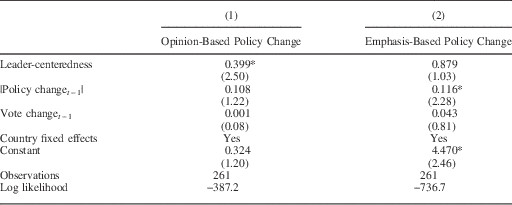
First, we argued that how parties organize should affect the extent to which parties shift their policy positions via opinion-based and emphasis-based policy change (Hypotheses 1a and 1b). To test these expectations, we estimate two regression models using the magnitude of each type of policy shift as the dependent variable, using |Policy change| to denote the absolute value of opinion- and emphasis-based policy change:
 $$\eqalignno{ \left| {Policy\,change_{t} } \right| \,{\equals}\, a_{0} {\plus}& a_{1} \cdot Leader{\hbox-}centeredness{\plus}a_{2} \cdot \left| {Policy\,change_{{t{\minus}1}} } \right| \cr {\plus} & a_{3} \cdot Vote\,change_{{t{\minus}1}} {\plus}Country\,fixed\,effects. $$
We are primarily interested in the effect of Leader-centeredness, but also account for the potential impact of electoral defeat in the previous election, Vote change t−1 (Somer-Topcu Reference Somer-Topcu2009). Like Adams, Ezrow and Somer-Topcu (Reference Adams and Somer-Topcu2014) and Fernandez-Vazquez and Somer-Topcu (Reference Fernandez-Vazquez and Somer-TopcuForthcoming), we use linear regression models with standard errors clustered for parties, capture serial correlation using the lagged dependent variable, and include country dummies to capture institutional differences across countries. The results are shown in Table 1.
Explaining the Magnitude of Policy Change by Party Organization

Note: t statistics in parentheses; country fixed effects not reported. Model estimates based on a linear regression model with standard errors clustered by parties.
+p<0.1, *p<0.05, **p<0.01, ***p<0.001.
The positive and significant effect of Leader-centeredness in Model 1 supports our Hypothesis 1a: leader-dominated parties are more likely than activist-dominated parties to engage in opinion-based change. The size of the effect (0.40) is about one-third of the dependent variable’s SD (1.15), and thus substantial in substantive terms. In contrast, we find no evidence that activist-dominated parties are more likely than leader-dominated parties to engage in emphasis-based change (Hypothesis 1b). The effect of Leader-centeredness in Model 2 is positive, indicating that the magnitude of emphasis-based policy change is higher, not lower, for leadership-dominated parties than for activist-dominated parties. Yet, the coefficient does not reach conventional levels of statistical significance and is also substantively weaker than the one in Model 1: the coefficient (0.88) is about one-fifth of the dependent variable’s SD (4.44). Thus, we have no clear evidence that party organization affects the magnitude of emphasis-based policy change. Overall, we have more evidence that activist-dominated parties simply move less than leadership-dominated parties, both in terms of opinion-based and emphasis-based policy change.
Next, we use two regression models to study how party organization affects reactions to party system policy change using opinion-based and emphasis-based policy change (Hypotheses 2a and 2b). Using Policy change to denote opinion- and emphasis-based policy change, we test the following model:Footnote 15
 $$\eqalignno{ Policy\,change_{t} \,{\equals}\,a_{0} {\plus} & a_{1} \cdot {\rm }Party\,system\,policy\,change_{t} \cr {\plus} & {\rm }a_{2} \cdot Leader{\hbox-}centeredness{\rm } \cr {\plus} & {\rm }a_{3} \cdot Party\,system\,policy\,change_{t} X\,Leader{\hbox-}centeredness \cr {\plus} & {\rm }a_{4} \cdot Mean\,voter\,change_{t} {\plus}a_{5} \cdot Policy\,change_{{t{\minus}1}} \cr {\plus} & a_{6} \cdot Vote\,change_{{t{\minus}1}} {\plus}a_{7} \cdot Policy\,change_{{t{\minus}1}} X\,Vote\,change_{{t{\minus}1}} \cr {\plus} & a_{8} \cdot Change\,in\,unemployment{\plus}Country\,fixed\,effects. $$
We again use linear regression models with standard errors clustered for parties, a lagged dependent variable and country fixed effects. As shown below, our major conclusions are robust to different model specifications.
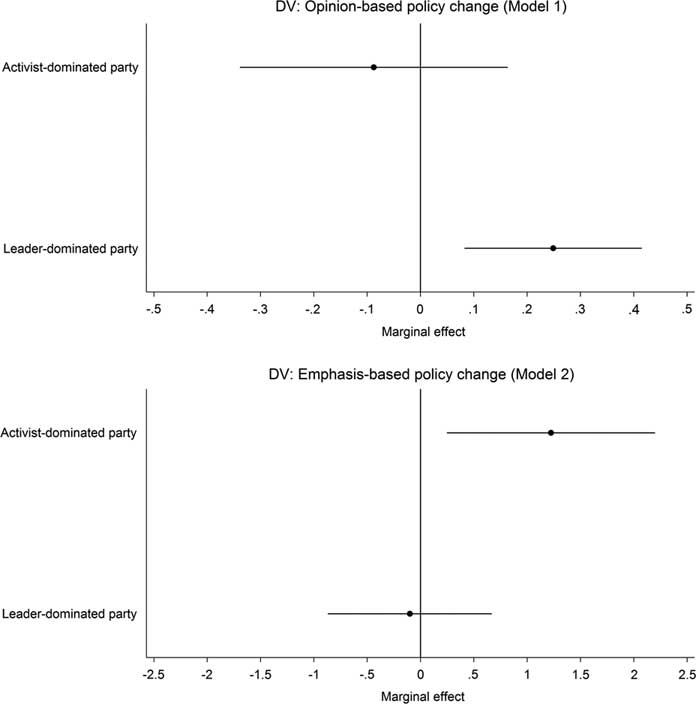
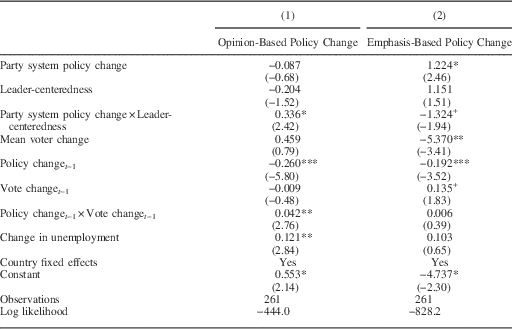
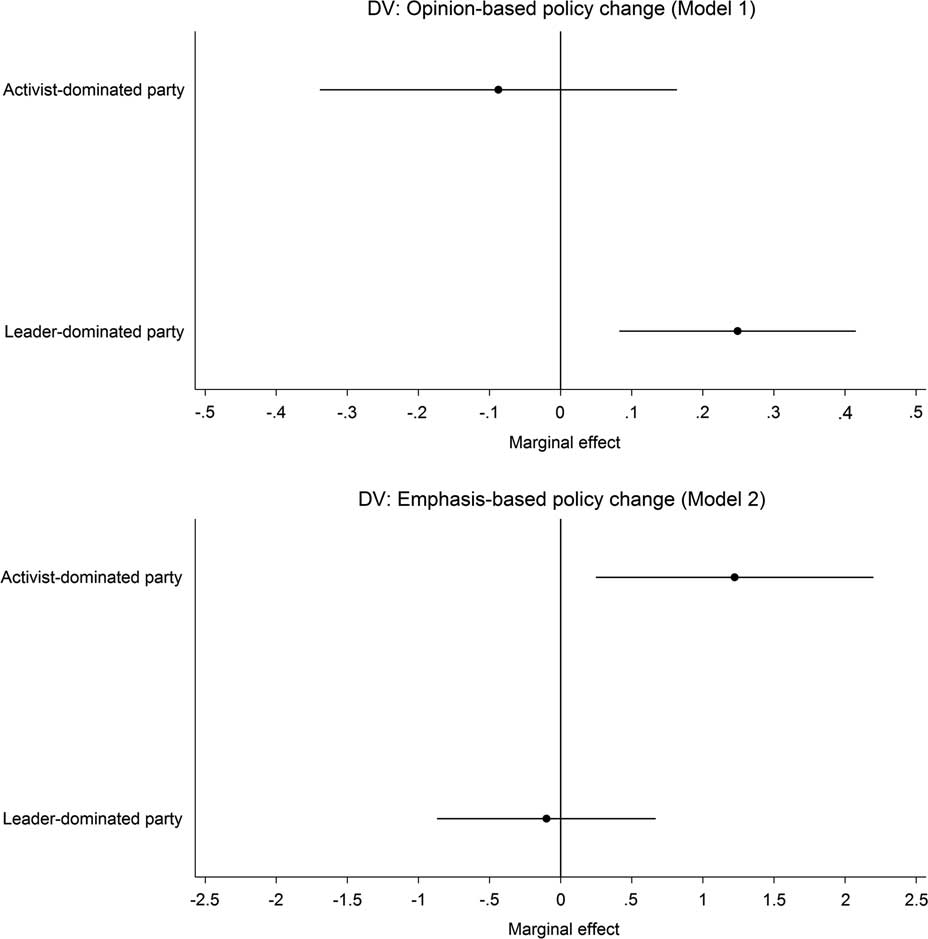
The results of the empirical analysis are shown in Table 2 and the corresponding marginal effects in Figure 2. Both models show that activist- and leader-centered parties differ substantially in how they respond to party system changes. Leader-centered parties mainly shift their policy platforms using opinion-based policy change (Model 1), while activist-centered parties adapt their policy platforms using emphasis-based policy change (Model 2). The effect of Party system policy change in Model 1 is small and not statistically significant for activist-dominated parties. In contrast, the same effect for leader-centered parties is substantially larger and statistically significant at conventional levels (Figure 2, upper panel). This suggests that, compared to leaders of activist-centered parties, leaders with more power within their organization have more room for maneuver on party policies and can shift stances in line with other parties. Yet, activist-centered parties are not necessarily immobile. For emphasis-based policy change, the results in Model 2 show that activist-centered parties are in fact more likely to respond to changes in rival parties’ policy platforms: if rival parties shift to the right, activist-centered parties put more emphasis on issue where they have right positions, de-emphasizing those where they have positions on the left. In contrast, the effect is weaker and not statistically significant for leader-dominated parties (Figure 2, lower panel).
Marginal effect of party system policy change on policy change Note: Estimates based on Models 1 and 2 in Table 1. All remaining covariates held constant at their mean (continuous variables) or mode (categorical variables).
Explaining Why and How Parties Adapt Their Positions to Rival Parties

Note: t statistics in parentheses; country fixed effects not reported. Model estimates based on a linear regression model with standard errors clustered by parties.
+p<0.1, *p<0.05, **p<0.01, ***p<0.001.
Turning to the control variables, we also see important differences in how parties react to other changes in their environment. Changing voter preferences affect emphasis-based but not position-based policy changes. Interestingly, the negative effect in Model 2 suggests that parties react to voter shifts to the right by talking more about issues where they have a relatively left-wing stance. What also differs is how parties react to their electoral performance. In Model 1, the interaction with changes in vote share is positive and statistically significant, while there is no such effect for emphasis-based policy change in Model 2. These results suggest a refinement of the general expectation that parties shift policy positions in response to past election results (see Kollman, Miller and Page Reference Kollman, Miller and Page1992; Budge Reference Budge, Ezrow and McDonald1994; Laver Reference Laver2005): parties do react to their electoral performance, but the mechanism of doing so is opinion-based policy change. Finally, the economic environment affects opinion-based, but not emphasis-based policy change. Thus, increasing unemployment makes parties take up more right-wing stances (Model 1), perhaps because government parties may have to defend austerity in hard economic times.
We use several tests to evaluate the robustness of our findings. First, existing research has used different model specifications to account for the time-series cross-sectional data structure. Schumacher, de Vries and Vis (Reference Schumacher, de Vries and Vis2013) use panel-corrected standard errors (Beck and Katz Reference Beck and Katz1995; Beck and Katz Reference Beck and Katz1996), while Adams and Somer-Topcu (Reference Adams, Haupt and Stoll2009) use standard errors clustered by elections. Our substantial conclusions do not change when we use these alternative model specifications (Online Appendix D). Second, we estimate models that include controls for the rival parties’ policy changes in the previous election (Adams and Somer-Topcu Reference Adams, Haupt and Stoll2009; Williams Reference Williams2015). As shown in the Online Appendix E, the effects are in the same direction but weaker than those for concurrent shifts, suggesting that parties have more incentives to follow concurrent than previous shifts.
Third, a crucial assumption in the analysis above is that the main difference between party organizations is whether parties or activists dominate within parties. We test this assumption using a continuous measure for party leader-centeredness. Following previous research (Schumacher, de Vries and Vis Reference Schumacher, de Vries and Vis2013; Wagner and Meyer Reference Wagner and Meyer2014), we use the Laver–Hunt expert survey data and subtract the experts’ assessment of the power of party activists (1=“have no influence at all”; 20=“have a very great influence”) from the perceived power of party leaders. The empirical range of this continuous measure is from −12.4 to +14.1. In the Online Appendix F, we use interactions with this continuous measure, its squared term and party system policy change to test whether the interaction effect for party organization is indeed non-linear (see also Giger and Schumacher Reference Giger and Schumachern.d.). As expected, the main distinction is between party organizations where activists dominate (negative values) compared to those where leaders dominate (positive values). Especially for Hypothesis 2b (emphasis-based policy change), the marginal effect plots are almost flat for all values in the positive range. These results support the conclusion that the main distinction is between two party organization types: activist- and leader-centered parties. Fourth, we also test whether our findings could be explained by other party characteristics. While party organization is a relatively exogenous measure, activist-centered parties such as Green parties differ in other ways from their rival parties. Therefore, we control for party size and the emphasis on economic policies (both at the previous election). The results (see Online Appendix G) are robust to this model specification. Finally, we use different indicators to capture the state of the economy. In the Online Appendix C we show regression models using the average gross domestic product growth in the inter-election period and inflation as indicators for the state of the economy. Our main conclusions do not change.
DISCUSSION AND CONCLUSION
While most studies implicitly assume that opinion change underlies policy change, we have argued that parties can also shift policy positions on issue areas via emphasis-based change on specific policy issues within that policy dimension. This type of policy change has so far been relatively neglected, even though early proponents of saliency theory noted its relevance (Robertson Reference Robertson1976; Budge and Farlie Reference Budge1977). We apply our approach to party manifesto data and find that parties’ internal organization affects how they enact policy change and how they react to rival parties’ policy shifts: leader-centered parties are more likely to engage in opinion-based policy change, also in reaction to systemic policy shifts; in contrast, activist-centered parties are more likely to change their emphasis on existing positions as a reaction to party system policy change. Thus, analyzing how parties move provides a more nuanced explanation for differences in party behavior.
Our framework is important because it does more than just add emphasis-based policy change as a way for parties to look like they are moving: we open up the black box of policy change. Hitherto, researchers have tended to disregard the question of how political actors carry out policy shifts. We have shown that emphasis-based change is a key mechanism by which parties can move, in addition to opinion-based change. Importantly, our approach invites researchers to consider the two types of policy change in their theoretical and empirical accounts of the causes and consequences of party policy shifts. In particular, we think our framework provides six key avenues for future research to explore.
First, there is already rich body of research that explains variation in issue emphasis (see e.g., Budge and Farlie Reference Budge and Farlie1983; Carmines and Stimson Reference Carmines and Stimson1989; Sigelman and Buell Reference Sigelman and Buell2004; De Vries and Hobolt Reference De Vries and Hobolt2012; Wagner Reference Wagner2012; Klüver and Spoon Reference Klüver and Spoon2014). This research has tended to portray salience change has an alternative to position change. However, our framework implies that changes in issue emphasis may also affect parties’ policy positions if certain party positions become more prominent within the party’s overall program (see also Feld, Merill and Grofman Reference Feld, Merrill and Grofman2014). Our approach will enable researchers to use insights from studies of salience-based issue competition (e.g., Budge and Farlie Reference Budge and Farlie1983; Carmines and Stimson Reference Carmines and Stimson1989; Sigelman and Buell Reference Sigelman and Buell2004) to gain a better understanding of how and why parties and candidates engage in policy shifts. For example, parties adapt their issue priorities in response to changing issue concerns of voters (Klüver and Spoon Reference Klüver and Spoon2014; Wagner and Meyer Reference Wagner and Meyer2014). A direct implication for spatial models is that changing voter policy concerns should result in emphasis-based policy change, but not necessarily opinion-based policy change. By establishing these mechanisms, we can learn more about how parties respond to demands to adapt their policy profiles. Future research in this field should therefore examine whether and under what conditions changes in issue emphasis also affect position change.
Second, previous research has shown that not all issue dimensions are the same: some dimensions are generally principled issues (Tavits Reference Tavits2007), while others may form a party’s core issues (Green Reference Grimmer and Stewart2011). Future work should consider whether the relevance of the two types of position change is likely to differ across policy areas. For example, opinion-based change may be less likely on core and principled issues.
Third, we also know that the extent of policy change depends on the competitive context, for instance, the emergence of new rivals (Meguid Reference Meguid2005). Future research should examine whether the use of the two mechanisms exhibits contextual variation. For instance, it may be that opinion-based change is more likely in contexts of deeper electoral volatility and serious competitive threats.
Fourth, recent research has established the importance of issue evolution and issue entrepreneurship for understanding party competition (Carmines and Stimson Reference Carmines and Stimson1989; De Vries and Hobolt Reference De Vries and Hobolt2012). This means that issues can emerge on or disappear from party system agendas, with important consequences for parties’ ideological positions and electoral success. Such issue change should also have consequences for party position shifts. In our framework, we treat issue change as an extreme form of emphasis-based policy change; however, discarding “old” and emphasizing “new” issues may actually differ in important ways from other types of policy change. On the one hand, issue change may present an opportunity for parties. They can choose new issues where constraints are relatively low, and the pool of potential new issues is likely to be large. On the other hand, issue change may also be a challenge for parties. New issues may in part be forced on a party by the media or by rival parties (e.g., Meguid Reference Meguid2005), and on some new issues the party will be bound by existing positions on linked issues. For example, parties chose how to position themselves on European integration based on their other ideological stances (Marks and Wilson Reference Marks and Wilson2000). So, there are still limits to the range of positions a party can take on a new issue if it wishes to remain credible.
Fifth, our account may explain why previous research reaches differing conclusions about the frequency of policy shifts. For example, Page (Reference Page1978, 110) notes that “instances of outright variation in policy stands are rare”, while research using party statements in manifestos finds that substantive policy shifts are frequent (e.g., Budge Reference Budge, Ezrow and McDonald1994; Budge, Ezrow and McDonald Reference Budge and Laver2010). This discrepancy may be the result of different understandings of what policy change is. Researchers focusing on opinion-based policy change may stress the rarity of such change, while those who also take into account emphasis-based shifts may find policy change to be a normal part of party competition. Hence, our approach suggests that the empirically determined frequency of position shifts may depend on what kind of shifts we examine. Future research should further explore this possibility.
Finally, recent research has presented diverse findings on whether voters actually notice changes in policy positions of political actors (Adams, Ezrow and Somer-Topcu Reference Adams, Ezrow and Somer-Topcu2011; Adams, Ezrow and Somer-Topcu Reference Adams and Somer-Topcu2014; Fernandez-Vazquez Reference Fernandez-Vazquez2014; Fernandez-Vazquez and Somer-Topcu Reference Fernandez-Vazquez and Somer-TopcuForthcoming). These analyses have not distinguished between types of policy change. Hence, future research should consider whether the way parties and candidates adapt their policy positions affects how voters react to these changes. While we argue that opinion-based policy change is more likely to be noticed by voters, endanger credibility, and enrage activists, we have not tested this assumption empirically. Distinguishing between types of policy change may help to explain why some studies find evidence that voters perceive policy shifts of political actors, while other studies find no such effect. In sum, our framework therefore provides important avenues for future research on the causes and consequences of party policy shifts that may help us to find new answers to old questions.