Ideas of modernity, conveying novel ways of imagining the world and one's place within it, together with new forms of societal organization and intellectual production, first reached Bosnia through Ottoman and Habsburg policies in the nineteenth century. The two empires that overlapped in Bosnia Herzegovina shared some features in their respective modernization practices, with both pursuing such state interests as centralization and an intensified control over their subjects’ lives, but they diverged in their strategies and outcomes. The two distinct imperial conceptions also differed from the ways in which notions of modernity were internalized locally, as well as from the discourses of modernization theory and developmentalism that often plagued European scrutiny of non-European regions, including the Balkans. The modernity envisioned by the Muslim intellectuals in Habsburg Bosnia Herzegovina not only represents an alternative to the historiography's modernity narrative, but it was also an alternative to the contemporaneous understanding of modernity in imperial Ottoman and Habsburg visions.
In this article, I analyze individuals who, in diverse ways, articulated Bosnian Muslim modernity during the Habsburg period. My intent is to come to a nuanced understanding of what modernity signified for them and in what ways it informed their definitions of Bosnian Muslim society and shaped cultural and political activity. Inspired by Pierre Bourdieu's emphasis on the strategies that social agents employ, in his conceptualization of reflexive sociology, this study offers an understanding of how the individuals analyzed here made sense of their world and what actions they undertook to navigate the boundaries and utilize the potentials of their environment. For Bourdieu, these strategies are a product of agents’ experiences of social space—their “practical sense.” These practices, rather than structures such as societal rules, inform agents’ social actions, although within the limits and possibilities of their social environment. When analyzed through their strategies of social action, individuals can be observed as agents actively negotiating their social environment rather than passively following predetermined societal structures.Footnote 1
The actors examined here are regarded as intellectuals because of their concern for their society, and for proposing ideas and devising solutions to societal problems in their capacity as notables, educators, writers, religious officials, journalists, and administrators. Many saw themselves as reformers pursuing the task of enlightening their society and making it compatible with the requirements of the “new age,” and redefining it in the process. In contemporary Bosnian historiography, these thinkers are considered guardians of national identity. They had differences and rifts that sometimes spilled over into the public realm, but they often cooperated to form new social and cultural organizations and publish papers, and they shared political interests that frequently brought them together. Although not a unified or formally organized group, these actors singled out similar problems and struggles in Bosnian society, offered comparable solutions to them, and tapped into related cultural and religious imagery. In analyzing them here, I have adopted Paul Rabinow's perspective that, rather than attempting the impossible task of defining modernity, one must explore how it has been understood and used by self-proclaimed modernists.Footnote 2
I contend that the Muslim intellectual elite of Habsburg Bosnia Herzegovina, in addition to their new Eastern and Central European position, remained active in the Ottoman intellectual context, and that they considered themselves to be part of a broader community of the world's Muslims. Although there have been extensive analyses of the Muslim world's reform movements of this period, Bosnian Muslim intelligentsia have yet to be studied as part of them.Footnote 3 Their concerns with the future of their culture, education, and society in general—all the while working to reconcile Islam with modernity—had much in common with the modernist movements across the Muslim world at this time. These intellectuals were influenced by developments in Istanbul and Cairo, and they closely followed the activities of Muslims ruled by non-Muslims in tsarist Central Asia, Russia, and independent Bulgaria. My discursive approach to experiences of Volga Tatars, Turks in Bulgaria, Malayan Muslims, and others that I bring up here in relation to Muslim issues in Bosnia, provides insights for comparing different Muslim lives under non-Muslim rule in the last decades of empires and in new nation states. Comparative analysis shows that Bosnian Muslim experiences not only ran in parallel with those of other groups, but also influenced and shaped the broader Muslim modernist discourse. I make a case that Ottoman European regions such as Bosnia Herzegovina need to be integrated into scholarly debates on Islam and modernity that are usually limited to the Middle Eastern or South Asian contexts. Further, I demonstrate how important it is for studies of Europe and the Balkans to consider imperial connections and continuities with the Middle East.
Being part of the Habsburg and Ottoman imperial context, but also being Slavs (and Slavic-speaking) and members of the universal Muslim community (the umma), provided Muslims with a variety of social environments and imagined communities and introduced a distinctive trajectory of intellectual life in Bosnia Herzegovina. The significant Habsburg influence on the modernization and transformation of the intellectual outlook in the province has been studied and documented in depth.Footnote 4 What has been neglected are Ottoman continuities and the lasting effect that Islamic intellectual discourse in Bosnia Herzegovina has had on the understanding and expression of modernity there (or in southeastern Europe, for that matter). Studies of Muslims in Bosnia Herzegovina often highlight the exceptional nature of a particularly European Islam, albeit an East European one. These analyses range from examinations of life in Bosnia Herzegovina as a unique example of vibrant multiculturalism to explorations of problematic diversity as the root cause of contemporary conflicts. Historiography conceives of Bosnia's modern period as dating from its break with the Ottoman Empire, and as a consequence of European influences that began with Austria-Hungary's occupation after the Berlin Conference of 1878. According to this narrative, the Habsburgs, as the representatives of what was modern, European, and enlightened, took over the derelict province from the Ottomans, who after 1878 seem to have disappeared from the Bosnian scene in every significant respect.
Scholarly work on the post-Ottoman period in southeastern Europe has been hampered by analyses limited by national and disciplinary boundaries, and it almost always centers on the break with the Ottoman Empire and the otherness of “Asiatic Islam.” Scholars of the Balkans are situated in Eastern European studies and the region is frequently studied separately from the Ottoman context, which falls within Middle Eastern studies. One consequence of this has been that the means by which European modernist discourse reached different social and intellectual groups across Eastern Europe and the Middle East are seldom taken into account, and the nuanced ways in which that discourse was received and modified locally are neglected.
I focus on Muslim intellectuals and treat the transition from one empire to another not as a radical break, but rather as a process that displayed many continuities. This allows me to move away from a fixation on modernity as simply an outcome of Habsburg rule and reconsider conventional historiography's portrayal of Muslim subjects as passive recipients of European modernization and sociopolitical organization, disconnected from former Muslim centers. This is to discount neither the effects of top-down Ottoman reforms nor how the Habsburg imperial, colonial context shaped and nurtured ideas and activities associated with modernity.Footnote 5 How new intellectual elites defined the notions of tradition and modernity and the place of individuals in the community and the world were affected by structures the state set in place for administrative organization, the treatment of individuals and groups (the Ottoman millet system and its continuation in the Habsburg period), and education, print media, and social associations.
What follows draws on Bosnian and Ottoman primary source material from a variety of genres of writing. It examines how the modernist discourse developing in the Ottoman Empire and the wider Muslim world influenced Bosnian Muslim intellectuals’ conceptions of their particular Muslim modernity in a European context. I argue that Habsburg Bosnia Herzegovina was not only a particular response to modernity, but also a unique location in which intellectuals, in interaction with other sites and struggles, forged their own European Islamic intellectual tradition.
While reform was a recurrent aspiration throughout Islamic history,Footnote 6 beginning in the eighteenth century, the need for reform was understood in the context of the European encroachment that threatened Muslim societies on all fronts: militarily, economically, politically, and culturally. Muslim reformers at the turn of the twentieth century, from southeastern Europe to Southeast Asia, and Sub-Saharan Africa to Central Asia, articulated reasons for Muslim weakness vis-à-vis Europeans in terms of a fundamental opposition between tradition and modernity within their own societies. The most influential figures of this intellectual movement, such as Sayyid Jamal al-Din al-Afghani (1839–1897), Muhammad Rashid Rida (1865–1935), and Ismail Bey Gasprinski (1851–1914), were known across the Muslim world through their publications in the ever-growing Muslim press. Their opinions were lauded, debated, and sometimes dismissed by local authors who engaged with questions about modernity and its effects on their immediate environments.Footnote 7 These activists sought to make their societies compatible with modernity, which they understood as a set of ideas and practices that included cultural revival, modern education, women's rights, various institutional and associational developments, and science. How these ideas reached different areas where Muslims lived varied considerably. So too, Muslims’ interpretations and strategies of modernization were quite diverse both geographically and also amongst local and regional proponents of modernity.
In Bosnia Herzegovina, the foundations of modernizing reforms and intellectual concepts were laid out in the last decades of Ottoman rule. Although the Tanzimat period in Bosnia was brief, it saw the introduction of measures and basis for the modernization of all aspects of society. Most importantly, in this period the fundamentals of reforms, as well as of opposition to them, were articulated in the context of the Islamic state and in Islamic terms. Bosnian notables intensely opposed the Tanzimat; they wanted to maintain autonomy in local affairs and taxation as well as their military privileges, and they expressed their resistance to Ottoman centralization efforts as a rejection of “un-Islamic” Ottoman practices. By the 1860s, however, Bosnia Herzegovina had become a model province and advanced Ottoman modernization policies took root there.
The Ottoman reform introduced multi-level representative councils and modern elementary and higher-level schools were established alongside the traditional mekteb (elementary school) and medrese (seminary).Footnote 8 An administrative school (Mekteb-i hukuk) and a teachers’ school (Dar ul-muallimin) opened in Sarajevo and they educated the first generation of modern bureaucrats and teachers in the spirit of the Ottoman reform. These new schools met little resistance from religious officials, who continued to control education in the traditional schools, especially the elementary mekteb that most students attended. Nonetheless, the new schools were an important departure in education in that they treated religion as only one of many elements in the curriculum.
During the tenure of Governor Topal Şerif Osman Pasha (1861–1869), the province experienced the most successful features of the Tanzimat. In addition to reorganizing the province and building roads, railways, schools, hospitals, and libraries, this Ottoman governor founded an inter-religious provincial assembly and executive council. The intensity of anti-Ottoman nationalist propaganda emanating from Croatia and Serbia through textbooks for confessional and missionary schools, and the increasingly relevant role of the press, compelled the governor to introduce comparable local sources of Ottoman influence. Among his important legacies were the founding of the official Vilayet (provincial) printing press in 1866, the initiation of the papers Bosnaski vijesnik (Bosnian Herald) in Bosnian Cyrillic script and Bosna (Bosnia) in Bosnian and Turkish, and the publication of the Ottoman official yearbook, Salname-i vilayet-i Bosna. As a local response, journalist and educator Mehmet Šakir Kurtćehajić (1844–1872) launched Sarajevski cvjetnik—Gülşen-i saray in 1868. By 1878, the provincial press had published more than twenty-two titles and administrative publications in Turkish and Bosnian.Footnote 9 These Ottoman, top-down measures, particularly the establishment of a provincial printing press, educational reform, and enhanced communication systems, created the conditions for greater intellectual production that continued during the Habsburg era. The Austro-Hungarian state maintained a top-down approach, which significantly aided Muslims in furthering the modernist intellectual development initiated during the Ottoman period.
The Ottomans invoked reforms to reaffirm their authority throughout their domains, but also in response to European encroachment, and the increasingly relevant public opinion, to preserve the state's global imperial position. Similarly, Austria-Hungary aspired to exhibit its new province as a successful model of the multicultural Dual Monarchy that for the first time incorporated Muslims. The population of the Habsburg Empire was already heterogeneous and there were concerns over nationalist movements challenging imperial authority. This informed the policies in its newest province, which was itself made up of a religiously diverse population of Muslims, Orthodox Christians, Catholics, and Jews, none of which comprised an absolute majority. The Habsburg occupation in 1878 did not discontinue the reform efforts of the last Ottoman years. The Austro-Hungarian administration carried over Ottoman practice and laws in most areas, and planned to gradually implement changes that would not alarm Muslims, who were seen as the key population through which the province could be ruled effectively.
The Habsburg occupation of Bosnia Herzegovina was the first takeover of an Ottoman province in the Balkans that was not followed by an expulsion of its Muslims. Instead, the administration worked to integrate Muslims into its imperial sphere and, like the reformist Ottomans had, make Bosnia Herzegovina into its model province (Musterstaat).Footnote 10 This affected Bosnian Muslim attitudes toward the new administration and slowed migration to Ottoman lands. Soon after the province was acquired, vigorous development began in areas ranging from industrialization, to infrastructure, to education. Provincial folk poetry compendiums were commissioned, and even customary carpet patterns in Vienna were redesigned for weavers in Bosnia Herzegovina.Footnote 11 In encouraging Muslim participation in the new state, the Habsburgs sought to define Muslim culture as integral to the empire's new image.
Bulgaria was also created as an outcome of the Berlin Congress, first as the Bulgarian Principality and Eastern Rumelia. It was then annexed to form the Bulgarian nation state. It provides comparative evidence for the Muslim minority position under imperial and national rule. The Ottoman Danubian province, most of which later became Bulgaria, was, like Bosnia, one of the Ottomans’ model modernization provinces. Under governor Midhat Pasha (1864–1867), the province led the way in the number of post-elementary, rüşdiye schools attended by both Muslims and non-Muslims. In the Russo-Ottoman War (1877–1878) the Muslim population suffered atrocities and expulsion and the war and its aftermath caused a complete breakdown of intercommunal relations. This was followed by one of the nineteenth century's largest Muslim migrations to the Ottoman Empire.Footnote 12 Though the new state had a Constituent Assembly and over a dozen Muslim deputies, it largely disregarded Muslims and hoped they would ultimately all emigrate. The authorities rarely responded to cases of violence, illegal property alienation, religious discrimination, or other acts against its Muslim population, and then only when it damaged the new Bulgarian state's international image.Footnote 13 Most Muslims there spoke Turkish, and so when the official language became Bulgarian that further alienated Muslims from participating in the new society.
Bulgaria discouraged the publication of Turkish papers by introducing measures that required editors to have a high school or university education even though no schools in Bulgaria offered Muslims that level of education. When papers tried to bypass the requirement by employing Bulgarian or Greek figure editors, the administration tightened the requirements by demanding that editors be fluent in the language of their paper.Footnote 14 The Habsburg administration, on the other hand, encouraged and financed the publication of Muslim papers even in Turkish, and advanced similar local initiatives with a long-term goal of drawing Muslim leaders and educated elites into the Habsburg and Central European intellectual circles and away from Ottoman influences.
The Habsburg administration started the Bosansko-hercegovacke novine (Bosnia Herzegovina paper)—later the Sarajevski list (Sarajevo paper). In addition to relevant news, it promoted the administration's particular civilizing mission with Europeanization, Latin script, and modern education as the basis of progress and separation of the province from its “Oriental” heritage. There were sporadic dedications of articles to stylized “Eastern” themes in poems and short stories (“Stories from the Arab desert,” “Story from Persia”) written by non-Muslim authors, and other articles examined Turkish influences on the Bosnian language (“Turcizmi u Bosni”). These testify to the administration's earliest efforts to represent and include Muslims as a constituent element in the province.Footnote 15
Austria-Hungary supported the printing of a yearbook in Turkish that continued from 1882–1893. It took its original purpose from the Ottoman period, and even its official character, publishing statistical and administrative information in addition to a calendar of yearly events and articles on history and culture.Footnote 16 Muslim writers at first felt more comfortable publishing in this yearbook in Turkish than in the Bosansko-hercegovacke novine in its Bosnian Latin script. The yearbook's articles were written by late Ottoman scholars and former Ottoman officials such as Salih Sidki Hadžihuseinović Muvekkit (1825–1888), its editor and the official Ottoman timekeeper; Ibrahim Beg Bašagić (1840–1902), a member of the Ottoman parliament and a district governor in both the Ottoman and Habsburg administrations; Mehmed Hulusi (1849–1907), editor of the Ottoman paper Neretva, journalist, and an official in the Habsburg pious endowments administration; and Mehmed Teufik Azapagić (1838–1918), an Istanbul-educated religious scholar, mufti of Tuzla, and Reis ul-ulema of Bosnia Herzegovina.
Muslim writers also began publishing in Vatan (Homeland), established in 1884 in Turkish, which was supported by subscriptions and donations. Though papers printed in Ottoman Turkish receded over time, the names of many remained Turkish: Behar (Blossom), Musavat (Unity), Gajret (Endeavor), Tarik (Path), Muallim (Teacher), and Misbah (Lantern). Discussions about the place of Turkish language in Bosnian education and print, as a link with the Ottoman Empire, Islam, and even political stances, continued throughout the Habsburg era in Bosnia Herzegovina.Footnote 17 Although the administration saw Turkish as a threatening bond to Ottoman influences in the province, it tolerated it, probably because literacy levels in Turkish were low and its importance was diminishing on its own.Footnote 18
That the first publications were in Turkish, and their content and their authors’ writing styles closely followed the trends of Ottoman literary and journalistic currents, indicate that they inhabited the Ottoman as much as the new Habsburg Bosnian world. Muslim activists who supported the Habsburg modernizing measures were part of late Ottoman reform efforts. Some of them had been educated in Istanbul and were therefore affected by trends at the heart of the Ottoman Empire. Whereas the Ottoman sociocultural framework continued to be relevant, Bosnian Muslim intellectuals did not claim, or work toward, a political bond with the Ottoman Empire. They were acutely aware of their new regional circumstances and worked to preserve their former status and to actively participate in Habsburg developments relevant to their future.
Intellectuals’ understandings of modernity did not develop as a linear process of rejecting the Ottoman, Islamic, or Eastern in favor of the Habsburg, European, and Western. Their modernity was a complex response to, first, their immediate sociopolitical environment in the province; second, the reformist currents in the Ottoman Empire and the wider Muslim world; and finally, the administration's efforts to cultivate them in hopes of attracting and integrating them into the Habsburg imperial setting.
The Austrian administration supported the Muslim intelligentsia and worked to separate the religious establishment from Istanbul. To that end, it restructured the existing Ottoman educational institutions (mekteb, ruždija, and medresa) and established new ones that would end the need to travel to Istanbul for education. Key in this effort were the separation of the provincial Islamic hierarchy from the authority of the Ottoman Şeyhülislam in Istanbul, and the creation of institutions of higher religious education that would produce religious officials to serve in the province. In 1887, Mekteb-i nuvvab was established with a main purpose of educating sharica judges who would work within the Habsburg provincial legal system, which had adopted some of the sharica laws. The students at this school studied subjects related to sharica and Habsburg jurisprudence, Arabic, Bosnian, Turkish, Persian, German, and French, as well as subjects in the sciences and humanities. The school was an outcome of the Habsburg effort to accomplish its political aims while also satisfying the demands of the local religious establishment. It became an exemplar of modern education in the Muslim world, so much so that Muhammad ‘Abduh (1849–1905), a Muslim reformer and mufti of Egypt, cited it when he proposed to the Egyptian government that it establish a school for sharica judges.Footnote 19 For comparison, the first Muslim higher education school in Bulgaria, the Medresetünnüvvab, was not founded until 1920.Footnote 20
The graduates of this and other schools in Bosnia Herzegovina continued their higher education in Zagreb, Vienna, Istanbul, Salonica, or Cairo. Although educational patterns are often explained to account for the split between the modernist and traditionalist factions (the Ottoman educated being the traditionalists), the fact is that many of those educated in the Ottoman capitals were part of the reformist intellectual elite that was active beyond the Habsburg period. Those studying in Vienna and Zagreb often attained specializations in Oriental languages, which gave them access to developments in the Muslim world through literature and the press.
The religious officials and notables who opposed the Habsburg administration of Bosnia Herzegovina organized a movement for religious and educational autonomy. They insisted that Ottoman rather than Habsburg authorities appoint religious officials, to ensure the pious foundations and the educational system did not lose their Islamic character and legitimacy. In many petitions written to the Ottoman and Habsburg authorities, notables voiced their concerns about the unlawfulness of any land reform, which they portrayed as inextricable from the interests of Bosnian Muslims as a whole.Footnote 21 These issues were fused into a struggle to preserve tradition, which they presented as indistinguishable from the perpetuation of Islam in the province. Intellectuals criticized the oppositionists for misinterpreting Islam, for an unreasonable reliance on the Ottoman Empire, and their insistence on an archaic Ottoman system. Yet they voiced no opinion about land reform, which was likely to involve Muslim notables losing land to their mostly Orthodox Christian tenants or to the state.
Even after autonomy in religious and educational affairs was achieved in 1908 and the provincial assembly was created in 1910, land reform remained the major point of contention in debates among the nationally divided parties. Muslim intellectuals, religious officials, and notables of differing ideological backgrounds all assumed the same stance, evocative of the Muslim Faction in the Russian Duma: though they belonged to different parties, they united on issues relating to Muslims. Even advocates of modernization did not promote land reform, which would result in Muslim economic collapse. This selective adoption and rejection of features considered fundamental to the modernization process supports the claim that, for its advocates, modernity did not represent an abstract set of ideas, but instead was related to specific local conditions creating an alternative modernity.Footnote 22
One of the originators of Muslim reform in Bosnia Herzegovina, Mehmed-Beg Kapetanović Ljubušak (1839–1902), a notable and an Ottoman and Habsburg official, described the implications of the Habsburg occupation for Bosnian Muslims, and compared their fate to that of Muslims in the rest of the Balkans: “Never before have over half a million Mohammedans lived in full freedom under the protection of a Christian ruler, as we live today in our homeland.”Footnote 23 This realization is reminiscent of that of Muhammad Iqbal (1877–1938), who, referring to the South Asian Muslim experience, wrote in 1909, “It is not the number of Muhammadans that it protects, but the spirit of the British Empire that makes it the greatest Muhammadan Empire in the world.”Footnote 24 Russian Muslims, too, found that they could advance within the framework of a non-Muslim state, while Ottoman intellectuals such as Şemseddin Sami Frasëri (1850–1904), advocated for a focus on eradicating ignorance, which had once been a European problem as much as it was a contemporary problem for Muslim societies.Footnote 25 The idea that Islam and Muslims could thrive under non-Muslim rule was a principle readily promoted by Muslim thinkers concerned with the diminishing socioeconomic status of Muslims who failed to adjust to their new circumstances.
Ljubušak served as district governor and as mayor of Sarajevo, and was elected to the first Ottoman parliament. He was awarded the Ottoman Third Class Order of Mecidiye for his participation in Ottoman reform efforts. After the Habsburg occupation of Bosnia Herzegovina, he was one of the Muslim representatives who traveled to Vienna for an audience with the emperor. He was subsequently reappointed as Sarajevo's mayor, this time by the Habsburgs. The administration awarded him the Habsburg Order of the Iron Crown Third Class, and upon his request for an Austrian title he was granted a place in the Austrian knighthood (österreichischen Ritterstandes).Footnote 26
This almost seamless transition from one empire to another was characteristic of notables and officials who distinguished themselves in Ottoman reformist cultural and educational activities and who continued their endeavors into the Habsburg period. The development of print brought about the growth of the press and the circulation of literature, along with greater ease of travel. These facilitated new ways of recognizing one's place within overlapping communities—religious, economic, linguistic, and regional—in ways that had been impossible before. Bosnian intellectuals’ understandings of modernity, as initiated by Ottoman reform measures that further expanded within the Habsburg framework, developed around concrete and immediate social, political, and economic struggles involving Muslims. They engaged with tangible issues such as convincing Muslims to send more of their children to modern schools that would provide them opportunities to become active participants in their future, the province, and the new empire. They worked to counter Muslims’ economic decline that was caused by disparities in the Habsburg economic and trade system, but also by Muslim landlords and merchants being slow to adopt modern agriculture and market capitalism. Finally, Bosnian Muslim thinkers and activists espoused Habsburg institutions and features of provincial sociopolitical life, insisting that these were not inconsistent with Islam, and that only by embracing the “new” could Muslim existence in the province be preserved.
Though the Bosnian-Ottoman experience with neighboring Austria in earlier centuries had included expulsion and the forceful conversion of Muslims, Ljubušak now saw the Habsburg administration in a new light: “Everyone knows that religious wars and the Crusades ended a long time ago.”Footnote 27 He reasoned that the authorities’ promise of equality and impartial treatment for all, regardless of religion, should be the basis of Muslims’ loyalty to the monarchy.Footnote 28 By voicing such a definitive attitude regarding the end of Bosnian territorial existence within the Ottoman Empire, Ljubušak firmly resolved the limbo in which some Muslims were lingering, still hoping for an Ottoman return, or at least Ottoman support in their political endeavors. He wrote: “As for the thoughts and hopes of Bosnian return to Turkish hands, everyone here knows that in the past two centuries, whatever the Turkish government lost, or was taken away from it, was never returned. Bosnia can be a lot of things, but never Turkish.”Footnote 29 Instead, he advised people to focus on improving Muslim economic and political positions under Habsburg rule by taking advantage of the opportunities the administration provided.
The encounter with a foreign, occupying power was a common theme among Muslim modernizers at the turn of the twentieth century, and some saw it as an opportunity to improve their own societies. Malayan Muslim modernists advised that Muslims there should take advantage of British colonial justice and freedom and improve themselves so as to be able to assist the British in projects that brought benefits to their country. They even praised the British as God's “righteous servants.”Footnote 30 Muhammad Iqbal, the visionary of Pakistan's independence, stressed the British “civilizing factor” in a similar context.Footnote 31
Bosnian intellectuals of the Habsburg period were graduates of modern Ottoman and Habsburgs schools and universities in Zagreb, Vienna, and to a lesser extent, Istanbul. Many came from notable families and were employed in offices of the provincial administration and educational institutions. Their ideas and political attitudes were expressed in the ever-growing provincial press, where they published literary content, essays, and translations, most often from Turkish, but also from French, German, Hungarian, English, and even Japanese.Footnote 32 Publications by Bosnian authors referenced not only classical and modern Muslim sources, but also European ones, demonstrating their familiarity with and acceptance of European intellectual heritage as relevant to and supportive of their arguments.Footnote 33
The first individual works and publications written exclusively by Muslims in Bosnian and Cyrillic/Latin script appeared in the 1890s. The spread of Latin script literacy and a rise in readership followed publishing activities, which drew interest to a number of books printed in the 1890s by Bosnian Muslim writers, about and for Muslims.Footnote 34 Popularizing Bosnian in the Latin script opened up a growing readership to a variety of new print sources, both provincial and regional, and the literary, political, and social influences that they projected. Bosnian was not a new language in the province, but its Latin rendition was. Suggestions that the provincial language be used in education and publications appeared during the implementation of the Ottoman reforms. The author of the textbook Sehletul Vusul (Effortless approach), printed in 1875 in Bosnian Arabic script, proposed that Bosnian be the official language of education.Footnote 35 Throughout the Ottoman period a body of literature known as Bosnian alhamijado literature, in Arabic script, existed alongside literature in Turkish, Arabic, and Persian,Footnote 36 and Bosančica (western, or Bosnian Cyrillic) was used in pre-Ottoman and Ottoman-era epistolary literature.
These forms of writing and literature in Bosnian did not disappear with the Habsburg occupation. Moreover, Bosnian Arabic script was revised for the printing press and works were published in it until World War II. Ljubušak himself used Bosančica.Footnote 37 Many of the Muslim intellectuals writing in Bosnian also wrote, published, and translated from Turkish. Arabic remained the language in which religious scholars wrote their treatises and official opinions, while Persian literary output and study, associated with the dervish orders, and particularly the Mevlevi, receded with the decline of Sufism and its educational establishments in Bosnia Herzegovina.
In 1900, a group of eminent writers led by Safvet Beg Bašagić (1870–1934), a notable who studied Islamic languages in Vienna and was later president of the Bosnian Assembly (1910–1919), established an independent paper of primarily literary content, intended to influence and educate the young, corresponding to the “spirit of time and needs of the people.”Footnote 38 In the words of one of the founders, Behar (Blossom) was to be “exclusively ours, Islamic, and arranged in a clear and sensible Islamic spirit,” and written and read by Muslims.Footnote 39 Considered the arena of Muslim literary renaissance, Behar, through its popularity and wide readership, influenced educational and cultural developments and shaped Muslim political views.
In addition to poetry and prose authored by Bosnian Muslim contributors, Behar, Biser, Gajret, and other periodicals also offered literary critiques and translations, with a special focus on contemporary Ottoman Turkish literature. The Ottoman avant-garde literary-political periodical Servet-i Fünun (Wealth of knowledge) was widely read and had considerable influence on Muslim writers in Bosnia Herzegovina. Assessing Turkish literary directions and European influences, Bašagić expressed his vision of Muslim literary production in Bosnia Herzegovina by following Turkish modern writers who “do not blindly follow the French decadents, but take from them what is beautiful, and according to their eastern tastes, complement the unrefined in decadence with Eastern gaiety and poignancy.”Footnote 40 This understanding of the “juncture of East and West” in Turkish literature affected the work of Bašagić and other writers in the generations that followed.Footnote 41
Most influential were translations of poetry, prose, and literary criticism published as serials, predominantly from Turkish, but also Arabic and Persian. Theater became popular, not least due to the high rate of illiteracy, and many amateur theatre associations were established in cities. Muslim audiences, however, were not attracted by Serbian and Croatian plays, which habitually portrayed Muslims and the Ottoman period in a negative light. Muslim actors often refused to play non-Muslim or immoral characters, and a need emerged for content that would appeal to an exclusively Muslim audience.Footnote 42 Plays by Namık Kemal (1840–1888), a prominent Ottoman advocate of constitutionalism and reform, were among those most translated from Turkish, while local authors readily espoused the new form of expression and its wide-ranging audience.Footnote 43 European plays also appeared in Muslim literary publications, among the first being Henrik Ibsen's Nora and An Enemy of the People. The first rendition of Molière's Les Fourberies de Scapin in Bosnian was actually a translation of a Turkish adaptation of the play for Muslim audiences.Footnote 44 Looking at these phenomena in theatre and literature, some scholars have found that Western literary influences did not reach Bosnia Herzegovina directly, or at least not only, from Europe, but by way of Ottoman Turkish literary agency.Footnote 45
Some Bosnian Muslim thinkers voiced in their works the need to free women from traditionalist constrains so they could perform their role in a modern society. Bosnian authors translated poetry and prose by Ottoman women writers such as Fatma Aliye (1862–1936) and Nigar (1856–1918), and expressed hope that the Muslim women in Bosnia Herzegovina would follow in their steps. Editors often lauded the reputations of their publications, claiming that “even the women read them,” while some maintained that popular serialized novels encouraged many women to learn the Latin script.
Muslim women began appearing as authors: Vahida, Nafija Zildžić and M. Munira in Behar; Hatidža Djikić, Šefika Nesterin Bjelavac, and P. K. Fatma in Gajret; and Nafija Sarajlić in Zeman and Biser. They wrote poetry and prose, often under pseudonyms, and distinguished themselves from earlier Bosnian Muslim women writers by writing in Bosnian and publishing in provincial journals.Footnote 46 The first women's organizations and magazines appeared after World War I, although girls’ education, women's activism, and public appearances were encouraged in the Habsburg period. Women were teachers and educators, writers, and activists in women's chapters of cultural associations.Footnote 47 Bosnian Muslim reformers, similarly to reformers around the Muslim world, criticized the conditions of women in their society. The focus of their efforts was education for girls and women, and they argued that Islam already granted it to them. Leading the way in the emancipation of Muslim women were the Ottoman Empire, which had the first women's publication staffed and edited entirely by women in 1895; and Crimea, where Pembe Bolatukova, sister of the prominent reformer Ismail Gasprinski, started the first New Method girls’ school in 1893. Gasprinski's daughter Şefiqa edited a women's magazine, Alem-i Nisvan (Women's world). Appeals to improve the status of women in reformers’ writings, however, had only a slow impact on change in Bosnian society. The editors of Biser distanced themselves from the prolific Istanbul-educated author, Hifzi Bjelavac (1886–1972) because his liberal outlook, which included support for the full emancipation of women, was not in line with the editorial board's views.Footnote 48 These and other debates concerning women, such as that surrounding (un)veiling, had to wait until social and political circumstances brought them to the fore during the interwar period.Footnote 49
While the Habsburg oppositionists warned of the disappearance and ruin of the Muslim community because of its separation from the Ottoman Empire and the loss of the traditional Muslim way of life, reformists warned of the destruction of Muslim society on another level. Edhem Mulabdić (1862–1954), renowned for his didactic prose, defined the key idea of his entire generation of intellectuals engaged in the Muslim cultural-literary reform movement through one of his characters: “Gone are the times when we defended our land, fame, reputation, and might with a sword […] today is the time to defend these with education. Only education can safeguard them for us. If we are not hard working and accept it, there would be no one else to blame but ourselves if we lose all these to others who had accepted education in time.”Footnote 50
A Bulgarian reformer, Tırnovalı Osman Nuri, advised in almost the same words: “In our age the extent of the power of a nation and the guarantee of its future is no longer determined by the possession of cannon, guns, and ammunition but by education!”Footnote 51 Analogous arguments in much of the Muslim world at the time focused on the damage that misidentification of tradition with Islam was doing to attempts at reform. They all saw education as key to reconciling these two conceptualizations. Education was also the focus of nationalist projects: teachers were the earliest agents of such movements and had a crucial role in spreading ideas of national identity in the Balkans. Newly formed nation states in the Balkans, as well as in the Habsburg Empire, made elementary education compulsory and free. Yet, only a fraction of Muslims attended.
Ljubušak warned, “One should not ceaselessly hold on to the old ways, that meant something in the past, but should move on as the occasion requires,”Footnote 52 and critiqued fanatical adherence to tradition when it led to passivity in the face of progress. The harshest critique came from the pen of Osman Nuri Hadžić (1869–1937), a law graduate of Zagreb and Vienna universities and a productive writer who held various posts in the provincial administration. His novels and short stories condemned Muslim dissoluteness and resignation during the Habsburg period. He summed up the problem at the beginning of his work Muslimansko pitanje u Bosni i Hercegovini (The Muslim question in Bosnia Herzegovina):
It is obvious that in the last twenty years the Muslims have overwhelmingly stagnated, and are perishing day in and day out. The fortunes and properties they owned until the occupation began to shrink and by now have largely slipped out of Muslim hands. The new cultural innovations in our lands are not being used by us, Muslims, or are used very little, whilst trade is slipping from our hands daily. Consequently, two main factors of human society, and two main aspects of a modern state: material wellbeing and spiritual intelligence, are missing among the Muslims in Bosnia Herzegovina.Footnote 53
Hadžić and other intellectuals saw the roots of Muslim stagnation in the lack of education and the ignorance of the ulema, who rejected everything associated with modernity yet had control over Muslim primary education and a monopoly on defining what was Islamic. Hadžić’s descriptions in his prose of decaying medresas, with inept students wasting their lives in an irrational educational system with inadequate, corrupt teachers were his gloomiest and represent the most relentless critique of the clerical class.Footnote 54 He directly blamed the “lazy” and “self-indulgent” ulema, ignorant of Islam, for the intellectual and material downfall of the Muslim people.Footnote 55 These descriptions are strikingly similar to those found in the Singapore paper Al-Imam, which published equally unsympathetic critiques of the seminaries and their teachers,Footnote 56 and the Bulgarian Muvazene, which expressed matching feelings of doom and anger, and similar views regarding the direness of the Muslim predicament.Footnote 57
The Bosnian cultural reformists saw in the thinking and preaching of the ulema, on whose advice the common folk greatly relied, a blind adherence to a distorted tradition, a rejection of everything new and modern, and a paralyzing reliance on the prospect of an Ottoman return. From South Asia to Egypt, to the Ottoman Empire and Central Asia, Muslim intellectuals reassessed cultural-religious values and offered unique understandings of Islam as consistent with modernity, with modern education being its most important aspect. In addition to writing about how education was the basis of reform, Bosnian Muslim thinkers actively worked to realize such goals by taking up teaching positions, funding students, and participating in organizations that supported educational endeavors. Muslims worldwide likewise saw education as the first step in reform to be followed by economic and political mobilization that would allow Muslims to effectively participate in their societies. Comparable to the Crimean Tatar reformers in the Russian Empire, Bosnian reformers focused on promoting educational, cultural, and social reform and engaged in political mobilization and participation only later, when political associations became legally sanctioned in the Habsburg Empire. In this they differed from Bulgarian Muslims, who were involved in the political activities of the Bulgarian Constituent Assembly from its inception in 1879.Footnote 58
What characterized all Muslim reformers was their use of Islamic discourse in their articulations of modernity and their insistence on upholding Islam's “true” principles as essential in modernizing societies. For the cultural reformists, modernity, progress, and advancement were all rooted in “genuine” and “unspoiled” Islam. They did not criticize traditionalists for their religiousity, but rather for what they saw as an understanding of Islam that had become distorted. They advised that modernity, progress, and Islam were in a mutually conditional relationship: Islam warrants progress, and knowledge and community (in its unity, proper organization, and prosperity) enable the true understanding of Islam. Ljubušak pointed out that Islam had no boundaries when it came to progress and he quoted Qur'anic verses to illustrate that there were no hardships in religion, which he further supported by citing examples from Islamic history and Islam's emphasis on education.Footnote 59 Bašagić wrote that Islam was “founded on democratic institutions” and that it preached “realistic socialism,” which was the reason for its equal “appeal to an African, and a European.”Footnote 60
By engaging Islamic discourse and interpreting the scriptures in reference to contemporary issues, these thinkers engaged in a novel intellectual exercise that had until then been monopolized by religious scholars. Muslim reformists in Bosnia and elsewhere claimed the right to contribute new interpretations as part of the Islamic discourse, and made this the central issue of the Muslim reformist movement worldwide.Footnote 61 In Bulgaria, which became one of the most important centers of Young Turk activity in the Balkans, Young Turk exiles were keenly involved in local reform endeavors and shared the reproachful attitude toward the ulema. However, because Islam and its discourse were central to the identity of the Bulgarian Muslim minority, the exiled Ottoman oppositionists were careful not to denounce religion and promote positivism as they did in the Ottoman Empire and Europe, and they employed Islamic discourse to communicate their ideas.Footnote 62
Muslim reformist thinkers defined education and hard work, based on Islamic principles, as essential to the existence of Muslim communities. Islamic discourse informed new ways of organizing and keeping the community united. To maintain the community, they said, it was essential for Muslims to participate in new schools, economic establishments, social and cultural institutions, and ultimately political parties. Bašagić often quoted hadith (the practice and sayings of the Prophet Muhammad) to demonstrate that congregation was envisioned as a duty of the faithful not only for the purpose of performing prayer, but also to develop mutually beneficial social and ethical values.Footnote 63 Associations, organizations, and clubs proliferated in Bosnia Herzegovina as a consequence of these concrete efforts to modernize society.
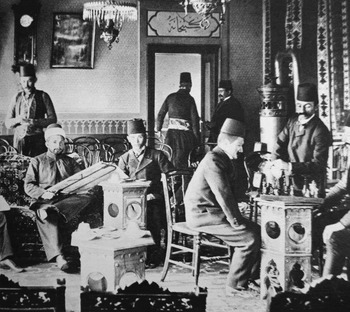
One such development was the founding of kiraethana (Tur. kıraathane), an Ottoman concept of public reading room, first in Sarajevo in 1888 and then in other cities (see figure 1). The reading room was a public space that offered its patrons newspapers, journals, and books and organized lectures and discussions. It served as a public forum, elevating public consciousness about issues relevant to Muslims, and it was the birthplace of the movement for educational and religious autonomy. Most importantly, the kiraethana was intended to combat illiteracy, and important material was often read aloud and discussed. Such reading rooms also opened in Russe, Vidin, Shumen, and Varna in Bulgaria, and in Samarqand and Tashkent in Russian Central Asia. They were an outcome of new forms of sociability that characterized the reformers’ circles, promoting communication through print in societies with established oral traditions.
Interior of the kiraethana (reading room) in Sarajevo, Bosnia Herzegovina, 1901. Courtesy of Muzej Sarajeva.

Based on the notion of uniting, Bašagić worked on expanding associational life through supporting, funding, and initiating clubs, societies, and other organizations that promoted modern values among Bosnian Muslims. He supported the work of the reading rooms, and in 1903 was a founding member of Gajret, an association with the primary purpose of financially helping students gain education in modern schools.Footnote 64 Soon after, an association of Muslim academics, Zvijezda, was founded in Vienna, followed by the cultural association El Kamer in Sarajevo, and the Islamska dionička štamparija (Islamic printing house) in 1905. Bašagić also participated in founding the Association of Muslim Youth in 1906 and the Muslim Central Bank and Združena Tiskara (Joint printing house) in 1911. Trade and workers’ associations were established bearing Turkish/Arabic names: Ittihad (Unity) in Mostar in 1906, and Hurrijet (Freedom) in Sarajevo in 1908. The first Muslim charitable society, Merhamet, was started in 1913 to fight poverty, a modern version of the work that pious endowments traditionally performed.
That new forms of sociability were beginning to dominate the social and cultural landscape in Bosnia Herzegovina was obvious when the so-called traditionalists, who had opposed the founding of Gajret and other modern associations, which they deemed un-Islamic, effectively took control over Gajret's board through organized voting politics in local chapters. Members of the ulema also established their own associations: Muslimansko muallimsko—imamsko društvo za Bosnu i Hercegovinu (Muslim teachers and clerics association of Bosnia Herzegovina) in 1909, and Udruženje bosansko-hercegovačke ilmije (Association of religious scholars of Bosnia Herzegovina) in 1912. They published papers as well: Muallim (Teacher) and Misbah (Lantern). Such organizations and the intensive interaction they offered contributed to a rapid exchange of ideas and efforts to reach out to the broader Muslim population.
Creating an intellectual elite and a prosperous economic community that would support it, both modern and Muslim, were key aims of the intellectuals in their efforts to regenerate society. Muslims’ attitudes toward capitalism and acquiring wealth was one aspect of society that reformists thought needed to change. In this case too, Bašagić reminded his readers of the hadith that presented poverty as being close to faithlessness, and the necessity of acquiring wealth in order to do good.Footnote 65 The emphasis on acquiring wealth was rooted in the weakening economic state of contemporary Muslims, and the intellectuals’ own experiences had made them realize that reform and modernization needed financial backing to be successful: Bašagić financed his own education in Vienna; Ljubušak, Bašagić, and Hadžić self-financed the publications of their first works; and many of the papers and societies were fully dependent on contributions from their subscribers and members. Ademaga Mešić, a prominent merchant and patron of reformist endeavors, set an example of such investment: he owned the leading paper Behar, and was majority owner of the first Islamic printing house and a generous donor to Gajret. The First Muslim Publishing Printing House and Bookstore in Mostar was also founded in 1911 by a business entrepreneur, Muhamed Bekir Kalajdžić, and he brought about another wave of publishing activity through his paper Biser (Pearl) and editions of the Muslimanska biblioteka (Muslim library), which published works that catered to Muslim audiences.
The circumstance of Bosnian Muslims was indicative of Muslim conditions elsewhere. For example, Muslim industrialists and merchants were instrumental in financing Muslim reform efforts in the Volga-Ural regions in Russia and Azerbaijan.Footnote 66 In Bulgaria, the Ahmetbegov brothers of Vidin in their wills left their considerable wealth to support the work of the local reading room and a pious endowment,Footnote 67 while politically engaged tobacco industrialists negotiated advantages for Muslims.Footnote 68 The understanding that social and cultural advancement and participation in the increasingly integrated economy demanded skilled and modern-educated individuals encouraged Muslim industrialists and merchants to finance reform initiatives and fund schools and students. Principles of market capitalism factored into the discourse of modernity and were put into practice by reformist thinkers and their supporters.
A noticeable feature of the change taking place in the sociocultural landscape was a disintegration of the ulema's control of education about religion, which was at the core of the reformists’ efforts. Although moral and Islamic education was relevant for the reformists, what this meant for them was different from the traditional mekteb and medresa instruction based on memorization in Arabic and Turkish. One of the first works Ljubušak authored for the Habsburg school board was Risale-i ahlak (Tract on moral conduct), based on Ottoman textbooks and modern curricula. The visionaries of modern education dismissed rote recitation and encouraged education in Bosnian rather than Turkish, which the Habsburg oppositionists continued to insist upon more for its political connection to the Ottoman Empire than for any practical merit.
Like the modern Ottoman and the New Method schools in Central Asia, the modern schools of Habsburg Bosnia, especially the Mekteb-i nuvvab described earlier, taught Islam as well as other subjects unrelated to Islam—“marking off Islam from the rest of knowledge,” as Adeeb Khalid observed in the Central Asian case.Footnote 69 Ottoman schools and Habsburg mixed elementary and secondary schools in Bosnia Herzegovina had separate religious education classes, while other subjects were taught without regard to students’ religion. In this manner, Islam was “situated squarely in a desacralized world defined by progress through history.”Footnote 70
In Russia, the Volga-Ural Muslims worked to reform and modernize their existing madrasas, which eventually led to secularization of those institutions. They operated independently instead of establishing parallel lay educational institutions, since those would have required unwanted supervision of Russian authorities.Footnote 71 However, the reform efforts limited to existing schools reinforced the divisions between the modernists and the traditionalists as they fought for control over the same spheres. Bulgarian Muslim education was also limited to schools established during the Ottoman period. Many of these once-flourishing schools were destroyed in the Russo-Ottoman War or closed due to migration or lack of funding. The remaining schools that taught in Turkish were classified as private and were contingent on local Muslim initiative, with nominal support from the state.Footnote 72 Left to their own devices, Bulgarian Muslim educators established the Muslim Teachers Association in 1906, which worked to coordinate reform in schools and implement the New Method curriculum.Footnote 73 The Bulgarian government did take an interest in the minority Bulgarian-speaking Pomak Muslims. It founded “Bulgaro-Muhammedan” schools to encourage their Bulgarian affiliation based on Slavic origin and language rather than religion, but the results were limited.Footnote 74
The Habsburgs, by contrast, supported and encouraged Muslim reformist endeavors so long as they were articulated within the discourse of a religious community (rather than a nation). In this the Habsburg administration differed from other national or colonial administrations that ruled over Muslim populations and saw Muslim reformists as a possible threat to their hegemony.Footnote 75 Although the intellectual elite was contemptuous of traditionalists, personified in the image of the (usually lower-ranking) ulema, many high-ranking, Ottoman-educated religious officials did engage in reformist efforts, and thus enjoyed popular and institutional support.Footnote 76 In Bosnia, too, the split between the so-called traditionalists and modernists was less precise. Especially after the province was annexed into the Austro-Hungarian Empire in 1908, and the Bosnian religious hierarchy's legitimacy was preserved through a symbolic confirmation by the Şeyhülislam in Istanbul, the ulema took up a more active role in Muslim mobilization and toward achieving reformist goals. Likewise, Sunni and Shi'a religious scholars in British India, Iran, Egypt, and Iraq saw the need to reform religious educational institutions and acknowledged the critique that blind imitation and rigid interpretation were unfit for the modern world.Footnote 77 The Qur'an, hadith, and examples from Islamic history and literature were employed to rationalize, justify, and organize new cultural and political undertakings. These reformists, however, did not engage in theological debates or intellectual deliberations on abstract ideas and theories—the urgency of the dismal Muslim situation led them to focus on practical aspects that produced direct results.
In addition to these sorts of issues that were engaging Muslims worldwide, Bosnian Muslims faced the polarizing agendas of South Slav nationalisms that were present in the region for much of the nineteenth century. In an environment gradually defined by ethno-confessional nationalisms, these native, Slav Muslims engaged in related ideological activism. Their notions of romantic nationalism blended with the ideas of Pan-Slavic, Pan-German, and Pan-Turkic movements, but were also inspired by the Pan-Islamism in which Muslim intellectuals of Bosnia Herzegovina found issues comparable to those their own community wrestled with. Muslim writers were often branded Serbian or Croatian when their pieces appeared in the Serbian or Croatian publications, though few declared themselves Serbs or Croats (or switched back and forth) or participated in nationalist activities.
Political differences caused disagreements and rifts that sometimes became personal. Poet and playwright, Osman Đikić (1879–1912), educated in Belgrade, Istanbul, and Vienna, was barred from publishing in Behar after Osman Nuri Hadžić, one of the paper's founders, harshly criticized his compilation of politically charged patriotic poetry. Another prominent writer of this period, Musa Ćazim Ćatić (1878–1915), subtitled his poem “I am a Bosniak” with “to traitor Avdo S. Karabegović,” which condemned another writer's Serbian nationalist leanings. Whereas nationalism was only one of the many overlapping identities an imperial subject could assume, Muslims’ political formation became a pressing issue.
In their efforts to thwart the emerging forces of nationalism, both Ottomans and Habsburgs engaged with and adopted strategies of nationalist movements.Footnote 78 Both administrations encouraged regional Bosnian identification so as to deflect nationalist movement attempts to fragment the allegiance to the empire. For instance, the Ottomans introduced a Cyrillic standard in the Bosnian provincial press even before it was accepted by other South Slavs, thus appropriating a form of nationalist cultural production (language and script) for the purposes of imperial reform.Footnote 79 The Habsburgs also founded the paper Nada (Hope), which promoted Bosnia as the center of South Slavic culture, its Bosnian language, and regional affiliation within the imperial domain.Footnote 80 Bosnian Muslim reformers readily accepted the idea of regional association, which repelled the nationalist Serbian or Croatian appropriation of Bosnia and more specifically of its Muslims.Footnote 81 Even more importantly, Bosnianism provided a base for the promotion of reform and modernization efforts articulated in contemporary forms of patriotic language and consistent with changing ideas of identity and loyalty.
The Muslim intellectuals’ characterization of a Bosnian, multi-religious nation was ridiculed in the non-Muslim press, and in the first years of the twentieth century the Habsburg administration officially abandoned it as a policy of countering Serb and Croat nationalism. The Bosnian/Bosniak identity then increasingly came to be understood as equivalent to Muslim.Footnote 82 The nation was imagined within the boundaries of the province in territorial and linguistic, but also confessional terms. Islam gained importance as an essential part of identity and a link to the Bosnian Muslims’ moral, cultural, and historical heritage. For instance, tolerance and equality, as elemental characteristics of Ljubušak's Bosnianism, were also rooted in Islam.Footnote 83 In his poem Šta je Bošnjak? (What is a Bosniak?), Bašagić depicted Bosnian Muslims as “One small branch / of the great Slav tree.”Footnote 84 He also defined Bosnian people as Muslims with a shared past and a common fatherland, and he established patriotism as a religious responsibility when he cited the hadith “Love of the fatherland is part of faith.”Footnote 85 National identity was rationalized through references to the Islamic cultural and intellectual heritage and the history of Bosnian Muslims’ contributions to the Ottoman and Islamic civilizations. Association with Islam alternated between an emphasis on the ethno-confessional individuality of Muslims in Bosnia Herzegovina and stressing the importance of belonging to the universal community of Muslims (the umma).
Bosnian Muslim reformers looked eastward and imported Islamic literature and journalism in translation, due both to their shared cultural heritage and because the writings focused on sociocultural issues that were also current in Bosnia. Publications typically featured a section of news from the Muslim world. One of the first treatments of the notion of Pan-Islam in the press was “Pan-Islamska Ideja” (Pan-Islamic idea) in Behar. Its author, Fehim Spaho (1877–1942), elaborated on cultural and religious unity as the focus of twentieth-century Pan-Islamism and linked it to Muslims in Bosnia Herzegovina living under non-Muslim rule.Footnote 86 Articles published in Biser indicate a profound interest in Pan-Islam as an idea and related debates, as seen in the choice of translated articles: “Pan-Islamism and Pan-Turkism,” translated from French; “Muslim Woman” by Muhammad Farid Wajdi (1875–1954), and “Pan-Islamism and Europe” by Rafiq Bey al-‘Aẓm (1865–1925). The editor of Behar and Biser, Musa Ćazim Ćatić, who used the pseudonym “Panislamista,” translated Muhammad Abduh's poem expressing discontent with the ulema, finding its message close to the Bosnian reformists’ attitudes toward the clerics.Footnote 87
There was interest in and fascination with other Muslims around the world, and the rapid spread of information about their circumstances became possible only with the advent of presses and postal mail. This was facilitated by the Turkish, Arabic, and Persian languages that educated Muslims of the time were expected to have mastered. Gajret published articles about the conditions of Muslims in Russia, reform of the medrese system in the Ottoman Empire, and Islamic education in Bukhara.Footnote 88 Behar ran a report about Bakhchysarai in Crimea, and about the paper Tercüman/Perevodchik and its editor Ismail Gasprinski.Footnote 89 Articles from Tercüman were often printed in translation and letters to the editor from as far away as Cairo were published. Papers ran stories that mentioned the Bosnian Muslims, from Crimean papers like Tercüman and Sabah, and discussions of Bosnian Muslims from the Bulgarian press.Footnote 90 Likewise, the Bulgarian papers Uhuvet and Tuna stressed the importance of maintaining links with the Jadid movement among the Russian Tatars,Footnote 91 while the Bulgarian paper Gayret criticized attempts to divide Muslims between various nations, which was particularly harmful to the multi-ethnic Bulgarian Muslims.Footnote 92
Bosnian Pan-Islamist reformers placed importance on maintaining association with the rest of the Muslim world. Whereas Bosnian papers attentively followed the worldwide Muslim press, the press in Bosnian was largely inaccessible and had limited readership beyond the Balkans, unlike the Crimean Tercüman, or the Bulgarian Gayret published in Turkish, which were widely read and had contributors from other regions. There was a felt need to continue publishing in Ottoman Turkish as a way of taking an active part in Muslim intellectual activities on a global scale. In Bosnia, Vatan and Rehber were published entirely in Turkish, Misbah ran in Turkish and introduced Bosnian Latin and Cyrillic script, while others, like Behar, only later began to publish a few extra pages in Turkish. Biser, although published in Bosnian Latin script, ran its heading with two mottos in transliterated Arabic: “True believers are brothers,” and “Islam triumphs over everything, and nothing triumphs over it.” The press, then, increased the linkage between different Muslim communities and awareness of Muslims and their issues in other regions. The result was a globally interconnected Muslim community that had not previously existed.
This made the challenges of, and a need for action in the face of, escalating threats to Muslim existence and rights comprehensive. It also deepened the belief that Muslim populations around the world needed a Great Power protector. Sultan Abdülhamid II's construction of the Hijaz railway, which connected parts of the Ottoman Empire with the holy cities of Mecca and Medina and facilitated the Muslim pilgrimage, was followed with interest in the Muslim press, and calls for donations to the project appeared in Bosnian papers. The press also brought news from the Ottoman fronts in Libya in 1912 and the Balkan Wars of 1912–1913. Young men from Bosnian Herzegovina volunteered in the Ottoman army, and the Bosnian Red Crescent committees collected donations for Ottoman defense efforts and refugees. Mehmed Džemaludin Čaušević (1870–1938), an Istanbul-educated religious scholar, prominent reformer, and Reis ul-ulema of Bosnia Herzegovina, pointed out the magnitude of the Ottoman predicament and its relevance for the entire Muslim world:
It is obvious that the attacks the great Ottoman State is facing are aimed at destroying the Islamic world, because Turkey is the hope for the liberation of the entire Muslim world. Turkey is the heart of the whole Islamic world. The ability of Muslims to live like Muslims is tied to the perpetual existence of the Turkish government. That is why the Muslim world truly desires the Ottoman State and the Caliphate to be strong, and excel in its prosperity and honor. Those enemies of Islam, aware of this, are taking action in every way. To diminish it, they engage in all kinds of deceit and conspiracy. Their aim is to weaken and make Turkey—the basis and support of the Muslim world—wretched. Our coreligionists in Turkey are defending the honor of the Caliphate with their lives. They are dealing with unexpected attacks from four kingdoms and one million enemies….Footnote 93
For Bosnian readers, their ties to the Ottoman Empire, existing by way of their past affiliation, were further encouraged by the Pan-Islamic sentiment that placed the Ottoman State and the Caliphate at the center of Islamic existence and Muslim struggles. Antagonistic Balkan nationalisms and the severity of violence perpetrated against Muslims during the Balkan Wars polarized Muslim public opinion and sparked interest in how Muslims in other parts of the world overcame similar threats to their existence.
In the eyes of many Muslims, a paramount symbolic roles were played by the Ottoman Empire as the powerful Muslim state defying European Powers, the Caliphate as the symbol of Muslim unity and community, and the person of the sultan-caliph as its leader. Istanbul, then one of the most cosmopolitan cities of the world, was also a junction of ideas, peoples, and ideologies: it was where the Central Asian and Balkan Muslims stopped over on their way to the hajj, where exiled Iranians wrote and published, and where Arab and many other Muslims came for advanced education.Footnote 94
Policies of Sultan Abdülhamid II employed the Pan-Islamic outlook in the diplomatic arena as leverage with the European Great Powers, maintaining its spheres of influence in regions lost and building relations with colonized Muslims who had never been Ottoman subjects. In its Pan-Islamic endeavors, the Ottoman Empire focused on the features of Pan-Islamism that served its diplomatic interests, while it tried to control and contain facets of Pan-Islamic activity it deemed unnecessary or harmful to its concerns: by censoring the press, banning foreign Muslim publications from entering Ottoman domains,Footnote 95 and controlling the activities of prominent Pan-Islamists. An example of the latter was Jamal al-Din al-Afghani (1838–1897), the acclaimed originator of Islamic modernism. The sultan first supported and promoted his teaching, but later placed him under surveillance and de facto house arrest in Istanbul.
Pan-Islamists around the world did not adhere to Ottoman policies. On the contrary, their versions of Pan-Islam were molded according to the specific circumstances of their immediate environments and the different concerns of Muslim communities in Bosnia Herzegovina, tsarist Central Asia, Bulgaria, Egypt, Malaya, or India. Pan-Islam was one way to reconcile Muslim identity with ideas of modernity. For Bosnian Muslims, Pan-Islam focused on bridging the internal differences within the Bosnian Muslim community, as well as neutralizing appropriations of Muslims by other national programs. It provided an alternative political formation. Since Pan-Islam spread through the printed word it was confined to the reading elites, for whom it was only one of multiple identities and ways through which modernity was mediated. Contrary to the fears of European countries with Muslim colonies, or Ottoman efforts to monopolize Pan-Islam, it was not a movement of the masses, but rather of the reformist-inclined elites who were shaping local modernist discourses.
*****
The turn-of-the-century reform movement among Muslim intellectuals in Bosnia Herzegovina was an outcome of the encounter with modernity in the context of Ottoman and Habsburg imperial policies, and intellectual currents extending across southeastern Europe and the Middle East impelled by improved communications and an interconnected market economy. The enhanced circulation of information, greater ease of travel, and new forms of associational life all enabled Bosnian Muslim intellectuals to envision themselves as part of overlapping global communities of Muslims, Slavs, and citizens of the “civilized” world, as well as Habsburg and Ottoman subjects. By reconstructing a nuanced picture of this intellectual environment we can place it at the intersection of imperial and national, as well as European, Ottoman, Balkan, and Muslim intellectual trajectories, which are often considered separate and even contradictory. The overlap of these affiliations shaped the ways in which modernity was mediated and embodied in the sociopolitical and cultural experience of the province's people.
These alternative modernities developed out of intellectuals utilizing the potentials of their intersecting but delineated environments. The initial introduction of reforms within the Ottoman and Islamic framework weakened opposition to modernization that was based on religious reasoning, while the modernists’ insistence on interpreting Islamic discourse in new ways made it one of the main approaches to promoting modernization. In an effort to deter nationalistic aspirations within a multi-religious province, both the Ottomans and Habsburgs selectively adopted forms of nationalist ideology, while continuing to treat their subjects as religious groups. Furthermore, in response to the progressively polarizing South Slav nationalist agendas Muslim thinkers engaged in ideological debates that stimulated the Bosnian Muslim political self-formation. The result was a unique, modern response.
Even upon separation from the Ottoman Empire, reformers remained within the intellectual spheres of the Ottoman and the Muslim worlds. Awareness that Muslims elsewhere faced similar challenges to themselves helped Bosnian Muslim intellectuals to compare and define problems. They expressed solutions through an Islamic prism, but also influenced the Muslim modernist discourse through model intellectual and political developments in Bosnia. Correspondingly, the Habsburg view that Muslims were a key element of state-building in the province, and the administration's sponsorship of Muslim culture as integral to the image of the empire, played a vital role in shaping Muslims’ understandings of their place in the new regional and intellectual realignments.
In Bosnia Herzegovina, the realization that Muslim cultural reform was a path to attaining membership in the modern world, combined with the precariousness of Muslims’ socioeconomic and demographic positions, focused intellectuals’ approaches to challenges facing the community, and how they articulated their urgency through localized cultural and religious interpretations. The most significant realization of these modernist reformists was that Islam and Muslim life were compatible with, and could even be enhanced in, Austro-Hungarian and European settings, as witnessed in the achievements and institutional development in Bosnia Herzegovina. Muslims developed a cross-regional modernity rooted in Ottoman and Muslim thought, to negotiate a place in Europe, not despite Europe. They came to see themselves within overarching identity formations that were comprehensible only from a cross-regional perspective encompassing southeastern Europe and the wider Middle East. What emerged was an Islamic intellectual discourse that became integral to twentieth-century Europe.