Introduction
The poultry industry is considered the largest animal stock in the world, encompassing commercial farms in developed countries as well as backyard poultry reared extensively but in very small numbers in developing countries (Ali and Khan, Reference ALI and KHAN2013). Backyard poultry may be improved or unimproved genetic stock but it usually makes up 80% of all poultry in most developing countries (Conan et al., Reference CONAN, GOUTARD, SORN and VONG2012; Sarwar et al., Reference SARWAR, USMAN, UMAR, HASSAN, REHMAN and RASHID2015). Poultry is also a main a source of income in rural areas and plays an important role in lives of farmers. The average price per bird is equal to US$6.53 and is part of how farmers meet their daily expenses (Moreki et al., Reference MOREKI, DIKEME and POROGA2010). According to estimates, more than 60% of the human population in developing countries is facing the problem of protein deficiency. The requirement of total protein per person is 103 g per day, out of which individuals receive only 69% of it in the form of livestock meat. Red and white meat is important sources of animal protein, as chicken and eggs are the cheapest sources of animal protein in most developing countries (Mengesha, Reference MENGESHA2012; Ashraf and Shah, Reference ASHRAF and SHAH2014; Abedullah and Bukhsh, Reference ABEDULLAH and BUKHSH2007).
Poultry producers in Asia, Africa, Europe, Central and South America face severe losses due to Newcastle disease (ND) and avian influenza (Belova et al., Reference BELOVA, SMUTKA and ROSOCHATECKÁ2013). Worldwide control measures have been established since 1950, but these diseases remain most significant diseases in the world and cause substantial losses (Balachandran et al., Reference BALACHANDRAN, SRINIVASAN, SIVASEELAN, BALASUBRAMANLAM and MUTHY2014). In fact, poultry diseases cause 10 to 20% economic loss to gross value of production in developed poultry industries and this is likely to be higher in developing countries (http://www. fao. org /ag/ againfo/ themes/en /poultry/ animal health. html). Infectious diseases in poultry such as Newcastle's disease (ND), avian influenza (AI), infectious bursa disease (IBD), reovirus infection, infectious bronchitis, chicken anaemia and chicken coccidiosis are the most common (Belova et al., Reference BELOVA, SMUTKA and ROSOCHATECKÁ2013; Umar et al., Reference UMAR, ULLAH, YAQOOB, SHAH and DUCATEZ2014; Reference UMAR, GUÉRIN and DUCATEZ2016; Rehman et al., Reference REHMAN, MENG, UMAR, MUNIR and DING2016). In developing countries, disease control practices are uncommon, making statistical data about mortality and morbidity caused by these diseases inadequate (Aini, Reference AINI2013; Shahid and Daniell, Reference SHAHID and DANIELL2016).
Current precautionary measures to control poultry diseases
Vaccination is a major tool to prevent and control infectious diseases as it is a good alternative to antibiotics and reduces the chances of secondary infections. Vaccination has improved the animal health and reduced the risk of zoonotic infections in humans by food contamination (Loza-Rubio and Rojas-Anaya, Reference LOZA-RUBIO and ROJAS-ANAYA2010; Topp et al., Reference TOPP, IRWIN, MCALLISTER, LESSARD, JOENSUU, KOLOTILIN, CONRAD, STÖGER, MOR and WARZECHA2016; Shahid and Daniell, Reference SHAHID and DANIELL2016). A variety of vaccines are available and include inactivated virus vaccines, attenuated virus vaccines, subunit vaccines and vector vaccines have been developed to control and prevent major viral diseases of poultry (Alexander, Reference ALEXANDER2012). These vaccines require a complex system of production and purification, are expensive, require cold storage and trained people to administer them (Nochi et al., Reference NOCHI, TAKAGI, YUKI, YANG, MASUMURA, MEJIMA, NAKANISHI, MATSUMURA, UOZUMI and HIROI2007; Ferraro et al., Reference FERRARO, MORROW, HUTNICK, SHIN, LUCKE and WEINER2011; Aswathi et al., Reference ASWATHI, BHANJA, YADAV, REKHA, JOHN, GOPINATH, SADANANDAN, SHINDE and JACOB2014).
Formalin-inactivated virus and β-propiolactone-inactivated virus are the most important examples of inactivated virus vaccines. They are produced by propagation of the virus in the allantoic fluid of chicken embryos, followed by inactivation with ß-propiolactone or formalin (Alexander, Reference ALEXANDER2012). There are various examples of commercially available killed vaccines against Newcastle disease virus and avian Influenza virus (Shil et al., Reference SHIL, MAHMUD, AMIN and HOSSAIN2012). The major drawback of inactivated vaccine is weaker immune response and multiple boosters are required to produce sufficient level of systemic immunity (Shahid and Daniell, Reference SHAHID and DANIELL2016).
Live virus vaccines are prepared using live and weak virus that is still able to cause infection. Most of them are prepared in a lyophilised form that and can be stored at low temperature up to one year. There are differences in the level of pathogenicity of live vaccines and some of them are recommended for application of one-day-old chicks and other vaccines for old chickens. There are various examples of commercially available live vaccines against IBD (Kelemen et al., Reference KELEMEN, FORGÁCH, IVÁN, PALYA, SÜVEGES, TOTH and MESZAROS2000), ND (Rauw et al., Reference RAUW, GARDIN, PALYA, VAN BORM, GONZE, LEMAIRE, VAN DEN BERG and LAMBRECHT2009; Palya et al., Reference PALYA, TATÁR-KIS, MATÓ, FELFÖLDI, KOVÁCS and GARDIN2014) IBV (Islam et al., Reference ISLAM, KHAN, ISLAM, KAYESH, KARIM, GANI and KABIR2008) Mycoplasma gallisepticum (Pakpinyo et al., Reference PAKPINYO, WANARATANA, SANGTHONGDANG and PANIAGO2013) Salmonella spp. (de Paiva et al., Reference DE PAIVA, PENHA FILHO, ARGÜELLO, DA SILVA, GARDIN, RESENDE, BERCHIERI and SESTI2009; Lee and Al-Attar, Reference LEE and AL-ATTAR2010) and chicken infectious anaemia (Chansiripornchai et al., Reference CHANSIRIPORNCHAI, WANASAWAENG, WONGCHIDWAN, CHAICHOTE and SASIPREEYAJAN2012). The major drawback regarding live vaccines is their retrieval virulence. For instance, the Sabin strain reverted to a virulent virus by point mutation in a live virus-based oral vaccine against polio (Shahid and Daniell, Reference SHAHID and DANIELL2016).
In addition, spray or aerosol delivery modes are very common for live vaccines and some of them are recommended for application of one-day-old chicks and other vaccines for old chickens (Zhang et al., Reference ZHANG, WANG, SU, ZHAO and ZHANG2010; Alexander et al., Reference ALEXANDER, ALDOUS and FULLER2012). Moreover, it is unfeasible to perform injections in poultry reared on big farms (Shahid and Daniell, Reference SHAHID and DANIELL2016).
Developments in genetic engineering dating back to 1970 have made it easy to develop recombinant vaccines in E.coli expression systems. In an E.coli-based expression system, an immunogenic gene is used to express and purify the vaccine, instead of using whole virus system. Various immunogenic antigens against viral and bacterial diseases of poultry have been successfully expressed through this E.coli-based system (Shahid and Daniell, Reference SHAHID and DANIELL2016).
Yin et al. (Reference YIN, LIN, WEI, QIN, LIU, SUO and HUANG2014) expressed EtIMP1 derived from C-terminal against coccidiosis in E.coli and reported positive immune response in chickens (Yin et al., Reference YIN, LIN, WEI, QIN, LIU, SUO and HUANG2014). Similarly, another study showed the production of high titre antibodies against IBD by expressing VP2 protein in E.coli (Pradhan et al., Reference PRADHAN, PRINCE, MADHUMATHI, ROY, NARAYANAN and ANTONY2012). Moreover, Dou et al. (Reference DOU, LI, CHENG, ZHAO, LIU, CUI, LIU, JING and GUO2013) cloned the gp85 gene against avian leukosis in E. coli and found significant immune response in chickens (Dou et al., Reference DOU, LI, CHENG, ZHAO, LIU, CUI, LIU, JING and GUO2013). Currently, a number of expression systems are used in practice such as yeast, transgenic animals, insect cell and mammalian cell cultures. However, purification of immunogenic protein and the removal of host-derived contaminants are major contributing factors towards cost of recombinant therapeutics.
Vector vaccines are engineered vaccines that use some poxviruses, like vaccinia, fowlpox, adenovirus and flaviviruses to express immunogenic genes. These viruses perform an abortive replication cycle similar to natural infection and triggers immune responses. Fowlpox viruses are more specific and restricted to avian species. There are some problems linked with vector vaccines, such as deletion of vectors gene, induction of non-specific immune response and sometime decreased replication cycle does not attain require immunity (Ryan and Walsh, Reference RYAN and WALSH2012). Examples of vector vaccines exist commercial for ND (Esaki et al., Reference ESAKI, GODOY, ROSENBERGER, ROSENBERGER, GARDIN, YASUDA and DORSEY2013) IBD, and Mycoplasma gallisepticum (Armour and García, Reference ARMOUR and GARCÍA2014).
Advancement of plant-based vaccines to control poultry diseases
Plant-based vaccines can provide a new way to overcome some of the problems associated with traditional vaccines in developing countries (Mason et al., Reference MASON, WARZECHA, MOR and ARNTZEN2002; Topp et al., Reference TOPP, IRWIN, MCALLISTER, LESSARD, JOENSUU, KOLOTILIN, CONRAD, STÖGER, MOR and WARZECHA2016). Plant-based vaccines are recombinant types, using immunogenic genes from plants, and oral administration of transgenic plants to birds supports the production of antibodies against a particular disease (Lossl and Waheed, Reference LOSSL and WAHEED2011).
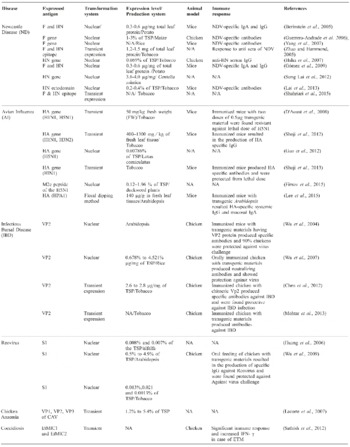
Plant-based oral vaccines have many advantages over traditional vaccines. They are cheaper because of their low cost of production and purification. They do not need to be maintained at cold temperatures because they are stable at room temperature. Their delivery via by the oral route is more comfortable for animals and poultry; multiple antigens can be delivered through bioencapsulated plant-based vaccines. They are free of toxins and pathogens associated with traditional vaccines and can be easily scaled up in green house or field area. Importantly, lyophilised plant material expressing vaccine antigen can be stored at room temperature for more than one year (Shahid and Daniell, Reference SHAHID and DANIELL2016; Su et al., Reference SU, ZHU, SHERMAN, WANG, LIN, KAMESH, NORIKANE, STREATFIELD, HERZOG and DANIELL2015; Kwon and Daniell, Reference KWON and DANIELL2015) and can induce higher immune response than traditional vaccines. Plant-based vaccines are more beneficial in animals as they can be given in the form of feed by expressing vaccine antigen in fruit plants like maize, rice, soybean and potato after oral priming with adjuvant. A number of bacterial and viral antigens have been expressed in different plants against various diseases of animals and poultry ( Table 1 ). Moreover, the main advantage of plant-based vaccines is that they can induce a mucosal immune response, which is the first barrier against invading pathogens (Shahriari et al., Reference SHAHRIARI, BAGHERI, BASSAMI, MALEKZADEH SHAFAROUDI and AFSHARIFAR2015).
Plant-based vaccines against poultry diseases.

Protective immune responses induced by oral delivery of plant-based vaccines
The mucosal surface of host is a primary barrier against encountering pathogens as it produces antibodies, which bind with virus specific-antigens. Therefore, the mucosal immune response is very important to prevent various infections. Among many advantages of plant-based antigens, one of the significant aspects is the production of systemic and mucosal immunity. Orally delivered plant-based antigens produce both mucosal and systemic immune response and protected against acidic environment of host gastrointestinal tract. Moreover, plant-based antigens have ability to pass through epithelial barrier and therefore provoke gut immune response. For example, antigens expressed in angiosperms, such as rice and maize, offer better protection against specified pathogen than purified product, and could be further enhanced by expressing the antigen in storage organelles like vacuoles, protein storage bodies and oil bodies. For poultry, the best vaccine production systems are in fodder or cereal crops, as these are part of diet, are easy to administer, and have minimal chances of rejection ( Figure 1 ) (Aswathi et al., Reference ASWATHI, BHANJA, YADAV, REKHA, JOHN, GOPINATH, SADANANDAN, SHINDE and JACOB2014). Animals immunised with transgenic seeds, fruit or plants produce mucosal and serum specific antibodies (Sack et al., Reference SACK, HOFBAUER, FISCHER and STOGER2015) and the immune response to weak antigens can be increased by fusion with mucosal carriers like cholera toxin B (CTB) and latent tuberculosis (LTB). The bacterial proteins from CTB and LTB have the ability to form pentamers, and intestinal epithelial cells have specific GM1 receptors for these pentamers which enhance the immune response of fused antigens (Topp et al., Reference TOPP, IRWIN, MCALLISTER, LESSARD, JOENSUU, KOLOTILIN, CONRAD, STÖGER, MOR and WARZECHA2016; Chan and Daniell, Reference CHAN and DANIELL2015; Xiao et al., Reference XIAO, KWON, HOFFMAN, KAMESH, JONES, HERZOG and DANIELL2016). Immunised animals with transgenic materials in the form of fruits and plants activate the GALT (gut associated lymphoid tissue) to produce specific immune response. M cells in the Peyer's patches uptake the antigen from lumen and activate B-lymphocytes with the help of Th cells. B-lymphocytes ultimately induce specific IgA antibodies, cytokines, such as interleukin 4 (IL4), interleukin 10 (IL10) and transforming growth factor-β (TGF-β). DCs also contribute to induce systemic immune response. CTB or LTB directly bind to GM-1 ganglioside receptors, after, but independently of, surviving the harsh environments of the stomach (Lamichhane et al., Reference LAMICHHANE, AZEGAMI and KIYONO2014; Chan and Daniell, Reference CHAN and DANIELL2015; Verma et al., Reference VERMA, MOGHIMI, LODUCA, SINGH, HOFFMAN, HERZOG and DANIELL2010).
A sketch for process of plant-based vaccines production against poultry diseases.
Figure1 legends: Foreign immunogenic gene are isolated from infected chicken and introduced into plants through plant expression vector. Immunogenic gene can introduce into plant by different system of edible vaccines production i.e. nuclear transformation, chloroplast transformation, cell suspension based and transient expression. Oral feeding of transgenic plants resulted in the production of specific immune response against infectious diseases of poultry.

Commercial considerations
The advancement in the field of plant-based vaccines has resulted in the development of transient expression-based commercial setup under good manufacturing practice (cGMP). The Caliber Biotherapeutics facility was set up under a project named Defense Advanced Research Projects Agency (DARPA). This system produced sufficient amount of plant-based vaccines against H1N1 influenza virus in less than 18 months with the ability to process almost 3500 kg of plant material within a week. This system has the capacity to produce 100 million doses from transgenic plants that are grown in hydroponic system with constant supply of LED light. These transiently expressed plants undergo processing such as infiltration, post infiltration and harvesting of transiently expressed recombinant protein. The infiltration area has the capacity to hold 7000 litres of infiltrate. After harvesting these plants, they undergo downstream processing for final purification. This commercial setup offers good advancement of plant-based vaccines (Holtz et al., Reference HOLTZ, BERQUIST, BENNETT, KOMMINENI, MUNIGUNTI, WHITE, WILKERSON, WONG, LY and MARCEL2015) for use in developing countries. However, successful commercialisation of plant-based veterinary vaccines needs collaboration with poultry producers for proper instigation and financing.
Conclusions
Many efforts have been made to express foreign antigens in plants against different diseases, including those found in poultry. The USDA has now approved the first plant-based vaccine against NDV and Gusher's disease in the form of a glucocerebrosidase enzyme. Research has shown that plant-based oral vaccines own all the necessary qualities of vaccines, such as room temperature stability and long-term storage. Promising results with plant-based vaccines against various infectious diseases of poultry show that they offer a good alternative to live and killed vaccines. However, adjuvant based oral priming remains a challenge in this field and need to be addressed.
Acknowledgments
The authors acknowledge the Higher Education Commission, Pakistan for financial support for the PhD student (No. 112-26729-2Bm1-396) to conduct this study.