Introduction
Executive functions are often a key focus in contemporary neurocognitive models of schizophrenia, due to both the early recognition of executive functioning deficits in patients with the illness (Kraepelin, 1913/Reference Kraepelin1971) and their clear relevance to independent and social functioning (Green, Reference Green1996; Palmer & Savla, Reference Palmer and Savla2007; Velligan & Bow-Thomas, Reference Velligan and Bow-Thomas1999). Executive functions, historically referred to as “higher mental functions,” are considered to be “uniquely human” (Luria, Reference Luria1966), and have been extensively studied in schizophrenia. Early documentations of the striking “concreteness” of people with schizophrenia (see Zec, Reference Zec1995, for review) were followed by numerous empirical studies exploring tasks measuring abstract thinking and logical reasoning among people with the illness (e.g., Cameron, Reference Cameron1939; Goldstein, Reference Goldstein1959). However, a second sense of the construct of executive functions is that of executive control, defined as “the ability to flexibly and dynamically adjust one’s performance to changing environmental demands and internal goal states” (Barch, Braver, Carter, Poldrack, & Robbins, Reference Barch, Braver, Carter, Poldrack and Robbins2009).
Some studies indicate that executive functions may be more impaired than other cognitive functions in schizophrenia (e.g., Kremen, Seidman, Faraone, & Tsuang, Reference Kremen, Seidman, Faraone and Tsuang2001), but others suggest that impairment in executive functions may be less than that associated with attention and verbal learning (Atbasoglu, Ozguven, Saka, & Olmez, Reference Atbasoglu, Ozguven, Saka and Olmez2005). This inconsistency may partially reflect the substantial heterogeneity among schizophrenia patients (cf., Braff et al., Reference Braff, Heaton, Kuck, Cullum, Moranville, Grant and Zisook1991), but key conceptual and methodological issues also make consensus difficult. Specifically, the construct executive functions comprises several skills, which are each measured by multiple neuropsychological tests; neither the set of skills nor the ways in which they are measured has been consistent across studies. Whereas some executive skills such as abstraction (vs. concreteness) have no immediate connotation of self-regulation, those such as executive control emphasize the cybernetic (i.e., pilot or governor) aspects of executive function, and their interaction with more basic (nonexecutive) processes (Royall et al., Reference Royall, Lauterback, Cummings, Reeve, Rummans, Kaufer and Coffey2002). Furthermore, the skills that typically make up the executive functions domain are hierarchical in nature, building upon more basic cognitive skills in other domains, such as attention or processing speed, which may themselves be impaired among people with schizophrenia (cf., Dickinson, Ramsey, & Gold, Reference Dickinson, Ramsey and Gold2007). Because each specific executive function and other (nonexecutive) cognitive ability likely reflects at least partially distinct brain systems or circuits (Lichter & Cummings, Reference Lichter and Cummings2001), it is important to disentangle the effects of schizophrenia on various types of executive functions, as well as to distinguish deficits in these functions from the more basic cognitive processes upon which they draw. The lack of consensus in the definition of the construct, compounded by the lack of psychometric equivalence of commonly used tests makes it difficult to draw firm conclusions about the degree of differential deficits and interrelationships among specific executive functions, as well as those between executive and other cognitive abilities (Chapman & Chapman, Reference Chapman and Chapman1973).
A partial solution to the above confounds is provided by the Delis-Kaplan Executive Function System (D-KEFS; Delis, Kaplan, & Kramer, Reference Delis, Kaplan and Kramer2001). The D-KEFS is a battery of nine psychometrically comparable tests (and several subtests) designed to measure multiple types of executive functions. The tests were co-normed on a large national standardization sample, which allows for a head-to-head comparison of the tests. In addition to the achievement scores, which indicate overall performance on each of the D-KEFS tasks, a subset (specifically, those measuring executive control) also include contrast scores, which reflect the residual higher-order cognitive skills after adjusting for performance on lower-level or basic component skills. This allows for a more direct discernment of the extent to which impairment on a task intended as a measure of an executive function may reflect impairment on the more basic (non-executive) cognitive skill upon which the executive function also draws. For example, the achievement score of the Number-Letter Switching task of the D-KEFS Trail Making Test is the total time taken to complete the task. Successful completion of the task, however, requires both basic component skills such as visual scanning, processing speed, and motor speed as well as higher-order skills such as executive control or set-switching. The contrast scores of this task would reflect the residual of the achievement score after controlling for each of these basic component skills.
To our knowledge, there have been no prior published studies employing the full D-KEFS, or any other co-normed battery of executive tests to examine a range of specific executive functions in schizophrenia with the goal of determining differential deficits (if any) among these functions. Thus, in the present study we evaluated the types and levels of executive functioning impairments among persons with schizophrenia or schizoaffective disorder (SC) relative to normal comparison (NC) participants, individually matched on demographic variables and crystallized verbal abilities. Our most general hypothesis was that, relative to NCs, the SCs would have worse mean performance on the selected total achievement scores on D-KEFS. We also examined whether the SC-NC differences on the executive function scores differed among the types of executive function scores, that is, whether there was a differential degree of schizophrenia-related impairment among the specific executive functions. Given the lack of prior studies comparing types of executive functions in schizophrenia, these were intended as exploratory analyses. In addition to the above, we also conducted a comparison of the NCs and SCs on the contrast scores of the five executive control tasks, so that we could test the hypothesis that schizophrenia-related deficits in executive control are non-specific, that is, deficits in higher-order skills can be fully accounted for by the degree of deficit in the underlying basic skills. Finally, given the expected heterogeneity among people with schizophrenia, we also conducted post hoc correlational analyses to explore the relationships between clinical variables and the executive functioning tasks among our schizophrenia sample.
Method
Participants
Participants included 145 community-dwelling individuals with schizophrenia or schizoaffective disorder and 145 normal comparison participants with no neurological or psychiatric diagnosis. Data for the schizophrenia sample were partly obtained from two ongoing studies at the University of California, San Diego (UCSD; n = 124), both led by one of the co-authors (E.W.T.), and partly collected prospectively (n = 21). Patient participants were diagnosed by their treating psychiatrists clinically or with a structured clinical interview. Specifically, diagnoses for the 21 patients whose data were collected prospectively for this study were established with the MINI-International Neuropsychiatric Interview (or MINI; Sheehan, Lecrubier, & Sheehan, Reference Sheehan, Lecrubier and Sheehan1998). Diagnoses for the other 124 patient subjects were established by their treating clinicians, and then confirmed via chart reviews by formally trained research associates and postdoctoral fellows. Inclusion criteria were (a) Diagnostic and Statistical Manual of Mental Disorders, 4th Edition (DSM-IV) diagnosis of schizophrenia or schizoaffective disorder; (b) age 18 or older at the time of enrollment; and (c) the ability to give written, informed consent to participate in the studies. Exclusion criteria were (a) a concurrent DSM-IV diagnosis of dementia, delirium, or mental retardation; (b) history of head injury with loss of consciousness > 30 min; and (c) substance abuse or dependence per DSM-IV criteria within 1 month of enrollment.
Since the parent studies included patients with either schizophrenia or schizoaffective disorder, and prior research indicates these two groups to be neurocognitively equivalent (reviewed in Palmer & Savla, Reference Palmer and Savla2009), we included individuals with either diagnosis in the patient group. T tests and chi-square tests confirmed that there were no demographic (age, education, ethnicity, and gender) or clinical (American National Adult Reading Test [ANART] estimated Verbal IQ, Positive and Negative Syndrome Scale [PANSS], or Hamilton Depression Rating Scale [HAM-D] scores) differences between the schizophrenia and schizoaffective disorder subsamples. The Wilks’ λ omnibus test statistic indicated no significant differences between the two groups, F(10, 134) = 1.767, p = .072, across the 10 D-KEFS executive functioning variables.
Data for the normal comparison sample (n = 145) were obtained from the D-KEFS national standardization sample (total N ≥ 18 years of age = 916), selected based on propensity score matching to maximize demographic similarity to the SC group. (The method by which we calculated propensity scores and used them to match the samples is described in detail in the data analyses section.)
The parent studies as well as the current study were approved by the UCSD Human Research Protections Program and all participants gave written consent for use of their data.
Each participant’s age, highest level of education, gender, ethnicity, and living situation were recorded. For the patient sample, age of onset of illness, duration of illness, and medication information (current medication type, i.e., conventional, atypical, or both) were recorded.
Assessments
Psychopathology
Severity of positive symptoms (e.g., hallucinations, delusions) and negative symptoms (e.g., blunted affect, alogia, apathy) were assessed using the PANSS (Kay, Opler, & Fiszbein, Reference Kay, Opler and Fiszbein1987). Severity of depressive symptoms was measured with the 17-item HAM-D (Hamilton, Reference Hamilton1967).
Crystallized verbal functioning
As a measure of crystallized verbal knowledge, reading scores are widely used to estimate premorbid Verbal IQ (e.g., Baade & Schoenberg, Reference Baade and Schoenberg2004); thus, using a previously validated and published formula (Grober & Sliwinski, Reference Grober and Sliwinski1991), we estimated each patient’s premorbid Verbal IQ based on his or her ANART performance. We did not have ANART data for the NCs; however, we used their Verbal IQ estimates from the Wechsler Abbreviated Scale of Intelligence (computed from WASI verbal subtests, i.e., Vocabulary and Similarities; Wechsler, Reference Wechsler1999) as a comparable verbal ability measure.
Executive functioning
The D-KEFS (Delis et al., Reference Delis, Kaplan and Kramer2001) was designed to incorporate principles of the process approach to neuropsychological assessment whereby basic processes required for successful performance of the higher order tasks can be assessed separately and then built upon over successive conditions. For example, to ensure that any observed deficits on a mental flexibility task such as the Number-Letter Switching condition of the Trail Making Test (analogous to the widely used Trail Making Test, Part B; Reitan & Wolfson, Reference Reitan and Wolfson1993) are not attributable to more basic skills, those basic skills (e.g., visual scanning, number sequencing, letter sequencing, and motor speed) are also assessed separately.
Participants in the present study completed the full D-KEFS, but our analyses were focused on 10 higher-order conditions across the nine tests. In particular, we used the following tasks:
1. Trial Making (Switching, total correct): Described above.
2. Verbal Fluency (Category Switching, total correct): Participants are asked to rapidly name words from two categories, alternating between the two categories with each successive response.
3. Design Fluency (Switching, total correct): Participants are given 60 s to connect pre-printed filled or unfilled dots with a set number of lines to generate as many different designs as they can think of. In the switching condition, they must alternate the connections between filled and unfilled dots.
4. Color-Word Interference (Inhibition and Inhibition/Switching, total correct): The former is analogous to the Color-Word Interference trial of the Stroop task (Golden & Freshwater, Reference Golden and Freshwater2002). In the latter, some of the color words are printed inside small boxes, others are not. Participants are required to read the word for boxed words, and to name the color of ink for unboxed words.
5. Sorting (Free Sorting, confirmed correct). Participants are given six cards that vary across several dimensions (such as shape, number of sides, color, content, and so forth), which they must sort into different piles multiple times, using as many different sorting strategies as they can think of.
6. Twenty Questions (total achievement score): Participants are shown a large card with a variety of objects on it, and they must use a series of yes or no questions to determine the target object in as few questions as possible.
7. Word Context (total consecutively correct): Participants are shown a sequence of five sentences with one non-word (but with a pronounceable, plausible combination of consonants and vowels) embedded within each sentence. The participant must use the context of the word within each sentence to determine the word’s meaning.
8. Tower (total achievement score): Analogous to the widely used Tower of London/Hanoi tasks (Sullivan, Riccio, & Castillo, Reference Sullivan, Riccio and Castillo2009).
9. Proverb (Free Inquiry, total achievement score): Analogous to the proverb questions on the Comprehension subtest of the Wechsler intelligence scales (c.f., Wechsler, Reference Wechsler2008).
For each of these tasks, we examined achievement scores reflecting overall performance. We further examined Trails Switching, Category Switching, Design Fluency Switching, Color-Word Inhibition, and Color-Word Inhibition/Switching (all tasks measuring executive control) in terms of their underlying processes, that is, basic component skills such as processing speed, visual scanning, and motor speed) and contrast scores (residual scores after adjusting for “basic” component skills). Basic component skills included Number Sequencing, Category Fluency, Combined Filled and Empty Dots, Color Naming, and Color-Word Inhibition, respectively, for each of the five executive control tasks, and contrast scores were calculated by subtracting achievement scores from scores on the basic component skills for each task. Age-corrected scaled scores for the achievement scores, basic component task scores, and contrast scores based on the D-KEFS normative sample were used for analyses.
Analyses
Propensity score calculation and matching
We computed propensity scores (probability of being in the SC group; Rosenbaum & Rubin, Reference Rosenbaum and Rubin1983) based on variables deemed a priori likely to confound executive functioning performance: age, education, ethnicity, and estimated premorbid Verbal IQ. Propensity score matching is a technique that attempts to reduce bias in estimates of group effects due to unequal distribution of confounding variables; subjects with the same propensity score also have the same probability of belonging to either the SC or comparison group; matching pairs of subjects with similar propensity scores can therefore substantially reduce covariate imbalances across groups. We used logistic regression with SC group status as the dependent variable and the a priori chosen confounders as independent variables, along with all pairwise interactions of these to calculate these scores. The scores were then used to create 145 matched pairs of SC and NC subjects using a propensity score matching program (Painter, Reference Painter2010) that uses syntax and macros in PASW (Predictive Analytics SoftWare, version 18.0). We tested the resulting SC and NC samples for equivalence on the potential confounding variables after pair matching.
Analyses of target variables
The distributions of all variables were checked for normality; none of the variables required transformation to meet assumptions for parametric analyses. We examined the differences between the NC and SC participants on the 10 executive functioning tasks via a between-subjects (1 factor [diagnostic status], 2-level [NC vs. SC]) multivariate analysis of variance (MANOVA) to account for correlation among the variables. Following a significant omnibus test yielded by the MANOVA, we conducted post hoc analyses of variance (ANOVAs) between the NC and SC groups to determine group differences between the individual executive functioning tasks. We used .005 as the Bonferroni-adjusted level for significant differences. We used Cohen’s benchmarks (Cohen, Reference Cohen1988) to categorize the magnitude of the effect sizes (partial η2s; .01 = small, .06 = medium, and .14 = large).
Next, we compared the relative strength of differences between the NC and SC groups on the 10 executive functioning tasks. A difference score was computed on each of the 10 tasks, for each of the 145 NC-SC pairs. The resulting difference scores were bootstrapped using 10,000 resamples with replacement. Mean values and 95% confidence intervals were extracted from the resulting bootstrap distributions. These were Bonferroni-adjusted using alpha = .05/10 = .005 as the cutoff level of significance testing difference scores against zero. Finally, we computed all 45 pairwise comparisons of the 10 executive functioning tasks, computing means and 95% confidence intervals from the bootstrap distributions. These 95% confidence intervals were Bonferroni-adjusted using alpha = .05/45 = .001.
We conducted separate MANOVAs to examine differences between the NCs and SCs on basic component skills and contrast scores (higher-order/multilevel processes isolated from these basic processes). The MANOVAs were followed by post hoc univariate ANOVAs after significant omnibus tests.
Relationships with clinical variables
For the SC sample only, we conducted bivariate correlational analyses to examine relationships, if any between clinical variables (positive and negative symptoms [PANSS], and depressive symptoms [HAM-D]) and the D-KEFS tasks (both total achievement scores and contrast scores).
Results
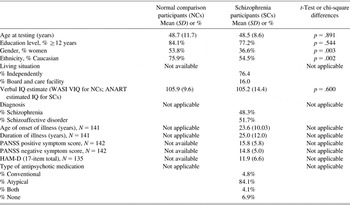
As shown in Table 1, the NC and SC paired samples did not differ on mean age, education, and estimated premorbid Verbal IQ. Relative to the SC group, the NC group had significantly more Caucasians (p = .002) and women (p = .003). As a group, the SC participants were clinically stable, with mild psychopathology.
Description of the samples

Note. Where not indicated, N = 145; ANART = American National Adult Reading Test; WASI = Wechsler Abbreviated Scale of Intelligence; PANSS = Positive and Negative Syndrome Scale; HAM-D = Hamilton Depression Rating Scale; VIQ = Verbal IQ.
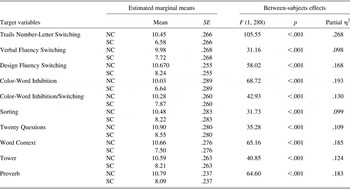
Using Wilks’ λ as the omnibus test statistic, the combined D-KEFS achievement scores resulted in a significant main (and large) effect of diagnostic group (NC vs. SC), F(10, 279) = 16.38, p < .001, partial η2 = .370. Follow-up univariate ANOVAs revealed significant differences between the NC and SC groups on all 10 D-KEFS achievement scores, with SCs consistently performing worse than NC subjects (Table 2). Effect sizes for the individual achievement scores ranged from medium (partial η2 = .098 and .099 for Verbal Fluency Switching and Sorting, respectively) to large (partial η2 = .268 and .193 for Trails Switching and Color-Word Inhibition, respectively).
Group differences on D-KEFS executive functioning tasks

Note. Cohen’s benchmarks for η2: .01 = small, .06 = medium, .14 = large. Variables indicate achievement scores; all are age-scaled scores. D-KEFS = Delis-Kaplan Executive Function System; NC = normal comparison participants; SC = schizophrenia participants.
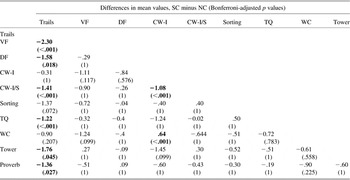
Results of the ranking and bootstrapping method to statistically examine the relative magnitude of differences between the NC and SC groups on the executive functioning tasks are presented in Table 3. The SC-NC difference for Trails Switching was significantly greater than differences for Verbal Fluency, Design Fluency, Color-Word Inhibition/ Switching, Twenty Questions, Tower, and Proverb tests. Color-Word Inhibition was differentially more impaired than Color-Word Inhibition/Switching and Word Context tests. The magnitudes of SC-NC differences among the other D-KEFS tasks were not statistically significant.
Mean Schizophrenia-Normal comparison pair differences on D-KEFS executive functioning tasks

Note. Bolded values denote significant differences between tasks. Trails = Trails Switching Total Time; VF = Verbal Fluency Category Switching Total Correct; DF = Design Fluency Switching Total Correct; CW-I = Color-Word Inhibition Total Correct; CW-I/S = Color-Word Inhibition/Switching Total Correct; Sorting = Sorting – Confirmed Correct Sorts; TQ = Twenty Questions – Total Achievement; WC = Word Context – Total Consecutively Correct; Tower = Tower – Total Achievement; Proverb = Proverb – Total Achievement.
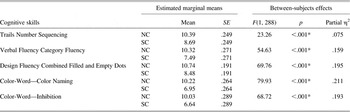
Separate follow-up MANOVAs for the basic component skills and contrast scores were conducted to evaluate the levels of impairment underlying the achievement scores on five D-KEFS executive functioning tasks. As shown in Table 4, using Wilks’ λ as the omnibus test statistic, the combined basic component skills resulted in a significant and large main effect for diagnostic group (SC vs. NC), F(5, 284) = 26.02, p < .001, partial η2 = .314, indicating a large effect size of diagnostic group on performance. Follow-up ANOVAs indicated that SCs did consistently worse than did the NCs on all basic component skills (all ps < .001), with large effect sizes, except for Trails Number Sequencing (medium effect size).
Group differences on basic component skills underlying D-KEFS executive control skills

Note. Age Scaled Scores were used in these analyses. Cohen’s benchmarks for partial η2: .01 = small but not trivial, .06 = medium, .14 = large. *Significant differences after Bonferroni correction for multiple comparisons. NC = normal comparison participants; SC = schizophrenia participants.
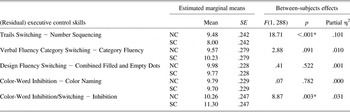
As shown in Table 5, using Wilks’ λ as the omnibus test statistic, the combined contrast scores resulted in a significant large main effect of diagnostic group on performance (SC vs. NC), F(5, 284) = 9.43, p < .001, partial η2 = .142. Follow-up univariate ANOVAs indicated SCs performed significantly worse than NCs on the Trails Switching contrast score (partial η2 = .101, p < .001), with diagnostic group having a large effect on switching performance. However, SCs performed marginally (but at statistically significant level) better than the NCs on Color-Word Inhibition/Switching contrast score (partial η2 = .031, p = .003). These differences continued to be significant after Bonferroni adjustments for multiple comparisons, that is, .05/5 = .01. There were no differences between the SCs and NCs on the other tasks.
Group differences on contrast scores, i.e., executive control skills adjusted for the basic component skills

Note. Age-corrected scaled scores were used in these analyses. Cohen’s benchmarks for η2: .01 = small, .06 = medium, .14 = large. *Significant differences after Bonferroni correction for multiple comparisons. NC = normal comparison participants; SC = schizophrenia participants.
Bivariate correlations revealed small effect size but statistically significant associations between severity of positive symptoms and the total achievement scores on the Trails Number-Letter Switching, Verbal Fluency, and Color-Word Inhibition tasks (r = −.230, −.261, and .188, respectively; all ps ≤ .026), between severity of negative symptoms and the Word-Context task achievement score (r = .171, p = .042), and between severity of depressive symptoms and the achievement scores on Trails Number-Letter Switching and Color-Word Inhibition tasks (r = −.234 and −.239, respectively, both ps = .005). There were no other statistically significant correlations between severity of symptoms and D-KEFS achievement scores, nor between severity of symptoms and any of the D-KEFS contrast scores.
Discussion
In this study, we examined executive impairment in schizophrenia in terms of three categories of scores: (1) the primary achievement scores on executive functioning tasks, (2) scores on basic component skills, and (3) contrast scores, that is, residual executive control skills isolated from basic component skills. Consistent with our a priori hypotheses, SC patients had worse functioning than did NCs on the achievement scores on all executive function tasks and all basic skills. They had significantly greater impairments on the Trail Making Switching task than on any other D-KEFS executive functioning task. The SC group continued to do poorly on Trails Switching even after accounting for processing speed (on which they were also significantly impaired). However, there were no group differences on the other executive control tasks (i.e., Category Fluency Switching, Design Fluency Switching, and on Color-Word Inhibition, after accounting for basic skills (which were all impaired among the SCs). The findings from the contrast scores suggest that the difficulties on switching/cognitive flexibility commonly observed among people with schizophrenia or schizoaffective disorder at least partially reflect impairment in more basic or component skills also measured by these tasks, such as processing or psychomotor speed (Dickinson et al., Reference Dickinson, Ramsey and Gold2007).
Contrary to our expectations, the SCs in fact did slightly better than did NCs on the isolated Color-Word Inhibition/Switching component, that is, once the score was adjusted for performance on the more basic Color Word Inhibition task. This finding is counter-intuitive as we can think of no model of the cognitive deficits associated with schizophrenia that would lead one to predict a difference in this direction. It may best serve as a reminder of the complex challenges involved in deconstructing higher-order cognitive processes, and the need for replication before drawing definitive conclusions about any particular cognitive deficit or strength among the entire population of individuals with schizophrenia.
Symptoms of psychopathology among the SCs, (particularly severity of positive and depressive symptoms) were significantly related with some achievement scores of some of the executive functioning tasks, but with not with any of the contrast scores. This suggests that psychopathology was likely related to the more basic component processes involved in those tasks, but not the switching processes. In contrast, there were no significant relationships among negative symptoms and any executive functions (with the exception of Word Context, wherein the relationship was small). Our sample, on average, had minimal psychopathology with little variance in scores, and the small magnitude of relationships (when present) was expected, but these findings may not fully generalize to SC patients in acutely psychotic states and/or to those in long-term institutional settings.
With regard to the more basic cognitive processes, it is hardly surprising to find that schizophrenia diagnosis had large effects on fluency deficits; both verbal and spatial fluency were significantly impaired among the SCs and this is consistent with previous findings (e.g., Moore et al., Reference Moore, Savla, Woods, Jeste and Palmer2006). It has been previously suggested that people with schizophrenia tend to show greater-than-normal speed when naming the ink color in the Color Naming task on the Stroop test (reviewed by Perlstein, Carter, Barch, & Baird, Reference Perlstein, Carter, Barch and Baird1998). This was not found to be the case with our current sample of SCs, whose performance on color naming was significantly impaired. Surprisingly, their performance on the response inhibition component of the Color-Word task was equivalent to that among the NCs, indicating that they seemed to have the most difficulty with processing speed, even on relatively simple tasks such as color naming. We did not, however, have data on whether SCs made more or equivalent numbers of errors on the Color-Word tasks—it would have been interesting to determine whether SCs made a speed/accuracy tradeoff on these tasks, in a qualitatively different way than did NCs.
Notably, the only executive control task that SCs did worse on than NCs, after accounting for processing speed, was Trails Switching. This task may be a particularly good measure of overall cerebral integrity in schizophrenia; it was designed to measure switching ability primarily, but also measures inhibition (by incorporating “capture stimuli” or close foils) and other processes measured by the standard Trail Making Test, Part B, including attention, motor and processing speed, sequencing, and working memory. Working memory is especially overloaded in this task, involving not only switching but also consecutively maintaining the sequence of numbers and letters and inhibiting automatic responses (i.e., avoiding capture stimuli). This finding is supported by the extensive literature on Trail Making Test Part B versus Part A, which suggests that patients consistently do worse on Trails B (Braff et al., Reference Braff, Heaton, Kuck, Cullum, Moranville, Grant and Zisook1991; Saykin et al., Reference Saykin, Gur, Gur, Mozley, Mozley, Resnick and Stafiniak1991).
The results of our study are particularly interesting because (a) people with schizophrenia, even those with relatively higher levels of educational achievement and premorbid verbal functioning, had difficulties with executive functioning, (b) an examination of underlying processes indicates that the primary difficulty may be with processing speed, although complex, multi-level skills which demand the simultaneous processing of a set of rules may also be difficult for people with schizophrenia, and (c) the Number-Letter Switching component of the Trail Making Test, of all executive control tasks, may be differentially impaired among people with schizophrenia.
To our knowledge, this is the first study to comprehensively characterize executive functioning abilities in schizophrenia using a large battery of co-normed measures including the standard multilevel tasks and measures of the basic abilities underlying each task. Executive functions have never been previously examined in this manner among people with schizophrenia, despite suggestions in the literature that they may be particularly important predictors of everyday functioning (Green, Kern, Braff, & Mintz, Reference Green, Kern, Braff and Mintz2000). Another strength of this study is that we were able to individually match the schizophrenia and normal comparison samples on age, education, ethnicity, and crystallized verbal knowledge, which allowed us to make more plausible conclusions about schizophrenia-related cognitive impairments.
There were some limitations in the present study. This study was largely based on secondary analyses of existing data, resulting in several constraints on the data; the SC and NC data were not collected in parallel, so the possibility of examiner or cohort effects cannot be completely ruled out. However, the D-KEFS was administered according to standardized procedures; also, use of data from the D-KEFS standardization sample permitted one-to-one matching of the SCs and NCs, resulting in a level of comparability not typically achieved in prospectively collected case control samples. Also, the measures estimating crystallized verbal knowledge differed in the SC and NC samples, the former being assessed with the ANART and the latter, with the WASI. There are no published data, to our knowledge, that directly compare the ANART and WASI scores in schizophrenia patients, but using the scores from these two measures permitted a gross matching of participants in terms of overall premorbid verbal functions as part of the propensity score calculations used in matching NC to SC patients.
Our SC sample comprised outpatients with chronic illness (with a mean duration of illness of 25 years), who were relatively stable on their medication, had low levels of psychopathology, and had higher-than-expected estimated crystallized verbal knowledge. It is possible that the present pattern of results may not readily generalize to individuals with markedly different demographic or clinical characteristics. On the other hand such characteristics have not generally shown strong associations with level or pattern of cognitive deficits among people with schizophrenia (reviewed in Palmer, Dawes, & Heaton, Reference Palmer, Dawes and Heaton2009).
Our SC sample also consisted of a large proportion of patients with schizoaffective disorder, which could be considered by some to be a separate comparison group with schizophrenia, given its mood component. However, a review of the literature [including a prior study from our group (Evans et al., Reference Evans, Heaton, Paulsen, McAdams, Heaton and Jeste1999)] suggests that the two subgroups are neurocognitively equivalent (Palmer & Savla, Reference Palmer and Savla2009). Thus, it appears unlikely that the present pattern of results is affected by the proportion of patients with schizoaffective disorder.
Although the D-KEFS has many strengths, it is also limited in the scope of executive functions and their underlying processes it is able to measure. The broader construct of executive functions embodies such socially-mediated processes as environmental monitoring, goal-setting, foresight and planning, and self-regulation based on internal and external states (Barkley, Reference Barkley2001). Also, some of the D-KEFS tests (i.e., those measuring abstraction, logical reasoning, or planning aspects of executive functions) did not allow for the deconstruction of component processes. Unlike the executive control tasks, wherein higher-order tasks naturally draw on lower-level cognitive processes, there is no such analogue to these tasks. An examination of the processes underlying impairments in these functions would be a useful complement to those evaluated in the present study.
The above limitations noted, however, the current findings nonetheless have some clear theoretical and pragmatic implications. Executive functions are universally acknowledged as vital to optimal daily functioning, yet have so far remained a nebulous and poorly defined construct. On a theoretical level, the identification of specific types of executive functioning skills contributes to overall efforts to identify meaningful neurocognitive subtypes, and to link cognitive deficits to the underlying pathology in neurological systems or processes. The present findings suggest value in distinguishing between achievement scores and underlying process scores, especially in regard to executive functioning tasks. On a clinical or pragmatic level, this study sheds light on the importance of including a wide array of executive functioning measures in a comprehensive neuropsychological assessment in schizophrenia, and considering the relative strengths and weaknesses within the executive functioning domain to identify targets for rehabilitation/vocational planning for patients with schizophrenia.
Despite more than a century of research, little is known about schizophrenia’s effect on the brain, partly because of the heterogeneity among individuals with illness, and partly because of lack of adequate methodology to study its complex presentation. Future directions include studies to examine the relationships between the specific executive functions and domains of social cognition, as well as real life functioning among patients with schizophrenia, in areas such as medication adherence, decision making capacity, driving ability, academic/vocational functioning, and other instrumental activities of daily living to better determine the types of strategies needed to rehabilitate patients with the illness. This study also suggests the potential role of both structural and functional neuroimaging studies in shedding light on frontal-subcortical neural pathways that mediate executive (as well as other cognitive) functions, and differential deficits and brain abnormalities associated with schizophrenia.
Acknowledgements
Gauri N. Savla, Department of Psychiatry, University of California, San Diego; Elizabeth W. Twamley, Department of Psychiatry, University of California, San Diego, Center of Excellence for Stress and Mental Health, Psychiatry Service, VA San Diego Healthcare System; Wesley K. Thompson, Department of Psychiatry, University of California, San Diego, The Sam and Rose Stein Center for Research on Aging, University of California, San Diego School of Medicine; Dean C. Delis, Department of Psychiatry, University of California, San Diego; Dilip V. Jeste, Department of Psychiatry, University of California, San Diego, The Sam and Rose Stein Center for Research on Aging, University of California, San Diego School of Medicine; Barton W. Palmer, Department of Psychiatry, University of California, San Diego.
This study was conducted as part of Dr. Savla’s dissertation at the San Diego State University/University of California, San Diego Joint Doctoral Program in Clinical Psychology.
This work was supported by the National Institutes of Health/National Institute of Mental Health (grant numbers MH19934, MH064722, and MH080002) and a grant from the National Alliance for Research on Schizophrenia and Depression.