Introduction
Yams, Dioscorea sp., are dioecious monocotyledon vines cultivated for their starchy tuber. West Africa is the world's largest yam-producing region, yielding about 36 Mt per year. In West Africa, 95% of this production concerns the African species D. rotundata Poir. (Enantiophyllum section), also called Guinea yam. Benin is the fourth-ranking yam-producing country in West Africa, after Nigeria, Ghana and Côte d'Ivoire (Food and Agriculture Organization, 2006). In Benin, yams are mainly cultivated in the northern and central regions (Atacora, Borgou and Collines departments) by different ethnic groups, especially the Otamari (Atacora), Bariba (Borgou) and Nago (Collines).
In West Africa, Guinea yam is an important staple crop but also a ‘cultural crop’. Some cultivars are used for gifts, ritual exchanges and special ceremonies (Coursey and Coursey, Reference Coursey and Coursey1976). In traditional yam farming systems, cultivated yam is always vegetatively propagated and consequently each cultivar is considered as a clone. Farmers preserve many cultivars to use different ecological niches and to cope with the high soil diversity. For instance, in north-eastern Benin, farmers manage three to 30 different cultivars that are obtained by heritage, gift or purchase nearby (Baco et al., Reference Baco, Tostain, Mongbo, Daïnou and Agbangla2004). The best adapted cultivars are thus selected. For these reasons, we thus expected to find high genetic diversity in cultivated yam in the traditional agrosystems in Benin. It would be important to determine whether cultivars with different vernacular names are genetically identical, i.e. synonyms, and whether cultivars with the same name present different fingerprints.
In the African ‘yam belt’, farmers generally distinguish between early- and late-maturing cultivars (Dumont, Reference Dumont1977). Early tuberization is a feature of early-maturing cultivars, thus enabling two harvests per year. Tubers of the second harvest are used for the next planting season (four ‘seedlings’ on average by tuber). Late-maturing cultivars are very hardy and harvested only once during the dry season. Farmers use several methods to avoid mixing cultivars, e.g. growing distinct cultivars in separate rows (Borgou and Collines departments) or separate fields (Atacora). They store tubers in separate sheds or yam barns for the same reason. However, in Atacora region, early- or late-maturing cultivars are intercropped to take advantage of the soil heterogeneity. This practice could be the reason for tuber mixing and duplicate forms with different names.
In Benin, about 300 different cultivar names have been identified (Dansi et al., Reference Dansi, Mignouna, Zoundjihékpon, Sangaré, Asiedu and Quin1999). Using morphological descriptors, 90 morphotypes were described and classified into 26 cultivar groups, mainly from two diversity zones in the north-west and the south (Dansi et al., Reference Dansi, Mignouna, Zoundjihékpon, Sangaré, Asiedu and Quin1999). Only a few studies have been carried out on genetic relationships between yam cultivars—these involved isozyme markers (Dansi et al., Reference Dansi, Mignouna, Zoundjihékpon, Sangaré, Asiedu and Ahoussou2000a; Mignouna et al., Reference Mignouna, Dansi and Zok2002a; Mignouna and Dansi, Reference Mignouna and Dansi2003), restriction fragment length polymorphism (RFLP) markers (Terauchi et al., Reference Terauchi, Chikaleke, Thottappilly and Hahn1992), random amplified polymorphic DNA (RAPD) markers (Dansi et al., Reference Dansi, Mignouna, Zoundjihékpon, Sangaré, Ahoussou and Asiedu2000b) and amplified fragment length polymorphism (AFLP) markers (Mignouna et al., Reference Mignouna, Abang and Fagbemi2003; Tostain et al., Reference Tostain, Agbangla, Baco, Okry and Daïnou2003).
Microsatellites or simple sequence repeat (SSR) loci present many codominant alleles, and are therefore useful for genetic diversity studies or varietal identification (Grapin et al., Reference Grapin, Noyer, Carreel, Dambier, Baurens, Lanaud and Lagoda1998; Hokanson et al., Reference Hokanson, Szewc-McFadden, Lamboy and McFerson1998; Fregene et al., Reference Fregene, Suarez, Mkumbira, Kulembeka, Ndedya, Kulaya, Mitchel, Gullberg, Rosling, Dixon, Dean and Kresovich2003). A study of 45 yam cultivars from eight West African countries using nine SSR loci showed that all the cultivars could be distinguished with three SSR loci (Mignouna et al., Reference Mignouna, Abang and Fagbemi2003). These authors found that the SSR-based classification differed from that based on morphotypes. No geographical structure was observed. To our knowledge, the power of SSR markers has not been used for a detailed analysis of Guinea yam cultivar diversity in a single country. In this study, we focused on cultivar diversity in Benin. The aim was: (i) to describe the diversity of a large collection of Guinea yam cultivars; (ii) to analyse how this diversity is structured and determine the main organizing factors of this diversity; and (iii) to assess the power of SSRs for fingerprinting Guinea yam cultivars.
Material and methods
Plant material
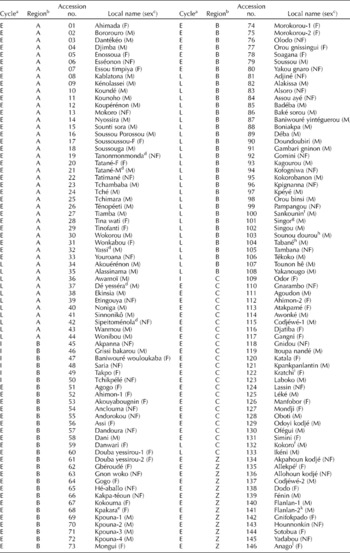
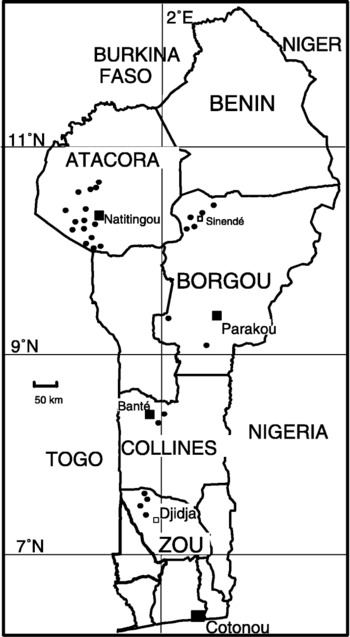
Four yam cultivation regions of Benin (Atacora, Borgou, Collines and Zou) were sampled from 2000 to 2003. These regions are the most productive and contain the greatest number of cultivars (Dansi et al., Reference Dansi, Mignouna, Zoundjihékpon, Sangaré, Asiedu and Quin1999). We sought to sample the maximum number of different cultivars from D. rotundata species (137; Table 1Fig. 1) designated by a local name. Each accession consisted of one tuber randomly collected from a set cultivated by a farmer, except for cultivars Ahimon (two accessions), Douba yessirou (two), Codjéwé (two), Flanlan (two), Tatané (two), Morokorou (two) and Kpouna (four). These cultivars have a broad geographical distribution and have been found in several regions (Tostain et al., Reference Tostain, Baco, Okry, Mongbo, Agbangla and Daïnou2002).
List of yam cultivars used in the study

a E, early; L, late; I, intermediate maturing cultivars.
b A, Atacora; B, Borgou; C, Collines; Z, Zou.
c F, female; M, male; NF, not flowering.
d–l The cultivars with the same SSR genotype are considered duplicate cultivars: dduplicate with EA07. eduplicate with EB53. fduplicate with LB91. gduplicate with LB84. hduplicate with LB93. iduplicate with EC117. jduplicate with EC126. kduplicate with EZ136. lduplicate with EB78.
Benin and locations from where accessions were collected (44 from Atacora, 64 from Borgou, 25 from Collines and 13 from Zou).

Cultivars were classified as early- or late-maturing according to farmers' knowledge and the field observations of Dansi et al. (Reference Dansi, Mignouna, Zoundjihékpon, Sangaré, Asiedu and Quin1999). A few cultivars (called ‘intermediate’) could not be classified as early or late cultivars because farmers used them in both ways. Exceptionally, early cultivars can be used by farmers as late ones (but not vice versa). Among the collection, 43 came from Atacora (32 early and 11 late), 59 from Borgou (25 early, 28 late and six intermediate), 24 from Collines (21 early, two late and one intermediate) and 11 from Zou (all early). Overall, there were 89 early, 41 late and seven intermediate cultivars.
The sex of 110 accessions was recorded in the field at flowering. The others cultivars did not flower (Table 1). In a field, all representatives of a cultivar had the same sex except for cv. Tatané (Tatané-M and Tatané-F).
DNA extraction and PCR
Leaves were collected in the field and desiccated on silica gel (Chase and Hills, Reference Chase and Hills1991) or collected fresh from a greenhouse. DNA was extracted as described by Scarcelli et al. (Reference Scarcelli, Tostain, Mariac, Agbangla, Daïnou, Berthaud and Pham2006a, Reference Scarcelli, Tostain, Vigouroux, Agbangla, Daïnou and Phamb) and PCR according to Tostain et al. (Reference Tostain, Scarcelli, Brottier, Marchand, Pham and Noyer2006). Reaction volume was 10 μl containing 12.5 ng DNA, 200 μM dNTP, 0.05 U/μl Taq polymerase, 1 × reaction buffer, 2.5 mM MgCl2, 0.01 μM forward primer tailed by either M13 (5′ CAC GAC GTT GTA AAA CGA C 3′) or T7 (5′ TAA TAC GAC TCA CTA TAG GG 3′), 0.15 μM reverse primer and 0.15 μM fluorescently labelled forward primer.
Ten nuclear SSR loci were targeted as described by Tostain et al. (Reference Tostain, Scarcelli, Brottier, Marchand, Pham and Noyer2006). Six loci were duplexed (3 F04–2 C05, 2 D06–2 D08 and 1 A01–2 E07). The remaining four SSRs (1 C12, 2 B12, 1 F08 and 2 E09) were amplified separately.
Statistical analyses
Indices of fixation F is and F st (Weir and Cockerham, Reference Weir and Cockerham1984) and gene differentiation G st (Nei and Chesser, 1983) were calculated using the Genetix v. 4.04 software package (Belkhir et al., Reference Belkhir2004). Allelic richness was calculated using FSTAT v. 2.9.3 (Goudet, Reference Goudet2002) which was also used to test the F st significance. The XLSTAT v. 6 software package (Fahmy, Reference Fahmy2003) was used to carry out the principal component analysis (PCA) and to test differences in allele richness with the Friedman test. Powermarker v. 3 (Liu, Reference Liu2002) was used for the calculation of the ‘population differentiation test’, heterozygosity (H obs), polymorphism information content (PIC; Botstein et al., Reference Botstein, White, Skolnick and Davis1980), log shared allele distance D LS (Chakraborty and Jin, Reference Chakraborty, Jin, Pena, Chakraborty, Epplen and Frey1993), Nei's minimum genetic distance D, and to build an un-rooted radial phylogram by the neighbour-joining method (Saitou and Nei, Reference Saitou and Nei1987).
The correlation of genetic diversity with geographical distance and various biological traits was computed between the matrix of genetic distance between accessions, and (i) the geographical distance matrix calculated from the longitude and latitude of collecting locations; (ii) the matrix constructed by comparison of the cultivation cycle length between cultivars (the value was ‘0’ when compared cultivars were both early or late maturing, and ‘1’ when they differed in cycle length); and (iii) the matrix constructed from the sex comparisons (‘0’ when two cultivars had the same sex and ‘1’ when they did not). The statistical significance of these correlations was assessed using a Mantel test (Mantel, Reference Mantel1967).
Results
Genetic diversity
In all, 84 alleles were observed at the 10 loci over the 146 accessions including 64 of Borgou, the vastest area of Benin and whose production is most important.
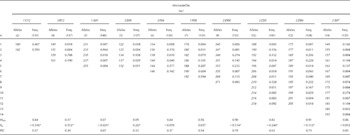
As cultivars Alakissa, Ikéni and Ofégui showed some unique alleles for a few markers and the PCA separated these three cultivars from the remainder, these cultivars were considered as not belonging to the D. rotundata species (see Discussion) and were therefore excluded from the subsequent analyses. Hence, a total of 75 alleles were observed among the 143 accessions (Table 2) with the number of alleles per locus ranging from two at 1 C12 locus to 14 for 2 E07. The mean heterozygosity (H obs) was 0.56. The heterozygosities per locus (Table 2) ranged from 0.07 (1 A01 with five alleles) to 0.91 (2 D06 with 12 alleles). Four loci had a high PIC value: 2 E07 (14 alleles), 2 D06 (12 alleles), 2 D08 (eight alleles) and 2 C05 (12 alleles).
Mean frequencies (Freq.) of alleles, heterozygosity, fixation index and PIC of different SSR loci calculated for accessions from Benin (numbers in parentheses refer to the number of alleles and available data)

H obs, observed heterozygosity; F is, fixation index (*different to zero P < 0.05 after 1000 bootstraps on the loci).
The mean fixation index for the 10 SSRs was not significantly different from zero (P < 0.05 after 1000 bootstraps). F is was negative for five loci, indicating an excess of heterozygotic genotypes (Table 2) and positive only for locus 3 B12. The presence of null alleles at this locus almost certainly underestimated the number of observed heterozygotic genotypes.
Relationship between cultivar names and genotypes
Cultivar name was a good indicator of genetic distinctiveness. Ninety genotypes were encountered for 103 cultivar names. However, there were also accessions with different names which were genetically identical at all SSR loci: there were 24 duplicates among the 103 accessions for which there was complete data (Table 1). For subsequent analyses, we considered those accessions with similar bands genetically identical and thus chose one accession to represent the genotype. On the other hand, pairs of homonyms (Codjéwé-1 and Codjéwé-2; Douba yessirou-1 and Douba yessirou-2; Flanlan-1 and Flanlan-2) were genetically heterogeneous, but other such pairs were not [such as Morokorou-1 and Morokorou-2 (one-allele difference) and Ahimon-1 and Ahimon-2 (three-allele differences)]. The Kpouna accessions were also closely related to one another, forming a group along with accessions having different names, such as Laboko and Hounonkin.
Genetic differentiation
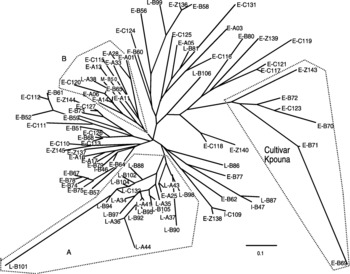
The radial phylogram constructed from the 90 genetically distinct accessions without missing data provides an overview of the diversity structure (Fig. 2). One branch contains the late-maturing cultivars (group A), mainly from the north (Borgou and Atacora), but including cultivar Kokoro (Collines). The other branches contain the early cultivars. There is evidence for some geographical differentiation. Group B mainly consists of accessions from the Atacora region. Most of the accessions from Borgou cluster in group A.
Unrooted dendrogram of 90 accessions of Dioscorea rotundata from Benin based on the neighbour-joining method according to the D LS distances (E, early maturing accessions; L, late accessions). Group A: most of the accessions are late cultivars; group B: most of the accessions are early cultivars from Atacora.

These trends were studied through more detailed analyses.
SSR diversity and geographical origin of cultivars
Correlation between the D LS genetic distance matrix and the geographical distance matrix was low but significantly different from zero (r = 0.10; P < 0.01). As this may reflect the effect of an unbalanced distribution of early and late cultivars across regions, the study was limited to cultivars from Atacora and Borgou, two regions with a relatively similar proportion of early and late cultivars. The correlation was similar (r = 0.11; P < 0.01), thus confirming the relation between geographical and genetic distances. The same analysis on early cultivars only confirmed this genetic differentiation between regions (r = 0.092; P < 0.01).
Significant multilocus gene differentiation was present among the four regions (F st = 0.042, P < 0.05). The pairwise F st values between regions were all significant, except between Zou and Collines. Atacora cultivars were the most genetically distant from Zou (D = 0.074 and F st = 0.11, P < 0.05) and Collines cultivars (D = 0.033 and F st = 0.049, P < 0.05).
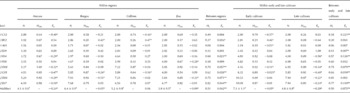
Cultivars from Borgou were slightly closer to the Collines cultivars than those from Atacora and Zou. The average number of alleles (allelic richness) observed at the 10 loci (Table 3) significantly differed between regions (Friedman χ2 = 32.5, df = 9, P < 0.05). They ranged from 3.9 in Zou to 6.4 in Borgou. The multilocus fixation index F is showed an excess of heterozygotes in Atacora, Borgou and Zou region cultivars (Table 3).
H obs (heterozygosities), H s (intra-group diversity), fixation index within subgroups (F is), gene differentiation among subgroups (F st) and allelic richness per group, locus by locus, of accessions classified in four Benin regions and classified as early or late cultivars

N, number of alleles.
* P < 0.05; **P < 0.01.
a Allelic richness.
Differentiation of early- and late-maturing cultivars
Correlations between the genetic distance and maturity type were assessed from a sample of 89 early, 41 late and seven intermediate cultivars, and proved to be significantly different from zero (r = 0.09, P < 0.01). This is interpreted as evidence that the late- and early-maturing cultivars are genetically differentiated. Both the population differentiation test (Fisher test: χ2 = 105, df = 20; P < 0.01) and the multilocus F st significance (Table 3; F st = 0.075, P < 0.01) confirmed this result. At five loci there was a significant F st between early and late cultivar groups, with the intermediate types shown as being genetically closer to early than to late cultivars. Allelic richness was higher in early than in late cultivars (Table 3). The multilocus fixation index F is showed an excess of heterozygotes in early and late cultivars (Table 3).
Differentiation between male and female cultivars
The sex ratio among the 110 accessions for which the sex was known was balanced in early accessions (40 males, 39 females), but all the late-maturing accessions were male. Consequently, the sex ratios differed within Atacora accessions (20 males versus eight females) and within Borgou accessions (six males versus 16 females).
Genetic distances between accessions and sex data were significantly correlated (r = 0.037, P < 0.01). There was a genetic differentiation between male and female accessions especially in Borgou (r = 0.516, P < 0.01) and Collines (r = 0.145, P < 0.05) accessions.
Among the male accessions, the PIC for the early accessions was significantly higher than for the late accessions (0.59 versus 0.43). This indicates that the genetic differentiation between early and late cultivars was not due to sex. We detected only one different allele out of 20 alleles between male and female plants of the only cultivar displaying both sexes, i.e. cv. Tatané from Atacora.
Discussion
The present results provide a baseline for studying the origin and dynamics of sequence polymorphism in this asexually propagated crop. Significant heterozygosity was present in D. rotundata, at a comparable level with that in wild Japanese yam D. tokoro (Terauchi and Konuma, Reference Terauchi and Konuma1994). Three microsatellite markers, 2 D06, 2 D08 and 2 E07, which have shown a large diversity among studied cultivars (Tables 2 and 3) are particularly useful for the study of genetic diversity of yams.
The genetic diversity
The excess of heterozygotes may be the result of farmer selection during the domestication process, but an accumulation of somatic mutations can also contribute to the number of heterozygous genotypes (Birky, Reference Birky1996). An excess of heterozygous genotypes is found for many loci in the plants from Atacora (Table 2). In this area yams have to survive very harsh conditions, with very poor soils, floods and long periods of drought. The strong selection carried out by farmers could favour these heterozygous genotypes.
While farmers were able to clearly differentiate between D. alata, D. bulbifera and D. dumetorum, they appear not to have drawn a distinction between groups of Guinea yam cultivars. The three cultivars Alakissa, Ikéni and Ofégui had unique SSR alleles. These may have a complex origin, with the possibility of having been domesticated from various wild species such as the perennials D. burkilliana or D. mangenotiana (Dansi et al., Reference Dansi, Mignouna, Zoundjihékpon, Sangaré, Asiedu and Quin1999; Mignouna and Dansi, Reference Mignouna and Dansi2003), or from interspecific hybrids between D. burkilliana or D. minutiflora and D. abyssinica or D. praehensilis (Terauchi et al., Reference Terauchi, Chikaleke, Thottappilly and Hahn1992).
Cultivars of a vegetatively propagated crop are assumed to be clonal. In the Borgou region, Baco et al. (Reference Baco, Tostain, Mongbo, Daïnou and Agbangla2004) reported up to 154 cultivar names in use by several ethnic groups. Through discussions with farmers 27% of these were synonymous. Similarly, in the present study, 23% of cultivars shared genotype at the 10 SSR loci but 77% had a unique profile. Overall, vernacular names corresponded well to genotypes. Cultivar history can generate the situation of identical genotypes having different names. For example, Anago in the Fon language means ‘cultivar originating from the Nago ethnic group (Collines)’. The SSR profiles of Anago and Soagona (Borgou), which are both cultivated in the Collines region, were identical, suggesting that they are in fact the same cultivar.
Major genetic differences were obtained within the cultivars Flanlan, Doubayessirou and Codjéwé. These may have arisen from errors in the morphological descriptions of the tubers (Dansi et al., Reference Dansi, Mignouna, Zoundjihékpon, Sangaré, Asiedu and Quin1999). Flanlan-1 could have been confused by farmers with cv. Gnidou, which is the most common cultivar in Zou and Collines. In the Atacora region, early- and late-maturing cultivars were cultivated in different fields but the cultivars were mixed within each field (unlike in the Borgou region, where fields are planted to a single cultivar) which can lead to confusion.
Farmers from Benin still domesticate volunteer yams (Dumont and Vernier, Reference Dumont and Vernier2000), which may be wild species, or be hybrids between cultivars, or between cultivars and wild yams (Scarcelli et al., Reference Scarcelli, Tostain, Mariac, Agbangla, Daïnou, Berthaud and Pham2006a, Reference Scarcelli, Tostain, Vigouroux, Agbangla, Daïnou and Phamb). Much of the major genetic difference within cultivar may derive from the incorporation of volunteer tubers within a morphologically similar cultivar.
The genetic structure
In the two northern regions, the SSR diversity was structured according to physiological characteristics, such as tuberization. Early-maturing (double harvest) and late-maturing (one harvest) cultivars can be distinguished by morphological traits such as the number of tubers per plant or tuber length (Dumont, Reference Dumont1977; Dansi et al., Reference Dansi, Mignouna, Zoundjihékpon, Sangaré, Asiedu and Quin1999). For a long time African farmers have preferred plants with a few large tubers (generally early cultivars) rather than those bearing many small tubers (late cultivars). This tendency can explain the number and diversity of early cultivars as well as the number and diversity of their archaic local names in Borgou (Dumont, Reference Dumont1977). The late cultivar group would thus have experienced a genetic bottleneck through a selection process from early cultivars, so that this group would end up with a narrower genetic base than the early cultivars. This is confirmed by the fact that all the late cultivars are of male sex (Dumont, Reference Dumont1977). The loci 2 D06 and 3 B12 show high F st between geographic groups but not between early and late cultivars. Conversely, the loci 2 E09 and 1 C12 show high F st between early- and late-maturing cultivars (Table 3). The locus 1 C12 could be linked to genes involved in the tuberization process.
In Benin, the genetic diversity is organized according to cropping regions. In contrast, Mignouna et al. (Reference Mignouna, Abang and Fagbemi2003) found no geographical structure in a collection of cultivars from eight West African countries. As geographical structure appears to be expressed only in small-scale analyses, many more samples need to be analysed in each area to be able to characterize the overall structure throughout West Africa.
Tubers are regularly exchanged between farmers within a region and between regions in Benin (Dansi et al., Reference Dansi, Mignouna, Zoundjihékpon, Sangaré, Asiedu and Quin1999). Despite this, few cultivars were present across several regions, as presumably only a small number of cultivars is able to adapt well to new cropping conditions. This explains the geographical organization of yam diversity observed. Extended SSR profiling can be applied to gain an insight into the relationships between cultivars from countries neighbouring Benin, and to characterize endemic yam germplasm. As the African floristic composition of the vegetation is structured in a Guinean and a Congolese domain (Maley and Brénac, Reference Maley and Brénac1998), it would be interesting to compare the genetic diversity of Beninese cultivars with that of cultivars from Ghana and Togo (representing the Guinean domain) and Nigeria and Cameroon (representing the Congolese domain).
Conclusions
Mignouna et al. (Reference Mignouna, Mank, Ellis, Van den Bosh, Asiedu, Ng and Peleman2002b) considered that SSR markers were less discriminating than AFLP markers, which are numerous and well distributed throughout the genome. However, it is clear that SSR-based genotyping was effective for revealing polymorphism, fingerprinting cultivars and assessing relationships among yam cultivars. The crop diversity structure detected, based on cropping regions and on the early-maturing trait associated with other morphological characters, results directly from the cultivation practices and specific farming techniques used. Our description of this structure should improve methods for sampling and conserving the genetic resources of cultivated yams from Benin.
Acknowledgements
This study was supported by the Bureau des Ressources Génétiques (France). C. Agbangla benefited from a scientific exchange scholarship from the French Institut de Recherche pour le Développement (IRD). We thank N. Baco for his assistance in the study of cultivars from Borgou, as well as Y. Vigouroux for his help in the genetic analyses.