Over the last 30 years, scholars have paid considerable attention to the under-representation of women in politics. Initially, the main area of concern was women's ‘descriptive’ under-representation: although women had won the right to vote and stand in elections, obstacles that undermined their numerical presence in parliament remained. As such, parliament did not mirror society and – according to some – lacked claims to representativeness (Phillips Reference Phillips1995; Williams Reference Williams1998; Young Reference Young2000). The focus then shifted to women's ‘substantive’ representation, or the representation of women's interests in decision-making. Once women entered elected assemblies in greater numbers, the question became whether ‘it was worth the effort’. Did the presence of female politicians make a difference? Did female MPs serve feminist causes and open up political agendas to women's issues?
Initial studies of women's substantive representation thus asked whether women's interests were furthered by the (numerical) presence of women in parliament. Building on studies testing the ‘politics of presence’ and ‘critical mass’ arguments (Celis Reference Celis2008; Childs and Krook Reference Childs and Krook2008), numerous scholars found women/feminists and leftist parties to be the leading advocates of women's interests in parliament. Female MPs, due to their experiences and position in society, were more likely than their male colleagues to promote women's issues and to further the agenda of the women's movement. Scholars also found that leftist ideologies were more likely to embrace equality and group interests, encouraging parties on the left to recruit and select female candidates more often, maintain contacts with women's organizations and support women-friendly policies.
But the difference elected women, feminists and leftist parties make is not necessarily ‘a drastic one’ (Tremblay Reference Tremblay1998: 440) as it often depends on opportunities offered by the institutional environment and the activism of individual MPs. Several recent studies have also pointed to the lacunae in our knowledge of the contributions of ‘non-traditional’ actors such as men (Celis Reference Celis2006; Opello Reference Opello2008) and conservative parties (Childs and Webb Reference Childs and Webb2012; Evans Reference Evans2011; Wiliarty Reference Wiliarty2010). Although they are less likely to do so, these non-traditional actors also represent women's interests. What further complicates the issue is that findings may be influenced by research design: testing the politics of presence and critical mass theories using a specific feminist or leftist set of women's issues tends to bias findings in favour of women, feminists and left-wing MPs (Celis Reference Celis2008; Erzeel Reference Erzeel2012). In order to obtain a broader – and hence more realistic – view of women's substantive representation, an open and inductive methodological approach is required to see who acts for women, on which issues and interests, and why (Celis et al. Reference Celis, Childs, Kantola and Krook2008).
This article will not answer all these questions, nor does it aim to explain the numbers or ideological preferences of female MPs. Instead, it wants to find out whether an open and inductive approach indeed broadens our understanding of who represents women's interests: does an open and inductive approach to women's substantive representation bring ‘unexpected’ actors to the fore who previously remained absent in studies of women's substantive representation? For this we make use of new comparative data from the 2008–11 PartiRep survey on the attitudes and behaviour of MPs in 10 European countries.Footnote 1
In what follows, we first review the literature on women's substantive representation and substantiate our claim on research designs favouring women, feminists and left-wing parties. We then discuss our inductive research design, which focuses on MPs who behave as ‘critical actors’ in the substantive representation of women, regardless of their sex and without pre-defining the content or direction of representational acts. We then present our findings on the ideological affiliation, individual left–right positioning, sex and feminist activism of critical actors. They are indeed quite diverse, with a significant number of centre/right, male and non-feminist MPs fitting the critical actor criteria. Although these ‘unusual actors’ often form a minority, their mere presence calls for scholars to revisit the conception of women's substantive representation. The conclusion reflects on the theoretical consequences of our findings.
Beyond The Usual Suspects
Studies of women's substantive representation often find that female MPs make a difference for women. Women are generally more inclined than men to attach importance to women's issues (Childs Reference Childs2004; Reingold Reference Reingold2000) and they are also more likely than men to work in favour of feminist policy change and to represent the perspectives of the women's movement (Bratton Reference Bratton2002; Tremblay Reference Tremblay1998; Wangnerud Reference Wangnerud2000). Differences between men and women are largest in studies focusing on MPs’ behaviour during the early stages of the policymaking process, for example the signing of early day motions or participation in parliamentary debates (see Childs and Withey Reference Childs and Withey2004; Grey Reference Grey2006). In those circumstances, female representatives are able to act freely for and ‘as women’ without institutional constraints (Curtin Reference Curtin2008).
Yet other studies argue that it is not so much the presence of women, but rather the presence of feminists in parliament that matters for women's substantive representation. Feminists demonstrate a stronger willingness to represent women's interests and to invest scarce resources in order to change the policy status quo for women in a feminist way (Tremblay and Pelletier Reference Tremblay and Pelletier2000).
In addition, the importance of equality in leftist ideologies is expected to lead to the political inclusion of traditionally marginalized groups (Duverger Reference Duverger1955; Kittilson Reference Kittilson2006; Matland and Studlar Reference Matland and Studlar1996). Left-wing parties are traditionally close to progressive women's movements, a partnership based on the egalitarianism of left-wing ideology (Beckwith Reference Beckwith2000). In addition, those parties are considered ‘women-friendly’ because they are more inclined to select female candidates (Kittilson Reference Kittilson2006). Scholars have indeed found a strong macro-level correlation between left-oriented political systems and women's substantive representation (Lovenduski and Norris Reference Lovenduski and Norris1993). Particularly when left parties are in power, legislation of importance to women is produced and supported (Beckwith and Cowell-Meyers Reference Beckwith and Cowell-Meyers2007), demands of women's movements are translated into policy (Lovenduski Reference Lovenduski2005; McBride Stetson Reference McBride Stetson2001) and related policy agencies operate more effectively (McBride Stetson Reference McBride Stetson2001). Further, micro-level research shows that women in leftist parties have more progressive attitudes, resulting in the introduction of more bills for women (Swers Reference Swers2002; Wangnerud Reference Wangnerud2000).
In sum, the scholarship on gender and political representation has found that female, feminist and left-wing MPs are more likely to represent women. These studies, however, were designed to examine how the presence of women in elected office affects the furthering of a feminist or women's movement agenda. As such, their findings cannot simply be extrapolated to the broader process of women's substantive representation.
First, studies that focus on whether the representation of women's interests benefits from the presence of (a critical mass of) female MPs tend to overlook the activities of men on behalf of women (Celis et al. Reference Celis, Childs, Kantola and Krook2008; Erzeel Reference Erzeel2012). In addition, such studies foreground not only women but also the left since the number of women MPs has risen faster in leftist parties (Kittilson Reference Kittilson2006). Although many studies included male MPs and other political parties, the focus has primarily been on women and parties on the left (Childs Reference Childs2004).
Second, how these studies defined women's interests was not neutral. Scholars have interpreted ‘women's interests’ in numerous ways, focusing on the autonomy and wellbeing of women – areas that established views on gender relations consigned to the private sphere – and on issues of concern to broader society where surveys discovered gender gaps (Bratton Reference Bratton2002; Mateo Diaz Reference Mateo Diaz2005; Wangnerud Reference Wangnerud2000). This variety notwithstanding, it was the priorities of the progressive Second Wave feminist movement – such as abortion, equal pay and domestic violence – that were most often selected when examining whether female representatives acted for women (McBride and Mazur Reference McBride and Mazur2010; O'Regan Reference O'Regan2000; Reingold Reference Reingold2000; Swers Reference Swers2002). Given the ideological proximity of progressive women's movements to leftist parties (Beckwith Reference Beckwith2000) – and especially to women within these parties – research designs have tended to privilege left-wing female representatives.
Although the studies cited above present a fair view of the role of women, feminists and left-wing MPs in advancing the issues and interests of Second Wave feminism, they also limit our understanding of other actors championing other issues that fall under women's substantive representation. Research has shown that both men and women in left-wing and centre/right parties speak on behalf of women (Celis and Childs Reference Celis and Childs2012; Evans Reference Evans2011). Exposure to feminist attitudes and gender-related information, or receiving incentives from the party political context, seem to encourage both female and male MPs to support these issues (Erzeel Reference Erzeel2012; Tremblay and Pelletier Reference Tremblay and Pelletier2000).
Efforts to increase the number of female representatives have been made by most parties, including non-left ones (Childs and Webb 2012; Kittilson 2006; Matland and Studlar 1996), while many centre/right parties have also established women's sections (Lovenduski Reference Lovenduski2005; Wiliarty Reference Wiliarty2010). Electoral strategy (Childs and Webb Reference Childs and Webb2012), pressure from internal and external conservative women's movements (Wiliarty Reference Wiliarty2010) and strong left-wing support of women (Ruiz-Jiminez Reference Ruiz-Jiminez2003) all push centre/right parties to act for women. Although conservative women's organizations often reject the ‘feminist label’ (Schreiber Reference Schreiber2002), feminist attitudes can be discerned among some MPs in conservative parties (Dillard Reference Dillard2005; Swers Reference Swers2002). Other activities and claims of conservative women in favour of women are not ‘leftist feminist’ in intent but nonetheless ‘bring a women's perspective to policy issues’ (Schreiber Reference Schreiber2002: 331). Such ‘gendered claims’ stem from the gender ideology and consciousness of conservatives and link gender identity to political action (Schreiber Reference Schreiber2008).
These findings suggest that research on women's substantive representation needs to change its initial methodological design, if it wants to include men, right-wing parties and non-feminists as potential actors. Studying women's substantive representation through a ‘critical actor’ perspective is one way to do so, as we demonstrate in the next section.
Critical Actors in Comparative Perspective
As we believe that understanding the substantive representation of women requires that we study all acts and actors (Celis Reference Celis2008), we propose a broad definition that includes different types of feminist and gendered representation. We accept that substantive representation is ‘acting in the interest of the represented (women) in a manner responsive to them’ (Pitkin Reference Pitkin1972: 209). The degree of responsiveness to the diverse needs of women constitutes its essence, not its feminist direction or its preferred actors. This ‘open’ definition is operationalized in our study through the concept of the critical actor. Childs and Krook (2009: 138) define ‘critical actors’ as ‘legislators who initiate policy proposals on their own and/or embolden others to take steps to promote policies for women, regardless of the number of female representatives’. Critical actors are not by definition female, feminist or left-wing. What they have in common is not that they share particular life experiences or ideological ideals. Their common feature is their relatively low threshold for political action (Childs and Krook 2009). This means that they exhibit specific attitudes and behaviour: they are attitudinally strongly motivated to promote women's interests in parliament and are highly active in representing women's issues.
Critical actors are identified using new comparative survey data gathered by the PartiRep project among MPs in 10 European democracies: Belgium, Germany, Hungary, Ireland, the Netherlands, Norway, Poland, Portugal, Switzerland and the United Kingdom (UK). The PartiRep survey targeted members of national and federal parliaments in each of these countries as well as members of (a selection of) regional parliaments. In order to single out the group of critical actors, we combined responses from three survey questions. For the attitudinal component, respondents had to tick one of the last three boxes on a seven-point scale to indicate the importance they attached to representing the views and interests of women.Footnote 2 For the behavioural component, we assumed that critical actors are more actively involved in substantively representing women than other actors and intervene regularly on behalf of women. To meet this criterion, respondents had to indicate that they note situations that are disadvantageous to women in society during parliamentary party group (PPG) meetings at least every three months or that they make proposals during parliamentary party group meetings at least every three months to solve the problems women face in society.Footnote 3 We focus on the parliamentary party group because of its crucial role in parliament, where it constitutes the nexus of a party's work and is the place where individual MPs can influence the party platform. Both the attitudinal and behavioural question leave open the exact content of women's interests: the relevant policy issues and the ideological direction of these issues are not specified in advance by the researcher.
We created a dummy variable based on MPs’ answers regarding their attitudes and behaviour in parliamentary party groups. Representatives who met the criteria on both counts (that is, the critical actors) were coded 1. Representatives who did not meet these criteria, or met only one, were coded 0. Note that if respondents reported signalling situations that are ‘disadvantageous’ to women in society, we accepted this claim to be true. We did not apply criteria to distinguish between feminist, non-feminist and anti-feminist claims made on behalf of women.Footnote 4
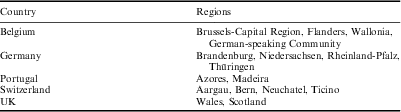
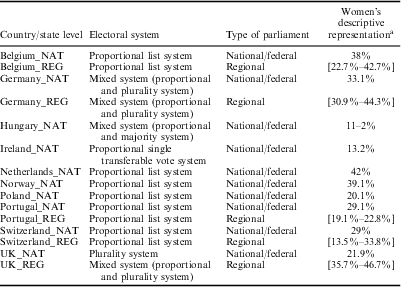
The comparative PartiRep project selected 10 European countries with a variety of political systems, allowing us to control for system-level variation and to test the generalizability of our claims. In particular, variation was sought in three areas that had previously been shown to influence women's substantive representation: the electoral system, type of parliament and level of women's descriptive representation. Proportional electoral systems are more likely to foster women's substantive representation because interest representation under proportional rules is more likely to surpass ‘geographical boundaries’ and to leave room for non-territorial constituencies (Sawer Reference Sawer1998; Tremblay Reference Tremblay2006). The type of parliament matters because regional parliaments are more likely to be women-friendly than national and federal parliaments; regional parliaments offer new opportunities for promoting alternative political cultures, for including new groups and for strengthening ties between parliaments and women's movements (Mackay Reference Mackay2006). Regional parliaments in the five multilevel democracies Belgium, Germany, Portugal, Switzerland and the UK were included. In Belgium and Portugal, all regions were involved. In the UK, Germany and Switzerland, the selection reflected a careful balance of central and peripheral regions, regions with weak and strong identities and regions controlled by the left and the right (see Appendix 1). Finally, descriptive representation matters because critical mass theory assumes that women's substantive representation is more likely when there are more women in parliament. Appendix 2 presents an overview of the variation between countries in these three areas.
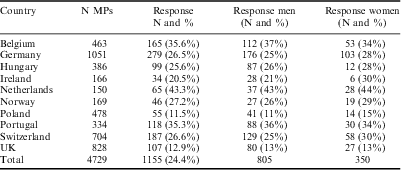
All members of selected parliaments were invited to fill in the questionnaire online or on paper between March 2009 and January 2011. They were recontacted at least twice. The general response rate was 24.4 per cent (see Appendix 3), which is comparable to that of other international research projects. Differences in response rates between men and women (after t-test) were not significant in any of the countries. A large majority of the parties in each parliament are represented in the data set. One shortcoming is the slight over-representation of leftist parties. We weighed the data by parliamentary party group to correct for differences in party response, calculated by dividing the number of expected seats based on population data by the number of seats in the sample.
Our analysis is based on the self-reported behaviour of MPs, meaning that results could be vulnerable to a social desirability bias. We tried to limit socially desirable answers to the maximum extent possible. For instance, respondents were given the opportunity to summarize their accomplishments in several areas of their work, some unrelated to women's issues. These questions gave MPs the chance to show that they were hard-working in other ways. There are no indications that social desirability bias differentially affected respondents by sex or party affiliation.
Critical Actors: Left, Female, Feminist?
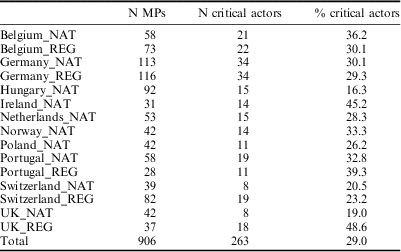
Overall, 263 out of 906 representatives in our study (or 29 per cent) were identified as ‘critical actors’ because they met the two criteria above. Table 1 shows the cross-country differences in the number of critical actors, although these are not striking. In the UK (regional level), Portugal (regional level), Belgium (national level) and Norway, critical actors make up between one-third and half of all MPs. The number of critical actors is quite low in Hungary and on the UK national level, where fewer than one-fifth of MPs met our criteria. To a certain extent, these differences between countries are due to their institutional arrangements (Erzeel et al. Reference Erzeel, Caluwaerts and Celis2014), especially in terms of electoral system design: MPs in proportional systems are more likely to act on behalf of women than MPs in plurality or majoritarian systems. In any case, our focus on political parties and individual MPs directs our attention to party affiliation, the sex of representatives and their feminist activism.
Critical Actors by Country or Regional Level

Note: The percentages are row percentages.
NAT = national level; REG = regional level.
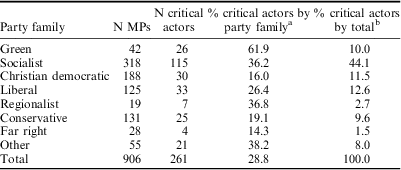
In Table 2, the parties are grouped together in party families: green/ecologist, socialist/social democratic, Christian democratic, liberal, ethnic/regionalist, conservative, far right and ‘other’ (including agrarian, communist, single-issue and religious parties). The party families are comparable in all countries.
Critical Actors by Party Family

Notes: aThe ‘% critical actors by party family’ is calculated by dividing the number of critical actors by the total number of MPs in a particular party.
bThe ‘% of critical actors by total’ is calculated by dividing the number of critical actors in each party by the total number of critical actors. Differences in terms of party ideology are significant and strong (p < 0.000; Cramer's V = 0.253).
The results confirm the general finding that left-wing parties are more likely to act for women than centre or right parties (after Chi-squared test; p < 0.000; Cramer's V = 0.253). 61.9 per cent of green MPs and 36.2 per cent of socialist MPs were found to be critical actors. Within regionalist parties the figure was 36.8 per cent, in part due to these parties often having leftist ideological programmes. These figures are significantly higher than the proportion of critical actors in centre and right parties such as the liberal (26.4 per cent), conservative (19.1 per cent), Christian democratic (16 per cent) and far right parties (14.3 per cent).
The claim is often heard that (critical) actors in the substantive representation of women belong mainly to socialist parties. Our findings in Table 2 confirm that socialist or social democratic MPs make up the largest subgroup (44.1 per cent) in our data set of critical actors. A cross-country comparison further shows that differences between party families are significant in each of the 10 European countries. Particularly in Germany, Norway, Portugal and Switzerland, we see the significant participation of greens and socialists in ‘critical acting’.
However, parties on the right of the ideological spectrum also make up a substantial group of critical actors in the substantive representation of women in Europe. More than one-quarter of the liberal MPs in our data set claim to act on behalf of women, which is not significantly different from the proportion of critical actors in socialist parties (after Chi-squared test). Between 14 and 19 per cent of MPs in the Christian democratic, conservative and far right party families were also found to be critical actors. Out of our overall sample of critical actors, 12.6 per cent are members of liberal parties, 11.5 per cent members of Christian democratic parties, 9.6 per cent members of conservative parties, and 1.5 per cent members of far right parties. Adding up these numbers, 35.2 per cent of the critical actors in our data set are members of centre/right parties.
This clearly shows that if we want to understand how women's interests are represented in Europe, we need to look at centre/right as well as left-wing parties. Studying only left-wing MPs renders a skewed image of the substantive representation of women in parliament. In Belgium, Christian democratic and liberal MPs participate almost as much as left-wing parties in critical acting. In Hungary and Poland, the number of critical actors from Christian democratic or conservative parties is the same as the number of critical actors from socialist parties. A significant contribution to women's substantive representation can also be found among regionalist and conservative MPs in the UK. In Ireland the results are even more remarkable: Labour does not count a single critical actor among its members, while half of the critical actors are liberal MPs.
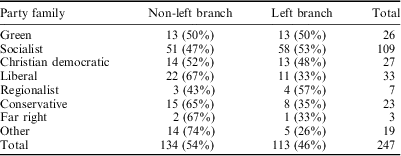
To understand better the behaviour of these critical actors in centre and right parties, we examine whether they consider themselves to be part of the ‘left’ or ‘non-left’ branches of their respective parties. Here we made use of a left–right self-placement scale to gauge the individual positions of MPs within their own parties.Footnote 5 The results in Table 3 show that individual ideology plays only a small role (Cramer's V = 0.194, n.s.). In green, socialist and Christian democratic parties especially, critical actors do not adopt clear left or non-left positions within their parties. Interestingly, critical actors in liberal, conservative and far right parties are more likely to position themselves in the non-left branch of their respective parties, suggesting that the substantive representation of women in these parties may be rooted in right-wing ideologies.
Critical Actors by Individual Ideology

Note: The percentages are row percentages (Cramer's V = 0.194, n.s.).
We now turn to examine whether women and feminists are more likely to be critical actors in women's substantive representation. Table 4 shows that men and women are critical actors in relatively equal proportions, but comparison by party shows important differences. Women constitute a majority of critical actors in only two party families: greens and regionalists. There are more female than male critical actors in socialist and Christian democratic parties, but the difference between the sexes is small, with male critical actors making up an important minority in both (43 and 45 per cent, respectively). In the liberal, conservative and far right parties, male critical actors actually outnumber their female counterparts.
Critical Actors by MPs’ Sex

Note: The percentages are row percentages (Cramer's V=0.301, p<0.001).
These findings clearly illustrate that representing women's interests is not the exclusive domain of female representatives, and that solely focusing on the activities of female representatives generates a skewed picture of who is actually involved in discussions about women's interests within political parties and in parliament. More significant is the fact that sex and party affiliation interact. The participation of male actors is especially high in centre and right parties such as the liberal, conservative and far right parties. This means that focusing solely on female MPs undervalues the contributions not only of male MPs, but also those of centre and right parties in women's substantive representation.
The next question is whether critical actors are mainly feminists. Several scholars contend that it is the combination of attitudes (feminist or gender consciousness) and access to resources (ties to the women's movement) that forms the basis of substantive representation (Childs Reference Childs2006; Dovi Reference Dovi2002). To measure MPs’ feminist attitudes, we asked MPs to indicate on a five-point scale to what extent they agreed with the following four propositions: (1) On the whole, women and men enjoy real equality today; (2) Government should ensure that women and men have equal opportunities; (3) Affirmative action is a legitimate measure to address the under-representation of women in politics; (4) Women's organizations are no longer necessary today. Each of these statements measures a different dimension of ‘feminist consciousness’ (Conover and Sapiro Reference Conover and Sapiro1993; Gurin Reference Gurin1985; Tremblay and Pelletier Reference Tremblay and Pelletier2000). The first focuses on whether MPs are aware of inequalities between women and men; it measures ‘power discontent’ (Tremblay and Pelletier Reference Tremblay and Pelletier2000). Feminists not only observe inequalities but are committed to ending them. The second item measures MPs’ commitment to changing gender inequalities. Feminists recognize the need for solutions to improve the status of women as a group, measured through items (3) and (4) (Tremblay and Pelletier Reference Tremblay and Pelletier2000). To measure representatives’ access to feminist resources, we asked MPs to indicate how often they are in contact with women's organizations in their country: at least once a week, at least once a month, at least every three months, at least once a year or (almost) never.
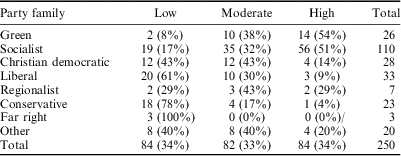
We created a ‘feminist activism’ scale based on respondents’ answers for the above five items.Footnote 6 Because the scale is not normally distributed, we placed MPs in three terciles according to their responses: MPs with low, moderate and high feminist activism. The distribution of critical actors according to these three categories is compared across the different party families in Table 5.
Critical Actors by Feminist Activism

Note: The percentages are row percentages (Cramer's V = 0.385, p<0.000).
Party differences are again obvious. We only find a strong connection between feminist activism and critical acting in left-wing parties. In green and socialist parties, the majority of critical actors show high levels of feminist activism. The link between feminist activism and critical acting is much weaker in centre and right parties. In Christian democratic parties, critical actors largely consist of moderate (43 per cent) and low (43 per cent) feminist activists. In liberal, conservative and far right parties, the results are even more striking: a large majority of critical actors display low levels of feminist activism. We thus conclude that the ‘feminist’ profile of critical actors differs significantly between left and centre/right parties. Whereas traditional assumptions regarding the role of feminists in women's substantive representation hold for the former, they are questionable for critical actors in centre and right parties.
Conclusion and Discussion
Shifting the focus from studying who acts for women given a specific set of women's interests to a more exhaustive understanding of women's substantive representation alters the picture of who acts for women. Whereas previous studies often showed that women's substantive representation is predominantly an affair of left-wing, female and feminist MPs, our study of MPs in 10 European countries shows that the group of critical actors claiming to represent women is much more diverse. Using an open and inductive approach, we were able to identify an intriguing and large set of male, non-feminist and centre/right-wing critical actors. One-third of these actors – indeed constituting a ‘critical mass’ – in the substantive representation of women are members of a right or centre-right party and are furthermore overwhelmingly on the right within their own parties. In the rightist parties in particular, men are more likely to speak on behalf of women and are less likely to be feminists. The identification of these critical actors is in itself important and invites further empirical study on who they are and what motivates them. Above all we would like to draw attention to the theoretical innovation hinted by our study.
First, this ‘unusual’ group of representatives challenges leading theories on women's substantive representation. Critical mass and politics of presence theories both point to women's life experiences, their knowledge of the female condition, their networks and contacts with women's organizations as increasing their likelihood of advocating for women. Other scholars point to the influence of egalitarian ideologies. How, then, should we understand conservatives, men and non-feminists with no ties to the women's movement speaking on behalf of women? Is it a genuine – albeit conservative – concern for women's wellbeing and equality, similar to what we assume to be the case, for instance, among feminists? Or should we regard it with more suspicion? Indeed, making claims for women might be ‘anti-women claims in disguise’ (Squires Reference Squires2008). Hence our theories need to be extended and refined to capture, to understand and also to judge the unusual suspects in the substantive representation of women. In our view, the extent to which they are responsive to female citizens is crucial in such an assessment (Celis and Childs Reference Celis and Childs2012).
Second, our findings raise crucial questions about the very nature of women's substantive representation. How can we include the contributions of both the usual and unusual actors in an encompassing concept of women's substantive representation? Clearly, the ideal of female representatives joining forces around a progressive set of demands from the women's movement and pushing a feminist agenda – what Erzeel (Reference Erzeel2012) terms ‘advocacy representation’ – is not a welcoming host for male, non-feminist and conservative actors and interests. In this view, ‘adversary’ actors and claims do not contribute to the substantive representation of women; on the contrary, they get in the way of promoting women's interests and might even provoke a ‘backlash’ (Kanter Reference Kanter1977; Yoder Reference Yoder1991). But unusual actors and alternative, non-feminist, views on women's interests can, in theory, be given a more constructive and even key role in women's representation when understood as ‘representation by deliberation’ (Erzeel Reference Erzeel2012). In this view, the content – in this case what is in the interests of women – is not a given, but is the subject of genuine political debate. Because women have diverging and even conflicting interests, these have to be heard and included in the representational process for it to be responsive to different groups of women (Celis Reference Celis2013; Celis and Childs Reference Celis and Childs2012; Weldon Reference Weldon2002, Reference Weldon2011). Critical actors in this view are not ‘advocates’ of the women's movement, but rather ‘deliberators’ participating in the debate and raising the level of responsiveness by bringing additional and contradictory perspectives to the table. From this perspective, both usual and unusual actors have a crucial role to play in women's substantive representation. It is up to future research to examine under what institutional, political and discursive conditions they can both participate and contribute to a responsive process in representing women's interests, be it as advocates or deliberators.
APPENDICES
List of Regions

Variation in Parliaments

Response Patterns