Introduction
Huntington’s disease (HD) is an autosomal dominantly inherited neurodegenerative disorder presenting with progressive motor, neuropsychiatric, and cognitive symptoms. The disease is caused by an expanded CAG repeat in the huntingtin gene (The Huntington’s Disease Collaborative Research Group, 1993). The cognitive deterioration in HD is commonly observed before the onset of motor symptoms and is thought to be caused by dysfunction of the frontostriatal circuits due to gradual degeneration of the caudate nucleus (Alexander, DeLong, & Strick, Reference Alexander, DeLong and Strick1986; Royall et al., Reference Royall, Lauterbach, Cummings, Reeve, Rummans, Kaufer and Coffey2002; Tabrizi et al., Reference Tabrizi, Scahill, Durr, Roos, Leavitt, Jones and Stout2011). Due to the dysfunction in frontostriatal circuits the first signs of cognitive impairment are expected to be in cognitive functions associated with the prefrontal cortex (Montoya, Price, Menear, & Lepage, Reference Montoya, Price, Menear and Lepage2006; Royall et al., Reference Royall, Lauterbach, Cummings, Reeve, Rummans, Kaufer and Coffey2002). Studies on cognition in HD have consistently shown that the earliest signs of cognitive impairments are found in psychomotor speed, emotion recognition, and executive functions (Dumas, van den Bogaard, Middelkoop, & Roos, Reference Dumas, van den Bogaard, Middelkoop and Roos2013; Paulsen, Reference Paulsen2011; Stout et al., Reference Stout, Paulsen, Queller, Solomon, Whitlock, Campbell and Aylward2011). Cognitive impairment has significant impact on patients’ ability to maintain everyday functioning and on the quality of life of both patients and caregivers (Paulsen, Reference Paulsen2011; Ready, Mathews, Leserman, & Paulsen, Reference Ready, Mathews, Leserman and Paulsen2008). Thus clinical assessment of cognitive impairment in HD gene-expansion carriers is essential.
Executive functions is a generic term for cognitive functions thought to be mediated by the prefrontal cortex such as planning, decision making, monitoring, control of action, cognitive flexibility and set-shifting (Lezak, Reference Lezak2004). Impairment of executive functions can be debilitating and interferes with the ability to maintain everyday functioning (Burgess et al., Reference Burgess, Alderman, Forbes, Costello, Coates, Dawson and Channon2006; Jurado & Rosselli, Reference Jurado and Rosselli2007). Deficits in executive functions can also interfere with other cognitive functions such as memory retrieval and prospective memory (Nicoll et al., Reference Nicoll, Pirogovsky, Woods, Holden, Filoteo, Gluhm and Gilbert2014). Executive functions have been studied intensively in HD (Dumas et al., Reference Dumas, van den Bogaard, Middelkoop and Roos2013; Paulsen, Reference Paulsen2011). Some studies used measures that have been adapted from experimental psychology and are not included in a typical neuropsychological assessment (Stout et al., Reference Stout, Paulsen, Queller, Solomon, Whitlock, Campbell and Aylward2011). Other studies have demonstrated that patients with HD are impaired on neuropsychological tests tapping executive functions such as the Stroop test, Verbal fluency, Wisconsin Card Sorting Test, Tower of London, Symbol Digit Modalities Test, and Trail Making Test B (Brandt et al., Reference Brandt, Inscore, Ward, Shpritz, Rosenblatt, Margolis and Ross2008; Paulsen, Reference Paulsen2011; Peinemann et al., Reference Peinemann, Schuller, Pohl, Jahn, Weindl and Kassubek2005; Snowden, Craufurd, Griffiths, Thompson, & Neary, Reference Snowden, Craufurd, Griffiths, Thompson and Neary2001; Unschuld et al., Reference Unschuld, Liu, Shanahan, Margolis, Bassett, Brandt and Ross2013). For this study, we used measures of executive function and psychomotor speed that have proven sensitive to HD in previous studies (e.g., SDMT, Stroop test, lexical fluency, TMT B) (Larsson, Almkvist, Luszcz, & Wahlin, Reference Larsson, Almkvist, Luszcz and Wahlin2008; Stout et al., Reference Stout, Paulsen, Queller, Solomon, Whitlock, Campbell and Aylward2011, Reference Stout, Queller, Baker, Cowlishaw, Sampaio, Fitzer-Attas and Borowsky2014; Tabrizi et al., Reference Tabrizi, Reilmann, Roos, Durr, Leavitt, Owen and Langbehn2012) and new measures that have not been used to study HD before to our knowledge (e.g., Hayling and Brixton test, Alternating fluency, Zoo map test).
Most studies on cognition in HD aim to find sensitive cognitive measures that can serve as markers of disease progression by comparing group means at different disease stages. A statistically significant difference in mean score does not indicate the frequency of performances that can be classified as cognitively impaired. On neuropsychological tests the variation of scores is often large and increases with disease progression. So when choosing tests for clinical neuropsychological assessment, group differences in mean scores may be misleading. To our knowledge only two studies have investigated the frequency of cognitive impairment in HD gene-expansion carriers (Duff et al., Reference Duff, Paulsen, Mills, Beglinger, Moser, Smith and Harrington2010; Vinther-Jensen et al., Reference Vinther-Jensen, Larsen, Hjermind, Budtz-Jorgensen, Nielsen, Norremolle and Vogel2014). These studies have investigated the frequency of a more global cognitive impairment. This study is the first to investigate specifically the frequency of impaired performances on a wide range of individual neuropsychological tests of executive functions and psychomotor speed.
The overall aim of this study was to get a better understanding of which of the measures of executive function and psychomotor speed used here were most sensitive for clinical assessment of individual patients. This was done by (1) Investigating cognitive performances on nine measures of psychomotor speed and executive functions in a consecutive group of premanifest and manifest HD-gene expansion carriers and (2) analyzing the frequencies of impaired performances relative to healthy controls on these neuropsychological tests in premanifest and manifest HD gene-expansion carriers.
Methods
Participants
Participants were recruited from January 2012 to March 2013 from the Neurogenetics Clinic, Danish Dementia Research Centre, Rigshospitalet. Ninety-eight HD gene-expansion carriers with a CAG repeat ≥39, a Unified Huntington’s Disease Rating Scale-99 total motor score ≤35 (UHDRS-TMS) (Huntington Study Group, 1996), a Mini Mental State Examination (MMSE) score ≥24, and a Montreal Cognitive Assessment (MoCA) (Nasreddine et al., Reference Nasreddine, Phillips, Bedirian, Charbonneau, Whitehead, Collin and Chertkow2005) score ≥19 were included in the study. HD gene-expansion carriers with a UHDRS-TMS score of >5 were classified as manifest HD gene-expansion carriers (N=48). If the score was ≤5, indicating no substantial motor signs, a classification of premanifest HD gene-expansion carrier (N=50) was used. The UHDRS-TMS is a scale developed to standardize motor rating. Motor signs are evaluated on 31 items each rated (0–4) from normal to severe impairment (Huntington Study Group, 1996). Exclusion criteria were other neurological illness, ongoing alcohol or drug abuse, and having a native language other than Danish. Thirty-nine healthy HD gene-expansion negative individuals (who were offspring of a HD gene-expansion carrier and had been genetically tested with a CAG repeat length of less than 30) were included as controls. All individuals had gone through genetic counseling and were informed of their genetic status before (and independent from) study enrollment.
Procedure
The study was approved by the Ethics Committee of the Capital Region of Denmark (H2-2011-085), and written informed consent was obtained from each participant before enrolment. All participants had a minimum of two planned visits. At one visit psychiatric screening, Hamilton Depression Rating Scale (HAM-D), physical and neurological examinations were performed. At another visit neuropsychological testing was performed. The two visits were preplanned and performed in random order, 83.2% of the evaluations were performed within 14 days of each other and only 3 (2.1%) of the evaluations were performed more than 3 months apart. All evaluations were performed blinded to one another. The same physician and the same neuropsychologist performed all examinations.
Neuropsychological Testing
All participants were tested with an extensive 3-hr battery of neuropsychological tests, including tests of attention, memory and visuospatial functions. The results from these tests have been published elsewhere (Vinther-Jensen et al., Reference Vinther-Jensen, Larsen, Hjermind, Budtz-Jorgensen, Nielsen, Norremolle and Vogel2014). The battery also included tests of social cognition (which will be published elsewhere).
The tests were administered in a fixed order. General IQ levels were estimated using an education index score and DART (Danish Adult Reading Test), an equivalent of the NART (Nelson & O’Connell, Reference Nelson and O’Connell1978). DART was used because measures of pronunciation of irregular words are highly correlated with general measures of intelligence and have been shown to be relatively unaffected by dementia processes in other neurodegenerative diseases in the early stages of disease (O’Carroll, Reference O’Carroll2014). Crawford, Parker, and Besson (Reference Crawford, Parker and Besson1988) found that NART score was relatively more resistant to cognitive decline than WAIS vocabulary score in HD. Also general intelligence or crystalized intelligence has been shown to be less sensitive to frontal lobe damage than fluid intelligence (Duncan, Burgess, & Emslie, Reference Duncan, Burgess and Emslie1995; Royall et al., Reference Royall, Lauterbach, Cummings, Reeve, Rummans, Kaufer and Coffey2002) and thus was expected to be less affected by executive deficits. The education index score (range, 8–17) was calculated as the sum of years of schooling (range, 7–12) and the level of post-secondary education stratified into groups (range, 1–5) based on the method previously used by Mortensen and Gade (Reference Mortensen and Gade1993). Motor speed was evaluated using the Trail Making Test 0 (TMT 0), which is an equivalent to the Trail Making Test for motor speed from the D-KEFS battery, but adapted in size to be the same as the TMT B used in our study. TMT 0 was used as a covariate to control for the effect of motor speed on performance.
The test battery consisted of one test of psychomotor speed and eight different tests of executive functions. We based our choice of executive function tests on the Factor Analysis made by Testa, Bennett, and Ponsford (Reference Testa, Bennett and Ponsford2012): Stroop interference test and Trail Making Test B were thought to measure set-shifting and interference management, Zoo map test and Brixton test was thought to measure task analysis, The Hayling test was thought to reflect response inhibition and the lexical fluency test was thought to measure strategy generation and regulation. Alternating fluency was not part of the factor analysis by Testa et al. (Reference Testa, Bennett and Ponsford2012), but have been associated with internal attentional control and set-shifting difficulties in Parkinson’s disease (Zec et al., Reference Zec, Landreth, Fritz, Grames, Hasara, Frazier and Manyam1999), thus we chose to make an additional label called internal attentional control.
Psychomotor speed
Symbol Digit Modalities Test (SDMT) (Smith, Reference Smith1982)
The SDMT involves a simple substitution task using a reference key with nine different digit–symbol pairs. Each participant was given 90 s to pair specific numbers with given abstract symbols. Number of correct responses was used for analysis.
Set-shifting and interference management
Trail Making Test B (TMT B) (Reitan, Reference Reitan1955)
The participants were asked to connect circles alternating between numbers in numeric order and letters in alphabetical order. The time to completion was recorded.
Stroop Interference Test (Stroop, Reference Stroop1935)
This 100-word version of the Stroop task consisted of a simple reading task and an interference test. In the interference test the name of the color and the color of the ink did not correspond, for example the word blue could be written in green ink, and the participants were asked to name the colors instead of reading the words. Participants were instructed to complete as fast as possible and to correct their mistakes. Only the time to completion for the interference test was used for analysis.
Internal attentional control
Lexical alternating fluency
This fluency test was developed by the researchers based on the most common first-letters in the Danish language besides S and F. The participants were asked to produce as many different words as possible in one minute, alternating between words beginning with the letter K and words beginning with the letter B. It was emphasized that it could be all types of words except for proper nouns. The number of correct responses was recorded, and improper alternations were counted as incorrect.
Semantic/lexical alternating fluency
This fluency test was developed by the researchers based on a category that was thought to be very broad and one of the most common first-letters in the Danish language besides S, F, K, and B. The participants were asked to produce as many different words as possible in one minute alternating between types of food and words beginning with the letter D. They were told it could be anything you can eat, and all words beginning with the letter D except for proper nouns. The number of correct responses was recorded; improper alternations were counted as incorrect.
Task analysis
The Brixton test
(Burgess & Shallice, Reference Burgess and Shallice1997) is a rule attainment task. The test consists of a stimulus book with each page showing the same basic array of ten circles set in two rows of five with each circle numbered from one to ten. On each page, one circle is blue. The position of the blue circles differs from page to page, and the participants were asked to guess where the blue circle would be on the next page, by trying to see a pattern based on previous pages. No feedback was given. The number of errors (range, 0–54) was recorded.
Zoo map test from the Behavioral Assessment of the Dysexecutive Syndrome battery (Wilson, Alderman, Burgess, Emslie, & Evans, Reference Wilson, Alderman, Burgess, Emslie and Evans1996) is a test of the ability to formulate and implement a plan (part one) and to follow a predefined plan (part two). The participant was asked to plot or follow a route through a map without breaking certain rules. The test was scored based on successful implementation of the plan, and penalties were given for rule breaks. The time spent on part one and total score (correct order of places visited minus penalties; maximum score for part one plus two was 16) were used for analysis.
Strategy generation and regulation
Lexical fluency (Lezak, Reference Lezak2004)
The participants were asked to produce as many words as possible within one minute beginning with each of the letters F, A, and S. It was emphasized that it could be all words in Danish except proper nouns. The number of different words produced with both F, A, and S were recorded and added together for total score.
Response inhibition
The Hayling test Footnote * (Burgess & Shallice, Reference Burgess and Shallice1997) is a test of response initiation and response inhibition. It consists of two sections (part one and two) of 15 sentences each where the last word is missing. The participant was asked to give a verbal response and complete the sentence as quickly as possible. In part one the participant was asked to complete the sentence sensibly, in part two (Hayling interference test) the participant was asked to give a word that was unconnected to the sentence in every way. The test manual guidelines were used to clarify whether the response was completely unconnected to the sentence (0), somewhat connected to the sentence (category B error) or a completely plausible completion of the sentence (category A error). Only the response time for the Hayling interference test was used in this study.
Data Analyses
Group comparisons were performed using one-way analysis of variance (ANOVA). To control for multiplicity an alpha level of .05 and Dunnett t test (2-sided) adjustment was applied for post hoc comparisons (Dunnett t tests treat one group as a control, and compare all other groups against it). Between group differences were evaluated using analyses of covariance (backward stepwise elimination) controlling for education, age, trail 0-score, and DART-score, and also correlation of test performances and scores on HAM-D was performed.
Effect sizes (Cohen’s d) were calculated by the following formula (Field, Reference Field2013):
 $${\rm Effect}\,{\rm size}={{{\rm Mean}\,{\rm HD}\,{\rm group}{\minus}{\rm Mean}\,{\rm Control}\,{\rm group}} \over {{\rm Pooled}\,{\rm SD}}}$$
Effect of disease burden for premanifest HD gene-expansion carriers was analyzed by calculating the CAG-Age Product Scaled (CAPs) formulated by the PREDICT-HD study (Zhang et al., Reference Zhang, Long, Mills, Warner, Lu and Paulsen2011) by the following equations:
 $${\rm CAP}={\rm age}_{0} \,{\rm x}\,{\rm (cag}{\minus}{\rm 33}.{\rm 66}00{\rm )}\,{\rm and}\,{\rm CAPs}={{{\rm CAP}} \over {{\rm 432}.{\rm 3326}}}$$
The premanifest HD gene-expansion carriers were divided into low-CAPs with a CAPs score of ≤0.67 and medium/high-CAPs with a CAPs score of >0.67. A low-CAPs score indicates that a person is far from predicted motor onset and a medium/high-CAPs score indicates that a person is closer to predicted motor onset. Group differences were investigated between the low- and medium/high- CAPs and healthy controls using ANOVA with an alpha level of .05. Dunett (2 sided) adjustment was applied for post hoc comparisons.
To investigate the number of HD gene-expansion carriers that could be classified as probably impaired/impaired on the neuropsychological tests the healthy control group was used as reference. Scores below the 10th percentile were classified as probably impaired, and scores below the 5th percentile were classified as impaired. Odds ratios were calculated for the frequencies of scores below the 10th percentile in the premanifest and the manifest HD-gene expansion carriers relative to healthy controls.
Results
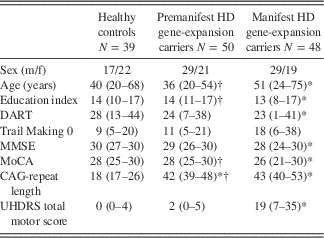
Table 1 shows the background information for HD gene-expansion carriers and healthy controls. The manifest HD gene-expansion carriers were significantly older and significantly less educated and, furthermore, had significantly lower scores on DART, TMT 0, MoCA and MMSE relative to the premanifest HD gene-expansion carriers and healthy controls.
Background information for HD gene-expansion carriers and healthy controls

Note: Results shown as median (range).
*Significant difference from healthy controls, p<0.05.
†Significant difference from manifest HD gene-expansion carriers, p<0.01.
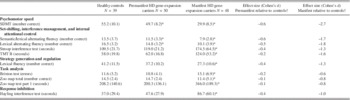
Table 2 shows the results from the neuropsychological tests and significance levels from the group comparisons before covariance analysis. The manifest HD gene-expansion carriers scored significantly lower on all neuropsychological tests as compared to healthy controls (p<.0001). After controlling for education, age, TMT 0-score and DART-score by analyses of covariance (taking multiplicity into account) the group comparisons between healthy controls and the manifest HD-gene expansion carriers remained significant on all neuropsychological tests except for the Brixton test, Zoo map test part 1 and Zoo map total. The premanifest HD gene-expansion carriers scored significantly lower than controls on SDMT, Semantic/lexical alternating fluency and Lexical alternating fluency. After controlling for education, age, TMT 0-score, and DART-score by analyses of covariance (taking multiplicity into account) the group comparisons between healthy controls and the premanifest HD-gene expansion carriers remained significant for SDMT and Semantic/lexical alternating fluency. There was a significant positive effect of HAM-D score on Hayling interference test in the premanifest group; otherwise HAM-D score was not significantly associated with neuropsychological test performances in either manifest or premanifest HD gene-expansion carriers.
Test performances for HD gene-expansion carriers and healthy controls

Note. Results shown as mean (SD).
*Significant difference from healthy controls, p<0.05.
†Negative numbers indicates worse performance relative to controls.
Premanifest HD gene-expansion carriers were divided into a low-CAPs group (N=23) and a medium/high-CAPs group (N=27). Compared to healthy controls the medium/high-CAPs group scored significantly lower on SDMT (p=.0001), Semantic/lexical alternating fluency (p=.004), Stroop interference test (p=.009), and Lexical alternating fluency (p=.040).
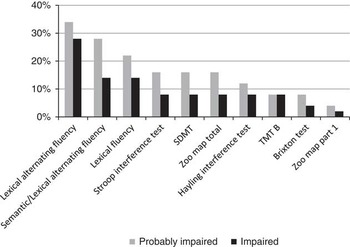
Figure 1 shows the percentage of premanifest HD gene-expansion carriers classified as probably impaired/impaired on the neuropsychological tests. Alternating fluency tests and Lexical fluency were the tests with the highest frequency of impairment among the premanifest HD gene-expansion carriers. Lexical alternating fluency was the most frequently impaired test with 34% of scores below the 10th percentile and 16% of scores below the 5th percentile.
Frequency of impairment: premanifest HD gene-expansion carriers. Probably impaired scores are on or below the 10th percentile and impaired scores are on or below the 5th percentile.

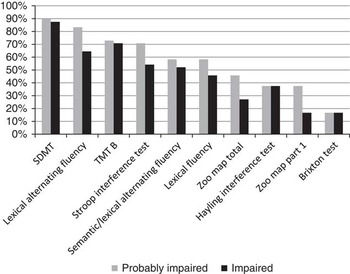
Figure 2 shows the percentage of manifest HD gene-expansion carriers classified as probably impaired/impaired on the neuropsychological tests. The large majority of the manifest HD-gene expansion carriers were probably impaired or impaired on all tests (except for the Brixton test). As compared to the results from the premanifest HD gene-expansion carriers there was smaller difference between the number of participants that were classified as probably impaired and impaired. The most frequently impaired test in manifest HD gene-expansion carriers was SDMT (89.6% of scores falling below the 10th percentile and 87.5% of scores falling below the 5th percentile).
Frequency of impairment: manifest HD gene-expansion carriers. Probably impaired scores are on or below the 10th percentile and impaired scores are on or below the 5th percentile

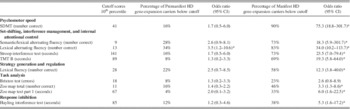
Table 3 shows the odds ratios for the frequencies of scores below the 10th percentile in the premanifest and the manifest HD gene-expansion carriers. For the manifest HD gene-expansion carriers, the odds ratios were significant for all tests except the Brixton test. For the premanifest HD gene-expansion carriers only the odds ratio for Lexical alternating fluency was significant and one test was trending significance (Semantic/lexical alternating fluency, p=.08).
Odds ratios and 95% CI for the percentages of HD gene-expansion carriers scoring below the 10th percentile relative to healthy controls

*Significant at p<0.05.
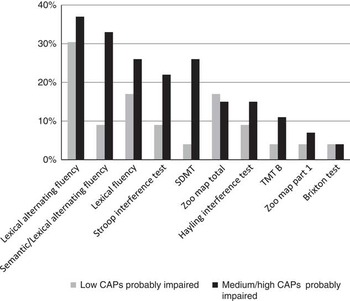
Figure 3 shows the frequency of scores that were probably impaired in the premanifest HD gene-expansion carriers when divided by CAPs score. The most frequently impaired tests were generally the same as in Figure 2 (the entire group of premanifest HD gene-expansion carriers) but as expected the frequency of impairment was generally higher for the medium/high-CAPs group. For both groups, the most frequently impaired test was Lexical alternating fluency with 37% of scores classified as probably impaired in the medium/high-CAPs group versus 30% of scores classified as probably impaired in the low-CAPs group.
Frequency of impairment: Premanifest HD gene-expansion carriers divided by CAPs score. Probably impaired scores are on or below the 10th percentile

Discussion
Previous studies on cognition in HD have focused on finding sensitive markers for disease progression by comparing mean differences between groups at different stages of disease (Paulsen, Smith, & Long, Reference Paulsen, Smith and Long2013; Stout et al., Reference Stout, Paulsen, Queller, Solomon, Whitlock, Campbell and Aylward2011; Tabrizi et al., Reference Tabrizi, Scahill, Durr, Roos, Leavitt, Jones and Stout2011, Reference Tabrizi, Reilmann, Roos, Durr, Leavitt, Owen and Langbehn2012). Although these studies have great importance in guiding future research they cannot be taken as a clear indication of clinically significant cognitive impairment (Stout et al., Reference Stout, Paulsen, Queller, Solomon, Whitlock, Campbell and Aylward2011). To our knowledge, the frequency of clinically significant cognitive impairment on individual neuropsychological tests has never been investigated in HD gene-expansion carriers. This is the first study to investigate the actual frequency of impaired performances in a large consecutive cohort of HD gene-expansion carriers on a wide range of neuropsychological tests measuring various aspects of executive functions and psychomotor speed.
Group comparisons showed a statistically significant difference between the healthy controls and the premanifest HD-gene expansion carriers on SDMT, Semantic/lexical alternating fluency and Lexical alternating fluency. These results are in accordance with many other studies that have found statistically significant differences on SDMT and verbal fluency for premanifest and manifest HD gene-expansion carriers (Holl, Wilkinson, Tabrizi, Painold, & Jahanshahi, Reference Holl, Wilkinson, Tabrizi, Painold and Jahanshahi2013; Larsson et al., Reference Larsson, Almkvist, Luszcz and Wahlin2008; Paulsen et al., Reference Paulsen, Smith and Long2013; Stout et al., Reference Stout, Paulsen, Queller, Solomon, Whitlock, Campbell and Aylward2011). As expected, the manifest HD gene-expansion carriers scored significantly worse than healthy controls on all tests (except one). This is also in line with previous research (Lemiere, Decruyenaere, Evers-Kiebooms, Vandenbussche, & Dom, Reference Lemiere, Decruyenaere, Evers-Kiebooms, Vandenbussche and Dom2002, Reference Lemiere, Decruyenaere, Evers-Kiebooms, Vandenbussche and Dom2004).
The frequency of impaired performances in manifest HD gene expansion carriers was substantial on most tests, with SDMT, Lexical alternating fluency, and TMT B being the most frequently impaired. Also the difference in frequency between scores classified as probably impaired and impaired was small for most tests. This indicates that clinically significant impairment in executive functions and psychomotor speed are frequent once onset of motor symptoms has occurred. For the premanifest HD gene-expansion carriers the most frequently impaired tests were Lexical alternating fluency, Semantic/lexical alternating fluency, and Lexical fluency. Contrary to expectation scores on SDMT were not very frequently impaired. This underlines the fact that a statistically significant difference in mean score does not necessarily indicate the frequency of clinically significant cognitive impairment on specific tests, especially if the distribution is somewhat skewed, which is not uncommon in clinical populations. So when choosing tests for clinical neuropsychological assessment, group differences in mean scores may sometimes be misleading and, therefore, cutoff scores for percentiles may be more helpful information for assessing individual patients in the clinical setting.
“Executive functions” is a generic term for a whole range of higher order cognitive processes, and there has been a great deal of debate on how best to measure them (Burgess et al., Reference Burgess, Alderman, Forbes, Costello, Coates, Dawson and Channon2006; Jurado & Rosselli, Reference Jurado and Rosselli2007; Stuss & Alexander, Reference Stuss and Alexander2007). Part of the challenge is that executive functions are most needed in unstructured situations that pose high demands on monitoring and control of action which in itself is somewhat contradictory to the typical neuropsychological test situation. This means that even though patients and caregivers might have grave cognitive complaints from everyday life, it might not show in any of the neuropsychological measures used to assess executive functions. Our aim was to investigate which measures of executive functions and psychomotor speed were most frequently impaired in premanifest and manifest HD gene-expansion carriers and would be of important clinical utility for the assessment of individual patients. We applied both measures shown to be sensitive in HD (e.g., SDMT, Stroop test, lexical fluency, TMT B) and neuropsychological tests that have not been investigated in HD populations (e.g., Hayling and Brixton test, Zoo map test, and Alternating fluency). We found no significant differences between the premanifest HD gene-expansion carriers and healthy controls on the Hayling interference test, the Brixton test and the Zoo map test and they were also the tests with the lowest frequency of impairment in HD gene-expansion carriers. This indicates that task analysis and response inhibition are either not affected in premanifest HD gene-expansion carriers or not well measured by these tests. The most frequently impaired test in the premanifest HD gene-expansion carriers were the Alternating fluency tests and Lexical fluency test. This indicates that set-shifting, interference management, internal attentional control, and strategy generation might be some of the earliest affected cognitive functions in HD. This is supported by imaging studies demonstrating early degeneration of the caudate nucleus in HD (Tabrizi et al., Reference Tabrizi, Reilmann, Roos, Durr, Leavitt, Owen and Langbehn2012) which is connected to the lateral prefrontal cortex through the frontostriatal circuits. Set-shifting and conflict monitoring have previously been associated with the dorsolateral prefrontal cortex (Glascher et al., Reference Glascher, Adolphs, Damasio, Bechara, Rudrauf, Calamia and Tranel2012; Starkstein et al., Reference Starkstein, Brandt, Folstein, Strauss, Berthier, Pearlson and Folstein1988), and performance on fluency tests in general and especially lexical fluency tests have previously been associated with damage to the prefrontal cortex (Robinson, Shallice, Bozzali, & Cipolotti, Reference Robinson, Shallice, Bozzali and Cipolotti2012).
The frequency of impairment differed between premanifest and manifest HD gene-expansion. The different frequency of impairment for manifest and premanifest HD gene-expansion carriers is not surprising. Some of the test used, for example, SDMT and TMT B pose demands on fine motor skills such as eye movements and handwriting, and performances on these tests will most likely decline concurrently with the evolvement of motor symptoms. The other tests used in this study may be more “pure” cognitive measures. This was supported by our data analysis which showed that covariance analysis with TMT 0 did not change the overall results. In our study, we used the very conservative classification criteria for the HD gene-expansion carriers that were also used in TRACK-HD (Tabrizi et al., Reference Tabrizi, Reilmann, Roos, Durr, Leavitt, Owen and Langbehn2012). We wanted to investigate cognitive impairment before and independent from any motor symptoms and thus it was important that our premanifest group had no substantial motor signs. This conservative method potentially pushes more people into the manifest HD gene-expansion carrier group than would be clinically diagnosed with HD using the UHDRS Diagnostic confidence levels (Huntington Study Group, 1996), but also ensures that the impairments on cognitive tasks in the premanifest HD gene-expansion carriers are not due to overt motor symptoms.
Disease burden is known to influence neuropsychological test performances in HD gene-expansion carriers (Harrington, Smith, Zhang, Carlozzi, & Paulsen, Reference Harrington, Smith, Zhang, Carlozzi and Paulsen2012; Paulsen et al., Reference Paulsen, Smith and Long2013). Dividing the premanifest HD gene-expansion carriers by CAPs score revealed that the statistically significant group differences were predominantly found for the medium/high CAPs group relative to healthy controls. The tests with the most probably impaired scores were overall the same for the low and medium/high CAPs group but the frequency of impaired scores were generally higher in the medium/high CAPs group. This indicates, as expected, that the frequency of impaired scores increases with increasing disease burden meaning that cognitive decline in HD gene-expansion carriers is greater the closer to predicted motor onset the person is. This is not surprising since the neurodegeneration also increases with closeness to predicted motor onset (Tabrizi et al., Reference Tabrizi, Reilmann, Roos, Durr, Leavitt, Owen and Langbehn2012).
Depression has been shown to influence performance on neuropsychological tests (Porter, Bourke, & Gallagher, Reference Porter, Bourke and Gallagher2007; Veiel, Reference Veiel1997) and depression is common in HD (Roos, Reference Roos2010). We investigated the correlation between score on HAM-D and test performances on all nine measures and found a significant positive effect of HAM-D score on Hayling interference test in the premanifest group; otherwise HAM-D score was not significantly associated with neuropsychological test performances in either manifest or premanifest HD gene-expansion carriers. This indicates that, even though it is important to evaluate the effect of depression on neuropsychological tests, executive functions can be affected in HD gene-expansion carriers without symptoms of depression.
From a clinical perspective, it is always important whether the cognitive profile fits with the clinical impression and the types of complaints that HD gene-expansion carriers and their caregivers have when examined. Fluency tests and Alternating fluency have been said to measure mental speed, cognitive flexibility, set-shifting, interference managing, internal attentional control/ monitoring, and strategy generation (Costa et al., Reference Costa, Bagoj, Monaco, Zabberoni, De Rosa, Papantonio and Carlesimo2014; Larsson et al., Reference Larsson, Almkvist, Luszcz and Wahlin2008; Lezak, Reference Lezak2004; Testa et al., Reference Testa, Bennett and Ponsford2012; Zec et al., Reference Zec, Landreth, Fritz, Grames, Hasara, Frazier and Manyam1999). When premanifest HD gene-expansion carriers and patients with early HD are worried about cognitive decline and referred to neuropsychological assessment, some of the most common complaints they have are problems keeping up at work, especially keeping track of and shifting between assignments and they often describe mental slowing. Since these complaints fit well with what fluency tests, especially alternating fluency tests claim to measure, the inclusion of fluency tests in the clinical neuropsychological assessment of HD gene-expansion carriers might prove useful for detecting early signs of cognitive decline and for follow-up assessments. Detecting the first signs of cognitive impairment can be important for both patients and caregivers to take the precautions needed, for example, to maintain a job, stop driving a car, and when the time comes to get the social services needed to maintain quality of life.
There were some limitations to our study. There was a significant age difference and a significant difference in DART score between the manifest HD gene-expansion carriers and healthy controls and thus the frequency of impairment need to be viewed in that light. It is well known that scores on neuropsychological tests are influenced by age and verbal premorbid intelligence, and, therefore, the frequency of impairment may be lower in the manifest HD gene-expansion carriers if compared to healthy controls with the same age as this subgroup of patients. However, when the results were controlled for age and verbal premorbid intelligence the group differences remained significant for all tests except for the Brixton test, indicating that the effect of background variables was small in our study. Additionally it is important to take into account that premanifest subgroup comparisons that covary age will underestimate effects of group, because these subgroups are defined partly based on age, and actual effects may be stronger than reported here.
The reference group in this study is rather small and this may have led to over or underestimation of cutoff scores especially on the 5th percentile which is very unstable in such a small group. Nevertheless in a previously published study by Vinther-Jensen et al. (Reference Vinther-Jensen, Larsen, Hjermind, Budtz-Jorgensen, Nielsen, Norremolle and Vogel2014), this same control group was compared to another reference material of 80 healthy adults from a database at the Department of Neurology, Rigshopsitalet, University of Copenhagen by regression analyses on a range of cognitive tests. This analysis showed that only 5% could be classified as cognitively impaired by the criteria used in the study. Nonetheless the frequency of impairment on the different neuropsychological tests should ideally be replicated with more extensive reference material (adjusted for age and premorbid intelligence).
To summarize, we found distinct group differences in frequency of impairment on executive measures in manifest and premanifest HD gene-expansion carriers compared to healthy controls, and our results indicate to what degree different executive measures can be expected to be clinically impaired. Based on our results fluency tests, especially Alternating fluency tests, seem to be sensitive in detecting executive deficits in premanifest HD gene-expansion carriers whereas SDMT, even though it is statistically significant in between group comparisons, is less so. This may be because SDMT is a test of psychomotor speed and thus is impaired later on concurrently with the evolvement of motor symptoms. In this study executive functions were also affected in premanifest HD-gene expansion carriers far from predicted motor onset, and based on these results it may be advisable to include Alternating fluency tests in cognitive screening and clinical neuropsychological assessment of all HD gene-expansion carriers.
Acknowledgments
We thank Thomas William Teasdale for fruitful comments on the manuscript. Ida Unmack Larsen and Tua Vinther-Jensen are both supported by grants from Copenhagen University. Jørgen Erik Nielsen is supported by a research grant from the Novo Nordisk Foundation.
Conflicts of interest
None.