The ability to use information and communications technologies (ICTs) effectively has been described as ‘the indispensable grammar of modern life’ and a ‘fundamental aspect of citizenship in the information age’ (Wills quoted in Selwyn, Reference Selwyn2002: 3). The risk of widening social divisions associated with developments in ICTs has been recognised by the UK government:
Information and communication technology has become all pervasive in our working lives and increasingly in our homes as well. How we adopt and use this technology will be crucial for our future prosperity. But there is evidence of a digital divide with some groups largely excluded from benefiting from access to the internet. (Department of Trade and Industry, 2005)
Initial policies to bridge this ‘digital divide’ in the UK focused on increasing access to ICTs, for example through providing public internet access points, such as the People's Network of internet-connected computers in public libraries (Department of Communities and Local Government, 2008a). Despite such measures, evidence persists of social divisions in ICT use and engagement in the UK. This paper uses survey data and findings from a review of research on communications and social exclusion published in the UK between 2001 and 2006 to explore variations in ICT engagement in the UK, focusing in particular on differences between young people (Sinclair et al., Reference Sinclair, Bramley, Dobbie and Gillespie2007). These sources suggest that digital inclusion will only be achieved if the social rather than technological barriers inhibiting digital engagement are addressed. The literature on social inclusion and social capital offers lessons on how communications inclusion may be enhanced.
Communications inclusion policy and young people
Achieving universal access among young people to the ‘new capital’ of information via ICTs has been a central goal of successive UK governments. Grouped under the umbrella of the National Grid for Learning (which ended in June 2006), this aim has been underpinned by unprecedented investment in ICT hardware, software and teacher training in schools (Furlong et al., Reference Furlong, Furlong, Facer and Sutherland2000). The 2005 Digital Inclusion strategy (DTI, 2005), Connecting the UK, continued to prioritise increasing access to ICT equipment among disadvantaged groups. Measures included the Computers for Pupils programme which provided internet-connected computers for 100,000 young people in deprived neighbourhoods in England (Department of Communities and Local Government, 2008a: 39). This was accompanied by the then Department for Education and Skill's ICT and e-learning strategy, Fulfilling the Potential (DfES, 2005). The Home Access Taskforce also launched an initiative to provide funding and support to increase ICT access and use, with the aim of achieving universal home access among households with young people aged five to 18.
Such ambitious and expensive measures to increase the availability of ICTs represent the first phase of digital inclusion policy in the UK. However, the success of this approach is at best questionable (Loader and Keeble, Reference Loader and Keeble2004); for example, evaluations of initiatives such as the Wired up Communities programme concluded that the principal beneficiaries were those already among the more digitally included (Citizens Online/National Centre for Social Research, 2008). It is now widely recognised that increasing access to ICT hardware does not necessarily translate into uptake nor effective use of such opportunities among more socially excluded groups and communities. Consequently, a second phase of digital inclusion policy has recently emerged, focusing more on developing the human and social capital resources which enable effective digital engagement. For example, the Department of Communities and Local Government's (2008b) Communities in Control White Paper proposed piloting Digital Mentors to assist deprived communities make better use of ICTs and social media to access public services. This policy turn brings the digital inclusion discourse closer to established analyses of social inclusion (Webb, Reference Webb2006).
Digital access and engagement in the UK
Much of the UK survey data on access to or use of ICTs refers to households. However, studies of older technologies, such as TV and videocassette recorders (VCRs), suggest that household access does not necessarily mean equal access for all members within households (Facer and Furlong, Reference Facer and Furlong2001). Bearing this qualification in mind, it is no surprise that the data demonstrate that access to new generations of ICTs has become a mass phenomenon. For example, home PCs were available to just under one fifth of households in the mid-1990s, but this had risen to over three-fifths by 2004/05 and almost three quarters by 2008 (Avery et al., Reference Avery, Chamberlain, Summerfield and Zealey2007; ONS, 2009).
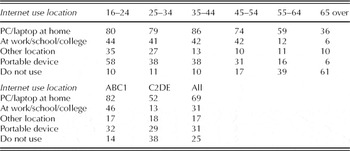
Despite this general increase in ICT access, there remain a number of well document ‘socio-demographic fault lines’ in ICT access (Empirica, 2006: 24). Table 1 shows that 38 per cent of households in social class C2DE do not use the internet at all, compared with 14 per cent of classes ABC1. Education appears to be a significant influence on internet use, with the proportion of adults under 70 using the internet falling from 95 per cent among those with degree or higher level qualifications to only 52 per cent among those with no qualifications (ONS, 2009: Table 19). Even modest educational qualifications, such as having GCSE grades D–G, can raise internet usage significantly (to 78 per cent in this case). Furthermore, this aspect of digital division may be worsening: the Oxford Internet Survey showed that the internet use gap between those with ‘basic education’ (secondary school only) and those with higher education widened from 35 to 44 percentage points between 2007 and 2009, with usage among the ‘basic’ group falling (Dutton et al., Reference Dutton, Helsper and Gerber2009).
Internet use location by age, and social class, 2009 (GB, %)

Source: Ofcom (2009a), ‘Media literacy tracker 2009’, Table 87.
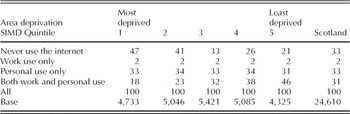
There is also a significant socio-geographic dimension to digital divisions. Table 2 analyses Scottish Household Survey data for 2007–08 (Scottish Government, 2009) in relation to the 2006 Scottish Index of Multiple Deprivation (Scottish Executive, 2006). This shows that 47 per cent of adults in the most deprived 20 per cent of neighbourhoods in Scotland never used the internet, compared with 21 per cent in the least deprived per cent of areas. There is no evidence of an additional area effect related to deprivation compounding the influence of individual household income. Table 2 suggests that an important difference between deprived and affluent areas is the ability of people to use the internet at work as well as at home or for personal use. This underlines the importance of worklessness in deprived areas for digital engagement.
Location of internet use by area deprivation, Scotland 2007–08 (%)

Source: Scottish Government (2009), Scottish Household Survey, Annual Report 2007–08, Table 9.1.9.
Data on age profiles of internet usage suggest that younger age groups are approaching near-universal use of the internet. Nevertheless, over one million children in the UK still have no home computer or internet access, and they are disproportionately from disadvantaged backgrounds (Department of Communities and Local Government, 2008a: 39). The 2009 Oxford Internet Survey confirms that almost 100 per cent of students use the internet, compared with 86 per cent of employed people but only 48 per cent of those who are unemployed (Dutton et al., Reference Dutton, Helsper and Gerber2009). Table 1 shows that in the 16–24 age group 10 per cent still do not use the internet, while 80 per cent use it at home, and 44 per cent use it at work, school or college. ICT exclusion among younger people is therefore of greatest concern for those who do not progress into further study or employment.
Regular and informal out-of-school access to ICTs are key influences in the development of computer literacy: school pupils with home computer access are more likely to obtain more than five GCSEs and gain at least one A-level, even when controlling for household wealth and income (Schmitt and Wadsworth, Reference Schmitt and Wadsworth2004). Young people without home ICT access are less likely to access computers at friends’ houses or in other informal settings (Facer and Furlong, Reference Facer and Furlong2001: 458); they are also less able than young people with home ICT access to call upon help from parents with ICT skills to overcome any problems they encounter (Citizens Online/National Centre for Social Research, 2008: 33). Limited cultural and social capital resources therefore compound the digital deprivation of young people from disadvantaged communities (Facer et al., Reference Facer, Sutherland, Furlong and Furlong2001: 215).
The uses to which home computer access are put are also important factors for developing ICT skills. In particular, while using a computer for educational purposes is positively linked to educational attainment, extensive use for entertainment is negatively linked with qualifications (BECTA, 2009). Not only are young people from lower income backgrounds more likely than higher income households to own entertainment technologies, such as a Playstation, ownership of such technologies is inversely related to ownership of home computers. Becker (Reference Becker2000) also found qualitative divisions in ICT use, with children from higher income households using home PCs for a much wider range of activities than those from lower income families. Reflecting this, children from higher social class households were more confident in their ICT skills. Evidence from the UK Children Go Online study (Livingstone and Bober, Reference Livingstone and Bober2005) indicates that divisions are evident between young people from higher and lower income households, distinguishing those for whom the internet is an ‘increasingly rich, diverse, engaging and stimulating resource of growing importance in their lives, and those for whom it remains a narrow, unengaging if occasionally useful resource of rather less significance’ (Livingstone and Bober, Reference Livingstone and Bober2004: 415). Young people from low-income households are therefore generally less skilled at using ICT for educational and vocational purposes, and are losing out on the wider communicative capacities achievable through new ICTs.
Increasing the provision and general availability of ICT equipment in schools could widen rather than reduce digital divisions (Furlong et al., Reference Furlong, Furlong, Facer and Sutherland2000: 108). Not only are those of greatest concern more likely to disengage from education at a young age, even when they are in school they are less likely than more digitally literate students to have effective access to the ICT facilities provided (Facer and Furlong, Reference Facer and Furlong2001). The significance of supportive home and community environments in reinforcing ICT engagement and skills is such that previous investment in digital access and education may have benefited better-off groups most (Hudson, Reference Hudson2006).
Communications inclusion and digital divisions
Both survey and qualitative evidence demonstrates that digital divisions in the UK involve more than access to ICT equipment. A recurring feature of the literature on communications exclusion is criticism of simplistic ideas of the ‘digital divide’ as an opposition between those who ‘have’ ICT access (often equated with home internet access) and those who do not (Foley, Reference Foley2004). Digital divisions are multifaceted and vary by technology, social group and degree of engagement. Selwyn (Reference Selwyn2004: 346) poses four questions which challenge simplistic ideas of the digital divide:
1. What is meant by ‘ICT’ – which technologies are considered?
2. What is meant by ‘access’ – how does the availability of equipment vary in terms of quality of access, conditions of use and the nature of the user's experience?
3. What is the relationship between access and use of ICTs – how are differences in the degree and nature of use considered?
4. How are the consequences of ICT engagement considered, e.g. variations in use and communicative outputs?
As Selwyn (Reference Selwyn2004: 357) observes, ‘the political and rhetorical appeal of the simplistic “digital divide” lies in its neat packaging of complex social issues in a form of social exclusion that governments can be seen to do something about’ through improving ostensible ICT access. This reiterates Townsend's (Reference Townsend1976) observation that social policy makers are inclined to convert complex multi-dimensional issues into discrete, technical and apolitical responses, as this makes them more manageable and corresponds with how organisations allocate their responsibilities. The notion of a binary division in relation to ICT encourages a narrow preoccupation with access to hardware at the expense of ‘the human and social systems that must also change for technology to make a difference’ (Warschauer, Reference Warschauer2004: 6).
Consequently, there is no single digital divide, but different levels of relative ICT engagement and exclusion. Such multi-dimensionality is a feature which the concept shares with that of social inclusion. Some definitions of social inclusion have been criticised as negative or narrow; that is as the absence of exclusion (Cameron, Reference Cameron2005) or equated with labour market participation (Levitas, Reference Levitas1996). However, social inclusion entails participation in society beyond mere material deprivation, and the opportunities for enhanced interaction and social participation which ICTs offer raise the possibility of a more positive and enabling conception of communications inclusion.
Communities are defined by their social relationships and interactions, and ICTs provide a mechanism for dispersed individuals to interact as a ‘distributed community’ (Gochenour, Reference Gochenour2006). For example, mobile ICTs enable networked social interaction and ‘gossip at-a-distance [which] help people to come to terms with living in fast-paced and fragmented worlds where people less often physically bump into each other’ (Fox, Reference Fox2001: 11). Similarly, e-mail and social networking have become increasingly important means for elderly and disabled people to participate in social life and overcome potential isolation; as one such user explained: ‘You get brain dead at home with your own company, you feel isolated, you forget how to converse, the internet can give you freedom’ (Thompson and Crush, Reference Thompson and Crush2005: 13). ICTs are also important for minority ethnic communities maintaining communication with family and networks overseas (Foley, Reference Foley2004).
Such virtual interactions have real world consequences: the UK Digital Inclusion Panel concluded that ‘It is now clear that the internet can be a powerful catalyst to encourage people who live in the same local community to meet and begin communicating offline in their local community’ (Digital Inclusion Panel, 2004: 22). International evidence suggests that interaction through ICTs can reduce the risk of individualisation in urban areas and enhance community cohesion (Van Winden, Reference Van Winden2001). The opposite of such communicative capacity and networking through ICT is social isolation, or ‘non-participation . . . in a society's mainstream institutions’ (Barry, Reference Barry1998: iv). Therefore inability to use ICTs effectively risks some being cut off from social relations and resources with potentially far-reaching consequences:
Being forcibly prevented from participating in a community through, for example, having one's access to the internet denied, amounts to having an aspect of one's development as a subject denied . . . if economic, social, or political forces deny me my participation in a community, then they also deny me the development of an aspect of myself. (Gochenour, Reference Gochenour2006: 47)
However, policies promoting digital inclusion must recognise that communication and social inclusion is a two-way process: ICTs enable interaction and community development, but social support networks are also required to assist potential users become digitally engaged. The first phase of UK digital inclusion policy focused on addressing the material dimension of exclusion by tackling economic barriers and increasing access to ICTs. Phase two requires investing in the skills and personal competencies (cultural capital) required to enable effective use of ICT facilities, and the social support networks which make acquiring such skills worthwhile (social capital).
Computers and other ICTs enter into ‘an already constituted social environment’ and the responses of individuals to them are shaped by this context (Facer et al., Reference Facer, Sutherland, Furlong and Furlong2001: 208). As technology is socially embedded, it is necessary to understand how far different social environments encourage and facilitate uptake and engagement with them. For example, qualitative studies demonstrate that the motivation and enthusiasm to acquire ICT skills among target groups are two important factors influencing the success of digital inclusion initiatives (BECTA, 2005). It could be argued that one potential obstacle to the successful diffusion of ICTs may be a lack of effective demand among currently excluded groups rather than any deficiency in supply. The authors of the Oxford Internet Survey distinguish between ‘digital exclusion’, referring to obstacles imposed by ‘the social, economic, geographical or physical situation of individuals, such as not being able to afford a computer’, and ‘digital choice’, which describes the ‘personal choices of individuals . . . shaped by an individual's cultural or social characteristics’ (Dutton et al., Reference Dutton, Helsper and Gerber2009: 16). This distinction between structural and agency barriers inhibiting ICT engagement raises the question of whether digital divisions may be attributed in part to voluntary self-exclusion. This requires considering how far any ‘choice’ not to engage with ICTs has been genuinely informed and freely made (Barry, Reference Barry1998). Arguably, those who lack the confidence, skill or support required to develop an interest in ICTs have not exercised a genuine choice, as they have never had an opportunity to assess their potential value. As John Fisher of Citizens Online argues: ‘I don't see it as a matter of choice, of people opting out. Yes, there will always be a rump of Luddites but for the vast majority they just haven't been given the choice’ (quoted in Wakefield, Reference Wakefield2005). It is therefore not technology itself that prevents digital engagement among some groups, but insufficient social impetus to exploit new communications opportunities. Sue Webb of Women Connect elaborates on this: ‘it is not a digital divide, it is a social divide – I don't like the term digital divide because the technology doesn't divide us, it's the access, and disadvantaged groups may not have the money or the resources or the skills or the time. It's not the equipment’ (quoted in Future Foundation, 2004: 13).
The implication of this view is that digital inclusion policies must consider how social frameworks of family and community might contribute to or impede young people's engagement with ICTs. Young people's enthusiasm for acquiring ICT skills and using technologies is not an entirely individual quality, but reflects their family environment, peer relationships and ‘techno-popular culture’ (Facer et al., Reference Facer, Sutherland, Furlong and Furlong2001: 205). Neither public access nor training in schools will themselves be sufficient for ICTs to become embedded in everyday social practices, if community and home life do not reinforce their relevance. Digital inclusion policies based on the assumption of enthusiastic interest in digital technologies among currently unengaged groups are therefore unlikely to be successful; a prior condition is a receptive audience and social context. Recent UK government statements indicate that they recognise the importance of cultural and social capital to challenging continuing digital divisions (Department of Communities and Local Government, 2008a). This is reinforced by some hard-won lessons from other areas of social inclusion policy.
Beyond virtual inclusion: lessons from social inclusion research
The limited impact of technologically driven responses to digital divisions indicates that a first step in framing a more effective digital inclusion policy must be to understand the complex social barriers inhibiting ICT engagement. A relevant lesson from other areas of social inclusion policy is that a ‘bottom–up’ approach to designing and delivering policy is most effective. For example, many regeneration initiatives have failed to engage with residents, and consequently did not address their principal concerns (Page, Reference Page2006). The most successful such initiatives have reflected residents’ interests and been informed by active community engagement (Griggs et al., Reference Griggs, Whitworth, Walker, McLennan and Noble2008). With appropriate support, those who are best placed to identify what prevents uptake of a service or to assess its quality are its intended recipients rather than those providing it (Calvert, Reference Calvert2007). If the perceptions and interests of excluded groups themselves are known, they can be addressed in a more sensitive way, taking account of particular circumstances and needs. This has not always been the case in social inclusion policy: ‘too often the way the services are provided is patronising and disrespectful of people's lives and experiences. This is most often felt as “not being listened to” and being on the receiving end of highly prejudicial judgements’ (Bartley, Reference Bartley2006: 22). This mistake has been repeated in some recent digital inclusion policies:
many projects are technologically led and flounder because of a mismatch between the communication needs and social structures of community networks and the presumed perspective of the techno enthusiasts. In many instances these groups simply don't even speak the same language let alone share a common vision. (Loader and Keeble, Reference Loader and Keeble2004: 39)
Therefore, increasing the number or proximity of public internet access points is at best only a first step in addressing digital exclusion (Hall Aitken, Reference Hall2003). To increase actual uptake, such access must be combined with appropriate community informatics strategies; that is, actively engaging communities in using ICTs for social, community and other purposes which they value (Webb, Reference Webb2006). Digital inclusion research has shown that to increase uptake and use of ICTs it is first of all necessary to stimulate the enthusiasm of those currently not engaged. Inspiring such enthusiasm among those currently indifferent to or apprehensive about ICTs requires what the Digital Inclusion Panel described as a ‘compelling proposition’; that is the kind of ‘killer application’ which led to the initial mass diffusion of ICTs in the 1980s – functions which are so beneficial that people will make the effort to learn how to use ICT (Digital Inclusion Panel, 2004: 39; Cringely, Reference Cringely1996). For example, research on financial inclusion has found that one of the strongest motivations among those previously unbanked to open a bank account was that this is required for some satellite TV subscriptions (Financial Inclusion Taskforce, 2010). Some ICTs are already integrated into the everyday lives of young people, including those from more deprived households, through their enthusiasm for computer games and the appeal of peer communication and maintaining social contacts (Condie and Munro, Reference Condie and Munro2007). These applications could form a basis from which to develop further ICT engagement (Livingstone and Bober, Reference Livingstone and Bober2004), but currently such uses neither extend the broader ICT education nor range of social networks and contacts of more deprived young people. There is in fact the danger that playing games and communicating with friends locally may restrict the ICT skills and social contacts of young people from deprived communities, so that they do not acquire the cultural and bridging social capital necessary for digital inclusion to contribute to social inclusion. Reducing this risk requires stimulating digital engagement not only among young people themselves but among their parents, carers, and community generally. Currently the gap between relatively more ICT literate younger people and less expert older people limits the extent to which parents may encourage, assist and guide the digital engagement of younger people in lower income households and communities (Livingstone and Bober, Reference Livingstone and Bober2004). Providing support and basic ICT skills training to parents is one way in which home life can reinforce ICT education in schools so that investment in human capital is reinforced by the development of cultural and social capital assets. Young people themselves are known to have little interest in the learning ICT skills for indeterminate future benefits (Facer et al., Reference Facer, Sutherland, Furlong and Furlong2001), but adults are generally better able to appreciate the value of supporting their children's learning, if they can be engaged to do so through accessible, sensitive and responsive community-based engagement initiatives.
Conclusion
Any communications technology has both an inclusive and exclusionary potential; this is not inherent in the nature of the technology itself, but the social distribution of opportunities for access and use. While ICTs enable some people to engage in new forms of social interaction, they may isolate and exclude others. Debates about the future scale and nature of digital divisions in the UK are characterised by a contrast between ‘cyberbole’ or digital optimists on the one hand, and ‘hyper-pessimism’ on the other (Vaitilingam and Woolgar, Reference Vaitilingam and Woolgar2000). Given the limitations of many definitions and measures of digital divisions, it is difficult to say with any certainty which scenario is most plausible. However, the existing research confirms Golding's (Reference Golding2005: 1) conclusion that, ‘The “digital divide”, though becoming a cliché, nonetheless describes a real schism in the experience and opportunities facing different groups in the population.’ Divisions in ICT engagement reflect existing socio-economic inequalities rather than new forms of stratification, but it is evident that exclusion in the virtual world of digital communications has impact in the real world. If appropriate efforts are not made to bridge these digital divisions, socially excluded groups will suffer further marginalisation. This requires applying lessons from social policy to address divisions which are only indirectly technological.