The subject of this paper is a missal of Cistercian use printed in Paris in the early sixteenth century, which is now in the library of York Minster (XI.P.3). Its exact provenance is uncertain but, as will be shown, deletions to the calendar and text show that it must have been in England during the early Henrician Reformation, and circumstantial evidence suggests that it most probably originates from a Cistercian abbey in northern England. The volume’s main interest, however, is in the four manuscript leaves bound at its end. The writing is in two different hands dating from the early and mid-sixteenth century. In the earlier hand is the Mass of the Holy Name. The later scribe has written prayers for the pregnancy of Mary i, which were almost certainly issued in late 1554 and are known from only one other source. In addition to the intrinsic interest arising from their rarity, the presence of these prayers raises fascinating questions about the ownership and continued use of the missal in the mid-sixteenth century, as well as hopes for the restoration of Catholicism during Mary’s reign.
The missal under discussion was printed in Paris in 1516 by Jean Adam and Jean Kerbriand for the bookseller Jean Petit, whose device ornaments the title page. It is an octavo on paper and collates A8 a–o8 p4 A–K8.Footnote 1 The first gathering (title page, calendar and computational tables) is not foliated. Gatherings a–p are foliated j–cxvj, and gatherings A–K are paginated j–clxji. As mentioned above, four manuscript (paper) leaves have been inserted at the back of the volume, the significance of which will be discussed presently. The leather binding and flyleaves are late eighteenth or early nineteenth century. On the front pastedown is the engraved bookplate of York Minster Library.
Several other copies of this edition of the Cistercian missal survive in libraries across Europe and are listed in bibliographical reference works.Footnote 2 In addition, two other copies have recently been identified in UK collections and, like the missal at York Minster, have evidence of an English Cistercian provenance. The first is in a private collection in London and has annotations to the calendar and text that can leave little doubt that it originates from a Cistercian house in Yorkshire.Footnote 3 The second is in the collections of Leeds City Library, and there are annotations to its calendar that strongly suggest ownership by a northern abbey.Footnote 4
Several other printed liturgical books with an English Cistercian provenance are also known to survive:
1. A missal for Cistercian use, which is almost certainly from Jervaulx Abbey, Yorkshire. Printed by Theilmann Kerver in Paris in 1515, it is now at Cambridge University Library (SSS.8.3).Footnote 5
2. A missal for the use of York printed in Rouen and given to Byland Abbey, Yorkshire, by the executors of Martin Colyns, treasurer of York (d. 1509), now also at Cambridge University Library (Res.B.162).Footnote 6
3. The breviary of Abbot Marmaduke Huby (1495–1526) of Fountains Abbey, Yorkshire, which was printed by Kerbriand for the bookseller François Regnault c 1520; impressive illuminations in the early Renaissance style have been added to several of its leaves and it is now at Christ Church, Oxford (e.8.29).Footnote 7
4. A fragmentary early sixteenth-century edition of the Order’s breviary with the ex-libris of Combermere Abbey, Cheshire, which is now at Stonyhurst College (S.2.5).Footnote 8
There is no monastic (or later) ownership inscription in the missal under discussion, and it is not known how it entered the collections of York Minster Library, though the binding, marbled pastedowns and style of the bookplate suggest this occurred in the late eighteenth or early nineteenth century. Despite this lack of explicit evidence concerning the missal’s early provenance, there can be no doubt that it originates from a Cistercian abbey. From the very beginning, the Order had its own distinctive liturgy and missal.Footnote 9 The first printed missal of Cistercian use was published in Strasbourg as early as 1487, and by 1516, when the volume under discussion was printed, there were already six editions of the Order’s missal. All but two of these editions were printed in Paris.Footnote 10
Deletions and cancellations to the text are witness to the reforming religious policies of Henry viii, which were ultimately to have catastrophic consequences for the monasteries. In obedience to a royal decree issued after Henry viii’s break with Rome in 1535,Footnote 11 all papal titles in both the calendar and text have been erased. The feasts of St Thomas Becket were proscribed in late 1538,Footnote 12 and consequently all mentions of the saint have also been cancelled.
The manuscript leaves bound at the end of the volume provide interesting evidence of developments in the liturgy and devotions of the Cistercian Order. Written on the first three leaves is the full text of the Mass of the Holy Name of Jesus. It is in a clear early to mid-sixteenth-century hand and gives this Mass almost exactly (except for minor errors in copying) as it appears in early sixteenth-century editions of the missal printed for the uses of Sarum and York.Footnote 13
Adoration of the Holy Name was ubiquitous across late medieval England and, indeed, the rest of Europe.Footnote 14 The votive Mass of the Holy Name was celebrated on Fridays and the liturgical feast of the Holy Name on 7 August was promulgated in the ecclesiastical province of Canterbury in 1488; one year later the northern province adopted the feast on the same day.Footnote 15 Even though the feast did not receive official recognition by the Cistercian Order until 1644,Footnote 16 and therefore its Mass does not appear in the Order’s missal before this date, it is clear that the cult was popular at Cistercian houses in early sixteenth-century England. The introit of the Mass of the Holy Name is inscribed on the bell tower at Fountains Abbey, which was built in the early sixteenth century by the prolific patron and reformer Abbot Huby.Footnote 17 Several other inscriptions on the tower also express the abbot’s devotion to the Holy Name, including an adaptation of his motto.Footnote 18 The liturgy and feasts of the local use of York must have been familiar to Huby and his fellow Cistercians, and, as has already been seen, a printed missal for the use of York was donated to Byland Abbey in 1509.
It is impossible to say which abbey owned this missal. However, a northern English origin seems probable. The vast majority of the medieval manuscript and printed books at York Minster Library that have an identifiable English provenance originate from religious institutions in the north.Footnote 19 Books from the Yorkshire monasteries were still circulating among collectors at approximately the time when the volume under discussion is most likely to have entered the Minster’s library; several were acquired by the Catholic antiquary Cuthbert Constable (c 1680–1746) of Burton Constable, near Hull, and the library of Dr John Burton of York (1710–71), author of the Monasticon Eboracense, contained a considerable number of monastic books.Footnote 20
Localisation of the missal to Yorkshire could be indicated by the single annotation to the calendar, the insertion in a sixteenth-century hand of ‘obitus Marmaduci’ for 10 April. Even in the sixteenth century, Marmaduke was an uncommon Christian name. However, it occurred more frequently in Yorkshire than other parts of England.Footnote 21 Indeed, several early sixteenth-century Cistercian monks in the county were named Marmaduke. They include: Marmaduke Christalowe, whose name appears in the 1538 pension list for Byland Abbey, but who was dead by April 1540; three monks of Fountains, the abbots Marmaduke Huby and Marmaduke Bradley (1536–39), and Brother Marmaduke Awdefeld, who was ordained priest in 1524; and the Rievaulx monk, Marmaduke Bossall, ordained in 1490.Footnote 22
The Cistercian abbeys in northern England suffered the same fate as all England’s religious houses and were suppressed between 1536 and late 1539. There is substantial evidence that the dispossessed religious made concerted attempts to save books from their former monasteries.Footnote 23 It is clear that liturgical books were among the volumes salvaged. The pension list for Byland Abbey includes the name of Richard Peerson, alias Helmsley.Footnote 24 He received a dispensation at the Suppression to hold a benefice and his name is inscribed on the flyleaves at back of the York missal bequeathed to his abbey in 1509; the missal would doubtless have been useful in Helmsley’s ministry after he was turned out of Byland. The last prior of Byland, Robert Barker, may even have rescued a substantial portion of the monastic library.Footnote 25 He was not alone in making such an attempt. In 1558, Edward Heptonstall, sometime monk of Kirkstall Abbey, Yorkshire, bequeathed a vestment and copy of the Sermones Discipuli (possibly the work by the German Dominican Johannes Herolt) to Leeds parish church. To John Heptonstall’s schoolboy son he bequeathed all the books in the chest at the foot of his bed, together with all the other books in his custody that had once belonged to Kirkstall, requiring his executors to keep them safely and restore them to the abbey ‘if it go up in their times’.Footnote 26
Heptonstall’s will gives a clear indication that former Cistercian monks hoped for the restoration of the monastic life. Indeed, during the reinstatement of Catholicism during the reign of Mary (1553–8), six religious houses were refounded.Footnote 27 Although none of the restored monasteries were Cistercian, the surviving former monks of Roche Abbey, Yorkshire, and Rufford Abbey, Nottinghamshire, appear to have hoped for the re-establishment of their monasteries. In 1555 the surviving brethren resumed their monastic titles when vouching for the good character and suitability of ordination to the priesthood of Richard Moresley, a novice of Roche at the time of its suppression in 1538.Footnote 28 However, the dispersal of monastic estates at the Suppression meant that a widespread return to monasticism was never a realistic prospect.
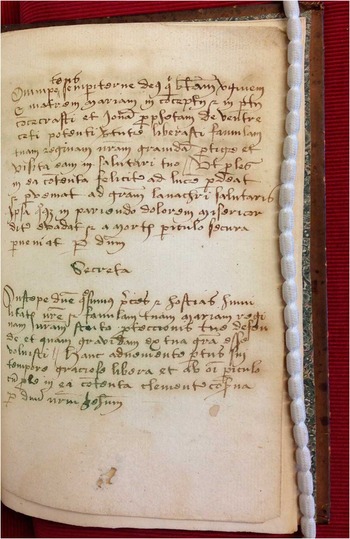
Manuscript additions to the missal at York Minster Library provide evidence of Catholic hopes at this time. Mary married Philip of Spain in July 1554, and the queen was thought to be pregnant in late 1554.Footnote 29 On 27 November of that year, the Privy Council issued a letter to Bishop Edmund Bonner of London, giving thanks for the pregnancy and ordering that priests and other ministers were to pray for the queen during Mass and the Divine Office; the letter (‘A copie of a letter sent from the counsel vnto the ryghte reuerende Father in God Edmonde Byshoppe of London’) was printed by John Cawood, printer to the queen.Footnote 30 Written on the recto and verso of the final leaf bound at the end of the missal are three prayers to be said during the Mass for the success of the royal pregnancy (figs 1a and 1b). They can be transcribed thus:
Omnipo\tens/ semperiterne [sic] deus qui beatam virginem
& matrem Mariam in conceptione & in partu
concecrasti [sic] et Jonam prophetam de ventre
ceti potenti virtute liberasti famulam
tuam reginam nostram grauidam protige [sic] et
visita eam in salutari tuo // Vt proles
in ea contenta feliciter ad lucem perdeat [for prodeat]
& perveniat ad gratiam lauachri salutaris
Ipsa quoque in pariendo dolorem misericor[-]
diter evadat & a mortis periculo secura
perueniat Per dominum
Secreta
Suscepe [sic] domine quesumus preces & hostias humi[-]
litatis nostre & famulam tuam Mariam regi[-]
nam nostram scuto proteccionis tue defen[-]
de et quam gravidam ex tua gratia esse
voluisti // Hanc adueniente partus sui
tempore graciose libera et ab omni periculo
cum prole in ea contenta clementer conserua
per dominum nostrum Jesum
Postcommunionem
Adesto supplicationibus nostris omnipotens
deus et famulam tuam Mariam Reginam
nostram in partu ab omni infortunio clementer
preserva ut proles ejus in hanc lucem edita
percepto lavachro [sic] salutari et graciose
mentis virtutibus et corporis feliciter
proficiat Incrementis per dominum nostrum
Prayers (Oratio and Secreta) for the pregnancy of Queen Mary i, written on a paper leaf bound at the end of the printed Cistercian missal at York Minster. Photograph: © York Minster Library

Prayers (Postcommunionem) for the pregnancy of Queen Mary i, written on a paper leaf bound at the end of the printed Cistercian missal at York Minster. Photograph: © York Minster Library

The prayers can be translated:
Almighty and everlasting God, you who sanctified the most blessed virgin mother Mary in her conception and childbirth and who freed the Prophet Jonah from the stomach of the whale by your mighty power, protect your servant the queen who is heavy with child and visit upon her your deliverance. May the child in her come forth happily and successfully into this world and may it come to the saving grace of the laver [ritual washing, ie the purification of baptism] of salvation, and in addition may she herself mercifully escape the pain of childbirth and remain safe from the danger of death. Through our Lord.
Said in private
Accept, Oh Lord, we beseech you, our humble prayers and sacrifices, and support with your shield of protection your handmaid our Queen Mary, whom you have willed through your grace to be with child. Graciously spare her when her time of delivery comes and mercifully keep her and the child within her safe from all danger. Through our Lord Jesus.
Post-Communion
Attend to our supplications, almighty God, and mercifully spare your servant our Queen Mary from all misfortune in childbirth so that her child, having been brought forth into this world and baptism having been received, may prosper increasingly in health and in the powers of mind and body. Through our Lord.
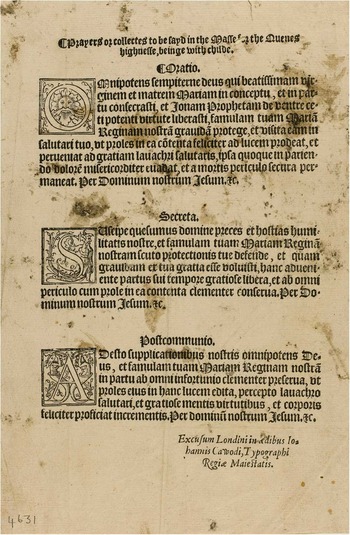
These prayers survive in only one other source, a single small folio sheet, also printed by Cawood, and almost certainly dating from late 1554 (fig 2). Entitled ‘Prayers or collectes to be sayd in the Masse for the Quenes highnesse, beinge with childe’, they are now tipped into the front of a missal of Sarum use printed in Rouen in 1510 by Martin Morin for Jean Richard, which was formerly in the collection of the Anglican clergyman Joseph Mendham (1769–1856).Footnote 31 Both the missal and the sheet with the printed prayers were donated to Lambeth Palace Library in 2014.Footnote 32 There are some differences between the printed and manuscript version of the prayers, including changes in word order and the omission or inclusion of specific words. Nevertheless, these differences are minor. There can therefore be little doubt that the version of the prayers in the missal at York is based on the printed sheet, clearly demonstrating the dissemination of the latter.
‘Prayers or collectes to be sayd in the Masse for the Quenes highnesse, beinge with childe’, printed sheet, and the only other known example of the prayers written in the missal. Photograph: © Sotheby’s

As the prayers were to be said by priests celebrating the Mass, it is no surprise that both surviving versions occur in missals. Their presence in the Cistercian missal at York clearly shows that this volume was still in use during the reign of the Catholic Queen Mary, almost two decades after the fall of the religious houses. The prayers for the queen’s pregnancy provide a tangible link between pre-Reformation monasticism and the Catholic restoration of Queen Mary.Footnote 33 There is considerable evidence that religiously conservative clergy and gentry collected and esteemed former monastic books,Footnote 34 and three of the printed missals known to survive from Yorkshire Cistercian houses display evidence of continued use in the later sixteenth century and beyond.Footnote 35
By the early summer of 1555 it was apparent that Mary was not with child, and when the queen died in 1558, the Catholic revival and hope for the restoration of monastic life died too. This hitherto overlooked missal, which adds to the expanding corpus of liturgical books known to survive from English Cistercian houses, is witness to England’s turbulent religious history in the Reformation era and the hopes for the maintenance of a Catholic dynasty, which would have answered the prayers of dispossessed monks for the restoration of their way of life.
Acknowledgements
My thanks are extended to the anonymous reviewers and Professor James Carley, FSA, Dr James Willoughby, FSA, and Dr Jeremy Ashbee, FSA, for their helpful comments on earlier drafts of this paper. I am also grateful to Alice Bennett and James Young of York Minster Library for allowing me to consult the missal. Charlotte Miller of Sotheby’s, London, patiently answered my questions about books in the Mendham collection. Dr Maria Grasso provided very kind assistance with the Latin translations.