Introduction
During armed conflict, injuries caused by weapons attract much public and medical attention. Reports on wounded people make it into international news, and medical journals regularly report on conflict, health, and injuries.Reference Schneider 1 For decades, humanitarian organizations have developed and run surgical programs in countries affected by armed conflict and have accumulated wide experience in the treatment of injuries inflicted by various types of weapons.
Morbidity and mortality due to traffic accidents have increased in many developing countries as faster means of transport have become more available and affordable. According to the World Health Organization (WHO; Geneva, Switzerland), traffic accidents are a public health issue. 2 During times of armed conflict, people still travel. This ongoing mobility exposes them to the risk of traffic accidents. In contrast to deaths and injuries directly related to violence, victims of traffic accidents rarely are reported by local and international media. Similarly, they are seldom a priority for humanitarian medical interventions or for epidemiological research.
Few data exist on the health impact of traffic accidents compared to weapon injuries in areas of conflict. 3 If available, information is often limited to anecdotal evidence. In this context of scarce data, the present observational study aimed to record, systematically and prospectively, injuries caused by weapons and by traffic accidents, as well as to relate the outcomes of the hospitalized patients. The challenging security situation and difficult working conditions allowed for the collection of data during one month only.
Methods
Setting
The Central African Republic is one of the least-developed countries. In 2013, gross national income per person was US $320/year and life expectancy was 49 years.Reference Sosa and Bhatti 4 A long-standing armed conflict between religious and political factions has exacerbated since 2013.
The capital Bangui has about 750,000 inhabitants. The Community Hospital is one of its larger public hospitals for adults. It offers medical, obstetrical, and surgical care. The International Committee of the Red Cross (ICRC; Geneva, Switzerland) has been working in this hospital since late January 2014 with two to three expatriate surgical teams to provide better care for victims of violence.
Data Collection and Analysis
From February 28, 2014 through March 27, 2014, all surgical patients admitted through the accident and emergency department in the Community Hospital in Bangui were included into this observational study. Patients hospitalized for personal security reasons only and patients dead on arrival were excluded. All patients gave oral consent for the inclusion in the study. The patient’s demographic information, the location of the main injury (coded using the International Classification of Diseases, 10th version 5 ), and the cause of the injury (gunshot, grenade, bladed weapon, or traffic accident) were recorded. The patients were followed during hospitalization, and their outcome (recovery, permanent disability, or death) was recorded prospectively in an anonymized database. Proportions were compared by the χ2-test, group means by Student’s t-test, using the statistical package of Stata (StataCorp; College Station, Texas USA).
Results
Study Population
There were 78 patients, 16 (21%) women and 62 (79%) men. Mean age was 31 years, ranging from 12 years to 70 years. Six (8%) patients died after their admission to the hospital, and five (6%) had a permanent disability. Grenades had caused the injury for 13 (17%), gunshots for 29 (37%), bladed weapon for eight (10%), and traffic accidents for 28 (36%) patients.
Patients injured by weapons were younger than the victims of traffic accidents (mean age=28 years vs 36 years; t=2.95; P=.004) and tended to be male (odds ratio=2.1; 95% confidence interval, 0.59-7.42). The duration of hospitalization tended to be shorter for victims of traffic accidents (median=two days vs five days).
Injuries and Intensity of Violence
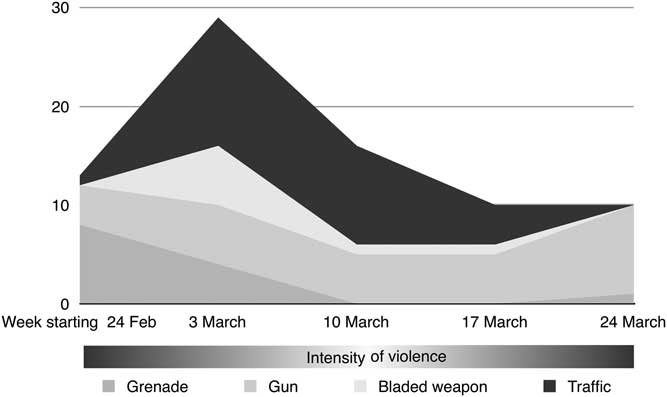
Figure 1 represents the distribution of causes of injuries over time. At the beginning and the end of the observation period, the security situation in Bangui was more tense than during the weeks of March 3rd and March 10th. 6 Accordingly, injuries inflicted by weapons were less frequent during the weeks with better security when traffic accidents accounted for more than half of the admitted patients (χ2=46.8; P<.001).
Distribution of Causes of Injuries Over Time.

Discussion
This study undertaken in Bangui during the armed conflict in early 2014 showed that traffic accidents were a frequent reason for surgical hospitalization, particularly during periods with less-intense violence. There was an inverse relation between the intensity of violence and the proportion of patients admitted due to traffic accidents. During days with heavy fighting, many people preferred not to travel and were therefore safe from traffic accidents.
More men than women were injured by weapons. Usually, men are more actively engaged than women in an armed conflict. The ICRC treats patients without discrimination 7 and has found the same gender imbalance in various war hospitals. 8
The relatively small sample size limits the internal validity of the results. However, the difficult and unstable situation in Bangui did not allow for a larger sample size without compromising the quality and precision of prospective data gathering. Nevertheless, the findings may contribute to a better understanding of the epidemiology of injuries and to generate evidence required to address the surgical needs in low-income countries with armed conflict.Reference Coupland and Samnegård 9
The study indicates that in conflict, injuries unrelated to the fighting are also a major health issue. While medical humanitarian organizations are ready and well-prepared to provide surgical care to war wounded patients, often for free, they are less likely to have the same approach to injuries of other types.Reference Clarke, Allen and Kayabu 10 These organizations should prepare to take care not only of weapon injuries, but also of injuries due to traffic accidents. This implies appropriate clinical expertise, surgical equipment, and an adapted public health approach.Reference Chu, Trelles and Ford 11
Conclusion
This observational study found that during a conflict in a low-income African country, traffic accidents caused relevant morbidity and mortality, along with injuries and deaths related to weapons. Traffic accidents particularly were frequent in periods with less-intense violence. The proportion of hospitalized patients from traffic accidents can vary with the intensity of the conflict, but it is substantial enough to require resources for adequate care. Medical humanitarian organizations should prepare to take care not only of weapon injuries, but also of injuries due to traffic accidents. This implies appropriate clinical expertise, surgical equipment, and an adapted public health approach. Eventually, this might require funding strategies that focus on wider health consequences of armed conflict.
Acknowledgements
Thanks to Dr. Pierre Alfred Issa Mapouka, Director of the Community Hospital, and to the team of the emergency department, for their support. Dr. Robin Coupland provided valuable comments.