Implications
Selection programmes considering longevity and functional traits can contribute to the health status and fertility of the herd. In rabbits, a maternal line established by selecting does with a long productive lifespan has been characterised by a greater reproductive robustness to environmental changes compared with does from a line founded and selected exclusively for reproductive traits. This study highlights the role of body reserves in underpinning the reproductive stability of these robust female rabbits. It also helps understand why they have a longer productive lifespan.
Introduction
In meat-producing rabbits, the high replacement rate of does (e.g. >120%; Ramón et al., Reference Ramón, Rafel and Piles2004) does not seem to be directly related to selection for reproductive intensity (Piles et al., Reference Piles, Garreau, Rafael, Larzul, Ramon and Ducrocq2006). Indeed, negligible genetic correlations between longevity and litter size traits were found in a line selected for litter size at weaning (Sánchez et al., Reference Sánchez, Baselga and Ducrocq2006). However, Rosell (Reference Rosell2003) and Rosell et al. (Reference Rosell, de La Fuente, Badiola, Fernández de Luco, Casal and Saco2009) have described discrete and seasonal factors (e.g. human and/or environmental) associated with an increment in sanitary risks, especially in young high reproductive does (Rosell and de La Fuente, Reference Rosell and de La Fuente2009). If the selection for reproductive intensity does not reduce longevity, but at the same time the environmental factors increase the sanitary risks and thus the replacement rate, the selection for reproductive intensity may have adverse effects on other life functions related to robustness.
Strandberg and Sölkner (Reference Strandberg and Sölkner1996) indicated that the increment of herd health status, fertility and thus the reduction in voluntary culling were all beneficial traits for the inclusion of longevity in the selection index for dairy cows. Similarly, Engblom et al. (Reference Engblom, Lundeheim, Dalin and Andersson2007) observed an overall better reproductive performance and health status of sows culled at ‘old ages’. Such information suggests that animals with long productive lifespans were those that were more able to adapt to a wide range of changing environmental factors (e.g. housing features, climatic conditions and diet) while maintaining adequate productive levels, that is, they are more robust.
This seems to be the case of a maternal rabbit line, called LP, founded by selecting female rabbits of extremely long longevity and a minimum acceptable litter size from a large set of Spanish and Portuguese commercial farms (Sánchez et al., Reference Sánchez, Theilgaard, Mínguez and Baselga2008). Does from line LP were characterised by having an extended lifespan (Sánchez et al., Reference Sánchez, Theilgaard, Mínguez and Baselga2008), a later reproductive senescence (Theilgaard et al., Reference Theilgaard, Sánchez, Pascual, Berg, Friggens and Baselga2007) and a greater adaptability to maintain the productive level in the face of nutritional constraints (Theilgaard et al., Reference Theilgaard, Baselga, Blas, Cervera and Pascual2009), compared with a maternal line exclusively founded and subsequently selected for reproductive intensity (line V; Estany et al., Reference Estany, Baselga, Blasco and Camacho1989). The advantages of LP does were dependent on specific conditions (environmental restriction or high reproductive effort) and seem to be related to the use of their greater soma (i.e. live weight and body reserves) (Theilgaard et al., Reference Theilgaard, Sánchez, Pascual, Berg, Friggens and Baselga2007 and Reference Theilgaard, Baselga, Blas, Cervera and Pascual2009).
However, it is also known that the rabbit lines selected for growth rate, characterised by a high feed intake, growth rate and adult live weight (Estany et al., Reference Estany, Camacho, Baselga and Blasco1992), and also by a reduced reproductive performance (Mehaisen et al., Reference Mehaisen, Vicente and Lavara2004; Vicente et al., Reference Vicente, Llobat, Viudes-de-Castro, Lavara, Baselga and Marco-Jiménez2012), showed an elevated disease incidence, despite having a higher body condition score (Sánchez et al., Reference Sánchez, de La Fuente and Rosell2012). Therefore, robustness in female rabbits seems not to be based solely on their greater body reserves or on their ability to obtain resources (greater intake capacity owing to larger size). It seems likely that the way in which such animals allocate their resources to different life functions, that is, their control of nutrient partition, is a major factor in their robustness (Friggens et al., Reference Friggens, Brun-Lafleur, Faverdin, Sauvant and Martin2012). In this context, it is noteworthy that Ferrian et al. (Reference Ferrian, Blas, Larsen, Sánchez, Friggens, Corpa, Baselga and Pascual2013) observed a better immunological response of LP female rabbits to a lipopolysaccharide challenge.
The above mentioned evidence suggests that the LP line may be classified as robust (Theilgaard et al., Reference Theilgaard, Sánchez, Pascual, Berg, Friggens and Baselga2007 and Reference Theilgaard, Baselga, Blas, Cervera and Pascual2009). However, it is not clear how these animals alter their nutrient partitioning in response to environmental constraints. Therefore, the present study was designed to: (i) characterise in restricted environments the changes in resource acquisition and allocation of female rabbits from a line recently founded on the basis of hyperlongevity, compared with a line founded and selected over 36 generations for litter size; (ii) quantify the consequences on productive performance; and (iii) thus improve our understanding of the possible implications of selection on reproductive intensity for robustness and lifespan.
Material and methods
The experimental proceedings were approved by the Universitat Politècnica de València ethical committee on the protection of animals used in experimentation and other scientific purposes, as established by Royal Decree 1201/2005 (BOE, 2005).
Animals
Female rabbits from two lines differing in foundational criteria and selection degree for litter size at weaning were compared. A total of 164 rabbit females started the trial, 85 from line LP and 79 from line V. The LP line was founded on reproductive longevity criteria by selecting females from commercial farms (indistinctively of its origin; i.e. purebreed or crossbreed of synthetic lines) that had a minimum of 25 partum with more than 7.5 kits born alive per partum (more details of the LP line constitution are given in Sánchez et al., Reference Sánchez, de La Fuente and Rosell2008) and then selected by litter size at weaning for the subsequent six generations. Line V was constituted from four specialised maternal lines into a composite synthetic line and then selected by litter size at weaning (Estany et al., Reference Estany, Baselga, Blasco and Camacho1989) for 36 generations. Both lines are used to produce crossbreed female rabbits destined to commercial farms.
Environments
To evaluate the animal response to environmental changes, three environmental conditions differing in room temperature and/or diet quality were set up. The control environment (NC) was the combination of normal room temperatures [N; 95% confidence intervals of minimum (17.7°C; 19.3°C) and maximum (23°C; 24.7°C) daily registered temperatures] and a control diet (C), similar to commercial diets formulated to cover the requirements of reproductive rabbit does [11.6 MJ DE/kg DM, 126 g digestible protein/kg DM and 168 g of ADF/kg DM]. The heat challenging environment (HC) was achieved by the combination of a high temperature room (H; following a daily sinusoidal variation of 25ºC to 35ºC) and diet C. Detailed information on the design and operating system of the climatic chamber can be found in García-Diego et al. (Reference García-Diego, Pascual and Marco-Jiménez2011). Finally, the nutritional challenging environment (NF) was created by combining normal room temperatures (N) with a low-energy fibrous diet (F), formulated to achieve 9.1 MJ DE/kg DM, 104 g digestible protein/kg DM and 266 g ADF/kg DM, which is clearly below the recommendations for lactating rabbit does (de Blas and Mateos, Reference de Blas and Mateos2010). Ingredients, chemical composition and apparent digestible coefficients of the experimental diets used in the different environments and the DE intake were calculated from digestibilities obtained in each environment, as described at Savietto et al. (Reference Savietto, Blas, Cervera, Baselga, Friggens, Larsen and Pascual2012). Therefore, the DE content of diets consumed by LP and V female rabbits were 12.67 and 12.43 at HC, 11.65 and 11.54 at NC, and 8.95 and 9.12 MJ DE/kg DM at NF, respectively.
Experimental procedure
Female rabbits were raised from birth until 63 days of age, according to a standardised management schedule described by Ragab and Baselga (Reference Ragab and Baselga2011), at which time they were transferred to the experimental farm. During the rearing period (from 63 days old to first partum), animals were subject to standard management with a commercial rearing diet (CP=15.3%, ether extract=2.5%, and crude fibre=23.1% of fresh matter), supplied ad libitum and a daylight scheme of 16 h light and 8 h dark. Young does were first artificially inseminated at 125 days old, reaching the first partum with an average live weight of 3636±294 g (mean±s.d.). At first partum, the does from lines LP and V were randomly assigned to one of the three environments (NC, HC or NF) in a 2×3 factorial design (LPNC=31, LPHC=26, LPNF=28, VNC=25, VHC=29 and VNF=25 rabbit does). Because the availability of animals was limited by the selection nucleus, the initial number of does differed. During the experimental period, which lasted from first until the third partum, does followed a programmed reproductive interval of 42 days, being inseminated at 11 days post-partum (dpp). Non-pregnant does were re-inseminated 21 days later and so on, until a maximum of three consecutive failures, when they were culled for infertility. The number of kits total born and born alive was recorded at each partum. Litters were standardised at birth to nine kits in the first lactation and to 10 kits in the second lactation. Subsequently, dead kits were not replaced. Kits were 28 days old when weaned.
In both lactations, the female rabbit’s live weight was measured at 0, 7, 14, 21 and 28 dpp, whereas perirenal fat thickness (PFT) was measured at 0, 14 and 28 dpp using the ultrasound method described by Pascual et al. (Reference Pascual, Blanco, Piquer, Quevedo and Cervera2004). Milk yield was measured 4 days per week over a period of 4 weeks. In the first 3 weeks, the female rabbits were weighed before having an access to the nest box and just after nursing their kits (i.e. weigh-suckle-weigh method). In week 4, the kits were too big to be confined to the nest space. The does were then placed in new cages, being transferred daily to nurse their kits. Owing to a limited number of cages in the HC environment, this practice was not possible; the female rabbits and their kits shared a common space, making it impossible to control the milk yield. DM intake was monitored weekly during both lactation and weaning to partum intervals.
Blood plasma parameters
Blood samples were collected from the central artery of the ear using tubes with EDTA after a minimum fasting period of 3 h on 0, 14 and 28 dpp. The samples were immediately centrifuged (3000 g during 10 min at 4ºC), and plasma was separated and frozen at −40ºC until further analysis. Samples from 12 does per group [2 lines (LP and V)×3 treatments (NC, HC and NF)] with complete records (for each partum, artificial insemination and weaning time) were analysed for total T3, leptin, non-esterified fat acids (NEFA), β OH-butyrate, lactate and glucose. Total T3 was analysed using the Beckman Coulter ‘Total T3 RIA KIT’ (IM1699-IM3287) (Immunotech AS, Prague, Czech Republic), according to the manufacturer’s guidelines. Intra-assay coefficient of variation (CV) was 7.1% and inter-assay CV was 7.5%. Leptin was analysed by Multi-species Leptin assays (RIA, XL-85K) (Millipore Corporation, Billerica, MA, USA), according to the manufacturer’s guidelines. Intra- and inter-assay CV were 9.1% and 9.3%, respectively. NEFAʼs were determined using the NEFA C ACS-ACOD assay method (Wako Chemicals GmbH, Neuss, Germany). β OH-butyrate was determined as an increase in absorbance at 340 nm owing to the production of NADH, at slightly alkaline pH in the presence of β OH-butyrate dehydrogenase. Sample blanks were included and the method involved oxamic acid in the media to inhibit lactate dehydrogenase as proposed by Harano et al. (Reference Harano, Ohtsuki, Ida, Kojima, Harada, Okanishi, Kashiwagi, Ochi, Uno and Shigeta1985). Glucose and lactate were determined according to standard procedures (Siemens Diagnostics® Clinical Methods for ADVIA 1650). Analyses of NEFA, β OH-butyrate, lactate and glucose were performed using an auto-analyser, ADVIA 1650® Chemistry System (Siemens Medical Solutions, Tarrytown, NY, USA); in all instances, the intra- and inter-assay CV was below 2% and 4%, respectively.
Statistical analysis
A mixed model with a repeated measure design (mixed procedure of SAS, 2009) was used to analyse performance, hormonal and metabolic data of rabbit does until third partum. The model considered the variation between animals and the covariation within them. The covariance structure was modelled using the spatial power function, after objectively comparing among other covariance structures, as suggested by Littell et al. (Reference Littell, Henry and Ammerman1998). The spatial power covariance function is a direct generalisation of first-order auto-regressive covariance function, with the advantage of considering different lag time between repeated measures (i.e. measures on the same individual are continuous). This covariance function is flexible, because for equally time-spaced measurements, the covariance structure is equal to fit a first-order auto-regressive covariance function. The model used to analyse reproductive performance (Table 1) included the line (LP and V), the environment (NC, HC and NF), partum (first, second and third) and their interactions. The model used to analyse performance traits (Table 2) and blood plasma parameters (Supplementary Table S2) included the line, the environment, the reproductive cycle (first and second) and their interactions. This model also included measurement day (different in function of the variable studied; see experimental procedure) and its interactions with line and environment as fixed effects. Finally, the evolution of DE intake, milk yield and PFT was analysed considering the line, the environment, the lactation week and their interactions. All models included the permanent effect of animal  $\big[ {p\,\sim\,N( {0,\sigma _{p}^{2} } )} \big]$
and the error term
 $\left[ {e\,\sim\,N\left( {0,\sigma _{e}^{2} } \right)} \right]$
as random terms. The models for intake (both DM and DE) and milk yield included the average litter size during lactation as a covariate. Serum concentrations of total T3, leptin, NEFA, β OH-butyrate and lactate did not follow a normal distribution; hence, a log10 transformation was applied before analysis. Variables were presented as least square means, and different contrasts were computed to test the effect of the environmental challenge [HC−NC: (LPHC+VHC)/2−(LPNC+VNC)/2 and NF−NC: (LPNF+VNF)/2−(LPNC+VNC)/2] and of the line [LP−V: (LPHC+LPNC+LPNF)/3−(VHC+VNC+VNF)/3] at each reproductive cycle.
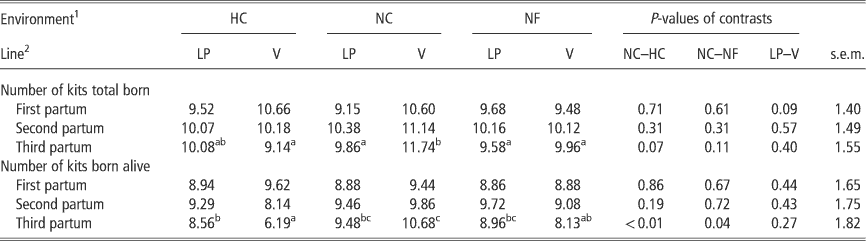
The effect of environment and genetic line on reproductive performance of rabbit does at first, second and third partum

Parity order effect and parity order within environment and line not shown.
1 Environment: HC: high room temperature (25°C to 35°C) and diet C (11.6 MJ DE/kg DM); NC: normal room temperature (18°C to 24°C) and diet C; and NF: normal room temperature and diet F (9.1 MJ DE/kg DM).
2 Line LP, founded on reproductive longevity criteria and then selected for litter size at weaning during six generations; and line V, founded on litter size at weaning and then selected during 36 generations.
a–cValues within a row with different superscripts differ significantly at P<0.05.
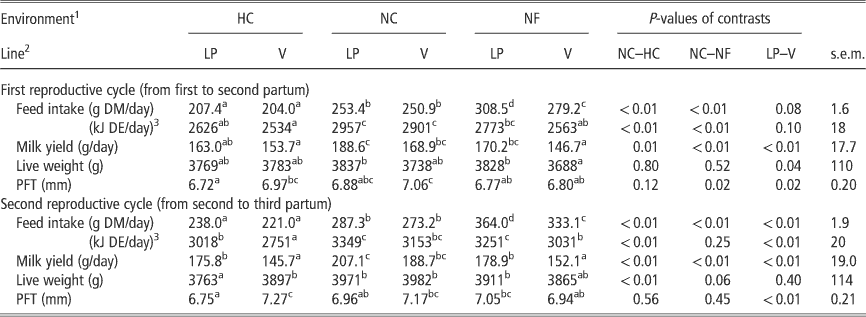
The effect of environment and genetic line on average DM and DE intakes, milk yield, live weight and PFT of rabbit does during first and second reproductive cycles
DM=dry matter; DE=digestible energy; PFT=perirenal fat thickness.
Parity order effect and parity order within environment and line not shown.
1 Environment: HC: high room temperature and diet C; NC: normal room temperature and diet C; and NF: normal room temperature and diet F.
2 Line LP, founded on reproductive longevity criteria and then selected for litter size at weaning during six generations; and line V, founded on litter size at weaning and then selected during 36 generations.
3 DE concentrations (kJ/g DM): HCLP=12.67; HCV=12.43; NCLP=11.65; NCV=11.54; NFLP=8.95; NFV=9.12.
a–dValues within a row with different superscripts differ significantly at P<0.05.
Results
The number of does housed and the number of does reaching the second and third partum are present in the Supplementary Table S1 (available on line). Of the 164 does initially housed, 135 completed the experiment. In the normal temperature room, 11 does fed diet C (five LP and six V) and five fed diet F (four LP and one V) did not finish the experiment. In the HC environment, 13 does (five LP and eight V) failed to reach the third partum. Of these, seven LP (three, one and three at HC, NC and NF, respectively) and two V does at NC were culled, and another seven LP (three, three and one) and 13 V does (eight, four and one at HC, NC and NF, respectively) died.
Independent of the environmental conditions, the conception rate, the weaning to partum interval and the partum to partum interval was similar between LP and V does (Supplementary Table S1). The overall conception rates at first, second and third partum were 89.1%, 59.6% and 67.1%, respectively. The overall interval between the first weaning and second partum was 29.0±13.6 days (mean±s.d.), and between the second weaning and third partum was 25.6±12.6 days. The overall interval between the first and second partum was 57.2±13.6 days, and between second and third partum was 53.6±12.6 days.
Performance traits
The average number of kits total born and born alive is presented in Table 1. At first partum, just before the random allocation of female rabbits to different environments, the average number of total born tended to be higher for V than LP litters (mean difference±s.e.d.:+0.80±0.47 kits; P<0.10). At second partum, regardless of the environment, no significant differences between LP and V were observed either in the number of total born or in the number of born alive. However, V litters had a higher average number of stillborn (+0.74±0.36 kits; P<0.05) than LP.
At third partum, V litters showed a higher number of total born (+1.88±0.94 kits; P<0.05) than LP litters when housed in NC, whereas the difference was not significant for the number of born alive. In this parity, the constrained environments (HC and NF) did not affect the number of total born and born alive for the LP line, relative to NC. However, for the V line, there was a significant reduction in litter size in the constrained environments in terms of total born (−2.59±0.94 and −1.78±0.92 kits for HC and NF; P<0.05) and born alive (−4.49±1.11 and −2.56±1.08 kits for HC and NF; P<0.05), relative to NC.
In general, the HC environment limited the intake of DM (−21%; P<0.01) and DE (−11.5%; P<0.01), and reduced milk yield (−15%; P<0.01) compared with NC. However, the negative effect of high environmental temperatures on live weight was seen only in second lactation (−4%; P<0.01). For does in NF, although the DM intake increased (+16.5%; P<0.01) during the first cycle, a lower DE intake was recorded (−8.9%; P<0.01), impairing both milk yield (−11%; P<0.01) and PFT (−2.7%; P<0.05) compared with NC. During the second reproductive cycle, does in NF also presented a higher DM intake (+24%; P<0.01) than those in NC, resulting in no significant differences between them in DE intake (−3.4%). However, milk yield (−16%; P<0.01) and live weight (−2%; P<0.10) of does housed in NF were lower compared with NC. LP does were characterised by higher feed intake and milk yield than V, both during the first (+5% and +10%; P<0.10) and especially the second reproductive cycle (+7% and +13%; P<0.05). Despite their greater live weight in the first cycle (+2%; P<0.05), LP does showed a lower average PFT than V does in both reproductive cycles (−2% at first and −3% at second). The main values of the productive traits of lactating rabbit does housed in different environments during the first and second reproductive cycles are shown in Table 2.
Figure 1 shows the evolution of DE intake of the LP and V does in the different environments. Although there were some minor differences, the intake curves for LP and V lines were similar in each of the lactations in NC, HC and NF environments but with the DE intake of the LP line being systematically higher than that of line V in NC (+114.2±64.5 kJ/day; P<0.10), HC (+199.2±60.1 kJ/day; P<0.01) and NF (+219.7±61.4 kJ/day; P<0.01).
Digestible energy intake (DE) of LP (▲) and V (○) female rabbits housed in: (a) normal [NC, normal room temperature (18°C to 24°C) and diet C (11.6 MJ DE/kg DM)], (b) heat [HC, high temperature room (25°C to 35°C) and diet C] and (c) nutritional [NF, normal room temperature and diet F (9.1 MJ DE/kg DM)] challenging conditions. Bars represent the standard errors of least square means. WP is the weaning to partum interval. *P<0.05 and †P<0.10.
The evolution of milk yield for LP and V does in the different environments is shown in Figure 2. In NC, LP does always yielded more milk than V, significant at weeks one (+27.7±9.5 g/day) and four (+25.2±9.5 g/day) of first lactation and three (+26.1±10.4 g/day) and four (+35.2±10.4 g/day) of the second. The higher milk yield of LP does was also observed in the second lactation on HC (on average +31.8 g/day; P<0.05), although it was similar for both lines during first lactation. On NF, LP does also yielded more milk than V does being significantly different at mid-lactation of the first (29.5 g/day; P<0.01) and second cycle (33.12 g/day; P<0.01). The milk yield differences observed between LP and V does during lactations followed the DE intake pattern.
Milk yield (MY) of LP (▲) and V (○) female rabbits housed in: (a) normal (NC), (b) heat (HC) and (c) nutritional (NF) challenging conditions. Bars represent the standard errors of least square means. WP is the weaning to partum interval. *P<0.05 and †P<0.10.
The evolution of PFT is presented in Figure 3. Independent of the environment, line or reproductive cycle, an accretion phase was observed during the first 2 weeks of lactation, whereas the evolution from this point to weaning, most frequently a mobilisation of PFT, was more dependent on DE intake and milk yield. Does of line V had greater PFT than LP does in the NC environment (+0.23±0.09 mm; P<0.01). This difference was accentuated in the HC environment (+0.35±0.08 mm; P<0.01), whereas in the NF environment the difference was reduced and became non-significant (+0.01±0.08 mm).
Perirenal fat thickness (PFT) of LP (▲) and V (○) female rabbits housed in: (a) normal (NC), (b) heat (HC) and (c) nutritional (NF) challenging conditions. Bars represent the standard errors of least square means. WP is the weaning to partum interval. *P<0.05 and †P<0.10.
Blood plasma parameters
The effect of environment and line on the concentrations of serum parameters is presented in Supplementary Table S2 (available online). No significant differences between lines were observed for any monitored plasma parameters of does. Only the lactate concentration of LP and V does differed during the second reproductive cycle on NF (2.61 and 3.40 mM, respectively; P<0.05). Although no significant differences were observed between LP and V does in HC, they showed a different response to this environment in respect to NC. Whereas LP does in HC reduced both lactate (at first cycle) and total T3 (at second cycle), line V increased the levels of β OH-butyrate and NEFA (only at second cycle). In a similar way, each line showed distinct responses to the NF environment compared with NC. Thus, LP does in NF had low levels of leptin in the first cycle, and low levels of NEFA in both cycles. In contrast, the response of V does to the NF environment was a reduction in lactate concentration during the first cycle. Moreover, both lines responded to the NF environment by increasing the β OH-butyrate levels.
Discussion
The designed environments aimed to produce different physiological constraints on female rabbits. The direct consequence of this was observed in the DE intake. Does subject to high temperatures (HC) had a DE intake reduction of −12% and −11% in the first two reproductive cycles, whereas the bulk feed generated by the fibrous diet (NF) resulted in a DE intake reduction of −9% and −3%, in first and second reproductive cycle, respectively. These responses confirm, on the one hand, the rabbit’s capacity to avoid excessive heat load by reducing the feed intake when exposed to high temperatures (Cervera and Fernández-Carmona, Reference Cervera and Fernández-Carmona2010), and on the other hand to partially compensate for a low-dietary-energy density by increasing the feed intake on feeds with an energy content below 9.0 MJ DE/kg DM (Fernández-Carmona et al., Reference Fernández-Carmona, Alqedra, Cervera, Moya and Pascual2003). It is also important to note that does were allocated to harsh environments just after first partum, a period of great energy demand because of milk production and the need to recover body reserves (Xiccato et al., Reference Xiccato, Bernardini, Castellini, Dalle Zotte, Queaque and Trocino1999; Pascual et al., Reference Pascual, Motta, Cervera, Quevedo, Blas and Fernández-Carmona2002). Thus, in the first lactation, the constrained does have to cope with the same litter size as non-constrained does (litters were standardised at partum). The situation in second lactation is different because the harsh environments were also applied during that pregnancy.
Genetic differences in NC environment
In the present study (i.e. with relatively few animals), just before the allocation of animals to different environments (i.e. after first partum), V does did not have significantly bigger litters (+0.80 kits total born and +0.44 kits born alive) than the LP does. However, the V does produced significantly larger litters at third partum (+1.88 kits total born and +1.20 kits born alive) in unconstrained conditions (NC). These values are in agreement with a large-scale study (>200 does per line; Sánchez et al., Reference Sánchez, Theilgaard, Mínguez and Baselga2008) that reported higher total born (+0.74 kits), born alive (+0.77 kits) and weaned kits (+0.54) during the first three partum for V does as compared with LP does.
The main differences between LP and V does in the NC environment were observed in the evolution of DE intake, milk yield and PFT. In both lactations, LP seemed to adapt the DE intake and milk yield to the litter requirements, avoiding the accumulation of PFT. Line V, in contrast, seemed to adjust the DE intake and milk yield to ensure a higher PFT at weaning. The effort of V does to accrete more PFT than LP does was also observed by Theilgaard et al. (Reference Theilgaard, Baselga, Blas, Cervera and Pascual2009), but cannot be clearly elucidated from Theilgaard et al. (Reference Theilgaard, Sánchez, Pascual, Berg, Friggens and Baselga2007). However, Theilgaard et al. (Reference Theilgaard, Sánchez, Pascual, Berg, Friggens and Baselga2007) observed a tendency of V line to sustain the PFT level across parities, whereas the LP line was more flexible. In addition, Theilgaard et al. (Reference Theilgaard, Sánchez, Pascual, Berg, Friggens and Baselga2007 and Reference Theilgaard, Baselga, Blas, Cervera and Pascual2009) reported higher live weight of LP does compared with V does. In the present study, LP and V does had similar live weight. A likely reason for this difference between studies is the difference in the reproductive rhythm adopted in each one. When the reproductive rhythm was less intense (insemination at 25 or 30 dpp), the initial live weight differences between lines were maintained (Theilgaard et al., Reference Theilgaard, Sánchez, Pascual, Berg, Friggens and Baselga2007 and Reference Theilgaard, Baselga, Blas, Cervera and Pascual2009), whereas when it was more intense (insemination at 4 or 11 dpp) the live weight differences disappeared (Theilgaard et al., Reference Theilgaard, Baselga, Blas, Cervera and Pascual2009).
Genetic differences in HC environment
The reductions in DE intake observed during the whole experimental period for does from lines LP and V were −12% and −18%, respectively. This was less than the DE intake reduction of −35% reported by Fernández-Carmona et al. (Reference Fernández-Carmona, Alqedra, Cervera, Moya and Pascual2003) in crossbreed rabbit does housed at a constant high temperature (30°C). The lower DE intake restriction observed in the present study may be related to the climatic chamber programme, which was set up to produce a daily sigmoid temperature curve from 25°C to 35°C, and thus allowed the does to concentrate meals in periods of reduced temperature (25°C), alleviating the effects of heat stress.
During the first lactation, the main differences between LP and V does in DE intake and milk-yield profiles were reduced relative to the differences between LP and V does in the NC environment. LP does adjusted their milk production and PFT use to the level of DE obtained, whereas does from line V generally showed a linear PFT accretion pattern during the whole lactation. This difference persisted even in the fourth week of lactation in HC, despite the LP does having a greater DE intake.
However, despite the above-mentioned differences, both LP and V does had a similar number of kits total born and born alive at second partum in HC environment. Thus, it seems that even under constrained conditions, the V line was able to sustain the reproductive effort by privileging body reserve accretion in the second part of lactation, ensuring thus a high reproductive performance in the subsequent partum. The LP does had achieved similar results by increasing the DE intake.
The ability of LP does to increase the DE intake under high temperatures may be associated with a reduced metabolic rate evidenced by a reduction in the total T3 (−0.081 log10 nM; P<0.05) and lactate (−0.079 log10 ng/ml; P<0.05) levels at HC compared with NC. Moreover, a reduced metabolic rate in the HC as compared with the NC environment may explain the different responses of these two lines.
The different strategies used by the LP and V does to ensure an adequate reproductive level in the first lactation was confirmed at the second reproductive cycle. Does from the LP line used the greater intake to ensure both milk yield and litter size at third partum without increasing the PFT levels, and also appeared to reduce the metabolic rate compared with the LP does in NC (i.e. lower total T3). The V does seem to base their reproductive success on ensuring they had ample body reserves (PFT). However, after an intense accretion of PFT reserves during the first half of the second lactation, a mobilisation period was established ending at third partum. Indeed, compared with NC, the V does in HC showed higher levels of NEFA and β OH-butyrate. High NEFA serum concentration may be related to a reduction in the number of born alive (−2.1 kits in does submitted to fasting until 2 h before insemination; Brecchia et al., Reference Brecchia, Bonanno, Galeati, Federici, Maranesi, Gobbetti, Zerani and Boiti2006). The intense PFT mobilisation of V does throughout the gestational period impaired their reproductive performance (−4.5 kits born alive compared with NC), probably as a consequence of subclinical ketosis.
Genetic differences in NF environment
Does eating a low-energy high-fibre diet could not fully compensate for the decrease in DE feed content, despite increasing their DM intake. Therefore, a lower milk yield and PFT was observed during the first lactation, compared with does in NC. However, there was an adaptation to this diet in terms of DM intake capacity, so that the NF does increased the intake by 26.6 g/day between the first and second reproductive cycles. This almost allowed DE intake compensation (−3.4% compared with NC) but not for milk yield (−16.4% compared with NC), because of the lower efficiency for milk yield of the DE ingested coming from high-fibre diet (Fernández-Carmona et al., Reference Fernández-Carmona, Cervera, Sabater and Blas1995). Does in NF had a similar milk yield in both lactations, whereas the milk yield at NC increased in the second lactation (+19.2 g/day).
Furthermore, the response to the NF environment seemed to have a genetic component. This was evident in the reproductive performance observed in NF. The higher feed intake capacity of LP does allowed an ingestion of +219.7 kJ DE/day more than V does in NF throughout the experimental period. This higher DE intake allowed the LP does to sustain the number of kits total born and born alive and an adequate milk production to nurse the current litter, without affecting the development of the future one. In fact, the LP does in NF and V does in NC yielded a similar amount of milk, especially during the first reproductive cycle. In contrast, the inability of V does to acquire resources in the NF environment was clearly seen by a lower milk yield (−22.1 g/day; P<0.05) and PFT (−0.26 mm; P<0.05) compared with NC, with the latter perhaps negatively affecting the number of total born (−0.98 and −1.78 kits at second and third partum, respectively). As the reproductive success of V line seemed to be based on the accretion and use of fat reserves, their low PFT values on NF led to a clear reduction in the number of total born at second and, especially, third partum. This also affected the number of born alive at second and third parity (−0.78 and −2.55 kits, respectively).
Environmental sensitivity reasons
Theilgaard et al. (Reference Theilgaard, Sánchez, Pascual, Berg, Friggens and Baselga2007) made two main observations, which, together with the present results, give a new insight to better understand and describe the relationship between body reserves, reproduction and survival. They first observed that the V does maintained their litter size during a stress period but not after it, and contrary to LP does, they showed a greater PFT mobilisation. Therefore, the hypothesis that reproduction in V does depends more on the use of body reserves than that in LP does that sustain it by increasing intake and maintaining PFT seems plausible.
The variations that occur in the environments experienced by rabbits on commercial farms have been described (Rosell et al., Reference Rosell, de La Fuente, Badiola, Fernández de Luco, Casal and Saco2009; Rosell and de La Fuente, Reference Rosell and de La Fuente2009). These variations were present in the commercial rabbit farms of Portugal and Spain where female rabbits used to establish the LP line came from (Sánchez et al., Reference Sánchez, Theilgaard, Mínguez and Baselga2008). This may explain the greater robustness (Theilgaard et al., Reference Theilgaard, Sánchez, Pascual, Berg, Friggens and Baselga2007 and Reference Theilgaard, Baselga, Blas, Cervera and Pascual2009) and the extended reproductive lifespan of LP does (Sánchez et al., Reference Sánchez, Theilgaard, Mínguez and Baselga2008). This study emphasises the role of body reserve usage in providing rabbits with adaptive capacity and are in agreement with previous findings. Theilgaard et al. (Reference Theilgaard, Sánchez, Pascual, Berg, Friggens and Baselga2007) and Sánchez et al. (Reference Sánchez, de La Fuente and Rosell2012) showed that any deviation from an adequate body condition increases the health risks in rabbit does. Ferrian et al. (Reference Ferrian, Blas, Larsen, Sánchez, Friggens, Corpa, Baselga and Pascual2013) also observed that the maintenance of body reserves under an immunological challenge with lipopolysaccharide provided an advantage for LP does compared with V does. It should be noted that it is not just the level of body reserves but also their rate of usage that is important. In this context, Rosell and de La Fuente (Reference Rosell and de La Fuente2009) reported the greatest mortality risk to be at the end of gestation, the period of greatest mobilisation of body reserves (Quevedo et al., Reference Quevedo, Cervera, Blas, Baselga, Costa and Pascual2005 and Reference Quevedo, Cervera, Blas, Baselga and Pascual2006). Therefore, the ability of LP does to sustain reproduction in the different environments without presenting great deviations in PFT levels and its ability to use reserves at the onset of constraints (Theilgaard et al., Reference Theilgaard, Sánchez, Pascual, Berg, Friggens and Baselga2007) seems to be a safeguarding factor to ensure both reproduction and longevity.
Acknowledgements
The authors thank Juan Carlos Moreno, Luis Ródenas and Eugenio Martínez-Paredes for their technical support and the Spanish Ministry of Education and Science (Project AGL2011-30170-C02-01) for the budget to conduct this study.