INTRODUCTION
Law enforcement, broadly defined as the implementation of national criminal laws by agencies such as the police, is not only one of the most apparent representations of the state in Africa. It has also become the focus of recent institutional reforms in African states. In particular, the question of how law enforcement agencies are governed in new democracies has led to a variety of policy studies and donor initiatives. Contributions to this journal have been very critical of these studies and initiatives (Hills Reference Hills2007: 403–5; 2008: 215–17).
This article seeks to take this critical approach to law enforcement governance further by drawing on the case of drug law enforcement in Nigeria. Drug law enforcement is a specific type of law enforcement. It enforces legal prohibitions on the consumption, trade and production of drugs, such as heroin, cocaine and cannabis, and may be executed by a specialist unit of the police, or by a specialist police agency – as is the case in Nigeria. While this specialist agency has a narrower mandate, its day-to-day work, such as patrolling and criminal investigation, as well as its governance, is comparable to that of the police force (Foster & Bowling Reference Foster, Bowling, Morgan, Reiner and Maguire2002: 987–96). Insights from police studies apply to drug law enforcement, and lessons from Nigerian drug control may therefore further our understanding of law enforcement governance in general.
Drug law enforcement in Africa has recently received much attention from policy makers and academics. Their main concern has been the danger of drug trafficking to West Africa and the inadequacy of enforcement responses (Ellis Reference Ellis2009; Mazzitelli Reference Mazzitelli2007; UNODC 2007, 2008). Nigeria is central to these concerns, as it is one of the countries most affected by illegal drug flows through Africa, and its nationals feature high in international arrest rankings. Nigeria has also one of the longest experiences of drug law enforcement in West Africa, with a specialised agency founded in 1989. In recent years, domestic and international law enforcement officials have started to promote the Nigerian approach to drug law enforcement as a model for other agencies in Nigeria and West Africa.
This article uses the case study of Nigerian drug law enforcement to draw comparative lessons for law enforcement governance. It emphasises the empirical dimension of drug law enforcement governance in Nigeria, rather than developing any new theoretical framework on how to view African law enforcement. This empirical focus is important, as little empirical work exists on law enforcement in Africa and much of it is based on hearsay or media sources (Hills Reference Hills2000: 3; Marenin Reference Marenin1982: 385). This article uses documentary sources collected during a window of access to the Nigerian drug enforcement agency in 2005 and 2007, as well as interviews with law enforcers, drug control experts and drug market insiders.
EXISTING RESEARCH ON LAW ENFORCEMENT
The great majority of studies of African law enforcement have been conducted by researchers who are either part of or close to the policy-making process in international organisations and governmental bodies (Hills Reference Hills2007: 405). Such studies deal with crime, law and its enforcement in a technical and politically neutral way. They are narrowly concerned with the effectiveness of law enforcement in terms of reducing crime or maintaining order. These approaches ignore the political dynamics that influence policy making and implementation, as well as the political process of defining crime problems.Footnote 1 Crime is seen as a given, and law enforcement as a domain for technical experts. Such studies rarely probe the underlying reasons for increases in armed robbery, drug trafficking and official corruption in West Africa, and do not question nationally reported crime statistics.
The United Nations (UNODC 2008) report Drug Trafficking as a Security Threat in West Africa is a good example. It defines West Africa's drug problem in terms of rising government-reported drug seizures, and argues for an improved criminal justice system in West African countries to stem the tide of cocaine flowing through the region. It does not assess the government-generated data that it uses, or attempt to place drug smuggling within larger global drug market developments, or the domestic economic dynamics underlying drug smuggling. Questions about political interests behind policy making are simply brushed aside. Instead, a strengthened criminal justice and policing system, most likely based on UN technical assistance, is the major policy reform proposed. Most other policy-oriented research applies a similarly apolitical approach to crime and law enforcement in Africa.
Apart from some historians of colonial policing, few academics have seriously studied law enforcement in Africa (Anderson & Killingray Reference Anderson and Killingray1991, Reference Anderson and Killingray1992; Tamuno Reference Tamuno1970). This is despite repeated claims about the importance of research on law enforcement agencies, which are one of the most apparent manifestations of the state in Africa (Marenin Reference Marenin1982: 379). In relation to drugs and law enforcement, Jean-Francois Bayart, Stephen Ellis and Beatrice Hibou (1999) have made the most far-reaching claims in their work on the so-called criminalisation of the African state. The ever growing drug trade through West Africa and direct involvement of law enforcement agents in this trade have been their core evidence for the process of state criminalisation (see also Wannenburg Reference Wannenburg, Clapham, Herbst and Mills2006).Footnote 2
Interestingly, these authors make the same mistake as much of the policy-driven research on law enforcement and drugs. They reproduce media reports or use official statements about drug markets without seriously considering the politics behind these statements. For instance, UN claims about Africa's growing role in drug transit and characterisations of Nigeria as one of the world's major heroin hubs in the mid 1990s have been central to academic arguments on the criminalisation of the state and economy (Bayart et al. Reference Bayart, Ellis and Hibou1999: 9–12, 29–31; US INL 1986: 285; 1994: 433–4; 1995). However, such claims do not simply reflect empirical evidence on West African drug trends, which at the time showed that African heroin and cocaine seizures accounted for less than 1% of global seizures (UNDCP 1998: 17–18). They also represent the drug control industry's political interests, as a means to attract donor attention to underfunded UN agencies. The claims of so-called technical experts thus need to be reassessed, in the light of the underlying political and bureaucratic interests involved.
Jean and John Comaroff (Reference Comaroff, Comaroff and Comaroff2006a, Reference Comaroff, Comaroff and Comaroff2006b), in their work on law and order in the postcolony, are more aware of these political dynamics when they describe the links between discursively constructed crime problems and law enforcement. These crime problems help, above all, to justify the work and continued existence of law enforcement agencies. In their view, crime is no longer a neutral and objectively measurable phenomenon, but is part of the larger politics of order and control in the postcolony. Unfortunately, their theorisations are not supported by sufficient empirical evidence.
More empirically grounded academic research on law enforcement is rare. Alice Hills's recent work on policing is exceptional in this respect. She is also critical of official research on police governance, which has tried to assess the accountability of police forces in new democracies such as Nigeria, and argues that the transition to democratic rule has done little to change the politicised and repressive nature of law enforcement agencies. In Nigeria, police commissioners have been part of political patron–client networks and have consequently always depended on the president who appointed them. In return for presidential support, commissioners serve presidents and ruling elites by enforcing order. Generally, police action is an expression of presidential preference. This ‘complete accountability’ to presidents and ruling elites is most apparent during elections, when police officers intervene to support the incumbents and suppress the opposition. The question of law enforcement's accountability is therefore redundant (Hills Reference Hills2007: 411–20; 2008: 225–6).
Hills's account of the police is largely valid for drug law enforcement in Nigeria. The central drug control body, the National Drug Law Enforcement Agency (NDLEA), and its chairman have clearly belonged to political patron–client networks. For instance, in the 1990s the head of the agency was a close friend of General Abacha and this relationship increased financial flows to the drug bureaucracy. These personal ties also partly explained why the brutal implementation of the drug war focused on the stronghold of the opposition to Abacha in south-western Nigeria. After 1999, personal ties between the new head of the agency and the vice-president were close. This guaranteed some level of political support to the drug bureaucracy at least until 2005, when the vice-president fell out of political favour with the president. The relationship between the head of law enforcement agencies and the president was thus an important variable in the governance of drug law enforcement in Nigeria (NDLEA director general 2005 int.).
Despite Hills's more informed view, there remain two problems with her assessment of African law enforcement. First, she analyses police forces primarily through personality centred patron–client relations. Police forces are almost exclusively represented by their commissioner, his personal characteristics, and his personal ties to presidents and big men. Political dynamics within the police force and between the police and other state institutions are often determined by the ethnicity, personality and personal connections of individuals, such as police commissioners or presidents (Hills Reference Hills2007: 418). There is clearly more to the politics of law enforcement than the personalities and personal ties of commissioners and presidents. There are important institutional interests, foreign interventions and structural processes involved, which help to explain the nature of law enforcement and how it is governed.
Second, much of this emphasis on ‘big man’ politics is a product of the limited sources available on law enforcement. In particular, media sources tend to represent the police and the state as a mass of corrupt officials headed by an all-powerful commissioner or president. With some media reports on law enforcement, it is also impossible to distinguish fact from rumour.Footnote 3 In contrast, the following analysis of the politics of drug law enforcement in Nigeria is based on documentary data from within law enforcement agencies and on interviews with law enforcers.Footnote 4 By using this set of data, my intention is not to defend the often violent, corrupt and ineffective work of drug enforcers, but to provide a more accurate assessment of drug law enforcement governance in Nigeria.
The next section describes law enforcement officials' own views of Nigerian drug problems and drug law enforcement. The subsequent sections assess the political and institutional dynamics hidden by this dominant official narrative of drug war, i.e. the processes of centralisation, exclusion and repression, as well as shifting bureaucratic interests since Nigeria's democratic transition. The article argues that only if patron–client relations are seen in the context of larger-scale institutional dynamics and bureaucratic interests, is an assessment of law enforcement governance in Nigeria possible.
NIGERIAN DRUG LAW ENFORCEMENT
Law enforcers' own views: crisis, correction and success
From a review of Nigerian drug policy statements and law enforcement publications since 1989, as well as interviews with law enforcers, official views of Nigerian drug control appear to have changed only slightly since the late 1980s. The prevalent official narrative of Nigerian drug control has always included three core elements: crisis, correction and success.
Nigeria's drug problem and law enforcement reactions are commonly seen as a product of the oil-based economic boom and the subsequent years of economic, political and social crisis. In the discourse of military governments since the regime of General Buhari, as well as the majority of drug law enforcers interviewed, the rise in heroin and cocaine trafficking since the mid 1980s has been a symbol of a large-scale crisis of Nigerian society and state.
This crisis has always been twofold. First, drug trafficking has symbolised a social crisis of illegitimate wealth or what is referred to as the ‘quick-rich syndrome’ (Apter Reference Apter, Comaroff and Comaroff1999: 296–9). A prominent Nigerian magazine illustrated this crisis in 1985:
Oil boom. The big contracts. Billions. Billions. Then million. Then a burst. And the contracts vanished. Nigeria abhors a vacuum in the money-making business, the coke man came along. At first slowly, imperceptibly, then furiously. A new life style had happened, a life style of drugs smuggling and sniffing … Nigerians, with a sharp nose for profit, smelled their way into the glamorous, greasy, grave-ground of drug traffic (Newswatch 4.2.1985).
Second, drug trafficking has also meant a crisis of Nigeria's international image. Since the earliest anti-drug policy, Nigerian drug control has aimed to improve the government's international reputation. This reasoning even appeared explicitly in several Nigerian drug laws. For instance the legal basis of Nigeria's current drug enforcement system states that the ‘government is deeply concerned about the magnitude of and rising trend in the demand for and traffic in narcotic drugs and psychotropic substances which adversely affect the international image of Nigerians and Nigeria’ (NFMG 1989). Governmental and law enforcement efforts have been responses to these two dimensions of the Nigerian crisis.
The response to this crisis has been a military-style campaign of social correction aimed at reforming Nigerian society. Since the Buhari regime, social reform has been an integral part of military government discourse. The War Against Indiscipline in the 1980s tried to impose a culture of queuing and sanitation on Nigerians (Graf Reference Graf1988: 164–5; Othman Reference Othman, O'Brien, Dunn and Rathbone1989: 137). In the field of drug law enforcement this meant the declaration of drug wars, which aimed to educate Nigerians about the dangers of drugs, and targeted drug smugglers at the country's ports and producers of domestically grown drugs, such as cannabis. Crude official messages about the social and image-related dangers of drugs were underpinned by the brute force of the law enforcement apparatus.
According to most drug enforcers, these campaigns started to be successful in the second half of the 1990s, when the military government made the drug war a top political priority. This drug war was able to stop the ever-increasing tide of illegal drugs shipped through Nigeria, and reduced the high level of corruption at Nigerian drug enforcement institutions. To support this claim of success, law enforcers point to increasing drug seizures as measures of performance, as well as approval messages from US and UN drug agencies.Footnote 5 Nigeria's drug wars were so successful at ‘combating the drug menace’ that Nigeria today serves as a model for successful African drug law enforcement. Nigerian law enforcers now pride themselves on coordinating West Africa-wide enforcement campaigns and on training many of the sub-region's law enforcers (NDLEA chairman, NDLEA director 4 2005 ints.).
This narrative of crisis, correction and success has been dominant not only among the majority of Nigerian drug enforcers since the late 1990s, but also among international drug enforcement officials dealing with Nigeria. Nigeria has started to serve as a model of drug law enforcement success in Africa since the late 1990s, when the NDLEA was praised as Nigeria's ‘most professional body’ and the ‘one indigenous force’ combating drug trafficking (US INL 1997, 1999, 2000). Since 2000 Nigerian drug enforcers have trained other African enforcers at a UN-sponsored academy in Jos, and the Nigerian drug agency has coordinated West Africa-wide enforcement operations sponsored by the US government. Today, in the eyes of Nigerian and foreign drug policy makers and implementers, Nigerian drug law enforcement serves as a model for much of West Africa.
Crisis in practice: stable drug markets
There are however serious problems with this law enforcement narrative of crisis, correction and success. The most apparent is that it assumes a development of drug market trends that is not supported by the available empirical evidence. Recurring wars on indiscipline, corruption and drugs have neither been primarily driven by trends in the drug market, nor have they had much effect on the drug market.
Heroin smuggling through Nigeria already existed before the end of the oil boom (former heroin and cocaine smuggler 2005 int.). Cannabis has been cultivated in West Africa at least since the 1930s (Akyeampong Reference Akyeampong2005: 432–4). Neither heroin nor cannabis attracted much political attention until military rulers declared them to be symbols of Nigeria's crisis. For instance, the already consolidated and prospering cannabis market was only rediscovered by Nigerian law enforcement in the second half of the 1990s. Then, law enforcement officials argued that ‘an epic proportional rise in cannabis trafficking is expected before the heavy hand of the law catches up totally with its traffickers in Nigeria, as happened to cocaine and heroin peddlers of the 1980s’ (Drug Salvation Force 1.7.1997).
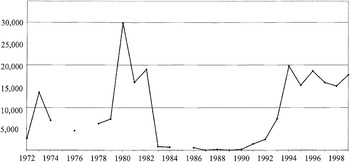
In fact, cannabis only became a problem for Nigeria when law enforcement started to focus on it. This is well illustrated by Figure 1, showing cannabis seizures by Nigerian law enforcers. Seizures abruptly declined in the late 1980s, just when cocaine and heroin became major policy concerns. In essence, cannabis and other drugs were only rediscovered when they fitted into the law enforcement narrative of social crisis.
Reported cannabis herb seizures in Nigeria (kilogram), 1972–1999.
Note: Figures are based on annual Nigerian reports to the UN Commission on Narcotic Drugs (CND) for the 1972 to 1989 period and on NDLEA figures for the 1990 to 1999 period. Sources: UN CND 1975–91; NDLEA 2005b.

Similarly, reductions in heroin and cocaine trafficking, cannabis use and cultivation have, at most, been temporary. The available evidence shows no great success story. The transit trade in heroin and cocaine has been fairly stable since the 1980s, and cannabis use and production has slightly expanded, largely due to growing demand and because cannabis has been a chief means of agricultural diversification (Bernstein Reference Bernstein1999: 30; Laniel Reference Laniel2006). A long-term view of heroin, cocaine and cannabis seizures shows that, besides some temporary and sharp increases due to a few exceptionally large seizures, the available figures reflect a rather stable market for these three drugs (NDLEA 2005b; UN CND 1975–1991). Hence, the relative stability of the drug market contradicts the narrative of crisis, correction and success.
In addition, shifts in seizures do not necessarily reflect market trends, even though this is always claimed by law enforcers, but are as much a reflection of law enforcement efforts. More fundamental shifts in heroin, cocaine and cannabis markets were probably due to larger-scale economic dynamics in Nigeria and globally. The law enforcement narrative intentionally ignores such dynamics, as it has no power over them.
By comparing the claims about Nigeria's drug problem with the available drug market information, it becomes apparent that crime problems were actively shaped by law enforcement agencies for their political purposes. Enforcers could claim that their actions led to a containment of a specific problem and justify their institutional existence. This discursive construction of Nigeria's crime problem, as described by the Comaroffs (2006a) in the South African case, has been relatively successful in Nigeria. Today, there is no significant counter-narrative left in official and public debates about drugs and drug control. The following section shows how institutional processes of centralisation and exclusion contributed to this dominance and persistence of the law enforcement narrative.
Correction in practice i: centralisation and exclusion
The simple narrative of crisis, correction and success, which is today promoted both domestically and internationally, obscures important institutional dynamics underlying Nigerian law enforcement and its governance, hiding drug law enforcement's centralisation, exclusion of alternative views, and emphasis on repressive methods.
Since the late 1980s, drug control has become monopolised in the hands of a single agency dealing with drug investigations, prosecution and demand reduction. Before 1989, various actors, such as the Ministry of Health, Nigeria Police Force, and Customs Service, shared responsibility for the control of drugs in Nigeria. But since its foundation in 1989, the NDLEA has been the centre of national drug control. Centralisation of drug policy functions into one enforcement outfit was the military government's answer to international drug control pressures and government concerns over its image abroad. The NDLEA not only became the main implementer of drug policy in the field of investigations, prosecution and demand reduction; it also started to supervise all other implementing agencies in the field and initiate new drug policies.
With such extensive powers, the NDLEA is exceptional among world drug enforcement bodies. The US Drug Enforcement Administration, for instance, handles neither drug prosecution nor demand reduction. The Ghanaian Narcotics Control Board is chiefly a policy-making body which leaves the implementation of policy to the Narcotics Unit in the Ghanaian police and the Ministry of Health (Bernstein Reference Bernstein1999: 23–4).
The only aspect of drug control that the NDLEA has never captured is the control of the legal use of drugs, which is covered by the National Agency for Food and Drug Administration and Control (NAFDAC), which regulates and controls the legal trade and use of food, drugs, water and chemicals. Drugs such as morphine for medical use are one part of the wider regulatory work of NAFDAC. Unlike its illegal drugs sister agency, NAFDAC has few policy-making powers and concentrates on the implementation of policy (Alemika Reference Alemika1998: 44–5).
In 1994, the centralisation trend went further. Abacha appointed a general as NDLEA chairman, who in turn concentrated decision-making powers inside and outside the drug agency. Interviewees recounted how every minor internal decision required the signature from the agency's military chairman (NDLEA chairman 2005 int.). In addition, the agency's policy-making board was abolished. This had acted as a forum for non-NDLEA officials to influence and check NDLEA powers and policies, as it included members from various state agencies concerned with drugs. The lack of a board meant that drug policy making as well as implementation powers were concentrated in the hands of the NDLEA chairman, who had very close personal ties to Abacha (NDLEA assistant director 1 2005 int.). At this point, the NDLEA became almost untouchable in the national drug control set-up.
Some institutional changes occurred with the transition to democratic rule in 1999. The National Assembly regained its powers to check the executive, especially in its specialised drugs and crimes committees and through the budgeting process. However, the legislature has been able neither to amend the centralised drug control framework nor to seriously influence the drug law enforcement budget, which was essentially determined by the president (Nigerian senator 2005 int.). On the executive side, the framework established under military rule in 1989 has largely survived the democratic transition. Except for the re-instatement of the NDLEA policy board, which still remains under the control of the agency chairman, no major institutional changes have been initiated. Internally, agency decision making is now dominated by two to three key officials with close links to the agency chairman and international drug agencies. In the field of illegal drug control the NDLEA has retained exclusive powers over policy making and implementation. Therefore, the historical trend of centralising drug control into one agency, and with it the exclusion of other state actors, has not significantly changed since 1999.
Beyond the institutional level, this centralisation has also meant the conscious exclusion of alternative views on Nigeria's drug problem since the late 1980s. Doctors, academics, NGOs and the media have been excluded from the policy making and implementation process. In the 1960s, medical professionals had been particularly important in the formulation of Nigeria's earliest drug policies, and they continued to challenge dominant drug control until the late 1980s. In the 1990s many of them moved into the NGO sector to practice alternative drug control. However, due to decreased donor funding in the late 1990s, little has remained of these alternative views on drug control (Adamson Reference Adamson1990; Emafo Reference Emafo1990; Famuyiwa Reference Famuyiwa1990). The NDLEA has become the only legitimate voice to represent Nigerian drug control. The limited elements of a debate about drug control now take place only within the agency itself, as shown below (former NDLEA assistant director 2007 int.).
This centralisation and exclusion has been the major structural characteristic of Nigerian drug law enforcement, besides the trend towards personalisation as shown by Hills (Reference Hills2007) in the case of the police. Centralisation was one of the hallmarks of military rule in 1990s Nigeria, not only in the law enforcement sector (Mustapha Reference Mustapha, Samatar, Samatar and Mustapha2002: 161–6; Othman Reference Othman, O'Brien, Dunn and Rathbone1989: 113–30). Centralisation of the Nigerian state meant that fewer policy experts were involved in the design of policies. This centralised and exclusive nature of the drug control system has not changed with democratic transition.
Correction in practice ii: repression
In terms of drug control methods, this centralised and exclusive framework has prioritised the repressive dimension of crime control. Drug law enforcement has emphasised the repression of drug supply through drug interdiction and punishment. The most apparent, and within drug enforcement circles celebrated, repressive policies have been the execution of drug smugglers in the mid 1980s, and large-scale cannabis eradication schemes since the 1990s (NDLEA assistant director 2, assistant director 4 2005 ints.).
Today the most common and most repressive drug law enforcement activities are anti-cannabis operations. These operations have immensely expanded since 1994, so that cannabis seizures and arrests today account for most of the investigation activity of the NDLEA today (NDLEA assistant director 2 2005 int.; NDLEA 2005b). The increasing trend in anti-cannabis efforts has continued into the 2000s, and has been unchanged by democratic transition.
Cannabis eradication is the most violent part of NDLEA work, to judge by the number of drug control-related deaths. Most deaths of Nigerian law enforcement officers occur during anti-cannabis activities (NDLEA 2005a). The number of civilian deaths is not known, but is likely to be a multiple of law enforcement deaths. The main reason for the violence of such operations is their intrusiveness in rural communities. The agency's coercive methods of detection, confiscation, arrest and destruction of farmland causes severe harm and opposition by local communities (Daily Trust 15.6.2006; Vanguard 16.5.2003). A large part of the agency's work against cannabis is thus a repressive and violent exercise that justifies the name ‘war on drugs’.
These repressive policies have come at the cost of medical and socio-economic approaches to drug control. Although demand reduction and drug user treatment are formal functions of the NDLEA, they only exist in a minimalist way. The agency provides counselling for a few users and refers most of them to state or private-run drug treatment and rehabilitation centres. The only in-house facility the agency provides for drug treatment is a prison cell for detoxification. This is where users are put for several days to deal with their own withdrawal syndromes (NDLEA assistant director 3 2005 int.).
Since the agency's inception, there have been internal debates about the importance of demand control vis-à-vis interdiction. In the early 1990s, drug demand reduction officials openly propagated a balance between supply and demand control efforts, even though they acknowledged the balance to be financially impossible (Drugforce 1.6.1992). In 2005, rhetorical consensus on the importance of demand control existed among all NDLEA interviewees. A balanced and integrated approach to drug control was mentioned like a mantra by all of them. But the actual implementation of such an approach was criticised by demand control officials, who argued that the NDLEA's current approach was too supply-dominated and therefore ineffective (NDLEA chairman, director 3, director 4 2005 ints.; Osih Reference Osih2001).
Despite these rhetorical commitments to demand control, repressive supply control was clearly seen as the major role of the NDLEA in the 1990s as well as the 2000s. Since the early 1990s, the main focus of drug law enforcement has been port interdiction and cannabis eradication. One interviewed NDLEA official illustrated this point perfectly by stating that ‘investigators see themselves as the real people of the NDLEA … like in the army they are seen as real field soldiers, real people getting out there and catching the drug barons’ (NDLEA director general, assistant director 2 2005 ints.). Repressive and often violent interdiction was the ‘real work’ and dominant mentality of drug control in the NDLEA.
These repressive methods of Nigerian drug law enforcement shared similarities with accounts of state policing. The coercive approach to drug law enforcement, as in the case of policing, remained unchanged by the 1999 transition to democratic rule. Port interdiction and violent anti-cannabis efforts are still the ‘real work’ of the agency, whereas drug demand reduction remains underfunded and conducted on the sidelines. This is comparable to recently promoted but rarely practised community policing work in Nigeria. There were contesting voices to this repressive approach from within the drug bureaucracy. However, like their counterparts outside the drug agency, they remained too weak and were easily sidelined by the dominant narrative of drug war, which prioritised Nigeria's drug supply problem and a repressive approach of interdiction as response.
Success in practice: shifting bureaucratic interests since 1999
In contrast to these continuities in the nature and execution of Nigerian drug law enforcement, high-level political support for the drug war has decreased since the transition to democratic rule. The war on illegal drugs has been replaced by the war against corruption and fake drugs under the presidencies of Obasanjo and Yar'adua. The drug bureaucracy has felt this shift in high political support through stagnating capital budget shares and legislative attempts to reform the drug control framework. These measures have been perceived as direct attacks on the drug bureaucracy.
In contrast to the late 1990s, when the drug war was a top political priority, political support and funds declined with the handover to civilian rulers. In 2005, every law enforcement interviewee stressed the lack of funding as the major challenge to the work of his section, and to drug law enforcement in general. Most officials argued that funding from the Nigerian government had generally decreased since the late 1990s (NDLEA director 3, director 4 2005 ints.).
Several high-ranking officials blamed the financial problems directly on the lack of political will in democratic Abuja. Increased bureaucratic hurdles to acquire funds, as well as the increased number of actors involved in dispensing money, such as the National Assembly, were seen as reasons for the decline in funds (NDLEA assistant director 1, assistant director 3 2005 ints.). Most often, the president was seen as not properly committed to the drug war, compared with the military regime of the 1990s (NDLEA director 1, director 2 2005 ints.). Consequently, the NDLEA perceived the lack of political will as the greatest threat to its work in 2005.
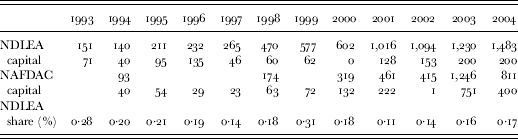
These perceptions of political and financial neglect can be contrasted with available Nigerian budget figures. As Table 1 shows, estimated federal expenditureFootnote 6 for the NDLEA has increased since the agency's foundation, although increases have been relatively smaller under civilian rule. In absolute terms, the NDLEA budget has increased steadily from N151 million in 1993 to N1·48 billion in 2004. However, if one highlights the hotly contested capital budget of the NDLEA, and compares it with a similar agency like NAFDAC, one can see that the relative importance of drug law enforcement in terms of capital budget share started to decrease in the first half of the 2000s. In addition, the last row in Table 1 shows that the NDLEA share of the total budget has on average been higher under military rule, in particular when the 1993–8 period is compared with the 2000–4 one. Essentially, the relative size of the NDLEA budget has decreased with the end of military rule, which indicates a relative decline in the NDLEA's importance in civilian Nigeria. Therefore, the perceived decline of political support for Nigerian drug law enforcement in the early 2000s has also been reflected in budget flows.
Estimated Nigerian budget expenditures for drug control (million Naira), 1993–2004
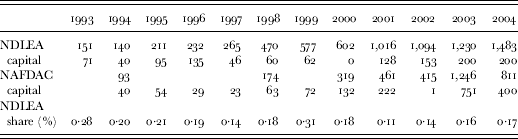
Note: Estimated federal budget expenditures are rounded to the next full million. No data was available for spaces left empty. ‘NDLEA share’ represents estimated expenditures for the NDLEA as per cent of total federal budget. The capital budget forms part of the total budget figures.
Source: Nigeria Federal Ministry of Finance (1992–2004).
While this perceived and actual decline in political support has been seen as emanating from the president and new democratic institutions, the Nigerian drug bureaucracy has been able to find alternative allies in international drug control agencies.
In contrast to the president and the National Assembly, Nigerian law enforcement never perceived US and UN drug agencies as a threat. They were rather seen as a resource for additional funds and recognition throughout NDLEA history. In the early 1990s, Nigerian law enforcement officials were very explicit about what they wanted from the USA and the UN for their drug control efforts. Capital goods, in particular interception equipment from the USA and treatment facilities from the UN, were the most sought-after support mentioned (Drugforce 1.3.1992, 1.10.1992, 1.10.1993).
During the second half of the 1990s requests for international, in particular UN, support continued. Yet the NDLEA's stance towards the US became more confrontational. As US political sanctions intensified and US technical assistance dried up during the Abacha years, Nigerian law enforcement officials directly attacked their US counterparts. The ‘multilateral Western conspiracy’ and the politicisation of drug control by the USA were seen as serious obstacles to the NDLEA's drug war in the late 1990s (Drug Salvation Force 1.7.1997).
This confrontational tone vanished abruptly when Abacha and US sanctions were gone. Democratic transition in Nigeria meant that NDLEA channels to its international counterparts were reopened. In civilian Nigeria, international cooperation was seen as excellent in all sections of the Nigerian drug bureaucracy. The UN was perceived as the most important partner, even more important than domestic ones, in the field of drug demand control. The US drug agency was seen as the most important and long-standing partner in drug supply control (NDLEA director 3, director 4, mid-ranking officer 2005 ints.). In its newsletter and the national media, the Nigerian agency and international drug law enforcement representatives praised each other and lauded the ‘new partnership’ between the Nigerian, UN and US drug agencies (Drug Salvation Force 1.3.2003, 1.3.2004).
The clearest material manifestation of this partnership was a rise in foreign drug control aid, which reached its highest levels in the 2000s. Most of the aid went directly to the establishment of a regional drug control academy in Jos. At this academy Nigerian drug officials train other African drug enforcers. In addition, the NDLEA started to coordinate US-sponsored West African drug enforcement operations in 2001 (UNODC 2005; US INL 2003: x-44).
The reunited partners swiftly buried their differences of the late 1990s and now fought the same drug war, whose enemy more frequently became the Nigerian government in Abuja. Potential disagreements over the international emphasis on heroin and cocaine, as opposed to the domestic priority of cannabis, were handled low-key in law enforcement documents and interviews (NDLEA director 4 2005 int.; Drug Salvation Force 1.3.2003). Instead, close NDLEA relations with international counterparts were used to put pressure on the government in Abuja. NDLEA officials recounted how US drug control representatives in Nigeria helped the NDLEA to a higher capital budget by pressurising the Obasanjo government during the 2001 budget process (NDLEA director 2 2005 int.). Now international agencies were major allies against the civilian government in Abuja.
In general, international cooperation shifted over the years from being a simple provider of additional capital funds towards a resource for funds and institutional recognition. International recognition of the NDLEA became more important in the 2000s, when the survival of the NDLEA was threatened by a government in Abuja which no longer saw the NDLEA as a policy priority. The alliance with the UN and USA provided international recognition, which, in turn, guaranteed institutional survival for the NDLEA.
The international counterparts of the Nigerian drug bureaucracy likewise benefited from the alliance. UN drug control projects faced a decline in donor funds from the first half of the 1990s, and the emphasis on the ‘new African threat’ of drug trafficking helped to galvanise financial support from some donor states (UNODC 2003: 4; 2007). In Nigeria, the UN and US drug agencies found a willing partner to implement their projects and fulfil their policy requirements. Existing law enforcement cooperation with the NDLEA also served as a platform to extend international influence on the continent. Nigeria's regional drug enforcement academy, which was equipped by the UN and USA, and the US-sponsored and NDLEA-coordinated joint law enforcement operations in West Africa, were the two most outstanding initiatives in this respect. Both initiatives use the NDLEA as a platform to widen US and UN influence in the West African region.
LESSONS FOR NIGERIAN LAW ENFORCEMENT
This account of Nigerian drug law enforcement since 1989 has highlighted the institutional and bureaucratic dynamics that determined how drug law enforcement was conducted and governed. Processes of centralisation, exclusion, repression and a shift in bureaucratic interests since 1999 were the underlying dynamics of drug law enforcement in Nigeria. These dynamics lay hidden behind the dominant official narrative of drug war, which stressed a linear evolution from drug crisis to corrective policy and enforcement success.
These institutional and bureaucratic dynamics are crucial for understanding Nigerian drug law enforcement and its governance since 1989. Centralisation was the key process which took the control over drug policy decision making out of the hands of a variety of agencies and individuals, and placed it in one core agency and a small group of policy makers. This centralisation process is not synonymous with a personalisation of drug law enforcement, as mentioned in accounts of the police. More important than the reduction of individuals involved in policy decisions was the strategic exclusion of policy experts from other state agencies, who propagated an alternative approach to drug control. Centralisation of drug law enforcement involved not only the exclusion of other state agencies, but also the curtailment of debate about what drug law enforcement was supposed to be. The only policy debate about Nigerian drug law enforcement today takes place within the NDLEA.
To be fair to accounts which have emphasised personal patron–client politics, drug law enforcement governance is more personalistic today than in the 1960s and 1980s, when various state agencies influenced drug policy. In particular, the ties between the head of the central drug agency and the president are important to understand drug law enforcement. As already mentioned, personal ties to the president guaranteed a larger flow of central funds into the hands of the NDLEA chairman and its officers. However, these patron–client ties were only one part of the picture, and arguably the less important dynamic concerning drug law enforcement governance in Nigeria.
The focus on patron–client relations also leads to a neglect of bureaucratic interests involved in law enforcement governance. The alliance between the NDLEA and the US and UN drug agencies after 1999 was not simply based on the personal interest of agency chairmen. The three bureaucracies were allied against other political actors, especially the Nigerian president. The period after 1999 was a clear case of bureaucratic rather than personal alliance, as these agencies not only aligned themselves against other political actors, but coordinated aspects of their operations and brought into line their narrative of Nigeria's drug problem and drug law enforcement.
These bureaucratic interests existed, even though the Nigerian drug law enforcement apparatus could be described as a dysfunctional or failed bureaucracy. Nigerian drug law enforcement is known to be highly corrupt,Footnote 7 and is in no way able to effectively fulfil its self-declared function of diminishing the supply and demand of illegal drugs in the country. In this sense, the Nigerian drug bureaucracy is dysfunctional, and nowhere near the ideal type of a Weberian bureaucracy. Nevertheless, it still has particular interests in the national political economy. These bureaucratic interests became most apparent after 1999, when the drug bureaucracy formed new political alliances to further its interests. In any case, being dysfunctional is nothing peculiar to Nigerian drug law enforcement institutions, as no other agency in global drug control history has successfully fulfilled its functions of controlling the supply and demand for illegal drugs.
This is not to say that personal ties and patron–client politics were unimportant in the governance of Nigerian drug law enforcement. My argument is that institutional and bureaucratic dynamics need to be seen in combination with personal dynamics for a better understanding of the politics of law enforcement. Nor was the case of drug law enforcement in Nigeria in every aspect comparable to other law enforcement agencies, such as the police. There were several important differences, notably the shorter existence of drug law enforcement, and the greater level of foreign intervention in the case of drug control.
In part, Nigerian drug law enforcement has been driven by concerns over the fulfilment of international norms and Nigeria's bad image abroad, as well as by direct foreign pressures, such as drug control-related US sanctions in the 1990s. However, this has only meant that foreign bureaucratic interests played a larger role in the case of drug law enforcement. The domestic bureaucratic interests and institutional dynamics of centralisation, exclusion and repression are similar in the case of drug control and police governance. These institutional dynamics, and arguably also the evolution of ideas about law enforcement, are crucial to explaining the work and governance of law enforcement agencies in Nigeria.
Finally, conclusions from the case of Nigerian drug law enforcement are also important beyond its comparison with other law enforcement fields. The repressive nature and style of drug control and its perceived success in the eyes of Nigerian and foreign drug law enforcers has had a direct effect on other areas of crime control. The still dominant narrative of crisis–correction–success has led to the reproduction of the drug law enforcement model in Nigeria and in other West African states. Nigerian state agencies, such as NAFDAC and the Economic and Financial Crimes Commission (EFCC), have either been directly based on the NDLEA model or have been trained by NDLEA officials. The NDLEA also coordinates West Africa-wide law enforcement training and operations. This means that the exclusive, repressive and ineffective approach to solving social problems perpetuates itself. With the reproduction of the Nigerian model of drug law enforcement in other policy fields, dynamics similar to the Nigerian case may be expected to appear elsewhere.