Introduction
Reservoirs are man-made water bodies created to store freshwater for a variety of purposes. They are constructed either by building a dam wall across an existing river, allowing flowing water to accumulate behind it, i.e. a river reservoir, or, less commonly, by pumping water into an artificial impoundment formed by a man-made embankment around its entire perimeter to create a fully bunded dam, i.e. a storage reservoir (Morley, Reference Morley2007).
The immediate effects of river reservoir construction on the parasite fauna of fish have been studied extensively (Izyumova, Reference Izyumova1987; Morley, Reference Morley2007). On the other hand, long-term studies on stabilized mature reservoirs are less common, and only a few studies have been undertaken on the fish parasite fauna of fish in storage reservoirs (Izyumova, Reference Izyumova1987).
A wide-ranging limnological investigation of the London storage reservoirs, including the largest, the Queen Mary reservoir, was initiated in the mid-1960s, principally to evaluate interactions between populations of phytoplankton and zooplankton (Duncan, Reference Duncan1990). As part of these studies, samples of the fish population were also taken for parasitological examinations.
The London reservoirs are completely man-made, large, flow-through pump storage basins whose function is to store water from the River Thames before passing it into treatment works to contribute to the daily supply of treated drinking water for London. The inner slope of each reservoir is constructed of concrete bricks with a narrow littoral zone and no emergent vegetation (Duncan, Reference Duncan1990; Kubecka & Duncan, Reference Kubecka and Duncan1994). Most of the larger London reservoirs are without fisheries management, and hence the fish population remains uncontrolled and dominated by perciform species (Seda & Duncan, Reference Seda and Duncan1994). This group of reservoirs therefore represents a uniquely challenging and completely artificial environment for wildlife.
In addition, the reservoirs are subjected to many management practices which, in combination with their design, are intended to maximize both quality and quantity of the storage water for consumers. This biomanipulation of the reservoir can create a stressful environment for the resident wildlife, particularly an unmanaged fish population. For example, when impounded, low turbulence conditions and the high nutrient content of the river water provide an ideal medium for algal blooms, especially cyanobacteria, to flourish at different times of the year (Windle Taylor, Reference Windle Taylor1955). The proliferation of many species of phytoplankton results in the production of secondary metabolites, which are toxic to a range of animals, including fish (Codd, Reference Codd2000; Landsberg, Reference Landsberg2002; Lewis et al., Reference Lewis, Morley, Drinkall, Jamieson, Wright and Parry2009). Algal blooms may also affect water quality and in order to reduce this proliferation during the 1960s, the London reservoirs were periodically dosed with copper sulphate, a toxic metal known to have many detrimental effects on aquatic organisms (WHO, 1998). Consequently, reservoir conditions were not always ideal for the resident fish fauna.
Stressed populations are also more susceptible to infectious diseases. Fish, in particular, when kept in poor environmental conditions can suffer from epizootic disease outbreaks (Sindermann, Reference Sindermann1990). During the summer of 1966, perch (Perca fluviatilis) and roach (Rutilus rutilus) in England suffered considerable mortalities due to a bacterium identified as Chondrococcus columnaris (Ajmal & Hobbs, Reference Ajmal and Hobbs1967), subsequently reclassified as Flavobacterium columnare (Tripathi et al., Reference Tripathi, Latimer and Rakich2003) and commonly known as ‘columnaris disease’. This is one of the most devastating bacterial infections of freshwater fish, causing gross lesions of the skin, fins and gills, and is often associated with mass mortalities (Tripathi et al., Reference Tripathi, Latimer and Rakich2003).
In 1966, the disease was particularly prevalent in the London reservoirs. Extensive mortalities of perch in the Queen Mary reservoir were first reported in mid-August, when water conditions and phytoplankton blooms were normal for the time of year. Lesions were reported on perch and, within 4 weeks, 2500 dead specimens weighing approximately 1.5 tonnes were removed. Bacteriological examination of the lesions demonstrated the presence of C. columnaris (syn. F. columnare). Most of the infected perch were relatively old (6–9 years), whereas younger perch, and initially roach, remained uninfected. However, by the end of September, small numbers of roach mortalities also occurred (Windle Taylor, Reference Windle Taylor1969). Periodic and less severe disease outbreaks continued during the remainder of 1966 and 1967 before petering out in 1968 (Windle Taylor, Reference Windle Taylor1971).
By chance, this period of mass mortality in 1966 coincided with a long-term study on the helminth fauna of perch in the Queen Mary reservoir, which was initiated in 1964. The effects of a significant reduction in a fish population on the dynamics of their parasite fauna have rarely been studied. Kennedy (Reference Kennedy1998, Reference Kennedy2001) reported that in a fish population crash in a lake in south-west England autogenic parasite species, whose life cycles are completed entirely within hosts confined to the aquatic habitat, had become extinct, probably because fish numbers had fallen below the threshold level at which parasites could be successfully transmitted. In contrast, allogenic species, which utilize at least one host that can migrate from one habitat to another, either survived or rapidly recolonized the lake. Zhokhov et al. (Reference Zhokhov, Pugatcheva, Molodozhnikova and Mironovskii2006) studied the helminth fauna of ruffe (Gymnocephalus cernuus) after a population collapse in the Rybinsk reservoir, Russia, in the late 1990s and compared these results with earlier studies undertaken in the 1950s. The majority of helminths were still present in the recovering ruffe population because they were generalists, present in other reservoir perciform species unaffected by the aetiological agent that devastated the ruffe, and only parasites specific to this species had not yet been re-established in the reservoir's fish population.
An examination of the perch population in the Queen Mary reservoir during the 1960s therefore provides a rare opportunity to study both the helminth fauna in a pump-storage reservoir and the immediate effects of a rapid decline in a fish population on its composition. The aim of the present study therefore is to evaluate both the perch helminth fauna in the reservoir and the effects of a mass perch mortality caused by columnaris disease on the prevalence and intensity of infections in this species of fish.
Materials and methods
Study site
The Queen Mary reservoir is a one of a number of reservoirs built in the lower Thames Valley to provide storage water for London. The reservoir was constructed during the 1920s, with water being first drawn for supply purposes in July 1927. It is a completely man-made, fully bunded reservoir consisting of a basin excavated down to the London clay and surrounded by an embankment with a clay core ‘keyed’ into the lower clay and the inner slope covered with ‘concrete bricks’. The reservoir is roughly circular with a baffle wall delimiting the outer area to approximately one-third of the whole and is filled with water pumped in from the River Thames. The reservoir is built up above the ground level of the surrounding land to increase exposure to the prevailing winds and encourage mixing of the water. However, due to its shallow depth, these measures proved to be inadequate, and intermittent stratification developed in the reservoir during most summers, thereby encouraging the development of phytoplankton.
The reservoir has a surface area of 290 ha, depth 12 m and volume of 30 × 106 m3. Normally, 2%, approximately 570 million litres, of its volume passes through it each day with water retention usually exceeding 40 days. Because it was built for storage purposes, fluctuations in the water level of the reservoir can be extreme, especially during periods of drought, but throughout 1964–68 water levels only varied between normal seasonal amounts of 80–100% maximum capacity (Collinge & Davis, Reference Collinge and Davis1975).
When impounded, river water from the Thames provides an ideal eutrophic medium for the proliferation of phytoplankton. In general, the algal season often began as early as mid-February with initial diatom blooms. During the summer, Chlorophyceae and Myxophyceae were often abundant and occasionally accompanied by diatoms, which can persist into the early autumn, when a second peak of diatoms occurs but much lower than in the spring. Nevertheless, patterns of plankton growth can vary from one year to the next and in adjacent reservoirs despite being fed from the same river source (Windle Taylor, Reference Windle Taylor1955).
Up to the early 1970s, in order to control algal blooms in the reservoirs, periodic treatment with copper sulphate was applied, which in the Queen Mary reservoir varied between 0.7 and 1 mg/l copper sulphate, depending on the severity of the algal bloom (Windle Taylor, Reference Windle Taylor1955). Treatment was carefully monitored because, if extended for too long a period or applied at too high a concentration, resistance developed in the algal population (Windle Taylor, Reference Windle Taylor1955). On occasions, the application of copper was restricted to the reservoir outlet area, covering about one-third of a square mile of surface area. However, during extensive algal proliferation, the entire surface area of the reservoir was treated, which extended to over a square mile of surface water. In addition, treatment was also undertaken at the intake pumping station of the reservoir on the River Thames. Analysis of copper concentrations undertaken during a typical dosing exercise in March 1960 showed that 5 weeks after application the copper concentration had fallen to levels naturally present in the supplied river water, while there was no evidence of any copper accumulation in the reservoir mud during the same period (Windle Taylor, Reference Windle Taylor1961). As an additional measure, when copper sulphate treatment failed to control an algal bloom, the reservoir was occasionally taken ‘off-line’ and isolated from the rest of the network with no water being pumped in or out for a period of days or weeks until the bloom dissipated and the water quality recovered.
The Queen Mary reservoir had never been stocked with fish, but contains an original population derived from fry periodically pumped into the reservoir from the River Thames, and the species recorded in the reservoir during the 1960s included perch (P. fluviatilis), roach (R. rutilus), three-spined stickleback (Gasterosteus aculeatus), pike (Esox lucius), ruffe (G. cernuus) and bullhead (Cottus gobio), with perch and roach as the dominant species.
Fish sampling
A total of 349 perch were sampled intermittently throughout the years between 1964 and 1968 except from August to December 1966. Fish were trapped throughout each year using purpose-built cages, and transferred immediately to the laboratory at Royal Holloway and examined within 24 h of capture. The total body length and weight were recorded. Fish were dissected and examined for helminths using standard parasitological techniques. The condition coefficient (K) was calculated for each individual fish as follows:

Data were presented as means and standard deviations for each sampling period. The prevalence, intensity and mean abundance of infection of perch with parasites were calculated according to Bush et al. (Reference Bush, Lafferty, Lotz and Shostak1997). Differences between K values for individual years were analysed using ANOVA. Changes in parasite occurrence were analysed using χ2 for prevalence and Mood's median test for intensity using Quantitative Parasitology 2.0 statistical package (Reiczigel & Rozsa, Reference Reiczigel and Rozsa2001).
Results
The perch population in the Queen Mary reservoir comprised a range of helminth species over the sampling period, including Diplostomum sp. and Tylodelphys sp. (eye lens and vitreous humour), Diphyllobothrium sp. (viscera), Triaenophorus nodulosus (liver), and Proteocephalus percae, Bunodera luciopercae, Camallanus lacustris and Acanthocephalus lucii (intestine). However, the occurrence of only the most abundant helminth species forms the basis of the present study.
The condition of the perch was significantly altered by the outbreak of columnaris disease and the associated population decline in the late summer of 1966. Fish sampled after the mortality event (1967–68) were significantly smaller with a reduced mean length (ANOVA, P < 0.001, F = 87.987), weight (ANOVA, P = 0.002, F = 9.383) and condition factor, K, (ANOVA, P < 0.001, F = 14.159) compared to the 1964–66 sampling period (tables 1 and 2).
Condition of perch (Perca fluviatilis) during 1964–66 prior to the population decline caused by the columnaris disease outbreak.

Condition of perch (Perca fluviatilis) during 1967–68 after the population decline caused by the columnaris disease outbreak.

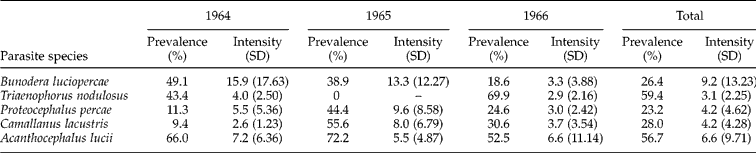
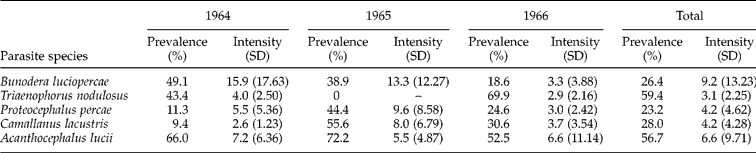
The infection levels of helminths in perch examined in the 1964–66 sampling period showed much variability between individual years (table 3), and these included T. nodulosus (prevalence χ2 = 40.417, P < 0.001; intensity P = 0.012), P. percae (prevalence χ2 = 9.948, P = 0.011; intensity P = 0.095), C. lacustris (prevalence χ2 = 16.472, P < 0.001; intensity P = 0.615) and B. luciopercae (prevalence χ2 = 21.219, P < 0.001; intensity P < 0.001). The acanthocephalan A. lucii, however, retained a stable prevalence but a variable intensity throughout this period (prevalence χ2 = 4.989, P = 0.083; intensity P = 0.003).
Prevalence and intensity of helminth fauna of perch (Perca fluviatilis) during 1964–66 prior to the population decline caused by the columnaris disease outbreak.
In perch examined between 1967 and 1968 (table 4), some changes in the helminth fauna occurred. T. nodulosus had a stable, low prevalence and intensity throughout these 2 years (prevalence χ2 = 0.353, P = 0.552; intensity P = 0.302), while A. lucii showed a very low prevalence in 1967, which recovered slightly in 1968 (χ2 = 9.562, P = 0.002) with a stable intensity (P = 0.245). The remaining helminths had significantly different prevalences between the 2 years, being lower in 1967 compared with 1968 for both C. lacustris, not even recorded in this year, and P. percae (χ2 = 12.181, P < 0.001; χ2 = 5.902, P = 0.015, respectively), and significantly higher for B. luciopercae in 1967 (χ2 = 8.857, P = 0.003); however, the intensity of infections for these three helminth species remained the same.
Prevalence and intensity of helminth fauna of perch (Perca fluviatilis) during 1967–68 after the population decline caused by the columnaris disease outbreak.

When data were combined into pre- and post-mortality event sampling sizes, it was found that after the columnaris disease outbreak T. nodulosus, C. lacustris and A. lucii had significantly lower prevalences (χ2 ≥ 10.312, P ≤ 0.001). B. luciopercae showed a significantly increased prevalence (χ2 = 12.672, P < 0.001), whereas there was no significant change in the prevalence of P. percae (χ2 = 1.671, P = 0.196). However, the intensities of all helminth infections in the perch population remained unaffected by the mortality event.
Discussion
The Queen Mary reservoir has never been stocked with fish, and the population is derived from fry pumped in accidentally from the River Thames. Perciform fish dominate the fauna, which is an unexpected composition for a hypertrophic water body. These fish exhibit high growth rates and may be more capable of adapting to the artificial conditions than cyprinids. This may be the result of the reservoir construction creating a reduced littoral zone of concrete bricks and the absence of suitable cyprinid-spawning substrata, in which perciforms appear less sensitive too (Kubecka & Duncan, Reference Kubecka and Duncan1994). The architecture of the reservoir, associated with its management practices, is also responsible for structuring the parasite communities of the resident fish population.
Parasitological studies of aquatic wildlife on the London reservoirs have been rare. The parasite fauna of a flock of razorbills (Alca tarda) on the Queen Mary reservoir was investigated in the 1930s (Baylis, Reference Baylis1934; Lowe & Baylis, Reference Lowe and Baylis1934), and, more recently, the occurrence of Dermocystidium percae on perch in the Queen Elizabeth II and Barns Elm reservoirs has been described by Morley et al. (Reference Morley, Campbell and Lewis2008).
How the parasite fauna develops in fish within newly formed pump-storage basins is not known in any detail, because unlike a river reservoir, when first filled there is neither vegetation, invertebrates nor fish. Colonization by a parasite population is therefore difficult and protracted, dependent on which definitive and/or intermediate host species are most successful in adapting to such artificial conditions (Morley, Reference Morley2007). Nevertheless, the emergence of invertebrate populations is critical in defining the occurrence and composition of helminths in fish with indirect life cycles (Morley, Reference Morley2007). Pump-storage reservoirs are therefore unique habitats for the development of a fish parasite community. An abundant zooplankton community in the London reservoirs (Cremer & Duncan, Reference Cremer and Duncan1969; Steel et al., Reference Steel, Duncan, Andrew, Kajak and Hillbricht-Ilkowska1972; Andrew, Reference Andrew1985) suggests that fish helminths that utilize this fauna as intermediate hosts should dominate and this is confirmed in the present study.
Under normal conditions, zooplankton is an important component in the ecology of the London reservoirs, being more abundant compared with the river source. Although the reservoir fauna is dominated by herbivores, such as Daphnia spp., which feed on phytoplankton, predatory cyclopoid copepods, the main intermediate hosts of helminths (Marcogliese, Reference Marcogliese1995), also demonstrate an increased abundance compared to the River Thames. For example, in the Queen Mary reservoir, concentrations of Cyclops strenuus were 5420 per 1000 litres, compared with 310 per 1000 litres in the river (Windle Taylor, Reference Windle Taylor1965). The structure and biomass of zooplankton in the Queen Mary reservoir can fluctuate from one year to the next (Cremer & Duncan, Reference Cremer and Duncan1969; Andrew, Reference Andrew1985) with changes occurring in the dominance of individual species (Duncan, Reference Duncan1975). Factors driving these changes may be related to abiotic and biotic conditions in the reservoir, particularly the availability of food, such as phytoplankton, and the production of phytoplankton biotoxins, released as a defensive response to grazing pressure (Kurmayer & Juttner, Reference Kurmayer and Juttner1999). The periodic application of copper (Rai & Mallick, Reference Rai and Mallick1993) and the reservoir being taken off-line, stopping the inflow of nutrients from the river (Steel, Reference Steel1972), may also influence the composition of the helminth fauna of perch in the Queen Mary reservoir, especially variations in the occurrence of parasite species during 1964–66.
Analysis of the intestinal contents of perch and ruffe indicates that predation on zooplankton mainly takes place during the early autumn and late spring in the open waters of the reservoir, whereas summer feeding was mainly on fauna characteristic of the reservoir edge (Duncan, Reference Duncan1975). The feeding of zooplankton by fish coincides with the peak abundance of Cyclops spp. in the Queen Mary reservoir (Cremer & Duncan, Reference Cremer and Duncan1969; Andrew, Reference Andrew1985) at a time likely to be the main period of parasite transmission to the fish host.
Changes in the population dynamics of cyclopoid copepods acting as intermediate hosts influence the prevalence and intensity of helminths in the fish population (Hanzelova, Reference Hanzelova1992). The ecology of helminth transmission through zooplankton is complex (Marcogliese, Reference Marcogliese1995), and factors such as seasonal changes in the geographical distribution within a water body (Riggs & Esch, Reference Riggs and Esch1987), the periodic diapause of the host (Evseeva, Reference Evseeva1996) and parasite-induced alterations of host behaviour to increase susceptibility to predation (Poulin et al., Reference Poulin, Curtis and Rau1992) are likely to influence parasite dynamics. In particular, changes in environmental conditions influencing copepod diapause (Monchenko, Reference Monchenko1996) may be a key factor structuring helminth populations in perch, since the fluctuating quality of the reservoir water, due to algal blooms and the application of copper, may induce unseasonable diapause in copepods, thereby interrupting parasite transmission.
During 1964–66, the majority of helminths demonstrated much instability, with only A. lucii retaining similar prevalences throughout this period. This acanthocephalan utilizes the isopod, Asellus aquaticus, as intermediate host (Brattey, Reference Brattey1986), suggesting that changes in the dominant helminth fauna of perch are more likely to be associated with fluctuations in the zooplankton population. The latter may be more sensitive to stressors than isopods, which have been shown to tolerate both algal biotoxins and copper (Brown, Reference Brown1976; Van Alstyne et al., Reference Van Alstyne, Wolfe, Freidenburg, Neill and Hicken2001).
The subsequent columnaris disease outbreak in 1966 produced profound effects on the perch population as both length and weight of fish were reduced, with a corresponding decline in the condition coefficient. This correlates with the contemporary report, which indicated that mainly older perch (6–9 years) were more susceptible to the pathogenic bacterium (Windle Taylor, Reference Windle Taylor1969).
The decline in the perch population of the reservoir was correlated with changes to the planktonic fauna. An increase in zooplankton biomass accompanied by a change in species composition occurred, while phytoplankton biomass decreased (Duncan, Reference Duncan1975). These changes were likely to be due to an increase in zooplankton caused by a reduction in fish predation and consequently a decrease in phytoplankton as a result of elevated levels of grazing pressure by herbivorous zooplanktonic species (Duncan, Reference Duncan1990).
The outbreak of columnaris disease and the associated decline in the perch population produced significant effects on the helminth fauna, leading to reduced prevalence of T. nodulosus, C. lacustris and A. lucii, and an increase of B. luciopercae. Only one parasite species, namely the nematode C. lacustris, was not found in perch in the year immediately following the mortality event, but its presence was reported subsequently. Such changes may be related to alterations in the biomass and population structure of the zooplankton, which act as intermediate hosts, except in the case of the acanthocephalan A. lucii, which is more likely to be associated directly with the decline in the fish population. However, although parasite transmission through the perch community may have been initially disrupted for many helminth species, the recovery was unlikely to be protracted as most of these helminths are generalists, capable of cycling through other perciform species in the reservoir, such as ruffe, and thus reducing the impact of the columnaris disease outbreak. Zhokhov et al. (Reference Zhokhov, Pugatcheva, Molodozhnikova and Mironovskii2006) found a similar result while investigating a ruffe mortality event in the Rybinsk reservoir.
The effects of the columnaris disease outbreak on the fish population of Queen Mary reservoir were substantial. The perch-dominated population of the 1960s was completely restructured. Although no quantitative data exist on the size and composition of the perch population immediately before and after the disease outbreak, angling records indicate that they were once caught in great numbers with large shoals present at the reservoir margins, but catches were negligible following the mortality event (Hopkins, Reference Hopkins1975).
In the long term, the perch population, which never recovered to its previous levels, was replaced by roach and ruffe, and these formed more than 85% of the biomass of fish species found during the 1990s (Kubecka & Duncan, Reference Kubecka and Duncan1994; Renton et al., Reference Renton, Duncan and Kubecka1999). The permanent reduction in the size of the perch population precluded any subsequent large-scale follow-up study on this fish species over the following years. Nevertheless, it is logical to assume that ruffe, as the dominant perciform species, also replaced perch as the principal hosts for helminth transmission in the Queen Mary reservoir.
Acknowledgements
Grateful thanks are extended to Thames Water Utilities Ltd (formally Metropolitan Water Board) for permission to sample fish from the Queen Mary reservoir.