INTRODUCTION
This paper studies the Cascajal Block, a serpentinite artifact with Olmec inscription brought to the attention of scholars worldwide by Rodríguez Martínez et al. (Reference Rodríguez Martínez, Ceballos, Coe, Diehl, Houston, Taube and Calderón2006a). It has four objectives: (1) introduction of a new line drawing that improves upon specific details of previous drawings of the inscription; (2) distributional analysis of the inscription to more carefully analyze the sign inventory, or signary, first outlined in Rodríguez Martínez et al. (Reference Rodríguez Martínez, Ceballos, Coe, Diehl, Houston, Taube and Calderón2006a:1613, Figure 5) and which I slightly revised (Mora-Marín Reference Mora-Marín2009:399, Figure 3); (3) to highlight seemingly irregular, recurring sign sequences (Justeson Reference Justeson, Nichols and Pool2012:840; Macri Reference Macri2006:2) that could be crucial to understanding its orthographic conventions; and (4) to review the evidence proposed by myself (Mora-Marín Reference Mora-Marín2010) and previous authors (Carrasco and Englehardt Reference Carrasco and Englehardt2015; Justeson Reference Justeson, Nichols and Pool2012; Rodríguez Martínez et al. Reference Rodríguez Martínez, Ceballos, Coe, Diehl, Houston, Taube and Calderón2006a) for sign pairings reminiscent of linguistic or iconographic couplets. The paper also offers an assessment of ways in which different proposals for the formatting of the text (reading orientation and direction) available in the literature (Anderson Reference Anderson2007; Freidel and Reilly Reference Freidel, Reilly, Staller and Carrasco2010; Justeson Reference Justeson, Nichols and Pool2012; Macri Reference Macri2006; Mora-Marín Reference Mora-Marín2009; Rodríguez Martínez et al. Reference Rodríguez Martínez, Ceballos, Coe, Diehl, Houston, Taube and Calderón2006a) affect the analysis and proposal advanced here.
The new line drawing introduced in this paper, based on Reflectance Transformation Imaging (RTI) imagery generously shared with me by Carrasco and Englehardt, largely agrees with previous drawings. It differs significantly, however, from two previous drawings (Rodríguez Martínez and Ortiz Ceballos Reference Rodríguez Martínez and Ceballos1999; Ortiz Ceballos et al. Reference Rodríguez Martínez and Ceballos2007; Rodríguez Martínez et al. Reference Rodríguez Martínez, Ceballos, Coe, Diehl, Houston, Taube and Calderón2006a; Rodríguez Martínez et al. Reference Rodríguez Martínez and Ceballos2007) with regard to the third glyph on the block, cataloged by Rodríguez Martínez et al. (Reference Rodríguez Martínez, Ceballos, Coe, Diehl, Houston, Taube and Calderón2006a) as Cascajal Script (CS) 27, a unique sign in their signary; in contrast, the line drawing introduced here supports the drawing by Justeson and Lowry (Justeson Reference Justeson, Nichols and Pool2012) in identifying this glyph with CS15, previously thought to occur only twice. The new line drawing introduced in this paper also agrees with the recent drawing by Carrasco and Englehardt in a crucial detail of the fifth sign of the text: instead of resembling a rectangular sign, for which Rodríguez Martínez et al. (Reference Rodríguez Martínez, Ceballos, Coe, Diehl, Houston, Taube and Calderón2006a) did not assign a specific catalog designation, the fifth sign is here shown to resemble CS16.
The paper also carries out a distributional analysis of the signs in the text, which, together with the results from the new line drawing, leads to the addition of two new signs, as well as revisions to the frequency of occurrence of several signs, including previously identified signs.
Perhaps the most significant proposal in this paper consists of the analysis of sign sequences previously described as irregular (Justeson Reference Justeson, Nichols and Pool2012:840; Macri Reference Macri2006:2), and characterized as unlikely to reflect linguistic motivation. I argue that these seeming irregularities are actually characteristic of logophonetic spelling patterns, wherein phonograms (whether consonantal signs, as in Egyptian, or syllabographic signs, as in Epi-Olmec, Mayan, Hieroglyphic Hittite, etc.) may appear preposed, postposed, or both preposed and postposed, as phonetic complements with respect to logograms (cf. Mora-Marín Reference Mora-Marín2008). The analysis shows that the distributional behavior of two signs (CS13 and CS15) points to logographic functions, while that of three signs (CS1, CS2/CS9, and CS3) points to syllabographic (or more generally phonographic) functions. Given that the three most thoroughly studied Formative Mesoamerican scripts (Zapotec, Epi-Olmec, and Mayan), all of which postdate the Cascajal Block script, employ both logograms and syllabograms, the analysis presented in this paper supports the contention that the Cascajal Block text may also contain logograms and syllabograms and, therefore, that the text is linguistically motivated.
Last, the paper deals with the question of pairings of signs argued by some to be linguistically (Carrasco and Englehardt Reference Carrasco and Englehardt2015; Mora-Marín Reference Mora-Marín2010; Rodríguez Martínez et al. Reference Rodríguez Martínez, Ceballos, Coe, Diehl, Houston, Taube and Calderón2006a) or iconographically (Justeson Reference Justeson, Nichols and Pool2012) motivated. As Carrasco and Englehardt (Reference Carrasco and Englehardt2015) have claimed, at present these pairings of signs constitute the best chance to establish sufficient semantic context to attempt a decipherment of the script. The paper discusses a new pairing (pelt/paw) that I originally proposed in 2010, and argues that it occurs twice in the inscription, although one of the two proposed instances relies on my proposed text formatting (Mora-Marín Reference Mora-Marín2009). There is evidence for the variable presence of a sign, CS2/CS9, which was previously suggested to function syllabographically in another set of repeated sign sequences, intervening in the proposed pelt/paw pairing; this variable presence could point to its use as a phonetic sign, and therefore supports the hypothesis of a syllabographic function.
Before delving into each task, I will provide some background to the Cascajal Block and its broader context, focusing on chronological and iconographic contextualization.
THE CASCAJAL BLOCK: CONTEXT, DATING, AND SCHOLARSHIP TO DATE
The Cascajal Block is a carved serpentinite block discovered in the municipality of Jaltipan, Veracruz; more specifically, it was discovered at the site of Cascajal, a site located within a relatively short distance (13 km) from the famous site of San Lorenzo, during the destruction of a mound that supplied gravel for construction. The block was first described by Rodríguez Martínez et al. (Reference Rodríguez Martínez and Ceballos1999) in a report detailing the various artifacts discovered together in disturbed soil, including four celts, ceramic sherds, an anthropomorphic figurine fragment, obsidian flakes, ground stone fragments, and the Cascajal Block. Ortiz et al. (Reference Rodríguez Martínez and Ceballos2007) and Rodríguez Martínez et al. (Reference Rodríguez Martínez and Ceballos2007) reviewed the contents of the original report and further examined the iconography of the signs on the block. Rodríguez Martínez et al. (Reference Rodríguez Martínez, Ceballos, Coe, Diehl, Houston, Taube and Calderón2006a) constituted the first detailed description of the block itself, the one that has inspired subsequent research on the inscription.
Although the ceramics found by the locals who discovered the block range from the Middle Formative to the Classic, Rodríguez Martínez et al. (Reference Rodríguez Martínez, Ceballos, Coe, Diehl, Houston, Taube and Calderón2006a:1611) state that “[a]bout three-fourths of these materials are Formative in date, and of these, all but two or three sherds of the Formative period can be positively identified as belonging to the San Lorenzo phase (uncalibrated 1200 to 900 BCE),” concluding that “[i]t seems probable, therefore, that the block, and its incising, can be dated to the San Lorenzo phase, perhaps toward the end of San Lorenzo B, that is to say, about 900 BCE.” Citing Pool (Reference Pool2007:7), Justeson (personal communication 2019) has noted that this corresponds to a calibrated date of ca. 1000 b.c.
From an iconographic standpoint, Rodríguez Martínez et al. (Reference Rodríguez Martínez, Ceballos, Coe, Diehl, Houston, Taube and Calderón2006a:1613) state: “As for dating, iconographic parallels indicate that the Cascajal block is best assigned to the transition between the Early and Middle Formative period (~1000 to 800 BCE). Signs 12, 16, and 20 appear in Early Formative graphs of San Lorenzo, but sign 1, with cleft element and inverted V motif, serves as a diagnostic element of Middle Formative imagery.” Other authors, such as Ortiz Ceballos et al. (Reference Ortiz Ceballos, Rodríguez Martínez, H. and C.2007), Rodríguez Martínez et al. (Reference Rodríguez Martínez and Ceballos2007), Anderson (Reference Anderson2007), Magni (Reference Magni2008), and myself (Mora-Marín Reference Mora-Marín2010) have previously offered iconographic comparisons of the signs in the Cascajal Block with specific Olmec elements and motifs, most of which are regarded to be Middle Formative in age, supporting the art historical assessment by Rodríguez Martínez et al. (Reference Rodríguez Martínez, Ceballos, Coe, Diehl, Houston, Taube and Calderón2006a).
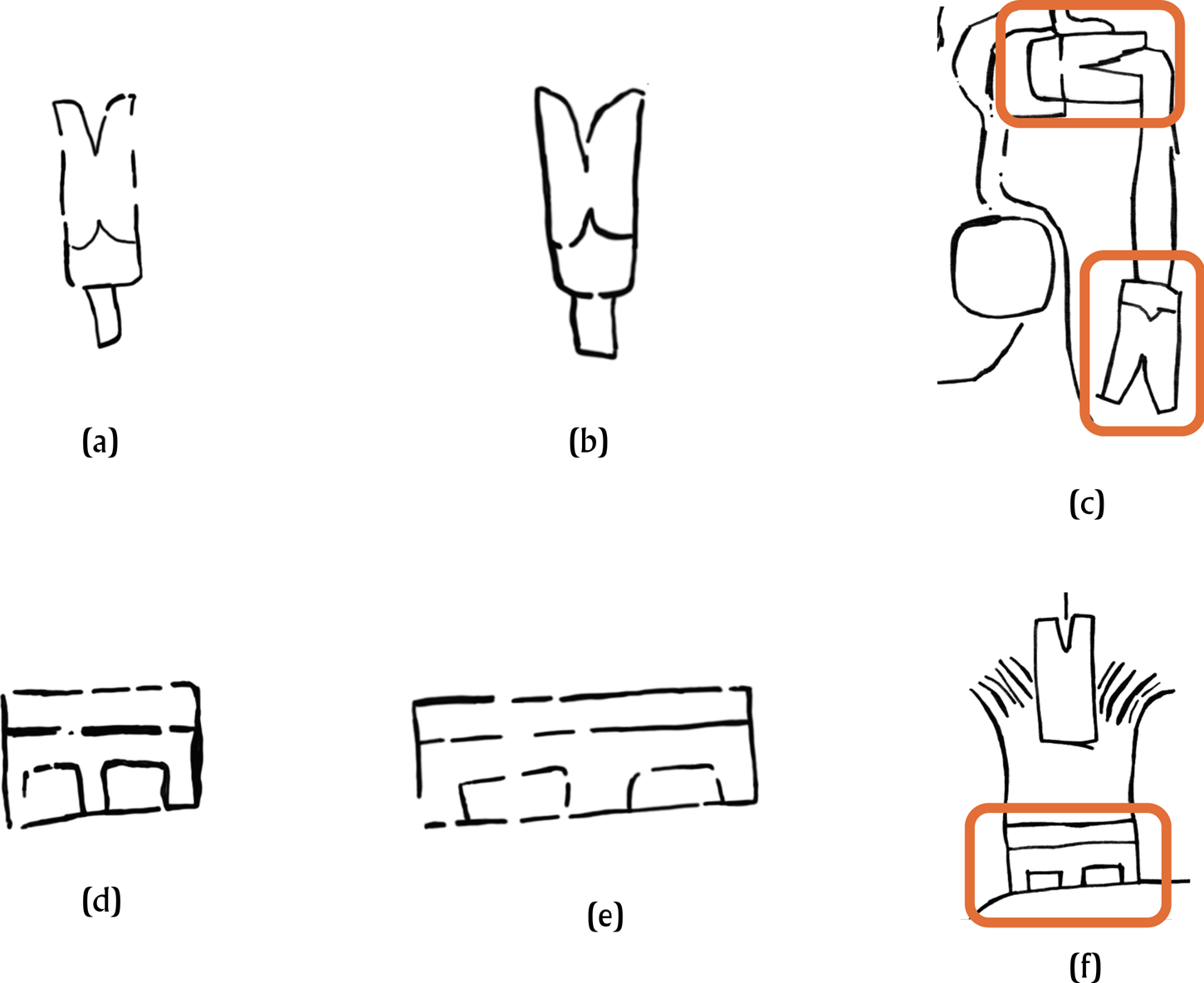
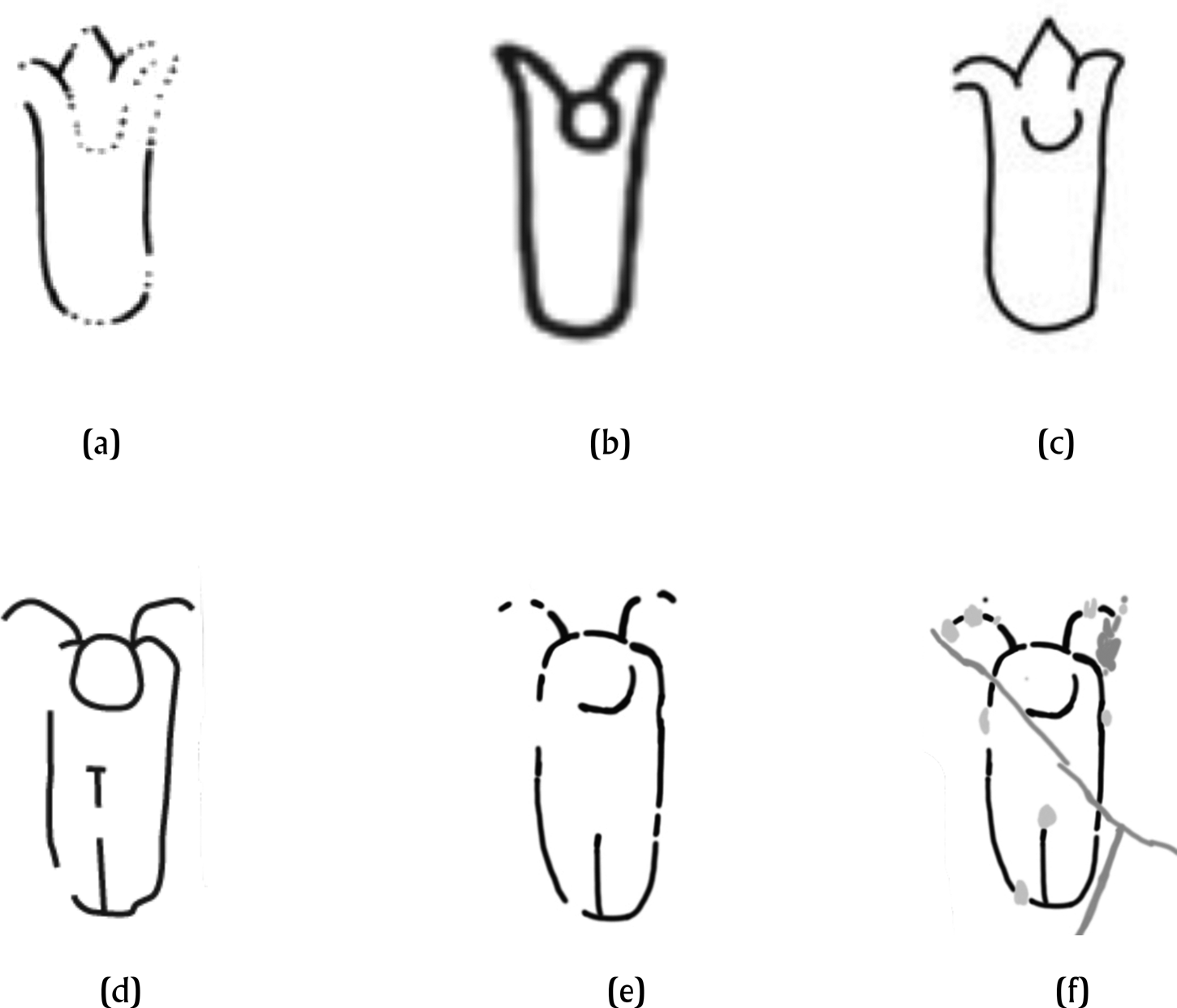
My own work (Mora-Marín Reference Mora-Marín2009, Reference Mora-Marín2010) lent iconographic support to this assessment, finding very close stylistic parallels between two signs on the Cascajal Block and the iconographic motifs and elements on one of two incised celts reportedly from Arroyo Pesquero (Figure 1; Mora-Marín Reference Mora-Marín2009:1–2, Figure 2, Reference Mora-Marín2010:4–5, Figure 1), a site located about 10 kilometers southwest of La Venta.
Comparison of CS1 and CS11 of Cascajal Block with specific motifs and elements from a celt reportedly from the site of Arroyo Pesquero. (a–b) CS1. Drawings by the author. (c) Detail from Arroyo Pesquero Celt 1. Drawing by the author after photograph in The Art Museum (Coe and Taube Reference Coe and Taube1995:104). (d–e) CS11. Drawings by the author. (f) Detail of iconography on Arroyo Pesquero Celt 1. Drawing by the author after photograph in The Art Museum (Coe and Taube Reference Coe and Taube1995:104).

I will now provide an overview of scholarship on the inscription itself, organized by topics that have been addressed to date, some of which will be revisited in this paper: reading formatting and direction (Anderson Reference Anderson2007; Houston Reference Houston2010; Justeson Reference Justeson, Nichols and Pool2012; Macri Reference Macri2006; Mora-Marín Reference Mora-Marín2009; Rodríguez Martínez et al. Reference Rodríguez Martínez, Ceballos, Coe, Diehl, Houston, Taube and Calderón2006a); the signary (Anderson Reference Anderson2007; Justeson Reference Justeson, Nichols and Pool2012; Macri Reference Macri2006; Mora-Marín Reference Mora-Marín2009; Rodríguez Martínez et al. Reference Rodríguez Martínez, Ceballos, Coe, Diehl, Houston, Taube and Calderón2006a); iconographic motivations of the signs (Anderson Reference Anderson2007; Freidel and Reilly Reference Freidel, Reilly, Staller and Carrasco2010; Houston Reference Houston2010; Magni Reference Magni2008; Mora-Marín Reference Mora-Marín2010; Rodríguez Martínez et al. Reference Rodríguez Martínez, Ceballos, Coe, Diehl, Houston, Taube and Calderón2006a); repeated sign sequences, constraints on sign occurrences, and overall structure of text (Anderson Reference Anderson2007, Reference Anderson, Hull and Carrasco2012; Hopkins Reference Hopkins2006; Houston Reference Houston2010; Macri Reference Macri2006; Mora-Marín Reference Mora-Marín2009, Reference Mora-Marín2010; Rodríguez Martínez et al. Reference Rodríguez Martínez, Ceballos, Coe, Diehl, Houston, Taube and Calderón2006a); iconographic rather than linguistic perspectives to analysis of the text (Freidel and Reilly Reference Freidel, Reilly, Staller and Carrasco2010; Justeson Reference Justeson, Nichols and Pool2012; Magni Reference Magni2008); identification of iconographic pairings or linguistic couplets or kennings (Carrasco and Englehardt Reference Carrasco and Englehardt2015; Justeson Reference Justeson, Nichols and Pool2012; Mora-Marín Reference Mora-Marín2009, Reference Mora-Marín2010; Rodríguez Martínez et al. Reference Rodríguez Martínez, Ceballos, Coe, Diehl, Houston, Taube and Calderón2006a); and its relationship (or lack thereof) to other Mesoamerican scripts (Anderson Reference Anderson2007, Reference Anderson, Hull and Carrasco2012; Justeson Reference Justeson, Nichols and Pool2012; Mora-Marín Reference Mora-Marín2009, Reference Mora-Marín2010, Reference Mora-Marín2016; Rodríguez Martínez et al. Reference Rodríguez Martínez, Ceballos, Coe, Diehl, Houston, Taube and Calderón2006a).
NEW DRAWING OF THE INSCRIPTION
Any attempt to study this unique inscription should make use of the most accurate data available. The available drawings (Carrasco and Englehardt Reference Carrasco and Englehardt2015; Justeson Reference Justeson, Nichols and Pool2012; Rodríguez Martínez et al. Reference Rodríguez Martínez, Ceballos, Coe, Diehl, Houston, Taube and Calderón2006a, Reference Rodríguez Martínez and Ceballos2007), while largely consistent with each other, exhibit important differences in detail that are diagnostic of different signs. The opportunity to resolve such discrepancies arose when Carrasco and Englehardt shared the results of their application of RTI technology with me. The RTI technology has been made available by Cultural Heritage Imaging (2011, 2013).
The methodology applied in the preparation of this drawing is as follows. (1) The RTI image of the Cascajal Block was exported as a JPEG file. (2) The image was opened in Adobe Photoshop CC 2018. (3) It was inverted to its negative and a few adjustments (brightness/contrast) and filters (sharpening) were applied. (4) The RTI image was opened with the RTI Viewer application on a separate computer. (5) The image already opened in Photoshop was saved as a TIFF file. (6) Several blank layers were added on top of the image in order to prepare line drawings of the outline of the block, the cracking on the surface, the pitting on the surface, and finally, the inscription. (7) The layers were stratified so that the layers indicating the cracks and pitting overlaid the layer with the line drawing of the inscription. (8) The drawing of each glyph was made using an Intuous digital pen and tablet. (9) As I drew each feature (glyph, crack, pit, and outline), I compared what I was seeing on the Photoshop image against the closeup of each feature on the RTI Viewer that was opened on the separate computer, or toggling back and forth between Photoshop and the RTI Viewer on the screen of the same laptop. Only cracking and pitting features that were immediately relevant to the glyphs were rendered in their respective layers.
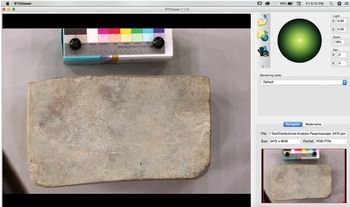
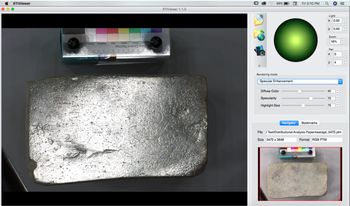
The RTI Viewer allows one to see the image in ten different rendering modes. It also allows one to adjust the lighting angle to cast shadows, as well as to zoom in and out on details. Figure 2 shows the basic appearance of the RTI Viewer and the image of the Cascajal Block in its default rendering mode. Of the various rendering modes, the specular enhancement mode, illustrated in Figure 3, was consistently useful for distinguishing cracking and pitting on the surface from incised lines.
RTI image of the Cascajal Block: Default rendering mode. Courtesy of The Mesoamerican Corpus of Formative Period Art and Writing, Michael D. Carrasco and Joshua D. Englehardt.

RTI image of the Cascajal Block: Specular enhancement mode. Courtesy of The Mesoamerican Corpus of Formative Period Art and Writing, Michael D. Carrasco and Joshua D. Englehardt.

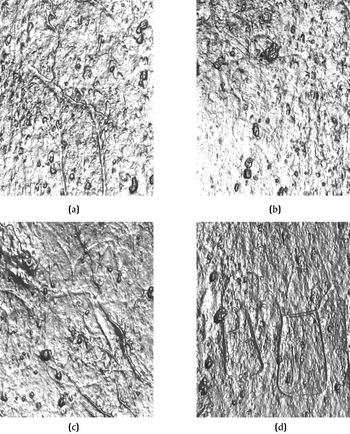
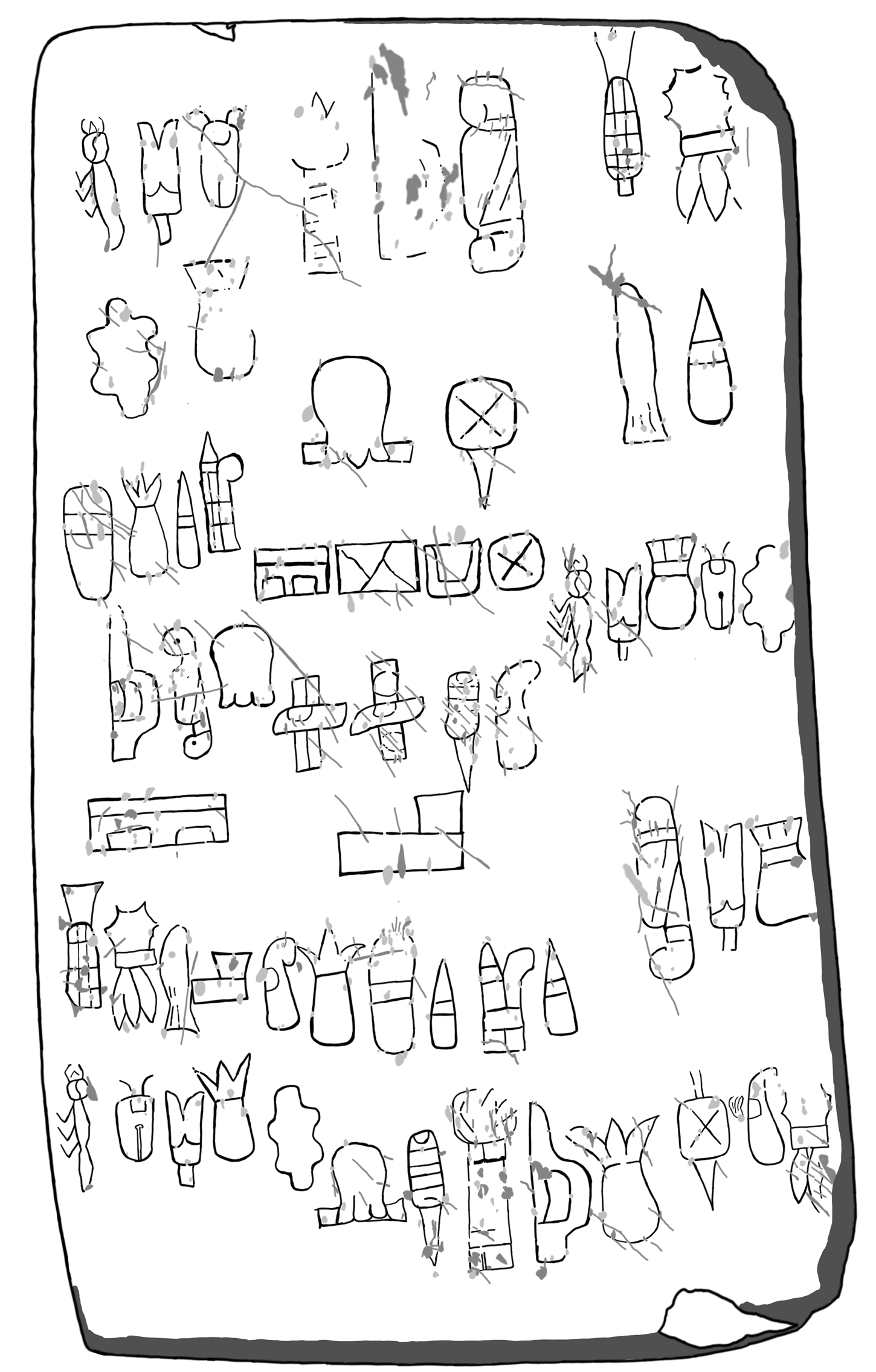
Some incisions were overlaid by cracks (Figure 4a), while very few incisions appear to have been traced onto cracks (Figure 4b). The pitting of the surface seems to postdate the incisions, as pits on the surface commonly obliterate incised details (Figure 4c), although sometimes a light or delicate trace of an incised line may remain visible at the bottom of a pit (Figure 4d).
Types of scratch lines and pitting. (a) Scratch lines that damage incised lines. (b) Scratch lines that may have preceded the incisions. (c) Pitting that destroys incisions. (d) Pitting that overlays but does not completely destroy incisions. Images prepared by the author using the RTI imaging produced by Michael Carrasco and Joshua Englehardt.

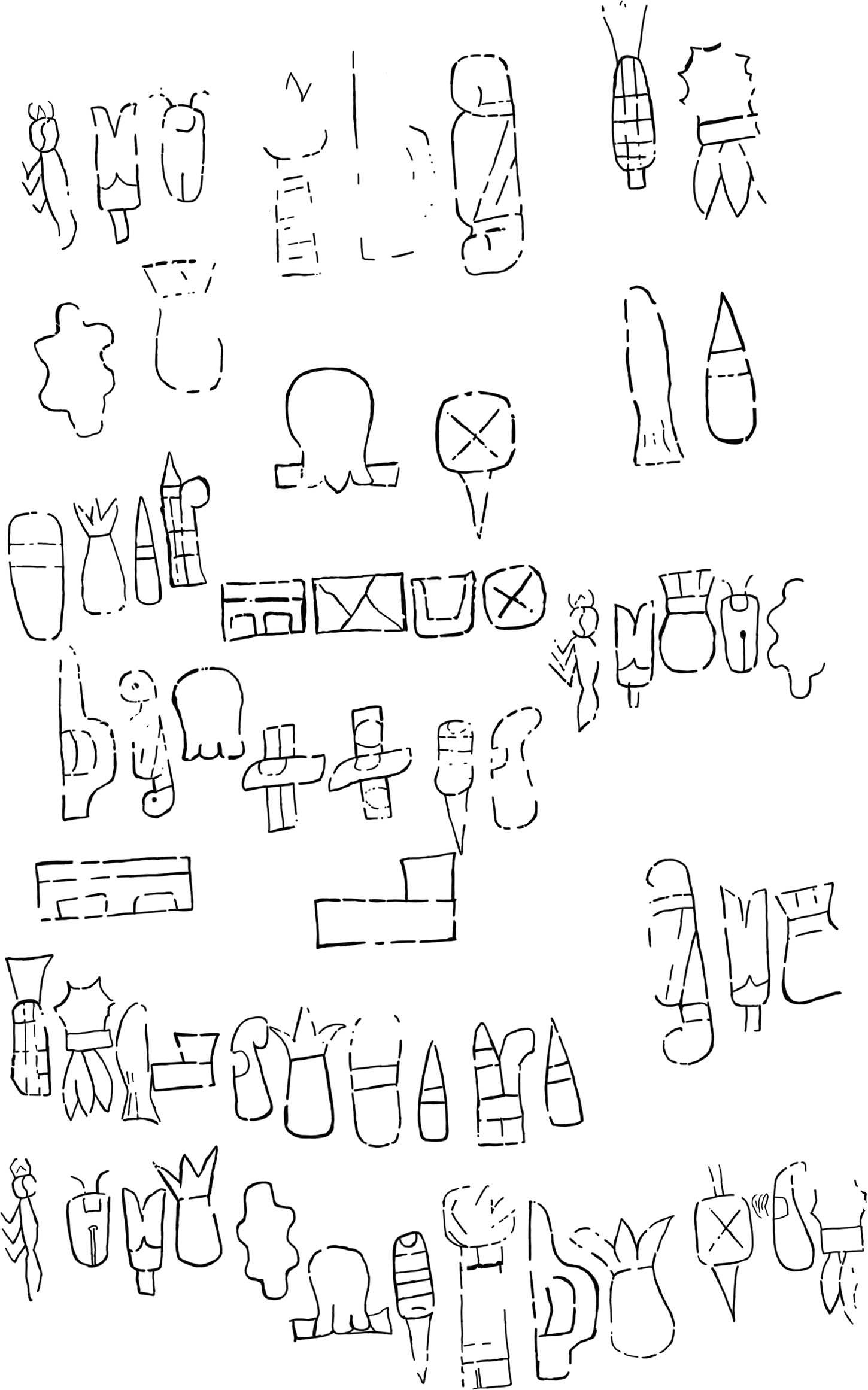
The full drawing of the inscribed surface of the block can be seen in Figure 5. This figure provides the outline, cracks, pitting, and incisions. Attention should be paid to the way in which two of the signs on the right edge of the block are incomplete: the scribe reached the end of the block on the third and fifth lines of the text and, as a result, the last sign on each of these lines is incomplete. I return to this observation below, in connection with my previously proposed reading (Mora-Marín Reference Mora-Marín2009). Figure 6 provides only the incised lines. The Supplementary Material provides a version of Figure 6 with numerals added to each sign following my proposed reading formatting (Mora-Marín Reference Mora-Marín2009).
Drawing by the author showing surviving incised lines, as well as cracks and pitting that have damaged incised lines.

Drawing of the inscription on the Cascajal Block, showing only incised lines. Drawing by the author.

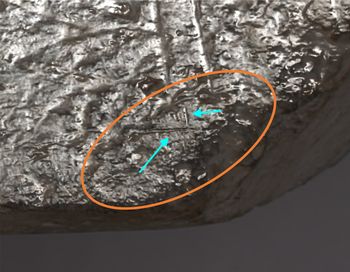
It has been suggested, based on the nature of the material, that the Cascajal Block could have been used multiple times, given the low hardness and ease of abrasion of serpentinite, without pointing to any direct evidence for this (Rodríguez Martínez et al. Reference Rodríguez Martínez, Ceballos, Coe, Diehl, Houston, Taube and Calderón2006a:1612; Ortiz Ceballos et al. Reference Ortiz Ceballos, Rodríguez Martínez, H. and C.2007:18). But evidence for such use may exist. Figure 7 shows what may be a leftover portion of an earlier layer of material that appears to be raised above the surface of the current layer of the inscription, with traces of at least two, roughly perpendicular, incised lines. Englehardt et al. (Reference Englehardt, Insaurralde Caballero, Melgar Tísoc, Velázquez Maldonado, Torres, Bernard and Carrasco2019) identified additional examples of traces of incisions from an earlier layer of text.
Section near top right corner of Cascajal Block, showing the eighth sign from the left on the top line of signs, and to its right, a raised area left over from an earlier layer of the stone that has since been mostly abraded away. This raised area contains the remains of an incised sign, specifically a long line intersected at a right angle by a shorter line, marked by arrow. RTI image detail of the Cascajal Block: Specular enhancement mode. Courtesy of The Mesoamerican Corpus of Formative Period Art and Writing, Michael D. Carrasco and Joshua D. Englehardt.

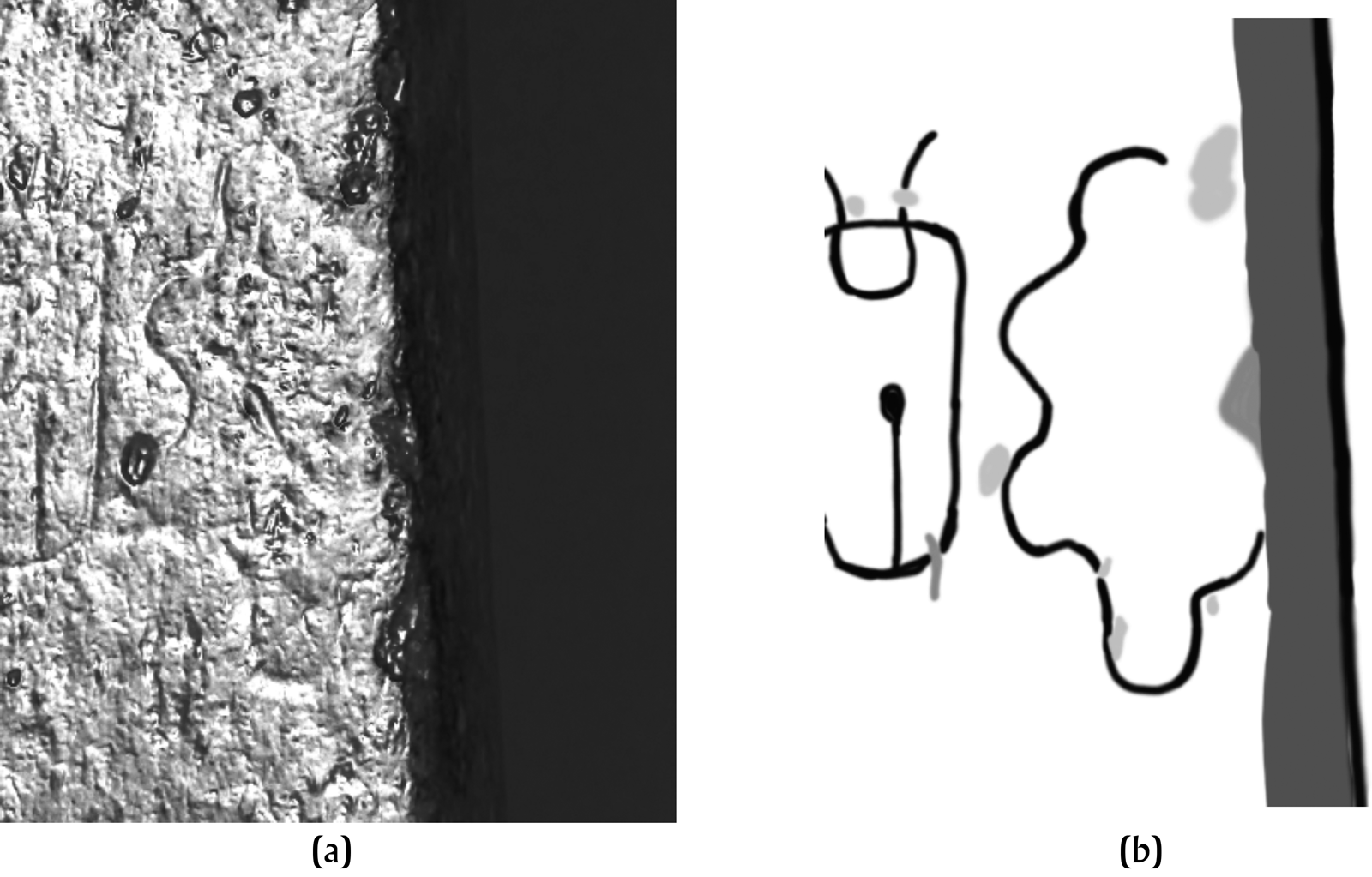
Another important issue pertains to the rendering of last sign on line 3 of the text, following Rodríguez Martínez et al.’s (Reference Rodríguez Martínez, Ceballos, Coe, Diehl, Houston, Taube and Calderón2006a) proposed text formatting. The sign, cataloged as CS6, resembles a pelt or hide. I (Mora-Marín Reference Mora-Marín2009:403–404) previously proposed a formatting of the text in which line 3 of the text is the antepenultimate column of the text and argued for a line crossover effect, suggesting that the scribe began the second line (the penultimate column according to my proposed text formatting and reading direction) with CS6 after having finished the preceding line with CS6. This crossover could have been the result of the scribe attempting to include a full phrase within the same line of the text, rather than splitting the phrase between lines. A closer look at the evidence suggests that it was not just a crossover effect: the scribe ran out of room at the end of line 3 and could not render CS6 whole. Re-rendering the sign at the beginning of the next line of the text was in this analysis an attempt by the scribe to correct this mistake. Rodríguez Martínez et al. (Reference Rodríguez Martínez, Ceballos, Coe, Diehl, Houston, Taube and Calderón2006b) provide three photographs of the block as supporting online materials; the second of these photographs shows the block at an oblique angle, with the right edge of the block in the foreground. This photo makes it possible to see that the instance of CS6 on the third line from the top is in fact incomplete and at the edge of the block, i.e., the scribe ran out of room to incise the full sign. Here I provide another image (Figure 8a), based on the RTI data shared by Carrasco and Englehardt, demonstrating that CS6 on line 3 was not completely rendered by the scribe, along with my line drawing of that section of the block (Figure 8b).
Incompletely rendered example of CS6 on the block. (a) RTI image using specular enhancement mode showing CS6 on the right edge of the block. (b) Line drawing by the author of the same section of the block.

DEPARTURES FROM PREVIOUS DRAWINGS OF THE INSCRIPTION
At least four drawings of the Cascajal Block inscription have been published: by Houston in Rodríguez Martínez et al. (Reference Rodríguez Martínez, Ceballos, Coe, Diehl, Houston, Taube and Calderón2006a:1612, Figure 4); by Rodríguez Martínez et al. (Reference Rodríguez Martínez and Ceballos2007:30, Figure 9), presumably the same drawing that appears in Ortiz Ceballos et al. (Reference Rodríguez Martínez and Ceballos2007:16); by Justeson and Lowry (Justeson Reference Justeson, Nichols and Pool2012:841, Figure 63.5), based on high-resolution photographs provided to them in 2011 by Rodríguez Martínez and Ortiz Ceballos; and by Carrasco in Carrasco and Englehardt (Reference Carrasco and Englehardt2015:2, Figure 1). A new drawing prepared by Carrasco appears in this volume (Englehardt et al. Reference Englehardt, Insaurralde Caballero, Melgar Tísoc, Velázquez Maldonado, Torres, Bernard and Carrasco2019) and shows agreement with my drawing in most details.
A major difference among the four published drawings lies in the third sign following the reading order by Rodríguez Martínez et al. (Reference Rodríguez Martínez, Ceballos, Coe, Diehl, Houston, Taube and Calderón2006a). This sign is rendered as a plant-like motif by Houston's drawing in Rodríguez Martínez et al. Reference Rodríguez Martínez, Ceballos, Coe, Diehl, Houston, Taube and Calderón2006a; Figure 9a), Rodríguez Martínez et al. (Reference Rodríguez Martínez and Ceballos2007; Figure 9b), and Carrasco's (Carrasco and Englehardt Reference Carrasco and Englehardt2015; Figure 9c) drawings. It is rendered as a different sign altogether, however, matching CS15, in Justeson and Lowry's (Justeson Reference Justeson, Nichols and Pool2012) drawing (Figure 9d). Ortiz Ceballos et al. (Reference Ortiz Ceballos, Rodríguez Martínez, H. and C.2007) also use the same drawing as Rodríguez Martínez et al. (Reference Rodríguez Martínez and Ceballos2007). The new line drawing I prepared and introduce in this paper (Figures 5 and 6) also renders this sign as a version of CS15 (Figure 9e), supporting Justeson and Lowry's rendering. If correct, the sign would then occur three times in the text. The confusion is probably the result of several cracks and pits that were misinterpreted as incisions by some of the scholars who have prepared drawings of the artifact. Finally, Carrasco's new drawing of the inscription (Englehardt et al. Reference Englehardt, Insaurralde Caballero, Melgar Tísoc, Velázquez Maldonado, Torres, Bernard and Carrasco2019) independently rendered sign 3 of the block as an instance of CS15.
Renderings of the third sign on the top of the block following orientation by Rodríguez et al. (Reference Rodríguez Martínez, Ceballos, Coe, Diehl, Houston, Taube and Calderón2006a). (a) Drawing by Stephen Houston in Rodríguez et al. (Reference Rodríguez Martínez, Ceballos, Coe, Diehl, Houston, Taube and Calderón2006a:1612, Figure 4). (b) Drawing by Rodríguez et al. (Reference Rodríguez Martínez and Ceballos2007:30, Figure 9). (c) Drawing by Michael Carrasco in Carrasco and Englehardt (Reference Carrasco and Englehardt2015:2, Figure 1). (d) Drawing by Justeson et al. (Reference Justeson, Nichols and Pool2012:841, Figure 63.5a). (e) Drawing by the author. (f) Drawing by the author showing cracks and pits on the surface of the stone that were misinterpreted as incisions in some of the previous drawings.

Another important difference with respect to previous drawings is found in sign 5 of the block. Rodríguez Martínez et al. (Reference Rodríguez Martínez, Ceballos, Coe, Diehl, Houston, Taube and Calderón2006a) did not include the sign in their inventory, perhaps because they were unsure of its identity. Such a sign, illustrated as an elongated and rectangular sign by Rodríguez Martínez et al. (Reference Rodríguez Martínez, Ceballos, Coe, Diehl, Houston, Taube and Calderón2006a), as well as in a couple of the previous drawings (Carrasco and Englehardt Reference Carrasco and Englehardt2015; Justeson Reference Justeson, Nichols and Pool2012), is instead rendered as a version of CS16 in my drawing. If so, this sign occurs three times instead of two, a point that is reiterated in the distributional analysis section; I also discuss this sign again in connection with the topic of sign pairings that may be linguistically and/or iconographically motivated. The more recent drawing by Carrasco (Englehardt et al. Reference Englehardt, Insaurralde Caballero, Melgar Tísoc, Velázquez Maldonado, Torres, Bernard and Carrasco2019:Figure 7) also renders this sign as a version of CS16; in their paper, the authors provide illustrations of RTI imagery supporting this identification. Carrasco independently arrived at this rendering of sign 5 and the two of us only communicated about it by email after the fact.
DISTRIBUTIONAL ANALYSIS: SIGNARY AND SIGN BEHAVIOR
Background to Text Formatting and Reading Order
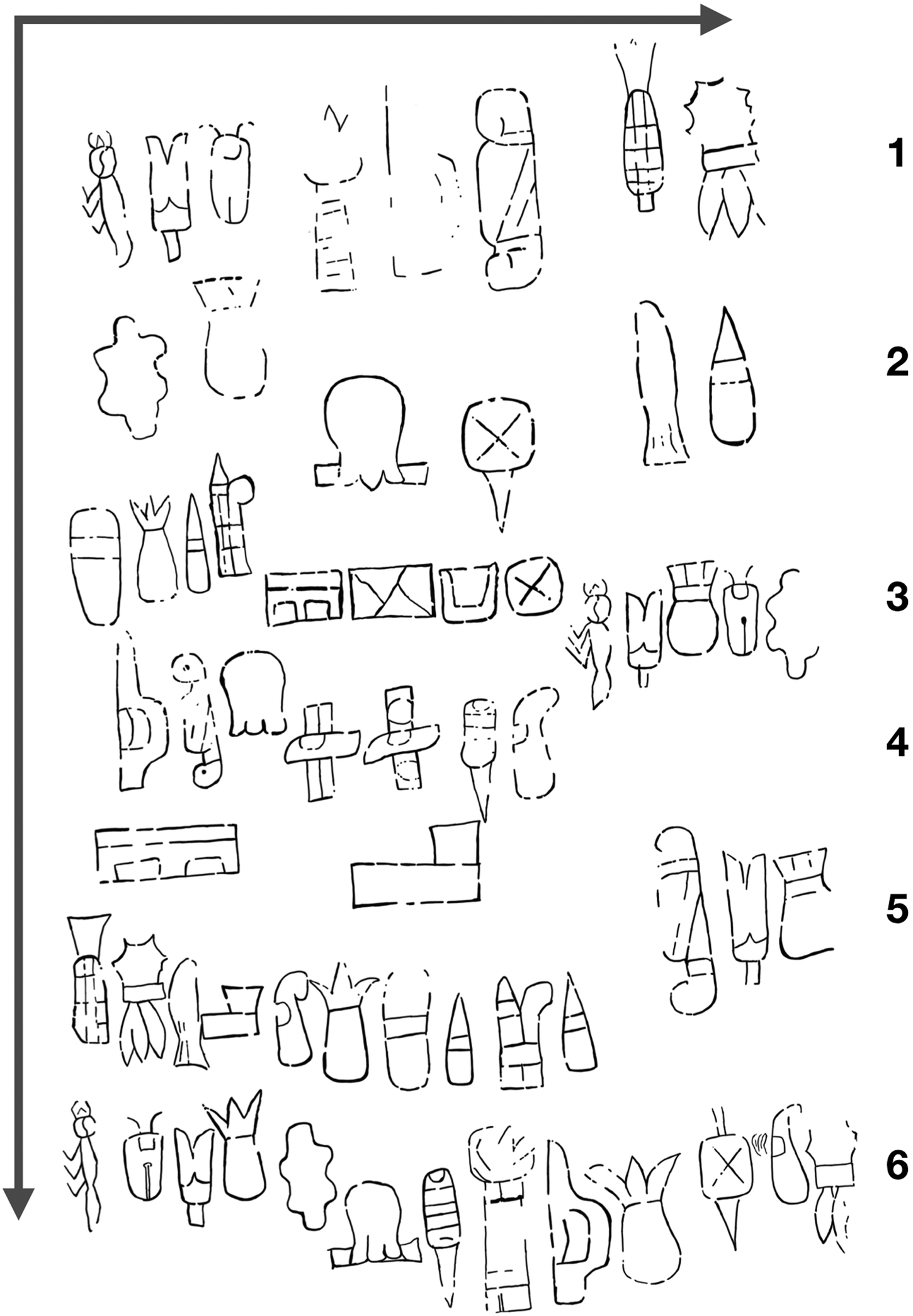
Rodríguez Martínez et al. (Reference Rodríguez Martínez, Ceballos, Coe, Diehl, Houston, Taube and Calderón2006a:1612, 1614) have argued for a top-to-bottom, left-to-right reading direction, and for a text formatted in rows. Their proposed orientation of the block and its text relies on the orientation of signs resembling “vegetal icons” and the assumption that the orientation of such icons within a text would be consistent with their orientation within pictorial iconography; their proposed reading direction relies on the fact that Mesoamerican scripts typically read from left-to-right, top-to-bottom. Houston (Reference Houston2010) reinforces the first assumption, stating “Sign ‘behavior’ in a text—the ways in which scribes orient signs—tends to conform to its disposition in imagery.”
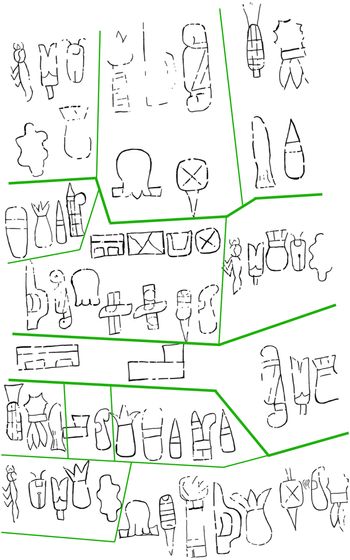
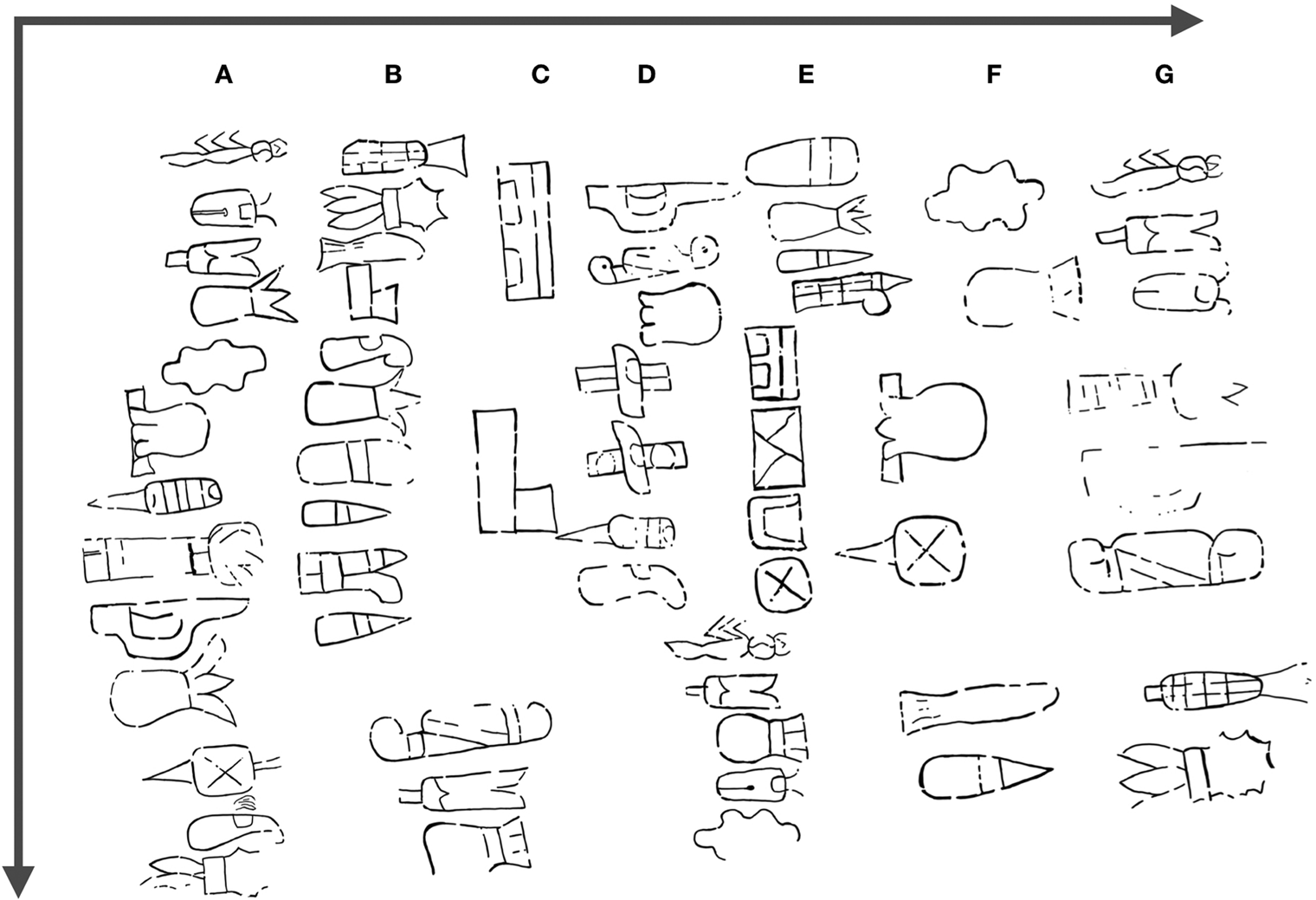
In contrast, I (Mora-Marín Reference Mora-Marín2009) proposed a top-to-bottom, left-to-right reading direction, but one that requires that the block be rotated 90° to the right with respect to the orientation assumed by Rodríguez Martínez et al. (Reference Rodríguez Martínez, Ceballos, Coe, Diehl, Houston, Taube and Calderón2006a). Skidmore (Reference Skidmore2006:4) had already envisioned this possibility, stating that “a horizontal orientation of the block would have the advantage of creating a roughly columnar layout,” but he chose to follow the criteria for the formatting of the text by Rodríguez Martínez et al. (Reference Rodríguez Martínez, Ceballos, Coe, Diehl, Houston, Taube and Calderón2006a). I arrived at my proposed formatting based on the identification of long, repeated sign sequences and the suggestion that, since two, different, repeated sign sequences are spread across lines of text, the only formatting and reading order in which such sequences remain unbroken entails a horizontal orientation of the block and columnar arrangement of the lines (Mora-Marín Reference Mora-Marín2009). Moreover, as already stated, at least one sign, CS6, appears to have been left incomplete at the end of the line, and then re-rendered at the beginning of a following line—if one assumes my proposed formatting.
Following the distributional analysis of the signary and possible implications of apparent spelling practices, as well as the presence of sign pairings and their significance, I review additional proposals for the formatting and reading direction of the text by Macri (Reference Macri2006), Anderson (Reference Anderson2007, Reference Anderson, Hull and Carrasco2012), Freidel and Reilly (Reference Freidel, Reilly, Staller and Carrasco2010), and Justeson (Reference Justeson, Nichols and Pool2012). Nevertheless, in doing so my goal will be strictly to assess the extent to which the conclusions of my distributional analysis are affected by such varying proposals.
Previous Discussions of the Signary
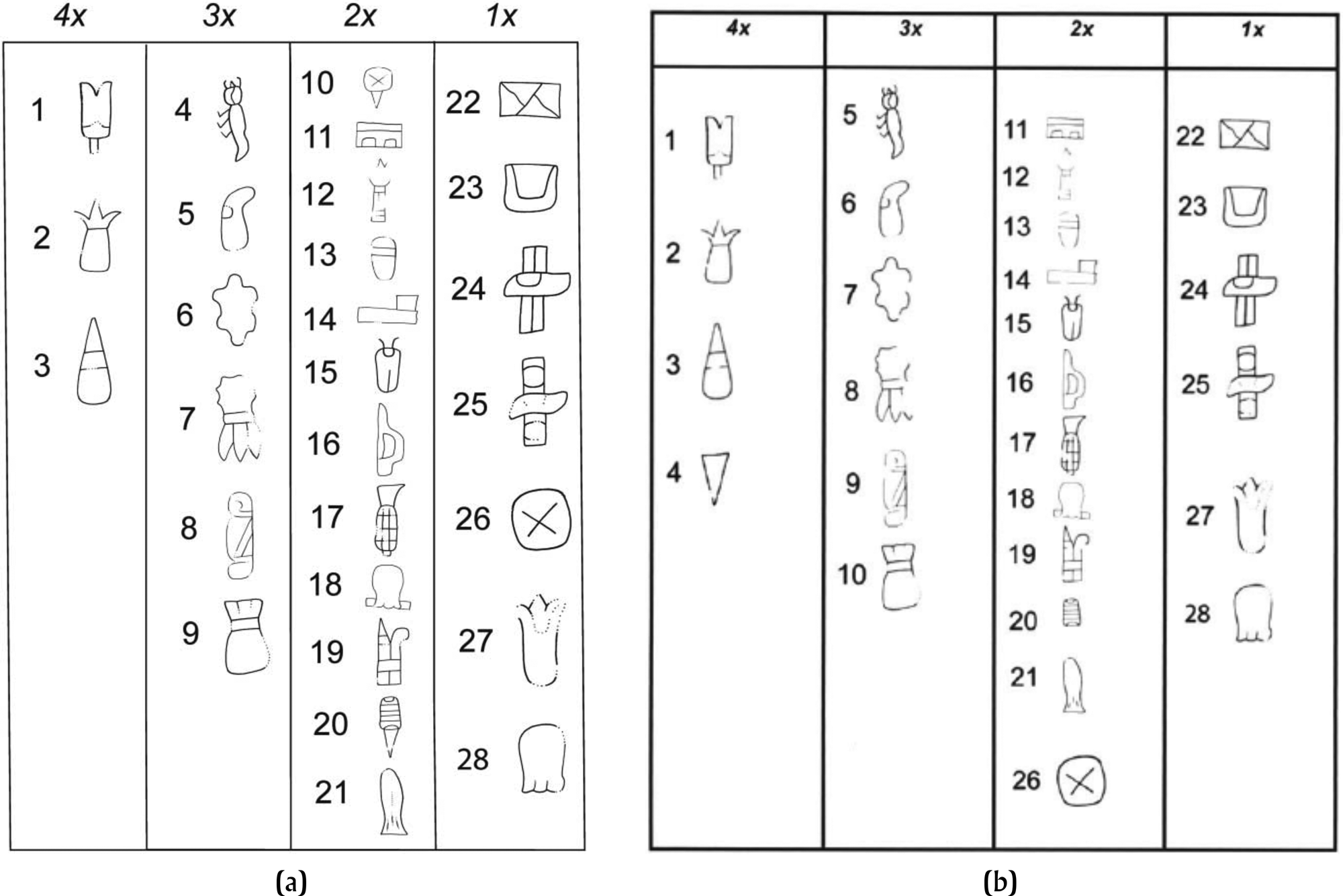
The signary was first discussed in detail by Rodríguez Martínez et al. (Reference Rodríguez Martínez, Ceballos, Coe, Diehl, Houston, Taube and Calderón2006a:1612–1613). Those authors propose a total inventory of 28 signs in the CS (Figure 5; Rodríguez Martínez et al. Reference Rodríguez Martínez, Ceballos, Coe, Diehl, Houston, Taube and Calderón2006a:1613), arranged by number of occurrences, as seen in Figure 10a. I (Mora-Marín Reference Mora-Marín2009:397–399, Figure 3) proposed two previously undistinguished signs and a revision in the frequency of another sign; my revised signary is seen in Figure 10b, and involves a renumbering of signs CS4–CS10. A problem with the signary as defined by Rodríguez Martínez et al. (Reference Rodríguez Martínez, Ceballos, Coe, Diehl, Houston, Taube and Calderón2006a) is that sign codes are based in part on the number of occurrences within the Cascajal Block, instead of formal criteria of the signs themselves; should additional texts in the script be found, a more comprehensive catalog would be required. But since only one such text is known, I have decided to abide by the original conventions in Rodríguez Martínez et al. (Reference Rodríguez Martínez, Ceballos, Coe, Diehl, Houston, Taube and Calderón2006a). Two additional problems with my revisions are also worth pointing out here: the renumbering of CS4–CS10 could create confusion, and is abandoned in this paper; and, after arguing that CS26 and CS10 should be merged, with the triangular basal element of CS10 isolated as a separate sign and reclassified as CS4, I included the merged sign, CS10, in the column showing signs with two occurrences instead of the column for signs with three occurrences, an error that is corrected in this paper. In the following section, I offer a new version of the sign inventory that adds new numerical codes for newly identified signs, instead of simply (and confusingly) reassigning already existing codes, as I did previously (Mora-Marín Reference Mora-Marín2009); the new classification also lists each sign in the appropriate frequency column.
Two previous proposals for the signary and frequencies of distribution. (a) Sign inventory proposed by Rodríguez et al. (Reference Rodríguez Martínez, Ceballos, Coe, Diehl, Houston, Taube and Calderón2006a:1613, Figure 5). (b) Sign inventory proposed by Mora-Marín (Reference Mora-Marín2009:399, Figure 3).

DISTRIBUTIONAL ANALYSIS: REVISIONS TO THE SIGNARY
Next, citing the signs by their CS numbers in Rodríguez Martínez et al. (Reference Rodríguez Martínez, Ceballos, Coe, Diehl, Houston, Taube and Calderón2006a), I offer a distributional analysis that will lead to a new proposal for the signary. The following remarks pertain to only a few of the signs classified as distinct in Rodríguez Martínez et al. (Reference Rodríguez Martínez, Ceballos, Coe, Diehl, Houston, Taube and Calderón2006a): CS10, CS20, CS26, CS18, CS28, and CS16. I assume the text formatting and reading directionality that I previously proposed (Mora-Marín Reference Mora-Marín2009), but will note where such assumption leads to a different analysis from what would be obtained assuming other proposals for formatting and directionality.
As I have already discussed elsewhere (Mora-Marín Reference Mora-Marín2009:397–399), Rodríguez Martínez et al.’s (Reference Rodríguez Martínez, Ceballos, Coe, Diehl, Houston, Taube and Calderón2006a) CS10 and CS20 appear to be composite signs (Supplementary Figure 1a): both consist of a complex component on the top, and an identical, simplex, triangular-shaped component on the bottom (Supplementary Figure 1b). Their comparable distribution with respect to similar sequences of preceding signs (Supplementary Figures 1c and 1d) suggests that Rodríguez Martínez et al.’s (Reference Rodríguez Martínez, Ceballos, Coe, Diehl, Houston, Taube and Calderón2006a) CS10 and CS20 are functionally equivalent, perhaps identical in value (and, if so, allograms), or distinct in value but functioning as complementary members of a paradigm, i.e., perhaps representing different lexemes/morphemes within a lexical/morphological paradigm. In addition, the top component of Rodríguez Martínez et al.’s (Reference Rodríguez Martínez, Ceballos, Coe, Diehl, Houston, Taube and Calderón2006a) CS10 is identical to CS26 (Supplementary Figure 1e), suggesting that the triangular element of both CS10 and CS20 is a distinct sign, and if so, it requires its own designation in the signary. CS26 will remain as such, only now it occurs four times; CS10 is eliminated; CS20 is now redefined as consisting of only the complex banded component minus the triangular element; and the triangular basal element that I previously isolated as a separate sign and recoded as CS4 (Mora-Marín Reference Mora-Marín2009), is now recoded as CS29. Alternatively, as suggested by one of the reviewers of this paper, there is a possibility that Rodríguez Martínez et al.’s (Reference Rodríguez Martínez, Ceballos, Coe, Diehl, Houston, Taube and Calderón2006a) CS10 and CS20 are different ways of depicting the same real-world object, perhaps a bloodletter or knife with a handle that can be fashioned into different designs; if so, the triangular element would not consist of a distinct grapheme. Since the top elements of Rodríguez Martínez et al.’s (Reference Rodríguez Martínez, Ceballos, Coe, Diehl, Houston, Taube and Calderón2006a) CS10 and CS20 have very different shapes, I prefer to apply a “splitting” approach, rather than a “lumping” one, in order to breakdown the structure of the script as much as possible in order to formulate hypotheses for testing against future finds.
Rodríguez Martínez et al.’s (Reference Rodríguez Martínez, Ceballos, Coe, Diehl, Houston, Taube and Calderón2006a) CS18 and CS28 also incorporate the same sign, argued in the Sign Pairings section to be, iconically, a PAW. That said, their contexts are different (Supplementary Figures 2a and 2b), with Rodríguez Martínez et al.’s (Reference Rodríguez Martínez, Ceballos, Coe, Diehl, Houston, Taube and Calderón2006a) CS18 occurring in close proximity to CS6 (Supplementary Figure 2a), the PELT sign, and Rodríguez Martínez et al.’s (Reference Rodríguez Martínez, Ceballos, Coe, Diehl, Houston, Taube and Calderón2006a) CS28 occurring in a different environment (Supplementary Figure 2b). This suggests that the graphic difference between the two, the presence of two squarish notches on Rodríguez Martínez et al.’s (Reference Rodríguez Martínez, Ceballos, Coe, Diehl, Houston, Taube and Calderón2006a) CS18, is contrastive, and therefore a distinct grapheme (Supplementary Figure 2c). One of the two examples of this grapheme, shown in Supplementary Figure 2c, shows a horizontal line that extends from one of the two squarish notches in the direction of the other; perhaps the scribe intended for them to connect but, in either case, this version, with this additional line, seems to be the more complete form of the sign. This new, distinct grapheme is redefined as CS18, and Rodríguez Martínez et al.’s (Reference Rodríguez Martínez, Ceballos, Coe, Diehl, Houston, Taube and Calderón2006a) CS28 is now redefined as occurring three times instead of only once. The new CS18, consisting as it does of two squarish components potentially connected by a line, resembles Epi-Olmec MS20 wʉ (Supplementary Figure 2d; Justeson and Kaufman Reference Justeson and Kaufman1993, Reference Justeson and Kaufman1997; Kaufman and Justeson Reference Kaufman and Justeson2001, Reference Kaufman, Justeson and Woodard2004; Macri and Stark Reference Macri and Stark1993), with the bracket that partially encloses the two notches in MS20 wʉ corresponding to the line that was seemingly intended to connect the two notches in the new CS18. This resemblance, however, is merely suggestive at this point.
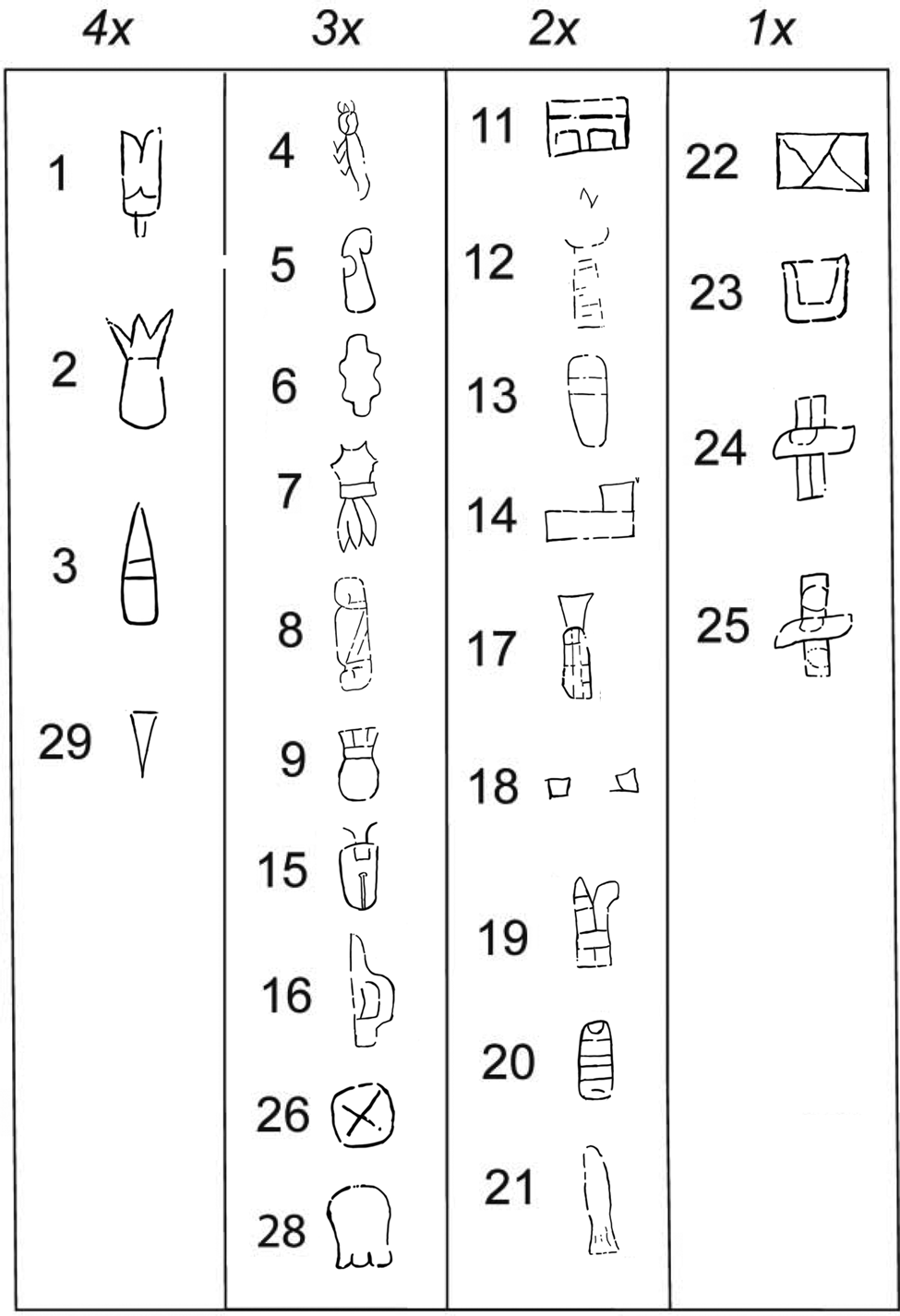
As already noted, sign 5 on the block appears to be another instance of CS16, according to the new line drawing presented in this paper. Thus, CS16 requires relocation to the column for signs with three occurrences. Similarly, sign 3 on the block was discussed as consistent with the characteristics of CS15. This calls for the deletion of CS27, and the relocation of CS15 to the column for signs with three occurrences.
The revised signary prompted by these observations is shown in Figure 11. The signs labeled with the numerals 29, 18, 20, 26, 15, and 16 are those that have undergone revision; the first, CS29, is newly coined, the second and third signs, CS18 and CS20, have been modified formally, and the rest have been revised in terms of their frequency.
Newly proposed sign inventory and frequency list, incorporating revisions proposed in Mora-Marín (Reference Mora-Marín2009) and in this paper.

FURTHER DISTRIBUTIONAL ANALYSIS: PALEOGRAPHY AND ORTHOGRAPHY
Based on sign sequence repetition, sign co-distribution, and sign substitution patterns, the following observations and proposals can be made.
CS2 and CS9 (Supplementary Figure 3a) could constitute stylistic variants (stylistic alternations of the same grapheme) or perhaps allograms (iconographically unrelated signs with the same value; Supplementary Figures 3b and 3c), as suggested by their roughly equivalent placement within two repeated sequences identified by several authors. That said, one of the two versions of these repeated sequences illustrated below (Supplementary Figure 3b) relies on the reading formatting and direction that I proposed (Mora-Marín Reference Mora-Marín2009:403, Figure 10). I assume equivalence between CS2 and CS9 from this point on.
Interestingly, the long, repeated sequence just cited, as well as another one I also identified (Mora-Marín Reference Mora-Marín2009:403, Figure 9), exhibits sign arrangements that Justeson (Reference Justeson, Nichols and Pool2012:840–841) has regarded as inconsistent, noting that “while certain symbol groups recur, sign order within them is not entirely consistent.” The implication is that they may not be linguistically motivated. For now, I will restrict myself to a shorter section of the repeated sequences already mentioned above (Supplementary Figures 3b and 3c), reproduced as Supplementary Figures 4a and 4b. (The longer version of the sequences relies on the validity of the reading formatting I previously proposed [Mora-Marín Reference Mora-Marín2009]. The shorter version discussed here does not.) In these sequences we find CS1-CS2/CS9-CS15 (Supplementary Figure 4a) and CS15-CS1-CS2/CS9 (Supplementary Figure 4b). CS15, shown within a rectangle, shows a thoroughly inconsistent placement with regard to CS1 and CS2/CS9, occurring after the CS1-CS2/CS9 sequence in one case, and before it in the other. The second lengthy, repeated sequence of signs that exhibits an inconsistent internal arrangement merits examination. (The same disclaimer about the difference between the shorter and longer versions of the repeated sequence noted above for the first set of examples applies here.) Here it is reproduced in part in Supplementary Figures 4c and 4d. The first consists of CS2/CS9-CS13-CS3 (Supplementary Figure 4c), and the second of CS13-CS2/CS9-CS3 (Supplementary Figure 4d). CS13, shown within a rectangle, shows a thoroughly inconsistent placement with regard to CS2/CS9 and CS3, which occur in the same position with respect to each other in both cases (CS2/CS9 first, CS3 after).
These patterns of sign co-distribution might at first appear irregular or inconsistent, and unlikely to reflect linguistic motivation. But when one considers how logophonetic scripts work, a different option is available: these patterns resemble the way in which phonograms and logograms may combine in logophonetic spellings. For instance, in Mayan writing, a logogram, such as WAY for *wahy, “shape-shifter” (Houston and Stuart Reference Houston and Stuart1989), may appear complemented by syllabograms (e.g., wa and ya) as follows: wa-WAY, WAY-ya, wa-WAY-ya, wa-ya-WAY, WAY-wa-ya (Mora-Marín Reference Mora-Marín2008:198–200, Figure 2). The way in which CS1 and CS2/9 combine with CS15 on two different occasions (Supplementary Figures 4a and 4b, repeated as Supplementary Figures 5a and 5b for ease of comparison) resembles the internal arrangement of syllabograms used as phonetic complements with respect to the logogram they complement in two of the Mayan spellings in question (Supplementary Figures 5c and 5d). Similarly, the way in which CS2/CS9 and CS3 combine with CS13 on two different occasions (Supplementary Figures 4c and 4d, repeated as Supplementary Figures 5e and 5f for ease of comparison again) resembles two of the Mayan spellings just mentioned as well (Supplementary Figures 5g and 5h). Thus, these patterns of repetition, co-distribution, and variation would suggest that CS15 and CS13 behave like logograms, and at the same time, that CS1, CS2/9, and CS3 behave like phonograms (e.g., syllabograms).
With regard to CS15, it is worth remarking on the implications of the revised renderings of the third sign on the block by myself, Justeson and Lowry, and Carrasco. If the new rendering of this sign as another instance of CS15 is correct, the resulting sequence would be similar to that present in the examples discussed above (Supplementary Figures 4a and 4b), reproduced again as Supplementary Figures 6b and 6c, except that in the new example there is no CS2/CS9 sign. This omission is, of course, consistent with the expected optionality of phonetic complements with respect to logograms, supporting both the possible syllabographic function of CS2/CS9 and the possible logographic function of CS15. Elsewhere, at the end of the fifth line from the top, CS1 and CS2/CS9 appear in sequence, without CS15 (Supplementary Figure 6d); it is possible this sequence could constitute a purely syllabographic spelling of the word spelled by the possibly logographic CS15.
In one instance, CS2/CS9 intervenes between what appears to be an iconographic pairing PELT-PAW (Supplementary Figures 7a and 7b). If CS2/CS9 does, in fact, function syllabographically, then one could entertain a value if one assumes that the PELT (CS6) and/or PAW (CS28) signs are iconically motivated logograms. If it were complementing an iconographically motivated PELT logogram, possibly based on Proto-Zoquean *naka “shell, skin,” then a possible value would be ka. But if it were complementing an iconically motivated PAW logogram instead, a possible value kɨ based on Proto-Mixe-Zoquean *kɨʔ, “hand, arm,” could be considered. For the moment, there is no way to determine which of the two signs, CS6 PELT or CS28 PAW, is the one that is complemented by CS2/CS9. And even if one could determine this, there is insufficient evidence to test the resulting hypothesis (whether ka or kɨ), given that the other contexts where CS2/CS9 might be functioning syllabographically are semantically or lexically opaque: for one, it is not clear what real-world entity might be the iconic referent of CS15; and for another, as far as CS13 is concerned (Supplementary Figure 4), which I (Mora-Marín Reference Mora-Marín2010:16–17) argue to be a bound greenstone celt, there is no single, obvious source word that could be used to test a hypothesis.
CS3 was already argued to function as a syllabogram, specifically in the context where it is used, together with CS2/CS9, as a possible phonetic complement to CS13, as already seen (Supplementary Figures 5a and 5b). There, it is used in combination with CS2/CS9 as a possible complement to CS13 (Supplementary Figure 8c). In another instance, CS3 is inserted between CS19 and CS11 (Supplementary Figures 8a and 8b), seemingly optionally, given the other instance of the sequence CS19–CS11 where CS3 is not present.
Another sign, CS4, could be argued to be a syllabogram based on its contexts; as noted by Hopkins (Reference Hopkins2006), CS4 appears initially twice, both in text-initial position (whether on the top, left corner or bottom, left corner), and in line/row/column-initial position. I (Mora-Marín Reference Mora-Marín2009:405–406) also noted that this sign appears text-initially and line/row/column-initially; consequently, a clause-initial position seems likely, one that could signal its use to spell a grammatical morpheme (Supplementary Figure 9a), such as an aspect marker or person agreement marker. The sign represents an ant (Supplementary Figure 9b), as suggested by the prominent mandibles and the triangular-shaped clypeus in between the mandibles, and more generally by the three visible legs, assuming only one side of the ant is shown, and the segmentation of the body. It is not possible at this time, though, to test possible values, due to an obvious lack of contextualization for the three similar sign sequences where the ANT sign occurs, and the fact that it does not occur outside of such a sequence, in a different context.
In addition to CS4, I (Mora-Marín Reference Mora-Marín2009:405–406, 408, Figure 13) also noted that CS5 is the initial sign in one of the long sequences that is repeated twice (Supplementary Figure 10) and that, like CS4, it is possible to hypothesize, based on its frequency (three occurrences) and context of two of its occurrences (at the beginning of a long repeated sequence), that it could represent a phonogram used to represent (in at least two cases) a grammatical marker, perhaps an aspect or person agreement marker. I suggested that CS5 may also be present, as a text-initial sign, on the inscribed obsidian blade from La Venta (Mora-Marín Reference Mora-Marín2009:407, Figure 14).
SIGN PAIRINGS: COUPLETS AND KENNINGS
Rodríguez Martínez et al. (Reference Rodríguez Martínez, Ceballos, Coe, Diehl, Houston, Taube and Calderón2006a:1613) allude to the presence of possible couplets in the Cascajal Block, but do not explicitly elaborate on these. Couplets are common stylistic features in the verbal art traditions of Mesoamerica (and many other languages from around the world), consisting of paired phrases that together act rhetorically, i.e., to emphasize an idea (through repetition of the same phrase), or figuratively, i.e., to convey a third concept either metaphorically (a common type of kenning in Old English, e.g., “sea steed” for “ship” in Boewulf) or metonymically (a common type of kenning in Mayan languages today, e.g., “my father, my mother” for “my parents”); when the latter is the case, when a third concept is conveyed by means of two concepts expressed in a parallel grammatical structure, it is referred to as a diphrastic kenning, or difrasismo. (See the work of Knowlton [Reference Knowlton2002] and Hull [Reference Hull2003] on couplets, kennings, and parallelisms in Classic Mayan inscriptions.) Carrasco and Englehardt (Reference Carrasco and Englehardt2015) elaborate on one of these (Supplementary Figure 11a), interpreting it as diphrastic kenning, “throne and mat” referring more specifically to “rulership” or “authority.” Furthermore, those authors have suggested that the second component of this pairing, specifically sign CS22, reminiscent of a woven mat, may be read (at least in part) as ta based on Proto-Zoquean *pata, “mat,” which they suggest could be based (at least in part) on Proto-Mixe-Zoquean *taakʔ, “to weave” (Wichmann Reference Wichmann1995:425, 473). Justeson (Reference Justeson, Nichols and Pool2012) has identified three instances of Cascajal paired signs that appear to match paired motifs in Olmec iconography (Supplementary Figures 11b–11e); he argues that they are iconographically, but not necessarily linguistically, motivated. It is possible, however, that Olmec iconography exhibited pairings of motifs that were themselves motivated by linguistically paired expressions, whether couplets or diphrastic kennings.
I (Mora-Marín Reference Mora-Marín2010:47–50) previously proposed the presence of another such pairing, the case of the PELT-PAW pairing (Supplementary Figure 12), consisting of signs CS6–CS18 in the signary by Rodríguez Martínez et al. (Reference Rodríguez Martínez, Ceballos, Coe, Diehl, Houston, Taube and Calderón2006a), or CS6–CS18[28] in the revised signary I propose in this paper (Figure 11). At this time, I do not know whether this pairing relates to any known diphrastic kennings in Mesoamerican languages; that said, if the signs are iconic logograms for “hide/skin” and “paw/hand,” respectively, they could potentially signify, through metonymy, the concept of “body.” The pairing co-occurs with the newly defined CS18 sign, the double-notched element (Supplementary Figure 2c), somewhat reminiscent of Epi-Olmec MS20 wʉ (Supplementary Figure 2d). (I use Epi-Olmec sign values proposed in Justeson and Kaufman [Reference Justeson and Kaufman1993] and Kaufman and Justeson [Reference Kaufman and Justeson2001, Reference Kaufman, Justeson and Woodard2004].) And interestingly, one of the two examples of this sequence is separated by CS2/CS9, a sign already proposed to be a candidate for a syllabogram (or phonogram, more generally) based on some of its other contexts; hence, its optional presence within this repeated sequence supports, as already discussed (cf. Supplementary Figure 4b), a syllabographic function and, if so, it could be aiding in the reading of one of the two adjacent signs, either CS6 or CS28:18. (Here, the notation CS28:18, with a colon in between the two signs, is used to indicate that sign CS28 appears above sign CS18.) If the paired signs constitute a noun or noun phrase, perhaps referring to an individual's status (e.g., a status conferred by the donning of a pelt with paws still attached) and if CS18 is, in fact, a graphemic precursor of MS20 wʉ, it would be possible to analyze it in this context as an instance of the “relativizer” *-wʉʔ. Assuming for the moment that the pelt with paws attached, often shown in Olmec art being worn by individuals wearing multiple insignia of status, signified a particular status, then the use of *-wʉʔ, “relativizer” could be interpreted as rendering a phrase like “who is of a Pelt-and-Paw status.” If so, presumably, an individual's proper name would be adjacent to this phrase. Nonetheless, the pairing could be based on iconography: I (Mora-Marín Reference Mora-Marín2010:47–50) in fact identified it as a pairing based on the iconographic motif of a pelt with paws still attached (Supplementary Figures 12c and 12d). The PAW motif in Supplementary Figure 12d in particular shows a comparable shape to that of the proposed PAW sign, CS28.
If the pairings in Supplementary Figures 11 and 12 are linguistically motivated, they could constitute a potential key to decipherment. As Carrasco and Englehardt (Reference Carrasco and Englehardt2015:3) argue:
The potential to reveal shifting structural conventions in systems of visual communication is what makes kennings, couplets and other linguistic tropes of such significance in understanding the origins of writing. Their use indicates that linguistic structures were functioning as the dominant organizing principle.
Indeed, in the absence of obvious calendrical content or accompanying imagery, these pairings are the closest thing there is to a possible semantic control on the content of the text, and particularly on possible lexical values of specific signs or sign sequences. In any attempt at linguistic decipherment, therefore, such pairings should constitute the starting point, followed by the evidence for grammatical structure and phonographic functions of signs based on their frequency distribution and positioning within repeated sequences.
IMPACT OF DIFFERENT FORMATTING AND DIRECTION PROPOSALS ON THE PRESENT ANALYSIS
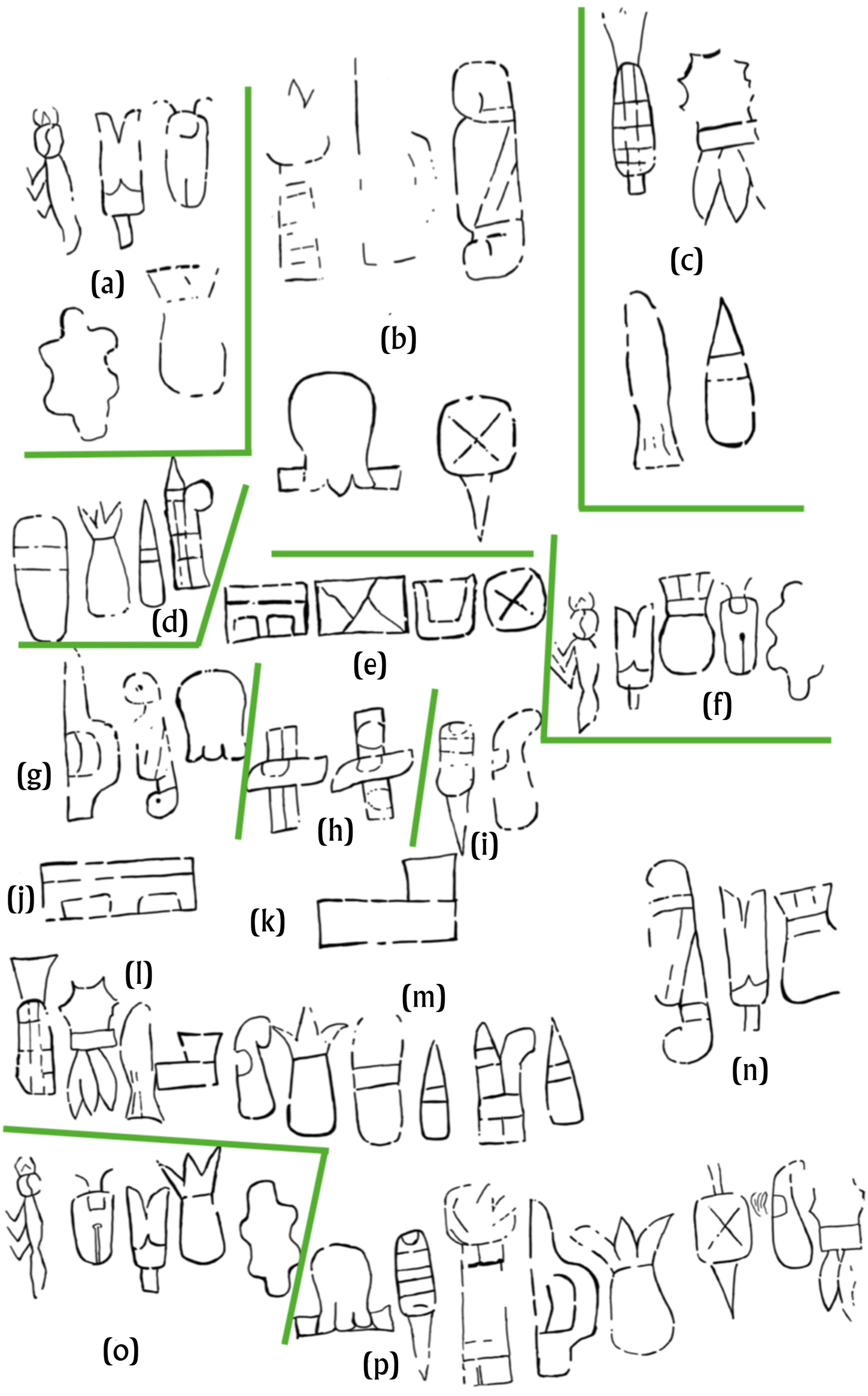
In this section, I address three alternative analyses of the internal structure of the Cascajal Block text and review how they affect the distributional analysis carried out so far. First, I address those by Macri (Reference Macri2006) in Figure 12 and Justeson (Reference Justeson, Nichols and Pool2012) in Figure 13. Both authors have independently offered very similar text formatting models; arguably, they are equivalent. Both authors assume the vertical orientation of the block proposed by Rodríguez Martínez et al. (Reference Rodríguez Martínez, Ceballos, Coe, Diehl, Houston, Taube and Calderón2006a). To my knowledge, their model is based on visual traits: relative structural organization of the text into sign groups, and relative size of signs within and between sign groups. Within each sign group, these authors seem to follow a top-to-bottom, left-to-right reading direction in rows. Neither model, however, seems to be based on evidence of cross-overs of repeated sign sequences. With regard to the proposals put forth in this paper, both models would invalidate the two instances of the PELT-PAW sequence of signs that I discuss in the preceding section (Supplementary Figure 12), as well as the proposal that CS5 could initiate two of the long, repeated sequences (Supplementary Figures 8 and 10), as I previously proposed (Mora-Marín Reference Mora-Marín2009).
Proposals for formatting by Macri (Reference Macri2006) and Justeson (Reference Justeson, Nichols and Pool2012). Format proposed by Macri (Reference Macri2006:2, Figure 1). The author has modified the original versions of those authors’ models by using the new drawing introduced in this paper.

Proposals for formatting by Macri (Reference Macri2006) and Justeson (Reference Justeson, Nichols and Pool2012). Format proposed by Justeson et al. (Reference Justeson, Nichols and Pool2012:841, Figure 63.5). The author has modified the original versions of those authors' models by using the new drawing introduced in this paper.

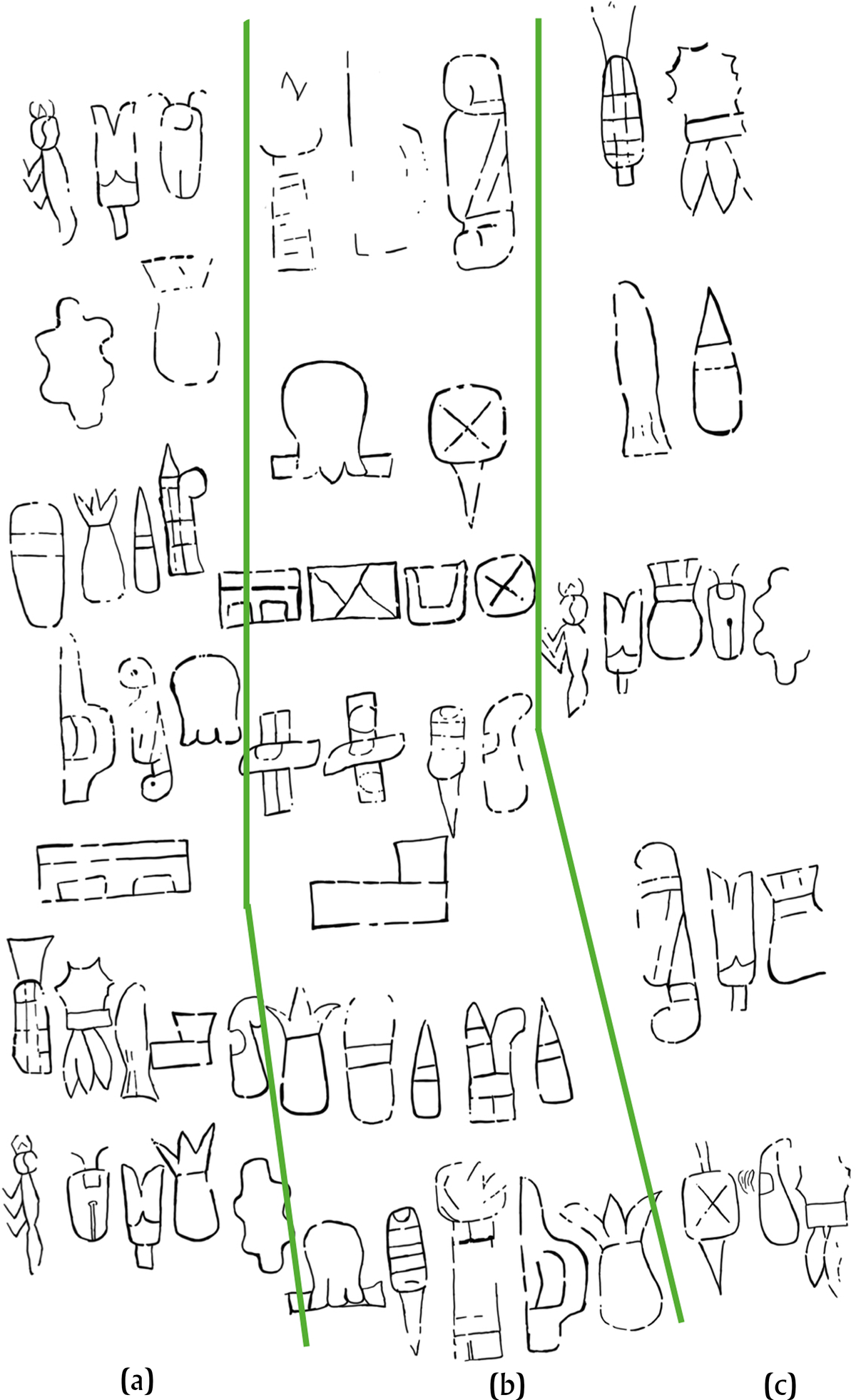
Anderson's (Reference Anderson2007) model (Figure 14), divides the inscription into three columns (A–C) following the orientation of the block by Rodríguez Martínez et al. (Reference Rodríguez Martínez, Ceballos, Coe, Diehl, Houston, Taube and Calderón2006a); he suggests that column B was the first to be inscribed, followed by A, then C. Within each column, he proposes a formatting in rows, read from left-to-right, top-to-bottom. A benefit of his model, Anderson proposes, is that it increases the number of repeated sequences; at the same time, he rejects my reading formatting and direction model (Mora-Marín Reference Mora-Marín2009) because it results in fewer such sequences. His model would have the same effect on my analysis as those by Macri (Reference Macri2006) and Justeson (Reference Justeson, Nichols and Pool2012): all three of these alternatives would invalidate the PELT and PAW pairing, and they would invalidate the proposal that CS5 begins two of the long, repeated sign sequences. Aside from this, the other distributional observations offered in this paper would not be seriously contradicted by Macri's, Justeson's, or Anderson's proposed formattings, at least not when I focused on the short versions of repeated sign sequences instead of the longer versions that result from the reading formatting and direction I previously advanced (Mora-Marín Reference Mora-Marín2009).
Reading formatting proposed by Anderson (Reference Anderson2007), modified by using the new drawing introduced in this paper.

Of course, my own analysis of formatting and reading direction (Mora-Marín Reference Mora-Marín2009) differs from that proposed by Rodríguez Martínez et al. (Reference Rodríguez Martínez, Ceballos, Coe, Diehl, Houston, Taube and Calderón2006a), as well as from the other authors’ reviewed here, as already stated. Rodríguez Martínez et al. (Reference Rodríguez Martínez, Ceballos, Coe, Diehl, Houston, Taube and Calderón2006a) propose a formatting and reading direction as seen in Figure 15, whereas mine is shown in Figure 16. But, again, despite the dramatic difference in these two proposed views of the formatting and reading direction of the text, only one of the patterns of sign co-distribution discussed above, namely the placement of CS3 between CS19 and CS11 (Supplementary Figure 8b), is affected when one uses the formatting and reading direction by Rodríguez Martínez et al. (Reference Rodríguez Martínez, Ceballos, Coe, Diehl, Houston, Taube and Calderón2006a) instead of mine (Mora-Marín Reference Mora-Marín2009).
Proposals for formatting by Rodríguez et al. (Reference Rodríguez Martínez, Ceballos, Coe, Diehl, Houston, Taube and Calderón2006a) and Mora-Marín (Reference Mora-Marín2009). Reading format proposed by Rodríguez et al. (Reference Rodríguez Martínez, Ceballos, Coe, Diehl, Houston, Taube and Calderón2006a). The new drawing introduced by the author in this paper was used as a basis for representing these two models.

Proposals for formatting by Rodríguez et al. (Reference Rodríguez Martínez, Ceballos, Coe, Diehl, Houston, Taube and Calderón2006a) and Mora-Marín (Reference Mora-Marín2009). Reading format proposed by Mora-Marín (Reference Mora-Marín2009). The new drawing introduced by the author in this paper was used as a basis for representing these two models.

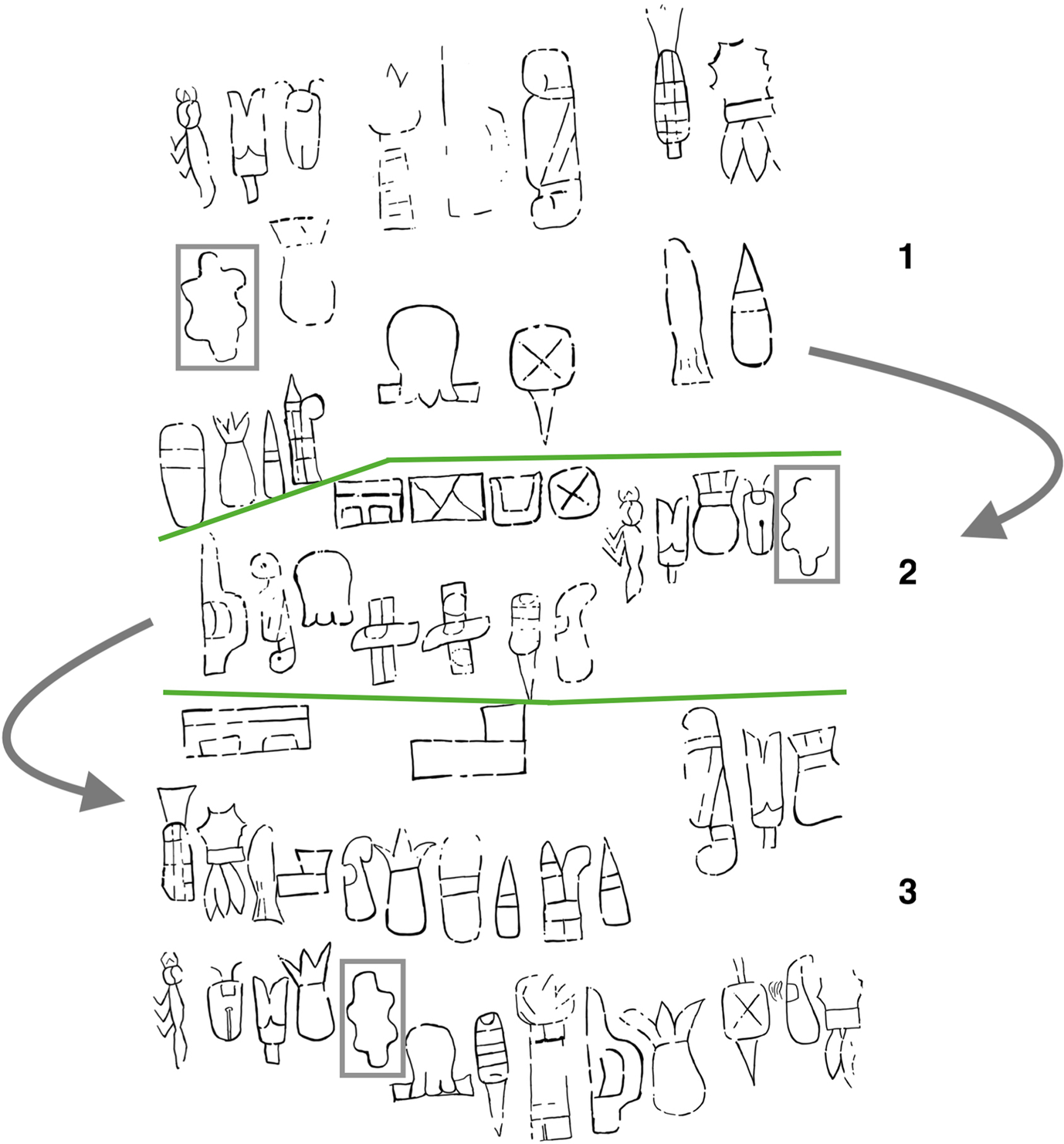
Lastly, Freidel and Reilly (Reference Freidel, Reilly, Staller and Carrasco2010:658–659) pursue an iconographic analysis based on ritual practices, and argue against a linguistic analysis. They propose that the text “is an incised representation of three opened bundles with their contents laid out in a precise ritual order.” Their analysis is based a vertical arrangement of the block following that proposed by Rodríguez Martínez et al. (Reference Rodríguez Martínez, Ceballos, Coe, Diehl, Houston, Taube and Calderón2006a), whose horizontal arrangement into rows, these authors note, is consistent with the seemingly horizontal arrangement of signs on two incised celts from the Middle Formative (Freidel and Reilly Reference Freidel, Reilly, Staller and Carrasco2010:663); they also utilize the distribution of six of the signs (CS1, CS5, CS7, CS9, CS10, and CS28) in the inscription as a basis for dividing the text into three separate “registers” (1–3; Figure 17), with the added complication that the transitions from the topmost row to the middle row to the bottom row follow a boustrophedon pattern, with the PELT sign, CS7, serving as a pivoting point between registers. (In a true boustrophedon formatting, one would expect the sequencing of signs to be reversed between registers, as in Hittite Hieroglyphs, and/or the orientations of signs to be possibly inverted, as in Easter Island writing. In the Cascajal Block neither phenomenon can be appreciated.) With regard to the analysis presented in this paper, one of the patterns of optional presence of CS3 (Supplementary Figure 8b) would be invalidated by Freidel and Reilly's model, but otherwise there would be no other impact.
Reading formatting model by Freidel and Reilly (Reference Freidel, Reilly, Staller and Carrasco2010:Figure 22), modified by using the new drawing introduced by the author in this paper. Sign CS7, the PELT sign, is enclosed within rectangles to highlight its proposed pivotal role between registers by Freidel and Reilly.

CONCLUSIONS
This paper contributes to the empirical documentation of the Cascajal Block, and provides additional support to the proposition that its inscription is consistent with that of a glottographic script, a script whose structure is linguistically motivated. I analyzed the sign inventory of the Cascajal Block, offering revisions to the original version in Rodríguez Martínez et al. (Reference Rodríguez Martínez, Ceballos, Coe, Diehl, Houston, Taube and Calderón2006a), some of which have been made possible by the more recent documentation by myself and others (Englehardt et al. Reference Englehardt, Insaurralde Caballero, Melgar Tísoc, Velázquez Maldonado, Torres, Bernard and Carrasco2019; Justeson Reference Justeson, Nichols and Pool2012). I also analyzed the structure of the inscription in order to look for evidence of linguistic patterning. In that regard, I propose that certain repeated sign sequences that exhibit irregular arrangements (Justeson Reference Justeson, Nichols and Pool2012; Macri Reference Macri2006) actually support the contention that the script is linguistically motivated, as it show parallels with patterns of logophonetic (likely logosyllabographic) spelling in a variety of writing systems, spellings involving logograms and phonograms, or, in the case of later Mesoamerican scripts such as Zapotec, Epi-Olmec, and Mayan, logograms and syllabograms. Such parallels allow for the hypotheses that certain Cascajal signs function, orthographically, as logograms (CS13 and CS15), and certain others as likely syllabograms (CS1, CS2, CS9, and CS3). A few other signs can be argued to be logograms because of their possible correspondence to linguistic kennings (CS11 and CS22; Carrasco and Englehardt Reference Carrasco and Englehardt2015) or iconographic pairings (CS12, CS16, CS 26, CS23, CS24, and CS25; Justeson Reference Justeson, Nichols and Pool2012), including another case proposed in this paper, the PELT-PAW pairing (CS7 and CS28). And a few additional signs, because of their frequency and context of distribution could be entertained to be phonograms (likely syllabograms) used to spell crucial grammatical markers (CS5, CS6, and perhaps CS18). These are obviously hypotheses that require testing against future findings. Although I have generally followed the reading formatting and direction I previously put forth (Mora-Marín Reference Mora-Marín2009), this paper strives to clarify which aspects of the present analysis would be consistent with other proposals, or invalidated by them. This should allow other scholars to conduct their own tests of the hypotheses raised in this paper.
Future findings of texts in the same script will hopefully provide more constrained contexts, such as accompanying pictorial imagery, correlations of different artifact types with parallel but distinct sign collocations, or numerical/calendrical/astronomical patterns, for making inferences about the content of the texts in this script. That said, the Cascajal text does provide certain promising settings for semantic analysis, as already noted by Carrasco and Englehardt (Reference Carrasco and Englehardt2015): several pairings of signs that could be linguistically motivated (as couplets or kennings). The signs involved in such pairings could provide a basis for the identification and decipherment of logographic signs, so long as they can be positively correlated with specific diphrastic kennings of relevance to ritual and political discourse; some of the signs associated with such pairings (e.g. CS3) could even function as phonetic complements to some of the logograms in question. Thus, at this moment, such pairings constitute the best starting point for testing possible phonetic and logographic sign values.
RESUMEN
Este artículo trata sobre el Bloque de Cascajal, un artefacto de serpentinita con una inscripción olmeca originalmente publicada por Rodríguez et al. (Reference Rodríguez Martínez, Ceballos, Coe, Diehl, Houston, Taube and Calderón2006a). El artículo lleva a cabo cuatro objetivos. Primero, introduce un nuevo dibujo de línea que aclara varios detalles gráficos que permanecían inciertos; este dibujo fue realizado en base a una tecnología de documentación fotográfica novedosa aplicada por Michael Carrasco y Joshua Englehardt, la cual facilita la distinción entre imperfecciones de la superficie y los detalles esgrafiados. Segundo, se realiza un análisis distributivo de la inscripción para analizar más cuidadosamente el inventario de signos, que se describió por primera vez en Rodríguez et al. (Reference Rodríguez Martínez, Ceballos, Coe, Diehl, Houston, Taube and Calderón2006a:1613, Figure 5) y fue ligeramente corregido en Mora-Marín (Reference Mora-Marín2009:399, Figure 3). En el presente, se elimina uno de los signos propuestos por Rodríguez et al. (Reference Rodríguez Martínez, Ceballos, Coe, Diehl, Houston, Taube and Calderón2006a) luego de demostrarse que fue dibujado incorrectamentre, se da apoyo a la añadición de un signo distintivo propuesto por Mora-Marín (Reference Mora-Marín2009), y se corrige el dibujo de uno de los signos que consiste de un tercer ejemplo correspondiente al motivo “knuckle duster” (“manopla”). Tercero, se destacan varias secuencias de signos aparentemente irregulares y recurrentes (Macri Reference Macri2006:2; Justeson Reference Justeson, Nichols and Pool2012:840) que podrían ser cruciales para el entendimiento de las convenciones ortográficas del texto; más específicamente, estas secuencias, en vez de mostrar irregularidades incompatibles con un sistema de escritura, parecen reflejar estrategias para el deletreo de palabras típico de sistemas de escritura logosilábicos. Tal paralelo permite la identificación preliminar de signos con funciones silabográficas y signos con funciones logográficas. Cuarto, se retoma el tema de las coplas o emparejamientos de signos, discutido por autores previos (Rodríguez et al. Reference Rodríguez Martínez, Ceballos, Coe, Diehl, Houston, Taube and Calderón2006a; Justeson Reference Justeson, Nichols and Pool2012; Carrasco and Englehardt Reference Carrasco and Englehardt2015), así como por el autor actual (Mora-Marín Reference Mora-Marín2010), el cual establece una copla adicional, la de PIEL-PATA, con dos ocurrencias dentro del texto. Se arguye que tales frases constituyen la mejor oportunidad para la contextualización temática del Bloque de Cascajal disponible hasta el momento, y por lo tanto, el punto de partida más viable para cualquier intento de deciframiento de este sistema de escritura. Finalmente, el artículo evalúa en qué medida el análisis elaborado se vería invalidado o respaldado por las diversas propuestas para el formato del texto (orientación y dirección de lectura) en la literatura (Rodríguez et al. Reference Rodríguez Martínez, Ceballos, Coe, Diehl, Houston, Taube and Calderón2006a; Macri Reference Macri2006; Anderson Reference Anderson2007; Mora-Marín Reference Mora-Marín2009; Freidel y Reilly Reference Freidel, Reilly, Staller and Carrasco2010; Justeson Reference Justeson, Nichols and Pool2012); se concluye que la mayoría de las propuestas reciben respaldo, pero que otras, como el caso de los emparejamientos de los signos PIEL-PATA, se invalidarían.
SUPPLEMENTARY MATERIAL
The supplementary material for this article can be found at https://doi.org/10.1017/S0956536119000270.
ACKNOWLEDGMENTS
I am indebted to John Justeson for the high-resolution versions of his drawing of the Cascajal Block inscription, detailed comments on a previous version of this paper, generosity in discussing a number of ideas on this topic, and encouragement. I am very grateful to Martha Macri for carefully proofreading and commenting on an earlier version of this manuscript. Also, I would like to commend Michael Carrasco and Joshua Englehardt for their generosity and collegiality in sharing their RTI image of the Cascajal Block, without which my research would not have advanced to the present stage, and discussing key sections of an earlier draft of my paper with me. I want to thank four anonymous reviewers who offered very positive and constructive critiques that have dramatically improved the content of the paper. Finally, I am extremely grateful to the editorial team for their supreme patience. Any errors that have persisted into the final version of this paper are entirely my responsibility.