Introduction
Focal brain lesions reliably produce characteristic syndromes, yet variability in initial symptoms and ultimate outcomes have long challenged the notion that all brains are created perfectly equal (Mohr, Reference Mohr2004). Applied to dementia, it has similarly been observed that seemingly equivalent neuropathological severity does not necessarily yield equivalent clinical severity. To explain this apparent inconsistency, Katzman introduced the concept of “brain reserve” based upon physical parameters such as brain weight and neuronal size (Katzman et al., Reference Katzman, Terry, DeTeresa, Brown, Davies, Fuld and Peck1988). The concept of cognitive reserve (CR) as formulated by Stern and colleagues in 1999 proceeded from the observation that the rate at which patients with Alzheimer’s disease (AD) declined on the selective reminding test (SRT) reflected their educational and occupational background (Stern, Albert, Tang, & Tsai, Reference Stern, Albert, Tang and Tsai1999). When matched for dementia severity, patients with higher CR harbored greater pathology (as measured by regional cerebral blood flow) than patients with lower CR arguing that CR mitigated the clinical impact of AD pathology (Scarmeas et al., Reference Scarmeas, Zarahn, Anderson, Habeck, Hilton, Flynn and Stern2003). Since these relatively early descriptions, investigators have sought to isolate the effects of intellectual and related forms of brain activity that most closely reflect CR from the quantifiable material properties of brain reserve such as brain size, disease susceptibility, and active compensatory mechanisms such as the ability to recruit new brain circuits into the service of damaged ones (Barulli & Stern, Reference Barulli and Stern2013; Stern, Reference Stern2012).
Either in isolation or in various combinations, years of education (most frequently), linguistic skill, intellectually stimulating leisure activity, social engagement, socioeconomic status, occupational complexity, measures of crystallized intelligence, literacy (Barulli & Stern, Reference Barulli and Stern2013; Bennett, Arnold, Valenzuela, Brayne, & Schneider, Reference Bennett, Arnold, Valenzuela, Brayne and Schneider2014), bilingualism (Craik, Bialystok, & Freedman, Reference Craik, Bialystok and Freedman2010), and musical background (Gooding, Abner, Jicha, Kryscio, & Schmitt, Reference Gooding, Abner, Jicha, Kryscio and Schmitt2013) have all been used as proxies for CR, yet all are associated with advantageous environmental factors such as housing, nutrition, access to healthcare, educational opportunities, and cultural resources possibly explaining discrepancies between studies examining their relationships to cognitive aging, incident MCI, incident dementia, rate of decline, mortality, and neuropathology (Sanders, Hall, Katz, & Lipton, Reference Sanders, Hall, Katz and Lipton2012; Van Gerven, Van Boxtel, Ausems, Bekers, & Jolles, Reference Van Gerven, Van Boxtel, Ausems, Bekers and Jolles2012; Zahodne et al., Reference Zahodne, Glymour, Sparks, Bontempo, Dixon, MacDonald and Manly2011; Zahodne, Schofield, Farrell, Stern, & Manly, Reference Zahodne, Schofield, Farrell, Stern and Manly2014). Indeed, cerebral amyloid burden has been shown to be diminishing over the course of the twentieth century without any consideration of CR presumably reflecting progress in health and hygiene more generally (Kovari, Herrmann, Bouras, & Gold, Reference Kovari, Herrmann, Bouras and Gold2014). Despite a wealth of studies, there remains therefore, continued uncertainty regarding the significance of CR: is it a purely passive neuropsychological construct in which intellectually advantaged people simply have further to fall before crossing a fixed threshold that defines impairment, or is there evidence that CR confers active neurobiological protection against AD, transforming itself into a form of acquired brain reserve?
To address this question, a more ideal proxy for CR should have a minimum of potential confounds, should directly reflect cognition, and should be sensitive to the earliest stages of AD. A potential category of proxies meeting these criteria are sex-related memory differences. At a group level, women outperform men on verbal memory tasks (Bleecker, Bolla-Wilson, Agnew, & Meyers, Reference Bleecker, Bolla-Wilson, Agnew and Meyers1988; Kramer & Daniel, Reference Kramer, D.C. and Daniel1988; Ruff, Light, & Quayhagen, Reference Ruff, Light and Quayhagen1989) and while the data are less consistent, men outperform women on visuospatial tasks generally (Beatty & Troster, Reference Beatty and Troster1987; Coltheart, Hull, & Slater, Reference Coltheart, Hull and Slater1975) including some memory tasks (Beinhoff, Tumani, Brettschneider, Bittner, & Riepe, Reference Beinhoff, Tumani, Brettschneider, Bittner and Riepe2008; Orsini et al., Reference Orsini, Chiacchio, Cinque, Cocchiaro, Schiappa and Grossi1986; Postma, Izendoorn, & De Haan, Reference Postma, Izendoorn and De Haan1998; Vecchi & Girelli, Reference Vecchi and Girelli1998). The female advantage for episodic memory has been shown to persist into old age (Beinhoff et al., Reference Beinhoff, Tumani, Brettschneider, Bittner and Riepe2008; Chapman et al, Reference Chapman, Mapstone, Gardner, Sandoval, McCrary, Guillilly and DeGrush2011; Gerstorf, Herlitz, & Smith, Reference Gerstorf, Herlitz and Smith2006). Presumably, because these emerge as a function of human development, they are likely less susceptible (but probably not immune) to environmental confounds than all of the previously cited proxies.
Both verbal and visuospatial memory decline during the preclinical stage of AD in apolipoprotein E (APOE) ɛ4 carriers, earlier than all other cognitive domains (Caselli et al., Reference Caselli, Locke, Dueck, Knopman, Woodruff, Hoffman-Snyder and Reiman2014), including executive skills (Caselli, Dueck, Locke, Hoffman-Snyder, et al., Reference Caselli, Dueck, Locke, Hoffman-Snyder, Woodruff, Rapcsak and Reiman2011), when such decline may be clinically undetectable and hence indistinguishable from normal aging. Pettigrew et al. found, in a cohort of 227 cognitively normal individuals whose mean age was 57 years that CR and APOE ɛ4 acted independently with CR reducing risk by 50% in both ɛ4 carriers and non-carriers while ɛ4 increased risk by 150%. APOE e2 interacted with CR so that CR was more protective in non-carriers (Pettigrew et al., 2013). Furthermore, just as APOE ɛ4 has been correlated with worse outcomes following head trauma and cerebrovascular disease (Caselli, Dueck, Locke, Sabbagh, et al., Reference Caselli, Dueck, Locke, Sabbagh, Ahern, Rapcsak and Reiman2011), so too has APOE been found to interact with physical measures of brain reserve such as head circumference such that physical factors which predispose to cognitive decline have a greater impact in ɛ4 carriers (Borenstein Graves et al., 2001; Kim et al., 2008).
We, therefore, hypothesized that if CR indeed prevented or reduced the rate of age-related decline, independent of confounding environmental factors, then women should have slower verbal memory decline than men and men slower visual memory decline than women, and such effects might be further influenced by APOE genotype. To determine whether superior memory performance confers neuroprotection against age-related memory decline, we therefore examined whether age-related memory decline was reduced in the advantaged sex.
Methods
Study Participants
Arizona APOE cohort
We used the Arizona APOE Cohort to test the hypothesis that the advantaged sex would decline less quickly, so that women would decline more slowly than men on verbal memory measures and men more slowly on visual memory measures. From January 1, 1994, through December 31, 2009, cognitively normal residents of Maricopa County age 21 years and older were recruited through local media ads and underwent APOE genotyping and longitudinal neuropsychological assessment every 2 years. All individuals gave their written, informed consent to participate in the study and have the results of the APOE test withheld from them which was approved by the Mayo Clinic Institutional Review Board. Determination of APOE genotype was performed using Taqman Single Nucleotide Polymorphism assays (Crook, Hardy, & Duff, Reference Crook, Hardy and Duff1994).
All identified ɛ4 homozygotes (HMZ) were matched by age, sex, and education to one ɛ4 heterozygote (HTZ; all with the e3/4 genotype) and two ɛ4 non-carriers. Many additional heterozygous persons and non-carriers who were otherwise eligible for enrollment were also recruited. Each participant had screening tests that included a neurological examination, the Folstein Mini-Mental Status Exam (MMSE), Hamilton Depression (Ham-D) Rating Scale, Functional Activities Questionnaire (FAQ), Instrumental Activities of Daily Living (IADL), and Structured Clinical Interview for DSM-IV. We excluded anyone with potentially confounding medical, neurologic, or psychiatric problems. None met published criteria for mild cognitive impairment (MCI) (Petersen et al., Reference Petersen, Stevens, Ganguli, Tangalos, Cummings and DeKosky2001), AD (McKhann et al., Reference McKhann, Drachman, Folstein, Katzman, Price and Stadlan1984), or other forms of dementia or major depressive disorder (American Psychiatric Association, 1994). Entry criteria included scores of at least 27 on the MMSE (with at least 1 of 3 on the recall subtest), 10 or less on the Ham-D, and perfect scores on the FAQ and IADL. Data were reviewed at each visit by a neurologist (RJC) and neuropsychologist (DECL) for indications of cognitive impairment, and anyone who developed MCI or dementia during the course of follow-up was excluded from this analysis to avoid skewing the results by a small number of individuals with a more precipitous decline. This resulted in 621 subjects with the following APOE genotypes: ɛ4/4 n=71, e3/4 n=194, e3/3 n=317, e2/3 n=39.
National Alzheimer’s Coordinating Committee (NACC) cohort
The National Institute on Aging (NIA) Alzheimer’s Disease Center program contains a central repository of neuropsychological data obtained at each center available to investigators. We included participants who were normal at entry and remained normal through their most recent follow-up visit. We sought to test our findings from the APOE cohort in this much larger cohort, and so examined the effect of sex on decline on a verbal memory measure involving paragraph recall (Wechsler Memory Scale Logical Memory) that is included in the NACC Uniform Data Set (Weintraub et al., Reference Weintraub, Salmon, Mercaldo, Ferris, Graff-Radford, Chui and Morris2009). There were 4575 subjects with the following APOE genotypes: ɛ4/4 n=106, e3/4 n=1075, e2/4 n=115, e3/3 n=2687, e2/3 n=563, and e2/2 n=29.
Neuropsychological testing
We have previously shown that memory is the earliest cognitive domain to decline in healthy appearing APOE ɛ4 carriers heralding the neuropsychological onset of preclinical AD (Caselli et al., Reference Caselli, Dueck, Osborne, Sabbagh, Connor, Ahern and Reiman2009), and subsequently confirmed its greater sensitivity than executive skills (Caselli, Dueck, Locke, Hoffman-Snyder, et al., Reference Caselli, Dueck, Locke, Hoffman-Snyder, Woodruff, Rapcsak and Reiman2011). Within the context of a previously described comprehensive neuropsychological battery, all APOE cohort participants completed the following four memory measures [two verbal memory and two visuospatial memory tests (Lezak, Howieson, & Loring, Reference Lezak, Howieson and Loring2004)] selected for this study that we have shown are highly sensitive to age-related memory decline; and three of the four are additionally sensitive to APOE ɛ4 related accelerated decline (Caselli et al., Reference Caselli, Locke, Dueck, Knopman, Woodruff, Hoffman-Snyder and Reiman2014):
Rey Auditory Verbal Learning Test (AVLT)
A 15-word list is presented over 5 learning trials followed by a distractor list, a short delay recall trial and a long (30 min) delay recall trial [long term memory (LTM)]. The LTM measure was used for an outcome measure.
Buschke Selective Reminding Test (SRT)
A 16-item list of unrelated words pictorially represented and presented over 5 learning trials. Every trial involves selectively presenting cues for those items that were not freely recalled. After a 30-min delay, a free recall and cued recall trial is again administered. Total items recalled without cuing (total free recall) during learning and recall trials was used for an outcome measure.
Rey-Osterrieth Complex Figure Test (CFT)
Participants are given up to 10 min to copy a complex 2-dimensional abstract figure, and then are prompted without forewarning to draw it from memory after a 10-min delay. The delayed recall score was used for an outcome measure. This was the only 1 of the 4 measures that did not show a significant APOE ɛ4 effect, but did show a baseline sex difference.
Benton Visual Retention Test (VRT)
Ten relatively simple abstract line drawings are shown to the participant for 10 s each after which they are removed and the participant must draw what they saw. Number correct out of 10 was used for an outcome measure. This was the only 1 of the 4 measures that did not show a baseline sex difference, but it did show an APOE ɛ4 effect.
Data analysis
To isolate the longitudinal cognitive change for our neuropsychological measures in these cross-sectional and longitudinal samples, we used a quadratic mixed model to gauge change in performance over time and to compare the effect of APOE ɛ4 status between men and women. The longitudinal growth model used in the current analysis is the same as a previously used model (Caselli, Dueck, Locke, Sabbagh, et al., Reference Caselli, Dueck, Locke, Sabbagh, Ahern, Rapcsak and Reiman2011), replacing the binary cardiovascular risk factor with sex. This mixed model approach isolates the longitudinal effect of age on AVLT-LTM (or other neuropsychological test) in a cross-sectional and longitudinal sample (Fitzmaurice, Laird, & Ware, Reference Fitzmaurice, Laird and Ware2004; Ware et al., Reference Ware, Dockery, Louis, Xu, Ferris and Speizer1990) and allows for comparison of the mean annual change in AVLT-LTM within non-carriers between men and women; within carriers between men and women; and a comparison of the longitudinal sex effect between non-carriers and carriers.
The model for Y ij (the j th response for the i th individual) is as follows:
 $$\eqalignno{ E\left( {Y_{{ij}} \mid b_{{{\rm 1}i}} } \right)= & \beta _{1} {\plus}\beta _{2} Carrier_{i} {\plus}\beta _{3} Sex_{i} {\plus}\beta _{4} Agec_{i 1} {\plus} \cr & \beta _{5} Carrier_{i} \,\times \,Agec_{i 1} {\plus}\beta _{6} Sex_{i} \,\times \,Agec_{i 1} {\plus}\beta _{7} Carrier_{i} \,\times \,Sex_{i} {\plus} \cr & \beta _{8} Carrier_{i} \, \times \,Sex_{i} \,\times \,Agec_{i 1}{\plus}\beta _{9} Agec_{i 1} ^{{\rm 2}} {\plus}\beta _{{10}} Carrier_{i} \,\times \,Agec_{i 1} ^{{\rm 2}} {\plus} \cr & \beta _{{11}} Agec_{{ij}} {\plus}\beta _{{12}} Carrier_{i} \,\times \,Agec_{{ij}} {\plus}\beta _{{13}} Sex_{i} \,\times \,Agec_{{ij}} {\plus} \cr & \beta _{{14}} Carrier_{i} \,\times \,Sex_{i} \,\times \,Agec_{{ij}} {\plus}\beta _{{15}} Agec_{{ij}} ^{{\rm 2}} {\plus}\beta _{{16}} Carrier_{i} \,\times \,Agec_{{ij}} ^{{\rm 2}} {\plus}b_{{{\rm 1}i}} , $$
where Carrier i is the APOE ε4 carrier status for the i th individual (1=Carrier; 0=Non-carrier); Sex i is the sex for the i th individual (1=Female; 0=Male); Agec ij is the age minus 60 (i.e., centered age) of the i th individual at the time of the j th response; and b 1i is an individual specific random effect allowing each subject to have a different intercept. Age is centered to reduce the correlation between the age and age-squared terms. In previous work (Caselli et al., Reference Caselli, Dueck, Osborne, Sabbagh, Connor, Ahern and Reiman2009), we found that APOE ε4 carrier status impacted AVLT-LTM at a quadratic level, so quadratic terms for APOE ε4 carrier status are included in all models.
From this cross-sectional and longitudinal model, the longitudinal models for male and female non-carriers are given by:
 $$\eqalignno{ & {\rm Male}\!:E\left( {Y_{{ij}} -Y_{i 1}} \right)=\beta _{{11}} \left( {Agec_{{ij}} -Agec_{i 1}} \right){\plus}\beta _{{15}} \left( {Agec_{{ij}} ^{{\rm 2}} -Agec_{i 1} ^{{\rm 2}} } \right), \cr & {\rm Female}\!:E\left( {Y_{{ij}} -Y_{i 1}} \right)=\left( {\beta _{{11}} {\plus}\beta _{{13}} } \right)\left( {Agec_{{ij}} -Agec_{i 1} } \right){\plus} \cr &\qquad \quad \ \,\beta _{{15}} \left( {Agec_{{ij}} ^{{\rm 2}} -Agec_{i 1}^{{\rm 2}} } \right), $$
and the longitudinal models for male and female carriers are given by:
 $$\eqalignno{ & {\rm Male}\!: E\left( {Y_{{ij}} -Y_{i 1}} } \right)=\left( {\beta _{{11}} {\plus}\beta _{{12}} } \right)\left( {Agec_{{ij}} -Agec_{i 1}} } \right){\plus}\left( {\beta _{{15}} {\plus}\beta _{{16}} } \right) \cr & \quad \quad \ \left( {Agec_{{ij}} ^{{\rm 2}} -Agec_{i 1}^{{\rm 2}} } \right), \cr & {\rm Female}\!:E\left( {Y_{{ij}} -Y_{i 1}} } \right)=\left( {\beta _{{11}} {\plus}\beta _{{12}} {\plus}\beta _{{13}} {\plus}\beta _{{14}} } \right)\left( {Agec_{{ij}} -Agec_{i 1} } \right){\plus}{\rm } \cr & \quad \quad \quad \,\ \left( {\beta _{{15}} {\plus}\beta _{{16}} } \right)\left( {Agec_{{ij}} ^{{\rm 2}} -Agec_{i 1} ^{{\rm 2}} } \right). $$
From these longitudinal models, the mean annual change can be estimated based on the following first-order derivatives:
 $$\eqalignno{ & {\rm Male\ non}{\hbox -}{\rm carrier}\!:dE\left( {Y_{{ij}} -Y_{i 1}} \right)/dAgec_{{ij}} =\beta _{{11}} {\plus}{\rm 2}\beta _{{15}} Agec_{{ij}} , \cr & {\rm Female\ non}{\hbox -}{\rm carrier}\!:dE\left( {Y_{{ij}} -Y_{i 1} } \right)/dAgec_{{ij}} =\beta _{{11}} {\plus}\beta _{{13}} {\plus}{\rm 2}\beta _{{15}} Agec_{{ij}} , \cr & {\rm Male\ carrier}\!:dE\left( {Y_{{ij}} -Y_{i 1} } \right)/dAgec_{{ij}} =\beta _{{11}} {\plus}\beta _{{12}} {\plus}{\rm 2 }\left( {\beta _{{15}} {\plus}\beta _{{16}} } \right)Agec_{{ij}} , \cr & {\rm Female\ carrier}\!:dE\left( {Y_{{ij}} -Y_{i 1} } \right)/dAgec_{{ij}} =\beta _{{11}} {\plus}\beta _{{12}} {\plus}\beta _{{13}} {\plus}\beta _{{14}} {\plus}{\rm 2}\left( {\beta _{{15}} {\plus}\beta _{{16}} } \right)Agec_{{ij}} . $$
From these first-order derivatives, the estimate of β 13 with confidence interval was used to assess the difference in mean annual change in AVLT-LTM between men and women within non-carriers; and the estimate of β 13 + β 14 with confidence interval was used to assess the difference in mean annual change in AVLT-LTM between men and women within carriers. A test of significance of β 14 was used to assess whether the impact of sex differed between carriers and non-carriers. Given imbalance in baseline covariates between groups, sensitivity analyses incorporate additional baseline covariates (education for the Arizona APOE and NACC cohorts, family history for the NACC cohort only). Modeling was carried out using SAS PROC MIXED (SAS Version 9). Baseline characteristics were compared between groups by using the two-sample t test or Pearson chi-square test. Analyses were carried out separately for the APOE cohort and the NACC cohort.
Results
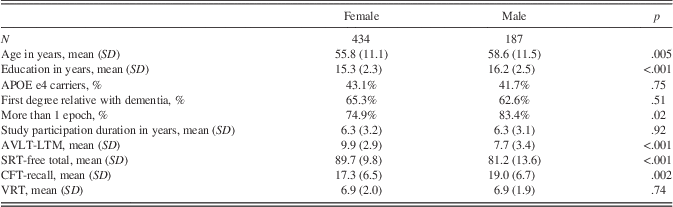
There were 434 women and 187 men from the Arizona APOE Cohort who were included in this study. Another 20 were excluded due to incident MCI or dementia during follow-up testing. Entry data are summarized in Table 1.
Arizona APOE cohort entry data

AVLT-LTM=Auditory Verbal Learning Test Long Term Memory; CFT=Complex Figure Test; SRT=Selective Reminding Test; VRT=Visual Retention Test; SD=standard deviation.
Men were moderately older (mean 58.6 vs. 55.8 years, p=.005), had an additional year of education (mean 16.2 vs. 15.3 years, p<.001), and a higher proportion had multiple epochs of testing (83.4% vs. 74.9%, p=.02) but were similar with regard to APOE ɛ4 carrier status (41.7% vs. 42.7% carriers, p=.75), family history of dementia in a first-degree relative (62.6% vs. 65.3%, p=.51), and duration of follow-up (6.3 vs. 6.3 years, p=.92). At entry, there were no significant differences between APOE ɛ4 carriers and non-carriers on any memory measure overall or within gender subgroups (supplementary e-table one), but women scored higher than men on both verbal memory tests, and men scored higher than women on 1 of 2 visuospatial memory tests, CFT-recall. Entry advantages on neuropsychological measures were retained throughout follow-up and at all ages.
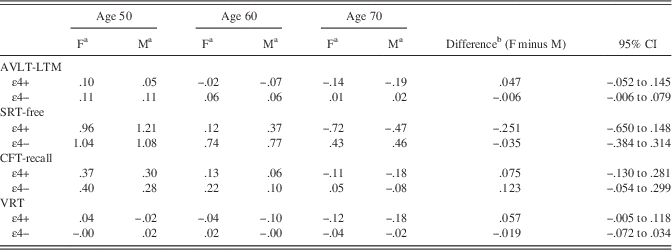
Age-related memory decline was accelerated in APOE ɛ4 carriers on both verbal memory measures (AVLT-LTM, p=.03; SRT-free recall p<.001), as well as on one visuospatial memory measure (VRT p=.006), but not on the CFT-recall (p=.39). See supplementary e-table two for beta coefficients and standard errors from the mixed model of each outcome. Table 2 summarizes the predicted annual change in men and women at ages 50, 60, and 70 years by APOE ɛ4 status.
Arizona APOE cohort predicted annual change

a Estimated mean annual change based on the mixed model in original units of the test. See supplementary material for equations and beta coefficients.
b Difference between the estimated mean annual change between males and females, based on the mixed model estimate of β 13 for non-carriers and β 13+β 14 for carriers (see Supplementary Material). Note, the difference estimate is indifferent to age (i.e., does not depend on the age at which the difference is estimated).
AVLT-LTM=Auditory Verbal Learning Test Long Term Memory; CFT=Complex Figure Test; SRT=Selective Reminding Test; VRT=Visual Retention Test; F=female; M=male; CI=confidence interval
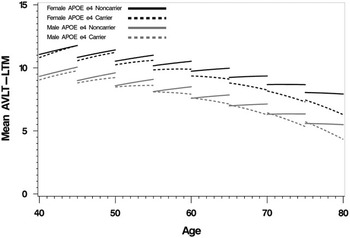
No sex differences between non-carriers and carriers in rate of decline (linear effects) were found for any measure: AVLT-LTM p=.89, SRT-free recall p=.84, CFT-recall p=.17, VRT p=.49, and correcting for educational differences did not affect these results. Figure one illustrates the trajectories for the AVLT and shows that while there is a visually evident difference between APOE ɛ4 carriers and non-carriers, the sex trajectories parallel each other reflecting the absence of sex-related effects on the rates of decline.
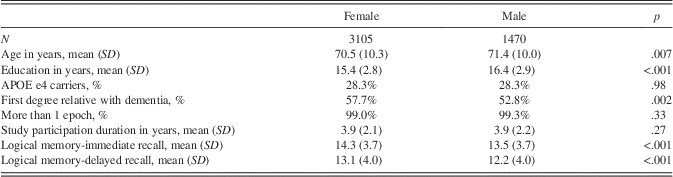
There were 3105 women and 1470 men from the NACC cohort who were included. Entry data are summarized in Table 3.
NACC Cohort Entry Data

SD=standard deviation.
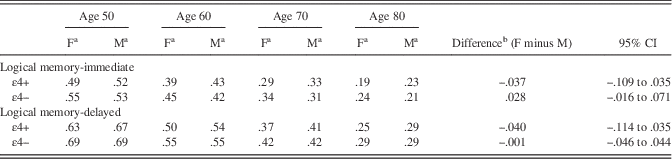
Men were slightly older than women (mean 71.4 vs. 70.5 years; p=.007), had more years of education (mean 16.4 vs. 15.4; p<.001), and fewer had a first degree relative with dementia (52.8% vs. 57.7%; p=.002). APOE ɛ4 carrier status (28.3% vs. 28.3%; p=.98) and mean years of follow-up (3.9 vs. 3.9; p=.27) did not differ between the groups. At entry, women scored higher than men on both immediate (mean 14.3 vs. 13.5; p<.001) and delayed (13.1 vs. 12.2; p<.001) recall scores on the Wechsler Memory Scale-Revised logical memory paragraph recall test, but longitudinally there was no sex difference between non-carriers and carriers in rate of decline (linear effects) on either measure (immediate memory, p=.21, delayed memory p=.95; see supplementary e-table three for beta coefficients and standard errors from the mixed model of each outcome). Correcting for educational and family history differences did not affect these results. Predicted annual change in men and women at ages 50, 60, and 70 years did not differ when APOE ɛ4 carriers and non-carriers were considered separately (Table 4).
NACC cohort predicted annual change

a Estimated mean annual change based on the mixed model in original units of the test. See supplementary material for equations and beta coefficients.
b Difference between the estimated mean annual change between males and females, based on the mixed model estimate of β 13 for non-carriers and β 13+β 14 for carriers (see supplementary material). Note, the difference estimate is indifferent to age (i.e., does not depend on the age at which the difference is estimated).
F=female; M=male; CI=confidence interval.
Discussion
Despite robust APOE ɛ4 effects on age-related cognitive decline evident on three of four memory measures in the APOE Cohort in quadratic effects (which are more demanding), no similar sex-related effects were found for any measure, including the SRT which was the cornerstone test of Stern’s 1999 CR concept (Stern et al., Reference Stern, Albert, Tang and Tsai1999), even in less demanding linear effects. Entry performance advantages were maintained throughout the study at all ages, but there was no indication that such an advantage influenced the rate of decline in the cohort overall or in either APOE ɛ4 carriers or non-carriers in either cohort. While we cannot completely exclude the possibility of a very subtle effect that our study was not powered to detect, any such effect would be much weaker than the observed APOE ɛ4 effect (and notably, unlike sex, there was no APOE related advantage at entry).
The sources of sex-related differences in memory are not well understood, and there are multiple conflicting claims with regard to anatomical and physiological differences between male and female brains (Wallentin, Reference Wallentin2009). Physiological differences emerge early in life. An event-related potential study in children aged 7–10 years found that developmental changes in basic auditory processing occurred earlier and faster in girls (Nanova, Lyamova, Hadjigeorgieva, Kolev, & Yordanova, Reference Nanova, Lyamova, Hadjigeorgieva, Kolev and Yordanova2008). MRI studies of amygdalo-hippocampal growth from infancy through early adulthood have shown that the female amygdala reaches its peak age a year and a half earlier than the male amygdala, and that there is a rightward laterality in the male amygdala (Uematsu et al., Reference Uematsu, Matsui, Tanaka, Takahashi, Noguchi, Suzuki and Nishijo2012). In a functional magnetic resonance imaging (MRI) paradigm, men outperformed women on a spatial navigation task during which they showed larger activation of the right hippocampus relative to women, and when required to indicate the direction of their point of origin on this task, women showed a larger left-sided activation than men, possibly reflecting a bias toward using a verbal mediation strategy (Persson et al., Reference Persson, Herlitz, Engman, Morell, Sjolie, Wikstrom and Soderlund2013). A consistent finding in multiple studies, in addition to the modestly larger size of the brain in men, is that the anterior cingulate cortex of women is larger than that of men (Chen, Sachdev, Wen, & Anstey, Reference Chen, Sachdev, Wen and Anstey2007; Good et al., Reference Good, Johnsrude, Ashburner, Henson, Friston and Frackowiak2001; Paus et al., Reference Paus, Otaky, Caramanos, Macdonald, Zigdenbos, D’Avirro and Evans1996). Anterior cingulate lesions in patients have been associated with reduced responsiveness ranging from abulia to akinetic mutism (Jurgens & von Cramon, Reference Jurgens and von Cramon1982; Laplane, Degos, Baulac, & Gray, Reference Laplane, Degos, Baulac and Gray1981; Nemeth, Hegedus, & Molnar, Reference Nemeth, Hegedus and Molnar1988), and anatomically restricted anterior cingulate lesions in primates result in drastically reduced phonation (Sutton, Trachy, & Lindeman, Reference Sutton, Trachy and Lindeman1981).
Despite the predominant genetic influence on brain development, significant environmentally-influenced differences in cerebral anatomy are evident in cortical thickness, particularly in the heteromodal sensory parietal lobes of adolescent identical twins (Yang et al., Reference Yang, Joshi, Joshi, Baker, Narr, Raine and Damasio2012), in the arcuate fasciculus of twins discordant for handedness (Haberling, Badzakova-Trajkov, & Corballis, Reference Haberling, Badzakova-Trajkov and Corballis2013), and in the degree of neurogenesis and exploratory behavior in genetically identical mice (Freund et al., Reference Freund, Brandmaier, Lewejohann, Kirste, Kritzler, Kruger and Kempermann2013). In each of these cases, sensory stimulation appears to be a key factor. The theory that CR could reflect alterations in the brain’s biology, therefore, has a sound neurobiological basis. Achievement and even simply exposure to intellectual and socially engaging stimuli may facilitate more synapses resulting in a larger neuronal ensemble for a given cognitive operation (the larger the target, the more pathology needed to disable it), greater flexibility for alternate networks to assist or replace the declining function within a damaged network, and more efficient integration so that reduced neuronal activity would generate less Abeta amyloid (Jagust & Mormino, Reference Jagust and Mormino2011). However, all of these mechanisms may be biologically innate adaptive processes that are not further influenced by “high normal” degrees of environmental stimulation, at least during the course of normal aging and the presymptomatic stages of AD. That is not to say that intellectual advantage, maintaining social activity or achieving greater socioeconomic status does not confer a myriad of benefits, or that frank abuses such as sensory deprivation, cultural impoverishment, disease, and trauma might not harm our brain and diminish our cognitive ability and potential. But if intellectual and related activities enhance CR through physiological or anatomical changes, then it is unclear why sex-related cognitive advantages despite sharing such properties, do not seem to mitigate age-related memory decline even in ɛ4 carriers who are more susceptible to preclinical AD.
Bennett and colleagues recently reviewed the relationship of environmental stimuli to neuropathological outcomes and showed that effects were largely confined to cerebrovascular pathology (Bennett et al., Reference Bennett, Arnold, Valenzuela, Brayne and Schneider2014). If the main effect of environmental stimuli is to reduce cerebrovascular pathology, then might improved cerebrovascular physiology result in improved cognition? Cortical thickness is itself influenced by vascular physiology and mediates the effect of beta-amyloid on memory (Villeneuve et al., Reference Villeneuve, Reed, Wirth, Haase, Madison, Ayakta and Jagust2014). Yet, interventional restoration of blood flow in patients with symptomatic internal carotid artery occlusion that improves oxygen extraction on positron emission tomography does not result in improved cognition (Marshall et al., Reference Marshall, Festa, Cheung, Pavol, Derdeyn, Clarke and Lazar2014). Bennett et al. noted 2 exceptions to the finding that CR was related primarily to cerebrovascular pathology: early adult linguistic ability in the Nun study correlated specifically with AD late in life [in women (Snowdon et al., Reference Snowdon, Kemper, Mortimer, Greiner, Wekstein and Markesbery1996)] and a composite measure comprised of education, occupation, and social engagement (Valenzuela, Brayne, Sachdev, Wilcock, & Matthews, Reference Valenzuela, Brayne, Sachdev, Wilcock and Matthews2011) correlated with greater brain weight, higher prefrontal neuronal density and gray matter thickness (again in women). While both findings are encouraging, both await replication in different patient populations. Once neuropathological burden is excluded, Wilson et al. found that, among members of the Rush Memory and Aging Project whose mean age at death was over 89 years old, a comprehensive measure of intellectual and socially relevant activities during the early, middle, and later stages of life accounted for 14% of the remaining variance in late life cognitive decline, showing that even though this measure of CR did not impact neuropathology it nonetheless did impact cognition (Wilson et al., Reference Wilson, Boyle, Yu, Barnes, Schneider and Bennett2013).
Diagnostic constructs of MCI and dementia are anchored to a threshold of performance that dichotomizes into normal or not, and if the threshold is held constant for all, regardless of premorbid intellectual ability, then it is easy to see how CR, as a passive neuropsychological construct (Stern, Reference Stern2002), would prolong the time needed for someone with high CR to cross the threshold relative to someone with low CR without necessarily suggesting anything further about neurobiological protection against AD. In this case, simply raising the bar for the intellectually advantaged might diminish or even completely erase such an apparent CR effect. Clinically this makes sense since high functioning individuals presenting with subjective cognitive impairment may fail to cross a fixed threshold for defining impairment even when checked a year or two later, but the degree of interval decline itself may exceed what one expects in a healthy individual. Determining what constitutes pathological decline remains an area of inquiry, but it is clear that domain specific decline, especially memory, correlates with both APOE ɛ4 carrier status and clinical outcomes (Caselli et al., Reference Caselli, Reiman, Locke, Hutton, Hentz, Hoffman-Snyder and Osborne2007; Caselli, Chen, Lee, Alexander, & Reiman, Reference Caselli, Chen, Lee, Alexander and Reiman2008). As a passive neuropsychological phenomenon, CR could still have implications for clinical diagnosis. Petersen and colleagues reported that both the incidence (Roberts et al., Reference Roberts, Geda, Knopman, Cha, Pankratz, Boeve and Petersen2012) and prevalence (Petersen et al., Reference Petersen, Roberts, Knopman, Geda, Cha, Pankratz and Rocca2010) of MCI was higher among men than women in Olmsted County even though the same was not true for dementia prevalence (Roberts et al., Reference Roberts, Geda, Knopman, Cha, Pankratz, Boeve and Petersen2012) suggesting that men cross the diagnostic threshold sooner even if fewer go on to develop dementia. Verbal memory measures are used more often than visuospatial memory measures especially in office-based mental status paradigms and men will cross the diagnostic verbal memory threshold sooner than women possibly helping to explain this seeming paradox. Among men and women dying with actual dementia, however, controlling for dementia severity, men show greater levels of pathology at autopsy (Barnes et al., Reference Barnes, Wilson, Bienias, Schneider, Evans and Bennett2005) suggesting women manifest dementia more readily than men. Conceivably there are further CR related effects once memory decline reaches severity levels of frank impairment that might not be evident within the milder spectrum of cognitive aging. If so, it may even be possible that CR effects increase in parallel with disease severity.
A limitation of this study is the possibility that it was underpowered to detect a smaller effect on memory decline, but if such an effect exists, it is clearly less than the APOE ɛ4 effect that was readily apparent in the Arizona APOE Cohort. In the NACC cohort, the logical memory paragraph recall test may be less sensitive to decline but a recent report showing greater incident MCI conversion in female ɛ4 carriers in this cohort (Altmann, Tian, Henderson, & Greicius, Reference Altmann, Tian, Henderson and Greicius2014) is at least suggestive that insensitivity was not a major concern, and the much larger number of participants assuages concern that our study was simply underpowered. In addition, we did not analyze the possible influence of estrogen exposure, but the Women’s Health Initiative recently reported no significant effect on cognitive function in postmenopausal women (Espeland et al., Reference Espeland, Shumaker, Leng, Manson, Brown, LeBlanc and Resnick2013) making this an unlikely source of error. A third limitation is that neither of our cohorts was community based. There was an over-representation of women, participants with a family history of dementia, and a more limited range of educational backgrounds that were generally higher than average so that we cannot assume our findings would equally apply to poorly educated men, for example. Finally, our study focused on age-related memory decline, but the distinction between healthy aging and preclinical AD is blurred by the fact that age-related cognitive decline is itself associated with a variety of chronic medical conditions including degenerative, vascular, and inflammatory processes among others (DeJager et al., Reference DeJager, Chibnik, Keenan, Raj, Wilson and Evans2012), and by the fact that APOE ɛ4 may be a risk factor both for AD itself as well as for cognitive aging in the absence of AD (Davies et al., Reference Davies, Harris, Reynolds, Payton, Knight, Liewald and Deary2014).
In conclusion, sex-associated intellectual advantage on a memory test was retained throughout adulthood, and while we cannot exclude the possibility of an effect during the ninth and tenth decades of life, or after the onset of clinically significant cognitive impairment, there was otherwise no evident effect on the rate of decline associated with age in either APOE ɛ4 non-carriers or carriers.
The longitudinal trajectories for the Long Term Memory (LTM) score of the Auditory verbal memory Test (AVLT) shows that, while there is a visually evident difference between APOE ɛ4 carriers and non-carriers (p=.03), the sex trajectories parallel each other reflecting the absence of sex-related effects on the rates of decline (p=.89).

Acknowledgments
R.J. Caselli is the principal investigator of this research, conceived and designed the study, obtained funding, supervised its conduct, assisted with data analysis, and wrote the main draft of the manuscript. A.C. Dueck conducted statistical analyses of all data in this study, and provided critical revisions to the draft manuscript. D.E.C. Locke supervised the administration of neuropsychological testing and data collection, assisted Dr. Caselli with study design and data interpretation, and provided critical revisions to the manuscript. L.C. Baxter assisted Dr. Caselli with study design and the interpretation of its results, assisted with data analysis, and provided critical revisions to the manuscript. B.K. Woodruff assisted Dr. Caselli with data collection and interpretation, and provided critical revisions to the manuscript. Y.E. Geda assisted Dr. Caselli with data interpretation and provided critical revisions to the manuscript. A.C. Dueck conducted statistical analyses. Funding for this research was provided by NIA P30AG19610, NIA R01AG031581, and the Arizona Alzheimer’s Consortium. No author has other significant financial relationships to disclose.
Supplementary material
To view supplementary material for this article, please visit doi:10.1017/S1355617715000016