The rate at which children develop language depends on both the quantity and quality of their language exposure (Hoff, Reference Hoff2006). In bilingual children, effects of the quantity of language exposure are most clearly seen in the well-established finding that the proportion of children's input that occurs in each language predicts their relative and absolute skill levels in those languages (De Houwer, Reference De Houwer2009; Gathercole & Thomas, Reference Gathercole and Thomas2009; Hoff, Core, Place, Rumiche, Señor & Parra, Reference Hoff, Core, Place, Rumiche, Señor and Parra2012; Hoff, Rumiche, Burridge, Ribot & Welsh, Reference Hoff, Rumiche, Burridge, Ribot and Welsh2014; Pearson, Fernández, Lewedeg & Oller, Reference Pearson, Fernández, Lewedeg and Oller1997; Place & Hoff, Reference Place and Hoff2011). Recent evidence suggests, in addition, that not all input is equally supportive of language acquisition. There are properties of dual language input that predict bilingual development over and above effects of the relative amount of input (Byers-Heinlein, Reference Byers-Heinlein2012; Grüter & Paradis, Reference Grüter and Paradis2014; Hoff, Welsh, Place & Ribot, Reference Hoff, Welsh, Place, Ribot, Grüter and Paradis2014; Place & Hoff, Reference Place and Hoff2011). Such indications of factors that influence the quality of input provide insight into the process of bilingual development and have implications for the design of policy and programs aimed at supporting the language development of children in bilingual environments. Before drawing inferences from the extant findings, however, it is important to be sure the findings reflect real relations between input and development and are not limited to the particular samples and measures employed in the still-small literature in this area.
The focus of the present study is on three properties of input to bilingually developing children that have been suggested in recent work to influence the rate of language development over and above effects of the amount of input. These properties are (1) the proportion of input provided by native speakers, (2) the number of different speakers who are sources of input, and (3) the degree of separation of the two languages in children's experience. The first two have been found to be positive predictors of language skills (Place & Hoff, Reference Place and Hoff2011); evidence is mixed regarding the effect of language separation versus language mixing (Byers-Heinlein, Reference Byers-Heinlein2012; Place & Hoff, Reference Place and Hoff2011). We introduce the present study first by reviewing previous findings and, second, by outlining the specific aims and approach of this research.
Previous Findings
The benefit of native speaker input for child language development
Two findings in the literature provide relatively direct evidence that input provided by native speakers is more supportive of language development than input provided by nonnative speakers. Place and Hoff (Reference Place and Hoff2011) found, in a sample of 29 twenty-five-month-old children in Spanish–English bilingual homes, that the proportion of the children's English input that came from native English speakers was a positive predictor of their English vocabulary and grammar--assessed using the MacArthur-Bates inventory, over and above effects of the relative amount of input that was in English. In another study, Hoff, Rumiche, et al. (Reference Hoff, Rumiche, Burridge, Ribot and Welsh2014) found, in a sample of 26 Spanish–English bilingual 4 year olds, which included some of the children studied by Place and Hoff (Reference Place and Hoff2011), that the amount of English use at home was a strong predictor of children's English skills if one of the parents was a native English speaker, while English use at home was only a weak predictor of children's English skills if both parents were native Spanish speakers. The properties of child-directed speech that are influenced by native speaker status and that underlie these relations require investigation. There is some evidence that parents use a larger vocabulary when talking to their children in their native language compared to a later-acquired second language (Hoff, Coard & Señor, Reference Hoff, Coard and Señor2013). There is also evidence that differences among mothers who are second-language speakers of English in the vocabulary they use and in the phonological accuracy of the English they address to their children are related to their children's vocabulary development (Core & Hoff, Reference Core and Hoff2014).
Other findings in the literature are also consistent with the hypothesis that native speakers provide more supportive input than nonnative speakers. In a sample of 4- to 7-year-old immigrant children in English-speaking Canada, Paradis (Reference Paradis2011) found that English input at home was not a significant predictor of children's English vocabulary, but out-of-home contact with English speakers was. Perhaps relatedly, two other studies in the U.S. have found that the English proficiency of immigrant mothers predicts their children's English vocabulary as children (Hammer, Komaroff, Rodriguez, Lopez, Scarpino & Goldstein, Reference Hammer, Komaroff, Rodriguez, Lopez, Scarpino and Goldstein2012) and as adults (Jia, Aaronson & Wu, Reference Jia, Aaronson and Wu2002). Thus, native speakers may be at the extreme point on a continuum of proficiency, and it is proficiency that matters.
These findings of native speaker effects and effects of second language speakers’ proficiency on the value of child-directed speech have important practical implications. They suggest that the advice often given to immigrant parents – to speak the majority language at home – may not benefit the children's majority language development as much as the sources of that advice assume. It also suggests that language proficiency should be an important criterion in staffing early child care and education programs. Given the import of this finding, it warrants replication.
The benefit of hearing speech from multiple sources for child language development
One study of school-aged children and adults in the U.S. who were bilingual speakers of English and a heritage language found that heritage language proficiency was related to the self- or parent-reported number of heritage language speakers spoken to in childhood, independent of effects of frequency of heritage language use (Gollan, Starr & Ferreira, Reference Gollan, Starr and Ferreira2015). And there is one study of young children in bilingual environments which more directly measured number of speakers and which found that input provided by multiple speakers is more useful than input from fewer speakers. In Place and Hoff's (Reference Place and Hoff2011) study of Spanish–English bilingual 25-month-olds, the number of sources of English in children's language experience, assessed concurrently, was a positive correlate of the children's productive English vocabulary and grammar, assessed using the MacArthur-Bates inventory – over and above effects of the amount of time children were exposed to English.
There could be several reasons for the findings of positive relations between the number of heritage language speakers children are exposed to and their later language proficiency. It could simply be that more speakers is an indicator of more input. There is, however, experimental work that suggests a more interesting basis of the benefit of exposure to multiple speakers. Singh (Reference Singh2008) found that when infants hear different affective prosodic variations of a word, they are better able to recognize the word in fluent speech. Rost and McMurray (Reference Rost and McMurray2009, Reference Rost and McMurray2010) found that infants are better able to learn minimally contrasting words when they hear the words from multiple speakers than when they hear them from a single speaker. This and other work argues that exposure to variability in input allows children to distinguish relevant from irrelevant features of the speech signal and supports the development in children of mental representations of words and/or phonetic categories that support word recognition (Fisher, Church & Chambers, Reference Fisher, Church, Chambers, Hall and Waxman2004; Singh, Reference Singh2008). Still other evidence indicates that children benefit from hearing a range of syntactic constructions (Huttenlocher, Waterfall, Vasilyeva, Vevea & Hedges, Reference Huttenlocher, Waterfall, Vasilyeva, Vevea and Hedges2010), and multiple speakers might contribute to that sort of variety in input. It may also be that hearing a language used by more speakers promotes acquisition by increasing the functional value of that language for the child. This interpretation is consistent with findings that community use of a minority language is positively associated with children's acquisition of that language (Alba, Logan, Lutz & Stults, Reference Alba, Logan, Lutz and Stults2002; Gathercole & Thomas, Reference Gathercole and Thomas2009).
The negative effect – or not – of language mixing on child language development
Current evidence is mixed regarding the value of keeping the two languages in a bilingual environment separate in children's experience. There are two studies in the literature. They came to different conclusions, but they used different measures of language mixing and studied children at different ages. Byers-Heinlein (Reference Byers-Heinlein2012) asked bilingual parents how often they mixed languages in talking to their children using a 5-item questionnaire and correlated that measure with measures of their children's English language skills at 18 and 24 months. (The children were bilingual in English and a variety of other languages.) Byers-Heinlein (Reference Byers-Heinlein2012) found a negative relation between parents’ self-reported frequency of mixing and their 18-month-olds’ English receptive vocabularies, no relation between parents’ language mixing and their 18-month-olds’ English productive vocabularies, and a marginally significant negative relation between parents’ language mixing and their 24-month-olds’ English productive vocabularies, assessed using the MacArthur-Bates inventories. Place and Hoff (Reference Place and Hoff2011) measured language mixing as the proportion of 30-minute waking time periods during which the child was exposed to two languages (English and Spanish, in this sample), assessed on the basis of a Language Diary mothers kept. This measure of language mixing in children's environments was unrelated to any measure of 25-month-olds’ English or Spanish development, assessed using the MacArthur-Bates inventories.
It is not clear whether there is any contradiction between the Byers-Heinlein (Reference Byers-Heinlein2012) finding and the Place and Hoff (Reference Place and Hoff2011) finding. The Language Diary measure used in Place and Hoff reflects only that both languages were used within the same short time period and thus probably in the same context. This could arise from the use of different languages by different speakers, from intersentential code-switching by individual speakers, and/or from intrasentential code-switching. In the 5-item Byers-Heinlein scale, 4 items are explicitly about intrasentential code switching and all items ask about a single speaker's language mixing. Thus, it is possible that the two measures tap different features of input, which have different relations to child language development.
The reasons proposed for why language mixing would be detrimental to children's language acquisition are of two sorts. One has to do with effect of within-speaker code-switching on the informativeness and/or processing of the speech signal. Byers-Heinlein (Reference Byers-Heinlein2012) has argued that when speakers code-switch, they disrupt regularities found in speech, such as statistical patterns that mark word boundaries (Saffran, Aslin & Newport, Reference Saffran, Aslin and Newport1996) and language rhythmicity (Bosch & Sebastián-Gallés, Reference Bosch and Sebastián-Gallés2003; Nazzi, Jusczyk & Johnson, Reference Nazzi, Jusczyk and Johnson2000). Also, studies of adult bilinguals find a switch effect in which changing languages results in slower responding (Hernandez, Dapretto, Mazziotta & Bookheimer, Reference Hernandez, Dapretto, Mazziotta and Bookheimer2001; Meuter & Allport, Reference Meuter and Allport1999; Thomas & Allport, Reference Thomas and Allport2000), and if this is true for young bilinguals, then mixing in input might slow processing – with consequences for learning. The other reason suggested for why language mixing might be detrimental to bilingual development has to do with influences on the functional value or prestige of the minority or heritage language. Parents who provide mixed language exposure to their children could increase competition between the dominant and minority languages, thereby diminishing the value of the minority language (Fishman, Cooper & Ma, Reference Fishman, Cooper and Ma1971).
In sum, there are both empirical findings and theoretical arguments suggesting that the native speaker status of sources of input, the number of different sources of input, and the amount of language mixing in input are all relevant to the quality of input to bilingual children. The empirical case for each has limitations, however. The findings come from a small number of studies, from relatively small samples, and all from studies that used only the MacArthur-Bates caregiver report inventories as measures of language skill. The aim of the present study was to investigate the relation of these properties of input to language development in a new, larger sample of bilingually developing children, using multiple measures of language outcomes.
The Present Study
The specific aims of the present study were to test the relation between three properties of input to bilingual children and multiple measures of the children's skill levels in each of the languages they heard. The hypothesized quality indicators of language exposure were the following:
-
(1) the proportion of input provided by native speakers
-
(2) the number of speakers who are sources of input
-
(3) the amount of language mixing in input, including both types of language mixing that have been examined in previous studies
We used the Language Diary method, as in Place and Hoff (Reference Place and Hoff2011), as the basis for estimating the proportion of input in each language provided by native speakers, the number of different speakers providing input in each language, and the amount of language mixing measured as proportion of 30-minute blocks in which two languages are addressed to the child. For two overlapping subsets of the children with bilingual primary caregivers, we assessed language mixing in two other ways: we administered Byers-Heinlein's (Reference Byers-Heinlein2012) Language Mixing Scale to the caregivers, and we used the Language Diary records to measure the percent of blocks in which those bilingual caregivers used both English and Spanish within the same 30-minute period when they were alone with their children. With those data we investigated the relation of the two measures of mothers’ language mixing to their children's language skill levels, to each other, and to their children's total exposure to mixed language input.
To measure the children's skill levels in English and Spanish, we used the MacArthur-Bates inventories, as did both Place and Hoff (Reference Place and Hoff2011) and Byers-Heinlein (Reference Byers-Heinlein2012), and we also used two examiner-administered instruments: the auditory comprehension scale of the Preschool Language Scale (PLS-4, Zimmerman, Steiner & Pond, Reference Zimmerman, Steiner and Pond2002a, Reference Zimmerman, Steiner and Pond2002b) and the Expressive One Word Picture Vocabulary Test (EOWPVT, Brownell, Reference Brownell2001).
Method
Participants
The participants were 90 thirty-month-old children (Mean age=30.61 months, SD=0.48, 42 boys and 48 girls), born in the U.S. All children were exposed to both Spanish and English to at least some degree from birth, according to parent report. Caregiver estimates of the balance of Spanish and English currently used in the home were obtained in the context of an extensive interview, and those estimate ranged from 100 percent Spanish and no English (for 7 children) to 10 percent Spanish and 90 percent English (for 1 child). On average, based on caregiver estimates, the balance of language use was 56.47% (SD=24.70) Spanish to 43.48% (SD=24.70) English. (The diary data to be described revealed that every child heard at least some English and some Spanish over the course of a week.) Caregivers reported that their children had been screened for hearing problems at birth. Recruitment was conducted through preschools, childcare facilities, libraries, advertisement, and word of mouth. These 90 children were those in a larger study whose primary caregivers kept week-long Language Diaries of their children's language exposure.Footnote 1 Caregivers of 50 additional children in that larger study either declined to participate in the diary collection or initially agreed to but then did not complete any diary records. An additional 16 completed only part of the diary, and their data were not used. Data on 3 children were excluded from analyses of native input because their caregivers did not record who was interacting with the child, and thus native speaker status could not be determined. There was no significant difference between those children whose caregivers completed the diary and those whose caregivers did not participate in their English (t[120]=.01, p=.992) or Spanish language scores (t[137]=1.42, p=.157) – based on the vocabulary measure in the MacArthur-Bates English and Spanish language inventories. The children whose caregivers recorded the language diary were marginally significantly more exposed to English (M=44, SD=25) – based on caregiver self-report – than those whose caregivers did not participate (M=35, SD=28) [t(154)=1.90, p=.059].
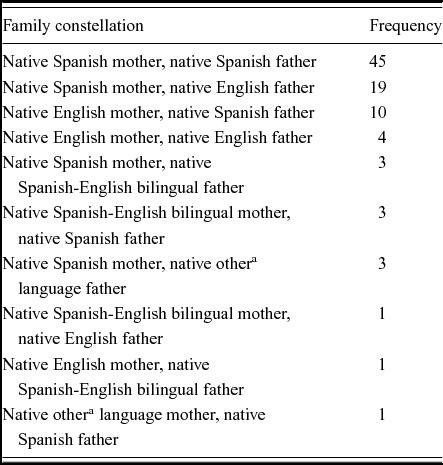
The language backgrounds of the parents of the children in the study varied, including ten different constellations of native languages. They are listed with their frequencies in Table 1. Seventy-eight percent of the mothers and 66% of the fathers were native Spanish speakers. Ninety-three percent of the native Spanish-speaking mothers and 86% of native Spanish speaking fathers were immigrants from South American or Caribbean countries; their mean age of arrival was 23.16 years (n=65, SD=9.60) for mothers and 21.25 years (n=51, SD=10.22) for fathers. The remainder of the parents who described themselves as native Spanish speakers were born in the United States. Ninety-three percent of the native Spanish-speaking parents and 23% of the native English-speaking parents described themselves as bilinguals.
Parents’ Language Backgrounds (N=90).

a Four parents were native speakers of a language other than English or Spanish (i.e., Russian, Haitian Creole, Italian, or Hindi). Three children of such parents nevertheless were exposed exclusively to English and Spanish. One child received 2% of his input in a third language.
Fifty-seven percent of the parents had college education or higher. Fifty-eight percent of the children had an older sibling. The remaining children were only children (33%) or first born (9%). Three of the households had a nonparental adult Spanish monolingual member (two were grandmothers; one was a live-in babysitter). One of the households had a nonparental adult member who was an English monolingual (an aunt). Eighty-six children lived in two-parent households; 4 lived in single-parent households.
The primary caregivers who kept the diary records of their children's language exposure consisted mostly, but not exclusively, of mothers who were native Spanish speakers and who described themselves as bilingual in English and Spanish. The exact composition of the sample of primary caregivers was as follows: 82 were mothers, 6 were fathers, 1 was a grandmother, and for 1 child both parents contributed to the diary data. Of the 90 primary caregivers, 70 were native Spanish speakers, 14 were native English speakers, 5 described themselves as native Spanish–English bilinguals, and one was native in a language other than English or Spanish. Across these categories of relation to the child and native language, there were 23 caregivers who described themselves as bilingual in Spanish and English, 9 who described themselves as monolingual speakers of English and 7 as monolingual speakers of Spanish, and 1 as bilingual in English and a language other than Spanish.
In addition to the Language Diary as a source of estimates of properties of children's total language exposure, two other types of measures were available for overlapping subsets of these participants. Of the 72 Spanish–English bilingual caregivers, 58 (all mothers) completed the Byers-Heinlein Language Mixing Questionnaire, providing a self-report measure of the frequency of their language mixing. The frequency of bilingual mothers’ language mixing was also estimated from the Language Diary as the percent of blocks in which the mother was alone with her child and both languages were addressed to the child. This was coded only for those mothers who spent at least one hour per day alone with their child over the course of the week of the diary record – a total of 49 mothers. The intersection of the set of mothers for whom a Language Mixing Score was available and the set of mothers for whom Language Diary-based estimates of their language mixing were available included 38 mothers.
Procedure
Data were collected over the course of 3 to 4 sessions with each participant, all within 6 weeks of the child's 30-month birthday. Visits were conducted in the home of the child (84%) or at the university laboratory (16%), according to caregivers’ preferences. The researchers were fully bilingual and interacted with the caregiver in the language of his or her choice. During the first session, the researcher administered to the child's primary caregiver an extensive questionnaire about the child's home language environment, which included the questions that composed Byers-Heinlein's Language Mixing Questionnaire (Byers-Heinlein, Reference Byers-Heinlein2012). The researchers also provided instructions for completing the Language Diary and the MacArthur-Bates inventories, which were left with the caregiver. In subsequent sessions, the bilingual examiner administered the standardized language instruments and other measures of the children's language skill not reported on here, on different days in English and Spanish in counterbalanced order. Caregivers were compensated for each session, and on the day of the final session the child received a small age-appropriate gift.
Input measures
Language Diary-Based measures
The primary caregiver of each child completed a Language Diary – developed by De Houwer and Bornstein (Reference De Houwer and Bornstein2003), recording for every 30-minute period of each day of the week, the person(s) with whom their child was interacting and the language or languages used in interaction with the child. There were four categories of language use: English only; Spanish only; both – but mostly English; both – but mostly Spanish. The majority of caregivers (60%) recorded the diary over the course of 7 weeks at 8-day intervals (i.e., Monday of the first week, Tuesday of the second week, and so on); some caregivers (40%) chose to record the diary over the course of one week.
In addition to providing a record of the child's dual language exposure, the Language Diaries, in conjunction with information about household members provided in the initial interview, provided the basis for coding the native speaker status of the primary conversational partner during each block in which only one language was used. When multiple conversational partners were present, primary conversational partner was determined based on the diary description of the activity (e.g., “playing with siblings”) and giving priority to more closely related speakers, following the coding system in Place and Hoff (Reference Place and Hoff2011). Interrater agreement calculated on 21 diaries was high, Cohen's Kappa=.99. On average, 10% (SD=22) of participants’ English-only blocks and 2% (SD=6) of Spanish-only blocks were uncodable because input was provided by both native and non-native speakers within the same 30-minute period. An additional 6% (SD=16) of participants’ English-only blocks and 2% (SD=7) of Spanish-only blocks were uncodable because the native language of the person interacting with the child was unknown.
Using the coded language diaries and using all 30-minute blocks in which the child was awake, the following measures were calculated:
-
(1) Percent of 30-minute blocks in which the child heard English only, Spanish only, English-dominant mixed input, and Spanish-dominant mixed input. Total mixed input was calculated as the sum of these, plus the percent of blocks for which the caregiver reported balanced mixed input.
-
(2) Number of different speakers who were sources of each language.
-
(3) Percent of exposure to each language provided by native speakers.
-
(4) Percent of blocks alone with primary caregiver in which the child heard mixed input.
Because the last measure was calculated only using those 30 minute blocks in which the caregiver (all mothers) was alone with her child, the percent of blocks with mixed input is a Language Diary-based measure of the mothers’ code-switching.
The Language Mixing Scale
Bilingual mothers reported on their own frequency of language mixing using the Language-Mixing Questionnaire, developed by Byers-Heinlein (Reference Byers-Heinlein2012). The questionnaire contains five items about the frequency with which the respondent mixes languages. The respondent answers by indicating the degree of agreement to each statement (e.g., “In general, I often mix English and Spanish.”) on a scale of 1 (very true) to 7 (not at all true). Following Byers-Heinlein's (Reference Byers-Heinlein2012) procedure, all answers were recoded on a scale from 0 to 6 so that higher scores indicated a higher degree of code switching. Answers were summed across the five items, yielding a composite score ranging from 0 – 30, (α=.84).
Language Development Measures
Productive language, MacArthur-Bates inventories
Caregivers completed the MacArthur-Bates Communicative Development Inventory, Words and Sentences (CDI) (Fenson, Marchman, Thal, Dale, Reznick & Bates, Reference Fenson, Marchman, Thal, Dale, Reznick and Bates2007) and its Spanish equivalent, el Inventario del Desarrollo de Habilidades Comunicativas, Palabras y Enunciados (IDHC) (Jackson-Maldonado, Thal, Marchman, Fenson, Newton & Conboy, Reference Jackson-Maldonado, Thal, Marchman, Fenson, Newton and Conboy2003). These instruments have been normed on monolingual children in each language and are designed for use with children between 18 and 30 months old. These instruments have established high validity in bilingual populations (Fenson et al., Reference Fenson, Marchman, Thal, Dale, Reznick and Bates2007, Jackson-Maldonado et al., Reference Jackson-Maldonado, Thal, Marchman, Fenson, Newton and Conboy2003; Marchman & Martínez-Sussmann, Reference Marchman and Martínez-Sussmann2002). Each yields a measure of productive vocabulary, a measure of the grammatical complexity of the children's productive language, and the mean length of the 3 longest utterances (MLU3) the child has produced in that language. Each instrument was completed by someone who was fluent in the language of the instrument and knew the child's language abilities well. For 43% of the children, this resulted in different household members completing the Spanish and English instruments; 57% percent of the children had both instruments completed by the same person.
Productive vocabulary, Expressive One-Word Picture Vocabulary Test (EOWPVT)
Trained, bilingual examiners administered the Expressive One-Word Picture Vocabulary Test (EOWPVT), Spanish-Bilingual version. The standard administration procedure for the Spanish–English bilingual version is to allow the child to provide a label in either language, but we modified this procedure to allow only English labels in the English assessment and only Spanish labels in the Spanish assessment in order to obtain separate estimates of the children's English and Spanish vocabularies, as have others (Anthony, Solari, Williams, Schoger & Zhang, Reference Anthony, Solari, Williams, Schoger and Zhang2009). We also modified the procedure to not require achieving a basal because we found many of the children from bilingual environments missed items within the first 8 items, but they were able to continue successfully beyond those first items (Hoff & Rumiche, Reference Hoff, Rumiche and Hoff2012). Thus, raw scores on the EOWPVT were the total number of pictures the child labeled correctly starting from the beginning of test until he or she missed 6 consecutive items. The test is designed for use with children from 2 years through adulthood.
Language comprehension, Preschool Language Scale-4 (PLS-4)
The same examiner also administered the auditory language comprehension subscales of the English (Zimmerman, Steiner & Pond, Reference Zimmerman, Steiner and Pond2002a) and Spanish (Zimmerman, Steiner & Pond, Reference Zimmerman, Steiner and Pond2002b) Preschool Language Scale-4 (PLS-4). These measure children's attention, semantics, and comprehension of morphological and syntactic markers by asking them to point to a series of pictures, to act on objects, and to follow simple commands. Raw scores potentially range from 0 to 62 in the English version and from 0 to 61 in the Spanish counterpart. Each additional task is more difficult than the previous one and administration is stopped once the child makes seven consecutive mistakes. The tests were designed for use with children from infancy through 6 years.
Data Analysis Plan
Prior to any analyses, the data were inspected for conformity to a normal distribution. Three predictor variables, the frequencies of English-dominant mixed input, Spanish-dominant mixed input, and English-dominant mixed input in mother-only time blocks, showed significant positive skew. Two outcome variables, the Spanish grammatical complexity score from the IDHC and the Spanish vocabulary measure from the EOWPVT, also showed significant positive skew. Therefore, for all inferential statistical analyses, these variables were square-root transformed. Descriptive statistics are reported for the untransformed measures. One variable, the percent of Spanish exposure from native speakers, showed significant negative skew – to a degree that transformation did not correct, and thus this variable was not entered into analysis. That is, very few children received more than very minimal amounts of Spanish input from nonnative speakers, essentially making the question of effects of nonnative Spanish input unaddressable with these data.
The first analyses investigated the relation of the Language Diary-based measures of properties of input – the frequency of mixed input, the number of different speakers who were sources of input in each language, and the percent of input in English from native speakers – to the five measures of children's skill levels in English and in Spanish. These analyses made use of data from all 90 participants.
The second analyses investigated the relation of bilingual mothers’ self-report Language Mixing Scale scores to the measures of children's English and Spanish skills. These analyses made use of data from the 58 participants who had bilingual mothers who completed the Language Mixing Questionnaire.
A third analysis investigated the interrelations among the three different measures of children's exposure to language mixing available in these data: the estimate of total language mixing from the Language Diary, the mothers’ self-reported Language Mixing Scale score, and a Language Diary-based estimate of mothers’ language mixing. Data for this analysis came from the 38 participants who had bilingual mothers and for whom all measures were available.
Finally, one additional analysis of the relation between exposure to language mixing and child language was conducted using the Language Diary-based measure of mothers’ code-switching, which was available for 49 bilingual mothers. Sample sizes for analyses also vary because of some missing data on the outcome measures.
Results
Descriptive statistics for measures of child language
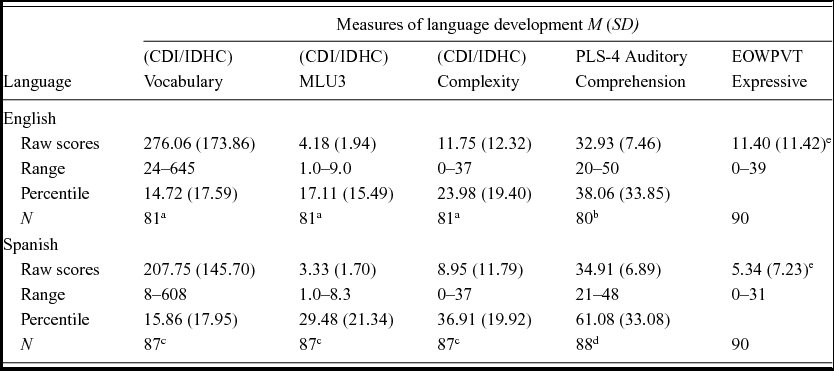
The range, mean, and standard deviation for measures of children's English and Spanish language skill are provided in Table 2. Percentile scores are provided here only to describe the sample. Analyses were conducted on raw scores – or, where appropriate, on square-root transformed raw scores. The low mean percentile scores (based on monolingual norms) are consistent with findings from other studies of bilingual children at this age (Hoff et al., Reference Hoff, Core, Place, Rumiche, Señor and Parra2012; Marchman, Fernald & Hurtado, Reference Marchman, Fernald and Hurtado2010).
Descriptive Statistics for Measures of English and Spanish Language Development in 30-Month-Old Bilingual First Language Learners.

a Data were missing for 8 children because there was no caregiver who spoke English to the child available to complete the inventory and for 1 child because the caregiver did not return the language inventory. bData were missing for 4 children because the child was uncooperative and for 6 children because of examiner error. cData were missing for 3 children because the caregiver did not return the language inventory. dData were missing for 2 children because of examiner error. eNorms for separate English and Spanish administration of the EOWPVT do not exist.
Descriptive statistics for Language Diary-based measures of input
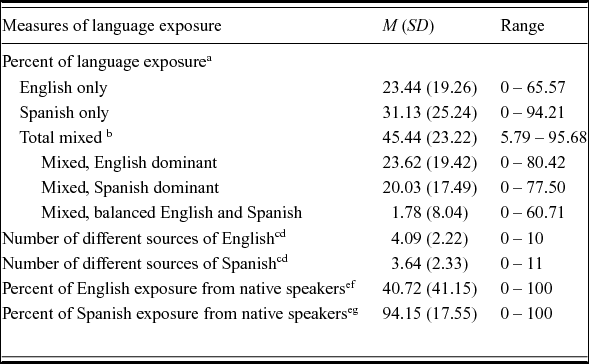
Means for the Language Diary-based measures of input are presented in Table 3. Children's exposure to Spanish-only blocks was marginally significantly higher than to English-only blocks, t(89)=1.90, p<.061. Mixed blocks were the most frequently occurring category and were evenly divided between English-dominant and Spanish-dominant mixed blocks. Fewer than two percent of blocks were balanced mixed blocks. English and Spanish input did not significantly differ in the number of different speakers who were sources of input, t(86)=1.19, p=.239. A higher proportion of English input than Spanish input was provided by nonnative speakers. On average, native speakers provided close to 40% of children's exposure to English and 94% of children's exposure to Spanish.
Descriptive Statistics for Language Diary-Based Measures of English and Spanish Exposure for 30-Month-Old Bilingual First Language Learners (N=90).

a Percent of 30-minute blocks in which only English, only Spanish, or both languages were spoken to the child. bTwo percent of 30-minute blocks consisted of equal proportions of English and Spanish. cAcross the 7 days of diary recording. dData were not available for 3 children because the caregiver did not record the person(s) interacting with the child (N=87). ePercent of native input was not calculated for those participants whose caregiver did not record the person(s) interacting with the child (n=3) and for those children who were not exposed to English-only blocks (n=6) or Spanish-only blocks (n=8). f(N=81). g(N=79).
Relation of Language Diary-based input measures to child language skill
Intercorrelations among Language Diary-based input measures
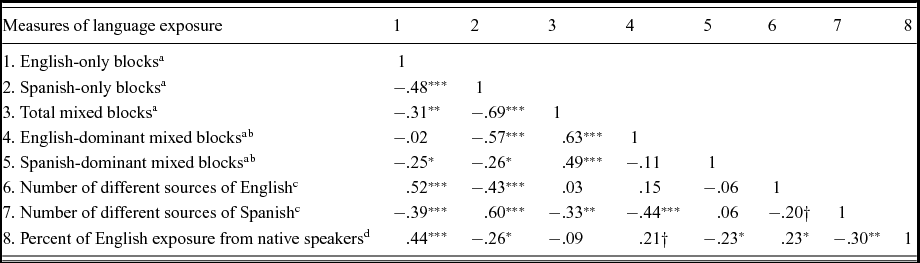
As a preliminary step, prior to examining the relation between the Language Diary-based measures of input and the children's language skill, we examined the intercorrelations among the diary-based input measures. Pearson's r correlations are presented in Table 4. Because the measures of English-only, Spanish-only, English-dominant mixed, and Spanish-dominant mixed were percentages of total exposure, there are, of necessity, intercorrelations among these measures. The frequency of English-only blocks was negatively related to the frequency of Spanish-only blocks. The frequencies of both English-only and Spanish-only blocks were negatively related to the total frequency of mixed blocks. The total frequency of mixed blocks was positively related to the frequency of English- and Spanish-dominant mixed blocks. Other intercorrelations reflect relations that are not necessary outcomes of the measurement approach: English-dominant mixed blocks were significantly less frequent in environments with more Spanish speakers. The number of English speakers and the percent of English input provided by native speakers were positively related.
Intercorrelations Among Language Diary-Based Measures of English and Spanish Exposure (N=90).

a Calculated as percent of 30-minute blocks in the diary record. bSquare-root transformed. cAcross the 7 days of diary recording (N=87). d N=81.
† p<.10, *p<.05, **p<.01, ***p<.001, all 2-tailed tests.
Zero order correlations between Language Diary-based input measures and child language skill
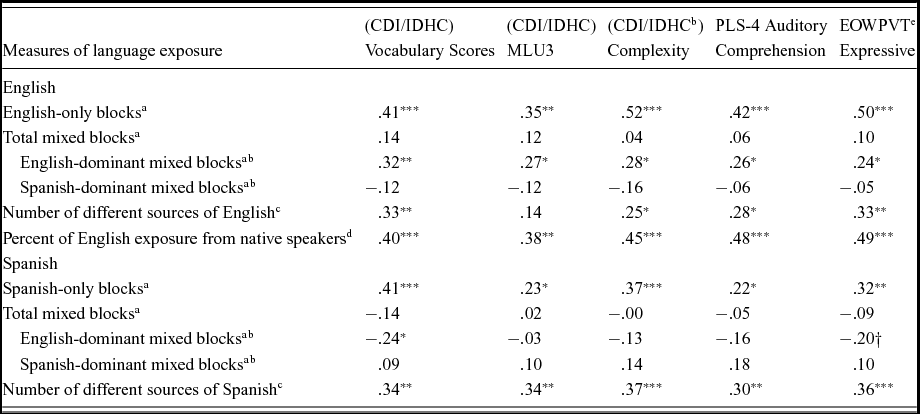
As a first step in investigating relations between input and child language skill, we calculated the zero order correlations between all measures of input and child language. They are presented in Table 5, separately for English and Spanish.
Zero-order Correlations Between Properties of Language Exposure and Measures of Language Development for English and Spanish (N=90).

a Calculated as percent of 30-minute blocks in the diary record. bSquare-root transformed. cAcross the 7 days of diary recording. (N=87). d N=81. eSquare-root transformed (Spanish measure only).
† p<.10, *p<.05, **p<.01, ***p<.001, all 2-tailed tests.
Relations between language exposure and children's English skill
Exposure to English-only blocks was a significant positive predictor of all measures of children's English skill. Total exposure to mixed blocks was unrelated to any measure of children's English skill. Considering English- and Spanish-dominant mixed blocks separately, exposure to English-dominant mixed blocks was a significant positive predictor of all measures of children's English skill and exposure to Spanish-dominant mixed blocks was not significantly related to any measure of children's English. The number of different sources of English was positively related to all English outcomes except the CDI MLU3 measure. The percent of English input provided by native speakers was a significant correlate of all measures of the children's English skill.
Relations between language exposure and children's Spanish skill
Exposure to Spanish-only blocks was a positive predictor of all measures of Spanish skill. Total exposure to mixed blocks was unrelated to any measure of Spanish skill. Considering English- and Spanish-dominant mixed blocks separately, frequency of Spanish-dominant mixed blocks was unrelated to the children's Spanish skill, while frequency of English-dominant mixed blocks showed a significant negative relation to IDHC productive vocabulary. The number of different sources of Spanish was a positive predictor of all measures of Spanish skill.
Unique relations between Language Diary-based properties of input and child language skill
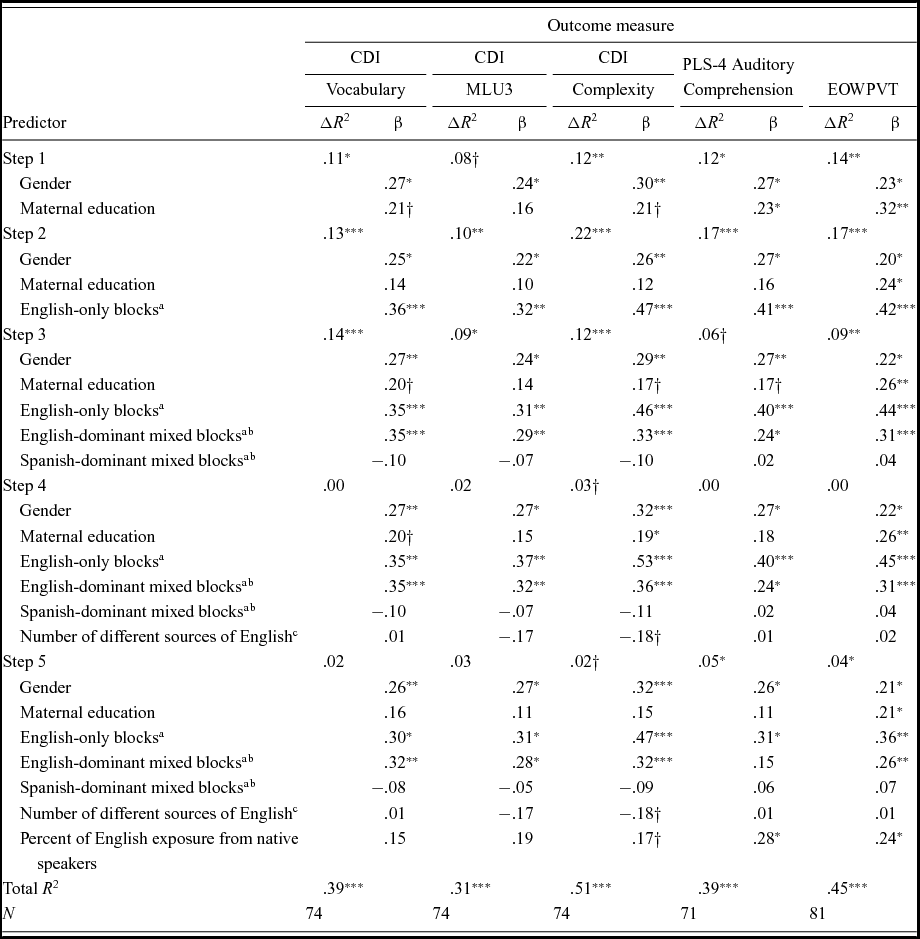
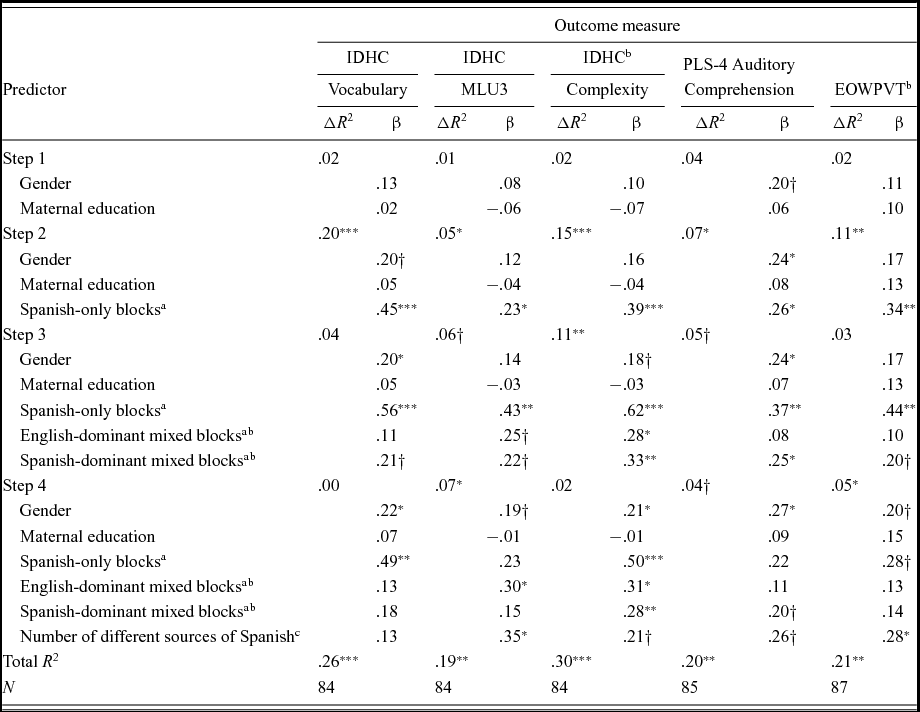
The central aim of this study was to ask which properties of input – beyond sheer amount – uniquely accounted for variance in the children's English and Spanish development and thus could be considered indicators of the quality of input. To address this question, ten separate hierarchical regressions were performed, one for each outcome measure (five English [see Table 6], five Spanish [see Table 7]). In these regressions, child gender and maternal education were always entered together in the first step as control variables, as was also done in Byers-Heinlein (Reference Byers-Heinlein2012). Both gender and maternal education are frequently related to language development and are potentially related to the predictors of interest. In the second step, the percent of single-language blocks in the language of the outcome measure was entered, also as a control variable. In order to test the unique effect of mixed language exposure, the percent of blocks that were English- and Spanish-dominant mixed input were entered together in the third step. In subsequent steps for English outcomes, the number of different speakers who were sources of English and the percent of English input provided by native speakers were entered. For Spanish outcomes, only the number of different speakers who were sources of Spanish was entered. Recall, the distribution of percent Spanish input from native speakers was too negatively skewed to be meaningfully analyzed. The order of entry was planned to provide a conservative test of the effect of number of speakers and to provide the most conservative test possible, within these data, of the variance uniquely attributable to native speaker input.
Hierarchical Multiple Regression Analyses Predicting Measures of 30 Month Old Bilingual Children's English Language Skill From Properties of the Quantity and Quality of English Input.

a Calculated as percent of 30-minute blocks in the diary record. bSquare-root transformed. cAcross the 7 days of diary recording.
† p<.10, *p<.05, **p<.01, ***p<.001, all 2-tailed tests.
Hierarchical Multiple Regression Analyses Predicting Measures of 30 Month Old Bilingual Children's Spanish Language Skill From Properties of the Quantity and Quality of Spanish Input.

a Calculated as percent of 30-minute blocks in the diary record. bSquare-root transformed. cAcross the 7 days of diary recording.
† p<.10, *p<.05, **p<.01, ***p<.001, all 2-tailed tests.
For all regression models, inspection of collinearity statistics indicated that the assumption of no multicollinearity was met. Multivariate normality was evaluated using Mahalanobis distance for the English and Spanish models. There were no multivariate outliers in either the English or Spanish models.
Unique correlates of variance in children's English language skill
After removing the almost-always significant relations with gender and maternal education in Step 1 (girls had more advanced English skills than boys, and higher levels of maternal education were associated with more advanced English language skills than lower levels of maternal education), the percent of blocks providing English-only exposure, entered in Step 2, remained a significant predictor of all measures of English language skill. Exposure to English-dominant and Spanish-dominant mixed input were entered together in Step 3, and together these measures of exposure to mixed input accounted for significant additional variance in four of the five measures of English productive language. The individual beta weights for English-dominant and Spanish-dominant mixed input indicated that the variance accounted for by children's exposure to mixed input was due to a positive relation between exposure to English-dominant mixed input and productive English skill. Exposure to mixed input was unrelated to the measure of English comprehension. The number of speakers who were sources of English, entered in Step 4, did not uniquely account for variance in any measure of children's English skill. Entered last, the percent of English input provided by native speakers uniquely accounted for significant variance in children's English PLS-4 auditory comprehension and children's English EOWPVT; the direction of both relations was positive.
Unique correlates of variance in children's Spanish language skill
Entered together in Step 1, the control variables of gender and maternal education did not account for significant variance in any Spanish outcome measure. In the final regression model, gender was significantly or marginally significantly related to each outcome, with girls outperforming boys; maternal education remained unrelated to any Spanish outcome. Exposure to Spanish-only blocks, entered in Step 2, uniquely accounted for significant variance in all measures of children's Spanish productive language. Exposure to mixed input uniquely account for significant variance in the measure of Spanish grammatical complexity. The separate beta weights for English- and Spanish-dominant mixed revealed both categories of mixed input were positively related to this outcome. The number of speakers who were sources of Spanish, entered in Step 4, accounted for significant additional variance in two measures of Spanish productive skill; the direction of these relations was positive.
The Relation of Mothers’ Self-Reported Language Mixing to Child Language
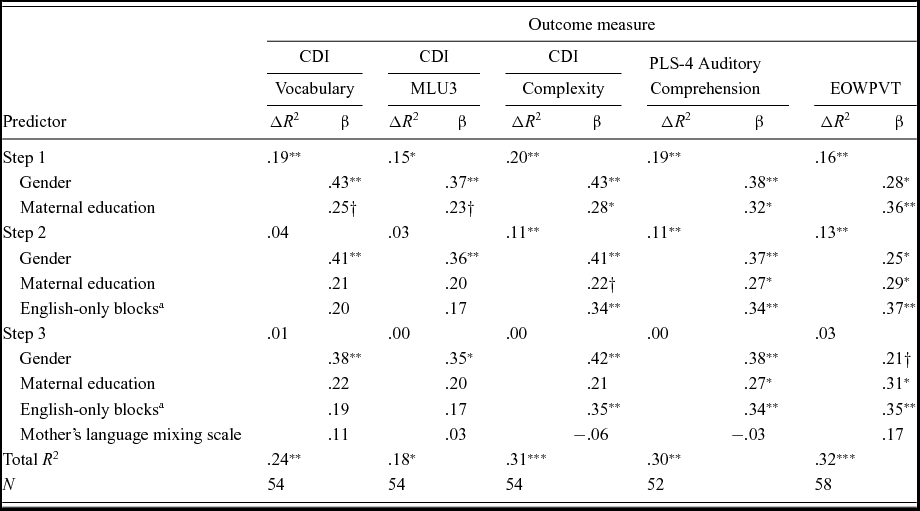
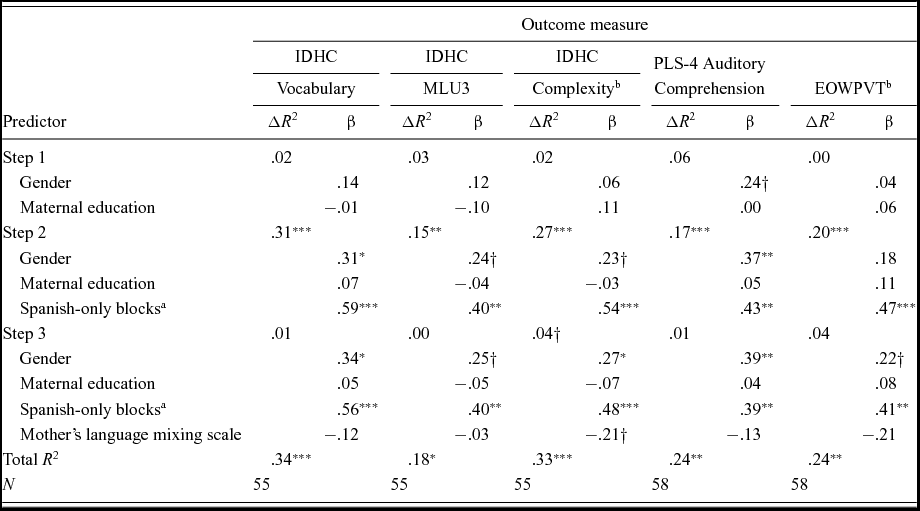
The second set of analyses asked whether there was a relation between exposure to language mixing and children's English or Spanish skill, using those children with bilingual mothers as participants and using the mothers’ scores on the self-report Language Mixing Scale as the index of exposure. The mothers’ mean score on the Language Mixing Scale was 14.00 (SD=7.41, N=58) on a scale from 0 to 30. Using the same analytical approach as was employed for the Language Diary-based measures of exposure to language mixing, separate hierarchical regression analyses tested the relation of mothers’ Language Mixing Scale score as the predictor to all language skill measures, holding constant gender, maternal education, and single language exposure. Sample sizes are sometimes smaller than 58 because of missing data on the outcome measures. Mothers’ language mixing scores were not related to any measure of their children's English skill (see Table 8); mothers’ self-reported language mixing had a marginally significant negative relation to one Spanish outcome measure (see Table 9).
Hierarchical Multiple Regression Analyses Predicting Measures of 30 Month Old Bilingual Children's English Language Skill from Measures of Mothers’ Self-Reported Language Mixing, controlling for Maternal Education, Child Gender, and Relative Amount of English Language Exposure.

a Calculated as percent of 30-minute blocks in the diary record.
† p<.10, *p<.05, **p<.01, ***p<.001, all 2-tailed tests.
Hierarchical Multiple Regression Analyses Predicting Measures of 30 Month Old Bilingual Children's Spanish Language Skill from Measures of Mothers’ Self-Reported Language Mixing, controlling for Maternal Education, Child Gender, and Relative Amount of Spanish Language Exposure.

a Calculated as percent of 30-minute blocks in the diary record. bSquare-root transformed.
† p<.10, *p<.05, **p<.01, ***p<.001, all 2-tailed tests.
The relation of mothers’ self-reported language mixing to Language Diary-based measures of language mixing
To ask how the Language Diary-based measure of total exposure to language mixing was related to the self-report Language Mixing Scale as a measure of children's exposure we calculated the correlation between these measures and also the correlations of these measures to a Language Diary-based measure based on time blocks in which only the mother was interacting with her child. Means for those measures and their intercorrelations are presented in Table 10, calculated for the 38 participants for whom all measures were available. The mothers’ scores on the Language Mixing Scale were significantly positively related to the Language Diary-based measure of maternal code-switching and mothers’ code-switching based on Language Diary data was positively related to the Language Diary-based measure of their children's total exposure to mixed blocks. Mothers’ Language Mixing Scale scores were only marginally significantly related to their children's total exposure to language intermingling.
Means and Intercorrelations for Bilingual Mothers’ Language Mixing Scores, Language Diary- Based Measures of Maternal Code-Switching, and Language Diary-Based Measures of Total Exposure to Language Mixing (N=38).

a Diary data measures based on percent of 30-minute blocks in English only, Spanish only, or mixed input when a bilingual native-Spanish-speaking mother was alone with her child. bCalculated as percent of 30-minute blocks in the diary record in which the child heard English only, Spanish only, or mixed input.
† p<.10, **p<.01, ***p<.001, all 2-tailed tests.
Follow-up analyses
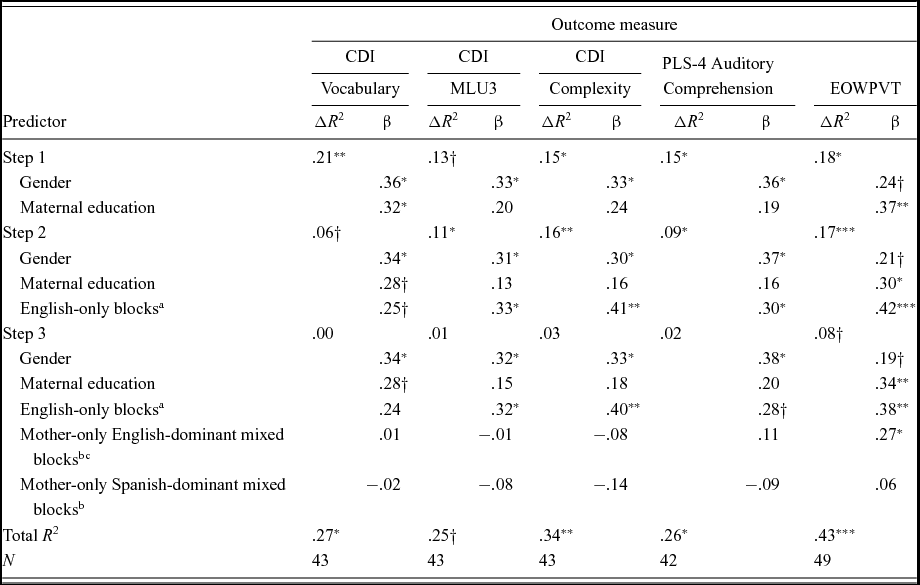
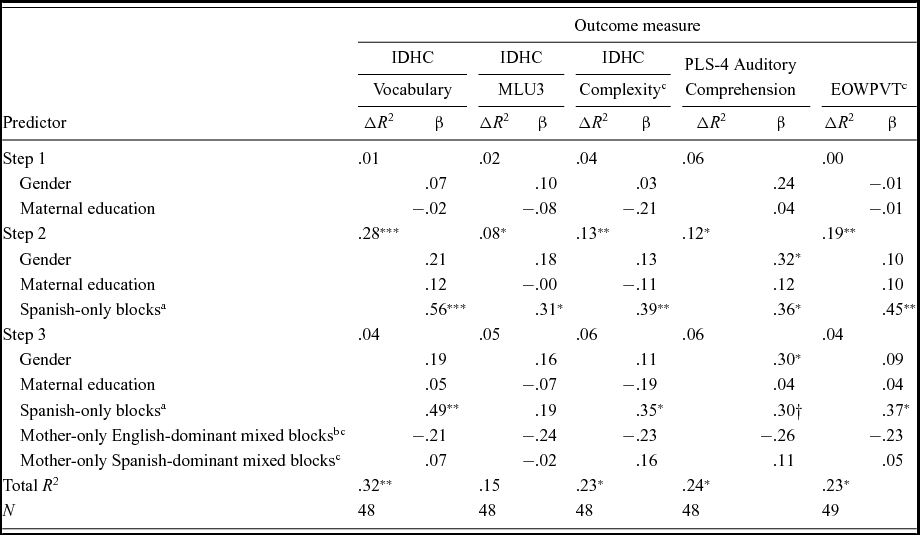
Although the outcomes of the regressions using the Language Diary measure of total exposure to mixing and the bilingual mothers’ Language Mixing Scale scores were similar – the former revealing no negative effects on either English or Spanish skills and the latter revealing only one marginally significant negative effect (on Spanish complexity scores) – they were not identical. Furthermore, mothers’ Language Mixing Scale scores and the Language Diary-based measure of children's total exposure to language mixing were not significantly related. We therefore pursued the possibility that the trend toward a negative relation obtained with the Language Mixing Scale score reflected a negative effect of mixing by a single speaker, while language mixing as a result of multiple speakers using different languages – which also contributes to the Language Diary-based estimate of language mixing – does not have a negative effect. Analyses exactly parallel to those in Tables 8 and 9, but using the Language Diary-based measures of mothers’ code-switching were conducted, using the 49 children for whom mother-only measures of language mixing could be calculated from the Language Diaries.
After controlling for gender, education, and English-only language exposure, the regressions revealed no significant relations between the frequency of mothers’ use of two languages within the same 30-minute period and any measure of their children's English or Spanish skill (see Tables 11 and 12).
Hierarchical Multiple Regression Analyses Predicting Measures of 30 Month Old Bilingual Children's English Language Skill from Diary Based Measures of Maternal Code-Switching, controlling for Maternal Education, Child Gender, and Percent of English Language Exposure.

a Calculated as percent of 30-minute blocks in diary record in which the child heard English only, Spanish only, or mixed input.
b Diary data measures based on percent of 30-minute blocks in English only, Spanish only or mixed input when bilingual native-Spanish-speaking mother was alone with her child. cSquare-root transformed.
*p<.05, two-tailed. **p<.01, two-tailed. ***p<.001, two-tailed. †p<.05, one-tailed.
Hierarchical Multiple Regression Analyses Predicting Measures of 30 Month Old Bilingual Children's Spanish Language Skill from Diary Based Measures of Maternal Code-Switching, controlling for Maternal Education, Child Gender, and Percent of Spanish Language Exposure.

a Calculated as percent of 30-minute blocks in diary record in which the child heard English only, Spanish only, or mixed input.
b Diary data measures based on percent of 30-minute blocks in English only, Spanish only or mixed input when bilingual native-Spanish-speaking mother was alone with her child. cSquare-root transformed.
*p<.05, two-tailed. **p<.01, two-tailed. ***p<.001, two-tailed. †p<.05, one-tailed.
In sum, the results of the many regression analyses presented in Table 6 through 9 and in Tables 11 and 12 include the following findings: the amount of input children receive in each language is a consistent and strong positive correlate of skill in that language (Tables 6 and 7), the amount of input in each language is a positive correlate of skill in that language even when the input includes the use of the other language (e.g., English-dominant mixed input is a positive correlate of children's English skill, Tables 6 and 7), the percent of English input provided by native speakers is an additional positive correlate of children's English skills over and above effects of the amount of input (Table 6), and the number of speakers who are sources of children's input is a positive correlate of some measures of children's Spanish skill (Table 7). Additionally, the results include the findings that no Language Diary-based measure of exposure to mixed input is a negative correlate of children's skill in either language and that the maternal self-report measure of language mixing is a marginally significant negative correlate of only one measure of children's Spanish skill and of no measure of children's English skill. In all these regressions, child gender and maternal education were entered first as covariates, although these variables showed significant relations only to children's English skills, not Spanish skills.
Discussion
The aim of this study was to pursue findings in the extant literature that have suggested particular properties of speakers and their speech to children that affect the degree to which language input in bilingual environments is supportive of language development. We assessed input using measures that have been employed in previous studies, including measures that have yielded conflicting findings. We assessed language development, in two languages, using both the caregiver-report measures employed in previous studies and also using two examiner-administered tests of children's skills. We tested the hypothesis that the measured properties of input affected the value of input for language development by assessing the variance in child language skill uniquely accounted for by each property, after removing effects of gender, maternal education, and the relative amount of input in that language.
The control variables of gender and maternal education were consistently significant predictors of children's English skill. As has been found in previous studies of monolingual development, girls showed more advanced language skills than boys and maternal education was positively related to children's language skill. In contrast, neither gender nor maternal education was related to children's Spanish language skills. The null finding with respect to maternal education has precedent in the literature, although its basis is not entirely clear (DeAnda, Arias-Trejo, Poulin-Dubois, Zesiger & Friend, Reference DeAnda, Arias-Trejo, Poulin-Dubois, Zesiger and Friend2015; Hoff & Giguere, Reference Hoff and Giguere2015). It is also the case in this study and in Place and Hoff (Reference Place and Hoff2011) that these measured variables account for more of the variance in children's English skills than in their Spanish skills. It may be that other, unmeasured factors influence Spanish development in this language minority context, and it also may be that the instruments that assess Spanish are less sensitive or less valid than the instruments that assess English when applied in the language minority context (Hoff, Reference Hoff and Gathercole2013; Hoff & Rumiche, Reference Hoff, Rumiche and Hoff2012). The present study replicated the well-established finding that quantity of exposure matters (De Houwer, Reference De Houwer2009; Gathercole & Thomas, Reference Gathercole and Thomas2009; Hoff et al., Reference Hoff, Core, Place, Rumiche, Señor and Parra2012; Pearson et al., Reference Pearson, Fernández, Lewedeg and Oller1997; Scheele, Leseman & Mayo, Reference Scheele, Leseman and Mayo2010). This is not news, but the replication in this sample using these measures argues that the present measures of input and language development are adequate to capture relations between the two.
The hypothesis that the percent of input provided by native speakers is a measure of the quality of input was supported in the present findings. The results of this study replicate the finding from a different sample of Spanish–English bilingual children reported by Place and Hoff (Reference Place and Hoff2011), that the proportion of input provided by English native speakers is a positive predictor of English language development. The zero-order correlations were significant for all measures of children's English skill, and the very conservative test of the variance uniquely accounted for by the proportion of input provided by native speakers was significant for both examiner-administered assessments of English skill – instruments that had not been used in previous research and that included measures of both productive vocabulary and language comprehension. The present findings thus importantly add to the previous evidence that native speaker input is more supportive of language development than nonnative input. The variance uniquely accounted for by the percent of English input provided by native speakers was small – between 4 and 5 percent, but the caregivers who were sources of nonnative input in this study were highly proficient. In households in which less proficient English speakers address their children in English, one would expect to find greater differences between the value of native and nonnative input. Other findings in the literature are consistent with this notion that the nonnative speech of more proficient speakers is more supportive of language than the speech of less proficient nonnative speakers (Hammer et al., Reference Hammer, Komaroff, Rodriguez, Lopez, Scarpino and Goldstein2012; Jia et al., Reference Jia, Aaronson and Wu2002). It was not possible to ask the parallel question for Spanish language outcomes because the distribution of the measure of input provided by native speakers was too skewed – very few children had exposure to Spanish produced by nonnative speakers.
The hypothesis that the number of different speakers who are sources of input is a measure of the quality of input received modest support in the present findings. The zero-order correlations between the number of different speakers from whom the children heard English and Spanish and their skill levels in those languages were both positive and significant, but the number of speakers of each language were also related to the relative amount of each language in the children's experience. When the quantity of language exposure was partialled out, variability in the number of speakers who were sources of each language was a significant source of variance in children's Spanish skill only. The previous finding in Place and Hoff (Reference Place and Hoff2011) was with English outcomes, raising the question of why this relation appears sometimes and not others. The present finding does echo a finding from Weisleder (Reference Weisleder2012), that the number of adults that 19-month-olds in Spanish-speaking homes in the U.S. interacted with was a marginally significant positive predictor (p<.10) of their Spanish language skill, after controlling for the amount of child-directed speech, and it is consistent with the findings that heritage language skill among older children and adults is related to the number of different heritage language speakers they spoke to as children, independent of frequency of heritage language use (Gollan et al., Reference Gollan, Starr and Ferreira2015). At present, the data suggest the conclusion that there may be a benefit of hearing input from more speakers rather than fewer speakers, but further research will need to investigate under what circumstances this benefit is observed.
The hypothesis that lack of separation of two languages in children's bilingual experience impedes language development was not supported, where lack of separation is operationalized as the frequency with which both languages are used within the same 30-minute period. The total frequency of 30-minute blocks in which children were exposed to both languages, based on diary records, was unrelated to any measure of English or Spanish development. This finding replicates the findings in Place and Hoff (Reference Place and Hoff2011). Not only was the frequency of mixed blocks not negatively associated with children's English or Spanish skill, but also the frequency of mixed blocks in which English was dominant was positively associated with children's English skill. It appears that English-dominant mixed input functions like English input for English outcomes, albeit with weaker relations to outcome measures. The frequency of Spanish-dominant mixed block showed less consistently significant, but still positive relations to measures of Spanish skill. One seemingly counterintuitive finding was a positive relation between children's exposure to English-dominant mixed blocks and their Spanish language skill. This finding becomes less mysterious when the zero-order correlations are considered. In the zero-order correlations, the frequency of English-dominant mixed blocks is negatively related to children's Spanish skill and also negatively related to the frequency of Spanish-only blocks. The positive relation in the regression analyses indicates that when the variation in Spanish skill associated with exposure to Spanish-only blocks is accounted for, then exposure to mixed input – even English-dominant mixed input – has a positive association to the residual variance in children's Spanish skill. It suggests that children learn from nondominant input as well.
Somewhat in contrast to the consistently null findings with respect to any negative effects of language mixing as indexed by the Language Diary-based measure, the self-reported frequency of language mixing by the bilingual mothers using the Byers-Heinlein Language Mixing Scale showed only a marginally significant negative relation to one language outcome. Although this is not evidence of a robust effect, it is a different pattern of findings than occurred with the Language Diary measure. The difference could not be attributed to differences in the samples analyzed or to the fact that the diary measure included mixed input as a result of multiple speakers, not just code-switching by a single speaker. It may be, however, that in recording mixed input in the Language Diaries, mothers did not consider intrasentential language mixing as mixed input, while the Language Mixing Scale clearly does. It may be that intrasentential mixing has a detrimental effect, as Byers-Heinlein (Reference Byers-Heinlein2012) has suggested, and that the present analyses did have sufficient power to clearly reveal it. It may also be relevant that the trend toward a negative effect was observed for Spanish, not English, and that in this bilingual community, English words are more likely to be used in speaking Spanish than vice versa.
Implications
The findings of the present study add to the evidence that for bilingual children, no less than for monolingual children, language acquisition is a process that depends on quantity and quality of children's language input. In addition, the findings of the present study add new evidence to the extant literature regarding factors in bilingual environments that influence the quality of input. The present findings replicate and extend previous findings that access to native speakers is one such factor. The present study found, in an environment in which on average 43 percent of the English children heard came from nonnative speakers, that the percent of children's exposure to English provided by native speakers was a unique, positive predictor of measures of English expressive vocabulary and grammar, and of English comprehension.
In considering the implications of this finding, it is important to note that the data do not show a negative effect of input from nonnative speakers. The finding is not that nonnative input is harmful; the finding is that it is less beneficial than native input. The properties of native speech that make it more supportive of language acquisition remain to be determined. Some evidence indicates lexical richness and phonological accuracy are two relevant variables (Core & Hoff, Reference Core and Hoff2014; Hoff, Coard & Señor, Reference Hoff, Coard and Señor2013). It is not unreasonable to suppose that the speech of even fluent nonnative speakers differs, on average, from the speech of native speakers in other factors such as grammatical diversity and conversational contingency that have been found to support monolingual development (Hoff, Reference Hoff2006; Huttenlocher et al., Reference Huttenlocher, Waterfall, Vasilyeva, Vevea and Hedges2010).
The present findings provide suggestive evidence that variation in the number of speakers who are sources of input may also influence the value of that input, with input from more sources being more supportive than input from fewer sources. More work is needed to identify the circumstances under which that relation will and will not be observed. One obvious candidate factor is how much variability there is among children in their access to multiple speakers of each language. Another candidate factor is variability in language growth. In a previous study (Place & Hoff, Reference Place and Hoff2011), the number of speakers predicted children's English and not Spanish skill. The range in number of speakers of each language was similar in the two studies, but the present study may have been more able to detect influences on variability in children's Spanish development than Place and Hoff (Reference Place and Hoff2011) because there was a greater range in children's Spanish scores.
Finally, the present findings suggest that separation of the contexts in which two languages are used does not benefit bilingual development, but the findings leave open the possibility that intrasential code-switching can negatively affect language development. Identifying if, when, and under what circumstances effects of code-mixing may operate is clearly an important task for future research. The lack of clear negative effects of hearing both languages from the same speakers does suggest that the widely-promulgated one-parent-one-language approach to supporting bilingual development is not necessary. The present study was not, however, well suited to testing that hypothesis because in the majority of families, both parents were native speakers of Spanish, and because in the Spanish–English bilingual community in South Florida, language mixing is ubiquitous.
The present findings have implications for designing policy and programs for bilingual children and for the advice teachers, child-care providers, and clinicians are often called upon to give. The finding of strong linear relations between the amount of input children hear and their language skills argues that children acquiring two languages, perhaps even more than children acquiring only one, need to experience language rich environments. Although children have a remarkable ability to build linguistic systems from the speech they hear, they need to hear speech. The finding that native input is more supportive of language development than nonnative input suggests that the advice often given to immigrant parents – not to speak their native language to their children but to use the language of the larger community instead – may not be good advice. Other studies find that in so doing, parents diminish their children's development of heritage language skills more than they support their children's development of the majority language (Hoff, Rumiche, et al., Reference Hoff, Rumiche, Burridge, Ribot and Welsh2014; Paradis & Nicoladis, Reference Paradis and Nicoladis2007). The finding that native input is more supportive of language development than nonnative input also suggests that children of immigrant parents need early access to native speakers of the community language in order to be ready for schooling in the community language.
Limitations
The current study does not provide a complete picture of children's input. Relative amount of exposure was measured in terms of time blocks in each and in both languages; there was no measure of how much speech was addressed to the child during these time blocks. Similarly, the measures of nonnative input and number of sources did not take account of differences among sources in how much they talked to the child. The measures of language intermingling and code-switching were indirect. We did not have measures of the English and Spanish proficiency of the adults addressing the children – other than their native speaker status. And, the study measured children's input and their language skill concurrently. Future studies will be needed to address these limitations with more direct and comprehensive measures of input and with longitudinal approaches. Those limitations notwithstanding, the present study provides new evidence replicating existing findings in a literature that is still quite small. These findings establish for future research that input from native speakers is uniquely valuable to the language-learning child and that code-switching is not reliably detrimental. What properties of native speaker input confer that value, under what circumstances or at what ages code-switching may diminish the value of input, and whether and at what age children benefit from input provide by multiple speakers are questions that need to be addressed in that future research.