Hundreds of thousands of Chinese took to the streets in nearly 400 separate protests across 208 cities during the 2012 Senkaku/Diaoyu Island (Diaoyu dao 钓鱼岛) crisis. The causes of these events have been analysed by scholars;Footnote 1 however, the subsequent impact of the protests has not been systematically examined beyond its role in Chinese foreign policy.Footnote 2
We argue that these protests should have domestic political and economic consequences. Politically, Chinese leaders have consistently emphasized the importance of social stability in slogans such as “stability above all” (wending yadao yiqie 稳定压倒一切).Footnote 3 Just as social instability is held against cadres in their evaluation process, local officials who allow or encourage anti-foreign protests might be penalized in the promotion process.Footnote 4 Local officials face considerable uncertainty and ambiguity when anticipating how nationalist activities will be factored into their performance review, leading to substantial variation in local strategies for the management of nationalist protests.
Many international relations theories expect anti-foreign nationalist unrest to affect economic ties between states. Businesses, investors and consumers take cues from political hostilities in anticipating the risk of conflict.Footnote 5 Governments may also use economic statecraft to advance the national interest, prompting businesses and investors to reallocate activities as tensions rise.Footnote 6 Yet Christina Davis and Sophie Meunier find no evidence that political tensions affected trade or investment between China and Japan, or between the United States and France during an earlier period (1990–2006).Footnote 7 Their analysis suggests that the sunk costs of developing production and distribution networks discourage economic actors from adjusting to political tensions; that governments competing for investment will be wary of taking action that might undermine investor confidence; and that product boycotts rarely succeed owing to consumer attachment, free-riding or the disguising of a product's national origin.Footnote 8
At the subnational level, we expect that foreign firms may be more likely to divert investments away from cities with heightened political risks as may be indicated by the occurrence of anti-foreign protests.Footnote 9 Consumers and business owners might worry about property being vandalized by nationalist protesters or feel social and political pressure to choose other products.Footnote 10
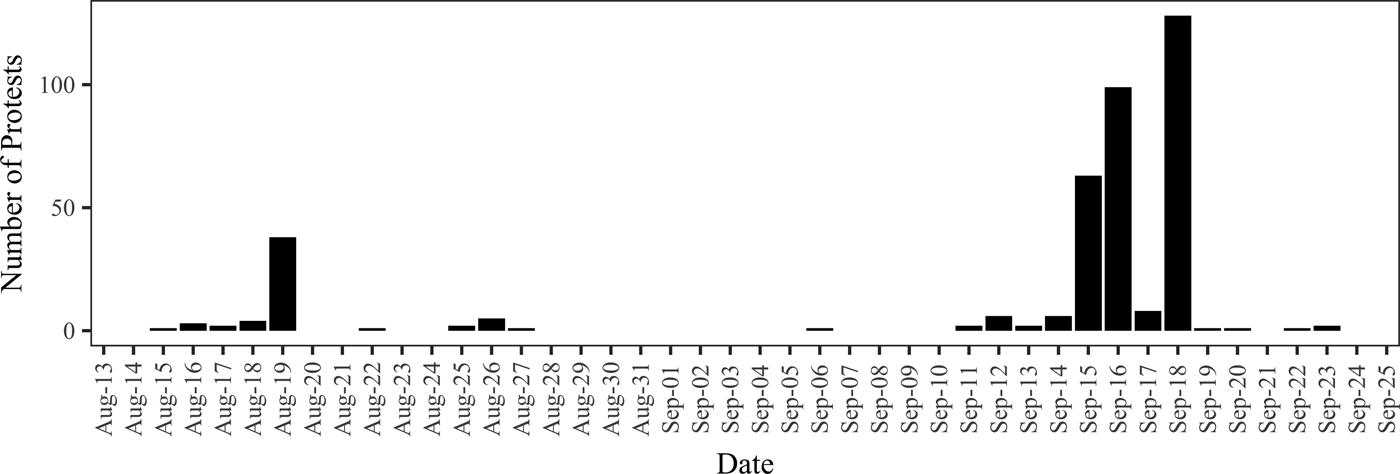
The anti-Japanese protests of 2012 are well suited to test these expectations. While China has experienced large numbers of mass public disturbances, most reflect local circumstances and grievances, and data on the distribution of these events are intermittent. Nationalist protests in 2012, on the other hand, arose from a common stimulus: the Japanese central government's purchase of three of the Senkaku/Diaoyu Islands. Responses varied across China's cities, with protestors taking to the streets earlier in some cities, and others following only once central government instructions encouraged the stage management of protests with the approaching September 18th anniversary of Japan's 1931 invasion of Manchuria. Between 15 August and 14 September 2012, 65 demonstrations took place; between 15 and 18 September, there were more than 300.
Leveraging this variation in protest activities across space and time, we find that local leaders in cities with early, relatively spontaneous protests were promoted at lower rates than their colleagues. In the three years following 2012, those cities that had experienced multiple anti-Japanese protests had slower foreign direct investment (FDI) growth compared to cities with one or no protests. Additionally, when we instrument for protests using the college student population and the presence of “patriotic education bases” and historical legacies of Japanese occupation, we find that the political impact of protests on promotion is not simply a response to economic consequences.
The rest of the paper proceeds as follows. After a brief account of the Senkaku/Diaoyu dispute and the protests it sparked, we provide our theoretical expectations, describe our datasets, and present our statistical results. Finally, the paper concludes with a discussion of how best to interpret these results.
The 2012 Anti-Japanese Protests
Both China and Japan claim sovereignty over the uninhabited Senkaku/Diaoyu Islands in the East China Sea. In April 2012, Tokyo governor Shintaro Ishihara declared his intent to purchase three of the islands from their private Japanese owner and develop them. To pre-empt the purchase, Japan's central government announced in July that it would buy the islands, arguing that national management would be more prudent for bilateral relations.Footnote 11 On 15 August, the anniversary of Japan's defeat in the Second World War, several Chinese activists landed on the islands and planted flags to assert Chinese sovereignty. Prominent Chinese media coverage of US–Japan military exercises, the landing of Japanese activists on 19 August, and official Japanese affirmations of sovereignty all stoked popular anger and calls for anti-Japanese demonstrations in China.
Between the start of the protest wave on 15 August and its apex on 18 September, the national-level context evolved from tacit tolerance of relatively spontaneous, grassroots nationalist protests to carefully orchestrated and controlled demonstrations. As Jessica Weiss notes, windows of opportunity for nationalist protest open and close with the central leadership's evolving diplomatic priorities and tactical adjustment between resolve and reassurance.Footnote 12 In this context, city leaders appear to interpret national-level windows of opportunity and “stability maintenance” instructions in view of local concerns, such as the minority share of the population and unemployed college graduates.Footnote 13 Just as social movement activists and participants must navigate the “political opportunity structure” when mobilizing protest, local officials also face shifting political winds in choosing whether to tolerate, repress or encourage nationalist protest.Footnote 14 Although social unrest is usually a black mark in a cadre's performance evaluation, anti-foreign and patriotic protests are sometimes tolerated and even encouraged by the national leadership.Footnote 15 City officials have to weigh the risk that protests might veer off course against the potential benefits of demonstrating their patriotic credentials.
The changing national opportunity structure provides us with an opportunity to assess the consequences of local variation in nationalist protest. We divide the protest wave into two periods: early (from 15 August to 14 September) and peak (from 15 September onwards). On 15 August, the national context became permissive but did not explicitly instruct government units to take charge of protest demonstrations. From 15 September onwards, national authorities encouraged “rational” (lixing 理性) expressions of patriotism and directed local authorities to play an active role in ensuring that nationalist demonstrations did not get out of control.
Until 15 August 2012, there had been no widespread anti-Japanese protests since the 2010 crisis over Japan's arrest of a Chinese fishing captain near the disputed islands.Footnote 16 Even as late as 7 July 2012 – the day that the Japanese government announced its intent to purchase the islands – activists in Beijing were only allowed to hold a brief gathering to commemorate the Marco Polo Bridge incident before being escorted away by state security.Footnote 17 As Chinese officials and diplomats warned Japan not to proceed with the purchase of the islands, Chinese state television broadcast live coverage of the Chinese activists landing on the islands on 15 August, signalling an opening of the domestic political opportunity structure. Events protesting Japan's claim to the islands began with a gathering of two dozen activists outside the Japanese embassy in Beijing on 15 and 16 August. Newspapers across the country featured full-page photographs of the activists landing on the islands alongside banner headlines. Calls for anti-Japanese protests that weekend were not systematically deleted by censors on national social media and internet platforms such as Weibo 微博 and Tianya 天涯.Footnote 18 As Christopher Cairns and Allen Carlson show, censorship of Diaoyu-related posts dropped precipitously on 18 August, the first weekend of widespread protests during the early wave, suggesting “a deliberate decision to censor less at that time.”Footnote 19
Over the following two weekends, protests spread to dozens of other Chinese cities. In August alone, anti-Japanese protests took place in more than 50 Chinese cities across more than a dozen provinces. During this period, many cities allowed grassroots protests to proceed under the close watch of security officials. In Guangzhou, police led the way and reportedly provided water to protesters on 19 August.Footnote 20 In Taizhou 台州 in Zhejiang, police flanked protesters as they marched from the central people's square to the municipal government headquarters, where SWAT police intervened to maintain order.Footnote 21 In Ganzhou 赣州 in Jiangxi province, a plainclothes policeman questioned protesters who had gathered outside the Ganzhou theatre but was unsuccessful in dissuading the crowd from raising flags and marching with banners demanding the return of the islands.Footnote 22 These early protests took place in less than a quarter of the cities in our dataset. A summary of the protest numbers is presented in Table 1.Footnote 23
Number of Cities with Anti-Japanese Protests by Period, August–September 2012

After Japan finalized the purchase on 11 September and a series of senior Chinese officials denounced the decision, protests again broke out in more than a dozen Chinese cities. From the weekend of 15–16 September onwards, Chinese authorities began a more concerted and coordinated effort to guide and manage anti-Japanese protests, which had turned violent in some cities including Qingdao 青岛, Changsha, Guangzhou and Xi'an. Over the weekend of 15–16 September, the Ministry of Public Security and city police departments urged citizens via official Weibo accounts to show “rational patriotism” (lixing aiguo 理性爱国) and warned that “beating, vandalism and looting” would be sternly punished.Footnote 24 On 17 September, all government units were instructed by a central government circular to hold emergency meetings and “properly manage issues arising from some mass marches against Japan's illegal ‘island purchase’.”Footnote 25 Ahead of the approaching 18th Party Congress, all units were to “actively guide, plan, and carry out stability maintenance work on ‘9.18’ and thereafter.”Footnote 26 By the peak of the wave on 18 September, more than 200 cities had held anti-Japanese protests.
During this phase, anti-Japanese protests took on a more scripted character, with local authorities managing the timing, participation and content of the demonstrations. In Ji'an 吉安 in Jiangxi province, police authorities told a web forum manager that they “absolutely supported” the planned 16 September protest but insisted on making advance arrangements (tiqian buzhi 提前布置) to prevent troublemakers from seizing the occasion.Footnote 27 In Wuhu 芜湖 (Anhui province), police led the way as the pupils and teachers of several primary schools marched to the city's memorial for revolutionary martyrs and to local government offices.Footnote 28 In Huaihua 怀化 (Hunan province), an internal circular from city authorities required all Japanese-branded cars to be moved off the street between 17 and 19 September.Footnote 29 Many speculated that the Xi'an city police chief and several plainclothes officers had led a protest on 15 September while wearing anti-Japanese T-shirts.Footnote 30 Other reports alleged that a local traffic police chief in the city of Cangzhou 沧州 in Hebei province was responsible for organizing a protest march on 15 September.Footnote 31
Political and Economic Consequences of Protest: Theory and Expectations
Since the development of a formal cadre responsibility system in the 1980s, government and Party leaders at every level have been evaluated and promoted based on a combination of political considerations and an internal list of responsibility targets set one level up in the administrative hierarchy.Footnote 32 Top leaders (lingdao ganbu 领导干部) within a given hierarchy such as a city government hold primary responsibility for meeting these targets and are also held responsible for the performance of officials at lower levels. Decisions on promotion and compensation for lower-level officials within a given hierarchy are greatly influenced by the performance of top leaders in that hierarchy under a system of collective responsibility.Footnote 33
Cadre responsibility targets vary by locality and are generally not made public. So, while it is known that targets typically relate to broad areas including revenue, per capita GDP and GDP growth as well as the maintenance of public order, the specific targets for local leaders cannot be readily studied beyond a comparison of small numbers of cases for which information is published or can be obtained.Footnote 34 Consequently, as Kevin O'Brien and Lianjiang Li note, local leaders at the township level meticulously enforce targets such as tax collection that are easily quantified at the expense of less clearly defined targets such as “respecting villagers’ autonomy.”Footnote 35 The empirical literature on the cadre responsibility system has likewise focused on economic indicators, such as GDP and tax revenue, that are both publicly available and known to be a part of nearly every cadre's responsibility targets.Footnote 36
These findings are supported by a large body of qualitative research based on published documents and field interviews, and the cadre responsibility system is regularly discussed in China's state media. Statistical analyses, however, offer mixed conclusions regarding the extent to which official targets play an important role in either shaping political behaviour or in influencing Party officials’ prospects for promotion. Studies affirming this connection include that by Hongbin Li and Li-An Zhou, which finds evidence of a correlation between GDP growth and the probability of promotion in a dataset of provincial leaders from 1979 to 1995,Footnote 37 and work by Gang Guo on the relationship between local government spending and the political cycle.Footnote 38
We go beyond prior studies in assessing the effects of social instability on the careers of local officials. Our first expectation is that the management of social unrest is an important factor in the evaluation and promotion of city leaders. That is, we test the argument that management of social unrest is a significant factor in the evaluation of city leaders’ fitness for promotion. This is plausible and consistent with reports of increasing senior leadership attention to local officials’ ability to deal effectively with protest movements through “social management” (shehui guanli 社会管理). China's Communist Party has since 2010 placed a significant and increasingly formal emphasis on the management of social unrest.Footnote 39 And while it is not known if city leaders have been charged with meeting specific, binding targets or guidelines regarding management of social unrest, anecdotal evidence suggests that this is the case. For example, a 2013 opinion piece published in state media stated that the proliferation of binding “veto power” targets at the local level had become a significant governance problem.Footnote 40
Our second expectation, following the work of others on cadre promotion, is that GDP growth and revenue collection are important drivers of career advancement for local officials in China. This expectation fits with the findings of Li and Zhou, among others, of the dominant role of economic performance targets in incentivizing local leaders.Footnote 41 If this claim is correct, we should expect to find a greater likelihood of promotion among leaders who have overseen high rates of GDP and revenue growth relative to national economic trends.
There is no consensus regarding the relationship between GDP growth and cadre evaluation and promotion. Victor Shih, Christopher Adolph and Mingxing Liu together estimate changes over time in the internal ranking of elite Party officials based on partially observed (i.e. grouped) rankings, and find that factional ties with senior leaders, rather than economic growth, most strongly predict advancement in the Party.Footnote 42 Another study, conducted by Pierre Landry, Lü Xiaobo and Haiyan Duan, finds evidence that promotion is correlated with GDP growth at the county level rather than in the Party's higher ranks, including cities and provinces where connections dominate.Footnote 43 These findings call into question not only the importance of GDP growth for city leaders but also the significance of the formal cadre responsibility system in advancing their careers. Support for either or both of these arguments about the management of social unrest and the centrality of economic performance, then, would strengthen confidence in the importance of the responsibility system.
We test these arguments with new data on city leaders in office during the 2012 dispute. This wave of protest provides a rare opportunity to study the effect of city leaders’ management of social unrest. We expect officials to do their best to comply with responsibility targets; however, leaders must often rely on intuition and limited guidance to prioritize between competing or even directly conflicting targets.Footnote 44 When political conditions are changing and uncertain, we expect variation in behaviour, with some leaders either misreading cues or taking actions out of sync with shifting central priorities and expectations.
The early wave of anti-Japanese protests was just such an uncertain environment. City leaders in August 2012 faced competing priorities: on the one hand, the desire to support the national display of indignation in the escalating dispute with Japan, and on the other hand, an increasing focus on the maintenance of public order. As detailed above and by Jeremy Wallace and Jessica Weiss in 2015, central guidance on managing anti-Japanese protests only gave local officials explicit instructions during the peak period from 15 to 18 September.Footnote 45 Once central instructions explicitly choreographed local management of anti-Japanese protests, there was less ambiguity for city leaders in how to respond. We therefore expect local leaders who presided over protests in the early period (between 15 August and 15 September) to encounter different consequences from those faced by leaders of cities where protests did not occur during this period, summarized as the central guidance hypothesis:
When carried out in accordance with central instructions, nationalist protests in support of China's foreign policy goals are unlikely to undermine the promotion prospects of local officials.
Nationalist protests may also have effects on the local economy, which could alter the promotion chances of local officials. In addition to the direct (negative) effects of unsanctioned nationalist protest on cadre promotion, anti-Japanese protests may also have led to localized economic costs, causing local leaders to miss GDP or revenue targets. This failure to meet economic targets, rather than the protests themselves, may lower city leaders’ chances for career advancement. We term this the adverse economics hypothesis:
The local economic impact of nationalist protest, rather than protests themselves, will negatively impact city leaders’ promotion prospects.
The relationship between international disputes, domestic unrest and economic ties remains contested. Although many international relations scholars have theorized that trade and investment should be sensitive to international tensions, Davis and Meunier find no relationship at the national level between international tensions and bilateral trade and investment ties in a study of US–France and Sino-Japanese disputes between 1990 to 2006.Footnote 46 Research on the effect of domestic political unrest on international economic ties is also inconclusive. Theoretical expectations regarding FDI emphasize the importance of stability, but a study by Alex Braithwaite, Jeffrey Kucik and Jessica Maves finds that only violent forms of unrest have a deterrent effect on FDI and, in particular, that violent campaigns that do not achieve their goals have the strongest deterrent effect.Footnote 47 Existing research, however, has not considered the difference between the local and national effects of unrest on FDI, nor the difference between anti-foreign and other kinds of unrest. In addition, Sino-Japanese tensions during the period examined by Davis and Meunier were primarily driven by frictions over history textbooks, the Japanese Second World War criminals enshrined at the Yasukuni Shrine, and Japan's bid for a permanent seat on the UN Security Council.Footnote 48 While territorial disagreements existed during this earlier period, the possibility of escalation to militarized conflict increased as Chinese vessels became much more active in the waters surrounding the islands.Footnote 49 Mid-air encounters between Japanese and Chinese aircraft also escalated dramatically between 2009 and 2013.Footnote 50
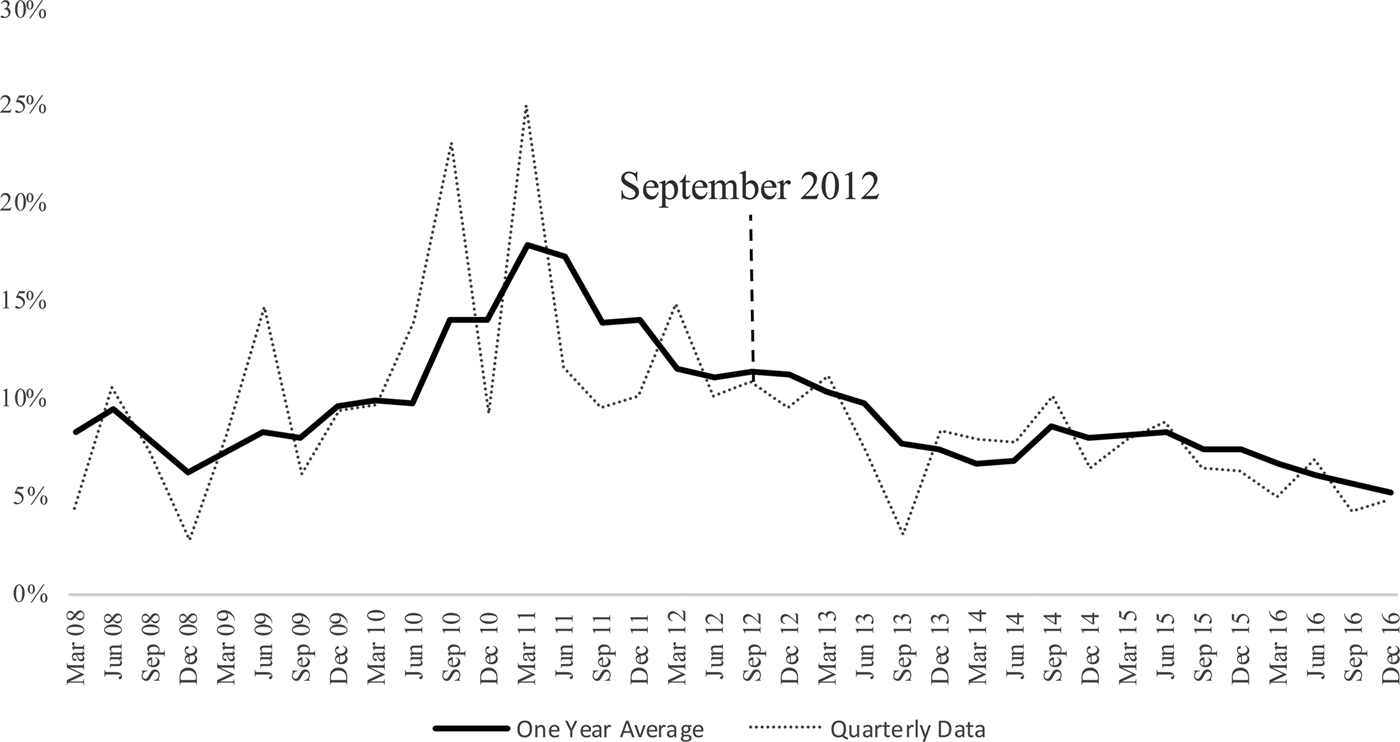
The 2012 protests witnessed a number of attacks on Japanese-branded stores, products and factories, and as such might be expected to lead to localized economic consequences for trade and FDI. Contemporary statements by analysts and prominent officials highlighted the risk to Japanese companies and to the Japanese economy. The Guangzhou Automobile Group Company, for example, reported on 11 September 2012 that 1,800 cars were damaged during the protests, and analysts reported a 30 per cent decline in sales for Japanese car brands in September.Footnote 51 A warning on 3 October by the ratings agency Standard & Poor predicted that prolonged tensions between China and Japan could hurt the Japanese economy and damage the credit ratings of Japanese companies doing business in China.Footnote 52 Figure 1 shows that annual Japanese FDI to China fell in 2012 and 2013 but was also trending downwards in 2011. We do not focus on the consequences of tensions and nationalist protests at the country level. Instead, we test the local economic harm hypothesis that protests had localized economic consequences:
The 2012 anti-Japanese protests had negative local economic consequences.
Share of Japanese FDI to China (Balance of Payment Data)

Data
Protest data
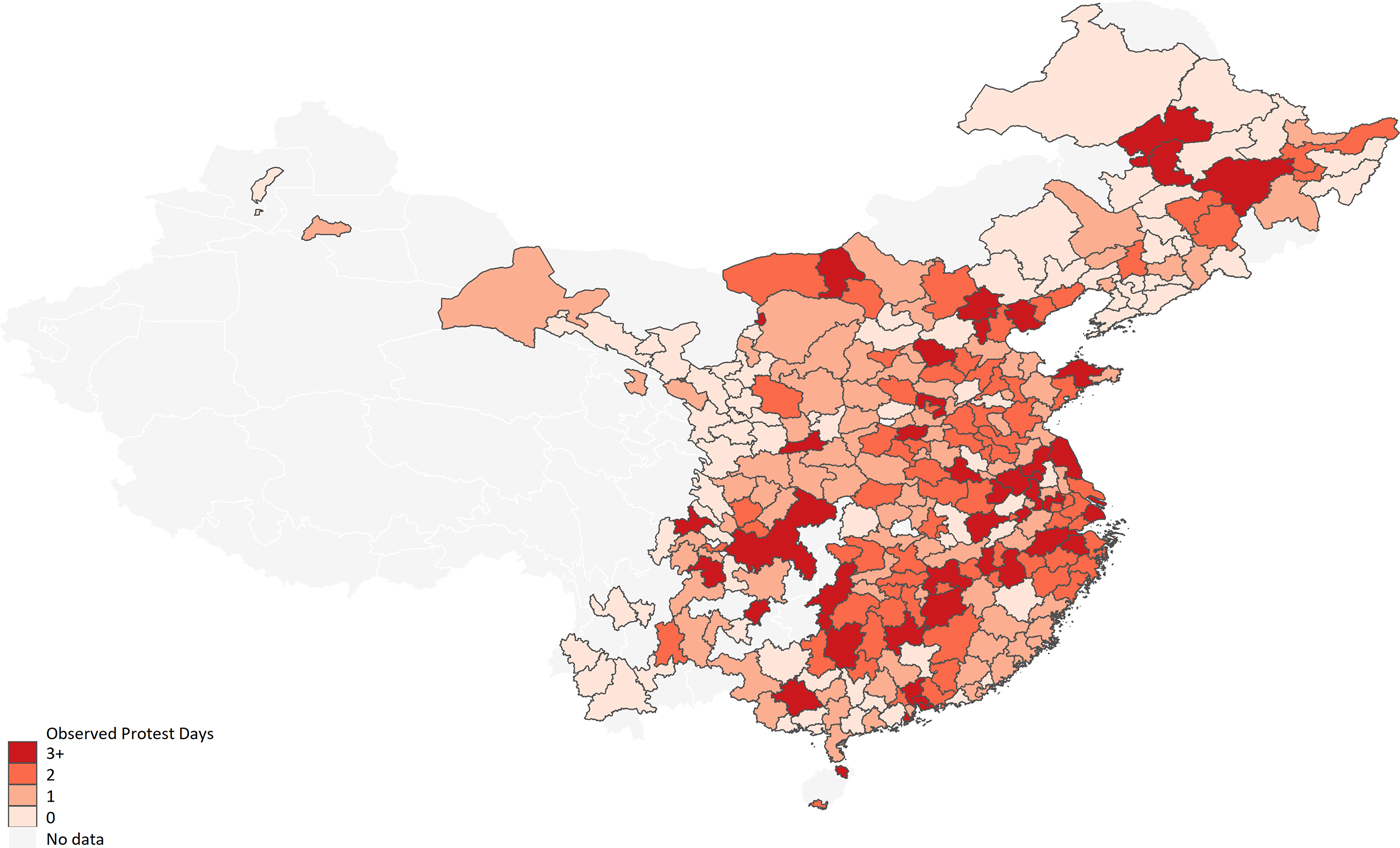
To better understand the consequences of China's 2012 anti-Japanese protests, we rely on an original dataset of 377 anti-Japanese protests across 208 of 287 Chinese cities at the prefectural level or above. This dataset was collected primarily between January and July 2013 via systematic internet searches including social media.Footnote 53 Figures 2 and 3 show the distribution of protests over time and across cities.
Daily Protest Counts

Geographic Distribution of Protest Events
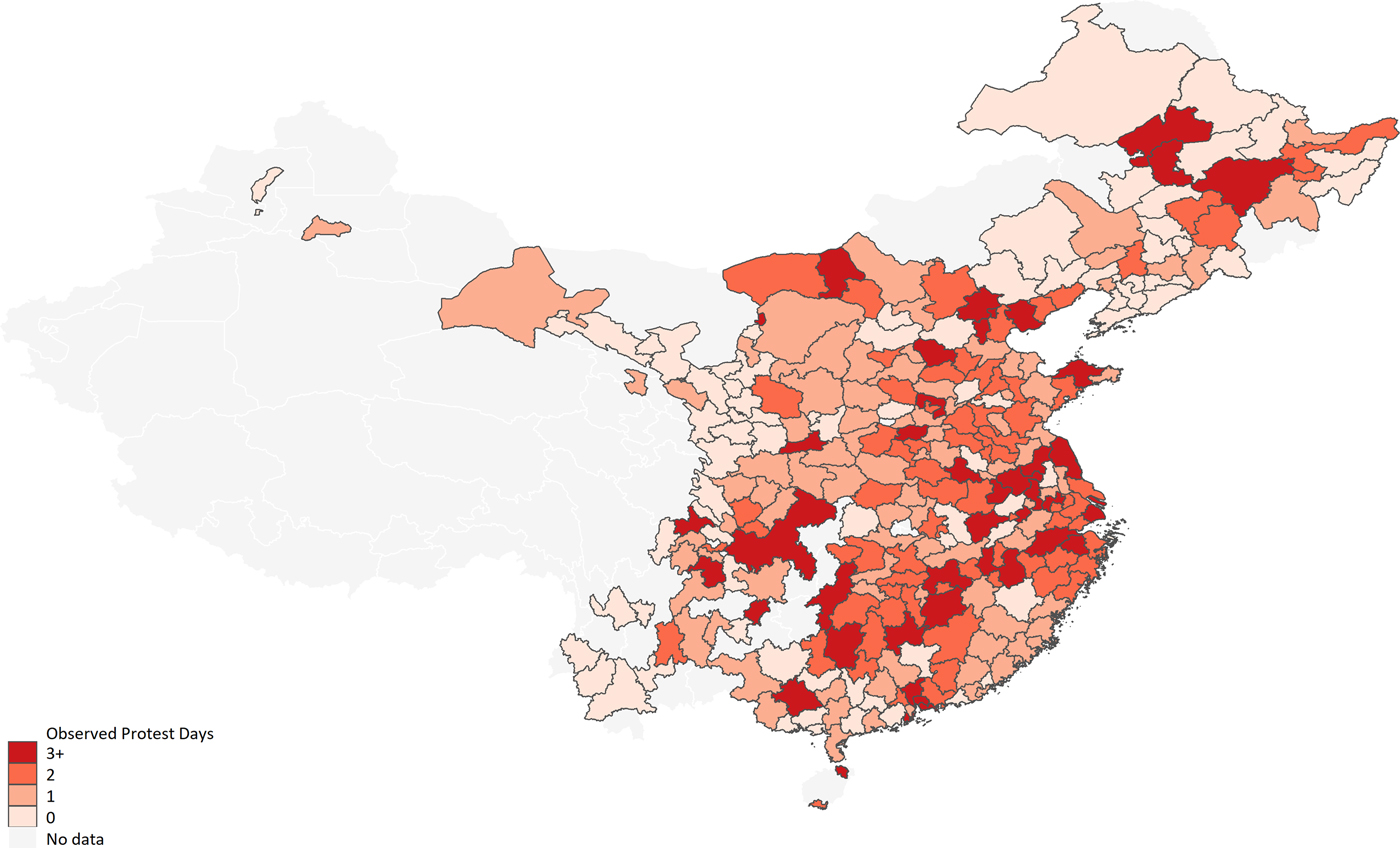
Protests in the dataset are coded by day, and in the analysis that follows, we analyse the protests either by the observed number of days of protests or by when they occurred. An important distinction is made between protests that occurred during the relatively spontaneous and unscripted early period (15 August–14 September) and the second period of more carefully managed protests (15–18 September). This second period saw the highest volume of protests and is denoted as the “peak” period of protests. Because we expect that city leaders are more likely to face negative consequences for protests occurring before 15 September, we rely on this periodization in our analysis of the political consequences of protests. Because we expect that this distinction is less relevant to foreign investors than the total volume of reported protests, we rely on the number of days of protests observed in our analysis of the economic consequences of protests.
Biographical data
To examine whether protests had consequences for the careers of the local officials who oversaw them, we built a second dataset of biographical data for the Party secretaries of each of the cities in the protest dataset. This dataset captures career information on every official who was a city Party secretary during the protest period, including the official's date of birth, ethnic minority status, start date for their 2012 position, the date of the next career change (if any), and a manually coded measure of the relative status of their next position relevant to the 2012 position, taking into account the many potential career paths open to officials at these levels.Footnote 54
To assess the political consequences of nationalist protest, we follow the basic research design of Li and Zhou, coding the change or non-change in each leader's position on an annual basis.Footnote 55 Unlike Li and Zhou, we distinguish between cases of non-promotion and cases of lateral transfer or “passing over,” i.e. cases in which leaders are neither promoted nor transferred after holding a given position for three years or more.
An anti-corruption drive initiated in 2013 under President Xi Jinping 习近平 is a potentially serious confounding variable. A total of 28 Party secretaries in the dataset were removed from office because of anti-corruption investigations; these removals and associated investigations complicate our analysis. We assume two possibilities regarding the nature of anti-corruption investigations. First, it is possible that officials who are less capable of maintaining social stability may also be more likely to be swept up in an anti-corruption investigation, which would imply that demotions, non-promotions or cases of removal from office as the result of an anti-corruption investigation should be included in the data. To account for this scenario, we first analyse the full set of observations (models 2.1 and 3.1). Second, it may be that there is no correlation between an anti-corruption investigation and the performance of local leaders, but removal from office as a result of an investigation prevents us from knowing what would have happened to an official's career had it not been for the investigation. In this case, data on removals associated with corruption drives are assumed to be meaningless. We therefore perform a second round of analysis on all person–year observations but exclude career changes (usually removal from office) associated with anti-corruption investigations (models 2.2 and 3.2). Finally, we recognize a third possible scenario in which anti-corruption investigations have implications that begin years before the announcement of an official's removal from office. To account for this scenario, we also analyse a smaller subset of our data that excludes all individuals who were at any time implicated in an anti-corruption investigation (models 2.3 and 3.3).
Economic data
Local officials’ promotion chances are influenced by many factors. As noted, economic performance is considered a crucial measure of successful tenure as a local cadre, so we follow established practice and include GDP, FDI and exports as factors in our model. In addition, these are the outcomes of interest in estimating the economic consequences of nationalist protest. FDI and exports are included as outcomes of interest because existing literature has focused on these as the main international channels of adverse economic effects. Both exports and the attraction of FDI have been central to China's economic development strategy since the 1980s.Footnote 56
Results
In this section, we estimate two effects: the effect of anti-Japanese protests on local economies and the effect of the same protests on officials’ career advancement. Overall, we find that anti-Japanese protests had a significant negative effect on FDI growth at the city level. After controlling for this effect and other standard controls, we find that leaders who presided over anti-Japanese protests during the more spontaneous initial wave of protests were less likely to be promoted in subsequent years. Consistent with expectations, we find no evidence that protests occurring on or after 15 September (the date on which explicit official guidance on protest management was provided to local leaders) led to negative career outcomes for Party secretaries. By controlling for economic variables including growth in GDP and FDI, we demonstrate that the career consequences of protest management are not simply the indirect result of negative economic effects of protest. Finally, to account for the potential endogeneity of early stage protests to local leaders’ political capabilities, we also estimate a bivariate probit instrumental variable model, with similar findings. These results are reported in detail below.
Economic covariates as predictors of protests
Before investigating the economic consequences of the 2012 anti-Japanese protests, it is useful to examine the social and economic correlates of the 2012 protests. In particular, it is important to ask if pre-protest rates of GDP growth, FDI or exports – the three indicators most closely associated with China's economic development model and with the Chinese Communist Party's system of evaluating cadre performance – were associated with increased protest activity. To test this, we estimate a logistic regression model to test for significant associations between these three variables and protests in the early and peak waves. The results are reported in the online Appendix Table 1. Consistent with the findings of Wallace and Weiss, we find no evidence linking relatively low levels of growth in GDP, FDI or exports to anti-Japanese demonstrations, with the exception of 2011 GDP growth, which has a small but significant (P < 0.01) negative association with protest activity in the early wave.Footnote 57
Of interest here, and also in keeping with the findings of Wallace and Weiss, we find student population, patriotic education bases and migrant population are all positively associated with protests either in the early or peak waves.Footnote 58 There is a significant (P < 0.01) association between the size of a city's university student population and the probability of protest activity. This effect is fairly large, with a one standard deviation shift in 2011 (log) university student enrolment resulting in about a 12.4 per cent increase (+/- 4 per cent) in the probability of a protest in the early wave, and about a 10 per cent increase in the probability of a protest during the peak period (also +/- 4 per cent). The presence of patriotic education bases, a proxy for state-led nationalism, predicts protests in the early wave but not in the peak period. Protests during the peak period are also significantly correlated with the share of migrant workers in the population. A one standard deviation increase in the 2011 migrant share of population is associated with about a 10 per cent increase (+/- about 6 per cent) in the probability of protests during the peak period. The share of ethnic minorities in a city's population is negatively associated with protests during this peak wave, with a one standard deviation increase in the minority share of population associated with about a 6 per cent (+/- about 3 per cent) decrease in the probability of protests in the peak wave.
Economic consequences of protests
To test the expectation that anti-Japanese protests have negative economic consequences, we look at pooled city-level economic data from 2013 to 2015 and regress percentage growth in FDI, exports and GDP on the total number of days for which protests were observed for that city in news and social media reports. Percentage growth is used in each model instead of absolute levels or year-on-year differences to minimize the substantial between-case variation resulting from very different sizes and levels of development of Chinese cities.Footnote 59
Our primary dependent variable is a measure of protest intensity in the form of number of days of observed protests. In addition to standard controls, a square term of protest intensity is included to capture decreasing returns or nonlinear effects. Although our measurement of total observed protests is potentially biased towards major cities that receive more news coverage, media coverage is also a crucial conduit for information about protests to current and potential foreign investors or buyers of exported goods.
The results support the hypothesis that cities with more anti-Japanese protests saw lower rates of FDI growth in the three years following the protests. The marginal effects of protest intensity on FDI growth are presented in Table 2, with the full results in the online Appendix. At mean levels of population, GDP and other standard covariates, an additional day of protests reduced subsequent rates of FDI growth by 6.45 per cent (+/- about 3 per cent). There is no evidence of a negative effect of protests on exports or GDP growth.
Effects of Protests on Growth in FDI, Exports and GDP

Notes:
Marginal effects at mean values based on OLS regression. Standard errors in parentheses. *** p < 0.01, ** p < 0.05, * p < 0.1. See also Appendix Table 2.
Career consequences of protests for Party secretaries
We estimate the effect of both GDP growth and protests in the early and peak periods on the probability of subsequent promotion. Our analysis differs from Li and Zhou in two significant ways.Footnote 60 First, we estimate the probability of each career outcome with a multinomial logit model rather than an ordered probit model. A multinomial logit model is justified because there is not necessarily a clear rank order between the three outcomes, particularly where retirement is warranted on the grounds of age. Second, we include only the first promotion or career change of each official in our dataset. This restriction is necessitated because our dataset is truncated; although most officials in place in 2012 would have been promoted by 2016, few officials would have received a second promotion between 2012 and 2015, the year our dataset ends. However, this approach unfortunately ignores “short hop” promotions, an increasingly common way for local officials to be fast-tracked to high office.Footnote 61
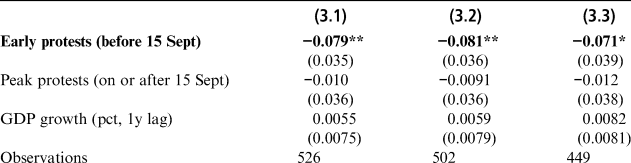
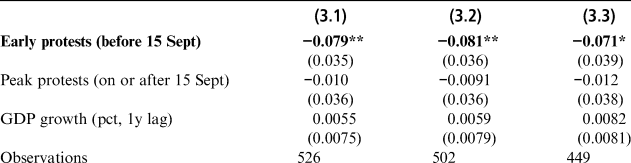
The results of the multinomial logit regression are reported in Tables 3 and 4. Protests in the early wave resulted in a significant (P < 0.05) and substantial (7.7 per cent, +/- 3.3 per cent) decrease in an official's expected probability of promotion. By contrast, we cannot reject the hypothesis that protests during the more organized peak wave (15–18 September) had negligible career consequences for city leaders. That age and tenure have significant and unsurprising consequences for promotion is consistent with expectations and earlier research: younger city leaders have better chances of promotion, and longer tenure in office is significantly correlated with promotion only in the first four years of tenure in office; after that point, excessive tenure in office appears to correlate with poorer evaluations and lower probability of promotion.
Early Protests and Probability of Promotion for Party Secretaries
Notes:
Marginal effects on promotion probability at mean values. Model 3.1 includes all observations. Model 3.2 excludes changes made as the result of anti-corruption investigations. Model 3.3 excludes all individual–year observations associated with officials implicated in anti-corruption investigations. Clustered standard errors in parentheses. *** p < 0.01, ** p < 0.05, * p < 0.1. See also Appendix Table 3.
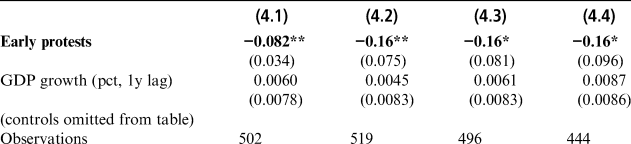
Instrumental Variable Analysis of Early Protests and Promotions

Notes:
Results of probit and bivariate probit models expressed in terms of marginal effects at mean values. Model 4.1 is a probit model with no IV; models 4.2–4.4 are bivariate probit (IV) models; model 4.2 includes all observations; model 4.3 excludes changes owing to the anti-corruption drive; model 4.4 excludes all individual–year pairs associated with officials implicated in anti-corruption investigations. Clustered standard errors in parentheses. *** p < 0.01, ** p < 0.05, * p < 0.1. See also Appendix Table 4.
A potential concern with the models reported in Table 3 is that early wave protests may be correlated with unobserved variables related to local officials’ capabilities. It may be the case, for example, that officials who allowed protests to take place during this early period – before protests had been officially sanctioned by central guidance – were less competent or politically capable than their counterparts in cities where protests did not occur. If true, this would suggest that additional, unobserved factors may have caused both poor evaluations and the breakout of early protests. In this case, a regression reporting a correlation between early period protests and poor career advancement would fail to establish a causal relationship between protests and negative career consequences.
To address this potential concern, we adopt an instrumental variable (IV) strategy. Table 4 reports the results of a bivariate probit model with an endogenous regressor in the second stage, estimated via maximum likelihood.Footnote 62 In the first stage, three instrumental variables are used that predict early protests but are theoretically uncorrelated with leader competence: the log of university student enrolment in 2011, the presence of patriotic bases (a proxy for variations in state-led nationalism) and historical legacies of Japanese occupation. Two of these variables (log student population and state-led nationalism) are shown in the online Appendix Tables 1 and 6 to be significant predictors of early wave protests, and the third is included because it is theoretically justified despite the lack of a significant correlation. All three variables are used as instruments because they predate the arrival of city leaders in place in 2012 and there is no a priori reason to expect that these variables would have any direct effect on city leaders’ prospects for promotion through other causal pathways.Footnote 63 Consistent with our main results, the IV model shows a significant negative effect of early stage protests on officials’ political careers and is reflected in a greater magnitude negative effect (odds ratio).
Conclusion
While national-level analyses continue to debate the effect of nationalist unrest and boycotts on international economic relations, at the subnational level we find both political and economic consequences of China's anti-Japanese demonstrations. Party leaders in cities that had early protests were less likely to be promoted to higher office, consistent with the widely-held but rarely tested expectation that social instability is punished in the Chinese Communist Party's cadre evaluation system. Yet, our results show that not all episodes of social unrest affect local leaders in the same way. Protests that occurred following central guidance on managing nationalist sentiment were not associated with lower rates of promotion, whereas leaders overseeing cities that had protests before this were less likely to be promoted. On the economic front, cities with higher levels of protest intensity during the crisis exhibited lower rates of FDI growth than other cities. However, our analyses suggest that political factors were a more important mechanism than economic factors in influencing career advancement.
This study contributes to our understanding of cadre promotion dynamics. While theoretical debates have centred on performance versus personal or factional connections, empirically the argument has largely revolved around quantitative assessments of the importance of core economic statistics – GDP growth and fiscal revenue – in promotions at different levels in the Chinese hierarchy. Our analysis includes an additional measure of political performance – social unrest – and finds that variation in unrest helps to account for promotion in the years afterwards. While not weighing against the significance of connections or factional politics, the results add further evidence that performance plays a major role in the Chinese political system.
A nuanced assessment of the political content and context of these demonstrations is critical. Our results extend the findings of Braithwaite, Kucik and Maves in showing that particular kinds of domestic political unrest – in our case, anti-foreign demonstrations – have negative repercussions on subsequent FDI.Footnote 64 The political context of such protests in a given city also appears to be critical, with only early protests harming political careers. Such differential results across Chinese cities confirm that timing is everything in politics.
These results do leave unresolved questions. First, why do leaders allow these kinds of disturbances to social stability before receiving explicit guidance from central authorities? Our analysis strongly points to the complexity of the task of local governance inside a political system filled with targets and evaluation categories. Amid often contradictory imperatives, local Party secretaries might have preferred to allow citizens to publicly air complaints about Japan and Japanese actions rather than let them voice local grievances. Officials might reasonably have believed that demonstrations showing nationalist support would not be punished by higher-level authorities, even in the absence of instructions to that effect. Being early, in this case, was not rewarded but punished. Of course, inattention, insufficient bureaucratic preparation and coordination, or poor political judgement could also explain local acquiescence to nationalist mobilization. In such cases, the performance-based promotion system could be said to have worked to keep low performers from ascending the ranks.
Second, are we capturing the direct effect of these nationalist protests or are they correlated with some other variable that might have causal power driving these apparent consequences of the protests? Early protests might correlate with the agent's general poor performance in the eyes of higher-level principals, either through inability or an unwillingness to carry out the tasks as the principals see fit. More narrowly, it is possible that the leaders who allowed protests before receiving central guidance might be likely to allow more social demonstrations generally, and that what we refer to as the consequences of these protests could also be the consequences of other, unobserved social disturbances. A different interpretation could be that allowing early protests against Japan is correlated with local leaders’ own nationalist predispositions, where lower rates of promotion could be seen as part of a drive to weed out local leaders who are seen as too nationalistic or “red.”
Finally, we caution that this kind of statistical analysis of promotion patterns is experienced very differently by the individuals and institutions directly involved. The organization bureau officials in charge of promotions and the evaluation system are unlikely to have based their decisions on the exact models we describe. Some leaders who allowed early protests were promoted; rather than feeling as if they escaped the guillotine, such officials may feel greater confidence in their own performance, and in their decisions to allow protests prior to receiving guidance. On the other hand, leaders removed from the system or stymied in their ascent up the bureaucratic hierarchy are perhaps more likely to engage in counterfactual musings. Regardless, it appears clear that these protests had consequences.
Supplementary material
Supplementary material is available online at https://doi.org/10.1017/S030574101800125X.
Acknowledgment
The authors would like to thank Jennifer Pan, two anonymous reviewers and the participants in the 2016 APSA mini-conference on Chinese politics for their valuable feedback and suggestions. The study was funded with support from the Cornell Institute for the Social Sciences.
Biographical notes
Kevin Foley is a PhD candidate in the department of government at Cornell University.
Jeremy L. Wallace is associate professor of government at Cornell University and the author of Cities and Stability: Urbanization, Redistribution, and Regime Survival in China (Oxford University Press, 2014).
Jessica Chen Weiss is associate professor of government at Cornell University and the author of Powerful Patriots: Nationalist Protest in China's Foreign Relations (Oxford University Press, 2014).