1. Introduction
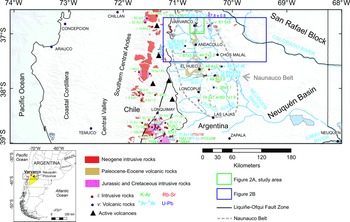
Cordilleran batholiths are large magmatic bodies that result from the accumulation of many smaller plutons, spatially and chemically associated, which may or may not be temporally related. Most of these batholiths are composed of granodiorite and tonalite, such as the Sierra Nevada Batholith (Bateman & Eaton, Reference Bateman and Eaton1967) and the North Patagonian Batholith (Ramos et al. Reference Ramos, Niemeyer, Skarmeta and Muñoz1982). The Patagonian Batholith represents a large granite intrusive complex that extends from 39° to 56° S, and is mainly composed of tonalites (Ramos et al. Reference Ramos, Niemeyer, Skarmeta and Muñoz1982). The main peak of intrusion relates to the development of the North Patagonian Batholith formed in Early Cretaceous time, between 136 and 127 Ma (Pankhurst et al. Reference Pankhurst, Weaver, Hervé and Larrondo1999; Hervé et al. Reference Hervé, Pankhurst, Fanning, Calderón and Yaxley2007), slightly before the onset of Late Cretaceous compression coeval with the Neuquén foreland basin development (Ramos, Reference Ramos and Caminos1999). In addition, in Late Cretaceous–Palaeogene times, the magmatic arc was expanded into the retro-arc region, including the present-day Cordillera del Viento range, by the intrusion of satellite igneous bodies at 130–150 km east of the present arc trend (Hervé et al. Reference Hervé, Pankhurst, Fanning, Calderón and Yaxley2007; Fig. 1).
Regional geological map of the Southern Central Andes. Ages for intrusive and volcanic rocks are listed in online Supplementary Material Table S1. Black rectangle indicates study area (Fig. 2a, b). The Naunauco Belt is marked with a grey dotted line; it comprises both plutonic rocks of Late Cretaceous–Palaeogene age and volcanic rocks of Paleocene–Eocene age. Numbers indicate ages obtained by different methods, as shown in legend.

Here, we study the internal structure of some of these satellite igneous bodies, the Varvarco Intrusives (Varvarco Tonalite, Radales Aplite and Butalón Tonalite) that are exposed in the Varvarco–Butalón region in the Cordillera del Viento (Neuquén Andes; Figs 1, 2a). We applied the anisotropy of magnetic susceptibility (AMS) method, combined with petrographic and mineral chemistry data to define magmatic structures and, thus, to infer magma emplacement mechanisms. The AMS method has been proven to be a very useful tool to study the internal structure of weakly foliated bodies (e.g. Archanjo et al. Reference Archanjo, Launeau and Bouchez1995, Reference Archanjo, Trindade, Bouchez and Ernesto2002; de Saint Blanquat & Tikoff, Reference de Saint Blanquat, Tikoff and Bouchez1997; Ferré & Améglio, Reference Ferré and Améglio2000; McNulty et al. Reference McNulty, Tobisch, Cruden and Gilder2000; Neves et al. Reference Neves, Araújo, Correia and Mariano2003; Žák et al. Reference Žák, Schulmann and Hrouda2005; D’Eramo et al. Reference D’Eramo, Pinotti, Tubía, Vegas, Aranguren, Tejero and Gómez2006; Stevenson, Reference Stevenson2009; Somoza et al. Reference Somoza, Tomlinson, Zaffarana, Singer, Puigdomenech Negre, Raposo and Dilles2015; Nédélec & Bouchez, Reference Nédélec and Bouchez2015; Olivier et al. Reference Olivier, Druguet, Castaño and Gleizes2016; Zaffarana et al. Reference Zaffarana, Somoza, Orts, Mercader, Boltshauser, González and Puigdomenech2017). In particular, the AMS method is relevant for the resolution of magmatic lineations, which are generally hard to measure in the field. The interpretation of the internal structure of plutons and their relationship with the country rock may be classified into three main types: reflecting the internal magma chamber, regional deformation processes (Paterson et al. Reference Paterson, Fowler, Schmidt, Yoshinobu, Yuan and Miller1998), or a combination of both.
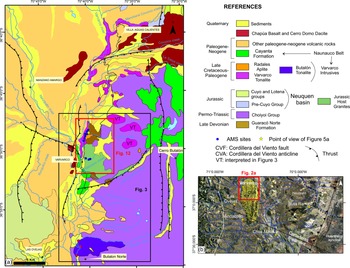
(a) Local and (b) regional maps of the study area. The maps are based on Zanettini et al. (Reference Zanettini, Santamaría and Leanza2001), Ramos et al. (Reference Ramos, Mosquera, Folguera and García Morabito2011), Giacosa et al. (Reference Giacosa, Allard, Foix and Heredia2014) and Sagripanti et al. (Reference Sagripanti, Folguera, Giménez, Rojas Vera, Fabiano, Molnar, Fennell and Ramos2014). Black rectangle indicates the area in Figure 3, and red rectangle indicates the area of Figure 12.

The timing of intrusion with respect to the exhumation of the Varvarco Tonalite and the Butalón Tonalite was also investigated by obtaining apatite fission-track ages for these intrusives. Crustal thickness estimates at the time of magma generation were aided by geochemical data (mineral chemistry for amphibole, plagioclase and biotite), with the aim of developing a model for emplacement and exhumation of the Varvarco Tonalite. Mineral compositions were used to constrain the magma chamber temperature and depth through geothermobarometric analysis (Hammarstrom & Zen, Reference Hammarstrom and Zen1986; Hollister et al. Reference Hollister, Grissom, Peters, Stowell and Sisson1987; Johnson & Rutherford, Reference Johnson and Rutherford1989; Schmidt, Reference Schmidt1992; Holland & Blundy, Reference Holland and Blundy1994; Anderson & Smith, Reference Anderson and Smith1995; Ridolfi et al. Reference Ridolfi, Renzulli and Puerini2010; Ridolfi & Renzulli, Reference Ridolfi and Renzulli2012; Putirka, Reference Putirka2016; Molina et al. Reference Molina, Moreno, Castro, Rodríguez and Fershtater2015, Reference Molina, Cambeses, Moreno, Morales, Montero and Bea2021). The combination of these methods allows us to unravel the history of the Varvarco satellite intrusives, from their emplacement to fast exhumation during the Late Cretaceous–Palaeogene period of the Andean orogeny.
2. Geological and structural framework
The three plutons investigated in this work, the Varvarco Tonalite, the Butalón Tonalite and the Radales Aplite, are located in the Varvarco and Butalón areas (Fig. 2a) and were originally named by Pesce (Reference Pesce1981) as the Varvarco Intrusives. They were later attributed to the Colipilli Formation (Franchini et al. Reference Franchini, López-Escobar, Schalamuk and Meinert2003; Kay et al. Reference Kay, Burns, Copeland, Mancilla, Kay and Ramos2006; Casé et al. Reference Casé, López-Escobar, Danieli and Schalamuk2008), the intrusive part of the volcanic and plutonic Late Cretaceous Naunauco Belt (Llambías & Malvicini, Reference Llambías and Malvicini1978; Zamora Valcarce et al. Reference Zamora Valcarce, Zapata and Ramos2011).
Pesce (Reference Pesce1981) had originally described the Varvarco pluton as a granodiorite body, but the average modal composition that we found in all our sites is more compatible with a tonalitic intrusive. Therefore, we renamed this pluton the Varvarco Tonalite. In the same way, the Radales Granite (Zanettini et al. Reference Zanettini, Santamaría and Leanza2001) is renamed here the Radales Aplite because its general texture is aplitic, typical of subvolcanic igneous bodies.
The Varvarco Tonalite has a K–Ar cooling age (whole-rock) of 64.7 ± 3.2 Ma (J.I.C.A./M.M.A.J., 2000 in Franchini et al. Reference Franchini, López-Escobar, Schalamuk and Meinert2003) and an 40Ar–39Ar cooling age for biotite of 69.09 ± 0.13 Ma (Kay et al. Reference Kay, Burns, Copeland, Mancilla, Kay and Ramos2006). A U–Pb SHRIMP zircon age of 67.8 ± 0.8 Ma was thoroughly documented by Assis (Reference Assis2019); thus, the crystallization age of the Varvarco Tonalite coincides with the K–Ar cooling age. The geochemistry of the Butalón Tonalite was studied by Casé et al. (Reference Casé, López-Escobar, Danieli and Schalamuk2008), who indicated that these igneous rocks are meta- to peraluminous calc-alkaline with low to medium K2O contents, coincidental with I-type granitoids like other granitoids in the area (e.g. Cerro Nevazón; Franchini et al. Reference Franchini, López-Escobar, Schalamuk and Meinert2003). The Radales Aplite is a granophyric granite intruding the Varvarco Tonalite (Zanettini et al. Reference Zanettini, Santamaría and Leanza2001). The Au–Ag veins that intrude the Radales Aplite and Permian and Jurassic rocks were dated by the 40Ar–39Ar stepwise method in adularia and yielded an age of 65.68 ± 0.22 Ma (Zappettini et al. Reference Zappettini, Korzeniewski and Segal2014). These 40Ar–39Ar data indicate that the break between the emplacement of the Varvarco Tonalite and the intrusion of the Radales Aplite was short.
The Varvarco Intrusives crop out in the Cordillera del Viento range in the Neuquén Andes of southwestern Argentina, which is a structurally complex area, with convergence of structures developed during different periods of time. The currently observed structural features in this region were mainly formed between Late Cretaceous and Miocene times (Giacosa et al. Reference Giacosa, Allard, Foix and Heredia2014; Turienzo et al. Reference Turienzo, Sánchez, Lebinson, Dimieri, Folguera, Contreras-Reyes, Heredia, Encinas, Iannelli, Oliveros, Dávila, Collo, Giambiagi, Maksymowicz, Iglesia Llanos, Turienzo, Naipauer, Orts, Litvak, Alvarez and Arriagada2018; Sánchez et al. Reference Sánchez, Coutand, Turienzo, Lebinson, Araujo and Dimieri2018), when the main compressive structures were developed (Fig. 2a, b).
The Cordillera del Viento Fault is one of the main compressional structures formed by the inversion of N–S normal faults that controlled the Late Triassic to Early Jurassic rift sedimentation in the westernmost part of the Neuquén Basin (Vergani et al. Reference Vergani, Tankard, Belotti, Welsink, Tankard, Suárez Soruco and Welsink1995). During the Andean orogeny, in pre-Eocene times, the inversion of the extensional system occurred, and the Cordillera del Viento Fault became a reverse fault that uplifted Palaeozoic rocks to form the Cordillera del Viento Anticline (Giacosa et al. Reference Giacosa, Allard, Foix and Heredia2014).
The core of the Cordillera del Viento Anticline (Giacosa et al. Reference Giacosa, Allard, Foix and Heredia2014) exposes a basement of middle Palaeozoic metamorphic rocks (Fig. 2a), grouped together in the Guaracó Norte Formation (Zappettini et al. Reference Zappettini, Méndez and Zanettini1987; Zanettini et al. Reference Zanettini, Santamaría and Leanza2001). These rocks include quartz-rich metasandstones and laminated quartzite layers, with slates towards the top of the sequence which are all cut by numerous quartz and granitic veins (Giacosa et al. Reference Giacosa, Allard, Foix and Heredia2014). The sedimentary protolith is characterized by rhythmic alternation of sandstone and pelite layers showing current ripples (Giacosa et al. Reference Giacosa, Allard, Foix and Heredia2014). The age of the Guaracó Norte Formation is Late Devonian, considering a maximum depositional age, based on the youngest peak of 369 ± 5 Ma (younger than 374 Ma and older than 326 Ma, U–Pb SHRIMP dating of detrital zircon; Zappettini et al. Reference Zappettini, Chernicoff, Santos, Dalponte, Belousova and McNaughton2012).
The Carboniferous sedimentary rocks of the Cordillera del Viento crop out south of the study area, near the Andacollo locality (Fig. 2b), and they are grouped into the Andacollo Group (Digregorio, Reference Digregorio and Leanza1972; Digregorio & Uliana, Reference Digregorio, Uliana and Turner1980; Llambías et al. Reference Llambías, Leanza and Carbone2007). Volcanic and plutonic facies from the Permo-Triassic Choiyoi Group (Stipanicic, Reference Stipanicic1966; Digregorio, Reference Digregorio and Leanza1972) crop out in the Cordillera del Viento. In the Varvarco area, the Choiyoi Group is composed of two sections, where andesites and rhyolites predominate in the lower and upper sections, respectively (Digregorio, Reference Digregorio and Leanza1972; Zanettini et al. Reference Zanettini, Santamaría and Leanza2001).
An extensional deformation period, associated with Gondwana break-up, is registered for the Cordillera del Viento. This extensional phase initiated N–S-trending and NNE–SSW-trending faults in the northern part of the Cordillera del Viento to E–W-trending faults in the southern part, where interbedded shale strata and ignimbrites with wedge geometry are separated by normal faults (Giacosa et al. Reference Giacosa, Allard, Foix and Heredia2014). Magnetic and gravimetric data, combined with field observations, suggest that Late Triassic rifting in the Cordillera del Viento area would have taken place in a regional WNW–ESE to NW trend, with minor local NE-trending structures (Sagripanti et al. Reference Sagripanti, Folguera, Giménez, Rojas Vera, Fabiano, Molnar, Fennell and Ramos2014). Magnetic data revealed that basement rocks are segmented by nearly orthogonal structures (Sagripanti et al. Reference Sagripanti, Folguera, Giménez, Rojas Vera, Fabiano, Molnar, Fennell and Ramos2014).
Between the Late Triassic and Cenozoic periods, the Neuquén Basin (Fig. 1) developed between 32° and 40° S (e.g. Howell et al. Reference Howell, Schwarz, Spalletti, Veiga, Veiga, Spalletti, Howell and Schwarz2005). During Jurassic and Early Cretaceous times, the Palaeo-Pacific Ocean transgressions produced marine strata that alternated with the deposition of continental sequences in the back-arc setting of this basin, which was affected by thermal subsidence (Legarreta & Uliana, Reference Legarreta, Uliana and Macdonald1991; Vergani et al. Reference Vergani, Tankard, Belotti, Welsink, Tankard, Suárez Soruco and Welsink1995; Howell et al. Reference Howell, Schwarz, Spalletti, Veiga, Veiga, Spalletti, Howell and Schwarz2005; Arregui et al. Reference Arregui, Carbone and Leanza2011).
On the eastern flank of the Cordillera del Viento, the Lower to Upper Jurassic syn-rift deposits of the early phase of the Neuquén Basin crop out, characterized by variable thicknesses and normal fault associations (Sagripanti et al. Reference Sagripanti, Folguera, Giménez, Rojas Vera, Fabiano, Molnar, Fennell and Ramos2014). The Pre-Cuyo Group (Hettangian–Sinemurian) is represented by the Cordillera del Viento and Milla Michicó formations (Gulisano et al. Reference Gulisano, Gutiérrez Pleimling and Digregorio1984; Riccardi & Stipanicic, Reference Riccardi, Stipanicic, Stipanicic and Marsicano2002). The Jurassic Cuyo and Lotena groups crop out in the northeastern corner of the studied area (Suárez & de la Cruz, Reference Suárez and de la Cruz1997; Leanza et al. Reference Leanza, Llambías and Carbone2005; Llambías et al. Reference Llambías, Leanza and Carbone2007; Fig. 2).
We discovered that an igneous body, previously assigned to the Radales Aplite, has an Early Jurassic age (185 ± 3 Ma). This aplite is here referred to by the informal designation Jurassic Host Granites (Figs 2a, 3a, b). These felsic intrusives are coeval with the Pre-Cuyo Group. The provisional name highlights that they are a part of the host rocks for the Late Cretaceous granites studied in this work.
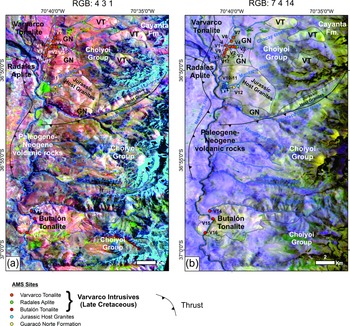
ASTER images of the study area: (a) RGB: 4 6 1 and (b) RGB: 7 4 14. VT – Varvarco Tonalite; GN – Guaracó Norte Formation.

As mentioned in Section 1, the Andean orogeny was mainly active in the Cordillera del Viento region between Late Cretaceous and Miocene times. The Andean orogeny reactivated Late Triassic WNW–ESE to NW and NE-trending normal structures (Giacosa et al. Reference Giacosa, Allard, Foix and Heredia2014; Turienzo et al. Reference Turienzo, Sánchez, Lebinson, Dimieri, Folguera, Contreras-Reyes, Heredia, Encinas, Iannelli, Oliveros, Dávila, Collo, Giambiagi, Maksymowicz, Iglesia Llanos, Turienzo, Naipauer, Orts, Litvak, Alvarez and Arriagada2018; Sánchez et al. Reference Sánchez, Coutand, Turienzo, Lebinson, Araujo and Dimieri2018). Sánchez et al. (Reference Sánchez, Coutand, Turienzo, Lebinson, Araujo and Dimieri2018) reported zircon (U–Th)/He thermochronological ages of from 72.2 ± 2.8 Ma to 66.0 ± 6.1 Ma, and the apatite fission-track ages are 51.7 ± 3.2 Ma and 56.5 ± 10.7 Ma for exhumation in the Chos Malal fold-and-thrust belt. The WNW–ESE- and NW-trending structures acted as transfer zones, whereas the NE-trending ones acted as frontal contractional structures (Sagripanti et al. Reference Sagripanti, Folguera, Giménez, Rojas Vera, Fabiano, Molnar, Fennell and Ramos2014). The N–S-trending structures have been interpreted as the result of Andean deformation, as these contractional structures are not related to the rifting architecture and cross-cut the depocentres (Sagripanti et al. Reference Sagripanti, Folguera, Giménez, Rojas Vera, Fabiano, Molnar, Fennell and Ramos2014; Giacosa et al. Reference Giacosa, Allard, Foix and Heredia2014). The studies concluded that Andean crustal shortening caused the formation of the N–S-trending faults and thrusts, and associated folds, as well as W–E- to WNW–ESE-trending strike-slip structures. The latter are regarded as lateral structures that control the N and S propagation of the Andean thrusts.
During the Andean compressive stage in middle Cretaceous time and slightly after, volcanic rocks of the Cayanta Formation (Rapela & Llambías, Reference Rapela and Llambías1985) were extruded, and subvolcanic magmatic bodies were emplaced into a satellite position with respect to the present magmatic arc in Late Cretaceous–Palaeogene times (Llambías & Rapela, Reference Llambías and Rapela1989; Franchini et al. Reference Franchini, López-Escobar, Schalamuk and Meinert2003; Cobbold & Rossello, Reference Cobbold and Rossello2003; Hervé et al. Reference Hervé, Pankhurst, Fanning, Calderón and Yaxley2007; Zamora Valcarce, Reference Zamora Valcarce2007; Llambías & Aragón, Reference Llambías and Aragón2011; Spagnuolo et al. Reference Spagnuolo, Folguera, Litvak, Rojas Vera and Ramos2012; Figs 1, 2a).
3. Analytical methods
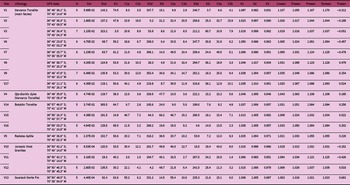
Field studies were carried out in the area of the Varvarco, Radales and Butalón plutons, and their host rocks, resulting in 23 thin-sections for petrographic studies. The AMS study was performed on 17 sites, of which nine sites belong to the Varvarco Tonalite, three sites to the Butalón Tonalite, one site to the Radales Aplite, three sites to the Jurassic Host Granites and one site to the Guaracó Norte Formation. A portable rock drill for palaeomagnetic sampling was used. From each site we collected at least five orientated cylinders, summing up to a total of 95 specimens (Table 1). The cylinders were orientated using solar and magnetic compasses. Sites are presented in Table 1; their distribution is located along roads and creeks (Fig. 2a).
AMS sites of the Varvarco, Radales and Butalón plutons, Jurassic Host Granites and Guaracó Norte Formation

GPS data is given in latitude and longitude. N is the number of samples used in statistics. Km = (K1 + K2 + K3)/3 is the mean magnetic susceptibility (SI units). L is the magnetic lineation (K1/K3); F is the magnetic foliation (K2/K3); P is the degree of anisotropy (Jelinek, Reference Jelinek1981); T = (lnF − lnL)/(lnF + lnL) is the Jelinek’s parameter (Jelinek, Reference Jelinek1981). K1, K2 and K3 are mean AMS eigenvectors, which represent the maximum, intermediate and minimum susceptibility intensities, respectively. Dec – declination in degrees; Inc – inclination in degrees; C1a and C1b are the semiangles of the major and minor axes of the 95 % confidence ellipse, respectively, calculated by the bootstrap method.
The high elevation of the Cordillera del Viento region makes it difficult to map the exact morphology of the Varvarco, Radales and Butalón igneous bodies. ASTER level 1B data were used to complement the mapping of the plutonic bodies (Fig. 3a, b). The studied geological units at 1:200 000 scale are presented in Figures 2a and 3a, b. Their recognition in ASTER satellite images was possible through combining two false-colour RGB compositions (RGB: 4 3 1 and RGB: 7 4 14), as shown in Figures 3a and b, respectively. False-colour RGB composition 7 4 14 is useful to discriminate rocks with different silica contents. In the map shown in Figure 3b the orange/yellow regions correspond to felsic litho-units that are richer in quartz, as shown by the diagnostic SiO-bond spectral absorption at 10.30–11.70 µm (Clark, Reference Clark and Rencz1999; bands 13–14 in ASTER).
3.a. Anisotropy of magnetic susceptibility (AMS)
An MFK1-B Kappabridge susceptibilimeter, located at the IGEBA, CONICET, Argentina, was used to perform the AMS measurements. A minimum of five specimens per site were used (Jelínek, Reference Jelínek1978, Reference Jelinek1981) to obtain the AMS ellipsoids (with principal axes K1 > K2 > K3) with the programs ANISOFT 4.2 (Chadima & Jelinek, Reference Chadima and Jelinek2009).
The rock magnetic fabric is defined by the three principal axes of the AMS ellipsoid (K1 > K2 > K3; Bouchez, Reference Bouchez2000). A magnetic lineation is defined parallel to K1. A magnetic foliation is the plane containing K1 and K2, with K3 being the pole to foliation. The magnetic lineation is parallel to the structural lineation (stretching or flow), and the magnetic foliation is parallel to the structural foliation (flattening or flow; Borradaile & Henry, Reference Borradaile and Henry1997). However, sometimes this relationship may be obliterated by fabric overprinting or by the presence of single-domain magnetite (e.g. Rochette et al. Reference Rochette, Jackson and Aubourg1992, Reference Rochette, Aubourg and Perrin1999; Borradaile & Henry, Reference Borradaile and Henry1997).
The domain state of magnetite was studied using the diagram of Day et al. (Reference Day, Fuller and Schmidt1977), which was constructed with the Hc, Ms and Mr (coercive force, saturation magnetization and remanent magnetization, respectively) hysteresis parameters, together with the remanent coercive force Hcr (obtained from the backfield curve; Bouchez, Reference Bouchez2000). Anhysteretic remanence measurements (Somoza et al. Reference Somoza, Tomlinson, Zaffarana, Singer, Puigdomenech Negre, Raposo and Dilles2015) were also performed in some representative samples to check the coaxial behaviour of the ferromagnetic and paramagnetic fabric of the rocks.
The minerals that control the magnetic fabric were investigated by hysteresis curves, isothermal remanent magnetization and backfield analyses in six representative samples (four from the Varvarco Tonalite and two from the Jurassic Host Granites). The anisotropy of anhysteretic remanent magnetization (AARM; e.g. Somoza et al. Reference Somoza, Tomlinson, Zaffarana, Singer, Puigdomenech Negre, Raposo and Dilles2015) was applied in three sites. Measurements were performed in the Department of Earth and Environment Sciences, Ludwig-Maximilians University in Munich, using equipment called a ‘SushiBar’ (Wack & Gilder, Reference Wack and Gilder2012).
3.b. Apatite fission-track dating (AFT)
Apatite fission tracks (AFT) from samples VAR5 from the Varvarco Tonalite and BU4 from the Butalón Tonalite were analysed in the LA.TE. ANDES laboratory (https://www.lateandes.com), Salta, Argentina. Both apatite fractions were obtained by mechanical separation, magnetic separation (Frantz isodynamic separator) and heavy liquid treatment (LTS and diiodomethane). Approximately 100 apatite crystals for each sample were then mounted in epoxy. In general, the apatite crystals are subhedral to euhedral, and fractured. The mounted samples were polished and then leached under nitric acid (HNO3) 5.5 N for 20 seconds at 20 °C to reveal spontaneous tracks. The samples were then irradiated with the External Detector in the RA-3 Reactor (Centro Atómico Ezeiza, Buenos Aires, Argentina). The irradiation process took place over 76 hours, with a fluency of 7 × 10¹⁵ n cm−2. After the decay period in the reactor, the batch was sent back to the LA.TE. ANDES S.A. laboratory for the fission-track measurements. Overall, ∼35 grains were used for measurements with a surface greater than 600 μm2. Areas with obvious crystallographic dislocations were avoided.
All measurements were made with a Zeiss AXIO Imager Z2m binocular microscope. The system is equipped with the TrackWorks Autoscan software, which carried out the counting of the tracks and determination of other parameters, such as fission-track etch pit diameter (Dpar). The ages were determined with the ζ value method from Hurford & Green (Reference Hurford and Green1982, Reference Hurford and Green1983) and Wagner et al. (Reference Wagner, Altherr and Van den haute1992). Data processing was done using Trackkey software (Dunkl, Reference Dunkl2002) that allowed age calculation. The uncertainty on obtained ages is reported at the 1–2 σ level (Fig. 15a, b).
3.c. Electron microprobe analysis
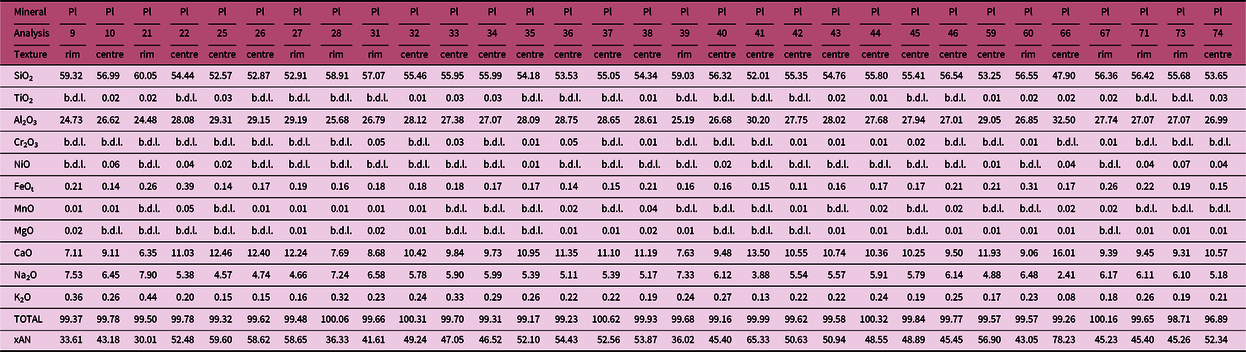
Electron microprobe analysis of major-element concentrations was performed at the Technical-Scientific Services of Oviedo University (Spain) using a Cameca SX-100 electron microprobe with a voltage of 15 kV, current of 15 nA and acquisition time of 10 s per element, in WDS mode. Silicates and oxides were used for calibration. The standards of the Bureau de Recherches Geologiques et Minières (BRGM) were used to refine the results. The obtained mineral compositions are presented in Table 2.
Plagioclase compositions analysed by electron microprobe in the Varvarco Tonalite

b.d.l. – below detection level
Amphibole compositions analysed by electron microprobe in the Varvarco Tonalite

b.d.l. – below detection level
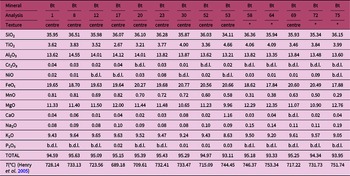
Biotite compositions analysed by electron microprobe in the Varvarco Tonalite

* Small crystal included in amphibole. b.d.l. – below detection level
Temperatures are calculated with the geothermometer of Henry et al. (Reference Henry, Guidotti and Thomson2005).
4. Results
4.a. ASTER data, field observations and petrography
As stated earlier in the text, the Varvarco Intrusives are composed of the Varvarco Tonalite, Radales Aplite and Butalón Tonalite. The Varvarco Tonalite and Radales Aplite are a part of a composite intrusion of ∼10 km diameter. The Varvarco Tonalite is located in the outer region; the Radales Aplite forms a small stock along the Chacay creek (Fig. 3a, b). These units intrude the rocks of the Guaracó Norte Formation and the Jurassic Host Granites. ASTER data suggest that the shape of the Varvarco pluton is broadly circular, with a typical normal zoning pattern, more felsic towards the centre of the intrusion, if we consider that the Radales Aplite is located towards the centre of the Varvarco Tonalite.
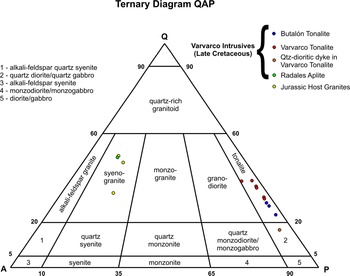
The shape of the Butalón Tonalite is more irregular; the body has a length of 8 km and is elongated in an E–W direction (Fig. 3a, b). The similar response of pink colours in RGB composition 4 3 1 (Fig. 3a) and yellow (Fig. 3b) in RGB composition 7 4 14 of the Butalón Tonalite to the Varvarco Tonalite reflects the same composition. The results of the petrographic analysis are shown in the QAP diagram (Fig. 4) and a detailed description of the outcrops visited in the field is presented below.
QAP ternary diagram for the Varvarco Intrusives and Jurassic Host Granites.

4.a.1. Guaracó Norte Formation
The Guaracó Norte Formation, representing the host rock of the Varvarco Tonalite and Radales Aplite, was investigated along the Chacay, Matancilla, Manzano and Guaracó Norte creeks (Figs 2a, 3a, b, 5a). This formation comprises quartzites affected by low-grade metamorphism. Generally, the metamorphic foliation has a NE–SW to N–S strike and steep dip (80°); steep inclinations were also measured close to the contact with the Varvarco Tonalite. In the Guaracó Norte creek, shales and phyllites strike N–S and have a low dip (22°) towards the east. The pelitic rocks and sandstones of this formation are affected by hornblende-hornfels metamorphism that led to the development of andalusite, biotite, diopside and hornblende. This has been related to the intrusion of the Late Cretaceous Varvarco Tonalite (Giacosa et al. Reference Giacosa, Allard, Foix and Heredia2014).
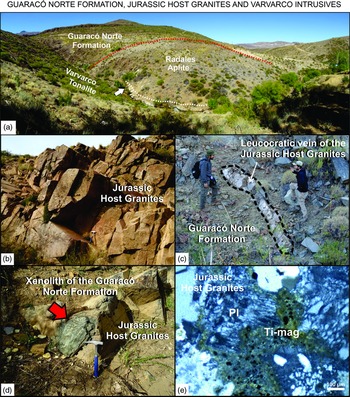
Outcrops of the Guaracó Norte Formation, Jurassic Host Granites and Varvarco Intrusives. (a) View towards the SE from Puesto Hernández, Chacay creek area, with the outcrops of the Varvarco Tonalite, Radales Aplite and the Guaracó Norte Formation. (b) Outcrops of the Jurassic Host Granites in the Manzano creek area. (c) Leucocratic dyke assigned to the Radales Aplite in the Manzano creek area. (d) Xenolith of Guaracó Norte Formation in the Jurassic Host Granites. Length of hammer for scale is 33 cm. (e) Plagioclase phenocrysts in granophyric matrix for the Jurassic Host Granites (cross-polarized light).

4.a.2. Jurassic Host Granites
Along the Manzano and Guaracó Norte creeks we discovered a new unit at site V12 (Figs 2a, 3a, b, 5b–e), which we tentatively name the Jurassic Host Granites because it has a 182 ± 3 Ma U–Pb age that was obtained by laser ablation multi-collector inductively coupled plasma mass spectrometry on 12 magmatic zircon crystals (unpub. data). This unit was previously described by Zanettini et al. (Reference Zanettini, Santamaría and Leanza2001) as part of the Radales Aplite (formerly considered the Radales Granite, see Section 4.a.5). The U–Pb geochronology data of the Jurassic Host Granites are part of a work in progress.
The Jurassic Host Granites enclose xenoliths derived from the Guaracó Norte Formation (Fig. 5d). Dykes of granitic composition that intrude the Guaracó Norte Formation in the Manzano creek (36° 50′ 42.1″ S; 70° 40′ 14.0″ W; site V10 in Table 1) can be assigned to the Jurassic Host Granites as well (Fig. 5c). The Jurassic Host Granites have the same syenogranitic composition (Fig. 4) and graphic texture (Fig. 5e) as the Radales Aplite, making it difficult to differentiate them in the field.
4.a.3. Varvarco Tonalite
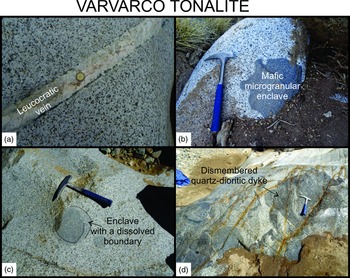
Along the Matancilla and Chacay creeks, the Varvarco Tonalite can be observed in excellent exposures (Figs 2a, 5a, 6a–d), which include the contact relationships with the Guaracó Norte Formation host rock and with the intruding Radales Aplite (Fig. 5a). The Varvarco Tonalite is represented by medium- to fine-grained, equigranular to porphyritic tonalites, in which mafic minerals appear concentrated in blocks (Fig. 6a, b). The Varvarco Tonalite also hosts microgranular enclaves of dioritic composition (Fig. 6b–d). They have a fine-grained, equigranular texture and are composed of amphibole, biotite, plagioclase, quartz and opaque minerals. The mafic magma was mixed and partially hybridized, as the enclaves show transitional contacts with the host rock (Fig. 6c). Enclave swarms that grade into disintegrated mafic dykes with different hybridization degrees were also observed (Fig. 6d).
Outcrop images of the Varvarco Tonalite. (a) Thin leucocratic vein intruding the Varvarco Tonalite in the Chacay creek area. Diameter of coin for scale is 2.3 cm. (b) Mafic microgranular enclave. (c) Partially dissolved (corroded) enclave in a hybrid magma of the Varvarco Tonalite. (d) Disintegrated quartz-dioritic dykes in the Varvarco Tonalite, where different degrees of hybridization are observed. Length of hammer for scale is 33 cm.

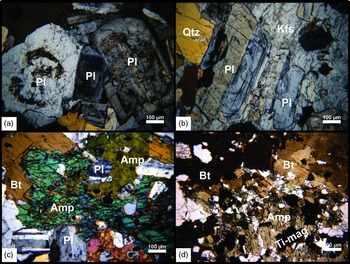
The average modal composition of the Varvarco Tonalite is plagioclase (50 %), quartz (30 %), orthoclase (4 %), amphibole (10 %), biotite (5 %), and titanomagnetite, titanite, apatite and zircon (1 %). Plagioclase crystals are subhedral with complex zoning patterns (Fig. 7a). Incipient sericitic alteration of plagioclase is observed in concentric areas. The observed orthoclase phenocrysts have an oikocrystic texture with amphibole and plagioclase inclusions (Fig. 7b). Amphibole is present as subhedral poikilitic megacrysts of nearly 2 cm length that contain plagioclase inclusions. In some areas these large amphibole crystals give the rocks a porphyritic appearance. Subhedral biotite is pleochroic from light to dark brown, and mostly fresh (Fig. 7c, d). Quartz is interstitial and contains inclusions of amphibole. Apatite is frequently acicular. All observed textures are magmatic; grain boundaries are straight, especially between plagioclase and orthoclase (Fig. 7b). Locally, polygonal contacts between quartz grains are observed, suggesting that static recrystallization has occurred.
Petrographic images of the Varvarco Tonalite in cross-polarized light. (a) Plagioclase (Pl) with cores of more calcic composition and lighter rims of more sodic composition. (b) Euhedral plagioclase crystals included in anhedral K-feldspar (Kfs; orthoclase) crystals. (c) Euhedral plagioclase and subhedral amphibole (Amp) and biotite (Bt). (d) Biotite, amphibole and titanomagnetite (Ti-mag) concentrated in blocks in the Varvarco Tonalite. Other mineral abbreviations: Qtz – quartz.

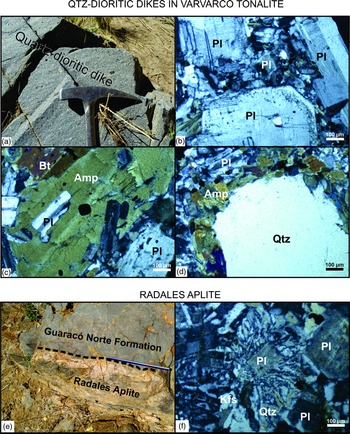
Late aplitic veins of granitic composition (Fig. 6a) intrude the Varvarco Tonalite in the Chacay creek area (orientations: 285°/75° ENE, 320°/65° ENE). Disintegrated porphyritic quartz-dioritic dykes also cross-cut the Varvarco Tonalite in the Chacay creek area (Fig. 8a). The dykes have poikilitic amphibole and plagioclase phenocrysts in a granular groundmass that is composed of plagioclase, amphibole, biotite, quartz and opaque minerals (Fig. 8b). Amphibole has inclusions of plagioclase and rounded quartz (Fig. 8c). Quartz ‘ocelli’ with reaction rims of amphibole and opaque minerals were occasionally observed (Fig. 8d).
Quartz-dioritic dykes intruding the Varvarco Tonalite and Radales Aplite. (a) Fine-grained texture of a quartz-dioritic dykes. Width of hammer head for scale is 17.5 cm. (b) Plagioclase phenocrysts in a fine-grained matrix mainly composed of plagioclase. (c) Amphibole phenocryst with inclusions of plagioclase and opaque minerals. (d) Rounded quartz xenocryst rimmed by amphibole and opaque minerals (quartz ocelli). (e) Contact between the Radales Aplite and the hosting Guaracó Norte Formation. Length of pencil for scale is 16 cm. (f) Xenolith of Guaracó Norte Formation in the Radales Aplite. Mineral abbreviations as in Figure 7.

4.a.4. Butalón Tonalite
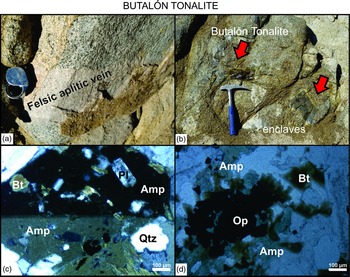
This intrusive body crops out in the Butalón Norte area, ∼15 km to the south of the Varvarco locality (Figs 2a, 3a, b). In the RGB compositions of Figure 3, the Butalón Tonalite is well distinguished from the hosting Permo-Triassic Choiyoi Group. Many granitic dykes and veins of steep to moderate dips and NW to NE strike cross-cut the Butalón Tonalite. They have highly variable widths of between 5 and 50 cm (Fig. 9a). The Butalón Tonalite is classified as a fine-grained tonalitic rock with an average composition of plagioclase (63 %), quartz (23 %), amphibole, biotite (12 %), orthoclase (2 %) and minor euhedral opaque minerals and acicular apatite (Fig. 4). Mafic microgranular enclaves of dioritic composition are present in this facies as well (Fig. 9b). Amphibole (hornblende determined optically) tends to form poikilitic phenocrysts with plagioclase and biotite inclusions (Fig. 9c). Plagioclase has complex zoning and many plagioclase cores are altered to sericite. Orthoclase is interstitial. Opaque minerals, amphibole and biotite are concentrated in blocks (Fig. 9d).
Outcrops and petrographic images of the Butalón Tonalite in cross-polarized light. (a) Felsic aplitic vein intruding the Butalón Tonalite. Length of hand lens for scale is 3 cm. (b) Mafic microgranular enclaves. Length of hammer for scale is 33 cm. (c) Amphibole megacryst with inclusions of plagioclase and biotite. (d) Mafic minerals. Mineral abbreviations as in Figure 7 and Op – opaque minerals.

4.a.5. Radales Aplite
The Radales Aplite crops out only along the Chacay creek (Figs 2a, 5a, 8e). In the satellite image of Figure 3b, the Radales Aplite is shown in yellow owing to its high silica content. The quartz-rich composition of the Guaracó Norte Formation is shown with a very similar colour, making these two units, which were relatively easy to distinguish in the field (red line in Fig. 5a), not clearly separated in terms of composition (Fig. 3b). Therefore, the boundary was highlighted by a dotted line with question marks (Fig. 3a, b).
The contact between the Radales Aplite and the Guaracó Norte Formation is distinctive (Fig. 8e). The Radales Aplite has a fine-grained to aplitic texture and a syenogranitic composition (Fig. 4). Plagioclase phenocrysts (12 %) are immersed in a granophyric matrix formed of quartz (43 %) and orthoclase (40 %) (Fig. 8f). The Radales Aplite is considered a late stage of the Varvarco Intrusives because late leucocratic veins intrude the Varvarco Tonalite (Fig. 6a) and the Butalón Tonalite (Fig. 9a), and these veins could correlate with the small stock cropping out along the Chacay creek (Fig. 5a).
4.b. Plagioclase, amphibole and biotite compositions for the Varvarco Tonalite
Electron microprobe analyses of plagioclase, amphibole and biotite from the Varvarco Tonalite are presented in Table 2.
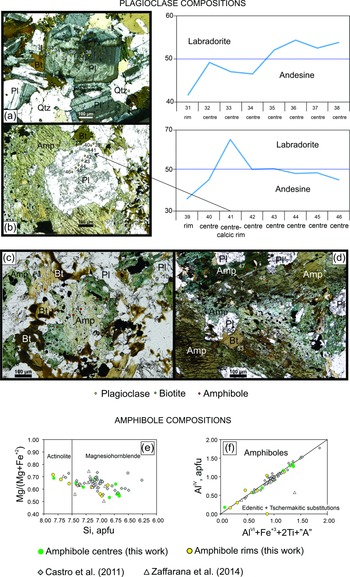
Plagioclase compositions were calculated based on a 32 oxygen formula unit. Plagioclases are labradorite–andesine or andesine (Fig. 10a–c; Table 2a). They show oscillatory zoning with a decreasing anorthite component (An60–30) from core to rim (Fig. 10a). In some profiles, plagioclase shows a slight increase in An45–51 from the core to more external zones and a labradoritic spike of An65 separating an external rim of An45–30 (Fig. 10b). These compositional spikes correspond to the inner rings observed in many crystals of the Varvarco Tonalite (Fig. 7a). In plagioclases included in amphibole, cores with an anorthite content of up to An78 were found.
Plagioclase and amphibole compositional classification. (a, b) Plagioclase zoning profiles for the Varvarco Tonalite. (c, d) Photomicrographs with cross-polarized light showing some analysed spots of amphibole (red), biotite (green) and plagioclase (yellow). (e) Amphibole classification diagrams of Leake et al. (Reference Leake, Woolley, Arps, Birch, Gilbert, Grice, Hawthorne, Kato, Kisch, Krivovichev, Linthout, Laird, Mandarino, Maresch, Nickel, Rock, Schumacher, Smith, Stephenson, Ungaretti, Whittaker and Youzhi1997). (f) AlIV versus AlVI + Fe+3 + 2Ti + ‘A’ graph (Kawakatsu & Yamaguchi, Reference Kawakatsu and Yamaguchi1987) shows that nearly all amphiboles have a good 1:1 fit between vertical and horizontal axes. This suggests that charge compensation due to the introduction of AlIV was accomplished by both the edenitic and tschermakitic substitutions.

Amphibole structural formulae were calculated based on a 23 oxygen formula unit and with all Ca in the M4 site (Dale et al. Reference Dale, Powell, White, Elmer and Holland2005). Calcic amphibole compositions were obtained, with Fet/(Fet + Mg) in the 0.30–0.49 range, and low to moderate TiO2 contents (0.09 to 1.69 wt %, and 0.01 to 0.19 atoms per formula unit (apfu), respectively). Amphibole cores are mostly magnesiohornblende, whereas amphibole rims are magnesiohornblende to actinolite (Fig. 10c–e). All amphiboles balance the Al tetrahedral site occupancy by both tschermakitic and edenitic substitutions (Fig. 10f).
Compositions of fresh biotite are shown in Figure 11. In order to calculate the biotite formula, we used the method of Li et al. (Reference Li, Zhang, Behrens and Holtz2020). Most biotites are eastonites close to the boundary with phlogopites, with only one biotite (sample 53) falling into the siderophyllite field (Fig. 11a). Fet/(Fet + Mg) ratios vary between 0.44 and 0.58, and aluminium contents vary between 13.21 and 14.55 wt % Al2O3 (Table 2c). In the diagram of Foster (Reference Foster1960) and in the trioctahedral Tischendorf et al. (Reference Tischendorf, Gottesmann, Förster and Trumbull1997) diagram, the analysed grains are classified as Mg-biotites (Fig. 11b, c), with biotite from sample 53 falling into the Fe-biotite field (Fig. 11c). In the ternary diagram of Nachit et al. (Reference Nachit, Ibhi, Abia and Ben Ohoud2005), the compositions are compatible with primary and re-equilibrated primary biotites (Fig. 11d). Given that biotite is prone to secondary alteration, Ti was proposed to act as a discriminator, with Ti content <0.55 Ti per 22 oxygen formula unit indicative of fresh magmatic biotite (e.g. Li et al. Reference Li, Chi, Zhou, Deng and Zhang2017). Varvarco biotites contain 2.6–4.66 wt % TiO2, which converts to 0.31–0.56 Ti pfu. Only one biotite grain (sample 53) is above 0.55 Ti apfu, supporting their magmatic origin.
Biotite compositional classification. (a) Biotite classification (AlIV as a function of its Fe/(Fe + Mg) ratio; Deer et al. Reference Deer, Howie and Zussman2013). (b) Biotite discrimination diagram after Foster (Reference Foster1960). (c) Trioctahedrical classification diagram after Tischendorf et al. (Reference Tischendorf, Gottesmann, Förster and Trumbull1997). (d) Ternary diagram for discriminating between primary magmatic biotites and re-equilibrated and secondary biotites after Nachit et al. (Reference Nachit, Ibhi, Abia and Ben Ohoud2005).

4.c. Anisotropy of magnetic susceptibility (AMS)
As was stated in the introduction, AMS studies are used here to evaluate the timing and possible emplacement mechanisms of the Varvarco Intrusives in relation to regional deformation affecting the Cordillera del Viento range. At all investigated sites, the petrofabric was magmatic, with most minerals of euhedral shape, and no evidence of late solid-state deformation. The AMS ellipsoids for the individual sites obtained for each lithology are presented in online Supplementary Material Figure S1a–e. As a usual practice in AMS studies, mineral and magnetic fabrics are assumed to be parallel. This could only be accomplished for site V8, the only site where we could measure the magmatic foliation in the field, whereas sampling in the other sites was carried out in isotropic rocks.
The corrected anisotropy degree Pj value and the shape parameter T (Jelinek, Reference Jelinek1981) can be used to describe the geometry of the magnetic ellipsoid. The general positive correlation between Km and Pj shows that titanomagnetite controls the anisotropy in the three analysed plutonic rocks, at both sample and site scale (online Supplementary Material Figure S1a–f). Most values of the shape parameter T at the site scale lie between −0.5 and 0.5 (online Supplementary Material Figure S1f; Table 1). Thus, the magnetic ellipsoids are predominantly triaxial, with good determinations of K1 and K3 axes corresponding, respectively, to magnetic lineations and poles of foliation planes.
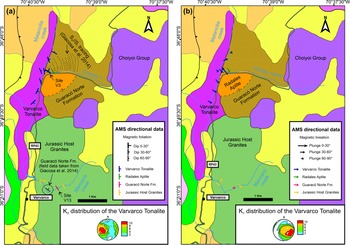
The structural mapping of the Varvarco Intrusives was constructed with the AMS data for each sampling site (magnetic foliation and lineation maps; Fig. 12a, b). The orientation of the metamorphic foliation of the Guaracó Norte Formation taken from Giacosa et al. (Reference Giacosa, Allard, Foix and Heredia2014) was also added to complete the structural map of the host rock in the Varvarco area (Fig. 12a). In this area, the strike of the magnetic foliation planes of the Varvarco Tonalite oscillates between NNW–SSE and NNE–SSW, and they systematically dip steeply to moderately towards the east (online Supplementary Material Fig. S1a; Fig. 12a). In turn, the magnetic foliation of the Radales Aplite and Jurassic Host Granites is steeply dipping as in the Varvarco Tonalite, but the strike of the magnetic foliation of the Jurassic Host Granites is more variable, especially in the Manzano creek area (online Supplementary Material Fig. S1c, d; Fig. 12a). The Guaracó Norte Formation in the area between the Chacay and Matancilla creeks shows steeply dipping metamorphic foliations in a N–S strike direction, changing to a NW–SE strike (Giacosa et al. Reference Giacosa, Allard, Foix and Heredia2014; Fig. 12a). The foliation obtained for site V13 in the Manzano creek has a steeply dipping NNW–SSE strike (online Supplementary Material Fig. S1e; Fig. 12a).
(a) Map showing magnetic foliation planes (K1–K2 planes), defined as the plane perpendicular to K3 in the Varvarco Tonalite. Inset shows K3 distribution of the magmatic foliations. (b) Map showing magnetic lineation (K1 direction) in the Varvarco Tonalite. Inset shows K1 distribution of the magmatic fabrics. The stereonets represent contoured Kamb equal-area lower-hemisphere stereographic projections made with the software Stereonet 9.9.5 (Allmendinger et al. Reference Allmendinger, Cardozo and Fisher2012; Cardozo & Allmendinger, Reference Cardozo and Allmendinger2013). The scale represents Kamb contours in standard deviation.

The average lineations of the Varvarco Tonalite plunge moderately to steeply towards the SE (online Supplementary Material Fig. S1a; Fig. 12b); with one site (V3) with a shallowly plunging lineation trending towards the NW (online Supplementary Material Fig. S1a; Fig. 12b). The lineations of the Radales Aplite and Jurassic Host Granites are more diverse: they plunge moderately towards the SE, but lineations plunging to the NE were also found (online Supplementary Material Fig. S1c, d; Fig. 12b). The lineation found in the Guaracó Norte Formation at site V13 is shallow dipping (online Supplementary Material Fig. S1e; Fig. 12b).
The quartz-dioritic dyke at site V4, belonging to the Varvarco Tonalite, has a steeply dipping NW–SE magnetic foliation plane, parallel to dyke strike (online Supplementary Material Fig. S1a). Magnetic lineation plunges moderately to the SE (online Supplementary Material Fig. S1a).
In the area of Butalón Norte, the Butalón Tonalite has steeply dipping magmatic foliation planes with different attitudes; two sites have an E–W strike (V14 and V16), whereas the remaining site (V15) has a N–S strike (online Supplementary Material Fig. S1b). The magnetic lineation is subhorizontal in the case of site V15, and sub-vertical in the case of sites V14 and V16 (online Supplementary Material Fig. S1b).
4.d. Mean susceptibility and minerals responsible for the AMS ellipsoids
The simple exploration of the nominal value of bulk magnetic susceptibility indicates which are the main minerals controlling the magnetic fabric of rocks (Bouchez, Reference Bouchez2000). The mean magnetic susceptibilities (Km) of the Varvarco Tonalite and the Butalón Tonalite are 38.56 × 10⁻³ SI and 43.57 × 10⁻³ SI, respectively. These values are significantly higher than those for the Radales Aplite of 2.37 × 10⁻³ SI and the Jurassic Host Granites of 20.18 × 10⁻³ SI (averages were taken using the data of Table 1). The Guaracó Norte Formation has an even lower Km of 0.44 × 10⁻³ SI (Table 1). These high bulk susceptibility values, higher than 4 × 10⁻⁴ SI in most of the samples of the Varvarco and Butalón plutons, suggest that the AMS signal is dominated by magnetite (following the method of Bouchez, Reference Bouchez2000; online Supplementary Material Fig. S2a, b). This is consistent with the mineralogy of the studied granitoids.
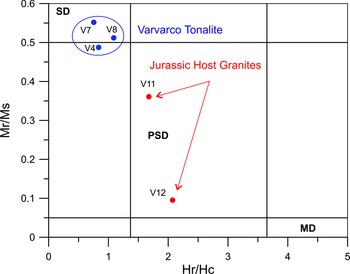
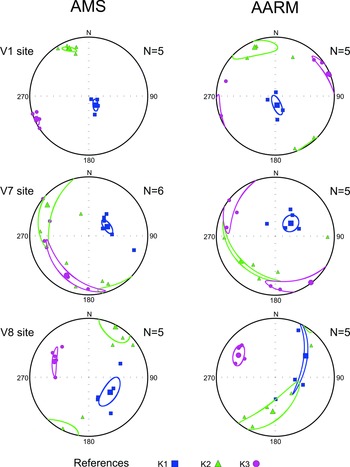
Rock magnetic studies can be used to further constrain which minerals dominate the magnetic anisotropy of the rocks. In particular, it is important to determine the domain state of the magnetite, which is essential for the correct interpretation of the magnetic ellipsoids (Grégoire et al. Reference Grégoire, de Saint Blanquat, Nédélec and Bouchez1995; Borradaile & Jackson, Reference Borradaile and Jackson2010). Therefore, hysteresis loops, the anisotropy of isothermal remanence (AIRM) and backfield curves were performed on the Varvarco Tonalite (online Supplementary Material Fig. S2a) and the Jurassic Host Granites (online Supplementary Material Fig. S2b), all in agreement with the presence of magnetite. Magnetite is mostly of pseudo-single-domain (PSD) type, as is suggested by the diagram of Day et al. (Reference Day, Fuller and Schmidt1977) (Fig. 13). However, two samples from the Varvarco Tonalite have a fine-grained, single-domain (SD) magnetite signature (samples from sites V7 and V8; Fig. 13). Consequently, for these AMS sites, anisotropy of the anhysteretic remanence ellipsoids (AARM) was determined. The coincidence of the AARM and AMS ellipsoids (Fig. 14) further supports that magnetite controls the AMS signal and no axis inversion is necessary owing to the presence of SD magnetite. It can be concluded that the interpretation of the AMS fabric in all sites is direct, as the magnetic lineation coincides with the K1 axis and the pole of the magnetic foliation corresponds to the K3 axis, with the K1 and K3 directions taken from the AMS ellipsoids.
Domain state of the magnetite of the Varvarco Tonalite and Jurassic Host Granites. Diagram of Day et al. (Reference Day, Fuller and Schmidt1977). Hc – coercive force; Hr – remanent coercive force; Ms – saturation magnetization; Mr – remanent magnetization; SD – single-domain; PSD – pseudo-single-domain; MD – multidomain.

Comparison of AMS and of AARM ellipsoids showing that magnetite and paramagnetic minerals have fabrics with the same orientations. Equal-area projection in geographic coordinate system.

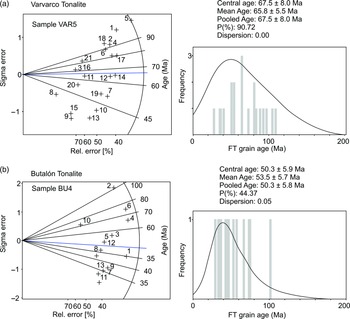
Apatite fission-track data of samples (a) VAR5 and (b) BU4. Diagrams on the left of the figure show the radial distribution of ages of each grain, where the central age is marked in blue. Diagrams on the right show the frequency histogram for obtained ages.

4.e. Apatite fission tracks (AFT) results
Samples VAR5 (36° 48′ 58.7″ S; 70° 40′ 20.2″ W) from the Varvarco Tonalite and BU4 (36° 59′ 03.2″ S; 70° 41′ 24.9″ W) from the Butalón Tonalite were analysed by AFT. For sample VAR5, AFT results were obtained for 21 apatite crystals. In the radial plot, the central age obtained is 67.5 ± 8.0 Ma (Late Cretaceous; Fig. 15a; Table 3), with low dispersion of ages from individual crystals. This sample passed the chi-square test suggesting that there is a sole age distribution (P(χ2) = 90.72 % > 5 %; Galbraith, Reference Galbraith1981; Green, Reference Green1981). From sample BU4, 13 apatite crystals were measured. The central age in the radial plot is 50.3 ± 5.9 Ma (early Eocene), with low age dispersion for individual grains (Fig. 15b; Table 3). The sample also passed the chi-square test (44.37 %), suggesting that the single grain ages have a sole age distribution (P(χ2) = 44.37 % > 5 %).
Apatite fission-track data

Central ages calculated with a calibration of 330.40 ± 20.16 Ma. n – number of measured grains. Ni, Ns and ND - total number of induced, spontaneous and dosimeter fission tracks in the sample respectively. ρs - spontaneous fission track density (x105 cm-2). ρi and ρD - density of fission tracks induced in the samples and in the dosimetric glasses respectively (x106 cm-2) in the external detector (g=0.5).
5. Discussion
5.a. Magma hybridization processes in the I-type Varvarco and Butalón intrusive bodies
According to the field and petrographic observations presented above, we interpreted that the Varvarco and Butalón tonalites are hybridized igneous bodies that have experienced magma mingling-mixing. In the area, the mafic member is represented by the quartz-dioritic dykes, which are intermediate in composition, whereas the felsic member are represented by the Radales Aplite. The intermediate composition of the quartz-dioritic dykes indicates that the hybridization process was strong in the area.
The presence of enclaves with different degrees of hybridization such as enclaves with distinct contacts with the host tonalite (Fig. 6b) or enclaves partially absorbed (corroded) and rimmed by a new hybrid magma (Fig. 6c), and the varied degree of hybridization observed in enclave swarms (Fig. 6d), suggest that the mingling process was progressive. Magmatic flow had possibly favoured the incorporation of heterogeneous enclaves such as those shown in Figure 5c–e (e.g. Bateman, Reference Bateman1995). At higher temperatures, mixing processes are likely to have taken place in the magma chamber. A schematic hybridization trend is shown in Figure 16, based on Barbarin’s (Reference Barbarin2005) model.
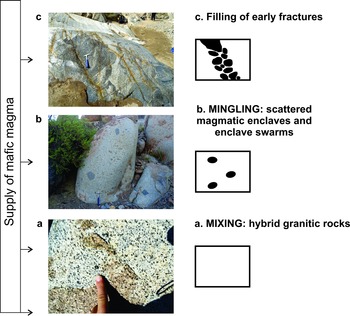
Schematic magma hybridization processes proposed for the Varvarco Tonalite, based on the model of Barbarin (Reference Barbarin2005).

Increasing crystallization stages of the intermediate host magma (given mainly by the more voluminous tonalite), would produce the magma hybridization textures that are observed, which range from early to late mingling features. Scattered mafic magmatic enclaves from the Varvarco and Butalón plutons represent early mingling textures (Fig. 16a, b), whereas the presence of needle-like apatite in these enclaves points to early mafic magma quenching (Wyllie et al. Reference Wyllie, Cox and Biggar1962). The lack of chilled margins shown by most of the enclaves suggests that local mixing was caused by partial dissolution of the originally chilled borders (Barbarin, Reference Barbarin2005). The presence of outer zones of calcic plagioclase (labradoritic spikes) in more sodic plagioclase of the Varvarco Tonalite (Fig. 10b) has also been interpreted as a result of mixing processes involving coeval acid and mafic magmas (fig. 7b in Hibbard, Reference Hibbard1981), and can be due to quenching related to magma hybridization (Mollo et al. Reference Mollo, Putirka, Iezzi, Del Gaudio and Scarlato2011; Molina et al. Reference Molina, Montero, Bea and Scarrow2012).
The enclave swarms present in the Varvarco Tonalite represent magma channels that were used by new pulses of magma arriving to the chamber (e.g. Bateman, Reference Bateman1995; Tobisch et al. Reference Tobisch, McNulty and Vernon1997). The disrupted quartz-dioritic dykes (Fig. 16c) suggest that mafic magma intruded through early fractures in the increasingly more crystallized Varvarco Tonalite (Barbarin, Reference Barbarin2005).
The presence of K-feldspar and amphibole oikocrysts with inclusions of early formed minerals is evidence of mafic magma undercooling and thermal adjustment (Castro et al. Reference Castro, Moreno-Ventas and de la Rosa1991). Separate plagioclase crystals constitute chadocrysts included in relatively larger, late amphibole oikocrysts. Chadocrysts remain representatives of an earlier textural development stage (Higgins & Roberge, Reference Higgins and Roberge2003).
Rounded quartz phenocrysts rimmed by amphibole (‘quartz ocelli’; Fig. 8d; Vernon, Reference Vernon1990; Hibbard, Reference Hibbard, Didier and Barbarin1991) are observed in the dioritic to quartz-dioritic dykes and are assigned to the liquid-dominated hybridization stage (compare Fig. 16a). For quartz ocelli, the parental magma of the quartz-dioritic dykes would have already mixed-mingled by the time it intruded the solidified host rock, suggesting that the hybridization process had been achieved in several stages.
No solid-state recrystallization textures were observed in the Varvarco Intrusives. The only modification of grain boundaries that was locally observed is some polygonization of quartz grains. This suggests that the rocks underwent some degree of static recrystallization (textural coarsening: Higgins, Reference Higgins2011). The Radales Aplite sample from site V5 sampled for this study has a granophyric texture suggesting that it cooled under shallow subvolcanic conditions (Vernon, Reference Vernon2010).
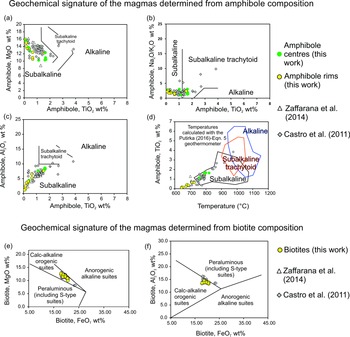
The affinity of the Varvarco Intrusives with calc-alkaline I-type magmas (Franchini et al. Reference Franchini, López-Escobar, Schalamuk and Meinert2003; Casé et al. Reference Casé, López-Escobar, Danieli and Schalamuk2008) and the predominance of intermediate compositions in the suite, with hornblende as the main mafic mineral, is typical of Cordilleran magmas. These water-rich compositions are characteristic of subduction environments (Bachmann & Bergantz, Reference Bachmann and Bergantz2008). Amphibole and biotite crystals from the Varvarco Tonalite crystallized from magmas of calc-alkaline composition (Fig. 17a–f). According to the classification of Molina et al. (Reference Molina, Scarrow, Montero and Bea2009), the amphibole cores and rims crystallized in equilibrium with subalkaline magmas (Fig. 17a–d), although some amphibole cores fall into the field of subalkaline trachytoid magmas (Fig. 17b). Given that the Varvarco area is poorly studied, there are no granitoid rocks in the vicinity to directly compare with the mineralogy of the Varvarco Intrusives. In Figures 10, 11, 17 and 18 we compare the compositions of amphiboles and biotites with the amphiboles and biotites of Zaffarana et al. (Reference Zaffarana, Somoza and López de Luchi2014) and Castro et al. (Reference Castro, Moreno-Ventas, Fernández, Vujovich, Gallastegui, Heredia, Martino, Becchio, Corretgé, Díaz-Alvarado, Such, García-Arias and Liu2011). Zaffarana et al. (Reference Zaffarana, Somoza and López de Luchi2014) reported granitoids of Late Triassic age from the Central Patagonian Batholith at Gastre (North Patagonian Massif) which were emplaced during the early stages of Gondwana break-up. In turn, Castro et al. (Reference Castro, Moreno-Ventas, Fernández, Vujovich, Gallastegui, Heredia, Martino, Becchio, Corretgé, Díaz-Alvarado, Such, García-Arias and Liu2011) reported Jurassic granites of the North Patagonian Batholith in the area of Bariloche (North Patagonian Andes) which were, like the Varvarco rocks, formed by the Andean subduction system. The Varvarco amphiboles largely overlap in composition with the amphiboles reported for the Late Triassic granites of the Gastre Superunit of the Central Patagonian Batholith studied by Zaffarana et al. (Reference Zaffarana, Somoza and López de Luchi2014) and have less variable TiO2 concentrations than amphiboles reported for the Jurassic granites of the Patagonian Batholith studied by Castro et al. (Reference Castro, Moreno-Ventas, Fernández, Vujovich, Gallastegui, Heredia, Martino, Becchio, Corretgé, Díaz-Alvarado, Such, García-Arias and Liu2011).
Geochemical signature of the magmas in equilibrium with amphibole and biotite from the Varvarco Tonalite. (a–d) Amphibole compositions of the Varvarco Tonalite plotted on the diagrams of Molina et al. (Reference Molina, Scarrow, Montero and Bea2009). (a) MgO versus TiO2. (b) Na2O/K2O versus TiO2. (c) Al2O3 versus TiO2. (d) TiO2 versus temperature calculated using geothermometer of Putirka (Reference Putirka2016). (e, f) Tectonic discrimination diagrams for biotites of the Varvarco Tonalite: (e) MgO versus FeOT and (f) Al2O3 versus FeOT (Abdel-Rahman, Reference Abdel-Rahman1994).

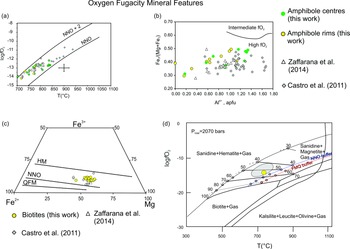
Oxygen fugacity conditions of the magmas in equilibrium with the amphiboles and biotites of the Varvarco Tonalite. Data from Zaffarana et al. (Reference Zaffarana, Somoza and López de Luchi2014) and Castro et al. (Reference Castro, Moreno-Ventas, Fernández, Vujovich, Gallastegui, Heredia, Martino, Becchio, Corretgé, Díaz-Alvarado, Such, García-Arias and Liu2011) are plotted for comparison. (a) logfO2 versus temperature diagram of Ridolfi et al. (Reference Ridolfi, Renzulli and Puerini2010). Error bars represent maximum logfO2 errors of 0.4 log unit and the expected σ (22 °C). (b) Diagram of Anderson & Smith (Reference Anderson and Smith1995) showing the effect of fO2 on amphibole compositions in terms of FeT/(FeT + Mg) versus AlIV (apfu). (c) Ternary diagram for oxygen fugacity in biotites (Wones & Eugster, Reference Wones and Eugster1965). (d) logfO2 versus T diagram (Wones & Eugster, Reference Wones and Eugster1965). Numbers represent 100*Mg/(Mg + Fe) ratios in biotites. Yellow circle shows an average of all biotite compositions from this study. Biotites from Zaffarana et al. (Reference Zaffarana, Somoza and López de Luchi2014) overlap with the yellow circle. Biotites from Castro et al. (Reference Castro, Moreno-Ventas, Fernández, Vujovich, Gallastegui, Heredia, Martino, Becchio, Corretgé, Díaz-Alvarado, Such, García-Arias and Liu2011) are shown in the grey oval. Oxygen fugacity buffers are nickel–nickel oxide (NNO), haematite–magnetite (HM) and quartz–fayalite–magnetite (FMQ).

The composition of the biotite crystals is comparable to that of calc-alkaline orogenic suites (Fig. 17e, f) in the tectonic discrimination diagram of Abdel-Rahman (Reference Abdel-Rahman1994). The presence of titanomagnetite as the main oxide in these rocks (Varvarco Tonalite; online Supplementary Material Fig. S2a) is also compatible with granites of the magnetite series of Ishihara (Reference Ishihara1977), in agreement with the results of Casé et al. (Reference Casé, López-Escobar, Danieli and Schalamuk2008). Similar to the amphiboles, the Varvarco biotites largely overlap in Al2O3, MgO and FeOT concentrations with biotites reported by Zaffarana et al. (Reference Zaffarana, Somoza and López de Luchi2014) and Castro et al. (Reference Castro, Moreno-Ventas, Fernández, Vujovich, Gallastegui, Heredia, Martino, Becchio, Corretgé, Díaz-Alvarado, Such, García-Arias and Liu2011) (Fig. 17e, f), with the biotites of Castro et al. (Reference Castro, Moreno-Ventas, Fernández, Vujovich, Gallastegui, Heredia, Martino, Becchio, Corretgé, Díaz-Alvarado, Such, García-Arias and Liu2011) showing slightly larger variations.
5.b. Parental melt conditions of the Varvarco Tonalite
5.b.1. Thermobarometry
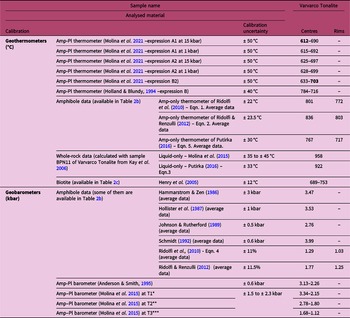
To estimate the magma storage temperatures we used geothermometers based on amphibole–plagioclase compositions (Holland & Blundy, Reference Holland and Blundy1994, expression B; Molina et al. Reference Molina, Cambeses, Moreno, Morales, Montero and Bea2021, expressions A1, A2 and B2), amphibole compositions (Ridolfi et al. Reference Ridolfi, Renzulli and Puerini2010; Ridolfi & Renzulli, Reference Ridolfi and Renzulli2012; Putirka, Reference Putirka2016), biotite (Henry et al. Reference Henry, Guidotti and Thomson2005) and melt compositions (Molina et al. Reference Molina, Moreno, Castro, Rodríguez and Fershtater2015; Putirka, Reference Putirka2016). Individual results are presented in Table 2, and a summary is presented in Table 4.
Summary of the temperatures and pressures calculated for the sample of the Varvarco Tonalite

In the amphibole–plagioclase barometer of Molina et al. (Reference Molina, Moreno, Castro, Rodríguez and Fershtater2015), T1 is the temperature obtained with the Ridolfi & Renzulli (Reference Ridolfi and Renzulli2012) geothermometer (equation 2) and T2 with the Putirka (Reference Putirka2016) geothermometer (equation 5). Standard deviation of the data is signalled in the appropriate cases. Errors are 1 sigma standard deviations.
T1* (Ridolfi & Renzulli, Reference Ridolfi and Renzulli2012, Eqn. 2)
T2** (Putirka, Reference Putirka2016, Eqn. 5)
T3*** (Molina et al. Reference Molina, Cambeses, Moreno, Morales, Montero and Bea2021, expression B2)
Temperatures obtained with the expressions A1, A2 and B2 from Molina et al. (Reference Molina, Cambeses, Moreno, Morales, Montero and Bea2021) agree reasonably and are between 612 and 703 °C (Table 4). In general, temperatures obtained with expression A1 are lower than those obtained with expressions A2 and B2 (Table 4). In the case of the pressure-dependent expressions A1 and A2, results obtained at 1 and 15 kbar are almost identical (Table 4). For these calculations, we used amphibole compositions 61, 62, 63 and 65, which are from cores of amphibole crystals that satisfy the validation criteria of these geothermometers (Molina et al. Reference Molina, Cambeses, Moreno, Morales, Montero and Bea2021). These amphibole cores were combined with plagioclases 9, 21, 28 and 39, of andesine composition An30–36, which also pass the validation criteria proposed by the authors (Table 2a, b).
The expression B from the Holland & Blundy (Reference Holland and Blundy1994) amphibole and plagioclase thermometer was used for the same plagioclase cores as in the Molina et al. (Reference Molina, Cambeses, Moreno, Morales, Montero and Bea2021) geothermometer, and amphibole cores with 0.2 (apfu) Ti and 1.5 (apfu) AlIV contents. This filter yielded a temperature of 716–784 °C for the amphibole cores, and these temperatures agree with the amphibole core-only temperatures (Putirka, Reference Putirka2016; Table 2b). However, the higher temperatures (Ridolfi et al., Reference Ridolfi, Renzulli and Puerini2010; Ridolfi & Renzulli, Reference Ridolfi and Renzulli2012; Tabla 2b) could be due to either their high AlVI or low Mg occupancies, and therefore we consider that the crystallization temperatures around 612–703 °C obtained with the expressions from Molina et al. (Reference Molina, Cambeses, Moreno, Morales, Montero and Bea2021) are more likely.
Liquid-only temperatures of Molina et al. (Reference Molina, Moreno, Castro, Rodríguez and Fershtater2015) and Putirka (Reference Putirka2016) for amphibole-saturated magmas are, as expected, higher than the temperatures calculated by using amphibole crystals and by the combination of amphibole and plagioclase crystal cores. They range from 922 to 958 °C (Table 4), and for these calculations the liquid composition was estimated using the whole-rock composition of sample BPN11 from the Varvarco Tonalite (sample reported in Kay et al. Reference Kay, Burns, Copeland, Mancilla, Kay and Ramos2006). The obtained liquid-only temperatures are compatible with the amphibole stability field in subalkaline liquids (see fig. 15 in Molina et al. Reference Molina, Scarrow, Montero and Bea2009 and fig. 9 in Kiss et al. Reference Kiss, Harangi, Ntaflos, Mason and Pál-Molnár2014), consistent with a system that involved amphibole-saturated parental melts.
The combination of Ti and Mg/(Mg + Fe) ratios of biotites were used to determine temperature following the method of Henry et al. (Reference Henry, Guidotti and Thomson2005). Biotite compositions are well within the calibration range of the method (XMg = 0.275–1.000, Ti = 0.04–0.6 apfu) and yielded temperatures between 689 and 753 °C, in excellent agreement with amphibole temperatures determined by Molina et al. (Reference Molina, Cambeses, Moreno, Morales, Montero and Bea2021) (Table 4).
Crystallization pressures were estimated using the Ridolfi & Renzulli (Reference Ridolfi and Renzulli2012) amphibole-only geobarometers and the Molina et al. (Reference Molina, Moreno, Castro, Rodríguez and Fershtater2015) and Anderson & Smith (Reference Anderson and Smith1995) amphibole–plagioclase barometers. For these calculations, as in the case of the geothermometers, only amphiboles 63 and 68 and plagioclases 9, 21, 28 and 39 (Table 2a, b) that passed all the validation parameters of Molina et al. (Reference Molina, Moreno, Castro, Rodríguez and Fershtater2015, Reference Molina, Cambeses, Moreno, Morales, Montero and Bea2021) were used. We also estimated pressures using the Al-in-hornblende geobarometers of Hammarstrom & Zen (Reference Hammarstrom and Zen1986), Hollister et al. (Reference Hollister, Grissom, Peters, Stowell and Sisson1987), Johnson & Rutherford (Reference Johnson and Rutherford1989) and Schmidt (Reference Schmidt1992) (Table 4).
The highest pressures were calculated using the Schmidt (Reference Schmidt1992) calibration, yielding ∼4 kbar for amphibole cores (amphibole rim compositions were not suitable for the Al-in-hornblende calibrations, because of their high silica content, higher than 50 wt %; Table 2b). However, Al-in-hornblende geobarometers tend to overestimate pressures, as both the pressure-dependent tschermakitic and the temperature-dependent edenitic substitutions govern the total Al content in amphiboles (Erdmann et al. Reference Erdmann, Martel, Pichavant and Kushnir2014).
Pressures range from 1.12 to 1.68 kbar when calculated with the geobarometer of Molina et al. (Reference Molina, Moreno, Castro, Rodríguez and Fershtater2015) and the temperatures obtained with the pressure-independent thermometer B2 from Molina et al. (Reference Molina, Cambeses, Moreno, Morales, Montero and Bea2021).
Higher pressures were obtained using the Molina et al. (Reference Molina, Moreno, Castro, Rodríguez and Fershtater2015) geobarometer combined with the temperatures obtained with the Ridolfi & Renzulli (Reference Ridolfi and Renzulli2012) and Putirka (Reference Putirka2016) thermometers (Table 4). These pressures broadly agree with the ones obtained with the Anderson & Smith (Reference Anderson and Smith1995) amphibole barometer (2.26–3.13; Table 4).
5.b.2. Oxygen fugacity
The oxygen fugacity of the parental melt to the Varvarco Tonalite was calculated using the method of Ridolfi et al. (Reference Ridolfi, Renzulli and Puerini2010) and Wones & Eugster (Reference Wones and Eugster1965) (Fig. 18a, d). Ridolfi et al. (Reference Ridolfi, Renzulli and Puerini2010) uses amphibole chemistry to derive pressure–temperature (P–T) conditions, H2O and fO2. It should be noted that the Ridolfi et al. (Reference Ridolfi, Renzulli and Puerini2010) barometer estimates pressures of 1.29 kbar for amphibole cores and 1.03 kbar for rims, which is significantly lower than pressures derived with other barometers. However, pressure differences within 1–3 kbar have very little effect (∼0.2 log unit) on the fO2 estimates by the Ridolfi et al. (Reference Ridolfi, Renzulli and Puerini2010) oxybarometer, which is within the uncertainty of the method (0.4 log unit). According to the Ridolfi et al. (Reference Ridolfi, Renzulli and Puerini2010) oxybarometer, amphibole cores and rims from the Varvarco Tonalite have similar oxygen fugacities in the range of −12.2–14.9 logfO2, which indicates that they crystallized under relatively high fO2 conditions between the nickel–nickel oxide (NNO) and NNO + 2 buffers, typical of calc-alkaline magmas (ΔNNO from −1 to +3; e.g. Gill, Reference Gill1981; Behrens & Gaillard, Reference Behrens and Gaillard2006).
Wones & Eugster (Reference Wones and Eugster1965) used Mg/(Mg + Fe) ratios in biotite and temperatures in order to estimate fO2. We used temperatures derived by Henry et al. (Reference Henry, Guidotti and Thomson2005) and biotite cations by Li et al. (Reference Li, Zhang, Behrens and Holtz2020). All biotites plot in the area outlined by a yellow circle (Fig. 18d). For comparison, biotites by Castro et al. (Reference Castro, Moreno-Ventas, Fernández, Vujovich, Gallastegui, Heredia, Martino, Becchio, Corretgé, Díaz-Alvarado, Such, García-Arias and Liu2011) plot over the wider ranges of fO2, but still between the NNO and haematite–magnetite (HM) buffers.
Oxygen fugacities between the NNO and HM buffers are also suggested by the Fe2+–Fe3+–Mg ternary diagram for biotite compositions of Wones & Eugster (Reference Wones and Eugster1965) (Fig. 18c). Additionally, high oxygen fugacities of the studied rocks are also inferred from the Fet/(Fet + Mg) ratios in amphibole (Czamanske & Wones, Reference Czamanske and Wones1973; Anderson & Smith, Reference Anderson and Smith1995), and by titanomagnetite as the main oxide phase of these rocks (see below, Fig. 18b; online Supplementary Material Fig. S2a).
5.c. Cooling history and exhumation of the Late Cretaceous and Palaeogene plutons
To date, three ages have been obtained for the Varvarco Tonalite: a recalculated K–Ar biotite age of 64.7 ± 3.2 Ma (J.I.C.A./M.M.A.J., 2000 in Franchini et al. Reference Franchini, López-Escobar, Schalamuk and Meinert2003), an 40Ar–39Ar biotite age of 69.09 ± 0.13 Ma (Kay et al. Reference Kay, Burns, Copeland, Mancilla, Kay and Ramos2006) and recently a U–Pb SHRIMP zircon age of 67.8 ± 0.8 Ma (Assis, Reference Assis2019). Zappettini et al. (Reference Zappettini, Korzeniewski and Segal2014) and Zappettini et al. (Reference Zappettini, Cozzi, Dalponte, Godeas, Korzeniewski, Peroni, Segal and Castro Godoy2021) reported an 40Ar–39Ar age of 65.68 ± 0.22 Ma for adularia from veins associated with the hydrothermal alteration of basic volcanic rocks from the Jurassic Colomichicó Formation (Zappettini et al. Reference Zappettini, Lagorio, Dalponte, Orestes and Belousova2018).
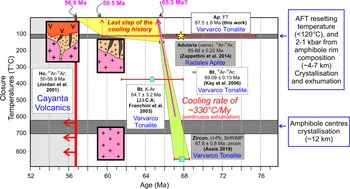
If the closure temperatures of the specific minerals for the various geochronological methods are taken into account, it is possible to construct a thermal profile and to calculate the exhumation rate (England & Molnar, Reference England and Molnar1990). Thus, the thermal profile/cooling curve for the Varvarco Tonalite was constructed (Fig. 19) considering the more accurate geochronological data, namely those obtained by Assis (Reference Assis2019) and Zappettini et al. (Reference Zappettini, Korzeniewski and Segal2014). The typical closure temperature for U–Pb on zircon is greater than 800 °C (Lee et al. Reference Lee, Williams and Ellis1997). Siégel et al. (Reference Siégel, Bryan, Allen and Gust2018) showed that the zircon saturation temperature in igneous rocks is variable, but normally between 780 and 860 °C for intrusive rocks. Since we do not have Ti-in-zircon data that would allow us to calculate temperatures more precisely, we assume a closure temperature for zircon of c. 850 °C. Considering that the closure temperature of radiogenic argon in K-feldspar can be as low as 120–150 °C (Foland, Reference Foland1974; Harrisson & McDougall, Reference Harrison and McDougall1982), we opted for using a closure temperature of 150 °C for adularia.
Cooling history of the Varvarco Tonalite. See main text for details.

A one-step theoretical curve between 67.8 ± 0.8 Ma (U–Pb in zircon) and 65.68 ± 0.22 Ma (40Ar–39Ar in adularia from hydrothermal veins) was constructed for the exhumation of the Varvarco Tonalite (Fig. 19). This curve gives a continuous cooling rate of ∼330 °C per Ma. Sánchez et al. (Reference Sánchez, Coutand, Turienzo, Lebinson, Araujo and Dimieri2018) proposed tectonically driven continuous exhumation for the Cordillera del Viento during the latest Cretaceous – early Palaeogene deformation event. Considering continuous and fast exhumation, the theoretical curve can be extended below 100 °C towards the graphically obtained age of 65.3 Ma (Fig. 19). Fast cooling and exhumation of the Varvarco Tonalite also agrees with the low pressures obtained by geothermobarometry (Tables 2, 4). The highest pressures calculated for amphibole and plagioclase cores are of the order of 3.34 kbar (Table 4), which correspond to a source at ∼12 km depth. Amphibole rims crystallized at lower pressures of ∼1–2 kbar, which is compatible with shallower emplacement at ∼4–7 km depth. It means that if the exhumation was a continuous process, as suggested by the thermal profile, the magmatic system could have been exhumed by ∼12 km in c. 2.1 Ma.
Considering that the Palaeogene Cayanta Volcanics intruded over the already eroded Varvarco Tonalite and Radales Aplite between 50–56.9 Ma (40Ar–39Ar hornblende ages, Jordan et al. Reference Jordan, Burns, Veiga, Pángaro, Copeland, Kelley and Mpodozis2001) and 67.5 ± 8 Ma (AFT age), and the Varvarco Tonalite has a final stage of exhumation (below 4–5 km) at least at 59.5 Ma, one important question that we are trying to answer is ‘When was the final exhumation of the Varvarco Tonalite plus Radales Aplite?’ The final tectonic exhumation must have occurred after the crystallization of the adularia veins in the Radales Aplite at 65.68 ± 0.22 Ma and prior to the extrusion of the Cayanta volcanic rocks at 56.9–50 Ma. The Varvarco Tonalite magmatic fabric was not affected by any solid-state deformation that could have been superimposed onto these rocks, and shallow emplacement conditions helped in the fast exhumation process. The Radales Aplite has a granophyric texture, which suggests that it would have experienced a greater degree of undercooling than the Varvarco Tonalite (Vernon, Reference Vernon2010), consistent with emplacement at a shallower crustal level. At this point, we do not have any crystallization age for the Radales Aplite that may corroborate the relationship between cooling and exhumation. The final exhumation possibly occurred coevally with the generation of the adularia veins in the Radales Aplite at 65.68 Ma or later as part of the continuous process of exhumation at 65.3 Ma (Fig. 19), or between 65.3 and 59.5 Ma, considering the AFT age. We do not exclude that the final exhumation could have happened after 59.5 Ma, but certainly before 56.9 Ma.
Note that the K–Ar biotite cooling age of 64.7 ± 3.2 Ma (Franchini et al. Reference Franchini, López-Escobar, Schalamuk and Meinert2003) falls onto this cooling curve given the uncertainty of the fission-track ages. The biotite age of 69.09 ± 0.13 Ma, also from the Varvarco Tonalite (Kay et al. Reference Kay, Burns, Copeland, Mancilla, Kay and Ramos2006), is much older than the U–Pb zircon age of Assis (Reference Assis2019). These two ages are not within the uncertainty. It is difficult to explain this age difference in the context of the thermal profile, but it could be related to an early (c. 69 Ma) input of mafic hydrated magma into the magmatic system of the Varvarco Tonalite.
Given the age of 50.3 ± 5.9 Ma (AFT, sample BU4), the Butalón Tonalite was exhumed a little later than the Varvarco Tonalite, in Palaeogene time. However, the exact age of its exhumation is not yet fully constrained. The AFT age of the Butalón Tonalite is not as well defined as that for the Varvarco Tonalite, because less fission-track data could be obtained from the dated sample BU4 (Table 3). It seems that the Butalón Tonalite was emplaced in an already exhumed orogenic system. This is also in agreement with the different cooling rates of the Varvarco Tonalite and the Radales Aplite, as inferred from their magmatic textures discussed before.
Temperature and pressure estimates derived from mineral chemistry are here integrated with the temperature–time path reconstruction in order to derive a geothermal gradient for the Cordillera del Viento area. In the first place, amphibole core compositions provide temperatures of ∼610–700 °C and pressures of ∼2–3.34 kbar, which correspond to nearly ∼12 km depth (Fig. 19). At these P–T conditions, the Varvarco Tonalite was almost completely crystallized and already cooling. Then, amphibole rim compositions record pressures of 1–2 kbar, which correspond to ∼4–7 km depth (Fig. 19), and, at this stage, the temperatures were no higher than 120 °C, as apatite fission tracks anneal at temperatures higher than this threshold (Ehlers & Farley, Reference Ehlers and Farley2003; Reiners & Ehlers, Reference Reiners and Ehlers2005). From these two T and P regimes, a geothermal gradient of ∼62.5 °C km−1 can be obtained, revealing the cooling and exhumation history of the Varvarco Tonalite. Such a high geothermal gradient suggests that the intrusive rocks were cooling down and exhuming at the same time. The lower geothermal gradients of ∼51 °C km−1 (Sigismondi, Reference Sigismondi2013; Sigismondi & Ramos, Reference Sigismondi and Ramos2009 a,b; see Galetto et al. Reference Galetto, Georgieva, García, Zattin, Sobel, Glodny, Bordese, Arzadún, Bechis, Caselli and Becchio2021) could be reflecting the pre-Andean tectonic scenario in the modern easternmost region of the Neuquén Basin, which was not affected by Andean deformation (Galetto et al. Reference Galetto, Georgieva, García, Zattin, Sobel, Glodny, Bordese, Arzadún, Bechis, Caselli and Becchio2021).
5.d. Magnetic fabrics of magmatic origin in the Late Cretaceous and Palaeogene plutons
As previously shown in Section 4.d, the magnetic fabrics determined by the ASM method in the Varvarco Tonalite, Butalón Tonalite and Radales Aplite can be interpreted as being of pure magmatic origin representative of magma flow during Late Cretaceous–Palaeogene times. In particular, the fast-cooling rate estimated from the U–Pb, 40Ar–39Ar and AFT ages suggests that the magmatic fabrics of the Varvarco Tonalite were acquired during pluton cooling and exhumation.
The magmatic fabrics from the Varvarco Tonalite and Radales Aplite are steeply dipping, with a predominant N–S strike (online Supplementary Material Fig. S1a), which is mostly consistent with the orientation of the regional structures from the Andean orogenic cycles (Giacosa et al. Reference Giacosa, Allard, Foix and Heredia2014; Turienzo et al. Reference Turienzo, Sánchez, Lebinson, Dimieri, Folguera, Contreras-Reyes, Heredia, Encinas, Iannelli, Oliveros, Dávila, Collo, Giambiagi, Maksymowicz, Iglesia Llanos, Turienzo, Naipauer, Orts, Litvak, Alvarez and Arriagada2018; Sánchez et al. Reference Sánchez, Coutand, Turienzo, Lebinson, Araujo and Dimieri2018). The oscillating character of the magmatic fabrics strongly suggests that they could have been influenced by intrinsic dynamics inside the magma chamber. However, there is some evidence of regional stress influence, such as N–S elongation of the pluton along the Matancillas creek (Figs 2a, 3a, b) and NNE–SSW to NNW–SSE fabrics. Even though coupling with the wall rock may not occur, the Andean stress field might have influenced magma flow to some extent. The N–S Matancillas creek goes along the trace of the N–S-directed Cordillera del Viento Fault (Fig. 2a, b). This fault was active during the Andean deformation and could have favoured magma ascent through the crust. The lack of tectonic deformation suggests that pluton emplacement took place either during or soon after the Late Cretaceous deformation event in the Neuquén Andes. Alternatively, similar fabrics may be possible even during a regional deformation event if strain partitioning in low- versus high-strain domains is present. However, post-tectonic emplacement is also in agreement with observations made in the other parts of the Naunauco Belt, where other subvolcanic bodies were post-tectonically emplaced (Llambías & Malvicini, Reference Llambías and Malvicini1978; Zamora Valcarce et al. Reference Zamora Valcarce, Zapata and Ramos2011).
Other plutons that were emplaced late with respect to the main tectonic deformation events have been described as having flat roofs and steeply dipping foliation planes along the pluton walls (de Saint-Blanquat et al. Reference de Saint-Blanquat, Habert, Horsman, Morgan, Tikoff, Launeau and Gleizes2006; Payacán et al. Reference Payacán, Gutiérrez, Gelman, Bachmann and Parada2014). Their internal fabric is strongly decoupled from the host rock fabrics, likely reflecting magma chamber processes (Paterson et al. Reference Paterson, Fowler, Schmidt, Yoshinobu, Yuan and Miller1998).
Unfortunately, the areas of the Varvarco Tonalite (marked as ‘VT’ in Fig. 2 and Fig. 3a, b) where we expected to see flattened magmatic foliations in the roof of the intrusion, were only inferred from satellite images and inaccessible for sampling. Some sites, such as site V3, within the Varvarco Tonalite show flat foliation planes, suggesting a location near the pluton roof. But in general, steeply dipping magmatic foliations are dominant and probably reflect closeness to the contact with the host rocks. The contact area is the place where the highest degree of coupling between the magmatic and host rock fabrics usually occurs (Paterson et al. Reference Paterson, Fowler, Schmidt, Yoshinobu, Yuan and Miller1998). In this sense, the parallel foliations presented by the metamorphic rocks of the Guaracó Norte Formation and the magmatic rocks of the Varvarco and Radales plutons in the area between the Matancilla and Chacay creeks suggest that some degree of mechanical coupling existed between them (Fig. 12a). However, the contact aureole in the margin-parallel fabrics rules out regional deformation as a significant cause of fabric formation, and instead suggests late fabric formation due to internal processes during emplacement (Paterson et al. Reference Paterson, Fowler, Schmidt, Yoshinobu, Yuan and Miller1998). In addition, the thermal contrast between the hornfels of Guaracó Norte Formation and the Varvarco Tonalite is consistent with the results obtained from geothermobarometry, which suggests that the Varvarco pluton was emplaced at a high crustal level at ∼2–3 kbar (∼12 km depth).
Lastly, magma feeder zones, where magma upwelled, can be traced by the existence of vertical magmatic lineations at sites for which AMS ellipsoids of prolate shape (T < 0) were measured, such as V1, V2, V6 and V7 from the Varvarco Tonalite (online Supplementary Material Fig. S1f).
6. Conclusions
Field observations and petrographic analysis indicate that magma hybridization was the main process in the Varvarco and Butalón plutons. The magnetic fabrics of these plutons are dominated by titanomagnetite. This, together with the mineral chemistry data (amphibole and biotite) confirms that these magmatic phases belong to the I-type series of calc-alkaline igneous bodies.
The fabrics are, without exception, magmatic, and the AMS data can be interpreted as the result of emplacement and rapid exhumation of fast-cooled plutons. The AFT ages of the Varvarco Tonalite are close to its crystallization age, as well as the fast-cooling age calculated for this pluton (330 °C Ma−1; Fig. 19). Shallow emplacement conditions were estimated based on geothermobarometry (2–3 kbar, equivalent to 12 km depth). These combined data allow us to infer uplift in the region between 66 and 64.9 Ma. Geothermobarometry and AFT data suggest a geothermal gradient for the area of ∼62.5 °C km−1. The magmatic system in the Varvarco area could have been exhumed by ∼12 km in c. 2.1 Ma.
The orientation of the magmatic fabrics implies that they formed mostly owing to magma chamber processes. However, they could have been controlled, in part, by the regional Late Cretaceous compressive deformation. As the plutons are located along the trace of the Cordillera del Viento Fault, and because they are devoid of post-emplacement tectonic deformation, reactivations of this fault are not supported.
Acknowledgements
We want to thank Dr Sebastián Oriolo and an anonymous reviewer for their valuable suggestions that greatly improved the manuscript. We cordially thank Fuat Yavuz for help with biotite diagrams in the earlier version of this article. The research projects from the Universidad Nacional de Río Negro (UNRN) PI-40-A-466, PI-40-A-547, PI-40-A-631, PI-40-A-798 and PI-40-A-916; project PIP CONICET 2015-2017 11220150100736CO; PICT 2019-01809; project CGL 2012-38396-C01 of the Spanish Programme for Science Technology (I+D+i) and FEDER Funds of the EU, contributed to finance this work. The research of José F. Molina has been supported for the Ministerio de Economía y Competitividad (Gobierno de España), grant numbers: CGL2013-40785-P and CGL2017-84469-P, and Consejería de Economía y Conocimiento (Junta de Andalucía), grant number: RNM2163. The research of Natalia Hauser has been supported in part by CNPq fellowships (grants 309878/2019-5). This study was financed in part by the Coordenação de Aperfeiçoamento de Pessoal de Nivel Superior – Brasil (CAPES) – Finance Code 001.
Supplementary material
To view supplementary material for this article, please visit https://doi.org/10.1017/S0016756821001163