Introduction
A recent paper by Kessler et al. (Reference Kessler, Smith and Lehnert2006) described four new species of Selaginella P.Beauv. (Selaginellaceae) from Bolivia, of which two, S. arroyoana M.Kessler & A.R.Sm. and S. chiquitana M.Kessler, A.R.Sm. & M.Lehnert, were found in the cerrados of eastern Bolivia, the latter known only from a single sterile collection. Recent collections by the Darwin Initiative Project 16-004 ‘Conservation of the Cerrados of Eastern Bolivia’ and study of herbarium material show that these two entities are identical in their fertile parts and have no significant morphological differences, being distinguished only by small, overlapping differences in dimensions. We are, therefore, treating these two plants as conspecific under the name Selaginella arroyoana, and a full description is provided below.
Species Description
Selaginella arroyoana M.Kessler & A.R.Sm., Edinburgh J. Bot. 63(1): 87 (2006). – Type: Bolivia, Dept. Santa Cruz. Prov. Velasco, Parque Nacional Noel Kempff Mercado, Campamento Las Gamas, 14°48′11″S, 60°23′35″W, 900 m, 1 iv 1993, Arroyo 202 (holo LPB; iso MO, UC, USZ).
Selaginella chiquitana M.Kessler, A.R.Sm. & M.Lehnert, Edinburgh J. Bot. 63(1): 91, syn. nov. – Type: Bolivia, Dept. Santa Cruz. Prov. Chiquitos, Serranía de Santiago, en la mesa del Arco de Piedra, 18°20′S, 59°35′W, 800 m, 23 ii 2003, Lehnert 642 (holo UC; iso GOET, LPB).
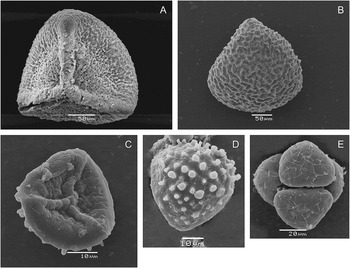
Creeping terrestrial plant. Stems prostrate, rooting throughout, c.0.3–1 mm in diameter, not articulate, not flagelliform, not stoloniferous, stramineous to pale green. Rhizophores straight, 0.1–0.6 mm in diameter, 3–5 cm long, arising from the leaf axils. Leaves trimorphic throughout; lateral leaves obliquely oblong, 1.5–2.5 × 1–1.2 mm, apically acute, basally rounded, margins hyaline, cilia at base 0.15–0.25 mm long, elsewhere to 0.05 mm, diminishing in length towards the apex; median leaves ovate-lanceolate, 0.8–2 × 0.3 mm, slightly auriculate on one side, short-aristate (arista c.1/6–1/20 of total leaf length), the apices straight, midribs ill-defined, margins hyaline, basally ciliate with cilia 0.1–0.2 mm long, elsewhere short-ciliate, diminishing in length towards the apex; axillary leaves lanceolate, 1.5–2.5 mm long, exauriculate, margin hyaline, basally with cilia to 0.25 mm long, diminishing in length towards the apex. Strobili 3–5(–10) × 1 mm; sporophylls monomorphic, ascending, asymmetric; megasporangia in two rows; megaspores 200–250 μm in diameter, foveolate, the proximal surface with irregular crests, the distal surface granulate; microspores 35–40 μm in diameter, the proximal surface irregularly rugose with sunken crests, the distal surface granulate clavate-tuberculate (Fig. 1).
Selaginella arroyoana M.Kessler & A.R.Sm. A, megaspore, proximal surface; B, megaspore, distal surface; C, microspore, proximal surface; D, microspore, distal surface; E, microspores in a tetrad before breaking up into individual spores, the granular surface mostly missing. From Wood, Pozo & Huaylla 24682.

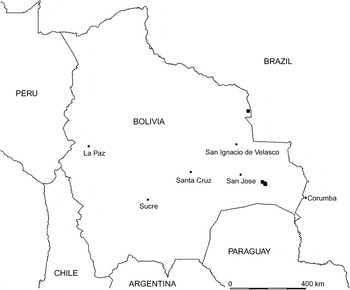
Distribution and ecology. This species is found between 750 and 1053 m on two isolated flat-topped serranias or mesetas in eastern Bolivia. The type collection from Las Gamas on the Serranía de Huanchaca (Meseta de Caparuch) is the only record from that area but, as this meseta is so vast (over a hundred kilometres in length) and so poorly explored botanically, there is every likelihood that it will be found in other localities in that area and possibly in the Serranía Ricardo Franco in neighbouring Mato Grosso. All the other records are from the series of flat-topped mesetas lying north of the town of Roboré having been found both at the western end (Santa Barbara) and eastern end (Serranía de Santiago) of this range (Fig. 2). Within this second area it is only likely to occur elsewhere on Cerro Motacú. It is not a plant of the Chiquitano dry forest, nor of disturbed areas, but of poorly developed scrub-like gallery forest along quebradas (small streams), where it is found on steep, partially shaded earth banks above the stream bed.
Distribution of Selaginella arroyoana.

Proposed IUCN conservation status. There is no immediate threat to Selaginella arroyoana, no evidence that the size of its population has decreased and every possibility that it is more widely distributed on the Serranía de Huanchaca than is currently known. However, populations are few and fragmented and it occupies a rare and very specialised habitat, occurring only on earth banks along streams in poorly developed gallery forest. This habitat is vulnerable in the Roboré area through cattle grazing, firewood collection or the possible construction of dams upstream to provide water for cattle. In both serranias it could be vulnerable to desiccation as a result of climate change. Populations should, therefore, be carefully monitored, particularly as there are unlikely to be other suitable locations for this rare species in eastern Bolivia. We believe that it would be best to treat it as Near Threatened (NT) (IUCN, 2001) for the reasons stated above. This conservation status could be revised after a search for additional sites on the Serranía de Huanchaca.
Additional specimens examined. Bolivia. Santa Cruz Prov. Chiquitos, Serranía de Santiago de Chiquitos, subiendo la quebrada, W del Arco de piedra, en ladera de roca, en lugar húmedo debajo de un bosquecito, 18°20′55″S, 59°33′01″W, 795 m, 1 x 2008, Wood, Pozo & Huaylla 24641 (K, LPB, USZ); Serranía de Santa Bárbara, NW de Roboré, Meseta de la serranía de Santa Bárbara, zona de campo rupestre, pasando a campo limpio con parches de campo húmedo en los vallecitos y restos de bosque al lado del agua, 18°14′14″S, 59°42′18″W, 1053 m, 3 v 2008, Wood, Pozo & Huaylla 24682 (K, LPB, USZ).
Kessler et al. (Reference Kessler, Smith and Lehnert2006) compared Selaginella arroyoana with S. kochii Hieron. and S. xiphophylla Baker. From both these species Selaginella arroyoana can be distinguished by its smaller, ciliate lateral leaves which reach only 2.5 mm (up to 6 mm in length and denticulate rather than ciliate in both S. kochii and S. xiphophylla). Kessler et al. (Reference Kessler, Smith and Lehnert2006) compared Selaginella chiquitana with the little-known S. falcata (P.Beauv.) Spring. from French Guiana, to which it keys out in Alston et al. (Reference Alston, Jermy and Rankin1981). The type specimen of Selaginella falcata (Chastelein s.n., OXF) is a sterile scrap but this, the illustration in Dillenius (Reference Dillenius1741) and Leprieur 180 (K) all show a far more robust plant than S. chiquitana, well characterised by Dillenius’ trinomial Lycopodioides dichotomum taxiforme. It has a strong superficial resemblance to a miniature dichotomously branching shoot of the well-known European yew, Taxus baccata L. The rhizophores of Selaginella falcata are much longer (to 30 cm) and thicker (0.8–1.2 mm), the lateral leaves are more than twice as long, reaching 6 mm in length, while the median leaves are strongly falcate, the apices pointing outwards as noted by Alston et al. (Reference Alston, Jermy and Rankin1981: 247).
The serranias where Selaginella arroyoana grows are the two outstanding hotspots for rare and endemic plants in eastern Bolivia, with about 20 species endemic to the Serranía de Huanchaca and about 35 to the serranias lying north of Roboré. Both serranias boast endemic species from a great diversity of plant families but with the exception of Selaginella arroyoana none of these endemic species occur on both serranias. This species thus provides a rather tenuous link between these two isolated hotspots.
Acknowledgements
Field work on which this paper is based was financed through the Darwin Initiative Project 16-004 ‘Conservation of the Cerrados of Eastern Bolivia’. We are also grateful to Michael Kessler for comments on an earlier draft of this paper and to Serena Marner for help with Dillenius’ herbarium and types at OXF.