

Introduction
Over the past three decades, the organic farming movement has grown tremendously, reaching a point in the 1990s when it became one of the fastest growing segments of US agricultureReference Greene1. Growth in the global organic food market has naturally paralleled that in organic agriculture, having reached an estimated value of sales at $40 billion in 2006, with fresh produce comprising about one-third of the total2. Because success of organic farming will ultimately be based on acceptability of the concept and buying behaviors of consumers, it is essential to focus research on consumer behavior and attitudes toward organic foods.
In popular discussions of trends in the food market, the growth in organic foods is often linked with two related but distinct developments. One is the growing interest in buying locally produced foods. In one nationwide survey, 30% of consumers indicated that they preferred to buy fresh produce from farmers' markets or directly from producers over buying from supermarkets or other markets that do not directly link the consumer and producerReference Thilmany, Keeling-Bond and Bond3. In a statewide survey of Maryland food producers, 74% of the certified organic and ‘organic interested’ respondents indicated that they wanted to sell locally4. In a similar survey targeting Maryland consumers, 79% of respondents indicated that they sought local foods, and 56% said they had purchased certified organic food in the past 6 months4.
The second development is that organic is favored by some people, not just as a way to avoid chemical residues in their food, but also as part of a more general rejection of the industrialization of US agriculture at the expense of small-scale and family farmingReference Honeyman, Pirog, Huber, Lammers and Hermann5. However, exactly the opposite tendency also has emerged, with organic seen as becoming increasingly like mainstream industrialized agriculture, a trend that some people believe runs counter to the organic philosophyReference Pollan6.
In a report on US public opinion regarding food, health and farms, Bostrom synthesized existing research that incorporated an assessment of the value that Americans place on organic, local and small-scale farmingReference Bostrom7. She concluded that Americans generally value farms and a strong US agricultural system, but especially favor small family farms over large industrial farms. Locally grown food has become a public priority, and organic products are viewed very positively, but loyal use is rare, with cost being the primary downside. Despite the contradictions between these values and the predominant direction of US agriculture, she concluded that there is little groundswell of public dissatisfaction regarding the current food system.
Other research has compared and contrasted consumers' views about locally produced versus organically produced food. A focus-group study in Wisconsin found that the ‘alternative’ (organic) shoppers were more likely to seek and use ‘local’ labels on food than were conventional shoppers, although shoppers in all focus groups had positive attitudes about local foodReference Zepeda and Leviten-Reid8. A telephone survey of 500 households in the Midwest (Nebraska, Iowa, Missouri and Wisconsin) found that more households thought a local label on food was either extremely or very important (48%) compared to those who thought an organic label was extremely or very important (25%). In this survey, top reasons given for buying local were freshness, taste and supporting local farmers, whereas top reasons for buying organic were no chemicals/pesticides, healthy/nutritious and taste9. A Missouri mail survey found that environmentalists were willing to pay a higher price for local food and for organic food than were non-environmentalists, although the majority of all respondents stated they cared about where a product was grownReference Brown10. Product quality and freshness were identified as the primary motivators for these respondentsReference Brown10.
The three areas considered in this paper—organic food, locally grown food and small-scale agriculture—are very different conceptually. Organic farms are not necessarily small, nor do they only sell to nearby consumers. Nevertheless, some people favor all three of these approaches as an attractive alternative to the dominant agricultural system. The basic question is whether consumers who do so critically distinguish among them, or indiscriminately favor all three of them as part of a generalized desire for a better way to produce our food.
The research was conducted in New England. The region's farms tend to be smaller than the national average, and emphasize vegetable, fruit and dairy production, with little production of grains or meat animals. In 2002, there were 28,254 farms in New England, and the average farm size was 141 acres11. Just fewer than 8000 of these farms had cattle and calves, 1236 farms had hogs and pigs, and 533 farms sold broilers and other meat-type chickens11. Corn for grain was being produced on just 228 farms, and wheat for grain on just 37 farms11. In contrast, vegetables were harvested for sale from 2999 farms, and 1635 farms had land in orchards11.
Considering organic and conventional agriculture in the two states where mail surveys were conducted for this research, we find some similarities and some differences relative to the national level data (see Table 1)12. Organic farms in Vermont are much closer in size to non-organic farms in Vermont, compared to Massachusetts organic and non-organic farms or the national average for organic and non-organic farms12. Vermont also has a much higher percentage of total farms that are defined as organic (8%) compared to Massachusetts or the nation overall12. Although the average size of a Vermont organic farm is close to the average size of an organic farm in the nation, the average Massachusetts organic farm is much smaller12.
Number and size of organic farms.

We initially used qualitative methods, including focus groups and individual interviews. Qualitative methods such as these have been used in the past to collect formative data regarding underlying reasons for consumers' organic food purchasing behaviorReference Makatouni, Lockeretz and Geier13–Reference Arvola and Lähteenmäki15. Results of our qualitative research then led us to a specific exploration, using a mail survey, of a number of potentially plausible hypotheses, including the hypothesis that ‘the reasons shoppers give for buying organic foods does not differ from the reasons shoppers give for buying foods produced locally, or from the reasons shoppers give for buying foods produced on small farms’. The formative data that led to this hypothesis, as well as the relevant results of the mail survey, will be provided here.
Methods
The qualitative component incorporated five focus groups, followed by 27 individual interviews, all of which were conducted with primary food shoppers in diverse New England households. A purposive, convenience sampling strategy was used to identify participants for both the focus groups and individual interviews, with the primary consideration placed on food shopping habits related to organic foods. Focus group participants were recruited in Vermont and Massachusetts through food shopping sites, including food co-ops, a supermarket, a farmers' market, and through referrals. Two focus groups consisted of ‘organic food buyers’ (defined by their verbal indication upon recruitment that they bought organic foods with some regularity), two focus groups consisted of shoppers who did not buy organic food (defined by their verbal indication upon recruitment that they never, rarely, or very occasionally bought organic foods), and one focus group contained some of each. Participants for individual interviews were recruited in Vermont, Massachusetts, Connecticut, New Hampshire, and Maine through referrals from friends and colleagues.
The same interviewer—(L. Berlin), a white, middle-aged, female—conducted all focus groups and individual interviews from February to October 2002. An interview guide, used in each focus group and individual interview, was designed to direct the conversation, while providing flexibility for the investigator to probe further in areas of greatest interest. Each focus group took approximately 2 h, and individual interviews ranged from 1 to 2 h. The guide started with open-ended questions about preferred shopping places, perceptions of the term ‘organic’, and scenarios that reflected the food shopping experience. It then addressed specific categories of interest, including food safety, the environment, animal welfare, farm worker safety, trust of food system members and industrialization of the food system. The guide used for focus groups was modified before it was used in individual interviews. In addition to the focus group questions, participants in individual interviews were asked about personal dietary changes; their level of interest in food; what they perceived to be advantages and disadvantages of organic foods; their familiarity with irradiation, sewage sludge, genetic engineering and bacterial or fungal contamination; and a few questions that stemmed from two theoretical models, the Health Belief ModelReference Strecher, Rosenstock, Glanz, Lewis and Rimer16 and an extension of Schwartz's Norm Activation ModelReference Blamey17.
Almost all interviews were tape recorded (the recorder failed during two of the individual interviews), and the interviewer took written notes as well. Following interviews, all tapes were transcribed and returned to the investigator, who reviewed them for accuracy. Transcripts were then imported into a qualitative data analysis program18 and coded. For data analysis, comments and discussion topics were examined by the interviewer to discover themes that emerged. These themes formed the basis for conceptions consumers had regarding organic, small and local farms. Additionally, matrices were formed to look for patterns in responses across respondents. Although the interview guide incorporated questions about how the respondent conceptualized the ‘ideal food system’, the interviewer did not have an initial set of questions explicitly designed to elicit views of local and small-scale farming. However, follow-up questions were asked if the respondent raised these topics. In conducting the analysis, the primary interest was in identifying relationships between organic food buying behavior and other responses. In quoting respondents, there will be an indication of whether the person was from an organic focus group (OFG), a non-organic focus group (NOFG), or a mixed focus group of organic and non-organic buyers (MFG), and in the case of individual interviews (II), the gender and age of the respondent will be included.
The quantitative component involved a mail survey sent to a random sample of 1100 adult residents in three New England communities. Specifically, mail survey recipients lived in Hardwick or Enosburg, Vermont, or Medford, Massachusetts. Hardwick and Enosburg are both rural communities that were selected because of their similar demographic profiles but contrasting shopping opportunities: one has a food cooperative that features organic foods year-round, and the other does not. Medford was chosen to reflect an urban community with diverse types of food marketplaces. As with the qualitative approach, the mail survey targeted the primary food shopper in the household by asking the original recipient either to complete the survey or to pass it along to somebody else in the household who met this qualification. The sample was randomly selected from voter registration lists for the two Vermont rural communities, and the 2000 census list of residents of Medford. The final survey was mailed out from November 2003 to February 2004. It was 13 pages, and consisted entirely of questions with set response categories, with the exception of one open-ended demographic question. In accordance with the Dillman techniqueReference Dillman19 a sequence of up to four mailings went out to each respondent in an attempt to achieve the highest possible response rate. Potential respondents were informed that a $5 donation would be made to a local organization (senior center, recreation committee or friends of the public library) for each survey that was returned. All phases of this study were approved in advance by the institutional review panel at Tufts University, for the protection of human subjects.
The samples
Twenty people participated in the focus groups in Vermont and Massachusetts and 27 people participated in the individual interviews in Vermont, Massachusetts, Maine, New Hampshire and Connecticut. They ranged in age from 21 to 74, were predominantly female (74%), and predominantly white (85%). They lived in diverse locations, with their place of residence described as everything from ‘farm’ to ‘urban’. Annual gross household income ranged from the lowest category of ‘less than $5000’ to the highest category of ‘$75,000 or more’. Twenty-eight percent of the respondents lived in households where incomes were under $30,000 per year. All but one participant had at least a high school education, and 30 participants had four or more years of higher education.
For the 372 people who returned the mail survey (38% response rate for delivered surveys), most answered all of the demographics questions. Of those who responded, 71% were female. Mean age for the sample was 54, with age ranging from 21 to 89. Twenty-one percent of the households had one adult, 61% had two adults, and 18% had between three and six adults. Thirty percent of the households had children. The sample was predominantly white non-Hispanic (95%). Respondents were given five pre-determined residence categories and asked to indicate which category best reflected where they lived. Six percent of respondents marked ‘farm’ as their place of residence, 19% marked ‘isolated rural’, 31% marked ‘small/large town’, 17% marked ‘suburban’ and 26% marked ‘urban’.
Nine income categories were provided. Twenty-six percent were in one of the first four categories (<$5000 to $20,000–$29,000), 30% were in the next two categories ($30,000–$39,999 to $40,000–$49,999), 25% were in the next category ($50,000–$74,999), and 19% were in one of the highest two categories ($75,000–$99,999 to $100,000 or more). Respondents had diverse educational backgrounds. Six percent of respondents had not completed high school, 32% had a high school degree or GED, 28% had 1–3 years of college, 19% had four years of college, and almost 15% had advanced degrees. Sixty-five percent were employed either full-time or part-time, and 35% were not employed. Types of jobs spanned the nine job categories defined by the US census. These categories are: (1) officials and managers, (2) professionals, (3) technicians, (4) sales workers, (5) administrative support workers, (6) craft workers, (7) operatives, (8) laborers and helpers, and (9) service workers20.
Results
Views of scale and buying local
Focus group and individual interview participants were asked about their perceptions regarding industrialization of the food system, including the influence of the consumer in defining the future of the system. There were strong feelings expressed about this issue by many participants. This section depicts these views.
In general, respondents associated agri-business with many negative outcomes. Examples of those experienced primarily by the consumer were loss of control over one's diet and loss of options in the supermarket. Additional negative outcomes included loss of connection between the producer and the consumer, bad labor practices, greater chance of carelessness or mistakes ‘in the process’, and increased need for pesticides. This negative association with agri-business included a negative feeling about large farms. For example, one respondent indicated:
‘What's the difference between the conventional food grower and the organic food grower? Well, the conventional food grower for the most part isn't a person anymore. It's a corporation’. (II, male, age 46)
Another said:
‘When I think of organic I think more of actually the people. I think more of the earth, farming, what people are doing in fact to grow organic foods. When I think of non-organic, I think of more, you know, mechanics, production, bigger business, even though organic foods is a big business too, I'm sure. Yet it seems more community or small farms’. (II, female, age 44)
Although none of the respondents in any of the focus groups spoke about large-scale business in a positive way, some respondents did express empathy for the farmers who feel forced to either get bigger or give up. One focus group respondent described the desperate situation of some small-scale farmers by saying:
‘They raise cattle and they raise chickens. They're very poor. Their barns are caving in. They have their livestock all squeezed in somewhere. I mean, it's really, really pathetic. It really is … it's poverty. I'm talking about poverty. That's what I'm talking about with small farmers’. (OFG)
The following sequence of comments made about dairy farming by two participants reflects their understanding of the need to grow larger to survive:
‘Most of them are milking three times a day just to get their milk products out. There's such a low price on them and they're milking 300, 400 head’. (NOFG)
‘The one that had the little 30 cows, they're gone, they're history. They got gobbled up’. (NOFG)
In summary, although respondents consistently expressed negative feelings about large-scale business, including farming, they expressed an understanding of the reasons that small-scale producers grow to survive.
Views of buying locally produced foods
In both the focus groups and individual interviews, buying foods produced locally was a frequently mentioned concept that was almost always framed in positive terms. Aspects of local purchasing that were mentioned included buying at farmers' markets, having farms in the city, and getting food that is fresh. One respondent also mentioned a desire to have large supermarkets sell more local products. While she indicated she would prefer lots of small shops, she did not think she would have the time to shop at them. (II, female, age 46)
Although no explicit attempt was made to have respondents define what ‘local’ meant to them, one organic buyer suggested there was something ‘between’ organic and conventional. Upon further questioning, the respondent said ‘I think that's what local is. Like I don't worry as much if it doesn't say organic lettuce, but if it says it was grown locally, I figure they won't have to use too much amendments’. (OFG)
Respondents provided some interesting perspectives on the many advantages of local food. In particular, they emphasized safety and familiarity as valuable attributes of local. The following is a sampling of comments that implied local was safer.
‘I think if it's grown locally, it has that safe label, you know, you feel comfortable even if you don't know the person that grew it, but because they are in the area, and pretty much get known by everybody else’. (OFG)
‘I think local is more safe. I don't think the issue is organic versus conventional. It's more like how many hands have been involved in that food, getting it to me’. (MFG)
‘Already beef producers in Vermont are sending their meat out of state to get slaughtered because there aren't the slaughterhouses to handle the load. I wonder, again, it's how close are you to your food? And the further away it goes, the more doubt in my mind about its integrity as an organic food. The closer it stays, the stronger my belief is that it's maintained that integrity’. (OFG)
However, this view of increased safety was not shared by all respondents.
‘So, although I like him, and I like the attempt he made, I think I'd actually rather have an organic strawberry from California than to buy strawberries that I know he used chemical fertilizers on, cause I know they're heavy feeders’. (OFG)
Similarly, a respondent who was focused on her children commented, when asked about choosing local versus organic, that her choice would depend on what her child was going to eat. If her child was ‘going to eat a lot of it,’ she stated she would ‘probably buy the organic’. (MFG)
The importance of familiarity was expressed in different ways by various respondents.
‘I feel guilty if I don't buy something that was grown in Vermont. This isn't organic, but if I don't buy Cabot butter, I feel guilty. I've got to buy Cabot. This is Vermont. We've got a town named Cabot. All these streets named Cabot’. (OFG)
‘I don't compromise with cheese. I just like to support the local people. Well, Vermont is about cheese more than it's about other stuff’. (NOFG)
‘If I see the farmer I'll buy his conventionally produced stuff almost for sure’. (MFG)
Merging understanding of local, small-scale and organic
Comments made both in focus groups and in individual interviews made it apparent that the concepts of local, small-scale and organic were often blended in people's minds. In other words, the view of organic farming was often imbued with attributes of local and small-scale approaches, making it difficult to differentiate the extent to which people's preference for organic related to elements of local and small-scale farming that are not in the formal definition of organic, and do not necessarily reflect the reality of organic in some locations.
The following quotations provide evidence of the ways in which small-scale and organic were often undifferentiated in respondents' minds. In these examples, the beneficial attributes of small-scale, organically produced foods relate to different taste of the food product, avoiding worker exploitation, and farm worker safety.
‘Well, because organic meat as I'm defining it for you tends to be raised on smaller farms, by smaller operations, I think there is a significant difference. I've had some that my friend has given me, and it's very different tasting, really different’. (II, female, age 46)
‘I associate organic with smaller, and I know I've heard that some of the larger farms are becoming organic, but … smaller farmers you would think would have more safety for their workers. And they would have fewer workers. The larger farms, I think, again, is run by a larger corporation that's not so personable, so I think that you lose some of that’. (II, female, age 52)
Similarly, respondents integrated the concepts of local and organic in one breath, as noted in the following quotes:
‘I just think one word that I wish I had associated, which in a way I did with organic, is local … It seems to me it makes more sense to buy local because they don't use preservatives to make things last forever, without taste’. (OFG)
‘If we thought that if we all bought organic that would feed all the local growers, and would in turn make the local economy strong, and if it would help save the planet from poisoning our water and everything else …’ (NOFG)
Although there was the tendency to merge the concepts of local and organic, one respondent specified that it depended on where you shopped. ‘Not organic in the grocery stores. There are organic sources locally, but you can't get it in grocery stores’. (MFG)
In an attempt to understand the extent to which respondents differentiated the benefits of organic versus local or small-scale, some respondents in individual interviews were asked which product they would choose if they were faced with a local, non-organic product, and an organic, non-local product. The product grown locally and/or on a small farm often won out over the organic product, as seen in the following quotes:
‘To me I can have a much more positive impact by supporting local farmers than I can by supporting an organic farmer at a distance and I think the impact on my own health by consuming a non-organic product is probably minimal. So it's worth it to me. I'd rather have a farmer nearby have a negligible impact on my health than lose the farm’. (II, female, age 44)
‘I'd probably go with the small farmer. I probably wouldn't even ask him if he was organic. See, I don't even ask them … of course it also depends on price, and looks. It depends on the product’. (II, female, age 52)
However, the ideal combined organic with either local or small-scale, as described by one person who commented that ‘organic has more value when I associate it with my neighbor, versus someone across the country’. (II, female, age 62)
Because the interviews in the qualitative component of this research identified a lack of differentiation of concepts when consumers thought about advantages of buying food produced on organic, small and local farms, we were interested in seeing if the mail survey would show that a broader group of consumers saw distinctions in these farming practices and related food products.
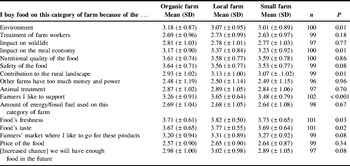
To test this, we asked the mail survey respondents to indicate how important each of 16 possible reasons to buy from each farm category was to them, if they actually bought from that farm category. There were four response choices for each reason, which included ‘not important to me’, ‘mildly important to me’, ‘moderately important to me’, and ‘very important to me’. The 16 reasons provided were the same regardless of whether the question was referring to organic, small or local farms (see Table 3 for the list of possible reasons). This resulted in a total of 48 responses from each respondent (16 questions for each of three farm categories).
For all statistical analyses completed on mail survey data, we did not choose an a priori statistical significance level for our quantitative data. Instead, we chose to report actual P-values. All data analyses were performed using SPSS version 12.0 (SPSS Inc., Chicago, Illinois, USA).
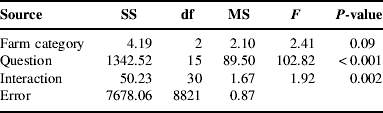
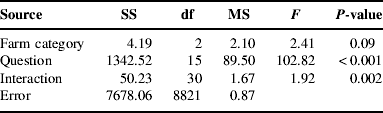
Of the 372 respondents, 102 indicated they bought from all three categories of farms. However, only 86 of these answered all 48 questions. We used a two-way ANOVA with 86 replicates to assess whether there appeared to be an overall effect of the farm category. In other words, were respondents providing similar answers regardless of whether they were addressing their reasons for buying from a local farm, a small farm or an organic farm? The results (see Table 2) show a relationship between farm category and the questions (F (2,8821)=2.41; P=0.09), indicating that people were providing different responses based on farm category, but the differences were not substantial. The differences in responses across questions were evident (F (15,8821)=102.82; P<0.001). The interaction between farm category and the question was apparent as well (F (30,8821)=1.92; P=0.002). Further analysis using post hoc repeated measures provided insight into where the greatest differences were between respondents' views on the importance of various reasons to buy food from each of the farm categories, as seen in Table 3. The sample size is greater than 86 for each of these questions because an individual's set of responses was included if the individual bought from all three categories of farms, and answered the particular question for each of the three farm categories. The six questions for which the differences across farm categories had the lowest P-values were related to the following topics: environment, rural economy, rural landscape, farmers, product freshness and product taste. Although there were differences across means, the differences were small.
Two-way ANOVA of responses to 16 questions about three farm categories.
Shoppers' reasons for buying from organic, local and small farms.

One possible reason for respondents providing similar answers to each of the 16 questions described in Table 3 is that they did not necessarily see the three farm categories as distinct. To better understand the extent to which this was the case, we asked respondents to indicate whether they thought that ‘organic farms tend to be smaller than average’, and whether ‘organic farms sell most of their products locally’. Two hundred and twenty-four respondents either strongly agreed or somewhat agreed that organic farms tend to be smaller than average. One hundred and ninety respondents either strongly agreed or somewhat agreed that organic farms sell most of their products locally.
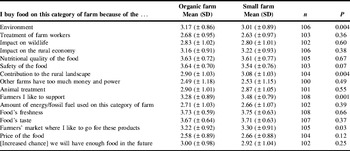
Given our interest in understanding how respondents compared organic to small-scale, we examined paired samples t-tests for the responses to the 16 statements listed in Table 3 for all respondents who bought from organic and small farms. Of the 16 statements, the responses to five of the statements had P-values that were much lower than the rest. These differences related to the environment, rural landscape, farmers, farmers' markets and safety of the food, as shown in Table 4. Responses to three of these five statements resulted in higher means for small farms than for organic farms. ‘Because of the environment’ and ‘safety of the food’ were the reasons that had higher means for organic farms than for small farms.
Shoppers' reasons for buying from organic versus small farms.

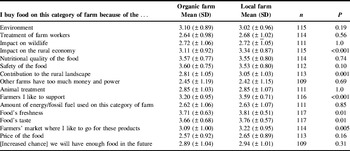
Using responses from shoppers who indicated they buy food produced on organic farms as well as on local farms, we examined paired sample t-tests for responses to the 16 statements in the same fashion as described above. There were very low P-values (<0.01) in analyses of respondents' reasons for buying from organic versus local farms for statements relating to impact on the rural economy, contribution to the rural landscape, wanting to support local farmers, food freshness, food taste and going to the farmers' market (Table 5). In all of these categories, the mean response was higher for this being a reason to buy from local farms rather than organic farms.
Shoppers' reasons for buying food from organic versus local farms.

In summary, people who bought from all three farm categories were more likely to state ‘impact on the environment’ and ‘safety of the food’ as more important to them when buying from organic, compared to buying from a local or small farm. However, consumers placed slightly greater importance on a number of other reasons to buy from local or small-scale, compared to organic, but none of the reasons stood out as being that much more important.
Conclusions
Consumers represented in this research tended to have very positive associations with local and small-scale farming. Although many of them similarly had positive associations with organic farming, some of what they valued in organic farms related to the fact that they tend to be smaller, and that they frequently sell their products locally. In recent years, across the country, there appears to be somewhat of a shift away from the perception that organic is predominantly local and small-scaleReference Guthman21. While it is true that organic farms in both Vermont and Massachusetts, on average, are smaller than the average organic farm in the country, Vermont organic farms are not that much smaller, and the non-organic farms in these two states are also significantly smaller than in the nation12. Organic farms in Vermont are, on average, 60% of the size of non-organic Vermont farms, whereas organic farms in Massachusetts are, on average, 26% of the size of non-organic Massachusetts farms, and nationally organic farms are, on average, 29% of the size of non-organic farms12. While it is understandable that organic is conflated with small by many consumers in the Northeast, in reality, the strength of the association is variable.
The challenge for the small-scale, local, organic producer will be to continue to hold the consumer's attention if and when the general perception of organic farming shifts to a more industrialized model. As further evidence of the importance of retaining the image of ‘local’ in ‘organic’, a study of 500 consumers in the Midwest (Nebraska, Iowa, Missouri and Wisconsin) found that 58% of those who had not purchased organic said they could be influenced to purchase ‘locally grown organic’. In this Midwestern study, the attribute ‘locally grown’ was consistently ranked higher as a reason to make a food purchase, compared to the reason ‘product is organic’9.
Although responses in our mail survey showed only small differences in beliefs about what organic, small and local farms offer, it is interesting to look closely at what consumers said were the most important reasons to buy food produced on these farms. Freshness, taste, nutritional quality and safety were some of the most compelling reasons attributed to all three farm categories. Promoting these qualities in organic products would likely be advantageous. While the superiority of organic products in regard to nutritional quality and safety has not been scientifically confirmed, farmers can say their products are nutritious without offering a comparison to non-organic products.
When stating the importance of different reasons to buy from local, small or organic farms, respondents in our mail survey tended to attribute greater importance to various reasons to buy from local farms, as compared to organic or small farms. In looking back at comments made during focus groups and individual interviews, it seems as though there is a certain degree of pride and familiarity associated with local that was not equated as much with small-scale and organic, and could not be accurately captured in any one of our response categories on the mail survey. For example, when one respondent spoke of the streets and towns that have the same name as a Vermont cheese, it was almost as though the cheese was a reflection of the community, and therefore connected to the respondent's own identity. This may help explain the strong positive feelings that so many consumers have for locally produced foods.
Although consumers seem to be searching for the ‘ideal’ food product, some comments in our focus groups and individual interviews suggest that they understand that farmers have to make difficult choices for their businesses to survive, and their choices may not always give priority to consumers' preferences. What is less clear is whether consumers can hold this awareness when they are making food choices in the marketplace, or whether awareness dissipates when they are faced with real options.
Limitations of the Research
The research was carried out in just one region of the country, so generalizations outside of New England need to be made cautiously. Voter registration lists were the source of names for the mail survey in two communities. Because only 77% of adults in the US are registered to voteReference Reynolds22, these lists do not include all people who could have participated in the written survey. Additionally, given the 38% response rate to the survey, it is possible that non-respondents were different in some way than respondents. Furthermore, only 21% of the written survey sample was included in the analysis represented in Table 2 given their food shopping habits. The qualitative data was collected prior to October 2002, when the National Organic Standards became law. The written survey was completed after the standards became law. It is possible that consumer awareness about certain topics shifted between phases of this research.
Implications for Further Research
Given the changes that have occurred in organic food production in recent years, it is possible that consumer perceptions are similarly shifting. Future research that continues to track consumer views about the importance of scale and locality to organic food purchases would be useful, as well as research that assesses consumer perspectives in different regions of the country. Considering this research in the context of the actual organic farm size in various locations, as well as actual sales of local foods, would be particularly useful. In other words, it would be useful to explore whether a shift in consumer perspectives in a particular region is consistent with a shift in the scale of organic farms and the degree to which organic products are marketed locally.
It would also be of interest to know whether consumer views about scale and the location of production differ by organic product category, and whether this is dependent on region. Our qualitative research highlighted some ways that this was the case for a small number of respondents, but we were unable to test this in our mail survey.
As a point of reference for understanding consumer views, it would be valuable to know what percent of locally marketed food is produced organically. Again, this is likely to differ by region of the country, but is sure to have an influence on consumer views.
Acknowledgements
This research was supported by the Initiative for Future Agriculture and Food Systems (IFAFS), USDA, Grant number 000-5192. We thank Dr Kathleen Merrigan, Assistant Professor in the Friedman School of Nutrition Science and Policy at Tufts University, and Dr Eric Sideman, Director of Technical Services for the Maine Organic Farmers and Gardeners Association, for their valuable input across the phases of this research.