Introduction
The native fish most commonly produced in South American continental aquaculture is the tambaqui Colossoma macropomum (Valladão et al., Reference Valladão, Gallani and Pilarski2018). However, in the last few years, health issues during its culture have been of great concern, particularly as a result of the emergence of the acanthocephalan, Neoechinorhynchus buttnerae, an endoparasite belonging to the family Neochinorhynchidae. In severe infections, acanthocephalosis causes changes in the intestinal tissue, affecting the mucosa, submucosa and muscle, leading to inflammation and granulomas, which slows fish growth (Jerônimo et al., Reference Jerônimo, Pádua, Belo, Chagas, Taboga, Maciel and Martins2017; Matos et al., Reference Matos, Oliveira, Gomes and Silva2017). Thus, one of the major focuses in the culture of this fish is to discover the best ways to control and prevent the onset of the disease in the fish stock.
Some products already available in Brazil have great potential for use in aquaculture. Among the nutraceutical commercial products, Natumix® (Nutreco company) and BioFish® (Merko Indústria e Comercio Ltda.) are highlighted.
Natumix® is a compound of natural origin (plant extracts and essential oils) and has antimicrobial activity due to the presence of sulphur and phenolic compounds that inhibit bacterial metabolism by altering cell membrane permeability (Nutreco, 2012). In vitro tests have confirmed the antibacterial action of this product, including the control of pathogenic fish bacteria such as Aeromonas hydrophila, Streptococcus agalactiae and Edwardsiella sp. (Varandas, Reference Varandas2012). Moreover, in in vivo tests, diets supplemented with Natumix® for Atlantic salmon Salmo salar decreased parasitism by Lepeophtherirus salmonis (Gatica, Reference Gatica2015) and prevented the virus known to cause infectious salmon anaemia (Skretting, 2015).
BioFish® is a natural product based on a citrus biomass, provided by a blend of ascorbic acid, organic citric acid and lactic acid. This product was shown to prevent parasitic infection by Ichthyophthirius multifiliis in silver catfish Rhamdia branneri (Guambe, Reference Guambe2017). Furthermore, it has shown antibacterial effects against Bacillus thuringiensis (Lozano et al., Reference Lozano, Neves, Alves, Potrich, Vilas-Bôas and Monnerat2018) and fungicidal effects against Hemileia vastatrix (Resende et al., Reference Resende, Araujo and Costa2006) and Metarhizium anisoplhiae (Mamprim, Reference Mamprim2011).
Despite the great potential of nutraceutical products for use in aquaculture, to our knowledge, there is no information about the anthelmintic effect of BioFish® and Natumix® against acanthocephalans. A set of in vitro and in vivo tests are essential to select potential substances for animal treatment. Thus, our objective was to evaluate the in vitro effect of these two commercial products against N. buttnerae and to classify the in vivo toxicity to the host.
Materials and methods
Tambaqui juveniles from commercial fish farm were euthanized by medullary section after anaesthetic deepening in benzocaine solution (0.1 g/l). At necropsy, the intestines were removed and opened with the use of surgical instruments to expose the acanthocephalans. Subsequently, the intestines were deposited in petri dishes containing saline solution (0.9%) to detach the parasites from the tissue. Parasites were then collected and placed in universal collectors containing RPMI 1640 medium (Gibco Laboratories, Grand Island, NY, United States of America®) for in vitro anthelmintic tests, as recommended by Costa et al. (Reference Costa, Lima, Cruz, Almeida, Martins and Jerônimo2018).
Commercial products (Natumix®, Nutreco company, Amsterdam, Netherlands) and (BioFish®, Merko Indústria e Comercio Ltda, Itajaí, SC, Brazil) were acquired directly from the respective companies. Natumix® is characterized by a blend of plant extracts and essential oils, while BioFish® is a blend of ascorbic acid, organic citric acid and lactic acid.
In vitro activity of nutraceutical products
Natumix® was not soluble in the medium, requiring the use of the solubilizer dimethyl sulfoxide (DMSO; Sigma-Aldrich, St Louis, MO, United States of America) for the test. The ratio used for solubilization in the test was 0.1 g of product to 200 µl of DMSO. The solubilizer was also used in the same proportion for the group of parasites exposed to Biofish® so that both products were studied in a similar environment.
For the in vitro test, live parasites (eight per replicate, totalling 32 per group) were randomly distributed in universal collectors containing 8 ml of RPMI medium (ratio of one parasite to 1 ml of medium). Both products were tested with three concentrations (defined in preliminary tests) with four replicates. The final concentrations in which the parasites were exposed were: 0.078, 0.313 and 1.25 mg/ml. Control groups (one with RPMI medium and one with RPMI containing the amount of DMSO used for the maximum concentration, 20 µl) were set up under the same conditions to ensure that the results were exclusively caused by the products tested.
Collectors were incubated at 26°C in a biological oxygen demand incubator, in the temperature range (24–32°C) tested by Costa et al. (Reference Costa, Lima, Cruz, Almeida, Martins and Jerônimo2018). In the optimum temperature range, there were no deaths of parasites in the RPMI medium. Mortalities of the parasites were quantified at 4, 12 and 24 h intervals, after exposure to the products.
The results obtained from each product were compared statistically with each other in the same concentration and in the same time. All the data were examined for normality (Kolmogorov–Smirnov test) and homogeneity of variance (Levene median test). Statistical differences between the tested products were evaluated by nonparametric Kruskal–Wallis one-way analysis of variance on ranks, followed by Dunn's Multiple Comparison Test, using the SigmaStat (version 3.5) software (Systat Software, San Jose, CA, United States of America).
Acute toxicity test
All tests for toxicity assessment followed the standards established by the OECD (Reference OECD1992). First, tambaqui juveniles (0.56 ± 0.06 g) were acclimatized under laboratory conditions in a 100-l tank, and later transferred to smaller tanks containing 6 l of water with different doses of nutraceuticals (Natumix® and BioFish®). When carrying out the preliminary test and determining the initial concentrations, the static systems were provided with constant aeration. The main test was conducted in tanks (6 l of water) with ten fish each (density less than 1 g fish per litre of water). The test was performed in triplicate and conditions were similar between all groups, including the controls. The fish were exposed to BioFish® at concentrations of 10, 20, 30 and 40 mg/l, and Natumix® at concentrations of 8, 11, 14, 17 and 20 mg/l. The tests were performed with two control groups, without any nutraceutical products and containing DMSO.
The mean water temperature was 25.9 ± 0.13°C and the dissolved oxygen was 7.31 ± 0.56 mg/l. The test period was 96 h, with observations and mortality counts at 24 h intervals. Fish were considered dead when there were no reactions to external stimuli and no opercular and flipper movements.
The different lethal concentrations (LCs) (10% mortality (LC10); 50% mortality (LC50); 90% mortality (LC90); 99% mortality (LC99)) were estimated by probit-log (dose) regression models (95% confidence level) established by Reference Lei and SunLei & Sun (2018). The results of LC50 were used to classify products for their toxicity to tambaqui according to the table proposed by Zucker (Reference Zucker1985) for aquatic organisms.
Results
In vitro activity of nutraceutical products
The groups exposed to DMSO and the control did not present mortalities, meaning that within 24 h of testing, the medium and solubilizer did not interfere in the product results.
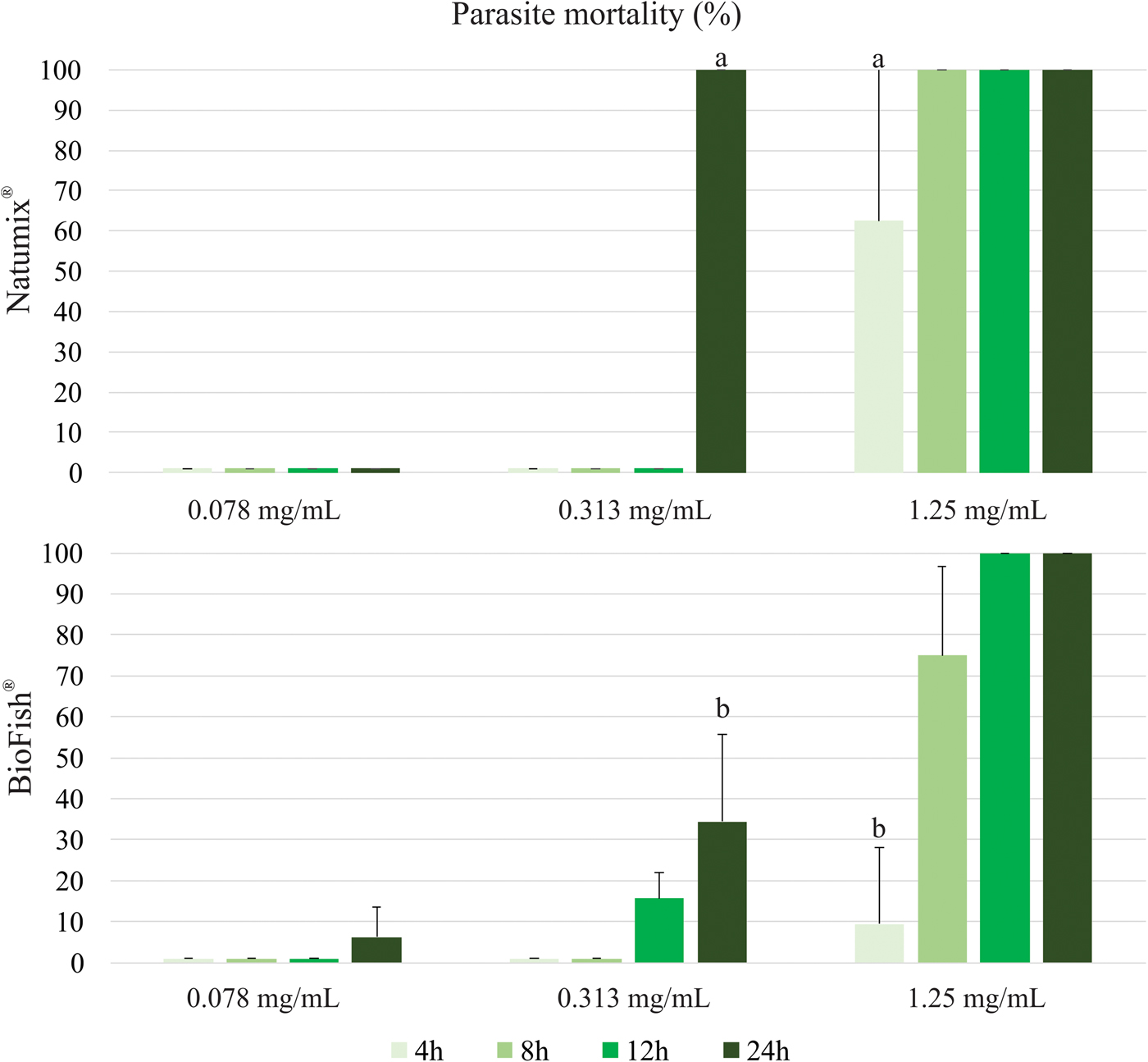
At the lowest concentration (0.078 mg/ml), the onset of parasite mortality was observed in the group exposed to BioFish® after 24 h of analysis. However, this result did not represent statistical significance compared to the control group or the group exposed to Natumix® (P > 0.05) (fig. 1).
Mortality (%) of acanthocephalan Neoechinorhynchus buttnerae exposed to Natumix® and BioFish®. Different letters indicate statistical difference (P < 0.05) between the products tested within the same time and of the same concentration.

At the intermediate concentration (0.313 mg/ml), after 24 h of testing, both products presented anti-acanthocephalan effects, differing from the control groups (P < 0.05). However, Natumix® presented significantly higher activity (P < 0.05) compared to BioFish® (fig. 1).
Using the highest concentration (1.25 mg/ml), after 24 h of testing, both Natumix® and BioFish® products culminated in 100% mortality of the parasites. However, after only 4 h of testing in this higher concentration, Natumix® killed approximately 60% of the parasites, while BioFish® killed approximately 10%, presenting a statistically significant difference (P < 0.05) (fig. 1).
During the test, it was observed (with the naked eye and microscopically) that both commercial products caused swelling in the body of the parasite and subsequent death.
Acute toxicity
Natumix®
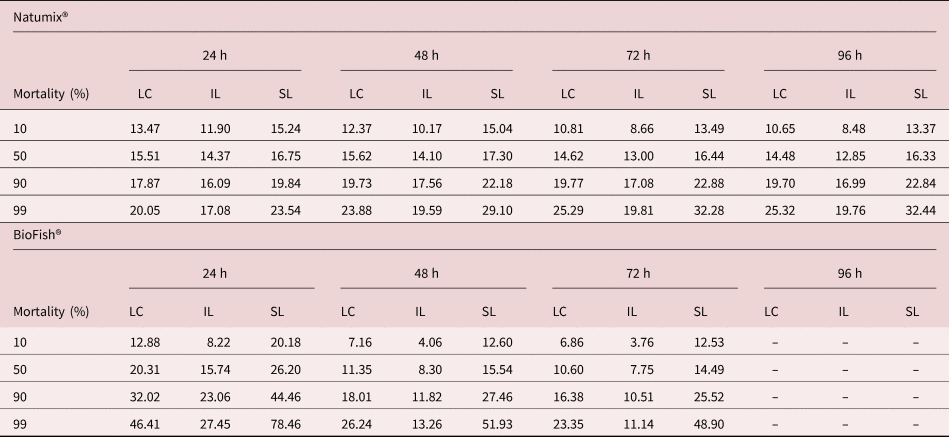
Based on the results of LC50 in the acute toxicity test (table 1), Natumix® was classified as slightly toxic. The LC50–24h was 15.51 mg/l, LC50–48h was 15.62 mg/l, LC50–72h was 14.62 mg/l and LC50–96h was 14.48 mg/l. (table 1).
Estimation of lethal concentrations (mg/L) of nutraceuticals (Natumix® and BioFish®) for tambaqui Colossoma macropomum.

LC, lethal concentration (mg/l); IL, inferior limit (mg/l); SL, superior limit (mg/l).
BioFish®
The toxicological classification of BioFish® was identical to Natumix®, as it was also classified as slightly toxic to tambaqui; however, the LC values differed from one another: LC50–24h was 20.31 mg/l, LC50–48h was 11.35 mg/l and LC50–72h was 10.60 mg/l. The LC50–96h was not calculated by the regression analysis, since the three highest concentrations of the five doses tested killed 100% of the fish, making it impossible to calculate (table 1).
Discussion
Based on the literature review of the treatment of fishes infected by acanthocephalans worldwide, we noted that most of the publications are outdated – for example, evaluating the use of chemotherapeutic agents such as bithionol (Nakajima et al., Reference Nakajima, Ota and Egusa1975; Kabata, Reference Kabata and Kabata1985), pyrvinium pamoate (Taraschewski et al., Reference Taraschewski, Mehlhorn and Raether1990), loperamide, niclosamide (Taraschewski et al., Reference Taraschewski, Mehlhorn and Raether1990) and oxyclozanide (Kumari, Reference Kumari2006). However, Oliveira et al. (Reference Oliveira, Majolo and Brandão2019) studied the effect of eight anthelmintic drugs (albendazole, levamisole, mebendazole, fenbendazole, emamectin benzoate, ivermectin, loperamide and praziquantel) against N. buttnerae due to its importance in aquaculture in South America. It is known that the use of these substances depends on the approval and regulation, following the rules of each country. Notably, none of these substances are approved for use in tambaqui. Therefore, research on nutraceutical products that are already commercially available is desirable. Once the efficacy against the pathogen is proved, it can provide the choice of a new drug for treatment or indicate its traditional use to at least decrease the level of parasitism. This was the first study with emphasis on the use of Natumix® or BioFish® against acanthocephalans. It was observed that both commercial products showed activity against the parasite, whose mortality was characterized by their swollen bodies.
Natumix® consists of a blend of essential plant oils that are known to have a cytotoxic effect causing permeabilization of the membranes of eukaryotic cells (Bakkali et al., Reference Bakkali, Averbeck, Averbeck and Idaomar2008). This mechanism of action of essential plant oils has been described for fish parasites, where swelling was followed by lysis in protozoans (Zhang et al., Reference Zhang, Xu and Klesius2013; Valladão et al., Reference Valladão, Gallani, Ikefuti, Cruz, Levy-Pereira, Rodrigues and Pilarski2016) and flatworms (Costa et al., Reference Costa, Valladão, Pala, Gallani, Kotzent, Crotti, Fracarolli, Silva and Pilarski2017) due to external liquid inflow. Lysis did not occur in the acanthocephalan N. buttnerae, which shows stronger body structure compared to the microscopic protozoans and flatworms; nevertheless, the swelling of the parasite was evident. Therefore, the major evidence is that Natumix® acts as a permeabilizing agent against the acanthocephalan.
The effect of Biofish® on N. buttnerae was identical and this may be due mainly to its active components being based on lactic acid and citric acid. It has been described that lactic acid has antimicrobial properties due to the reduction of the pH of the medium and it functions as permeabilizer of the outer membrane of gram-negative bacteria (Alakomi et al., Reference Alakomi, Skyttä, Saarela, Mattila-Sandholm, Latva-Kala and Helander2000) – that is, this acid alters the cellular osmotic stability. According to the literature, citric acid has also been reported to have an important permeabilizing agent for bacteria (Helander & Mattila-Sandholm, Reference Helander and Mattila-Sandholm2000). The effect of both acids (lactic and citric) on acanthocephalans is unknown; however, we have shown that they are the main cause of the permeabilizing effect of BioFish® against N. buttnerae, as it also culminated in swelling followed by the death of the parasite.
A positive point for the study of Natumix® and BioFish® is that these products are already present on the market and may be effective in reducing parasitosis even when included in the diet as nutraceuticals. These results may also encourage companies to conduct further research to register products as therapeutic. Now the challenge is to develop in vivo treatment protocols. For example, according to Guambe (Reference Guambe2017), the inclusion of BioFish® in the feed (200 mg/g) was effective in reducing infestation of the ectoparasite I. multifiliis in Jundiá R. branneri.
According to the acute toxicity classification for aquatic organisms (Zucker, Reference Zucker1985), where LC50 results are classified according to the concentration ranges (<0.1 mg/l is very highly toxic; 0.1–1 mg/l is highly toxic; >1 ≤ 10 is moderately toxic; >10 ≤ 100 mg/l is slightly toxic; >100 mg/l is practically non-toxic), both Natumix® and Biofish® were classified as slightly toxic. With this result, the products can be considered promising for different uses in the target fish (tambaqui), as they are among the lower classes of toxicity for the species. The lower toxicity effect also facilitates a possible market registration for use as a therapeutic (antiparasitic) agent. As a comparison with a known molecule, trichlorfon (the active ingredient of the only product registered as parasiticide for fish in Brazil) was described as extremely toxic to tambaqui, since its 50% LC was lower than 0.1 mg/l (Rocha, Reference Rocha2009).
In conclusion, both commercial products (Natumix® and BioFish®) tested in this study presented anti-acanthocephalan effects, making these promising for use in a monotherapy. Natumix® showed stronger activity even at lower doses. In addition, because the products have been described as permeabilizing agents, they may also be used as adjuvants in combination therapies.
Acknowledgements
The authors thank Adalberto Francisco de Jesus for the donation of the BioFish® product, Marcelo Toledo for the donation of the product Natumix® and Alexandre Honczaryk for the donation of the healthy fish for the experiments.
Financial support
This work was supported by the Brazilian National Council for Scientific and Technological Development (CNPq) (G.M.R.V., grant number 427325/2018-8), (G.T.J., grant numbers 402434/2016-1, 405224/2017-6) and financed, in part, by the Coordenação de Aperfeiçoamento de Pessoal de Nível Superior – Brasil (CAPES), finance code 001 (G.M.R.V., grant number 88881.200614/2018-01).
Conflicts of interest
None.
Ethical standards
The authors assert that all procedures contributing to this work comply with the ethical standards of the relevant national and institutional guides on the care and use of laboratory animals. The present study was approved by the Ethics Committee on Animal Use (CEUA) of Nilton Lins University (protocols 002/2018 and 009/2019) following the ethical principles of the Brazilian College of Animal Experimentation (COBEA).