It is, perhaps, testament to the remarkable nature of the subject that one of the less arresting stories told by Roger Manning in his pioneering study of unlawful hunting in Tudor and early Stuart England is of the exploits of Sir Alexander Culpeper of the parish of Goudhurst in the Kent Weald. Born in 1581, he ‘had become a hardened deer-stealer by the time he was 24 years of age’.Footnote 1 It was not as if the young man had no choice but to hunt other men's deer on other men's land if he wanted to pursue the passion he shared with Queen Elizabeth and King James. Although the trials and tribulations of Sir Alexander's recusant grandfather and namesake seem to have forced a reduction in its size, at the turn of the century the Culpepers of Goudhurst still maintained a deer herd in their park at Bedgebury, and Sir Alexander's marriage in 1602 to Elizabeth, daughter of Thomas Roberts, also gave him opportunities to hunt in his father-in-law's deer park at Glassenbury in Cranbrook.Footnote 2 But hunting per se was not really what mattered to the young Sir Alexander Culpeper. What mattered was staking a claim to gentlemanly prowess, and in his mind that meant killing someone else's deer on someone else's land; provided, that is, the stakes did not get too high. According to Star Chamber stories, between October 1601 and February 1606, he made frequent, mostly nocturnal but occasionally brazen and sometimes violent forays in the company, among others, of his Roberts family relatives into nearby Sissinghurst park, the property of Henry Baker, a minor, who was heir to one of the largest gentry fortunes in Kent. He also joined with Sussex gentlemen, including Thomas Stillion of Mayfield, ‘a great and common hunter of deer’, in killing deer and assaulting keepers in Ashdown forest in 1604, and in poaching at Hamsell park near Mayfield in 1605. Sir Thomas Waller, the owner of Hamsell park, who took his complaint about Culpeper and Stillion to Star Chamber in 1606, also suspected them of hunting in his home park of Groombridge.Footnote 3
In comparison with those of many gentry chronicled in Hunters and Poachers, Culpeper's exploits were restrained. ‘There is’, Manning argues, ‘little danger of overemphasizing the sheer love of violence that aristocratic sportsmen displayed’.Footnote 4 ‘Knocking a gamekeeper on the head was half the fun of breaking into a deer park, and hunters invariably went armed and armoured for combat’.Footnote 5 Often, poaching raids were ‘a disguised form of a challenge to a duel’, and death or serious injury commonly resulted when the challenge was met on the ground by park owners or their servants.Footnote 6 Daniel Beaver's recent study of ‘the violent negotiations of gentle status integral to the culture of the hunt’ in the forests of pre-civil war England distinguishes between the ‘ritual violence of the hunt’ and ‘the instrumental violence of practical coercion’ that was frequently entangled with it and insists that:
A knowledge and expertise in the art of the hunt informed gentle status, a masculine quality essential to the successful exercise of office and especially of judicial power. Gentlemen perceived the hunt as a school of honor and gentility, a testing experience that prepared the mind for magistracy.Footnote 7
There is no doubt some truth in this suggestion, but Manning's stress on the reluctance of many gentry to acknowledge constraints on their right to hunt remains more compelling, and it was this that led him to conclude that ‘in the early modern period, aristocrats and gentry were much slower to accept the dynastic state and the rule of law than has generally been supposed’.Footnote 8 At the very least, the modern historiography of hunting cautions against too ready an acceptance that ‘reconciliatory political culture’ predominated in early modern England.Footnote 9 It can certainly be argued that Manning makes insufficient allowance for the hyperbole characteristic of bills of complaint tendered to the court of Star Chamber, and for the fact that recourse to the courts sometimes signals a plaintiff's refusal to respond to warlike challenges or perceived slights by engaging in violent confrontations on the ground. Nonetheless, there remains evidence aplenty that a proportion of the Tudor and early Stuart gentry, including rural magistrates, regarded violence as a legitimate means of asserting their right to hunt wherever they pleased, and thus to display their gentlemanly credentials at will through participation in the violent rituals of the hunt.Footnote 10 Not for nothing did Gervase Markham recommend in 1616 that a deer keeper's lodge should be built like a fort with windows at angles or with loopholes ‘either to shoot, cast stones or scalding water’ to repel invaders.Footnote 11
There was, however, rather more to the incursions into Sissinghurst park in the opening years of the seventeenth century than a few established local gentry displaying ‘that tendency towards violence that was still inherent in aristocratic culture in the early modern period’.Footnote 12 Sir Alexander Culpeper may have led a large number of breaks into the park after 24th October 1601, the earliest date on which he was said to have forcibly entered it, but as one Star Chamber case Manning overlooked makes clear, nighttime raids on Sissinghurst park by small groups of blackened-faced poachers had been taking place for at least eleven months before Culpeper came on the scene. Indeed, according to the account of events submitted to Star Chamber by Sir Thomas Baker, Henry's uncle, who was guardian of the family estate until Henry reached majority in March 1607, park breaks in the months before October 1601 were neither led by, nor involved, any gentlemen; rather they were organised and conducted principally by a small number of Cranbrook clothiers.Footnote 13
After October 1601, clothiers may have made common cause with Culpeper and been happy to allow him to take the leading role, but it was men who made at least part of their living in the textile trade, not country gentlemen or their servants, who comprised the majority of Culpeper's poaching gang. While insisting that they had ‘other accomplices and confederates unto your subject as yet unknown’, Sir Thomas Baker named altogether thirty-seven participants in, or promoters of, raids on Sissinghurst park over the five and a quarter years of intermittent mayhem his three Star Chamber complaints alleged. Of the twenty-six whose occupation or status can be determined, only four, apart from Culpeper himself, were established gentlemen, to three of whom he was related by marriage: Edward and Richard Roberts, who were younger brothers of Thomas Roberts, head of the Glassenbury branch of the family, and Walter Roberts, who was Thomas's teenage son and Sir Alexander Culpeper's brother-in-law. The rest comprised nine clothiers, five clothworkers, two butchers, a hatter, a shoemaker, a yeoman, a labourer, and the innkeeper Thomas Lake.Footnote 14
Given that perhaps as many as one in four of the local male population found employment in the textile industry, one might obviously expect to find clothiers and clothworkers represented within any sizeable Cranbrook poaching fraternity, but clothiers in particular constituted a far higher proportion of identifiable promoters and participants in raids on the deer park than they did of the local population. No doubt the prospect of the thrill of the hunt and the adrenalin of the risk appealed as much to some of the clothiers gathered in Lake's alehouse on 16th November 1605 as it did to Sir Alexander Culpeper and Richard Roberts, who joined them that evening to drink ‘great and excessive quantities of beer’ before five of them moved off at eleven o'clock to hunt in Sissinghurst park.Footnote 15 The use that night of buck stalls which might trap several deer at a time and the presence of two butchers among Culpeper's poaching fraternity hint also at a commercial agenda that may have attracted all its members.Footnote 16 A poacher might earn as much in a night as an artisan could make in a month, and Manning found ‘many knights and esquires holding the king's commission of the peace who poached royal deer in order to supply a growing commercial market for venison’.Footnote 17 Yet Cranbrook's clothiers and clothworkers had particular cause to relish poaching in Sissinghurst, for the deer park was a potent symbol of the power of a family whose wealth rested in part on a Wealden commercial empire the most conspicuous local manifestation of which, the ironworks, they had long regarded as wholly injurious to the cloth industry, but which despite prolonged campaigning they had been unable to persuade Elizabeth's government to shut down.
Section III of this paper says something more of poaching in Sissinghurst park at the turn of the century, but at the heart of what follows is an account of the reasons why, and the ways in which, Cranbrook's richer clothiers and their allies amongst the parochial elite sought, during the later sixteenth century, to negotiate the closure of the local ironworks. While much of the story can be told only in outline, the survival in the papers of Sir John Leveson, one of Kent's late Elizabethan deputy lieutenants, of two files of criminal examinations and correspondence largely between parochial officials, country justices, Leveson, and Kent's lord lieutenant, Lord Cobham, makes possible a close reconstruction of the tactics of Cranbrook clothiers and parish officials in the winter of 1594/5. Events that winter unfolded eighteen months after parliament had rejected a clothiers’ bill ‘for the maintenance of cloth-making’ in the Cranbrook region, six months after the death of Sissinghurst's long-time owner Sir Richard Baker, and in the wake of a harvest sufficiently bad to prompt the government to reissue the dearth order book.Footnote 18 The files were known to Peter Clark, but the brief account of developments at Cranbrook in 1594/5 that he offered as part of his survey of popular protest in late sixteenth and early seventeenth-century Kent leaves more to be said.Footnote 19
The examinations and correspondence are notable not least for the light they cast on the alacrity with which the ‘richer sort’ of clothier and their friends among other ‘chief inhabitants’ of Cranbrook parish were prepared to manipulate and mobilise popular discontent, or else deploy the threat of plebeian disorder, in pursuit of the clothier interest. This is not to say that all clothiers and their allies shared a common strategy in the winter of 1594/5. The story told in section II of this paper may be summarised as follows. Having failed in 1593 to secure parliamentary legislation curbing competition for wood fuel from local iron manufacturers, and having failed in 1594 in their efforts to reach an accommodation with John Baker, Sir Richard's heir, that would at least have shut down his ironworks, there are indications that some Cranbrook clothiers encouraged a conspiracy among poor weavers to sabotage Baker's hammer mill. This, however, was derailed by other clothiers who favoured harnessing the weavers’ desperation over low wages and spiralling food and fuel prices in support of a mass supplication to the crown for the suppression of the ironworks. This plan, in turn, was seized on by two ‘well affected’ officers of Cranbrook parish who wished simultaneously to cement their credentials as defenders of the common peace and to persuade higher powers of the virtues of the offer richer clothiers had made to John Baker, but which Baker had turned down. Pointedly invoking the threat of an unruly march on the court, they managed to persuade deputy lieutenant Leveson to lobby the privy councillor Lord Cobham on behalf of Cranbrook's wealthier clothiers. Unsurprisingly, however, a wartime central government keen to maintain ordnance production in the Weald was not about to give encouragement to region-wide opposition to ironworks by yielding to pressure for a deal that would result in the closure of John Baker's furnace and forge. Having roundly chastised his deputy for allowing himself to be played, Cobham ordered a crackdown on those agitating for the supplication to the crown. Thereafter, plans for a mass petition were probably quickly abandoned by clothiers as too dangerous, and perhaps as now redundant. After all, parish officers had managed to bring their proposition to the attention of a privy councillor, but to no avail. The clothiers were left to nurse their grudge, or find ways of venting their frustration on a softer target among the Baker family's possessions.
I
The Baker family had risen to riches and local prominence as a result of the political and financial acumen of the lawyer and long serving mid-Tudor Privy Councillor Sir John Baker, whose endorsement of the Marian burnings earned him the sobriquet ‘Butcher Baker’ from John Foxe.Footnote 20 Sir John was as acquisitive as he was religiously conservative. Having inherited just one tenement, he bequeathed an estate largely, but by no means entirely, in the Weald that included land in twenty different Kent parishes and extended south into Sussex.Footnote 21 Although there is no reference to it in Sir John's will, in 1601 Sir Thomas Baker claimed that a deer park had been carved out of woodlands in the environs of the family mansion at Sissinghurst in the early 1540s, by which time only the Robertses of Glassenbury and the Culpepers of Bedgebury owned land in the Cranbrook area on a remotely comparable scale.Footnote 22 Sir John's eldest son, Richard, who inherited the estate in 1558, certainly nurtured if he did not create the deer park that signified his family's elevation to the ranks of Kent's magnate gentry, and which is noted in the first edition of William Lambarde's Perambulation, published in 1576.Footnote 23 Covering probably more than 750 acres, Sissinghurst was undoubtedly one of the largest active deer parks in Elizabethan and early Stuart Kent.Footnote 24 In material as in symbolic ways, Richard consolidated the family fortune, although he did so by commercial enterprise rather than by emulating his father's success in occupying and profiting from a succession of high offices of state. He did, however, contrive a long career on the Kent county bench. If he shared his father's conservative religious convictions, he was politic enough not to advertise them in the age of Elizabeth. Appointed as a Justice of the Peace in 1559, he was among those declared ‘outwardly conformable’ by the bishops in 1564, was knighted in 1573, served as sheriff of Kent in 1562–3 and 1582–3, was a commissioner for the restraint of grain during the dearth of 1586 and retained his place on the county commission of the peace until his death.Footnote 25
Whilst it is unlikely that Sir Richard Baker devoted much of his time to the burdensome administrative tasks that the poor laws of the 1570s assigned to Justices of the Peace ‘within every of their several divisions’, he did, at least occasionally, make an effort to oversee the governance of his home parish.Footnote 26 The Cranbrook vestry records are usually uninformative as to those attending meetings before 1596, but it is recorded that in 1565 Baker and fellow Justice of the Peace Walter Roberts were present to approve a decision to raise a church scot. Equally, after its foundation in 1574, Baker and Roberts sat on the board of governors of Cranbrook's grammar school alongside six clothiers, two merchants, a local farmer, and the vicar.Footnote 27 The more informative lists of attendees at parish meetings for the period after Sir Richard's death show that between 1597 and 1602 both Thomas Baker, Justice of the Peace, and Thomas Roberts, Justice of the Peace, were present each year to approve the accounts of the wealthier resident clothiers, farmers and traders who controlled the vestry and served as Cranbrook's churchwardens, overseers of the poor and highway surveyors.Footnote 28 Rarely is there anything in Cranbrook's laconic Elizabethan and early Stuart churchwardens’ accounts to suggest that the dinners vestrymen shared at ‘The George’ were other than harmonious as well as exclusive occasions, and, to be sure, their common interests as governors, not the least of which being keeping down the poor rate, were sufficient to encourage a fair amount of cooperation.Footnote 29
But the calculated ‘language of consensus politics’ that pervades vestry minutes is apt to mislead.Footnote 30 It would be quite wrong to suppose that the established local gentry and the self-styled ‘chief of the parish’ in Elizabethan and early Stuart Cranbrook were habituated to living exclusively, or even predominantly in congenial fellowship.Footnote 31 Recent work has shown that those who liked their Protestantism hot and those who preferred the cooler, statutory kind could no more avoid each other in vestry meetings than when abroad in the parish, where there was plenty of religious controversy during the later sixteenth century.Footnote 32 Yet had religion occasioned no division whatsoever, other rivalries would have sufficed to ensure that relations between members of the local governing class were often characterised by conflict as much as cooperation. The feud between the Bakers and the Robertses arising from the poaching in Sissinghurst of Thomas Roberts’ son and son-in-law meant that after 1602 it was seven years before the heads of the two families again attended Cranbrook vestry meetings together.Footnote 33 The most potent and enduring source of rivalry besides religion was commercial.
Between the 1560s and the early 1590s, the population of Cranbrook rose from 2000 to 3000. The six parishes bordering it also saw population increase, albeit by a more modest ten to fifteen per cent.Footnote 34 Although the area supported a wide range of crafts and trades, one quarter of all surviving inventories for its residents covering the period 1570 to 1599 indicate employment in the cloth industry.Footnote 35 ‘Clothing . . . in the Weald of Kent’, Lord Cobham declared in 1568:
Is the nurse of the people, so that in maintaining clothing the people are maintained; decay clothing and the people decay . . . the making of a broadcloth consisteth not in the travail of one or two persons, but in a number, as of thirty or forty persons at the least, of men, women and children.
These remarks were made in support of a successful application for a licence to export unfinished Kent cloth, notwithstanding an Act passed in 1566 prohibiting such exports, which, Cobham claimed, had been responsible for there being ‘1,000 cloths less yearly made’ in Cranbrook ‘than hath been in the years past . . . so that daily idleness and poverty greatly increases’.Footnote 36 In truth, however, by 1568 the economic climate characterised by buoyant domestic and continental demand for broadcloth that had underpinned the expansion of the Wealden textile industry during the late fifteenth and early sixteenth centuries had given way to one marked by increasing competition in a diversifying industry, changing fashions in dress, and faltering demand for broadcloth, especially in continental markets where English cloth was no longer as price-competitive as it had been.Footnote 37 Moreover, for a generation after 1568, the commercial problems facing those trying to sell English old draperies to European consumers were compounded by frequent and often major disruptions of overseas trade caused by the revolt of the Netherlands, the final destruction of the Antwerp entrepôt in the wake of the sacking of the city in 1576, civil strife in France, and war between England and Spain from 1585. Not until the shadows of war began to lift from the European scene at the turn of the century did things improve; Kent's broadcloth industry enjoyed one final ‘boom decade’ in the years after the 1604 peace treaty with Spain.Footnote 38
From as early as the 1520s, the cloth industry in the Cranbrook area was dominated by a handful of rich clothiers. The Couchman, Courthop, Lynch and Sharpe families each produced wealthy clothiers throughout the sixteenth century, while the Weller, Dence and Sheaffe families did so in the Elizabethan period. Without exception, the clothiers who managed not merely to survive but to prosper despite the more challenging commercial climate for broadcloth producers in the later sixteenth century were also landowners who, to varying extents, financed cloth manufacture from rents paid by tenants and, in turn, invested profits from the cloth trade in property that could be leased out. Peter Courthop, perhaps the richest of Cranbrook's clothiers at his death in 1567, left 241 acres besides moveable goods valued at almost £1800 while the 200 acres or so that the clothier Stephen Sharpe owned on his death in 1573 were leased to twenty different tenants. John Sharpe died in 1613 leaving a personal estate valued at £2689. His farm goods alone, which represented a mere five per cent of his personal wealth, were worth more than the entire estate of most Wealden farmers. Successful clothier-landowners may have ‘rarely deserted manufacturing for the life of a petty squire’, but they acquired greater wealth than all but the major gentry families of the locality, while their property investments staked claims to gentle status as surely as they provided hedges against the vagaries of the market for textiles.Footnote 39 Beneath this elite, however, were the many Cranbrook clothiers far less generously cushioned against difficult economic times. Only forty per cent of inventories that survive for clothiers in Cranbrook and five surrounding parishes for the period 1570 to 1599 were valued at more than £100.Footnote 40
In the interest of maximising manufacturing profits, besides drawing on the resources at their disposal as rentiers, the clothiers of Cranbrook adopted a ruthless approach to their employees. Zell estimates that at the time Cobham was describing clothing as ‘the nurse of the people’, about one in five of the entire Wealden population worked as spinners. These were mostly women and earned the equivalent of a meagre two pence to three pence per day, which was usually paid in arrears and often considerably in arrears. Among those styled ‘weavers’ there were some who achieved a measure of wealth, occasionally because of the scale of their weaving business and the number of servants they employed, sometimes because they also operated as clothiers, but more often because they also held land and practised farming. However, half of the Elizabethan ‘weavers’ in Cranbrook and surrounding parishes for whom probate inventories survive left moveable goods worth less than thirty pounds, and all the indications are that the great majority of weavers, for whom there is no inventory, were ‘mere cottagers’, whose subsistence depended on income from a combination of the husband's weaving and day labour in agriculture and his wife's, and perhaps children's, employment in spinning. Since reluctance to extend what was in effect free credit to clothiers might jeopardise their future employment, weavers, like spinners, often had to wait a long time for payment for their work.Footnote 41 Furthermore, the expansion of the local labour supply and weavers’ habituation to by-employment meant that the whip was ‘firmly in the clothier's hand’ when it came to determining wages levels. It was used. In real terms, weavers’ wages fell throughout the later sixteenth century.Footnote 42 By the 1590s, Cranbrook and its neighbouring parishes were home to large numbers of cloth-workers who at the best of times were able only to eke out a bare subsistence, and the 1590s were not the best of times.
Since they required large quantities of firewood to heat their vats for washing and dyeing wool, clothiers were as concerned to minimise fuel costs as they were to hold down clothworkers’ wages. A few of Cranbrook's richest clothiers owned enough woodland to supply all their fuel needs: the 241 acres Peter Courthop bequeathed in 1567 included sixty acres of woodland, while the clothier-cum-gentleman Alexander Courthop left ninety-two acres of woodland and 290 acres of other land on his death in 1608.Footnote 43 Most, however, were to some extent dependent on buying fuel in what was increasingly a seller's market, as clothiers competed not only with each other and with those purchasing for their domestic needs, but also with wood export merchants and, above all, with a growing number of local ironmasters. Ironworks were prodigious consumers of wood. Fuel accounted for ‘about 60 to 75 per cent of the total costs in the whole process of smelting and conversion’ of ore to bar-iron, and fuel costs rose sharply with distance from furnaces and forges, the number of which doubled in the Weald between the 1550s and 1570s.Footnote 44 A 1574 survey alleged that 6542 acres of woods in eight parishes around Cranbrook had been felled over the previous twenty years, with forty-five per cent of the wood supplying the iron industry and the rest going to clothiers and for domestic fuel. Pressure on local wood supplies increased with the onset of the late Elizabethan wars, which generated strong demand for the ordnance manufactured in the region and for timber for shipping.Footnote 45
Since any attempt to petition against each other's claims on local fuel supplies would have raised insuperable rhetorical problems, Cranbrook's clothiers joined forces in blaming exorbitant demand from ironmasters for the high fuel prices that reduced their profit margins. They were, however, careful to portray their opposition to ironworks as motivated by a public-spirited desire to prevent the exhaustion of local wood supplies and the crippling of an industry that provided vital employment for a high proportion of the large local population. After promoting two bills in parliament in 1581 for the prohibition of further ironworks and the preservation of local woods, neither of which reached the statute book, the clothiers did achieve a measure of success in 1585 with the passage of legislation forbidding the erection of ironworks in the Weald other than on existing sites or where the owner could supply sufficient wood from his own lands.Footnote 46 However, their goal remained a ban on all new ironworks and on the use in existing furnaces and forges of any wood other than that growing on lands already owned by their proprietors. In March 1593 the clothiers promoted a bill to this effect covering the area within an eight-mile radius of Cranbrook, which they advertised as necessary ‘for the maintenance of cloth-making in the parish’ that had ‘fallen into decay’. However, amidst booming wartime demand for the products of local ironworks, including that of the Queen's gunfounder, Thomas Johnson, at Horsmonden, there was never any chance that the clothiers’ bill would succeed. It was refused committal in May 1593.Footnote 47
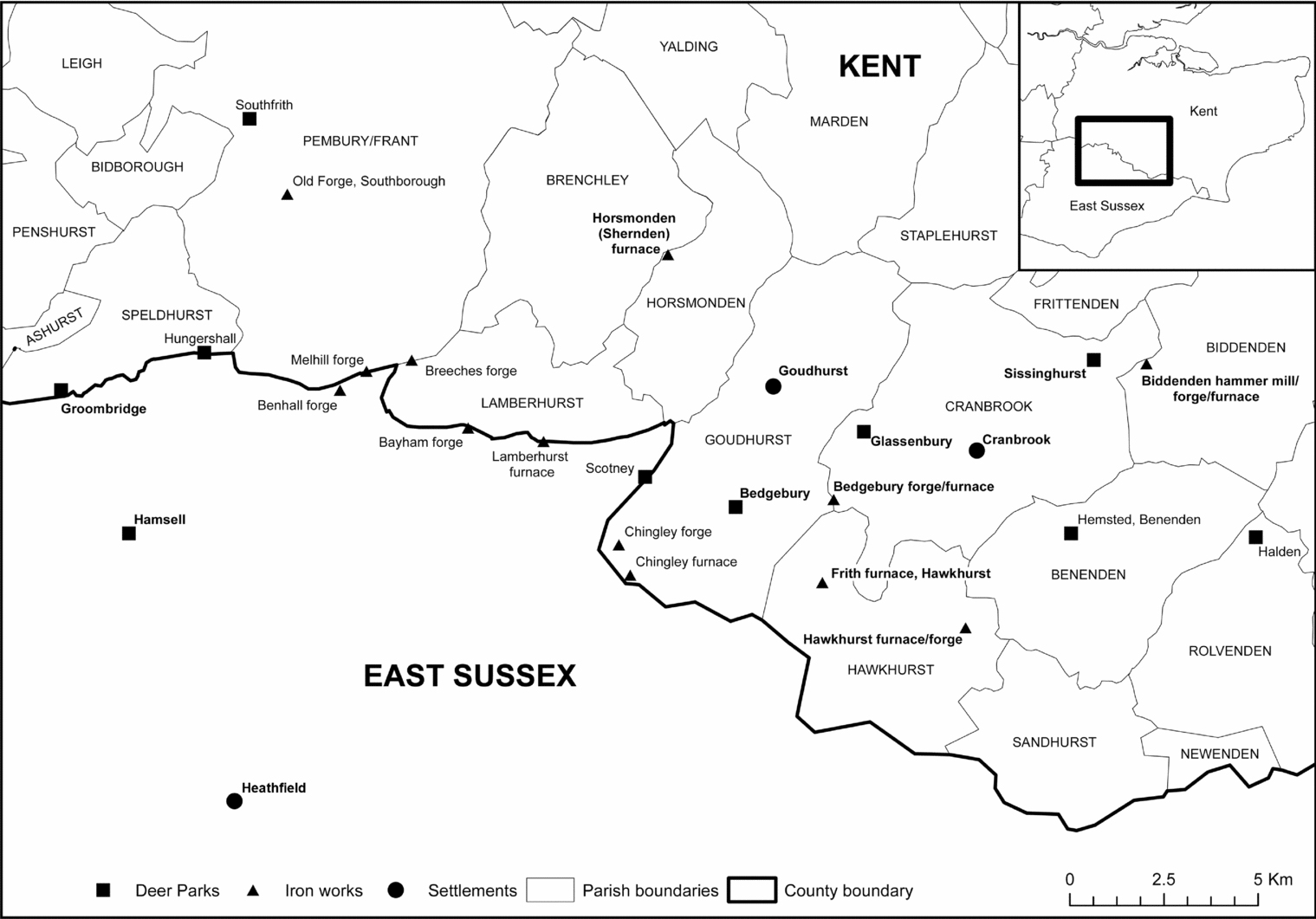
Deer parks and ironworks in the Cranbrook area during the late Elizabethan period.

High on the list of those whom Cranbrook's clothiers judged responsible for the prices they were having to pay for wood was Sir Richard Baker, whose commercial strategy for consolidating his inheritance included significant investment in the local iron industry.Footnote 48 By 1570 he had ‘at his great cost and charges’ built ‘one hammer mill or iron mill or forge’ on ground in Biddenden, ‘within one mile of his dwelling house’ at Sissinghurst, and by 1574 he also owned Frith furnace, which was working ores in the parish of Hawkhurst, about four miles from the family seat.Footnote 49 Although he delegated responsibility for the entire operation to his founder when he was away from home, Baker never leased out his furnace or forge. His bountiful landed inheritance initially guaranteed the supply of raw materials to his ironworks, but it was a series of significant purchases of woodland in the Cranbrook area that ensured that throughout his life he retained control over the supply of raw materials he required, as well as the various stages of iron manufacture. He was one of very few ‘magnate ironmasters’ in the Elizabethan Weald ever to achieve such complete vertical integration. In turn, however, his woodland acquisitions nurtured an ‘ancient hatred against Mr Baker's iron mill’. This was so pervasive among Cranbrook's parochial elite that Lord Cobham concluded that nobody could be trusted to report all they knew of the plans to halt its operation that were concocted locally in the months following Sir Richard's death in May 1594.Footnote 50
II
One of the strategies the clothiers devised to reduce local competition for woodfuel after the failure of their 1593 campaign for statutory legislation was revealed by the Horsmonden clothier John Austen in January 1595. Responding to questions from Justice George Rivers arising from a complaint by the Queen's gunfounder, Thomas Johnson, that ‘secret speeches blown abroad’ indicated local plotting to destroy Johnson's furnace, Austen explained that following parliament's rejection of their bill, which as he ‘remembreth was to put down all the ironworks within seven miles of Cranbrook’, there was ‘a general consent’ among the clothiers ‘that if they could by any honest and godly means they should suppress the said works’.Footnote 51 Pressed on what that meant, Austen said they had agreed where necessary to attempt to overthrow the titles of the lessees of ironworks, ‘or otherwise’ to negotiate ‘leases in reversion of the owners of the freeholds of the said works’.Footnote 52 Of course, in the case of Sir Richard Baker's Biddenden and Hawkhurst ironworks there were no lessees to dislodge, since Baker had owner-occupied them. It seems likely that as it became clear in the wake of Sir Richard's death that his eldest son and heir, John Baker, had no intention of continuing his father's policy of owner-occupation, hopes had at first risen among Cranbrook's richer clothiers that an end to the heavy local consumption of wood by the Baker family's furnace and forge might be brought about by the simple expedient of their buying or leasing the land on which the ironworks stood, as well as the local woodlands that supplied them, and halting production at the works. But such overtures as the clothiers made were turned down by Baker.
In early December 1594, John Baker journeyed from London to the family seat at Sissinghurst.Footnote 53 There was much local speculation in advance as to the purpose of his visit; some presumed he was coming ‘to enquire for his deer that is stolen’ from Sissinghurst park, but others were surely correct in surmising that the trip had more to do with ‘the hiring out of his ironworks’.Footnote 54 As he explained to Richard Dering, the Pluckley Justice of the Peace whom he called in to assist him on his arrival at Cranbrook, he had for some time been determined for ‘his more quietus and profit’ to lease out the local furnace and hammer mill his father had established, together with the woods that supplied them, as a going concern, but as news of his decision had ‘spread abroad’ during the autumn, so too had ‘mutinous speeches tending at the least to great disorder’, some of which had been reported to two of his servants. Dering's efforts ‘to find out the ground and truth of the matter’ soon led him to conclude that ‘great dislike’ of Baker's decision was felt as much among Cranbrook's ‘richer sort’ as among those poor, ‘very licentious in speech’ whose loose talk in November had sometimes been of plans to ‘cut up Mr Baker's hammer pond’.Footnote 55
During the late autumn of 1594, while Cranbrook's ‘richer sort’ nursed what Justice Richard Dering was to call their ‘grudge’ at John Baker's decision, the poorer sort of the parish were struggling merely to feed their families and keep warm.Footnote 56 The Weald was ordinarily dependent on grain imports to meet local demand, but these were scarce following the bad harvest and for much of the population grain quickly became very hard to afford, while high woodfuel prices were an even more pressing concern for domestic consumers as winter approached than they were for clothiers. On 8th November the Privy Council ordered Kent's Justices of the Peace to enforce the reissued dearth order book, but as paternally minded local Justices of the Peace knew, it took time to convene local juries, organise grain searches and direct available stocks to the markets where they were needed. In addition, there would be resistance from those farmers who saw ‘no reason’ in the dearth orders, as well as reluctance to enforce them among those on the county bench whose sympathies lay with commercial producers.Footnote 57 Two months later, on 11th January 1595, deputy lieutenant Sir John Leveson told Lord Cobham that despite some Justices of the Peace having given the matter ‘the best furtherance’ they could, ‘several juries’ had ‘but newly delivered in their presentments, so as no part of the shire hath received a full distribution of that corn which must be presently sent to sundry markets’.Footnote 58
Reporting the outcome of his enquiries on 13th December into recent events at Cranbrook, which he was plainly intent on playing down, Justice Dering chose to tell Sir John Leveson that he thought the ‘richer sort’ grudged John Baker's leasing of his ironworks but ‘inwardly’. That was not the conclusion Leveson was to reach as a result of the investigations he oversaw at the behest of a plainly irritated Lord Cobham. He, having received Dering's account of what he had done in the two days he had spent at Cranbrook on 21st December and judging these actions to be wholly inadequate, immediately urged Leveson, who lived at Halling, some fifteen miles from Cranbrook, and Sir Thomas Scott who, it transpired, was on his deathbed, to ‘take some pains therein for more security’.Footnote 59 Dering's reluctance to make much of events clearly stemmed from sympathy for the plight of ‘very poor men . . . greatly charged with children’ who were ‘as it seemed to me, sorry for their folly’. He decided that those brought before him on 13th December for their ‘lewd speeches’ threatening industrial sabotage should be bound over to be of good behaviour rather than imprisoned, hoping ‘rather to qualify their grudging minds than further to provoke them’.Footnote 60 His decision was supported by John Baker and by Sir Thomas Scott, who told Leveson on 23rd December that he thought Dering's actions ‘sufficient for the stay of this mutiny’.Footnote 61 Scott, who had strong paternalist credentials, had been pushing hard to implement the dearth orders in the area around his home at Smeeth, near Ashford, and had ordered ‘his own tenants to serve the market at reasonable prices’. His death on 30th December 1594 deprived the county bench of a weighty advocate of moral economic interventionism.Footnote 62
On 8th January 1595, Leveson told Lord Cobham of his own verdict that the ‘preaching’ of ‘mischief’ was ‘increased by the richer sort of the whole fellowship of the clothiers who repine much of Mr Baker's letting out of his ironworks’.Footnote 63 There was, however, perhaps more than one brand of ‘mischief’ being promoted by Cranbrook clothiers in the closing weeks of 1594. Some clothiers may have encouraged, if they did not devise, the conspiracy mooted in Cranbrook alehouses, manufacturing premises and domestic parlours during November 1594 to destroy the bay of the pond that supplied the waterpower for Baker's Biddenden hammer mill. That some clothiers urged the sabotage of the forge and some workers saw this as an opportunity to force concessions from their employers may be indicated by the reported words of an unidentified patron of widow Whittard's alehouse at the beginning of November: ‘what a world is this, the weavers now be at this point that they will not work except they have more wages, and when that is past there is a rumour that they will put down the hammer’. Other clothworkers, it appears, were at first convinced that with or without a promise of increased wages, it would be necessary to destroy the ironworks if there were to be any improvement in the availability of domestic fuel. At the ‘King's Head’ there was talk of ‘40 persons appointed to cut up’ Baker's pond because ‘there was a grudge among the people that they should have no wood’. By the end of the month, however, some erstwhile advocates of sabotage among Cranbrook's weavers were heeding advice that had been given to one of their number, Thomas Kempe, by the clothier John Wellard. On being told by Kempe in mid November of the plan to destroy the pond, he had counselled that ‘there be other ways for you, for this way there is no remedy but hanging, and to make uproars in the country it will be the worse for you’.Footnote 64 Determined to scotch the dangerous plans of ‘rascal knaves’, Wellard relayed something of what he had learned to ‘one of Mr Baker's men’. It would not then have been long before it was common knowledge in Cranbrook alehouses that Baker's servants had been tipped off.Footnote 65 Talk of pond-breaking began to give place to discussion of the less fatal strategies to which Wellard had alluded.
About ‘one month before Christmas’ Thomas Kempe attended a meeting at the Cranbrook home of John Milson. Both were employed as weavers ‘in the house of Daniel Wellard’, brother of John. At that meeting, Milson ‘took the names or marks and promises’ of some sixteen or seventeen weavers ‘to join in a suit to the clothiers for the amending of the wages of himself and other poor men that work under them, the said clothiers’. But that was not all that was under discussion that day, for Milson also:
Took the names or marks in writing of all the said parties, and their promises to join in a supplication to the Queen's Majesty (to be drawn by some worshipful man) touching the want of wood or corn and against all iron mills.Footnote 66
It seems likely that a mass supplication to the crown was what Wellard had in mind when he had spoken earlier to Kempe of ‘other ways’ to proceed against ironworks, and that the idea of a supplication originated among clothiers eager to harness popular distress in support of an attempt to persuade the government to take the measures to curtail the iron industry that earlier campaigns for parliamentary legislation had failed to obtain. Clothiers would have had no difficulty in endorsing complaints about local grain prices, and the weavers’ suit for a wage increase could be met with the reply that their wage and employment prospects would only improve if local ironworks were put down so that the costs of fuel for both clothiers and homes would fall.
Whoever's idea it was, by early January 1595 the local ‘constables and officers’ on whom Leveson was depending for news of events in Cranbrook were reporting that while ‘the heat of the stir’ to destroy Baker's hammer pond had ‘cooled’, the talk ‘among another sort of people not so-ill-minded we think’, was all of going ‘to the court with humble supplication to her majesty for the suppressing of the ironworks about us, and to this end there hath been solicitors from parish to parish and to divers people to join in that action’.Footnote 67 If testimony given by Thomas Kempe is any guide, the idea of a supplication that embraced their concerns also found a ready reception among the poor. According to Richard Dering, when he was examined on 13th December, Kempe was adamant that ‘“all the poor, all the poor”, often iterating’, meant ‘to go up to court to make complaint of corn, wood. etc’. Pressed ‘for a number, at length’ he had ‘answered two or three hundred’.Footnote 68 Questioned by Leveson in January, Kempe also claimed that at ‘about’ the time of the meeting at Milson's home, the weavers had received assurances that ‘the men of Biddenden would join to go with those others whensoever they would go, and the like hath been said of Benenden men’.Footnote 69
The proposal that large numbers should journey to court armed with a supplication to the Queen was to say the least bold. As Richard Hoyle has shown, although by the late sixteenth century it had long been acknowledged that subjects had the right to petition the crown, and to deliver petitions in the hands of a delegation, the central government was decidedly hostile to the gatherings of the commons out of which they often emerged, and was bound to view as a direct threat the prospect of a supplication accompanied by a crowd containing large numbers of the poor. As some of the commons assembled in Suffolk in 1549 were told, ‘it is not the part of quiet and obedient subjects first to assemble in numbers and so to make themselves (as were) a party against us’. Petitioning ‘reinforced by congregations of men could not be tolerated’.Footnote 70
One of many things for which Lord Cobham rebuked his deputy lieutenant in a remarkably bad-tempered letter dispatched on 9th January 1595 was Leveson's reliance on the chief inhabitants of Cranbrook rather than ‘such gentlemen as dwell thereby’ to investigate events in the parish.Footnote 71 To this charge, Leveson pleaded that he had been left with no choice:
I used the aid both of the constables and private persons for the apprehending of all the malefactors, for touching gentlemen I can learn of none to be there, Mr Baker, Mr Roberts, Mr Hendley being all at London with their families.Footnote 72
Nonetheless, Leveson told Cobham, he trusted that the men he had charged with reporting to him would thoroughly investigate any threat of disorder since they were ‘known to be rich, and thereby have cause to fear that if the rascally multitude should make an uproar they would first invade them who both hold them straight and have good booty to prey on’.Footnote 73 It is, of course, true that parochial elites and county gentry alike feared the many-headed monster. On the other hand, local governors, whether their sphere of responsibility was a single parish or a county division, were quite capable of emphasising the threat of plebeian uproar to encourage their superiors to be receptive to their own agenda, and of doing so in such a way as to represent themselves as solely interested in the maintenance of the common peace.Footnote 74 Such was the nature of enterprise in which Richard Taylor and Richard Jordan engaged on 7th January 1595.
Taylor and Jordan were two of the eight ‘constables and officers’ whom Leveson numbered among the ‘honest, well affected and . . . wealthiest inhabitants of Cranbrook’ and to whom he had entrusted the task of arresting those plotting to destroy Baker's hammer pond. On 7th January they wrote advising the deputy lieutenant, inter alia, of the supplication to the Queen being talked of in the parish.Footnote 75 They were anxious to stress that ‘in our consciences, we think these men which move the matter carry no ill meaning nor would undertake anything tumultuously’. At the same time, however, they were keen to point out that the supplicants were planning ‘in some unwonted and extraordinary number to go to the court’ and that ‘when such numbers are assembled and others of worser disposition cleave to them’ it was to be feared ‘the issue thereof will be dangerous, considering that it is not likely to be carried with so good discretion as were to be desired’. They concluded their letter:
Hoping that you will construe our good meaning to the best as wishing the peace and good of our country, and praying that by your good means the ground and true cause of these things may be looked into and carefully examined and such remedy applied as may be fit for such an evil.Footnote 76
Since they urgently required a warrant for the arrest of the weavers accused of plotting the destruction of Baker's hammer pond, Taylor and Jordan accompanied their letter to Halling, and there they availed themselves of the opportunity to apprise Leveson of the remedy they thought would avert all dangers. There was, they explained, ‘no reason that Mr Baker should convert his woods to ironworks’ since ‘certain wealthy clothiers would give to Mr Baker as much money for his woods only to be employed upon clothing as any ironmaster would do’.Footnote 77 His ‘honest’ and ‘well affected’ informants would mention no names, but Leveson emerged from the encounter having ‘gathered of myself’ that ‘the chief clothiers do favour underhand this suit to Her Majesty’.Footnote 78 Jordan and Taylor returned to Cranbrook with instructions ‘to attach any they shall find to solicit or further it’.Footnote 79
Nevertheless, their masterful piece of lobbying-with-menaces in the clothier interest had had the desired effect, at least insofar as Leveson was persuaded to importune central government, in the shape of the privy councillor Lord Cobham, on the clothiers’ behalf. On 11th January he wrote to Cobham explaining what Jordan and Taylor had told him, and then added that ‘seeing it is no loss to Mr Baker, if it might seem good to your lordship that Mr Baker were by some form or means persuaded to sell’ his woods ‘to the clothiers, it were a ready water to quench all this fire’.Footnote 80 This, however, was to overlook what from John Baker's perspective would have been the crucial issue. Wealthy clothiers might be prepared to match what any ironmaster would pay for woodland, but were they also willing to pay as much for the sites of the ironworks they intended to decommission as an ironmaster cognisant of and keen to exploit booming demand for their products? Baker's rejection of their offers suggests not, and privy councillor Cobham, who brought to bear a wartime government's perspective on the relative merits of the iron and cloth industries, was disinclined to persuade him to change his mind.Footnote 81
After 7th January, there seems to have been no more talk among Cranbrook's clothiers of a mass supplication to the crown. Perhaps it was thought that Jordan and Taylor had in their own way accomplished as much as could be achieved. But in any case, agitating for a procession to the court had become far too dangerous. On 9th January, the day after he heard from Leveson of the intended supplication to the Queen, Lord Cobham predictably ordered his deputy lieutenant to examine all who could be identified as ‘solicitors of the cause’ and to direct them to appear before the Privy Council.Footnote 82 He further suggested making those that ‘repine much at Mr Baker's letting of his ironworks . . . smart therefrom by bringing them into the Star Chamber, or by such other ways as Her Majesty shall think fit’. For good measure, he also upbraided his deputy for dismissing ‘upon his submission and tears’ one poor Cranbrook suspect who should ‘have been committed for example's sake to terrify others’, for accepting the assurances of constables that other suspects had fled when ‘you should not be so answered, nor they be credited in such a case’, and for trusting the Cranbrook parish elite ‘for your better information’. Finally, he warned Leveson:
I would be very sorry to see such disorders in the country or that Her Majesty should be in any such disorderly manner troubled. And therefore . . . be very careful to prevent both the one and the other that neither be attempted.Footnote 83
By 12th January, the local gentlemen, Thomas Roberts, Justice of the Peace, of Glassenbury and Mr Hendley had returned ‘from London to their houses in the country’. Perhaps they too had received a letter from Lord Cobham. Leveson had also recruited two other relatively local gentlemen, Mr Boys of Lamberhurst and Samuel Boys his son, ‘for the appeasing and preventing of any disorders . . . to have a watchful eye upon these parts’.Footnote 84
In the end, the plans of both Cranbrook's would-be industrial saboteurs and the supplicants to the crown came to nothing. The Baker family's hammer mill carried on for more than half a century, as did the clothiers’ complaints that the ironworks pushed up their fuel costs and undermined their trade.Footnote 85 But in the last decade of Elizabeth's reign, local resentment at the Baker family's Wealden commercial empire found expression in ways other than petitioning.
III
We can only speculate how often the ‘great store of game and conies’ in Sissinghurst park was subject to the depredations of poachers during the century before the civil war.Footnote 86 Almost no documentation of any kind pertaining to the criminal jurisdiction of Kent's Justices of the Peace exists for the years before 1593 or after 1617, and while indictments and sessions papers of various sorts survive in some bulk for the intervening period, the quantity of documentation varies considerably from one year to the next, and even at its fullest probably represents no more than a small proportion of what was originally generated. Engrossed county quarter sessions rolls exist only for the periods 1596–8 and 1601–5.Footnote 87
If the loss of most of the evidence of the work of Justices of the Peace in and out of quarter sessions is one major problem, the dark figure of unreported poaching is another. Although extant records of Kent assizes cover the whole of Elizabeth's reign, there is evidence of only eight indictments for poaching offences throughout the period, none of which took place in Sissinghurst park.Footnote 88 Of course, there were cheaper ways of dealing with a poacher than by indictment at quarter sessions or assizes, such as binding over, so as James Sharpe has noted, ‘it is hardly surprising that infringements of the game laws were very infrequently prosecuted at these courts’.Footnote 89 Yet the reluctance of much of the population of early modern England to regard the hunting of wild animals, including those within an enclosed park, as a crime must have meant that the reporting of poachers’ activities to the authorities was left largely to park owners or their servants.Footnote 90 Even if poachers were brought to trial, juries frequently refused to indict or convict violators of laws they considered unjust.Footnote 91 Keepers, for their part, were often torn between their duty to protect their master's game and their neighbours’ expectation that they be granted a certain latitude to hunt in their local park. Indeed, the dilemmas faced by keepers were in some respects not dissimilar to those confronting parish constables.Footnote 92 However, even where keepers felt no ambivalence about their responsibility to resist and prosecute poachers, the practical problems of detecting their activities were significant. The bigger the park, the greater the problem and at some 750 acres, Sissinghurst was amongst the largest deer parks in Kent. Much low-key poaching may simply have gone undetected.
Given the widespread visceral hostility in Cranbrook to the Baker family's ironworks, there is every reason to suppose that poaching forays into Sissinghurst park were commonplace by the 1590s. There was, as indicated above, some popular speculation in November 1594 that the main purpose of John Baker's impending visit was to ‘enquire for his deer that is stolen’.Footnote 93 Besides what we might term ‘protest’ or ‘grudge’ poaching, and commercial poaching, there was surely ‘subsistence poaching’, although of course forays might be spurred by a mixture of these motives.Footnote 94 It is clear from such quarter sessions papers as do survive for Elizabeth's last decade, that game poached in Sissinghurst park was sometimes served in Cranbrook households during the barren years of the 1590s. In December 1596, having witnessed a deer being killed in the park by a crossbowman who fled on being disturbed, Thomas Carpenter was delighted to have ‘happened on such a booty’ as he could make pasties from, and disappointed on returning with a helper to collect the carcass to discover that it had gone. He refused, nonetheless, to report the poacher, whom he had recognised, to Baker's deerkeeper.Footnote 95
In the same year, the apprentices of the Cranbrook weaver Peter Maye were ‘sundry times’ fed with the ‘head and necks of venison’, which their master served with the advice that ‘they were better eat that than nothing’.Footnote 96 Perhaps unable any longer to subsist as a weaver, by 1596 Maye had acquired a crossbow and was hunting two or three nights a week in Sissinghurst park and trafficking in venison and deerskins. Eventually arrested for possession of the crossbow, he was rescued on his way to Maidstone gaol in April 1597 by two men, one of them a clothier named John Weller, who was perhaps the ‘John Wellard’ who in November 1594 had advised weavers to find ‘other ways’ to respond to their desperate circumstances than sabotaging the ironworks. Whether Maye ever faced trial is unknown, but his rescue does not suggest that his nocturnal activities put him in much danger of the opprobrium of his neighbours.Footnote 97
By November 1601, incursions into Sissinghurst park were sufficiently frequent to prompt Thomas Baker to resort to Star Chamber in the hope of redress. Amidst the blaze of hyperbole customarily required in a bill of complaint, Baker identified two small poaching gangs, both led by clothiers. These, he alleged, operating separately over the previous year, had often hunted deer and conies at night and occasionally assaulted his deerkeeper and warrener. A third group, he explained, had helped itself to 200 carp from his Hawkhurst fishpond on 6th October 1601, and on 1st October a fourth group had forcibly evicted Baker's servant from his house in Betnames wood, which supplied fuel to Baker's ironworks.Footnote 98 Baker's resort to the prerogative court might have worked, had it not been for the arrival on the scene in October 1601 of Sir Alexander Culpeper, under whose gentlemanly coat-tails Cranbrook's avenging clothier-cum-commercial poachers were able to shelter for the next four years.
Called to account by Baker's second Star Chamber suit in June 1604, but able to take refuge behind a general pardon issued by James I, Culpeper hardly bothered to deny that between October 1601 and March 1603 he and his brother-in-law led at least seven night time hunting expeditions in Sissinghurst park involving up to a dozen men mostly drawn from the textile trade, during which many deer were killed and wounded. There was also a daytime incursion in June 1604.Footnote 99 At times, over the following eighteen months, Culpeper was diverted by the delights of the hunt in Ashdown forest and Hamsell park. But his Cranbrook fraternity occasionally regrouped, its exploits climaxing in a raid on Sissinghurst park in the early hours of 17th November 1605, which, according to the story Thomas Baker told Star Chamber in February 1606, led to wanton destruction of deer and a clash with Baker's servants that left them injured. His account of events that night is consistent with the findings of two inquisitions held at Cranbrook in December 1605.Footnote 100 This time, it required an elegant technical demurrer by Culpeper's counsel to deflect Baker's Star Chamber suit, and, facing other court challenges arising from his hunting expeditions elsewhere, he seems to have decided enough was enough.Footnote 101 At any rate, if Culpeper, or members of his fraternity, continued poaching in Sissinghurst park, no record of their activities remains in the increasingly patchy Kent assize and quarter sessions documentation that survives for the period after February 1606. Nor does it appear that any suits alleging further poaching in Sissinghurst park were lodged with the central equity courts after that date.
Of the nine identifiable clothier-cum-poachers named in Baker's Star Chamber suits, only Arthur Basden can confidently be identified among those for whom probate material has survived, because of the local rarity of his name. To judge from his modest personal possessions, valued at just twenty-five shillings at his death in 1615, Basden was emphatically not among Cranbrook's wealthier clothiers.Footnote 102 Thomas and Alexander Couchman shared a surname that did produce rich Elizabethan clothiers, but neither have full names that match men who left surviving evidence of conspicuous wealth during the early seventeenth century. A Thomas Couchman of Cranbrook, clothier, died in 1612 leaving moveables worth £161, another of the same name left moveables worth a similar amount in 1631, and a third Cranbrook clothier named Thomas Couchman died in November 1618 leaving a more modest inventory valued at ninety-nine pounds.Footnote 103 Of similarly middling status was the Alexander Couchman who died in 1617 leaving a house and lands in Frittenden and an inventory valued at seventy-nine pounds.Footnote 104 The clothier-poacher Alexander Weller, however, may have been a rich man, for a Cranbrook clothier of that name who died in January 1612 left four messuages, twelve parcels of land, cash bequests to his widow and three children totalling £360, and moveable goods valued at £789, while another Cranbrook clothier of the same name died in 1630 leaving unspecified ‘houses and lands’ in Cranbrook, cash bequests of £325 and an inventory valued at £587.Footnote 105 We can therefore add a desire to flex muscular claims to honourable status to the inventory of motives that may have inspired at least one Cranbrook clothier to hunt in the company of scions of the Culpeper and Roberts families.
The evidence throws up one other intriguing possibility. The clothier and aider and abettor of raids on Sissinghurst park named Peter Courthop may have been the Peter Courthop who, in 1613, purchased Bedgebury furnace. This was the furnace that in 1637 was being worked by John Browne, the royal gunfounder, of whom Cranbrook's clothiers complained in that year to the Privy Council over his consumption of wood.Footnote 106 If so, we should not be surprised. For all their opposition to Sir Richard Baker's ironworks, as individual entrepreneurs, Cranbrook's richer members were loyal above all to the maximisation of their own profits, however derived.
Nonetheless, there is more than a touch of irony about a poaching fraternity that made allies of Cranbrook clothiers and Sir Alexander Culpeper. For, like the proprietor of Sissinghurst, Sir Alexander Culpeper was heir to one of Kent's handful of Elizabethan ‘magnate ironmasters’. Bedgebury furnace was certainly owned by the Culpepers of Goudhurst in 1574 and 1588, and probably until it was sold to Peter Courthop in 1613.Footnote 107 Moreover, when in 1604 and 1605 Sir Alexander Culpeper took time off from poaching in Sissinghurst park in the company of Cranbrook clothiers, he spent days unlawfully hunting in Sussex with Thomas Stillion, whose family had made their late Elizabethan fortune operating a chain of ironworks across the Sussex weald.Footnote 108 But then, such federations of convenience were probably no more unusual in England during the late Elizabethan and early Stuart period than they are in contemporary society.
IV
Of course, Elizabethan gentlemen happily embraced the rule of law when it defended their immediate and apparent interests, but the real test of their commitment came when they were required to abide by, or as officeholders to enforce, laws that frustrated them or their friends. As the evidence of poaching marshalled by Manning shows, during the late sixteenth and early seventeenth centuries many gentlemen failed that test. Furthermore, while the ‘poaching magistrate’ may have been a rarity outside royal forests, evidence of large-scale sustained unlawful hunting has been uncovered in many regions of England, and can only have flourished ‘where corrupt magistrates protected poachers or were prepared to look the other way’.Footnote 109 It is certainly hard to believe that Justice Roberts was entirely ignorant of the participation in poaching raids on Sissinghurst park of his brothers, son and son-in-law.
As central governors knew well, it was not only in respect of restrictions on hunting that magisterial zeal for law enforcement was often in conspicuously short supply. As Michael Braddick has observed, while the crown ‘made constant reference to the duty of officeholders to act conscientiously’, privy council registers are peppered with rebukes issued to county benches for their failure to implement statutes ‘for the good and benefit of the whole state of the realm’, and with condemnations of magistrates animated only by ‘special causes of their own or their friends’.Footnote 110 The justices of late Elizabethan Kent certainly received their share of central government reprimands for failing to attend adequately to their duties. In April 1586, for instance, the privy council attributed grain shortages and high prices in the county's markets to ‘the remissness of some of you, being the commissioners appointed for the restraint of grain and victual’, to ‘whom special authority is given . . . to see the markets duly served’.Footnote 111 More remarkable, following a rash of food riots ‘in Aylesford, Yalding and Maidstone’ in December 1586, was William Lambarde's stinging criticism of fellow justices for their reluctance to order a ‘charitable distribution’ of grain ‘for the relief of the poorer people’ because ‘there be some of ourselves, divers of our friends and many of our farmers that shall be the losers by the execution of such an order’.Footnote 112 Like other privy councillors, Lambarde's close friend William Brooke, Lord Cobham, was often sharply critical of what he perceived as narrowly self-interested and lazy magistrates, and as we have seen, he took a particularly dim view of the initial response of local justices to events at Cranbrook in the winter of 1594/5. Nonetheless, in the lord lieutenant's judgement there was no option but to continue to rely on ‘such gentlemen as dwell thereby’ to ‘look narrowly’ into the conspiracies that had been hatched in the parish, since even those identified by deputy lieutenant Leveson as the most ‘honest and well affected’ among Cranbrook's chief inhabitants could not to be trusted to do so ‘in respect of their ancient hatred against Mr Baker's iron mill’.Footnote 113 Cobham's judgement was probably sound, and reminds us that there is no reason to assume that the parish officials on whose shoulders later sixteenth-century statutes heaped regulatory responsibility were any less likely than county magistrates to calculate their obligations to the state in an equation that was also attentive to narrow self interest or the expectations of neighbours and friends, sometimes at the expense of all other considerations.Footnote 114
There may have been clothiers encouraging weavers to sabotage John Baker's ironworks in the autumn of 1594, but it is most unlikely that they included any of Cranbrook's ‘richer sort’. Barely able to subsist as winter approached, clothworkers grumbled about fuel and grain prices, but also about their wages. Clothiers who had held down those wages yet lived conspicuously on the privileged side of the deep social gulf that divided late Elizabethan Cranbrook would surely have reasoned that a ‘rascal multitude’ once emboldened to destroy ironworks might well abandon restraint and attack those with ‘good booty to prey on’.Footnote 115 Reports of seditious plebeian speech lent credence to such anxieties: Thomas Delman of nearby Benenden was said to have remarked on 12th November 1594 that ‘he did hope to see the rich churles pulled out of their houses and to see them together by the ears in England before Candlemas day next’.Footnote 116
Counted among the ‘best sort’, the parochial governing class, Cranbrook's ‘chief clothiers’ had no intention of making common cause in any real sense with ‘lewd and ill-disposed persons of the baser sort’: those ‘froward, very beggarly’ weavers ‘licentious in speech’ and ‘charged with many children’, whom Justice Dering was to examine and come to pity.Footnote 117 Rather, they aimed first to ensure that their impoverished employees did not turn on them in the winter of 1594/5 and then to channel the force of popular discontent to their own ends by, as it were, appending plebeian requests for grain at reasonable prices to their own demand that ironworks be shut down, and by persuading poor clothworkers that only if that happened could domestic fuel prices fall and their wages rise. Although they failed to achieve their primary objective that winter, Cranbrook's clothiers and their allies among other chief inhabitants did succeed in manipulating to their own advantage the distress of the ‘baser sort’ of parishioner whose manners they so despised. That they were able to do so, however, perhaps discloses more about the inability of Wealden clothworkers to fashion their own robust sense of collective identity and common interest than it does about the political sophistication of their self-styled betters.