“Healthy wildlife populations, productive habitat for those populations, and access to subsistence hunting are all measures of our people's health.”
‒ Edward Itta, former Mayor of the North Slope Borough, Alaska (Glenn et al. Reference Glenn, Itta, Napageak, Lovecraft and Eicken2011)
INTRODUCTION
In the Arctic, rapid climate change has accelerated efforts to identify and project future trends in the habitats of marine birds and mammals. For example, based mainly on predicted loss of sea ice, polar bears (Ursus maritimus), walruses (Odobenus rosmarus), bearded seals (Erignathus barbatus) and ringed seals (Pusa hispida) have all been listed or considered for listing under the US Endangered Species Act. After earlier declines in Alaska breeding populations, the spectacled eider (Somateria fischeri) and Steller's eider (Polysticta stelleri) were listed as threatened, prompting delineation of habitat deemed critical to their recovery. Long-term spatial shifts in ice conditions and benthic prey for spectacled eiders have affirmed inevitable future change in the nature and accessibility of feeding areas (Lovvorn et al. Reference Lovvorn, Anderson, Rocha, Larned, Grebmeier, Cooper, Kolts and North2014, Reference Lovvorn, Rocha, Jewett, Dasher, Oppel and Powell2015). Increased shipping traffic and development of oil and gas reserves have further raised the importance of identifying habitat features and areas of special value for a range of taxa (Oppel et al. Reference Oppel, Dickson and Powell2009; Speer & Loughlin Reference Speer and Loughlin2011; Dickson & Smith Reference Dickson and Smith2013; Reeves et al. Reference Reeves, Ewins, Agbayani, Heide-Jørgensen, Kovacs, Lydersen and Suydam2014; Culloch et al. Reference Culloch, Anderwald, Brandecker, Haberlin, McGovern, Pinfield and Visser2016; Solovyev et al. Reference Solovyev, Spiridonov, Onufrenya, Belikov, Chernova, Dobrynin and Gavrilo2017).
Beyond concerns for the animals themselves, walruses, seals and eiders are also valued subsistence species for indigenous people (Braund & Associates Reference Braund1993a, Reference Braund1993b; Condon et al. Reference Condon, Collings and Wenzel1995; Byers & Dickson Reference Byers and Dickson2001). Access to these animals by hunters is greatly affected by annual and seasonal variations in nearshore ice conditions (Gearheard et al. Reference Gearheard, Matumeak, Angutikjuaq, Maslanik, Huntington, Leavitt and Kagak2006). The last one to two decades in the Chukchi Sea have seen decreased extent, thickness and stability of landfast ice, which extends from the shoreline and is attached to the sea floor (Druckenmiller et al. Reference Druckenmiller, Eicken, George and Brower2013; Mahoney et al. Reference Mahoney, Eicken, Gaylord and Gens2014). These changes have made spring hunting for bowhead whales (Balaena mysticetus) along the landfast ice edge, where eiders are also hunted, less predictable and more dangerous (Gearheard et al. Reference Gearheard, Matumeak, Angutikjuaq, Maslanik, Huntington, Leavitt and Kagak2006). Areas where ice conditions allow successful hunting are increasingly important.
Recent studies have shown that high densities of benthic prey in the nearshore Chukchi Sea are patchy and limited in extent (Lovvorn et al. Reference Lovvorn, Rocha, Jewett, Dasher, Oppel and Powell2015). Because sea ice can provide a valuable resting platform but can also exclude air-breathing predators from feeding areas, ice can have both positive and negative effects on accessibility and use of such habitats by these animals (Lovvorn et al. Reference Lovvorn, Grebmeier, Cooper, Bump and Richman2009, Reference Lovvorn, Anderson, Rocha, Larned, Grebmeier, Cooper, Kolts and North2014, Reference Lovvorn, Rocha, Jewett, Dasher, Oppel and Powell2015; Jay et al. Reference Jay, Fischbach and Kochnev2012). As a result, access to marine birds and mammals by hunters is expected to depend not only on ice conditions, but also on locations of suitable foraging areas relative to ice conditions.
For the Iñupiat of Arctic Alaska and the Inuit farther east in Canada (both hereafter referred to as Native people), subsistence is more than just obtaining adequate quantities of food (Wenzel Reference Wenzel2009). Culturally mandated sharing and exchange of wild game within the community is a primary means of promoting social cohesion and reciprocity; of caring for the elderly, sick or disadvantaged; and of transferring cultural expectations across generations (Condon et al. Reference Condon, Collings and Wenzel1995; Collings et al. Reference Collings, Wenzel and Condon1998; Beauparlant Reference Beauparlant2014). As a result, strong subsistence involvements are considered a principal means of maintaining healthy and resilient Native societies in the face of rapid cultural and economic change. Moreover, subsistence-based societies can be important allies in conservation, wherein a strong ethic of local stewardship can be more effective in conserving species than is unwelcome enforcement by outsiders (Haley et al. Reference Haley, Chartier, Gray, Meek, Powell, Rosenberg, Rosenberg, Lovecraft and Eicken2011). To conserve cultural diversity as well as biodiversity, both habitats needed by animals and access to those animals by subsistence hunters should be considered together in spatial planning (Brinkman et al. Reference Brinkman, Hansen, Chapin, Kofinas, BurnSilver and Rupp2016). This approach moves closer to ecosystem-based management to maintain a complement of ecosystem services to support the well-being of local people (Klein et al. Reference Klein, Chan, Kircher, Cundiff, Gardner, Hrovat and Scholz2008; Haley et al. Reference Haley, Chartier, Gray, Meek, Powell, Rosenberg, Rosenberg, Lovecraft and Eicken2011).
For Native communities along the northeast Chukchi Sea coast, eiders do not contribute a large fraction of meat consumed relative to marine mammals (Braund & Associates Reference Braund1993a, Reference Braund1993b). However, eiders are prized for the dietary variety they provide in early spring and are stored for special occasions throughout the year (Nelson Reference Nelson1981). Moreover, conserving threatened and sensitive eider populations is a high priority for management agencies, which currently delineate areas important for eiders separately from those for marine mammals. Given these considerations, we here use eiders as an example for integrating subsistence concerns into conservation planning.
During spring migration in April and May, common (Somateria mollissima) and especially king eiders (Somateria spectabilis) are hunted mainly from whaling camps along the edge of landfast ice. The landfast ice edge is separated from the moving pack ice by a lead of open water that varies from complete closure to over 100 km wide (Lovvorn et al. Reference Lovvorn, Rocha, Jewett, Dasher, Oppel and Powell2015). As a result, eider feeding and movements are not restricted to areas within the range of shotguns from the landfast ice edge. Rather, satellite telemetry has shown that eiders spread out across the open water, often several kilometres away from the ice edge, where they can access good foraging areas (Dickson & Smith Reference Dickson and Smith2013). King eiders, by far the main species hunted, used areas along the pack ice (outer) edge of open water as often as they used areas near the landfast edge. Thus, association of the edge of landfast ice with attractive feeding areas will affect the availability to hunters of eiders moving along the coast. Although the edge of landfast ice is highly variable within and among years (Mahoney et al. Reference Mahoney, Eicken, Gaylord and Gens2014), this edge is expected to occur within a zone that bounds most long-term variation.
In this paper, we explore the importance of two factors in the value of particular geographic areas for both eider feeding and eider hunting: (1) the locations of major patches of eider prey at profitable densities; and (2) long-term variation in the location of the landfast ice edge from which eiders are hunted. This information can help prioritize areas for conservation that maintain this social-ecological system in a fluctuating environment. Because much subsistence hunting throughout the Arctic occurs along ice edges, our methods should aid in incorporating the needs of indigenous people into planning of conservation areas throughout this circumpolar region.
METHODS
Study area
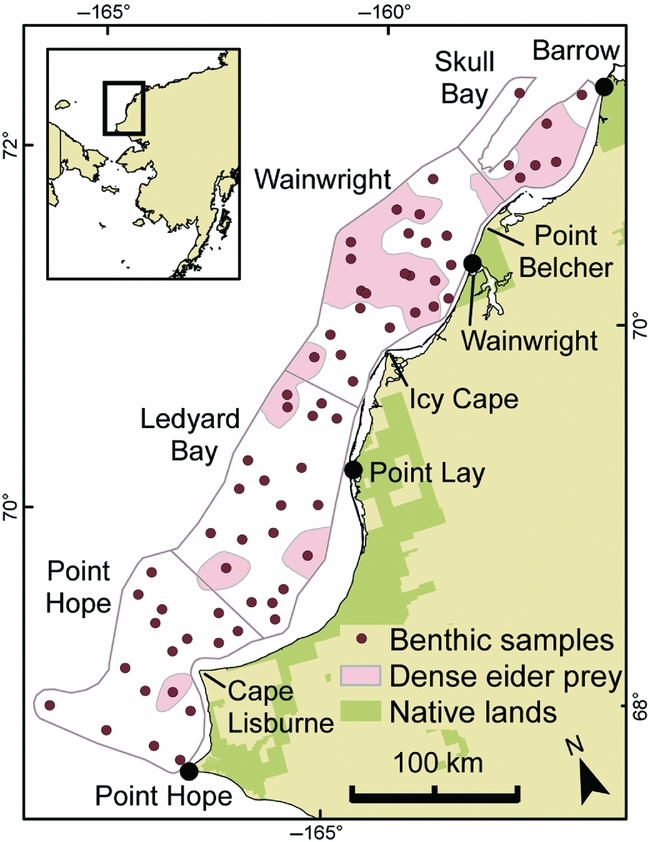
This study focused on nearshore areas (10–40 m depth) of the northeast Chukchi Sea, Alaska, USA (Fig. 1). Over the last decade, areas farther offshore have been studied intensively owing to prospects for exploration and development of oil and gas reserves (e.g. Dunton et al. Reference Dunton, Grebmeier and Trefry2014). However, research in the nearshore zone has been far more limited (Feder et al. Reference Feder, Foster, Jewett, Weingartner and Baxter1994a, Reference Feder, Naidu, Jewett, Hameedi, Johnson and Whitledge1994b; Lovvorn et al. Reference Lovvorn, Rocha, Jewett, Dasher, Oppel and Powell2015). Currents in this shallow area are complex, with overall northward flow being frequently rearranged by variable winds (Danielson et al. Reference Danielson, Eisner, Ladd, Mordy, Sousa and Weingartner2017). Resulting erosion and redistribution of sediments, of settled larvae and perhaps of older recruits result in a strong patch structure of benthic invertebrates based on sampling at scales of tens of kilometres (Fig. 1). Although significant patch structure may exist at smaller scales, areas of high benthic densities at the larger scales generally include areas where high densities at smaller scales most likely occur.
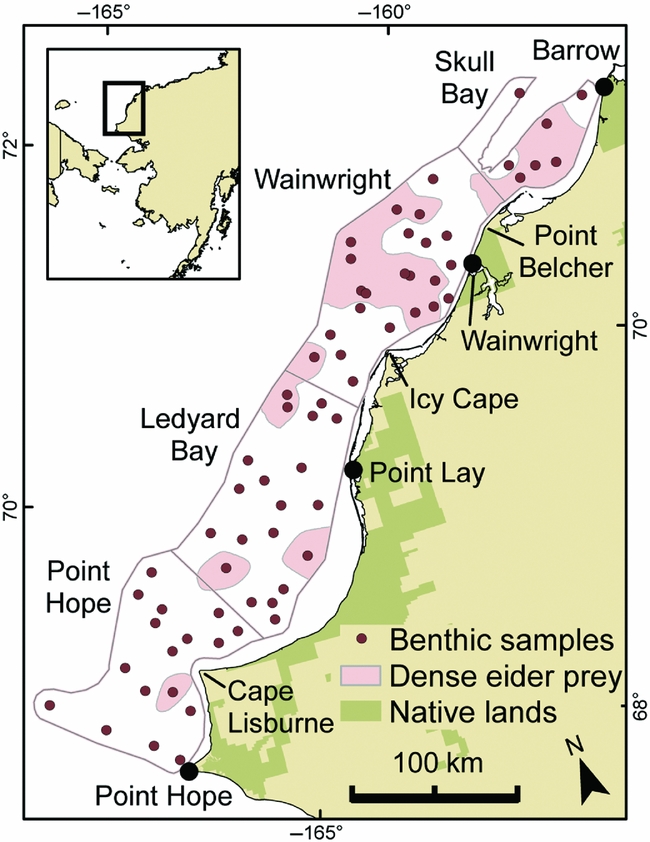
Benthic sampling stations in the northeast Chukchi Sea in August‒September 2010‒2012 (red circles). Inset at upper left shows location of the area in Alaska, USA. Shading in marine areas indicates habitats with densities of bivalve prey high enough to support profitable foraging by king eiders (see Lovvorn et al. Reference Lovvorn, Rocha, Jewett, Dasher, Oppel and Powell2015). Four segments of this nearshore corridor (delimited by 10-m and 40-m isobaths) used in analyses are labelled. Alaskan Native lands are shaded.
Mapping eider feeding areas
Based on benthic sampling in August‒September 2010‒2012 and a computer model of eider foraging energetics, Lovvorn et al. (Reference Lovvorn, Rocha, Jewett, Dasher, Oppel and Powell2015) delineated areas between 10 and 40 m in depth where bivalve prey were dense enough to allow foraging king eiders to achieve a positive energy balance (Fig. 1). For the generally small sizes of bivalves found in this area, the model indicated that profitable foraging required densities >200 m–2. King eiders are far more abundant than common eiders in this region (Quakenbush et al. Reference Quakenbush, Suydam, Acker, Knoche and Citta2009), which is reflected in numbers taken by hunters. Spectacled eiders and Steller's eiders also migrate along this corridor (Sexson et al. Reference Sexson, Pearce and Petersen2014; Martin et al. Reference Martin, Douglas, Obritschkewitsch and Torrence2015), but are federally threatened and therefore not legally hunted. Repeated benthic sampling from 1999 to 2010 in the northern Bering Sea indicated that the dispersion of large areas of high prey density may shift over periods as short as 5–6 years (Lovvorn et al. Reference Lovvorn, Grebmeier, Cooper, Bump and Richman2009, Reference Lovvorn, Anderson, Rocha, Larned, Grebmeier, Cooper, Kolts and North2014), apparently with strong effects of changes in currents driven by prevailing winds. However, in the nearshore migration corridor of the northeast Chukchi Sea, benthic data are available from only a single comprehensive sample over 3 years (2010–2012; Lovvorn et al. Reference Lovvorn, Rocha, Jewett, Dasher, Oppel and Powell2015), and regular sampling in the future is unlikely. Thus, our question is framed as: relative to a given dispersion of large areas of profitable prey densities (as in 2010‒2012), what is the range of positions that the landfast ice edge might occupy based on variations in ice conditions that can occur among years over the long term?
Mapping landfast ice
Landfast (shorefast) ice is sea ice that extends from shoreline to the interface with either drifting pack ice or open water, termed the ‘floe edge’. Near this edge, interactions with moving pack ice generate pressure ridges whose keels extend to the bottom and anchor the landfast ice (George et al. Reference George, Huntington, Brewster, Eicken, Norton and Glenn2004; Druckenmiller et al. Reference Druckenmiller, Eicken, George and Brower2013). A shelf of floating ice attached to a grounded pressure ridge can extend seaward of the ridge for some distance, but is not otherwise anchored to the bottom and is susceptible to breaking off to become part of the drifting pack. Whaling activities generally occur on this floating extension of landfast ice. Open water between the floe edge and offshore pack ice is called the ‘flaw lead’, which in this region is kept open by easterly winds that push the pack offshore, and can be closed by westerly winds. A combination of low wind speed and low temperature can also cause leads to freeze. Closing of the flaw lead generally halts whaling as well as eider migration (Nelson Reference Nelson1981; Norton & Gaylord Reference Norton and Gaylord2004). Large fragments of dense multi-year ice drifting south from the summer ice cap can become grounded and frozen into the landfast ice as it forms, providing greater stability and affecting the depth to which landfast ice extends (Mahoney et al. Reference Mahoney, Eicken, Gaylord and Gens2014). However, this effect has decreased in recent years as the polar ice pack has thinned and its late-summer extent retreated northward (Gearheard et al. Reference Gearheard, Matumeak, Angutikjuaq, Maslanik, Huntington, Leavitt and Kagak2006). Delineations of the edge of landfast ice along this coast by Mahoney et al. (Reference Mahoney, Eicken, Gaylord and Gens2014) for 1997 to 2007 are available online (http://boemre-new.gina.alaska.edu). We resorted Mahoney et al.’s (Reference Mahoney, Eicken, Gaylord and Gens2014) data on ice-edge locations during particular periods to derive new summary statistics, and used image processing methods similar to theirs to extend the time series from 2008 to 2011.
For mapping landfast ice, we used satellite imagery from Advanced Land Observing Satellite (ALOS) Phased Array-type L-band Synthetic Aperture Radar (PALSAR; 100-m resolution) and Advanced Synthetic Aperture Radar (ASAR; 150-m resolution). PALSAR was our primary data source, with ASAR providing supplemental coverage. After pre-processing, images were imported into a geographic information system (ArcDesktop; ESRI 10.3, Redlands, CA, USA). We adapted the gradient difference method of Mahoney et al. (Reference Mahoney, Eicken, Gaylord and Gens2014), whereby mosaics from three consecutive dates of available data were examined along with a gradient difference image to manually identify stationary ice. The gradient difference image highlights changes in the location or orientation of edge features and helps identify persistent ridges and individual floes. To cover the entire study area, we created mosaics from individual scenes collected within 2–4 days of each other over an average period of 19 days. Through inspection of sequential image sets and their composite gradient difference images, we manually delineated the landfast ice edge. For details of data acquisition, processing and analysis, see Appendix S1 in Supplementary Material (available online).
Areas suitable for ice-edge hunting
During April and May, hunting crews camp near the edge of landfast ice (George et al. Reference George, Huntington, Brewster, Eicken, Norton and Glenn2004), and eiders are hunted when few or no whales are passing by the camps. Many factors affect selection of sites for whaling camps, including: access to well-anchored ice; availability of safe camp locations and escape routes; ability to observe approaching whales; ice-edge configuration relative to whale movements; presence of low-salinity, multi-year ice for drinking water; and a broad, flat area thick enough to haul a dead whale onto for processing (Druckenmiller et al. Reference Druckenmiller, Eicken, George and Brower2013). Because a wide trail across the ice from the shoreline to the camp must be cleared for passage of snowmobiles, the frequency and size of ridges and the stability and thickness of ice along the way are considered. Other factors such as proximity to villages (length of trail to be constructed, travel time, fuel costs, noise from the village) and the personal experiences and traditions of different whaling crews are also important. Whaling camps may be moved among sites as conditions develop over a single whaling season. Given the diverse priorities and strategies among whaling crews and the regular spacing of villages (Fig. 1), in a given year whaling camps typically occur at widespread multiple sites along the coast (Druckenmiller et al. Reference Druckenmiller, Eicken, George, Brower, Aporta, Gearheard, Laidler and Kielsen Holm2010, Reference Druckenmiller, Eicken, George and Brower2013). Thus, we considered anywhere along the landfast ice edge to be a potentially viable location for whaling camps and associated eider hunting.
Analyses in this paper are intended to identify locations that: (1) coincide with large areas of high prey density where travel by eiders along the ice edge is most likely; and (2) occur along the edge of landfast ice where whaling camps (and thus eider hunting) can occur. To delineate the zone in which the landfast ice edge is located during the spring hunting period, we mapped the area between the minimum and maximum positions of the floe edge during April and May in each of 15 years from 1997 to 2011. The minimum position of the floe edge included a zone 200 m wide to account for hunting along the minimum floe edge if that edge were stationary. Ice edges that resulted from ice breakouts were omitted from the analysis. Breakouts were defined as >50% reductions of the ice-edge width observed in images fewer than 8 days apart. We then determined the overlap of the area between minimum and maximum ice extent and areas with high enough density of bivalve prey to allow eiders to feed profitably.
RESULTS
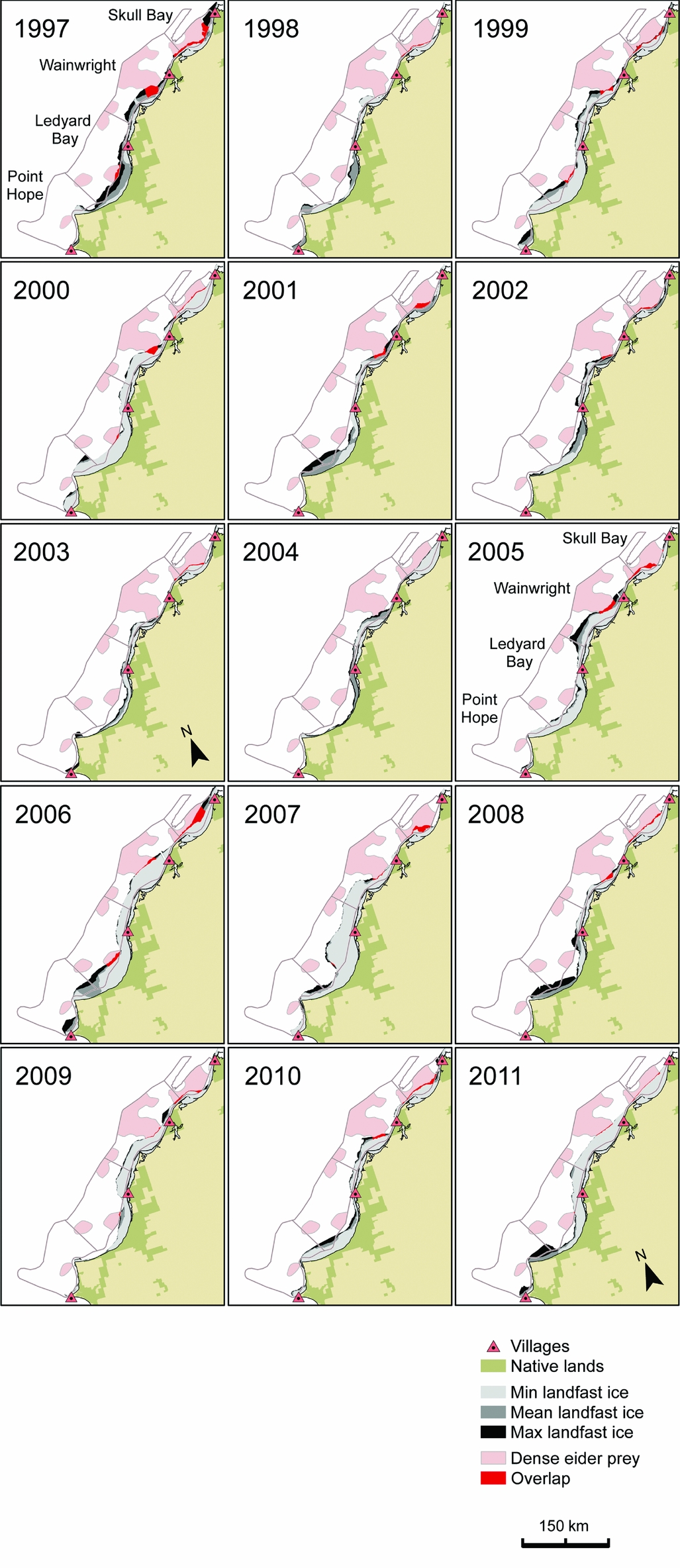
Over the 15 years of available data, in Skull Bay the floe edge tended to be rather stationary within years, with little difference between the minimum and maximum floe edges (Fig. 2). This stationary tendency typically resulted in a narrow band of overlap with viable eider habitat that extended along most of the Skull Bay coastline. However, in a few years (1997, 2001, 2006 and 2007) there were substantial differences between the minimum and maximum floe edges, resulting in a much larger area of eider habitat being accessible to ice-edge hunters over the spring season. Except in these four years, the overlap of floe edge with eider habitat in Skull Bay was near or below the long-term average (Supplementary Fig. S1).
Minimum, mean and maximum extent of landfast ice during April and May 1997‒2011 along the northeast coast of the Chukchi Sea, and overlap of the area between minimum and maximum ice extent with viable foraging habitat for king eiders in August‒September 2010‒2012 (from Lovvorn et al. Reference Lovvorn, Rocha, Jewett, Dasher, Oppel and Powell2015). Floe edge data for 1997‒2007 are adapted from Mahoney et al. (Reference Mahoney, Eicken, Gaylord and Gens2014).
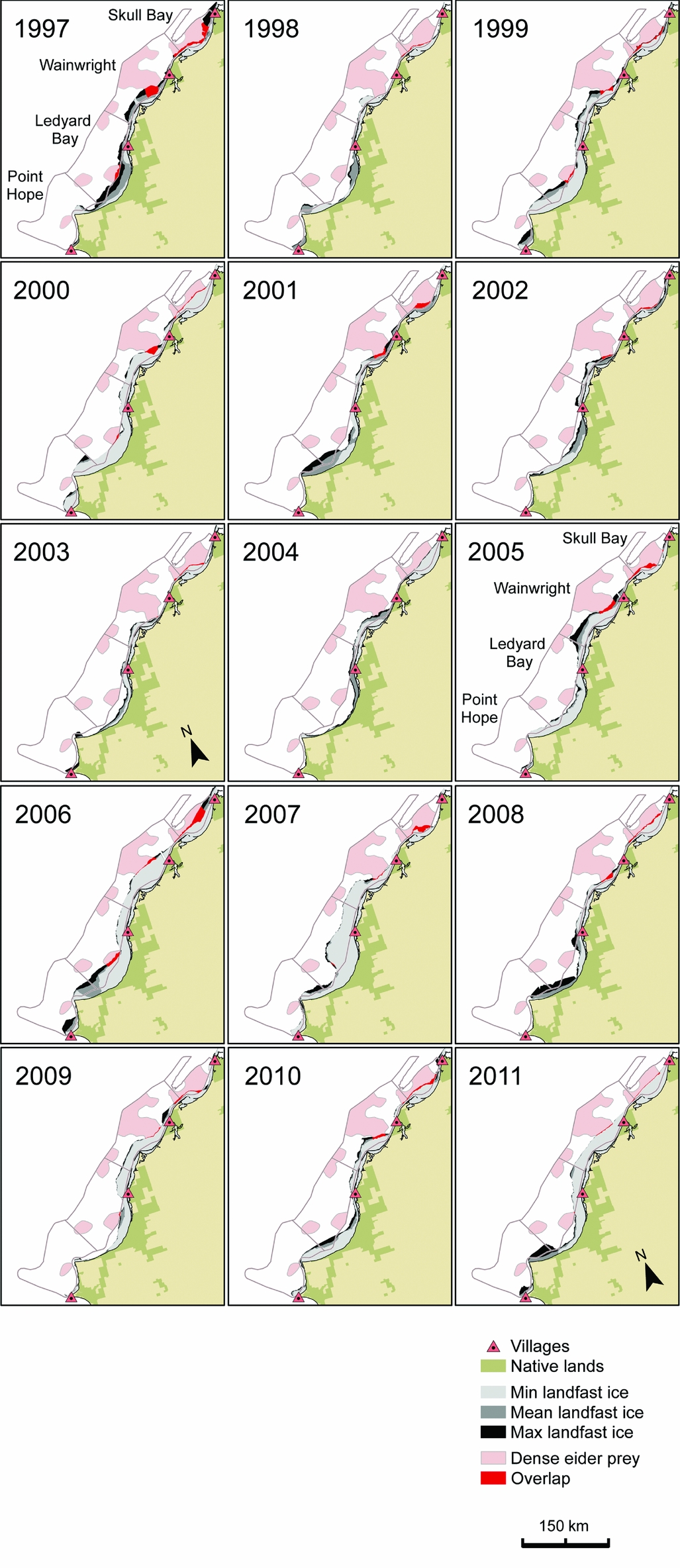
In the Wainwright segment, the area of overlap between the range in floe edge location and eider foraging habitat was more variable, generally shifting between areas farther offshore in 2006 and 2011 to areas closer to shore in other years (Fig. 2). In 1998 (when a breakout of shelf ice occurred) and 2003, the floe edge showed almost no overlap with viable eider habitat, whereas overlap was large in 1997, 2000 and 2004. As in Skull Bay, the degree of overlap in different years varied substantially from the 15-year mean (Supplementary Fig. S1).
Ledyard Bay includes a very wide, shallow area nearshore, and our sampling stations were all at depths of 10 m or more. Satellite locations of king eiders during the spring from 1998 to 2008 (Oppel et al. Reference Oppel, Dickson and Powell2009) indicated that these eiders typically feed at depths >10 m in Ledyard Bay. As a result, estimated viable habitat for eiders was too far offshore to overlap with the edge of landfast ice in most years (Fig. 2). Overlap occurred only in the central portion of the bay at large travel distances from land in 1997, 1999, 2000 and 2006 (Fig. 2 and Supplementary Fig. S1). No overlap was detected in the Point Hope sector in any year.
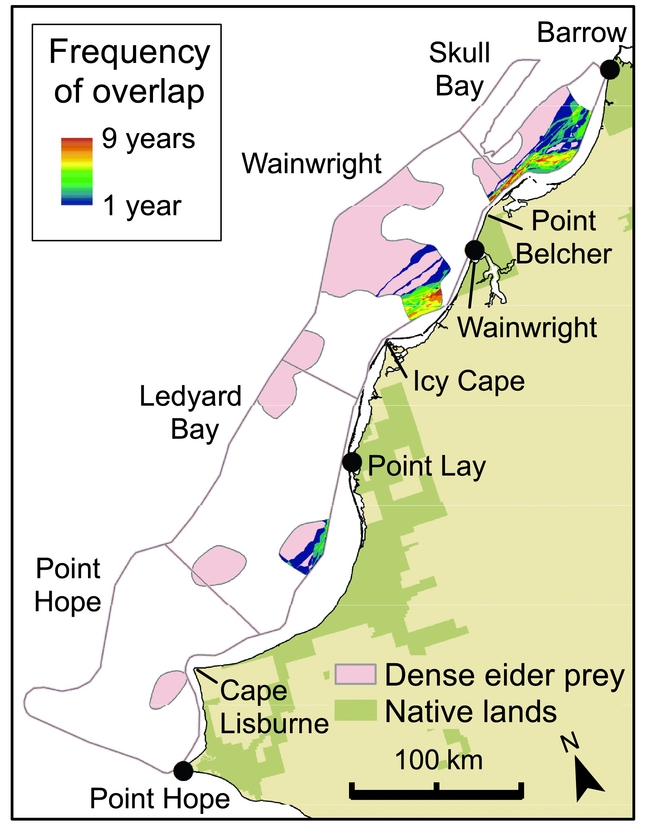
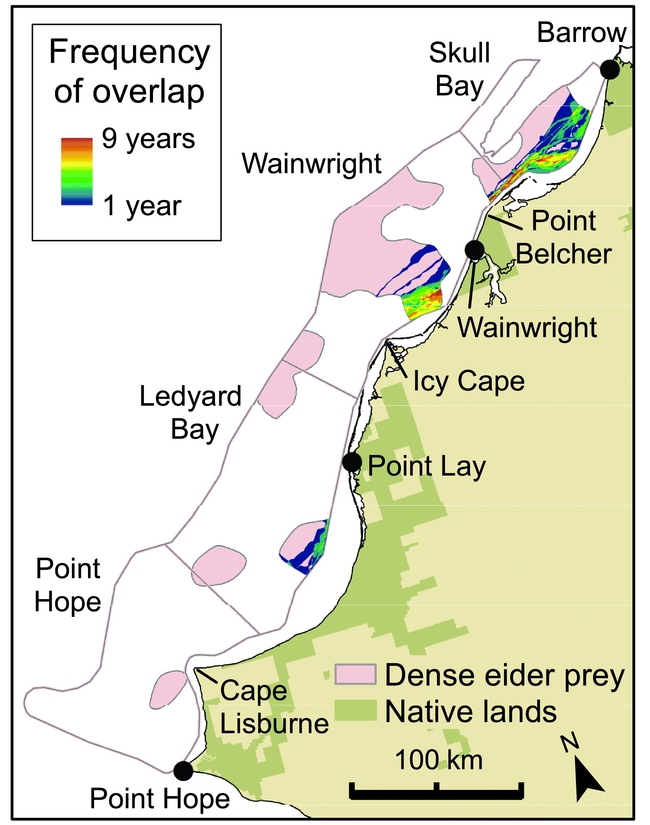
Despite wide variation in overlap between viable foraging habitat for eiders and the floe edge, the general locations of overlap when it did occur were rather consistent (Fig. 3). Much of the coastline of Skull Bay provided good habitat for eiders and hunting access to them. In the Wainwright segment, almost all overlap occurred from the village of Wainwright south to Icy Cape and not from Wainwright north to Point Belcher, which lacked good eider habitat in 2010‒2012. Although Ledyard Bay was the area most used by migrating king eiders during spring migration from 1998 to 2008 (Oppel et al. Reference Oppel, Dickson and Powell2009), in only a few years was there hunter access to good eider feeding habitat from the ice edge. Annual areas of overlap as a fraction of the total area of viable feeding habitat for king eiders averaged 4.2% (range 1.1–11.3%) in Skull Bay, 1.3% (range 0–4.2%) in the Wainwright segment and 0.7% (range 0–4.9%) in Ledyard Bay; no overlap was detected in the Point Hope segment. These values emphasize that areas meeting the needs of hunters make up a small and very specific portion of broader eider habitat and require special consideration beyond more general habitat protections for eiders.
Frequency of overlap among years (1997‒2011) between the range of positions of the landfast ice edge during April and May and viable foraging habitat for king eiders in August‒September 2010‒2012 (based on Fig. 2). The maximum number of years of overlap for any area was 9.
DISCUSSION
We propose the areas of overlap between the edge of landfast ice and viable foraging habitat for eiders (Fig. 3) as examples of high-priority ‘subsistence conservation areas’. These delineations are not meant to exclude other areas that might be used as ice patterns or dispersion of eider prey shift over time. Rather, they are intended as guidelines for prioritizing near-future placement of shoreline facilities, pipelines, shipping routes, etc., to minimize effects on both important habitats and subsistence hunting. These delineations can also focus research efforts on the portions of total habitat most critical to subsistence activities. Extending this information into the future will require updating prey dispersion at time intervals determined by the variability of high prey densities (cf. Lovvorn et al. Reference Lovvorn, Grebmeier, Cooper, Bump and Richman2009, Reference Lovvorn, Anderson, Rocha, Larned, Grebmeier, Cooper, Kolts and North2014), as well as monitoring trends in ice conditions.
Delineating the landfast ice edge (Fig. 2) emphasizes how close inshore the viable habitat must be for birds and mammals to be consistently available to floe-edge hunters when the animals are not constrained by a narrow flaw lead. Our sampling stations (Fig. 1) were much closer inshore and shallower than is typically accessed with larger oceanographic ships (cf. Grebmeier et al. Reference Grebmeier, Bluhm, Cooper, Danielson, Arrigo, Blanchard and Clark2015), but even so the ice edge in Ledyard Bay was often well inshore of our sampling area. If benthic studies are to be relevant to eiders and ice-edge subsistence hunting for them, sampling must include nearshore areas (10‒40 m deep) in the zone that typically includes the floe edge.
Long-term trends in landfast ice
Ice conditions vary greatly among years regardless of climate trends. However, Mahoney et al. (Reference Mahoney, Eicken, Gaylord and Gens2014) reported that in the northeast Chukchi Sea, the edge of landfast ice in late February to March was on average 13 km closer to shore in 1996‒2008 compared to 1973‒1976. In the region from Cape Lisburne to Point Lay (Fig. 1), the late-winter floe edge was on average 30 km closer to shore during the later period. Our results indicate that such decreases in the width of landfast ice can greatly reduce or eliminate overlap with viable eider habitat in that segment of the migration corridor (Ledyard Bay; Fig. 2). Landfast ice is formed not just by freezing in place, but also depends on incorporation of pack ice, and especially large fragments of southward-drifting multi-year ice, to stabilize and increase its area (Mahoney et al. Reference Mahoney, Eicken, Gaylord and Gens2014). Even if climate models predict that northern Alaskan seas will remain ice covered from January through May owing to normal lack of sunlight (Wang & Overland Reference Wang and Overland2015), reduced supply of multi-year ice from a steadily shrinking and thinning polar ice cap in summer could have important effects on the extent and duration of landfast ice.
Mahoney et al. (Reference Mahoney, Eicken, Gaylord and Gens2014) also reported that from Cape Lisburne to Barrow (see Fig. 1), ice breakup was 11 days earlier and ice-free conditions occurred 24 days earlier in 1996‒2008 than in 1973‒1977. These trends in timing of breakup and ice-free conditions, related mostly to earlier onset of thawing air temperatures, continued over the period 1996‒2008, but were not statistically significant. In terms of use by both eiders and Native hunters, the direction of prevailing winds is perhaps even more important than unsuitable landfast ice conditions, because persistent westerly winds that close the flaw lead can halt eider migration and eliminate whaling for extended periods (Nelson Reference Nelson1981; Norton & Gaylord Reference Norton and Gaylord2004). Shifts in prevailing winds can also rearrange the dispersion of benthic communities (Lovvorn et al. Reference Lovvorn, Grebmeier, Cooper, Bump and Richman2009, Reference Lovvorn, Anderson, Rocha, Larned, Grebmeier, Cooper, Kolts and North2014). Thus, in addition to changes in temperature and ice extent, altered patterns of prevailing winds could have major effects on the locations of feeding areas and their access by hunters. Nevertheless, zoning decisions for industrial development and conservation will be made in the short term, and existing conditions can help inform those decisions and guide longer-term monitoring for adaptive management.
Approaches to habitat delineation
In this study, important feeding habitat was delineated by a simulation model of prey densities needed by eiders to achieve energy balance (Lovvorn et al. Reference Lovvorn, Rocha, Jewett, Dasher, Oppel and Powell2015). An alternative approach to mapping important habitats is use of resource selection functions that statistically relate telemetry locations of animals to environmental variables such as prey density, ice conditions or water depth (Dickson & Smith Reference Dickson and Smith2013; Beatty et al. Reference Beatty, Jay, Fischbach, Grebmeier, Taylor, Blanchard and Jewett2016). Although based on actual animal locations, the resource selection approach of comparing used versus unused areas can be compromised if ice cover, adverse weather or lack of omniscience about prey locations prevents the animals from occupying the better benthic habitats during periods when telemetry data are collected.
For example, in 2009, spectacled eiders wintering in the northern Bering Sea were excluded by ice from much of the benthic habitat that could support profitable foraging, and instead were located in the few sites with open water. The eiders’ late-winter fat reserves in that year were 30–35% lower than in a year (2001) of more favourable ice cover that allowed access to higher prey densities (Lovvorn et al. Reference Lovvorn, Anderson, Rocha, Larned, Grebmeier, Cooper, Kolts and North2014). More dramatic mass starvations of king eiders due to severe ice conditions during spring migration (Barry Reference Barry1968; Fournier & Hines Reference Fournier and Hines1994) would likely be recognized in telemetry studies used in resource selection analyses. However, such examples emphasize that where the animals are located during a given period does not necessarily indicate where they prefer or need to be.
Even if the animals’ locations do correspond to superior prey densities, it is also possible that much viable habitat is not being used at a particular time by the sample of animals instrumented or by the population as a whole in unsaturated habitat. In contrast, the energetics modelling approach can allow mapping of all potentially viable habitat, but will not necessarily reflect other non-trophic factors that may alter habitat use. A drawback of energetics models is that they require estimates of factors affecting foraging profitability (Lovvorn et al. Reference Lovvorn, Grebmeier, Cooper, Bump and Richman2009), such as dive costs and functional responses (intake rates at a range of prey densities), information based on experimental measurements that are often unavailable for particular taxa. Thus, both resource selection and energetics modelling approaches have strengths and weaknesses and can provide unique and valuable insights into the distribution of important habitats.
Integrating conservation, subsistence and economic needs
Despite concerns that industrial development in the marine environment may compromise wildlife populations needed for subsistence, there is generally support for such development in coastal villages of the northeast Chukchi Sea. The standard of living for Native people of this region depends strongly on revenues from the Prudhoe Bay oilfield. Schools, healthcare, fire halls, water, sewage, roads and other public infrastructure are all paid for by those revenues (Glenn et al. Reference Glenn, Itta, Napageak, Lovecraft and Eicken2011). Subsistence hunting also requires large investments in boats, motors, snowmobiles, fuel, guns and ammunition, so inputs from a cash economy are critical to the subsistence economy (Ford et al. Reference Ford, Smit, Wandel, Allurut, Shappa, Ittusarjuat and Qrunnut2008; Beauparlant Reference Beauparlant2014). In two North Slope villages studied (Wainwright and Kaktovik), households with higher cash incomes generally achieved higher subsistence harvests and were more active in food-sharing activities (BurnSilver et al. Reference BurnSilver, Magdanz, Stotts, Berman and Kofinas2016).
Considering these issues, formal government designation of specific ‘protected areas’ is often viewed negatively by the local people. This sentiment results from reduced flexibility in economic development that will ultimately be needed to maintain basic amenities. This perspective also results from the desire for local assessment and control of areas important to both hunting and subsistence species. Equal influence by Native people in co-management with outside government authorities in this region has seldom been achieved, despite its potential for engendering valuable local support (Robards & Lovecraft Reference Robards and Lovecraft2010; Haley et al. Reference Haley, Chartier, Gray, Meek, Powell, Rosenberg, Rosenberg, Lovecraft and Eicken2011; Kendrick Reference Kendrick2013). Spatial planning to conserve sensitive species that are also hunted will likely be more effective if placed in the context of subsistence and other economic needs.
Given these complexities of implementation, our intent here is simply to provide example guidelines for planning by various parties involved. As subsistence activities often depend on hunting from landfast ice, our approach can aid in delineating and projecting the future of ‘subsistence conservation areas’ throughout the Arctic. Similar consideration of access to animals by Native hunters in conservation planning may facilitate efforts to sustain both sensitive species and threatened human cultures in various areas worldwide (Lyver & Tylianakis Reference Lyver and Tylianakis2017).
FINANCIAL SUPPORT
Major funding was from the National Science Foundation's program in Arctic Science, Engineering and Education for Sustainability grant 1263051 to JRL, T.E. Hollmén, H.P. Huntington and M.L. Brooks. Benthic studies were supported by the Alaska Monitoring and Assessment Program and the Coastal Impact Assistance Program of the US Fish and Wildlife Service. Additional funding for analysis of invertebrate samples was facilitated by C.V. Jay through the US Geological Survey and A.M. Macrander through Shell Alaska.
CONFLICTS OF INTEREST
None.
ETHICAL STANDARDS
None.
SUPPLEMENTARY MATERIAL
To view supplementary material for this article, please visit https://doi.org/10.1017/S0376892918000103