Introduction
The family Tephritidae includes economically important fruit fly pests that infest over 100 plant species from northern to southern Brazil. Some species, such as the South American fruit fly Anastrepha fraterculus (Wiedemann), the West Indian fruit fly Anastrepha obliqua (Macquart), Anastrepha grandis (Macquart), Anastrepha sororcula Zucchi and the Mediterranean fruit fly Ceratitis capitata (Wiedemann), are highly destructive pests in the tropical and temperate fruit zones of Brazil.
The most recent catalogue of the Anastrepha spp., listing 77 species, was published by Zucchi (Reference Zucchi1978). In the last 20 years, 17 new Anastrepha species have been found in Brazil. Among the Anastrepha species in Brazil, hosts have been recognized for 41 species. The genus Anastrepha is the most polyphagous in Brazil, with 58 species of host plants, and is associated with plants from 29 families. Out of a total of 41 Anastrepha species, 37% feed on Myrtaceae and 24% on Sapotaceae. The Anastrepha spp. complex is the major pest of apple in Brazil.
The South American fruit fly is a major quarantine pest. Many countries impose severe restrictions on importing fresh fruits from Brazil because of this insect. In the state of Ceará, there are sympatric species such as A. sororcula and Anastrepha zenildae Zucchi that are closely related to the South American fruit fly. In addition, the correct taxonomic identification of A. fraterculus and A. zenildae is controversial due to the high degree of morphological variation. The occurrence of genetic variation among populations has led to the concept of a complex of cryptic species. The economic importance of this species is justifiable, but it is difficult to conduct field and laboratory experiments on it.
Fruit fly surveys, and studies on identification and monitoring, have already been carried out in the region, but there is a lack of information on the predominant fruit fly species in most of the fruit-producing areas. The melon-producing areas of the states of Rio Grande do Norte and Ceará have already been proven by scientific research to be free of A. grandis.
This study was initiated in January 2005 in the laboratories of EMBRAPA – Brazilian Agricultural Research Corporation, Fortaleza City, state of Ceará, Brazil. The ‘Fundação Cearense de Peaquisa e Cultura’ (State of Ceará Culture and Research Foundation) was the guardian of the funds of this Coordinated Research Project. The objective of this study was to develop systems and protocols for mass-rearing A. fraterculus and integrating them into sterile insect technique management programmes.
Materials and methods
Adult fruit flies originated from fruits collected in guava orchards located in Pacajus county, state of Ceará, and from a sample of the A. fraterculus colony at the Instituto de Biociências da Universidade de São Paulo – IBUSP (Biosciences Institute of the University of São Paulo). The population of fruit flies originating from guava fruits was called the Anastrepha complex (Anastrepha spp.). According to previous studies carried out by Braga Sobrinho et al. (Reference Braga Sobrinho, Caceres, Islam, Wornoayporn and Enkerlin2006), this population includes several species of the genus Anastrepha.
The main goal was to establish three new colonies. Two colonies were formed from the Anastrepha complex population – one was the local species A. fraterculus (Af) and the other was the local species A. zenildae (Az). A third colony, A. fraterculus (AfSP), was formed from the insects obtained from the IBUSP.
Infested guava fruits were collected weekly. During the formation of pupae, the fruits were kept in trays with sawdust. Pupae were collected from the trays and transferred to cages for adult emergence. Adults were fed a standard diet based on brewer's yeast and white sugar (1:3). Cages were monitored every day, and each mating pair was collected separately and put into a small screen cage. Each pair was maintained in this cage with water, adult diet and a guava fruit as a substrate for egg-laying until the death of the female. (To guarantee that these guava fruits were initially free of fruit flies, the fruits in the field were covered with waxed bags to protect them from fruit fly attack.) The fruits were removed from the cages and placed in emergence boxes every week. The flies that emerged in these boxes were considered to be a population from an unknown species.
After the death of the female in each small screen cage, the species was identified. Each dead female was dissected and the ovipositor extracted to enable taxonomic identification. After the identification of the female from each small cage, the unknown species was now identified as A. fraterculus or A. zenildae and then used for colony formation. This procedure was repeated several times to maintain the colonies of the two species and also to renew and increase the colonies for biological studies.
Experiments were conducted to find a source of protein that would promote better egg production and hatchability. As the predominant species collected from the field was A. zenildae, it was selected for testing adult diets to find a local source of protein. Four diets with the following constituents were tested: diet A – brewer's yeast+white sugar (1:3); diet B – brown sugar (60%)+hydrolysed corn protein (26%)+brewer's yeast (5%)+honey (5%); diet C – hydrolysed corn protein+white sugar (1:3); and diet D – soybean protein+white sugar (1:3).
Three days before adult emergence, A. fraterculus pupae were put into plastic cages. Groups of 100 male and 100 female adults, aged < 3 days, were put into different screen cages; five cages were prepared for each of the four diet treatments, totalling 20 cages. Ten days after adult emergence, when sexual maturity had been reached (Salles, Reference Salles1992), 20 lekking males and 20 lekking females from the same treatment group were placed into an acrylic cage for mating. Mating pairs from each treatment group were placed into individual boxes for behaviour studies. The courtship behaviour was recorded from 10.00 to 12.00 h (laboratory conditions – mean temperature 27 °C and relative humidity (RH) 76%). Pairs that mated for more than 8 min were separated and selected for biological studies.
Ten mated females from each treatment group were also placed into a small plastic cage (16 × 10 × 10 cm) with a silicone panel on fine screen (organza) in front for oviposition. Flies in each cage were supplied with water and the corresponding adult diet. The experiment consisted of four treatments (diets) and five replicates (cage with 10 females), resulting in 20 cages with a total of 200 females. After 5 days, eggs were collected daily from each silicone panel, counted and spread on moist blotting paper in Petri dishes with a small camel-hair brush for egg hatch studies. After 10 days of egg-laying, the females from each treatment group were dissected, and the spermathecae were removed and placed onto a slide and then gently squashed with a cover slip for observation of the presence of sperm. Each of the three spermathecae from each female was observed under a light (40 × ) microscope, and the number of spermatozoa in each spermatheca estimated. The number of spermatozoa was estimated on a scale of 1–4: (i) zero spermatozoa; (ii) less than 100 spermatozoa; (iii) more than 100 spermatozoa but less than 1000; and (iv) more than 1000 spermatozoa.
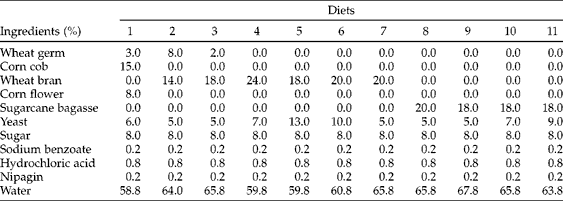
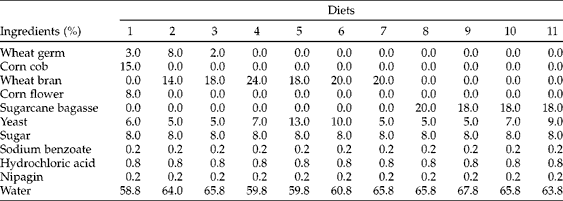
Eleven larval diets (Table 1) were screened to find suitable and economical diets for further comparison tests. Thirty grams of each diet were poured into a Petri dish (8.5 cm diameter and 2.0 cm high). Throughout the study period, the control treatment was the standard Salles (Reference Salles1992) fruit fly larval diet (diet 1, Table 1), which is based on wheat germ, brewer's yeast, white sugar, sodium benzoate, hydrochloric acid, nipagin and agar. Diets were mixed with a domestic blender. The pH of all diets was adjusted to a value between 3.8 and 4.0.
Various larval diets for Anastrepha spp., A. zenildae and A. fraterculus
A photoperiod of 10 h light–14 h dark was maintained in the rearing room with fluorescent lights. The general procedure for diet preparation was based on that used by Tanaka et al. (Reference Tanaka, Steiner, Ohinata and Okamoto1969). Quality control tests were carried out following the protocols specified in FAO/IAEA/USDA (2003). Five replicates of 100 eggs each (bubbled for 48 h) were seeded onto a fine strip of blotting paper placed on top of the diet. After the eggs were applied to the diets, they were held at 29 °C and 90% RH. After 6 days, the blotting papers were removed from the Petri dishes and checked for egg hatch. After 8 days, the Petri dishes were transferred to another room (temperature 21 °C and RH 75%), where larval development was completed. After 10 days, individual Petri dishes were put in plastic boxes with sawdust to await pupation. The number of pupae was recorded, and the pupae were then transferred to individual boxes for adult emergence.
The efficacy of the diets listed in Table 1 was determined by assessing pupal recovery, pupal weight and adult emergence. From the eleven diets, six (1, 4, 5, 6, 10 and 11) that resulted in over 50% pupal recovery were selected for another large-scale rearing test in plastic cages (30 × 19 × 2 cm) with 250 g of the corresponding diet. Trays with a strip of blotting paper on the diet were seeded with 300 eggs bubbled for 48 h. On the sixth day, the strip of paper was removed from each tray to evaluate egg hatch. After the eighth day, the trays were transferred to another room at 24 ± 2 °C and 75% RH until the completion of pupation. Afterwards, the pupae were transferred to an appropriate room for adult emergence. A sample of 100 pupae from each treatment group was taken to conduct adult flight ability test. This test consisted of five treatments and six replicates. In this test, we assessed egg hatch, pupal recovery, pupal weight, adult emergence and adult flight ability. Laboratory procedures were similar to those used previously.
Genetic compatibility studies were carried out under laboratory and field conditions on the following nine groups of individuals: Af♂ × Af♀; Af♂ × AfSP♀; Af♀ × AfSP♂; Af♂ × Az♀; Af♀ × Az♂; AfSP♂ × AfSP♀; AfSP♂ × Az♀; AfSP♀ × Az♂; and Az♂ × Az♀. Cages with 25 females and 25 males of each cross were set up and maintained for 10 days under laboratory conditions. Each cage was monitored to observe mating and its duration every day. As a substrate for oviposition, agar balls were placed into each cage. The agar balls were removed from the cages and replaced with new balls every day. Eggs were extracted from the balls, counted and subsequently used in viability tests. A sample of 100 eggs was placed on filter paper in Petri dishes to observe egg hatch. Viable eggs were counted, and genetic compatibility was assessed.
Newly emerged adults from the laboratory colony, adults of the same group of individuals described above, were released onto guava plants that were 3 years old and covered with plastic screen cages (2.5 × 2.0 × 2.5 m), 10 pairs per plant. A portion of adult diet was placed in the interior of each plant canopy along with water via a wick and an agar ball as a support for oviposition. For 10 days, the general behaviour of the insects was observed, from 08.00 to 10.00 h and 16.00 to 17.00 h each day. The minimum and maximum temperatures inside the cages were 23 and 31 °C, respectively. Some of the parameters observed were the time of day of mating, duration of mating, lekking, number of eggs per 10 females, and amount of time spent resting on the screen cage.
Results and Discussion
The final goal of a fruit fly mass-rearing system is to obtain a consistent yield of healthy and competitive adults. This success is highly dependent on the high quality control of all laboratory procedures and especially a suitable and economical diet.
Adults of two genera – Anastrepha and Ceratitis – originated from infested guava fruits collected from the field. The methodology described for species identification and colony formation was very time consuming because each mating pair was reared separately until the death of the female. Most of the adults originating from guava fruits collected in the state of Ceará belonged to the species A. zenildae. Adults emerging from the fruits were A. zenildae (88.4%), A. fraterculus (7.4%), A. sororcula (3.4%) and Anastrepha spp. (0.8%). Taxonomic identification was always required in this project.
After collecting adequate number of adults of A. fraterculus and A. zenildae, the next task was to find a suitable and economical adult diet for the predominant species. Four adult diets were tested (Table 2).
Biological observations made in Anastrepha zenildae adults fed on adult diets

Mean values in the same column followed by the same letter are not significantly different according to Tukey's honestly significant difference test (P< 0.05).
1 Diet A – brewers' yeast+white sugar (1:3); diet B – brown sugar (60%)+hydrolysed corn protein (26%)+brewers' yeast (5%)+honey (5%); diet C – hydrolysed corn protein+white sugar (1:3); and diet D – soybean protein+white sugar (1:3).
The diet based on brewer's yeast (diet A) resulted in the poorest performance with respect to number of eggs per female per day, egg hatch, mating duration, adult life span and number of sperm in the spermathecae. Diet B was, numerically, the best for most parameters assessed, but often did not differ statistically from diets C and D. Adult males fed on diet A exhibited a much lower response in searching for females, and a reduced mating duration, compared with those fed on diets B, C and D. Evidently, the adult diet has a profound effect on the number of sperm in the spermathecae. As soybean protein resulted in a high performance and is a locally available and cheap material, diet D was selected as the adult diet.
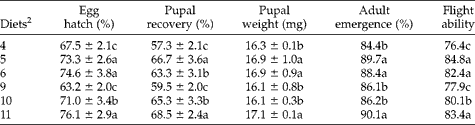
Finding a suitable and economical diet for the larvae of Anastrepha spp. was an essential requirement for maintaining a mass-rearing system. In this study, 11 treatments (diets) were used (Table 1). The standard diet was the Tanaka diet (diet 1). The primary assessments made were on egg hatch and adult recovery. Based on this comparison of larval diets (Table 1), we selected diets 4, 5 and 6 (based on wheat bran) and diets 9, 10 and 11 (based on sugarcane bagasse); these diets resulted in over 50% pupal recovery.
The efficacy of the six larval diets summarized in Table 3 was determined by evaluating egg hatch, pupal recovery, pupal weight, adult emergence and flight ability. According to flight ability test results obtained for diets 5, 6 and 11 (Table 3), there is clear evidence that the source of protein is a determinant for obtaining healthy and competitive adults. When compared with diets 5, 6 and 11, diets 4, 9 and 10, with low protein content, resulted in poorer performance with regard to egg hatch, pupal recovery, pupal weight, adult emergence and flight ability (Table 3). As there were no statistical differences among diets 5, 6 and 11, based on economics, diet 11 with 9% protein is recommended to be used for mass-rearing purposes.
Screening of various diets1 for the larvae of Anastrepha zenildae
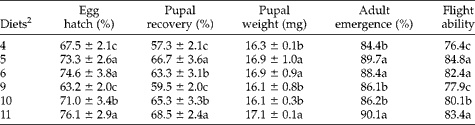
Mean values ( ± SE) in the same column followed by the same letter are not significantly different according to Tukey's honestly significant difference test (P< 0.05).
1 For all diets, the source of protein was brewer's yeast.
2 Diets 4, 5 and 6 are based on wheat bran and diets 9, 10 and 11 are based on sugarcane bagasse.
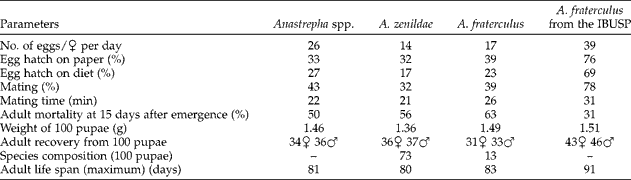
Several biological parameters of the four species were assessed (Table 4) using larval diet 11 and adult diet D. As the colonies of Anastrepha spp., A. zenildae and A. fraterculus are considered new and not yet established, the results given in Table 4 are still very different from those obtained for the already established colony from the IBUSP. Adult mortality is still high. Probably, the general management of rearing procedures should be improved. When the rearing data of Anastrepha spp., A. zenildae and A. fraterculus are compared with those of A. fraterculus from the IBUSP, it is easy to conclude that the good performance of the IBUSP colony is due to the domestication process influencing better adaptation in a rearing environment. Comparison of A. zenildae with A. fraterculus clearly shows that A. zenildae presents a higher degree of wildness. After a few more generations in the laboratory, it is expected that these colonies would be better adapted.
Biological parameters of Anastrepha spp., A. zenildae, A. fraterculus and A. fraterculus from the IBUSP (Instituto de Biociências da Universidade de São Paulo)
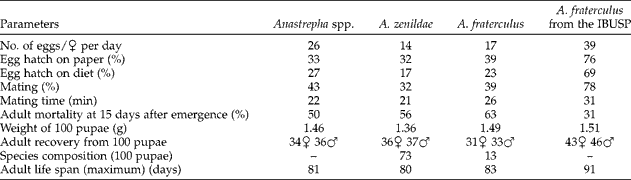
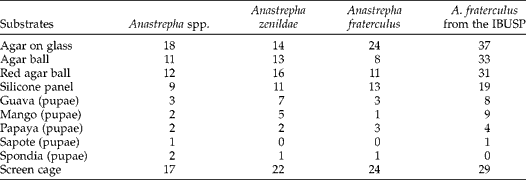
Table 5 summarizes the various egg-laying substrates tested for the four species. After making several attempts to find a good substrate, it was observed that most flies congregated on the surface of the brown glass with water that had a wet cotton wick as the water source. Based on this behaviour, the glass was then coated with agar by immersing it in hot agar until a 3 mm-thick membrane formed. This procedure was very important to get the colonies started. It was observed that a large proportion of the eggs were deposited on the screen cage. The red agar balls may have acted as a slightly better substrate than balls with the normal colour. Oviposition on fruits was not as high as expected. This study on substrates must be refined to find a definitive and efficient substrate for each species.
Mean number of eggs per female per day on various oviposition substrates
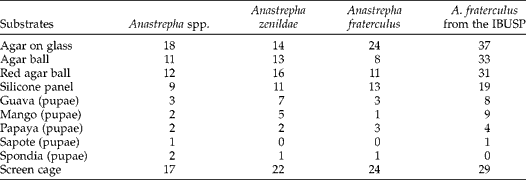
IBUSP, Instituto de Biociências da Universidade de São Paulo.
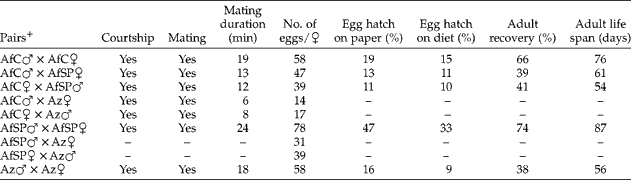
Mating compatibility tests among populations of Anastrepha in cages under laboratory conditions were conducted (Table 6). The crosses between A. fraterculus from the states of Ceará (AfC) and São Paulo (AfSP) yielded compatible individuals. However, for crosses between individuals of A. zenildae (Az) and those of A. fraterculus, no viable eggs were produced, indicating a high level of genetic incompatibility. On the other hand, in the interspecific crosses between AfC and Az, courtship and mating occurred, but no viable eggs were produced. The same result was not obtained for crosses between AfSP and Az; no courtship and mating occurred. This result may have occurred because the species AfC and Az live sympatrically, i.e. in the same area.
Mating compatibility among populations of Anastrepha under laboratory conditions in screen cages
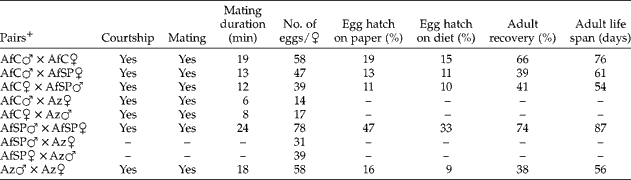
+ AfC – Anastrepha fraterculus from Ceará; AfSP – A. fraterculus from São Paulo; and Az – Anastrepha zenildae.
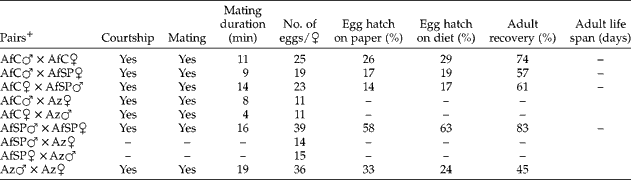
As has been described in the methodology, a similar test was carried out for Anastrepha populations in screen cages set up in the field (Table 7). Again, the incompatibility between A. fraterculus and A. zenildae was demonstrated. Guava plants were not as attractive as the screen of the cages for oviposition. Mating duration was shorter than that in the laboratory screen cages. There were fewer eggs per female than in the laboratory. The percentage of egg hatch on paper and on diet appeared to be higher than that in the laboratory. Apparently, adult recovery was also higher in field cages. In general, flight behaviour was very similar to that in laboratory cages, but lekking was done with much more intensity. Probably, the plants themselves and natural light influenced this behaviour. Nevertheless, field cage conditions may still not simulate real conditions in an open field. Also, the plants were very small and had immature fruits, so this test should be repeated when the plants have maturing fruits.
Mating compatibility among populations of Anastrepha under field conditions in screen cages
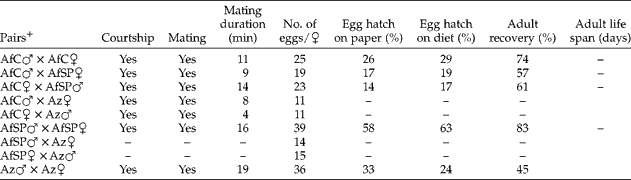
+ AfC – Anastrepha fraterculus from Ceará; AfSP – A. fraterculus from São Paulo and Az – Anastrepha zenildae.
As there are three or more fruit fly species (Anastrepha complex) in the area, it is important to consider alternative rearing procedures so that an adequate and unique rearing methodology is developed for each of the three species.
Acknowledgements
This study was conducted as part of a Coordinated Research Project with financial support from the International Atomic Energy Agency, Research Contract No. 13018/RBF.