Pulmonary atresia with ventricular septal defect and major aortopulmonary collateral arteries is a rare and heterogeneous form of CHD. Patients with pulmonary atresia, ventricular septal defect, and major aortopulmonary collateral arteries have variable pulmonary vascular development, including the native pulmonary arteries and the major aortopulmonary collateral arteries. Management of this disease imposes several challenges, with unifocalisation strategy and strategy of rehabilitation of pulmonary arteries representing the two antithetical extremes. Some groups reported satisfying short- and long-term results of the unifocalisation strategy. Reference Mainwaring, Patrick and Roth1,Reference Zhu, Meza and Kato2 Timing is crucial for good results, and a complete bilateral unifocalisation is usually performed between 3 and 6 months of age. However, most patients in our centre are too old to undergo unifocalisation. The multistaged rehabilitation strategy is more suitable for this situation. It promotes pulmonary artery growth and subsequently allows for complete repair with less reliance on major aortopulmonary collateral arteries.
Various procedures have been proposed in the literature, Reference Lenoir, Pontailler and Gaudin3–Reference Zhao, Yang and Li6 and there is no consensus on the management of major aortopulmonary collateral arteries for rehabilitation strategy. We adopted an aggressive approach towards the occlusion of the major aortopulmonary collateral arteries before, during, or after palliative surgeries. The association between this approach and long-term outcomes of patients, including survival, improvement of pulmonary arteries, and the probability of complete repair, is still unknown. Also, the ideal palliative procedure to increase the pulmonary artery tree and the probability of complete repair is still under debate. Last year, we reported outcomes of comparison of central shunt and right ventricle–pulmonary artery connection in our institution. There is little data on the comparison of outcomes of modified Blalock–Taussig shunt and right ventricle–pulmonary artery connection in patients with pulmonary atresia, ventricular septal defect, major aortopulmonary collateral arteries, and hypoplastic pulmonary arteries.
The purpose of this study is to investigate the association between long-term survival and different management of major aortopulmonary collateral arteries and to summarise our outcomes with different palliative procedures in patients with pulmonary atresia, ventricular septal defect, major aortopulmonary collateral arteries, and hypoplastic pulmonary arteries.
Materials and methods
Patient selection
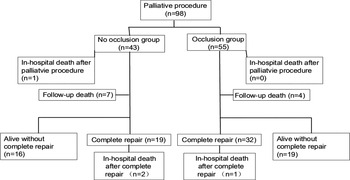
From November, 2009 to October, 2018, a total of 98 consecutive patients with pulmonary atresia, ventricular septal defect, major aortopulmonary collateral arteries, and hypoplastic pulmonary arteries treated with modified Blalock–Taussig shunt or right ventricle–pulmonary artery connection at Fuwai Hospital (Beijing, China) were included in this study. Fifty-five patients who received occlusion or ligation of major aortopulmonary collateral arteries during or after the palliative procedure were occlusion group, and the other 43 patients were no occlusion group (Fig 1). Exclusion criteria were pulmonary atresia/ventricular septal defect Type IV of the Castaneda classification, tetralogy of Fallot, univentricular heart, atrioventricular or ventriculo-arterial discordance, and an atrioventricular septal defect. Medical history and perioperative records were collected using all available records. Because this was a retrospective analysis of data collected for routine clinical care, individual informed consent was waived by the ethics committee (Approval NO. 2017-977; Date of review: December 18, 2019).
Flow diagram of survival and complete repair.

Our management of major aortopulmonary collateral arteries has been reported before. Reference Zhao, Yang and Li6,Reference Chen, Ma and Hua7 Timing of the occlusion included the placement of an right ventricle–pulmonary artery connection, interim period, and complete repair. A CT scan or angiography was applied to analyse the origin, size, distribution, and supply of the major aortopulmonary collateral arteries. If major aortopulmonary collateral arteries without significant stenosis were not the sole supply to the lung, they would be occluded percutaneously or ligated during the procedure. If major aortopulmonary collateral arteries were the sole supply to the lung or accompanied by severe stenosis, they would be left untreated. At the time of palliative surgery, the major aortopulmonary collateral arteries were occluded as much as possible to obtain satisfactory oxygen saturation (80–85%) through control of the diameter of the conduit. During follow-up, percutaneous occlusion of major aortopulmonary collateral arteries may be applied if patients had pulmonary hyper-perfusion and heart failure.
Evaluation of the pulmonary anatomy was based on angiography or CT. Reference Zhao, Yang and Li6 McGoon ratio and Nakata index were calculated before any palliative procedure and before complete repair evaluation. ΔMcGoon ratio was defined as the difference between the McGoon ratio prior to complete repair and before the palliative procedure. ΔNakata index was defined as the difference between the Nakata index prior to complete repair and before the palliative procedure.
Surgical technique for the palliative procedure
Two palliative procedures were applied in this study, modified Blalock–Taussig shunt and right ventricle–pulmonary artery connection. The surgical technique of right ventricle–pulmonary artery connection has been extensively described previously by our group. Reference Zhao, Yang and Li6 Briefly, patients were operated on under normothermic cardiopulmonary bypass on the beating heart. If the main pulmonary artery existed, a longitudinal incision was made, and an autologous pericardial patch was sutured to the edge of the arteriotomy. The incision was extended to right ventricle. Resection of hypertrophied muscle was made to create a sufficient right ventricle opening. The pericardial patch was then sewn to the edge of the right ventricle incision. If central pulmonary artery was absent or discontinuous from right ventricle, the right ventricle–pulmonary artery connection was reconstructed using an autologous pericardial roll, bovine pericardial roll, Gore-tex conduit, or bovine jugular vein. The Blalock–Taussig shunts technique included right-modified Blalock–Taussig shunts and left-modified Blalock–Taussig shunts, with a side-to-side Gore-tex anastomosis. The diameter of the Gore-tex shunt was dependent on the patient’s weight, vessel size, and pre-operative physiology.
Complete repair
When the pulmonary arteries achieved satisfactory growth (Nakata index > 160 mm/m2; McGoon ratio > 1.2), a biventricular repair would be performed. The ventricular septal defect was closed by a transatrial or transventricular approach. The right ventricular outflow tract was reconstructed with a patch or a valved conduit. The right ventricle/left ventricle pressure ratio was recorded after cardiopulmonary bypass.
Definition and follow-up
In-hospital morbidity included following complications: delayed sternal closure, reintubation, tracheotomy, diaphragm plication, pulmonary hyper-perfusion and infection, high-frequency oscillations, extracorporeal membrane oxygenation support, dialysis, gastrointestinal bleeding, post-operative conduit banding, reoperation, pleural and pericardial effusion, ascites, and cerebral complications. In-hospital mortality was defined as both 30-day mortality and death after operation but before discharge.
All patients after the palliative procedure were carefully followed up in our outpatient clinic. No patients were lost to follow-up. A CT scan or angiography was performed for patients with satisfactory pulmonary artery growth or decreased percutaneous blood oxygen saturation. Balloon angioplasty or stent implantation was applied to treat pulmonary artery or right ventricular outflow tract stenosis.
Statistical analysis
Continuous variables with normal distribution are expressed as means with standard deviations, such as weight, age, number of major aortopulmonary collateral arteries, Nakata index, McGoon ratio, oxygen saturation, cardiopulmonary bypass duration, diameter of conduit, and right ventricle/left ventricle pressure ratio. Continuous variables with abnormal distribution are expressed as medians and quartiles. Discrete variables are expressed as percentages. Mann–Whitney test was applied for continuous variables. The χ2 test or Fisher’s exact test were applied for discrete variables. Univariate analysis of predictors of death and complete repair was done with Cox’s proportional hazard model. Univariate predictors with a significance level of less than 0.1 were entered into a multivariate Cox’s proportional hazard model that used a backwards elimination algorithm. Because the occurrence of death could hinder the probability of complete repair, the Fine and Gray sub-distribution hazard model was applied to analyse predictors for complete repair. To reduce the effect of multicollinearity, we computed correlation coefficients of independent variables and confirmed that no pair of the independent variables had a value of more than 0.8. The level of significance for the multivariate model was set at 0.05. Survival and time-to-complete repair analyses were performed using the Kaplan–Meier method. A cut-off value of the Nakata index before the palliative procedure for complete repair was identified using receiver operating characteristic curve analysis.
A p-value <0.05 was considered to be statistically significant. The statistical analysis was performed using SPSS version 22.0 for Windows (SPSS Inc., Chicago, IL, USA). GraphPad Prism 7.00 for Windows (GraphPad Software, LaJolla, California) was used to obtain life tables and corresponding Kaplan–Meier survival curves.
Results
Baseline and outcomes of the palliative operation
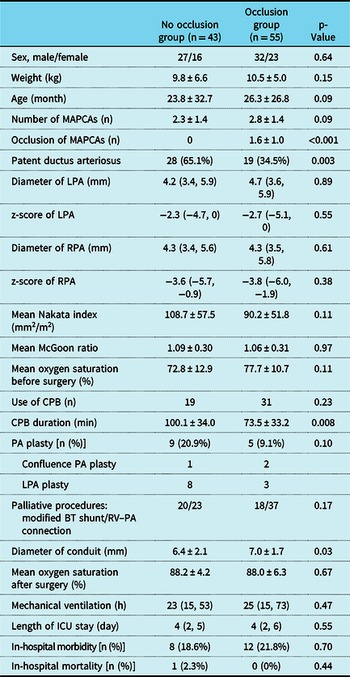
The baseline and operative data of patients in the two groups are summarised in Table 1. More patients in no occlusion group had patent ductus arteriosus (65.1 versus 34.5%, p = 0.003). The other pre-operative clinical characteristics were evenly distributed among the two groups. Nineteen patients in no occlusion group and 31 patients in occlusion group underwent palliative surgery with cardiopulmonary bypass. Nine patients in no occlusion group and 5 patients in occlusion group underwent concomitant pulmonary angioplasty, and most of them were due to left pulmonary artery stenosis. The mean diameter of the conduit was smaller in no occlusion group than the occlusion group (p = 0.03). In the no occlusion group, 39 patients had severely stenotic major aortopulmonary collateral arteries and 8 patients had major aortopulmonary collateral arteries that were the sole supply to the lung. After the palliative operation, no significant differences were seen between two groups in mechanical ventilation and length of ICU stay.
Baseline and outcomes of palliative operation

BT: Blalock–Taussig; CPB: cardiopulmonary bypass; LPA: left pulmonary artery; MAPCAs: major aortopulmonary collateral arteries; PA: pulmonary artery; RPA: right pulmonary artery; RV–PA: right ventricle–pulmonary artery
In no occlusion group, post-operative complications included pulmonary hyper-perfusion and infection (six patients), reintubation (two patients), diaphragm plication (one patient), reoperation because of haemorrhage (two patients), and cerebral haemorrhage (one patient). One patient suffered from pulmonary hyper-perfusion and underwent unsuccessful occlusion of major aortopulmonary collateral arteries post-operatively and died of pulmonary infection and hypoxemia.
In occlusion group, post-operative complications included diaphragm plication (two patients), tracheotomy (two patients), delayed sternal closure (one patient), conduit banding due to post-operative pulmonary hyper-perfusion (four patients), dialysis (four patients), extracorporeal membrane oxygenation support (one patient), occlusion of major aortopulmonary collateral arteries (four patients), and ligation of major aortopulmonary collateral arteries (one patient). No patient died in this group. The in-hospital morbidity and mortality after palliative operation were similar between the two groups.
Follow-up after the palliative procedure
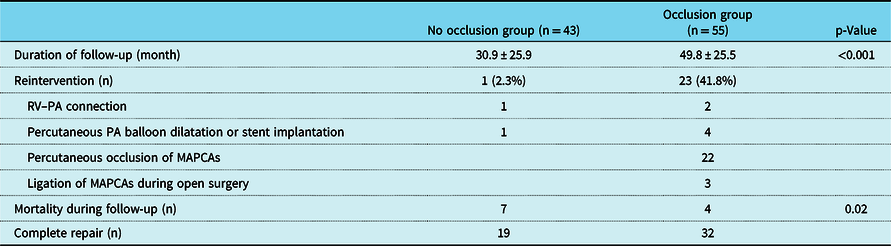
As shown in Table 2, the mean duration of follow-up was 30.9 months in no occlusion group (median follow-up, 24.6 months) and 49.8 months in the occlusion group (median follow-up, 54.3 months) (p < 0.001). In no occlusion group, one patient underwent a second right ventricle–pulmonary artery connection because of shunt thrombosis 1 year later, and percutaneous pulmonary artery balloon dilatation and stent implantation 2 years after the first operation. One patient underwent unsuccessful occlusion of major aortopulmonary collateral arteries. In the occlusion group, two patients underwent reoperation of right ventricle–pulmonary artery connection because of shunt thrombosis. Four patients underwent percutaneous pulmonary artery balloon dilatation or stent implantation due to inadequate native pulmonary artery growth. Twenty-two patients had percutaneous occlusion of major aortopulmonary collateral arteries, and three patients underwent ligation of major aortopulmonary collateral arteries during open surgery.
Follow-up results

MAPCAs: major aortopulmonary collateral arteries; RV–PA: right ventricle–pulmonary artery
During follow-up, seven patients died in no occlusion group. One patient died of heart failure. One patient died of cerebral complication. Three patients died of pulmonary infection. The cause of the other sudden deaths was unknown. Four patients died in the occlusion group. Two patients died of pulmonary infection, and the cause of the other sudden deaths was unknown. Finally, 19 patients in no occlusion group and 32 patients in the occlusion group received complete repair.
Outcomes of complete repair and pulmonary artery growth
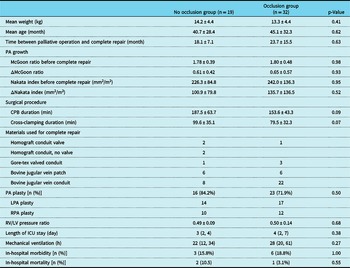
Data for complete repair are shown in Table 3. The time between palliative operation and complete repair was similar in two groups (p = 0.63). No differences were found in ΔMcGoon ratio and ΔNakata index (0.61 ± 0.42 versus 0.65 ± 0.57, p = 0.93; 100.9 ± 79.8 mm2/m2 versus 135.7 ± 136.5 mm2/m2, p = 0.52, respectively). Materials commonly used for complete repair were bovine jugular vein conduit and bovine jugular vein patch. Sixteen patients in no occlusion group and 23 patients in the occlusion group underwent concomitant pulmonary artery plasty (p = 0.50). There were no significant differences between two groups in post-operative right ventricle/left ventricle pressure ratio, length of ICU stay, and mechanical ventilation.
PA growth and perioperative results of complete repair

CPB: cardiopulmonary bypass; LPA: left pulmonary artery; PA: pulmonary artery; RPA: right pulmonary artery; RV/LV: right ventricular/left ventricular
In-hospital morbidity after the complete repair was similar in two groups (p = 0.32). In no occlusion group, post-operative complications included pneumothorax (one patient), dialysis (one patient), reoperation because of ventricular fibrillation (one patient), and extracorporeal membrane oxygenation support (one patient). Two patients died of severe infection and multiple organ failure in this group. In the occlusion group, post-operative complications included reintubation (two patients), diaphragm plication (one patient), tracheotomy (one patient), pneumothorax (one patient), reoperation due to unhealing wound (one patient), and dialysis (one patient). One patient died of multiple organ failure induced by pneumonia 2 weeks after the complete repair.
Prediction of patient outcome
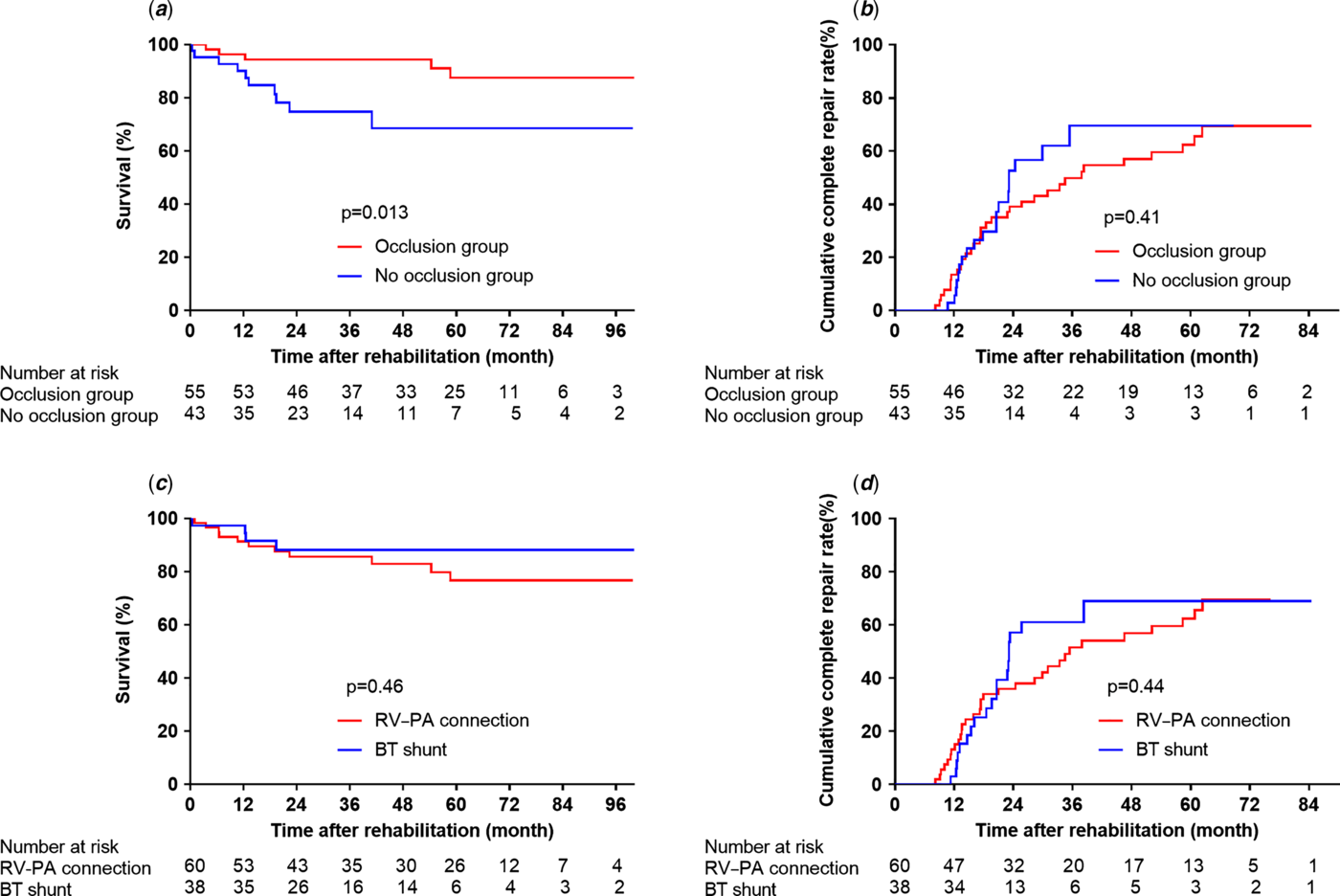
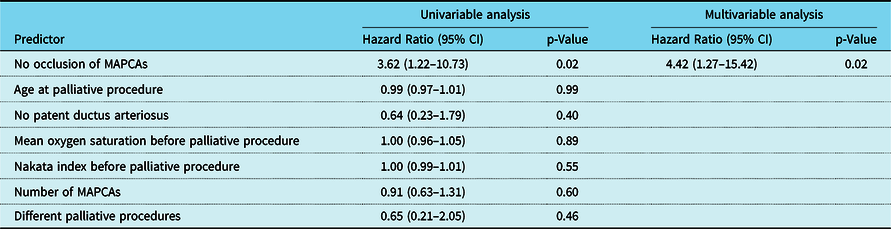
Table 4 summarises the results of univariate and multivariate analysis (Cox regression model) in identifying the risk factors associated with death. Both univariate and multivariate analyses showed that only no occlusion of major aortopulmonary collateral arteries was predictive of total mortality (Hazard Ratio: 4.42, 95% CI: 1.27 to 15.42, p = 0.02). The Kaplan–Meier survival curves (Fig 2a) confirmed that patients without occlusion of major aortopulmonary collateral arteries demonstrated worse survival as compared with the occlusion group (p = 0.013). The Kaplan–Meier estimates of survival rates were 90.1 ± 4.7% after 1 year and 68.5 ± 9.0% after 8 years in no occlusion group, which were lower as compared with 96.3 ± 2.6% after 1 year and 87.6 ± 5.56% after 8 years in occlusion group. The Kaplan–Meier survival curves of patients who underwent different palliative procedures showed no differences (Fig 2c).
Kaplan–Meier survival curves and cumulative complete repair rate of the study groups. RV–PA: right ventricle–pulmonary artery; BT: Blalock–Taussig.

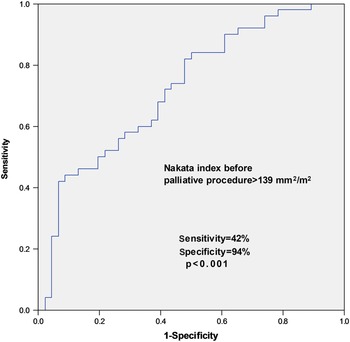
Receiver operating characteristic curve. Sensitivity and specificity of Nakata index before palliative procedure >139 mm2/m2 in predicting complete repair.

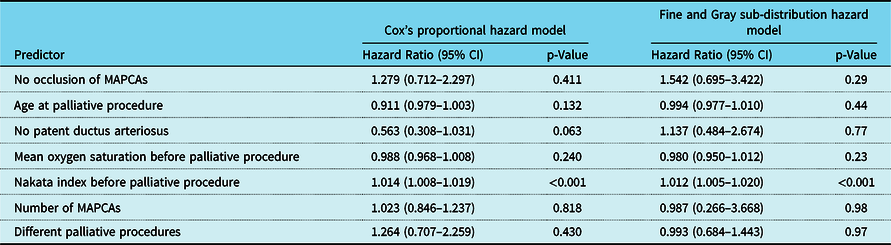
Table 5 summarises the results of Cox’s proportional hazard model and Fine and Gray sub-distribution hazard model in identifying the risk factors associated with the rate of complete repair. Both analyses showed that only a higher Nakata index before palliative procedure was associated with improved rate of complete repair (Hazard Ratio in the Fine and Gray sub-distribution hazard model: 1.012, 95% CI: 1.005 to 1.020, p < 0.001). The Kaplan–Meier curves of complete repair (Fig 2b and d) showed no differences between the study groups. Using receiver operating characteristic curve analysis (Fig 3), a cut-off value of the Nakata index before the palliative procedure for complete repair was found to be 139 mm2/m2 (sensitivity 42%; specificity 94%).
Independent predictors of death

MAPCAs: major aortopulmonary collateral arteries
Independent predictors of complete repair

MAPCAs: major aortopulmonary collateral arteries
Discussion
The present study demonstrates that patients without occlusion of major aortopulmonary collateral arteries have a higher risk of death following initial palliation of pulmonary atresia compared with patients who underwent occlusion of major aortopulmonary collateral arteries. The occlusion of major aortopulmonary collateral arteries is not associated with a higher rate of complete repair or better improvement of pulmonary artery growth. Only a higher Nakata index before the palliative procedure is found to be predictive of a higher rate of complete repair, and a cut-off value is found to be 139 mm2/m2. Besides, our findings suggest that neither modified Blalock–Taussig shunt nor right ventricle–pulmonary artery connection is associated with a higher rate of complete repair or survival.
The major finding of our study was that no occlusion of major aortopulmonary collateral arteries was associated with a higher risk of death in patients with pulmonary atresia who underwent an initial palliative procedure. The association between no occlusion of major aortopulmonary collateral arteries and higher mortality remained even after adjusting for age, patent ductus arteriosus, Nakata index, the number of major aortopulmonary collateral arteries, and palliative procedure. Many studies have been published on the strategy of occlusion of major aortopulmonary collateral arteries during initial palliative procedures, Reference Iyer and Mee8–Reference Soquet, Liava’a and Eastaugh10 yet our study is the first cohort finding its association with improved survival.
This may in part be attributable to the higher prevalence of pulmonary hyper-perfusion and infection in the no occlusion cohort compared with the occlusion cohort. Occlusion of the communicant collateral is helpful to reduce the occurrence of pulmonary hyper-perfusion, haemoptysis, low perfusion pressures, excessive intracardiac return, and heart failure, which leads to a stable post-operative recovery. Reference McGoon, Baird and Davis11 It also helps to promote pulmonary angiogenesis Reference DeCampli, Argueta-Morales, Zabinsky, Hannan and Burke12 and reduce right ventricular pressure after complete repair by decreasing the pulmonary artery pressures. Reference D’Udekem13 In this study, the survival rate of patients without occlusion of major aortopulmonary collateral arteries was consistent with previous reports, Reference Kaskinen, Happonen, Mattila and Pitkanen4,Reference Amark, Karamlou and O’Carroll14 which was lower than that of patients with occlusion of major aortopulmonary collateral arteries. Amark and co-workers found that an increasing number of lung segments supplied by major aortopulmonary collateral arteries was an incremental risk factor for death, which is likely a surrogate for elevated pulmonary vascular resistance. Reference Amark, Karamlou and O’Carroll14 The increased collateral supply adversely impacts end-state achievement independent of the choice of initial management.
As discussed previously by our group, Reference Zhao, Yang and Li6 patients in our cohort were relatively older, and many reasons are related to the later referral of these patients in our country, such as the bed availability in our institution, the family’s financial situation, limited specialty paediatrics, or the absence of clinically significant cyanosis. It is possible that some of these patients may be selected survivors of the initial neonatal period. Timing is crucial for the good results of unifocalisation, which is usually performed at between 3 and 6 months of age. Reference Malhotra and Hanley15 Most of our patients were too old to undergo unifocalisation procedure. Mainwaring and colleagues Reference Mainwaring, Patrick and Roth1 reported that the 5-year survival of their cohort was 90%, which was consistent with our 8-year survival of 87.6% of patients with occlusion of major aortopulmonary collateral arteries.
There was no significant difference between the two groups in the improvement of pulmonary artery growth. The time interval between palliative operation and complete repair was less than 2 years, which may not be long enough for obvious pulmonary artery improvement. Also, the age of our patients ranged from months to years, which may be an interference factor of this result. The younger the patient is, the more likely one is to capitalise on the potential for pulmonary artery growth and complete repair. Older patients are less likely to respond with the growth of native pulmonary artery sufficient to allow complete repair. Reference Ishikawa, Takahashi and Sato16 Their anatomy and severity of illness are diverse, and they are at increased risk of poor nutrition, congestive heart failure, pulmonary vascular disease, and the sequelae of prolonged cyanosis. Reference O’Byrne, Kanter, Berger and Jonas17
Contrary to expectations, the multivariate analysis showed that neither modified Blalock–Taussig shunt nor right ventricle–pulmonary artery connection was found to be associated with a higher rate of complete repair or survival. As reported previously by our group, Reference Zhao, Yang and Li6 right ventricle–pulmonary artery connection was more effective for the improvement of the probability of complete repair and pulmonary artery growth than central shunt. There are not much data concerning the comparison of outcomes after modified Blalock–Taussig shunt and right ventricle–pulmonary artery connection in patients with pulmonary atresia. Amark and his colleagues Reference Amark, Karamlou and O’Carroll14 reported that the initial placement of a systemic–pulmonary artery shunt was a risk factor for death. Wang and his colleagues Reference Wang, Lu, Li, Yan, Yang and Wang18 reported that the interphase between the initial procedure and complete repair was shorter in the right ventricle–pulmonary artery connection group than that in the systemic–pulmonary artery shunt group. However, systemic–pulmonary artery shunts in both studies included modified Blalock–Taussig shunts and central shunts together. In our cohort, 3 out of 38 patients (7.9%) who underwent modified Blalock–Taussig shunts received second right ventricle–pulmonary artery connections because of shunt thrombosis, which was lower than previous reports. Reference Li, Yow and Berezny19,Reference Williams, Bansal and Kim20 Post-operative complications due to diastolic run-off and impaired coronary perfusion were also uncommon in patients who underwent modified Blalock–Taussig shunts. This may be attributable to the relatively older patients, routine use of aspirin, and improved post-operative care in our centre.
In our study, only a higher Nakata index before the palliative procedure is found to be predictive of a higher rate of complete repair, and a cut-off value is found to be 139 mm2/m2. Patients with pre-operative Nakata indices higher than 139 mm2/m2 are more likely to achieve the complete repair. Whether this corresponds with improvement in long-term outcomes will have to be the subject of further study. This Nakata index cut-off is most likely a surrogate that reflects better development of native pulmonary vessels.
Limitations
Despite the use of various statistical measures (such as univariate and multivariate analysis) to help minimise selection biases between two groups, the findings should be interpreted cautiously given the non-randomised design of the study. Also, because genetic testing was not carried out routinely in our hospital, the factor of patients with 22q11.2 deletion could not be investigated in this study. Patients in our cohort were relatively older, so our findings do not apply to patients who are referred and managed at a younger age. The management implications for other centres are limited.
Conclusions
For patients with pulmonary atresia, ventricular septal defect, and major aortopulmonary collateral arteries when a primary repair is not feasible, those without occlusion of major aortopulmonary collateral arteries have a higher risk of death following an initial palliative procedure compared with patients who underwent occlusion of major aortopulmonary collateral arteries. The occlusion of major aortopulmonary collateral arteries is not associated with a higher rate of complete repair or better improvement of pulmonary artery growth. Only a higher Nakata index before the palliative procedure is found to be predictive of a higher rate of complete repair, and a cut-off value is found to be 139 mm2/m2. Besides, our findings suggest that neither modified Blalock–Taussig shunt nor right ventricle–pulmonary artery connection is associated with a higher rate of complete repair or survival.
Acknowledgements
None.
Financial support
This work was supported by the National Key R&D Program of China [2017YFC1308100].
Conflict of interest
None.
Ethical standards
The authors assert that all procedures contributing to this work comply with the ethical standards of Chinese guidelines on human experimentation and with the Helsinki Declaration of 1975, as revised in 2008, and has been approved by the institutional committees (Fuwai Hospital).