INTRODUCTION
Dense kelp forests can be found in the shallow hard-bottom sublittoral (5–30 m) in Spitsbergen fjords (Lippert et al., Reference Lippert, Iken, Rachor and Wiencke2001). These macroalgae communities consist mostly of large (up to 2–3 m high) kelps: Laminaria digitata (Hudson) Lamouroux, 1813, Saccharina latissima (Linnaeus) C.E. Lane, C. Mayes, Druehl & G.W. Saunders, 2006, and Alaria esculenta (Linnaeus) Greville, 1830. Macroalgae are an important component of ecosystems, not only as primary producers, but also as ecosystem engineers offering a habitat for a number of macrofaunal species. They provide substrate for a large number of sedentary animals (Kuklinski et al., Reference Kuklinski, Gulliksen, Lønne and Weslawski2006; Carlsen et al., Reference Carlsen, Johnsen, Berge and Kuklinski2007) as well as a shelter for mobile invertebrates (Martin-Smith, Reference Martin-Smith1993).
In polar regions, the development of seaweeds, and therefore of epifaunal assemblages is limited by the very short period of favourable light conditions (the polar night lasts about four months), by icebergs and sea ice scouring the bottom, and particularly by the high loads of fine sediment discharged with glacial or glaciofluvial melt water that restrict light penetration (Wiencke et al., Reference Wiencke, Clayton, Gómez, Iken, Lüder, Amsler, Karsten, Hanelt, Bischof and Dunton2007). The patterns of increasing disturbance by high levels of sedimentation in glacial fjords is related to continual glacier retreat (at a rate of up to 0.5 km y−1), which is a consequence of global warming (Svendsen, Reference Svendsen, Elverhoi and Mangerud1996; Wlodarska-Kowalczuk & Weslawski, Reference Wlodarska-Kowalczuk and Weslawski2001). High inorganic suspension concentration increases water turbidity, thus influencing light conditions. The seasonal fresh glacial water inflow disturbs the physical regime of fjord waters (Weslawski et al., Reference Wȩsławski, Koszteyn, Zajączkowski, Wiktor, Kwaśniewski and Skjodal1995) and impacts both macroalgal and macrofaunal communities. The presence of sediments in the water column is regarded as a severe stress agent for hard-bottom macro-organisms, especially the suspension feeders (Airoldi, Reference Airoldi2003). It is most likely that hydroids, the main focus of this study, as filter feeders are influenced by these factors.
Studies from other regions indicate that, among sessile organisms, a large part of epifauna is formed by hydrozoans (Nishihira, Reference Nishihira1965; Hughes et al., Reference Hughes, Johnson and Smith1991; Llobet et al., Reference Llobet, Gili and Hughes1991; Watson, Reference Watson1992; Faucci & Boero, Reference Faucci and Boero2000; Fraschetti et al., Reference Fraschetti, Giangrande, Terlizzi, Miglietta, DellaTommasa and Boero2002, Reference Fraschetti, Terlizzi, Bevilacqua and Boero2006). However, knowledge of Arctic epifaunal hydrozoans is very scanty, and there are only a few studies describing macroalgae and its epifaunal communities in the polar regions (Róycki & Gruszczyński, Reference Różycki and Gruszczyński1986; Hansen & Haugen, Reference Hansen and Haugen1989; Lippert et al., Reference Lippert, Iken, Rachor and Wiencke2001). The hydroids' inconspicuous colonies and the problematic identification of species are probably the most likely reason for the low number of records in the published literature cited above. This study intends to fill in some of the gaps in the knowledge of the ecology of Arctic hydrozoans associated with macroalgae.
Our aim was to describe the hydroid community associated with kelp forest in the specific environment of an Arctic glacial fjord. The objectives of the study were:
(1) to present an updated species list of hydroids associated with the kelp forest in Hornsund;
(2) to analyse the relations between hydroid biodiversity and substrate characteristics (species, age, biomass of algae and microsubstrate heterogeneity); and
(3) to describe patterns of hydroid community composition and diversity in relation to mostly glacial-driven environmental factors (mineral suspension concentration and sedimentation rate).
STUDY AREA
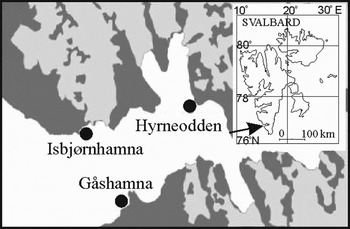
The 30 km-long Hornsund Fjord is the most southerly situated fjord off west Spitsbergen, the largest of about 150 islands of the Svalbard Archipelago located on the edge of the Barents Sea shelf, 74º–81ºN 10º–34ºE (Figure 1). The fjord is under the influence of two water masses: the relatively warm, saline Atlantic water (T > 2°C, S > 34.7 psu) of the West Spitsbergen Current and the colder Arctic waters of the Sorkapp Current (T < 0°C, S = 34.3–34.8 psu) (Loeng, Reference Loeng1991).
Sampling sites in Hornsund fjord; dark grey, land; light grey, glaciers.

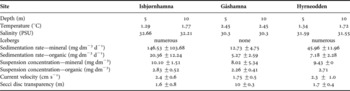
Fourteen tidal glaciers that enter the fjord waters, together with rivers running from the melting glaciers, strongly modify the hydrology of the Spitsbergen fjords especially in the summer season (Weslawski et al., Reference Wȩsławski, Koszteyn, Zajączkowski, Wiktor, Kwaśniewski and Skjodal1995). Due to the fresh water inflow (about 1.8 km3 annually in Hornsund; Jania & Pulina, unpublished data, after Weslawski et al., Reference Wȩsławski, Koszteyn, Zajączkowski, Wiktor, Kwaśniewski and Skjodal1995), the temperature and salinity oscillations are high and a gradient of inorganic sedimentation is created (Swerpel, Reference Swerpel1985; Görlich et al., Reference Görlich, Weslawski and Zajaczkowski1987). In July in Isbjørnhamna (Hornsund Fjord), over a distance of 3 km the surface salinity may vary from 15 to 31 psu and suspension concentration from 48 to 367 mg dm−3 (Görlich et al., Reference Görlich, Weslawski and Zajaczkowski1987).
Three sites at different distances to active glacier outflows were selected in order to compare contrasting sedimentary and hydrology regimes (Table 1; Figure 1):
Physical conditions at three sites (mean ± SD).

Isbjørnhamna: situated close to the fjord entrance, close to the Hansbreen glacier outflow, with very high inorganic particle sedimentation;
Hyrneodden: situated in the inner part of the fjord, close to several active tidal glacier outflows, with intermediate level of inorganic particle sedimentation; and
Gåshamna: situated close to the fjord entrance, far from the glacier outflows, with very low inorganic particle sedimentation.
MATERIALS AND METHODS
Sampling and environmental parameters collection
Three hundred and forty samples of algal thalli were collected in Hornsund fjord (Spitsbergen) in July 2003 at the three selected sites (Figure 1; Table 1), with 133 samples from Isbjørnhamna, 113 from Gåshamna and 94 from Hyrneodden.
Specimens of the most common macroalgal species (Laminaria digitata, Saccharina latissima and Alaria esculenta) were carefully collected at each site from 5 and 10 m depths by SCUBA divers. Each algae sample was placed in a separate bag with 1 mm mesh size. In the laboratory, the age of each laminarian algae was determined (after Kain, Reference Kain1963), and the algae were divided into caulloid, phylloid and rhizoid. The length, wet weight, and volume (measured as the volume of displaced water after immersion in the cylinder) of each part were measured. The associated hydroid fauna was fixed in 4% formalin and was identified under stereomicroscope and microscope. Other species of algae (Desmarestia sp., Phycodrys rubens (Linnaeus) Batters, 1902, and Odonthalia sp.) were collected less frequently in the study area. Due to the small number of samples collected, they were excluded from most of the analysis and comparisons.
The environmental parameters measured at each site included STD profiles, current meter measurements with a Sensordata Bergen SD6000 (deployed in Isbjørnhamna for 48 minutes, Gåshamna for 242 minutes and Hyrneodden for 68 minutes), and the collection of four replicates of water samples for inorganic and organic suspended matter concentrations, as well as the deployment of sediment traps made of PVC cylinders (opening diameter, 8 cm; height, 50 cm). In order to measure the sedimentation rate at each site, three traps were installed on the seabed. After 24 hours they were recovered and taken to the laboratory and left for another day and night, until the sediments had stabilized. Then, the supernatant was decanted, and the remaining mixture of water and sediment was filtered through the filters (Whatman GF/C, 47 mm). These were then dried at 60°C for 24 hours and weighed. The weighed filters loaded with sediment were placed in an oven (450°C) for 24 hours and then weighed again. The same procedure was used to analyse the organic/inorganic suspension concentrations.
Data analysis
Multivariate analysis (done with the PRIMER package) was performed to identify the patterns of hydroids occurrence. The similarity between samples was calculated with the Bray–Curtis index. Only presence/absence data were used, as it was often not possible to distinguish, and so to enumerate, separate colonies. The differences between species composition among the three sites, three kelp species and two depths were tested with the pair-wise ANOSIM test. The differences between the sample species richness among the same combinations of sample groups were tested using the non-parametric Kruskal–Wallis test. Pair-wise Mann–Whitney U-tests were used for post hoc multiple comparisons.
RESULTS
Species list
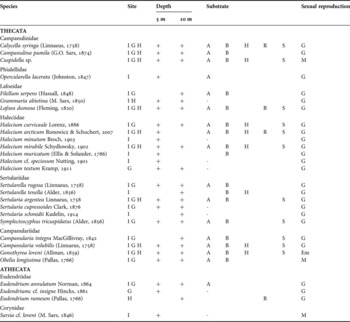
A total of 28 taxa of hydroids belonging to two orders and eight families were found associated with kelp forest (Table 2). The order Thecata was represented by 24 species, whereas Athecata was represented by only four species. Among taxa noted during the present study, merely three species (Cuspidella sp., Obelia longissima and Sarsia cf. loveni) generate the medusa stage for sexual reproduction and one species (Gonothyrea loveni) creates eumedusoids (Table 2).
List of all taxa recorded during the present study. Occurrence at the studied sites, depths and substrates, as well as reproductive mode for each taxon, are also presented.

Site: I, Isbjørnhamna; G, Gåshamna; H, Hyrneodden; Substrate: A, algae; B, Bryozoa; H, Hydrozoa; R, rock; S, shell; Sexual reproduction: g, fixed gonophores; m, medusae; em, eumedusoids.
Primary substrate characteristics
Seventeen hydroids taxa grew directly on the algae. The remaining 11 species colonized other types of substrata connected with the algae (Table 2), or were found unattached to any substrate.
The frequency of hydroid occurrence was very similar regardless of laminarian species, ranging from 21% on S. latissima to 27% on L. digitata.
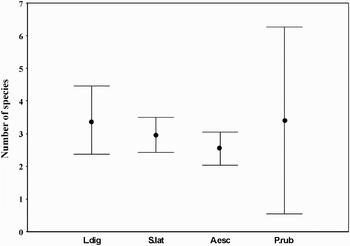
Each laminarian species hosted an average of 2.5 (A. esculenta) to 3.5 (L. digitata and P. rubens) hydroid species (Figure 2). The highest hydroid species richness per sample (= per algae specimen) was found on L. digitata (8 species). Altogether ten species of hydroids were found on this alga species. Maximum species richness per sample was slightly lower on S. latissima (7 species) and A. esculenta (6 species), but the total number of hydroids found on these two kelp species was higher than on L. digitata (14 and 13 species, respectively).
Numbers of hydroid species (mean ± 0.95 CI) per sample recorded on different algae (L.dig., Laminaria digitata; S.lat., Saccharina latissima; A.esc., Alaria esculenta; P.rub., Phycodrys rubens).

No differences were noted in species richness per sample among the sampled algal species (Kruskal–Wallis test, P > 0.05).
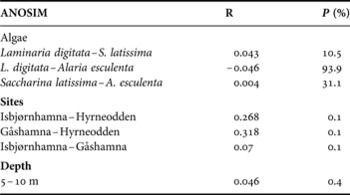
Pairwise analysis of similarities (ANOSIM) did not show any differences in hydroid assemblages between algal host species (P > 0.05; Table 3).
One-way ANOSIM pairwise analysis testing differences among species composition of kelp species, sites and depths.

The hydroid distribution among the three parts of laminarian thalli differed markedly. A significantly higher number of taxa settled on the rhizoid part of the algae, but there were just two species (Eudendrium annulatum and Opercularella lacerata) present exclusively on the rhizoid part. Only a few species were present on parts other than the basal (phylloids: Symplectoscyphus tricuspidatus, Calycella syringa, Eudendrium indet. and Eudendrium cf. rameum; caulloids: Sertularella rugosa and Campanularia integra).
Hydroid biodiversity was significantly, but very weakly, correlated to the total wet weight of algae (r = 0.26, P = 0.01). No relationship (at P > 0.05) was noted concerning hydroid diversity and the characteristics of the algae, such as age, total length, total volume, rhizoid wet weight, or rhizoid volume.
The algae species Desmarestia sp., Phycodrys rubens and Odonthalia sp. were also colonized by hydroids, with 88% frequency of occurrence on P. rubens, 50% frequency of occurrence on Odonthalia sp., and 18% frequency of occurrence on Desmarestia sp.
Microsubstrate heterogeneity
Hydroids colonized many kinds of microhabitats associated with laminarians. Laminarian thalli often hosted bryozoans or hydroids that created an additional substrate for other hydroids. Bivalves, Balanus sp., ascidians, poriferans, and rocks were found connected to algal holdfast, and served as extra ecological niches for epiphytic assemblage. Sample species richness was significantly correlated with the number of microhabitats available (r2 = 0.6, r = 0.8, P < 0.05).
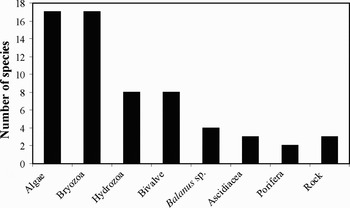
Three species (Halecium muricatum, Sertularella tenella and Eudendrium rameum) were not noted on any part of algal substrate, but exclusively on secondary substrate attached to seaweed (Table 2). Bryozoans were the preferred secondary substrate for hydroid settlement (Figure 3). As many as 17 species overgrew bryozoans, while hydrozoans and bivalves were also commonly colonized by eight species each (Figure 3). At least six species (of the families Eudendriidae, Haleciidae, Sertulariidae and Lafoeidae) offered a habitat for other hydroid settlement. Ascidians, Balanus sp., poriferans, and rocks were occupied by a lower number of hydroid species.
Total number of hydroid species recorded on different types of kelp associated microsubstrates.

Environmental factors
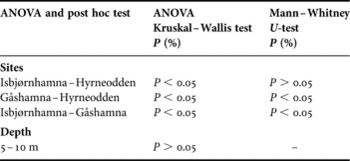
Neither sample species richness nor species composition were related to depth, as shown by the Kruskal–Wallis test (P > 0.05; Table 4) and the pair-wise ANOSIM test, (R = 0.046, P < 0.05; Table 3), respectively.
Analysis of variance and post hoc analysis testing differences between hydroids species richness at sites.

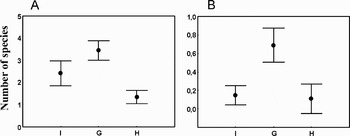
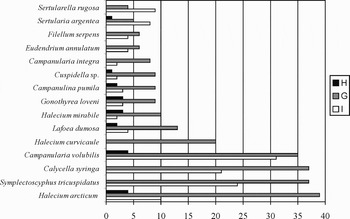
The highest mean sample species richness was in Gåshamna (Figure 4A). This was also the site with the highest frequency of hydroid occurrence and of the most common species (Figure 5). Hydroids were noted in 79% of samples taken at Gåshamna, in 63% of samples taken at Isbjørnhamna, and in 28% samples collected at Hyrneodden.
Mean (± 0.95 CI) number of species at the three sites; A, all species; B, fertile species (I, Isbjørnhamna; G, Gåshamna; H, Hyrneodden).

Frequency (%) of hydroid occurrence at sites (I, Isbjørnhamna; G, Gåshamna; H, Hyrneodden).

There were significant differences in hydroid species richness among the studied sites (Kruskal–Wallis test, P < 0.05; Table 4). A post hoc pair-wise test revealed significant differences between two pairs of sites: Gåshamna–Isbjørnhamna, and Gåshamna–Hyrneodden (Mann–Whitney U-test, P < 0.05; Table 4), whereas Isbjørnhamna and Hyrneodden did not differ significantly (Mann–Whitney U-test, P > 0.05).
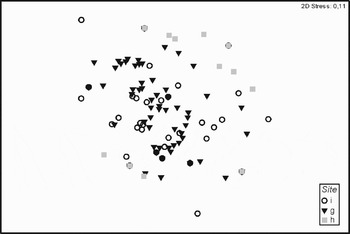
The low values of R statistic at P < 0.05 indicated that the hydroid species composition at three sites did not differ notably (pair-wise ANOSIM test; Table 3), nor was any clear separation of samples coming from the three sites observed on the MDS plot (Figure 6).
nMDS plot of Bray–Curtis similarities of species composition in samples based on presence/absence data (I, Isbjørnhamna; G, Gåshamna; H, Hyrneodden).

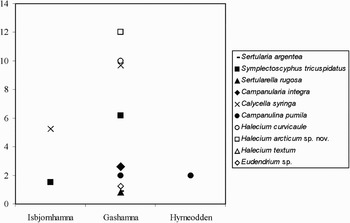
Ten species were found in the reproductive stage (as indicated by the presence of gonothecae or gonophores) at the time of the study (Figure 7). All of them were noted at Gåshamna. Furthermore the highest mean sample fertile species richness was in Gåshamna (Figure 4B). Only two fertile species were found at Isbjørnhamna, and one species at Hyrneodden (Figure 7).
Frequency of occurrence (%) of fertile specimens at sites.

There were statistical differences between the number of fertile species found at Gåshamna–Isbjørnhamna, and Gåshamna–Hyrneodden (Kruskal–Wallis test, P < 0.05; post hoc Mann–Whitney U-test, P < 0.05), but again there were no significant differences between Isbjørnhamna and Hyrneodden (Mann–Whitney U-test, P > 0.05).
DISCUSSION
In the extensive material collected during the present study, 17 species were found growing on the algae. That represents less than 15% of all the species recorded to date in Svalbard waters (117 species are reported by Palerud et al., Reference Palerud, Gulliksen, Brattegard, Sneli, Vader and Prestrud2004; Ronowicz, Reference Ronowicz2007 and Ronowicz & Schuchert, Reference Ronowicz and Schuchert2007). Other studies of Arctic seaweeds epifauna reported lower species diversity in this specific habitat. Lippert et al. (Reference Lippert, Iken, Rachor and Wiencke2001) found seven taxa of hydroids on macroalgea collected in Kongsfjord (north-west Spitsbergen), while Różycki & Gruszczyński (Reference Różycki and Gruszczyński1986) recorded only one hydroid species associated with laminarians collected in west Spitsbergen. The studies conducted in lower latitudes reported a similarly low number of species (e.g. 11 species of hydroids were found colonizing Laminaria digitata and L. hyperborea at Helgoland (Schultze et al., Reference Schultze, Janke, Krüß and Weidemann1990)). However, sampling efforts have never been as comprehensive as during the present study.
In the Mediterranean Sea, 32 epiphytic hydrozoan species were identified on brown algae Cystoseira amentacea at a high sampling effort (Frashetti et al., 2006), but they comprise only 7% of the taxa recorded in the Mediterranean area.
Primary substrate characteristics
The pattern of hydroid distribution along the kelp thalli is very pronounced. The most attractive part of the algae for settlement is the holdfast. The basal part of kelp provides protection from disruptive wave action and other disturbances (e.g. iceberg scouring in near-glacial areas). In contrast to rhizoids, phylloids grow seasonally and shed in winter and so they offer a short-lived and unstable substrate (Schultze et al., Reference Schultze, Janke, Krüß and Weidemann1990). A similar pattern of strong preferences for rhizoids by epifauna was observed for example, on Cystoseira amentacea (Fraschetti et al., Reference Fraschetti, Terlizzi, Bevilacqua and Boero2006) and Laminaria species (Schultze et al., Reference Schultze, Janke, Krüß and Weidemann1990; Schmidt & Scheibling, Reference Schmidt and Scheibling2006).
Biodiversity (number of species) seems not to depend on algal morphology (length and volume of thallus, wet weight) or age. According to studies by Kuklinski et al. (Reference Kuklinski, Gulliksen, Lønne and Weslawski2006), on bryozoans the size (surface area) and volume of algal substrate do not correlate with the number of species observed either. The common relation of an increase in epibenthic diversity and abundance with the substrate's size may occur in Hornsund kelp forests for whole benthic communities, but it does not have to be expressed in particular taxa (e.g. Hydrozoa). Different major taxa respond differently to physical factors and biological interactions, and so their distributional patterns may contrast with the patterns observed for the whole benthic community (as shown, for example, by Anderson et al., Reference Anderson, Diebel, Blom and Landers2005; Wlodarska-Kowalczuk & Kedra, Reference Wlodarska-Kowalczuk and Kedra2007).
Microsubstrate heterogeneity
The high heterogeneity of microsubstrate increases the hydroid species richness. This relationship has been often recorded both for sessile and mobile fauna: the more heterogeneous habitat the more species it hosts (Abele, Reference Abele1974; Kuklinski et al., Reference Kuklinski, Gulliksen, Lønne and Weslawski2006).
All the noted hydroids are known to be substrate generalists and occur on a variety of substrates without any specificity (Cornelius, Reference Cornelius1995a,Reference Corneliusb; Schuchert, Reference Schuchert2001). It may be suggested that the availability of habitat is the main force of settlement. There are studies indicating that competition for space is important in shaping Arctic marine assemblages (Barnes & Kuklinski, Reference Barnes and Kuklinski2003). The secondary substrates become important for sessile organisms because they provide a substitute home for inferior competitors. Hydroids are among the first colonizers of vacant substrates, but they often cannot withstand pressure from other colonizers, such as bryozoans, sponges and ascidians (Llobet et al., Reference Llobet, Gili and Hughes1991).
The high species richness occurring on bryozoans, hydroids and bivalves may be a consequence of a lower competition level on these types of substrates. The other reason for favouring bryozoans and hydroids may possibly be the fact that mobile, flexible substrates have an advantage over stable microhabitats by providing protection against burying by sediment and supplying better water flow conditions for suspension feeders, thus better food availability and more efficient waste evacuation (Wahl, Reference Wahl1989; Kuklinski & Bader, Reference Kuklinski and Bader2007).
Physical factors
A total of 83% of species collected in Hornsund belong to Thecata, an order grouping hydroids known to be more resistant to mechanical stress than the Athecata representatives (17%) (Faucci & Boero, Reference Faucci and Boero2000). The shallow Arctic sublittoral is an extreme environment for benthic organisms due to heavy icebergs scouring in addition to glacier-derived sedimentation.
Both biodiversity and frequency of occurrence were much lower at the two sites situated in the vicinity of glaciers than at the site not influenced by glacier disturbance.
The distribution pattern of sessile invertebrates is formed by the substrate selection processes occurring during larval settlement (Hayward, Reference Hayward and Price1980). In an environment disturbed by strong sedimentation, the loss of suitable substrata for colonization may inhibit larval recruitment (Irving & Connel, Reference Irving and Connel2002; Airoldi, Reference Airoldi2003). Several suspension feeding organisms have been observed to experience reduced survival and mortality as a consequence of burial, scouring, and clogging by sediments (Moore, Reference Moore1977; Smith & Witman, Reference Smith and Witman1999), causing changes in the species composition and diversity of already established communities. The most vulnerable species are excluded, and sediment tolerant species take their place. Naturally, there are many covarying factors that interact together with each other (e.g. sedimentation, hydrodynamics, salinity, turbidity and current velocity). Therefore, it is not clear whether the sedimentation regime is the only factor responsible for lowering hydroid species richness at Isbjørnhamna and Hyrneodden.
On the other hand, species composition is homogeneous at the study area with high small-scale variability. This patchiness might be a consequence of microsubstrate heterogeneity, which play an important role in colonization processes (Ronowicz, Reference Ronowicz2005).
In the collected material all reproducing species produce fixed gonophores. The loss of the planktonic dispersal stage (as in the case of most of the hydroids cited in the present study) has many advantages. It enables to keep subsequent generations in the vicinity of a favourable habitat, thus reducing the risk of spreading to an environment where the settlement of planulae would be impossible.
An interesting observation is that, at sites influenced by glacier disturbances, the sexual reproduction of hydroids seems to be limited or even stopped. Of ten fertile species found at Gåshamna, representing the ‘clearest’ site without glacier-induced disturbance, all were noted at other sites, but only two of them were fertile at Isbjørnhamna, and one at Hyrneodden sites which are under the strong influence of such perturbations. Investigations on the impact of environmental stress, such as decreasing temperature and salinity, on sexual reproduction of hydroids have shown a completely different reaction as revealed in the acceleration of gonophore formation (Piraino, Reference Piraino1991). The induction of reproductive processes under unfavourable physical conditions was explained as an adaptive response (Stebbing, Reference Stebbing, Tardent and Tardent1980; Piraino, Reference Piraino1991). In addition, experiments on the competitive ability of Hydractinia [GM] revealed that competition as a disturbing force, also causes an increase in the production of gonozooids (Ferrell, Reference Ferrell2004). For organisms lacking the medusa stage, the advantage of sexual over asexual reproduction is in the better adaptation of new genotypes to unfavourable conditions. However, there are also other studies showing no such response of hydroid colonies in the face of inflicted stress, for instance, the exposure of hydroid colonies to low concentration of copper and mercury, as well as poor conditions of water circulation, does not influence gonozooid production; it neither stops production, nor stimulates it (Piraino, Reference Piraino1991).
Since the hydroids do not reproduce at heavily disturbed sites, the impact of sedimentation may exceed the limit of their adaptability. Another possibility is that the reproduction period is simply shifted at sites with disturbed conditions.
The effect of different levels of mineral suspension concentrations on the growth and reproduction of suspension-feeders has not been experimentally tested yet. Such an experiment is desirable in order to fully understand and explain the environmental pattern.
ACKNOWLEDGEMENTS
We wish to thank Dr Peter Schuchert for kind assistance during the identification of problematic specimens. The authors also acknowledge Dr Marek Zajaczkowski's help with some physical environmental measurements. This project was supported by the State Committee for Scientific Research grant N304 034 31/1202.