‘A common wealth is called a society or common doing of a multitude of free men collected together and united by common accord and coveanauntes among themselves, for the conservation of themselves as well in peace as in warre.’Footnote 1 Sir Thomas Smith's familiar definition was at the core of his identification of the realm of England as a commonwealth, in his book De republica anglorum (1583) or ‘The commonwealth of England’, as it was termed in the title of the 1635 edition. Smith was far from alone in regarding England as a commonwealth. Yet by 1800, the term had been eclipsed by others, although it was reworked in the early and mid-twentieth century as a more acceptable form of the older British empire and persisted in the titles of several American states.Footnote 2 So what, from the late fourteenth to the eighteenth centuries, had this word or term meant? This article explores who used it and why, how far down the social scale the term was available, and how popular uses of ‘commonwealth’ interacted with those found in the treatises of writers such as Smith. It examines what work ‘commonwealth’ performed for contemporaries and how it changed its meaning over time. And, accepting that ‘commonwealth’ was a keyword of unusual importance in the early modern period, it tackles the question of whether it denoted a concept – a notional set of values that had some permanence outside of linguistic shifts – or was merely a word, the meaning of which was fixed by specific linguistic context and usage.
This article is the result of a collaborative investigation into the history of early modern keywords. It is both an exercise in contextualization and conceptual history, necessitating a holistic approach to reunite the history of political discourse with cultural, social, and literary contexts. The methodology adopted is explained more fully in a companion article, but a brief summary is necessary, since we have already implicitly raised questions about whether we are dealing with a ‘keyword’ along the Raymond Williams model, or a ‘term’ along the Cambridge school model, or a ‘concept’ along the German Begriffsgechichte model.Footnote 3 Since the approach adopted by the research group necessarily shaped some of its conclusions, the methodology needs to be declared at the start. Four points stand out.
First, the research group accepted the need, emphasized by the Cambridge school, to contextualize words and terms; but thought that the context that has been applied has often been a rather restricted one. In particular, it lacks a social dimension. Recent work has suggested that the state and power was socially constructed; and this social context needs acknowledgement.Footnote 4 Smith was forced to acknowledge that rulers of a commonwealth included those who were also subjects; there was what he called a ‘fourth sort’, the local office-holders, who created an ‘unacknowledged republic’ of self-governing free men within a monarchical and aristocratic framework, the mixed state that Smith championed. Thus the research group included a broad social context.
Secondly, the group began with the notion that language could help to constitute and shape behaviour as much as passively record it. Thus commonwealth, and its associated terms, was treated as part of a language that acted to legitimize or delegitimize agency, participation, and protest; commonwealth was an intrinsically contested term.
Thirdly, the research group was equally interested in words and terms associated with ‘commonwealth’, believing that whilst individual words and terms might have their own specific histories, the network of terms closely linked to commonwealth – including ‘the common good’, ‘common weal’, ‘community’, ‘the common interest’, and their virtues, ‘public spiritedness’, ‘justice’, ‘equity’, and so on – were particularly important. This network constituted something very like a concept or a series of inter-related concepts, a set of values that, whilst constantly shifting and described differently, nevertheless remained somehow enduring, partly perhaps because they were ideals as much as realities. We have thus been interested in some of the advantages offered by the German school of conceptual history. We prefer not to talk about a concept as a single entity, but as a network of value-laden terms that constitute a conceptual field, a network that is constantly changing both in the composition of terms and in the meanings of some of those terms. ‘Commonwealth’ may thus be understood in relation to two concepts, the polity and ‘the common good’, each of which had a conceptual field of (sometimes overlapping) cognate terms. Much of the case for the centrality of the term to the discourse of the early modern period can be understood to derive from the way in which it enabled interplay between the different parts that made up this field, and the way in which this interplay made the term something that could be appropriated by groups and individuals for a multiplicity of purposes. An additional advantage of the German school was an interest in change over time. Thus the waxing and waning of ‘commonwealth’ was worthy of study and demanded explanation requiring the examination not just of one context, but of a series of contexts, chronologically separated but linked through memory, institutions, and language.
Fourthly, the research group insisted that analysis needed to be attuned to the literary fashioning of the keyword and its associated terms and values. ‘Commonwealth’ was not something that could be experienced outside of language; it was a representation, and therefore constructed by means of style, genre, mode of production, and literary fashions. As a representation it also jostled among other terms, rising but also falling in popularity.
The research group argues that commonwealth is (a) a keyword: it was a term that had particular importance in the early modern period that ensured its ubiquity, but also (b) a word or term that requires careful contextualization, in the broadest possible sense and not just at any one moment but across time, and (c) part of a conceptual field, denoting certain values and ideals that certainly needed language to define them, but also existed in relation to concepts of vice and virtue whose meaning and relationship shifted relatively slowly. Commonwealth was thus one way of talking about ‘the common good’, a concept that was undoubtedly contested as soon as it was applied to any context but which, as an abstraction or ideal, had an enduring meaning of shared benefit. It was, after all, to exploit that long-standing concept that the term ‘commonwealth’ was revived in political discourse in the nineteenth and twentieth centuries. It was also a way of describing another concept: the polity.
This variety of usage – as keyword, as term, and as part of a conceptual field – requires the adoption of a variety of approaches associated with different methodological models. The result of our discussions has not been tension-free – the group felt pulled in different directions at times – but it allowed us to bear down on different aspects of commonwealth that might otherwise have remained sidelined. The result, we hope, is an investigation that brings together multiple layers of usage. We have been engaged in a process of mapping out the plural contexts and meanings of a single word, not only so that we can name the parts but also to analyse their interaction.
Accordingly, it was necessary to work on a scale and breadth difficult for the individual scholar to achieve. The approach of the group has therefore been interdisciplinary and collaborative, utilizing the approaches of social historians, literary scholars, historians of ideas, and political scientists. The mixed nature of the research group also enabled the incorporation of visual as well as written evidence; drama, poetry, and fiction as well as treatises and pamphlets; social custom and ritual as well as ideas and words; evidence generated in family conflicts, parish and village disputes, towns and shires as well as in law courts or parliamentary debate; and evidence surviving in manuscript, sometimes recording the spoken word, as well as the evidence found in England's rich print culture. Some attempt has been made to place our study in a wider geographical and linguistic context: France and the American colonies provided some points for comparison and also, for the end of the eighteenth century, an essential context for understanding reasons for the eclipse of ‘commonwealth’. Such a collaborative process has not been without its challenges, since a group of diverse scholars inevitably represents many different views; tensions may still be evident in what follows, though we hope they are creative ones.
I
The origins of ‘commonwealth’ in the fifteenth century help to explain multiple uses of the term.Footnote 5 The sixteenth-century usage ‘Commonwealth’ represents the transference of a prominent term denoting one concept – the common good – to cover another: the polity. That process was political and social, in ways that will be outlined, but it was also linguistic, reflecting the translation into the English vernacular of key Latin and French terms as part of a process that began at least a hundred years earlier.Footnote 6
The lexical basis for the sixteenth-century word ‘commonwealth’ is the mid-fifteenth-century neologism ‘common weal’: a term for the common good which gained rapid currency in the 1450s as the catch-phrase of critics of Henry VI's government, including the duke of York and the earl of Warwick.Footnote 7 In the middle ages, it was axiomatic that government was provided for the good of subjects, both collective and individual, and notions of bonum commune, utilitas communis, and utilitas publica, drawing on the combined inheritance of Cicero, Augustine, and Aristotle, were an established feature of both political theory and political discourse. Mirrors for princes advised rulers to uphold the common good of subjects as a first priority, while critics and petitioners, in parliament and outside, appealed to the ‘profit’, or ‘common profit’, of the ‘realm’ or ‘people’, the good, or ‘good estate’ or ‘betterment’, of the ‘realm’ or ‘land’, as the justification for reform or redress.Footnote 8 Hence ‘common weal’ was merely the latest coinage in a succession of terms denoting the ethical and social purposes of government, its duty to provide for security, social order, justice, peace, and prosperity.
The term was also conventional in a second sense: in its association with notions of the ‘commune’ or ‘community’ of the realm of England, the political collectivity which was represented in parliament, protected by common law, and invoked by baronial and popular rebels in 1215, 1381, 1450, and on many other occasions. As a Yorkist chronicle of the early 1460s put it, ‘the comones of this lande … loved the Duk of York, because he loved the communes and preserved the commune profyte of the londe’.Footnote 9 The language of ‘common’, ‘commons’, ‘commune’, ‘communitas’ was a powerful complex in later medieval political life. Across Europe, it was a prominent element in urban political discourse, but in England it was also given meaning at the national level by the institutions of an unusually powerful and centralizing monarchy. Sharing in relatively standardized systems of law, taxation, and representation, each of which deployed elements of this discourse, it was not hard for the English to regard themselves as a community.Footnote 10 Such terms as ‘common profit’ and ‘common weal’ thus linked notions of legitimate government to a conception of political collectivity, of polity, supplying a powerful reason for the sixteenth-century emergence of ‘commonwealth’ as a term for the political order, or state.
But it was not the only reason: the crucial additional ingredient in most sixteenth-century versions of ‘commonwealth’ was the notion of res publica, which was another term with a long classical pedigree. It was derived principally from extracts from Cicero's lost dialogue De re publica which were discussed by Augustine in The city of God, and abstracted in the works of other late Roman writers such as Macrobius and Lactantius, as well as from surviving works, such as De amicitia (On friendship), De oratore (On the Orator) and, above all, De officiis (On duties). These texts were among the most fashionable reading matter for fifteenth-century intellectuals, as the humanists among them sought to recover the best and purest Latin diction and to apply the wisdom and learning of the classical era with a new kind of authenticity. Thirty pre-1500 incunables of Cicero survive from England, and the first printed edition of De officiis, produced at Mainz in 1467, was owned by several Yorkist and early Tudor civil servants. As early as the 1430s, for example, Humphrey, duke of Gloucester, received several neo-Ciceronian tracts on the theme of res publica together with a translation of Plato and editions of all Cicero's major works. William Worcester, secretary to Sir John Fastolf, also wove quotations and themes from Cicero into his ‘Boke of noblesse’ (1451/75), which called for a revival of the war in France as the best ‘remedy for the fall of the res publica’.Footnote 11 Cicero defined res publica as res populi: the concern, or property of the people, where ‘people’ means a collectivity or community joined together ‘through agreement on law and community of interest’.Footnote 12 This somewhat opaque definition produced three main meanings in his writings and those influenced by him. First, it denoted what we would recognize as a republic, and what Cicero himself saw as a translation of the politeia of Plato and Aristotle, viz. a state founded on the consent of the people and run by officers on behalf of the people within a framework of agreed laws. Secondly, it indicated any kind of healthy state or political community, where the preservation of the interests of the people was paramount; and thirdly, public or political life, or business.Footnote 13
This wide application helps to explain the term's attractions to those writing on behalf of a range of political institutions – churches and monarchies, as much as self-governing Italian cities. As early as the late fourteenth century, English bishops invoked res publica as an artful term for the well-being of the realm, preferring it to the term ‘the common good’.Footnote 14 But the growth of public political debate in the fifteenth century encouraged more reflection on the nature of the English polity, and the letters, pamphlets, and speeches of mid-century figures such as William Worcester, Sir John Fortescue, George Ashby, Bishop Russell, and the Yorkist lords contained numerous attempts to characterize public life where the Ciceronian idea of res publica was prominent.Footnote 15 By the mid-fifteenth century, its usage was promiscuous, and numerous attempts were made to render it in English – as ‘thynge public’, for example, or ‘good publique’, or even in Worcester's explicit translation ‘comon profite’.Footnote 16 This last instance is a harbinger for the later development of common weal, or common wealth; weal and wealth are virtually interchangeable in middle English, with the former usage more common in the fifteenth century and the latter dominating by the 1520s and 1530s. From being a term for the common good for most of the 1450s, it began, in the next few decades, to denote an almost tangible entity, associated with laws, principles, and consultative tradition, and denoting the welfare of the people. It soon became the obvious translation for Cicero's res publica, and a number of early sixteenth-century usages suggest that it has been chosen with that in mind. By the 1530s, commonweal(th) was openly defined in Ciceronian terms in the works of Thomas Starkey and Richard Morison, and its adequacy as a translation challenged in Sir Thomas Elyot's Book named the governor. It continued to mean the common good, but was also the normal term for the ‘monarchical republic’ (a polity that was monarchical but contained structures and values that were republican) in which Tudor men and women lived.Footnote 17 Thus a mixture of factors had contributed to its usefulness: the high valency of ‘common weal’ in an era of civil strife which was also one of rapid reception of Roman republican writing; the participatory nature of fifteenth-century English politics, in which a real and necessary dialogue existed among popular representatives and the elite of king, magnates, MPs, and government servants; and the lasting power of communitarian values and structures – common law, parliament, and national taxation – which had been forged between the twelfth and fourteenth centuries.
II
If commonwealth was a term that arose from a blurring of conceptual fields and of appropriated language, it is unsurprising to find that it was a contested term with, to use Kevin Sharpe's felicitious phrase, a ‘commonwealth of meanings’.Footnote 18 The next section maps some of the term's social context.
Commonwealth became a charged keyword when used in its emotive and contested sense to mean a form of polity that enabled the pursuit of the common good and interest of the people. As already observed, Cicero had suggested this should be some form of mixed monarchy. Used in this way, ‘commonwealth’ evidently touched a number of raw nerves in the early Tudor state, raising questions about the monarch's power, the identity and extent of the ‘people’, the nature of their true interest and how best to achieve it. Some of this tension is evident in the different ways in which Starkey, Sir Thomas Elyot, and Smith defined a commonwealth. Starkey had not made monarchy central to his definition of commonwealth; indeed his dialogic treatise advocated a conciliar form of government, albeit under a monarch. By contrast, Elyot, writing in 1531, argued that res publica was mistranslated as commonweal and better styled a ‘public weal’, since the former carried implications of social levelling. A public, as opposed to a common, weal, Elyot insisted, should be a hierarchical polity in which res (property) were not held in common. Elyot preferred to distance himself from the language of commons, distinguishing between a public weal, of which he approved, and a common weal, of which he did not (for him, common weal was more properly a translation of res plebeia). Thus ‘A publike weale is a body lyvyng, compacte or made of sondry astates and degrees of men, which is disposed by the order of equite and governed by the rule and moderation of reason.’ The social implications of Elyot's definition were clear: ‘if there should be a common weal, either the commons only must be welthy & the gentle & noble men nedy & miserable, or els excluding gentilite all men must be of one degre & sort, & a new name provided’. For Elyot, the commons (‘plebs’) were not the people; public wealth necessitated inequalities; and at the head of the hierarchy was the ‘souerayne gouernour’: the king.Footnote 19 The authors of humanistic treatises thus disagreed about the definition of commonwealth as soon as they moved away from the term's weak meaning as shorthand for the polity, to the stronger one of a polity that would best achieve the common good.
Such difficulties were increased by a humanistic and evangelical concern with social justice at a time of dearth, enclosure, and inflation.Footnote 20 For writers such as Robert Crowley, these concerns led him to attack the greed of the gentry, as men who ‘would eate up menne, women & chyldren’ in their desire to engross land.Footnote 21 For Crowley, ‘the voyce of the pore (whom you have … thruste out of house and home) is well accepted in the eares of the Lorde, and hath steared up hys wrathe ageynst you’.Footnote 22 As Crowley's language suggests, humanism's concern with the commonwealth could fuse with that other keyword ‘reformation’, with explosive results. In September 1549, the Kentish rebels demanded ‘reformacyon’.Footnote 23 Like the commotioners of 1549, the northern rebels of 1536 and would-be Norfolk rebels of 1537 also deployed commonwealth and reformation terminology to justify their cause. A rebel warrant of 1536 justified the restoration of the church, purgation of the council of ‘vylan blode’, and suppression of all heresies as necessary to maintain the ‘comon welth’; the warrant was signed ‘in this or pilgrimage for grace to the comon welth’.Footnote 24
The notion of a godly, reformed commonwealth thus carried implications of social justice. In 1552, Hugh Latimer advised that ‘things are not so common, that another man may take my goods from me, for this is theft; but they are so common, that we ought to distribute them unto the poor, to help them, and to comfort them with it. We ought one to help another.’Footnote 25 Such ideas and language could create a space for what Elyot had feared: the ‘commons’, in times of crisis. The multivalency of ‘commonwealth’ could thus be used to legitimize protest or rebellion. The rebellious commons of Kent, Surrey, and Sussex rallied under ‘a captain they called Common-wealth’.Footnote 26 The rebels themselves were known as ‘commonwealths’, or as ‘councillors of the Commonwealth’.Footnote 27 Viewed in these terms, ‘commonwealth’ could thus denote not an ordered hierarchy, but rather the collective interests of the commons. Critics of the governing oligarchy in Edwardian Boston (Lincolnshire) complained that, in enclosing the town's commons, the corporation operated without ‘any comen welth towardes the pore inhabitaunts’.Footnote 28 In 1549, the leaders of rebellion in the Norfolk village of Tunstead persuaded their neighbours to sign a declaration against a local encloser, advising them that their protest ‘was for a Commonwealth’.Footnote 29 In 1536, one of the conspirators who planned to massacre the gentry of Fincham, intended that ‘the comynaltie … wuld ryse … for the comon welthe’; significantly, the Fincham plotters defined the ‘comon welthe’ as ‘the wele of the comynaltie’, the latter being a word whose meaning extended beyond those who ruled.Footnote 30 A little later, in 1568, William Fynney of Warslowe, Staffordshire, was prosecuted for destroying enclosures and ‘making his outward show that he would be a Commonwealth man’.Footnote 31 Andy Wood and Dave Rollison have suggested that this was not merely the commons appropriating humanistic language, but rather drawing on a language of commonweal/commons/common good that was deeply lodged in late medieval popular protest.Footnote 32
Both the words and actions of the rebels were opposed by their rulers. Sir John Cheke condemned the rebels for twisting one of the keywords of governance: addressing the Norfolk rebels, he argued that though they might ‘pretend a commonwealth’, the rebels brought only chaos. Archbishop Cranmer agreed, asking ‘is it the office of subjects, to take upon them the reformation of commonwealth?’ As Wood puts it,
in 1549, like in 1381, 1450 and 1536–7, an important element of the conflict between ruler and ruled involved not only a physical contest, but also a linguistic and ideological struggle. Over and again, terms like ‘commonwealth’, ‘reformation’, ‘traitor’ and ‘thief’ were twisted around by rebels, transforming them from the keywords of governance into weapons to be used against the gentry and nobility.Footnote 33
A different, but still socially inflected, reading of commonwealth focuses less on rebellion and more on the governance of England's early modern towns and corporations.Footnote 34 Such a reading is important in a number of ways. First, it exemplifies the involvement of the ‘fourth sort’ described by Smith in the practice of urban governance, through office-holding. Secondly, it illustrates the legacy of medieval concerns with the language of community and common good, particularly in civic settings. Thirdly, it stresses the economic implications of commonwealth at local levels. Promoting the commonwealth thus entailed promoting trade and economic well-being as much as social and religious well-being. Fourthly, it emphasizes the capacity of commonwealth to act as a language to articulate personal and public vices and virtues. The rebels had attacked the greed, covetousness, and fraud of landlords. Focus on the routine relationship between governed and governors in towns, and on corporate life more generally, stresses how commonwealth fostered an idealization of virtues necessary for governance in what Smith regarded as a society of free men collected together by common accord and covenants. As Phil Withington has shown, magistrates working for the common good were thought to have personal qualities that they brought to public life: honesty, civility, sobriety, diligence, discretion. By contrast – and it is noteworthy how often the language of commonwealth was constructed in terms of antonyms and synonyms – bad counsellors were selfish, in pursuit of private ends, ambitious and wilful. Thus, for example, in Ludlow, the town's ‘supposed governors’ effected ‘their own wills’ and ‘their own profits’, placing ‘their own private wealth and the wealth of their friends before the common wealth’. The Swallowfield articles similarly deployed a set of contrasting communal virtues and vices: the words honest, love, amity, liking, quiet, gentleness, affection, just, duty, consent, discretion, credit are pitted against strifes, griefs, disdain, malice, discontent, discord, dissentious, proud, arrogant, wilful, stubborn.Footnote 35 Here, the skills and attributes for the community are also those required for the national commonwealth.
The blurring of micro and macro and of public and private also meant that even the ostensibly non-political necessarily became political. Thus the ‘counsel’ offered by William Bullein in mid-sixteenth-century medical tracts also necessarily instructed readers about common well-being in the state; his phrase ‘government of health’ reflected this overlap. Similarly, his dialogue about physical fever extended to the diseases of the state: he wrote about talk, truth, and trust – and their relationship to knowledge and power – in the context of what appeared to be widespread self-interest and deception, and the corrosion of commonwealth values.Footnote 36 This overlapping of private and public also highlighted the role of women in the commonwealth in the sense that the private virtues that made for good counsel were often associated with men. Hence ‘commonwealthsman’ Henry Neville satirized the Rump as a ‘Parliament of Ladies’; and political pornography became an important genre in the second half of the seventeenth century to satirize those whose lusts threatened the body politic – such as republicans, courtiers, and even kings.Footnote 37 This blurring of boundaries between public and private and the stress on vice/virtue is important, since it tended to reinforce a correlation between the possession of material wealth and the virtues necessary for good government, as well as a tension whenever such private wealth was seen to obstruct the larger good. The language of vice and virtue was also one shared by the humanists and reformers as well as a much wider public; and the contest between vice and virtue was necessarily one that fostered a conspiratorial mindset about sinister designs being pursued against the commonwealth.
III
Commonwealth had become a keyword because its ambiguities gave it a creative adaptability. In a weak sense, it could be used to describe any polity; in a strong sense, it was used to discuss what form of polity was most conducive to the common good. That debate was often highly charged and contested because all the elements of res publica were ambiguous and because the ‘common’ language overlapped with corporate and popular discourse about good governance. Commonwealth could relate to notions of virtue and hence also inversely to notions of vice. This necessarily endowed it with moral and religious associations; and also ensured that it was contentious, since what constituted virtue or vice and what constituted social justice were debated. Further valency attached to the term because it could describe both a community, describing the composition of a people, state, nation, or polity and the form of government over those communities and institutions. Similarly, commonwealth could apply to both the private world of the household but also to the public sphere, often carrying over attributes from one to the other. It was thus necessarily socially constructed as well as religiously and politically. Nor was that all, for commonwealth also had an economic sense – literally to do with the common wealth – and hence to private and public profit. This does not, however, exhaust a mapping of commonwealth, and another dimension of commonwealth was closely tied to several of the foregoing threads: the relationship between commonwealth and genre, form, metaphor, and image.
Humanistic admiration for Cicero related as much to his rhetoric as his views about res publica, not least because he suggested that form and content were inter-related. Cicero stressed the role of deliberation – consilium – in the exercise of government; and deliberation was both a political good and a genre. It is not coincidental that so many discussions about commonwealth are couched as dialogues. Just as dialogues occurred within early modern states, between ruler and ruled or over definitions of the commonwealth, so it was appropriate to deploy such debates within a dialogic format. The broadly rhetorical dimensions of commonwealth were not accidental but rather incidental to its meanings.
For example, Sir Thomas Smith's appropriately named Discourse of the commonweal of this realm of England (written c. 1549 but printed posthumously, in 1581), shows how the commonweal could be cured through dialogue. The work, which echoes some of the themes of the tract discussed at the start of this article, dramatized a dialogue between the different estates (a knight, a husbandman, a capper, a merchant) about the advantages and dangers of enclosure, in which the interests of each were managed and negotiated by an academic doctor, who stands for Smith.Footnote 38Discourse of the commonweal recognized that negotiation of interest and desire for improvement were healthy characteristics. Dialogue was curative because it offered a gradual process of reasoning the polity back into good health, in ways reminiscent of Bullein, whose medical/political tract cited earlier had also used the dialogic form. The conversation evident in the dialogue form thus formed part of the recipe for the commonwealth's good health. In Smith's Discourse civil conversation was used as a model for the commonweal: each speaker was allowed to play his part, in a structured way under the doctor's eye. Just as commonwealth embodied a sense of collectivity – however idealized and open to contestation – conversation also epitomized the same values.
The political health of a community (a body politic) could also be measured by the conversations these texts depicted. A healthy community would listen to the various participants; an unhealthy one would not. In Thomas Elyot's Pasquil the playne (1533), for example, none of the interlocutors change their mind; hypocrisy and complicit silence prevail; and the plain speaker with integrity remained alienated from court. Here Starkey's recurrent use of the term ‘commynyng’ is instructive, since it was a word that encompassed various meanings, including communicating, conversing, participating, sharing, and eating together.Footnote 39 Tellingly, sixteenth-century dialogues also recurrently evoked communal settings, in imitation of their classical predecessors. Early modern English dialogues were frequently structured around meals, with conversations occurring before, after, or between repasts shared by the interlocutors. In Smith's Discourse, for example, the speakers gathered to share both a venison pasty and to participate in a civil discussion about the state of the commonwealth; whilst in Thomas More's Utopia (1516) an imminent meal dissipated any residual tensions caused by Hythloday's oration in Book ii. The breaking of bread together was obviously symbolic of community – and it was a feature of the communal life that took place on the island of Utopia – and also demonstrated the same hospitality and courtesy required for conversing, where interlocutors must listen as well as talk, and for the ideal governance of communities.
Invented dialogue was a way of deliberating about the common good and almost literally hearing what it might sound like. A fictional meal could also stand for the shared conversation within the commonwealth. But if harmony was their ideal, dialogues could also safely voice social critique, since authors could evade being charged with advocating or promoting views that were espoused by a fictional character. The dialogue form thus both explored and exploited the multivalent and contentious nature of commonwealth. A printed dialogue between Thomas Churchyard, Thomas Camell and others (c. 1551), for example, revolved around a debate concerning who had the right to voice an opinion on the state of the commonweal.Footnote 40 Who was legitimized to speak, either in their own right or on behalf of others, was thus both a literary and a political question. Indeed, the relationship between literary and political form is worth pursuing. The rise of the radical and reforming clubs in the later eighteenth century – themselves mini-corporations of free men governed by rules – are a further demonstration of the interaction between politics, conversation, and claims for inclusion in the dialogue about governance.
The dialogic nature of debates about the commonwealth reminds us about the dialogic quality of print itself. Print enabled such conversations to be disseminated to a wider public and to stimulate debate about the commonwealth among those who held different conceptions of it. Print could further the common good, by articulating ways to reform and restore the commonwealth. Yet the press was also a source of anxiety, for it allowed the ambitious, the self-interested, and the deceitful to entice the public away from pursuing the common good. Many feared that it sapped the virtues necessary for the common good and became a tool in the hands of those who sought to redefine key terms associated with the commonwealth. Fears that publicity could undermine the public came to the fore from the mid-seventeenth century onwards. A royalist broadside The interpreter (1643) – again adopting a dialogic form – thus sought to show that words had lost their meaning or rather, that their meanings were often the inverse of what they should be. The ‘true and perfect diurnals’ which pretended ‘to prevent misinformations’ were really ‘Lying Pamphlets’. In this world-turned-upside-down, ‘loyall subjects’ were castigated as ‘Malignants’ and the ‘peace of the commonwealth’ had become ‘Arme, arme’. Print undermined the fixity of the words in the conceptual field relating to the common good and could reconstruct it differently according to the self-interest of authors, parties, and booksellers. Examples could be multiplied from the period after the temporary lapse of licensing in 1679 and permanent demise in 1695, when the ubiquity of mendacious print was thought to have undermined Britons’ love of liberty so that by 1716 it had become necessary to pass a riot act and to repeal frequent parliaments.Footnote 41 The degradation of public dialogue therefore had political consequences.
Examining the form of discussions about commonwealth also highlights the importance of metaphors. One common image was that of the tree of commonwealth. Writing in the Tower shortly before his execution in 1510, Edmund Dudley wrote his Tree of Commonwealth in which he explained that
The common wealth of this realme … may be resembled to a faier and might[i]e tree growing in a faier field or pasture, under the … shade wherof all beastes , both fatt and leane, are protectyd and comfortyd from heate and cold as the tyme requireth. In all the subjectes of that realme wher this tree of common welth doth sewerly growe are ther by holpen and relyved from the highest degree to the lowest.Footnote 42
The tree acts as a metaphor but – like dialogue – also a means into analysis and thinking about the commonwealth. Other metaphors were similarly deployed: the ship and the body were two of the most popular, as well as images of the good governor as a shepherd or father.Footnote 43
Such metaphors of the commonwealth suggested positive links with concepts such as order, harmony, and health; but the metaphors also influenced and reflected how good governance was understood to work. Such images enabled the dissemination of commonwealth ideas and helped to shape attitudes and behaviour. Thus Robert Kett's rebels had a ‘tree of reformation’ at Wymondham. Integral to the meaning of such metaphors of commonwealth was the fact that they were constituted by different parts, all of which had a role to play – whether roots and branches of the tree, crew-members of the ship of state, or limbs and organs of the body politic. Should any one part not contribute fully, then the whole suffered. In A dialogue between Pole and Lupset (c. 1531) Thomas Starkey wrote of the commonwealth as ship: ‘even lyke as a schype then is wel governyd when both the mastur & rular of the strerne ys wyse & experte, … & every man also in the schype doth hys offyce & duty appoyntyd to hym’.Footnote 44 The metaphor encapsulated not only a participatory but also a hierarchical nature of commonwealth; and the image of a ship at risk of sinking in a storm could be seen as dramatic commentary on an endangered and dislocated commonwealth. Hence in the opening scene of Shakespeare's The Tempest (c. 1610–11), the courtiers were curtly ordered below decks by the boatswain: ‘To the cabin; silence!’Footnote 45 Aristocratic birthright here held no sway over professional expertise.
A very frequent analogy for the commonwealth in sixteenth-century writing was that of the body politic. Embodying the commonwealth allowed several corporeal parallels to be drawn. Like the human body the health of the body politic was dependent on the balance of the humours – reliant on a balance among its different elements (prince, aristocracy, and people), a metaphor which could thus emphasize the mixed constitution of the res publica.Footnote 46 Lacking that balance, the political body was subject to various maladies which could be compared to physical diseases. Hence Starkey likened idleness to dropsy; ill occupation (i.e. making luxury items), to palsy, and so on.Footnote 47
The openness of these metaphors to variant, and even conflicting, readings is most apparent in the way Starkey's fictional character ‘Pole’ categorizes the different members of the commonwealth in terms of different body parts. Whilst craftsmen and ploughmen were uncontroversially deemed its hands and feet, the ruler was depicted as the heart, from where ‘spryngyth out’ ‘felyng lyfe & al other natural powar’; and the role of the head ‘wyth the yes yerys & other sensys’ was allotted to the ‘offycers by pryncys appoynted, for as much as they schold ever observe and dylygently wayte for the wele of the rest of thys body’.Footnote 48 More usually, however, the monarch and his counsellors constituted the ‘head’ of the body politic. The change of location from heart to head invites a different conception of the relationship among the parts of the commonwealth, as appears in John Cheke's The hurt of sedition howe greevous it is to a communewelth (1549), a response to the rebellions of that year. In Cheke's tract, the ‘head’ of the body politic was the king and his council who possessed reason, wisdom, and sound judgement. By contrast, the rebels were identified with unruly affections. Just as ‘the viler partes of the body … contend in knowledge and governement wyth the fyve wyttes’, Cheke argued, ‘so doeth the lower partes of the communs welth … strive agaynst their duty of obedience to the Counsaile’. The metaphor emphasized the unnaturalness, beastliness, and irrationality of rebellion. The rebels thus mistook the virtues of commonwealth: ‘stoutnes, and sullennes is counted manhod, and stomakinge is coradge, and pratynge is iuged wysdome’.Footnote 49 Cheke's argument also shifted from representing rebellion as an illness within the body politic to explaining its effects on men's bodies: the effect of distemper in the body politic – rebellion – was the physical sickness of individuals. The legal incorporation of communities heightened the usefulness of the body metaphor of the body. It was, however, Thomas Hobbes who drew most dramatically on the metaphor in the frontispiece to his Leviathan (1651). Hobbes's commonwealth/state/sovereign was the embodiment of all the men who had, to paraphrase Smith, freely united under a set of common rules.
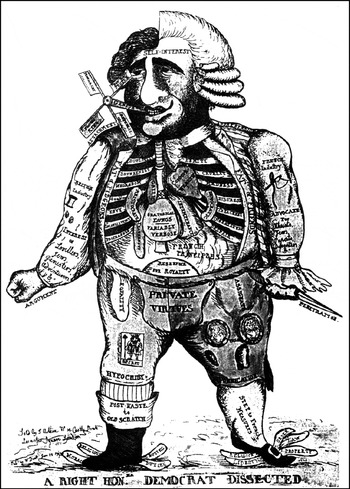
As Hobbes's frontispiece reminds us, metaphors were visual as well as verbal; and trees, ships, and bodies were all used to good effect in graphic satire. In one such satire of 1793, for example, the image of the body politic was used against Charles James Fox. His ribs, for example, were composed of duplicity, drunkenness, whoredom, envy, inconsistency, prophaneness, enmity, cruelty, madness, distress, treachery, ingratitude, despair; whilst his head was self-interest and his knee hypocrisy (Figure 1). These are the vices that work against the common good, and Fox tramples on liberty, property, religion, law and order. Significantly, however, Fox was not labelled a commonwealthsman in this depiction but a democrat – a shift of terminology to which we will shortly return.
A satire of 1793 giving visual expression both to the verbal metaphor of the body politic and to the vices that could corrupt the commonwealth. British Museum Satires 8291 © The Trustees of the British Museum.

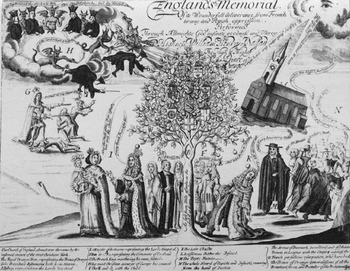
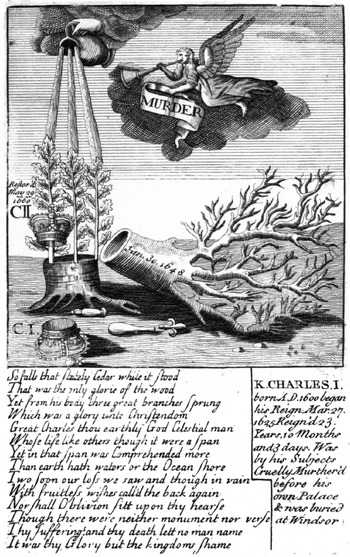
The tree of commonwealth was also deployed extensively in visual prints. In England's memorial (1688), the tree is quite explicitly an orange tree, referring to England's deliverance from ‘French tyranny and Popish oppression’ at the hands of the prince of Orange, William III (Figure 2). The threat of tyranny is rendered graphically, with the inclusion, in the upper left of the image, of Louis XIV ‘murthering his own subjects’. The tree represents a conjoined church-state, its fortunes overseen by the all-seeing eye of Providence. But conflict is ubiquitous: at the cosmic level, satanic forces amass behind the king of France and the pope as agents of ‘Hells assaults’, and on the ground, where lords, commons, and church cluster round and protect the tree of commonwealth. The tree, and hence the revolution, is nevertheless offensive to Queen Mary Beatrice who laments ‘How the smell of this orange offends me and the child’ (Prince James), while the Jesuits complain ‘How strong it smells of a free parliament.’ The image draws on a long history of anti-popery, celebrating deliverance from a threat both confessional and dynastic, to effect a counter-reformation in the commonwealth or church-state, but centres it round the similarly long-lasting metaphor of the tree. Indeed, the print may well be supplanting images of the Stuart oak (such as Figure 3) with a Williamite orange tree and hence intentionally breaking the association of the Stuarts with the welfare of the English commonwealth.Footnote 50 Following visual metaphors over time is one way in which the language of commonwealth can be charted.
England's memorial (1688) – an allegory of the Glorious Revolution. British Museum Satires 1186 © The Trustees of the British Museum.

The loyall mourner (single sheet print), 1660. British Museum Satires 747 © The Trustees of the British Museum.

IV
The following section examines how overlapping usages of commonwealth sketched thus far began to be prised apart over the course of the seventeenth and eighteenth centuries. Commonwealth became much less useful as a keyword, partly because of its association with the regime of the 1650s, and more generally because of the challenge it offered to new ideas about wealth, emerging languages of the state, interests, publics and republics, and patriotism and nation. Importantly, the concept of the public good endured, and many of the vices and virtues associated with commonwealth and its antithesis remained part of general political discourse; but their connection with the term loosened.
The argument over which form of government best worked for the common good came to a head in the mid-seventeenth century. It had long been the claim of monarchy to act for the good of the people; but by 1642, parliament was also claiming to do so against a king and a church that displayed the vices associated with those who undermined or actively worked against the commonwealth. Thus, the 1641 Grand Remonstrance declared that it was parliament that worked with ‘a zeal to the public good’ and ‘the Commonwealth’, and attacked the ‘private ends’ pursued by Charles's counsellors.Footnote 51 Highlighting the abandonment of the public good in favour of private interests, Henry Parker lamented how Charles I had relied on ‘his own private reason and counsel’, following ‘private advice rather than publique’ in pursuit of his ‘ambition’.Footnote 52 Yet the king's dilemma about how to respond to parliamentary demands replicated that faced by Elyot and others a century earlier: embracing the notion of mixed monarchy (as his advisers did in the Answer to the nineteen propositions) was to risk legitimizing the Commons’ demands.
It was 1649, however, that reoriented the meaning of commonwealth, binding it with a particular form of polity – a republic – and hence removing much of the term's flexibility, particularly after the restoration of the monarchy in 1660. On 19 May 1649, England was declared to be ‘a Commonwealth and Free State’, represented by parliament.Footnote 53 This identity was self-consciously a rejection of a monarchical realm: when ‘An additional Act, for the better Observation of the Lord's Day, Days of Publick Humiliation and Thanksgiving’, designed to promote a godly community, was given a third reading on 19 April 1650 it was ‘Resolved, That the Word “Realm” be put out; and the Word “Commonwealth” be put in, instead thereof’.Footnote 54 And the Engagement to the new regime required an oath to be ‘true and faithful to the Commonwealth of England, as it is now established, without a King or House of Lords’. The debate surrounding the Engagement focused attention on the meaning of ‘commonwealth’.Footnote 55 Some tried to retain its earlier usage as a description of the body politic. Although he found the term ambiguous Bishop Sanderson suggested that it could mean the ‘whole entire Body of the English Nation, as it is a Civil Society or State within it self, distinguished from all other Foreign Estates’. By prioritizing the latter sense royalists could take the oath, Sanderson implied, because ‘it relateth to the safety of the Nation, and importeth no more as to the present Governors, but to live peaceably under them de facto, and to yield obedience to them in things absolutely necessary for the upholding Civil Society within the Realm’.Footnote 56 Sanderson was thus invoking the ‘weak’ sense of commonwealth. The Leveller John Lilburne, too, saw continuing ambiguities in the term commonwealth, which could mean (a) ‘all the good & legall People of England’ or (b) ‘the essentiall and fundamentall Government of England, as it is now established’; it did not, he insisted, mean ‘the present Parl. Counsel of State or Councel of the Army, or all of them conjoined’, and therefore could be taken.Footnote 57 In distinguishing between ‘commonwealth’ as the particular government of 1649 and ‘commonwealth’ as community or people or the fundamental constitution, these commentators attempted to resist the equation of commonwealth with the ‘prevalent party’ of republicans. Increasingly, however, such arguments appeared casuistical as commonwealth became identified with the republican regime and form of government. Interestingly, the term ‘république’ was also being used in France by the end of the sixteenth century, after a similar period of civil war, to distinguish a non- or anti- monarchical polity. Of course, such a meaning existed alongside and in tension with other, less negative senses of the term, including Bodin's attempt to define ‘république’ as ‘state’.Footnote 58
After 1660, with the restoration of the monarchy in England, commonwealth and republic became synonymous; and the vices formerly associated with the threats to the commonwealth were now also attached to it.Footnote 59 Castigation of the previous republican regimes, coupled with conflict with the Dutch republic in two ideologically charged wars 1665–7 and 1672–4, meant a considerable amount of print in the 1660s was devoted to lambasting republican commonwealths.Footnote 60 The resurgence of Anglican-royalism during the administration of the earl of Danby, 1674–8, the instabilities created by the succession crisis, and the fear of a return to civil war, heightened loyalist rhetoric against commonwealth ideals, and the alleged plotting against the state by the republican Algernon Sidney and others in the early 1680s made it even more shrill. As a result, a close correlation between commonwealth, republic, and civil war was repeatedly asserted, so that commonwealth carried deeply pejorative overtones. ‘Commonwealth’ and ‘sedition’ or ‘rebellion’ became virtually interchangeable. In an imagined dialogue of 1680, a loyalist spokesman attacks a perceived drift to republicanism resulting in ‘Rebellion, Confusion and Anarchy’ and proudly proclaims ‘I am no commonwealths-man’.Footnote 61 ‘A Commonwealth! curse on that nauseous name/ Which from the Devil with damnation came’, rhymed one self-styled ‘satyr against Common-wealths’.Footnote 62 Aphra Behn referred to the ‘tyrannick’ or ‘damn'd commonwealth’; Dryden thought ‘a commonwealth sounds like a common whore’.Footnote 63 The frontispiece to Thomas May's Arbitrary government display'd, published in 1683 shortly after an alleged republican plot to assassinate Charles II, graphically depicted the dangers of a return to the ‘commonwealth’ in another visual metaphor.Footnote 64 The latter was depicted as a dragon, whose chain tail encircled and enslaved the people, devouring ‘laws’, ‘customs’, ‘Statutes’, ‘Magna Charta/prerogative/privileges/Liberties’, ‘Episcopy’, ‘Monarchey’, ‘Church Land & tytl[e]s’, ‘nobility & House of peers’, all of which were represented as ‘food for a commonwealth’. The title reminded viewers that a commonwealth also ruled ‘with a standing army’. The image also underlines the association of commonwealth with an attack on the established church – a perversion of the godly commonwealth of the sixteenth century.Footnote 65
The rise of political parties sharpened the polemical association between commonwealth and republic, since it became a stock allegation that the Whigs were the direct heirs of the mid-century republicans and similarly intent on king-killing. A Tory 1681 address to the king from Norwich promised to repel ‘all vile Attempts of all that do yet retain their old Commonwealth Principles, by whom Your Father of Ever-blessed Memory, was Barbarously Murthered’.Footnote 66 In the partisan conflict of Anne's reign the association between Whigs, commonwealthsmen and republicans became sharply articulated as fiercely Tory adulatory, loyal addresses presented to the crown between 1710 and 1713 illustrate. The 1710 address from St Albans abhorred ‘schismatical, anti-monarchical and republican principles’ and in 1713, when the Tories were again dominant, Orford's address attacked ‘the Republicans and Commonwealth men’.Footnote 67
Increasingly, an alternative vocabulary of patriotism (drawing on older distinctions between court and country), public interest, and public spiritedness prevailed.Footnote 68 These terms, by the late seventeenth century, offered a more useful, flexible, less negatively-charged, mode of discourse, a language equally available to the country Tory Bolingbroke as independent Whigs.Footnote 69 Thus the concept of the public good was separated from ‘commonwealth’ and expressed in new terms. Similarly, commonwealth was supplanted by different terms describing the polity. These included ‘state’, itself relatively new in the early sixteenth century. Indeed the debate over ‘commonwealth’ in 1649 may well help to explain this shift, for Hobbes's Leviathan elided the term with state, referring to ‘that great Leviathan called a Commonwealth, or State (in Latin Civitas), which is but an artificial man, though of greater stature and strength than the natura.’ In this formulation, the state assumed the mantle of both commonwealth and civitas, and emerged as a keyword flexible enough to apply to both monarchy and to an assembly.Footnote 70 The Hobbesian state could thus survive the rise of a parliamentary leviathan in the eighteenth century, which appropriated the representativeness of the civitas tradition.
Problems in using ‘commonwealth’ were also exposed in the colonial context. In England's early American colonies different meanings of commonwealth had generated varied polities. In 1610, Virginia's promoters advertised for ‘men of most use and necessity, to the foundation of a Common-wealth’, seeking to establish a colony that would protect and benefit the inhabitants who worked in the interests of the Virginia Company and the English state. In New England, puritans set up godly communities wherein, according to John Cotton, the ‘free Burgesses … such as are in fellowship of the Church’ established a ‘Christian commonwealth’.Footnote 71 Old World political and social ideals nevertheless proved difficult to transplant in New World communities lacking English local government traditions and institutions. The colonists were committed to the ideal of virtuous rulers, but not always convinced by the character and intentions of those who ruled. When obedience and ‘affection’ were not forthcoming, colonial governors relied on force, declaring martial law or banishing dissenters. Not all New England puritans migrated in search of the ‘pure and peaceable enjoyment of Christ's Ordinances’ and many of those who did disagreed with the orthodoxy propounded by the colony's leaders. In Virginia, the boom and bust of the tobacco economy bred antagonisms and competing visions of the polity that erupted in civil war in 1676. In America, then, appeals to commonwealth justified the vision of promoters, the authority of magistrates but also the insurgency of protestors, giving rise thereby to diverse and insular colonial societies.Footnote 72
For all the difficulties of deploying ‘commonwealth’, there were, however, attempts in the late seventeenth and eighteenth centuries to reclaim it as a term that could legitimately reconcile the notions of public good, public consent, and public wealth to a monarchical form of government. Thus The claims of the people essayed (1701), argued that England had been a commonwealth since the Conquest:
I say that England was a Common-wealth from the Reign of William the First, to King Henry the Third's time, tho it never wanted a king all that while. What strange magick Spell lies hid in the Word Commonwealth! It frights Men like a Goblin … Is any Government so much as tolerable which is not a Common-wealth? That is to say, which do's not aim at Common-weal? Ought not every King and every Subject to be a Commonwealth's man? And contribute all he can to the publick Weal of his Country? He who is not a Common-wealths-man is a political Schismatick and Separatist, a State Phanatick. A King who is not a Common-wealths-man is a Grand Turk, a Morocco Emperor, a French King, to whose Protection, we recommend such Subjects who hate Commonwealth.Footnote 73
Similarly, there was also a discussion of the positive relationship between commonwealths and trade – a literal concern with the promotion of public wealth – in the writings of Slingsby Bethel and others thinking about political economy in the mid- and later seventeenth century. Steve Pincus has identified a displacement of civic virtue in favour of a recognition that the common weal depended on the wealth-creation of individuals.Footnote 74 Part of that shift entailed a reconsideration of how far vices condemned by commonwealth principles were really detrimental to the commonweal. Writing at the beginning of the eighteenth century, Bernard de Mandeville famously argued that private vices were public benefits.Footnote 75 The rest of the eighteenth century was often highly ambivalent about whether luxury and pride were actually detrimental to the common wealth, thereby breaking an association that had prevailed for much of the previous two centuries. The term ‘commonwealthsman’ was occasionally embraced, when defined as denoting virtues of public-spiritedness and promotion of the public good and nation's wealth, but these latter terms became more useful.
At the end of the eighteenth century, ‘commonwealth’ was self-consciously invoked by radicals. Major Cartwright's The commonwealth in danger (1795) claimed that Britain was
in fact no other than a republic or commonwealth, nor will admit of any other earthly definition … if, as I conceive it, a commonwealth means a government, of which the common weal of the whole people is the object; and power, wisdom and goodness are the attributes; as having for its component parts democracy, aristocracy and regality; it must be admitted I have rightly denominated the British government.Footnote 76
The partial rehabilitation of the term commonwealth might have been eased by the publication of Hume's Idea of a perfect commonwealth (1754), which praised James Harrington's Oceana (1656) as ‘the only valuable model of a commonwealth, that has yet been offered to the public’. Moreover, rejecting monarchy as a result of the American Revolution might have made ‘commonwealth’ a more useful term again in the colonial context. The colonies of Massachusetts, Virginia, and Pennsylvania all established themselves as ‘Commonwealths’ (joined in 1792 by Kentucky).
But the French Revolution again sidelined ‘commonwealth’, since republicanism seemed to be the more appropriate focus of discussion and hence a more useful way of describing anti-monarchicalism. In embracing the republic in 1792, France added to the English inheritance a range of negative associations for the term that reformers struggled in subsequent years to counter. Indeed, the title of the Association for the Preservation of Liberty and Property against Republicans and Levellers (1791) illustrates how useful the term ‘Republican’ had become to de-legitimize anyone who seemed to question the monarch's powers or champion the people's rights. Partly this shift reflected events in France – English radicals were associated with the republicanism of the revolution – but it also reflected Paine's espousal of ‘republic’ as the correct term to describe the form of government that represented the individual, natural rights, and a commercially thriving nation. ‘Republic’ now performed for Paine what commonwealth had done in the sixteenth century. In the second, though not in the first, part of his Rights of man (1791), Paine defined a republic as follows: ‘What is called a republic, is not any particular form of government. It is wholly characteristical of the purport, matter, or object for which government ought to be instituted … res-publica, the public affairs, or the public good; or, literally translated, the public thing.’Footnote 77 Paine found sympathizers. Charles Pigott's political dictionary of 1795, for example, omitted commonwealth but defined republic as ‘a popular government, founded on the eternal and immutable principles of liberty and Equality, truth and justice’.Footnote 78
In many respects, the struggle over language provoked by the French Revolution by-passed commonwealth and focuses much more systematically on ‘republic’, ‘democracy’, ‘nation’, and so on. While the radical printer Spence published The constitution of a perfect commonwealth: being the French constitution of 1793, amended, and rendered entirely conformable to the whole rights (1796), the language of commonwealth was not emphasized, and the growing frequency of its appearance in the titles of publications is almost entirely a function of the impact of American work referring to the commonwealth states. And even there, republic seemed a more useful term.
By 1787, the individual representative polities that had given the American colonies the strength and confidence to win independence were deemed by some to be an obstruction to the establishment of a strong central state. In the Federalist (1787–8), those in favour of a strong national government rejected ‘little jealous, clashing tumultuous commonwealths’, which were now described as ‘the wretched nurseries of unceasing discord and the miserable objects of universal pity or contempt’.Footnote 79 Having essentially abandoned commonwealth as a term of art (it is used only seven times, four to refer to particular commonwealths in America and three to describe ancient states); and having turned their backs on monarchy, the Federalists needed to define what type of government they were proposing and why it was distinctive. ‘Democracy’ was not an option, partly because of the size of America, but also because of fears about popular tumults. Republic was useful because it could stress a representative form of democracy that could ensure the public good: ‘in a democracy, the people meet and exercise the government in person: in a republic, they assemble and administer it by their representatives and agents’.Footnote 80 Consent through representation could best be expressed, it was felt, in a positive invocation of the term republic. Importantly, therefore, the 1780s and 1790s witnessed an interconnected debate in Britain, France, and America about the res publica and common good. In all three arenas ‘republic’ rather than ‘commonwealth’ had become the contested keyword.
V
This article has suggested various ways of analysing one of the most ubiquitous terms of early modernity. One has been to relate the political discourse of treatises to social context, in which ‘commonwealth’ language played an important part, both in protest and in the routine life of corporations. Commonwealth was a way of discussing governance, social justice, and about how wealth was best created and shared. It offered a blurring of conceptual fields that rendered it useful for different social groups but it was also a contested term. This approach – the exploration of the social context of political discourse – could be extended to other keywords and to embrace other institutions, genres, or locales wherein the social context of political language can be explored, in sermons, petitions, proclamations; libels and verses; markets and alehouses. More research is needed on other terms associated with the common good; and other, sometimes cognate, concepts might be explored, such as reform and reformation, corruption, representation, and slavery.Footnote 81 Another approach adopted here has been to suggest that particular attention should be paid to the form, metaphors, and images in which the discussion about ‘commonwealth’ (and hence other terms) occurs. Commonwealth was associated with particular genres of writing, such as dialogue, and it deployed emblematic images that were contested as much as words. A third conclusion of this article has been that it is rewarding to map a term over time and over space; the origins of ‘commonwealth’ help to explain its multi-valency; its eclipse was largely due to the narrowing of its meaning and the disassociation of some of the elements that had hitherto allowed it to perform different functions. Following ‘commonwealth’ across space suggests how a European and colonial comparative analysis might inform a discussion of the interconnections of keywords. The result has, to be sure, been an exercise in contextualizing a term – and expanding the context that is usually invoked – but it has also been an exploration of a term in relation to conceptual fields associated with the common good and the polity. Commonwealth is thus best thought about in terms of different constructions of the polity that were possible from the network of terms and concepts to which it was related.