Introduction
In modern poultry husbandry, birds are raised intensively to maximize their productivity output, which makes them more susceptible to infectious diseases (Biggs, Reference Biggs1985). Infectious bursal disease (IBD) is a highly contagious, immunosuppressive viral disease of young chickens, caused by infectious bursal disease virus (IBDV) (Kibenge et al., Reference Kibenge, Dhillon and Russell1988; Saif, Reference Saif1991). Because of the resulting heavy mortality and economically detrimental loss of production, often as a result of the chickens’ increased susceptibility to secondary infections and sub-optimal response to vaccinations, IBD has become a major problem in the poultry industry (Balamurugan and Kataria, Reference Balamurugan and Kataria2006).
The most popular strategy for IBDV control is a passive immunization via an appropriate IBDV vaccine in order to achieve better antibody response (Fussell, Reference Fussell1998). However, vaccination has its own problems, which may lead to potential immunosuppression (Müller et al., Reference Müller, Islam and Raue2003) or failure to respond to very virulent IBDV (van den Berg, Reference van den Berg2000). Recently, several studies have revealed that the humoral immune response alone was not adequate in inducing protection against IBDV in chickens. Cell-mediated immune response, particularly T-cell involvement, plays the principal role in defence against IBDV and promotes viral clearance, even in the absence of antibody (Kim et al., Reference Kim, You, Kim, Yeh and Sharma2000; Rautenschlein, Reference Rautenschlein, Yeh and Sharma2002a, Reference Rautenschlein, Yeh, Njenga and Sharma2002b; Yeh et al., Reference Yeh, Rautenschlein and Sharma2002). Moreover, cell-mediated immune response, especially involving T helper cells (CD4+) and related cytokines, is actually involved in antibody production by activating and differentiating B lymphocytes into antibody-producing plasma cells (Raff, Reference Raff1973; Tanimura and Sharma, Reference Tanimura and Sharma1997; Vervelde and Davison, Reference Vervelde and Davison1997); thus, humoral immunity could improve as well.
No matter what type of immunity is responsible for defence against IBDV, the main purpose of improving it is to get better resistance to infection. As for animal production, safety and efficiency especially need to be taken into account. Among these, nutritional modulation of disease resistance is considered to be both a practical and efficient strategy in modern poultry production (Butcher and Miles, Reference Butcher and Miles2002; Abdukalykova et al., Reference Abdukalykova, Zhao and Ruiz-Feria2008). Improving the humoral and cellular immune response through nutritional modulation may, therefore, be a worthy attempt to guard against IBDV infection.
Soybean isoflavone (SI) has been reported to produce immunomodulatory effects. Curran et al. (Reference Curran, Judy, Newton, Lubahn, Rottinghaus, Macdonald, Franklin and Estes2004) reported that dietary soy isoflavones play a role in the modulation of cell-mediated immunity and type I inflammatory responses in response to bacterial infection. Daidzein enhances immune function in late-lactation cows under heat stress (Liu et al., Reference Liu, He, Liu, Tang, Jin, Chen, Li and Zhong2014). In addition, it has previously been found that the proportion of peripheral CD4+ T lymphocytes in pigs increased when SI was supplemented appropriately (Cheng et al., Reference Cheng, Lin, Yu, Jiang, Zhou and Jiang2005).
According to the observations above, it was speculated that dietary SI may modulate the T-cell-mediated immune response, which could in turn fight against the IBDV infection and promote viral clearance. Additionally, humoral immunity of IBDV-infected birds could be enhanced when T-cell-mediated immune response are elevated. Therefore, the objectives of the present study were (a) to examine whether exposure to SI could improve T-cell-mediated and humoral immune response when birds are under IBDV infection; and (b) to elucidate whether dietary SI supplementation could benefit the development of T-cell-mediated and humoral adaptive immunity in IBDV-infected yellow-feathered broilers.
Materials and methods
Birds, virus and diets
The experimental protocol was reviewed and approved by the Institute of Animal Science, Guangdong Academy of Agricultural Sciences, China.
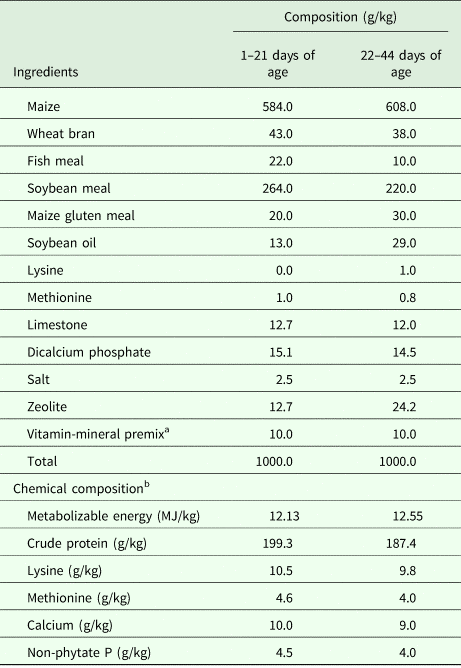
On the day of hatching, 200 male broiler chickens (Lingnan yellow-feathered broiler, a quality meat-type chicken, reaching market size at 63 days of age) were obtained from a commercial hatchery (Guangdong Wiz Agricultural Science and Technology Co., Guangzhou, P. R. China) and raised at a local facility under standard conditions, including routine vaccination against inactivated avian influenza virus (AIV) at day 10, with free access to water and feed. The strain of IBDV, BC 6/85, is a classic strain of virulent IBDV used as a standard challenge strain in China and was purchased from the China Institute of Veterinary Drug Control (Haidian District, Beijing). It had a titre of 105× bursal infectious dose causing 100% morbidity per ml. Nutrient levels of the diets were based on the National Research Council (1994) recommended nutrient requirements of broiler chickens (Table 1).
Ingredient and composition of the basal diets for Chinese yellow-feathered broilers at 1–21 and 22–44 days of age (as fed-basis)

a Supplied per kilogram of diet: vitamin A, 14 700 IU; vitamin D3, 3300 IU; vitamin E, 20 IU; vitamin K3, 3.9 mg; vitamin B1, 3 mg; vitamin B2, 9.6 mg; vitamin B6, 6 mg; vitamin B12, 0.03 mg; nicotinic acid, 60 mg; pantothenic acid, 18 mg; folic acid, 1.5 mg; biotin, 0.36 mg; FeSO4·7H2O, 80 mg; CuSO4·5H2O, 8 mg; MnO, 80 mg; KI, 0.38 mg; NaSeO3, 0.44 mg. The carrier was zeolite.
b Values were calculated from data provided by Feed Database in China (2016) except that crude protein was analysed.
Experimental design
On the first day of the experiment, 200 1-day-old yellow-feathered male broiler chickens were weighed and allotted randomly to five treatment groups, each consisting of four replicates of ten birds. Broilers were placed in floor pens (1 × 2 m). All birds were offered the same basal diet, supplemented with 0 (non-infected control), 0 (infected control), 10, 20 or 40 mg/kg SI (a synthetic SI, containing 98.5% glycitein, supplied by Newland Feed Science and Technology Co., Guangdong, China). These treatments are described as non-infected control, IBDV (0 SI), IBDV (10 SI), IBDV (20 SI) and IBDV (40 SI), respectively. At 21 days of age, chickens were inoculated with the bursal infectious dose causing 50% morbidity of the IBDV BC 6/85 strain by the eye-drop and nasal route, except for the non-infected control group. A pre-experiment had been conducted to titrate the optimal dose of the inoculation. By administering the chosen dose, visible pathological changes were visible on the bursa of Fabricius at 5 days post-infection (dpi) without evident morbidity or mortality. During the experiment, which lasted 44 days, infected and non-infected groups of chickens were housed in equivalent but separate places.
Sample collection
Eight broilers per treatment group (two birds per replicate) were selected randomly and bled into heparinized tubes (7 ml per bird) from a wing vein at 3, 7 and 23 dpi, for the examination of peripheral T lymphocyte proliferation and proportion of T lymphocyte sub-populations. At the same time, another 2 ml blood sample per bird was collected and allowed to clot in order to prepare serum for quantifying specific antibodies to the IBDV.
T lymphocyte proliferation assay
Mitogenic responses of peripheral blood leukocytes, prepared as described previously by Lee et al. (Reference Lee, Sharma, Nazerian and Witter1978), were quantified using an MTT (3-(4, 5-dimethylthiazol-2-yl)-2, 5-diphenyltetrazolium bromide) assay. The heparinized whole blood samples were diluted with an equal volume of phosphate-buffered saline (PBS) and layered carefully on the surface of the lymphocyte separation medium. After 15 min centrifugation at 2100 rpm, a white cloudy band was observed in the lymphocyte separation solution interface. The lymphocyte band was collected and washed twice with RPMI-1640 media (Gibco Laboratories, Grand Island, NY, USA) without foetal bovine serum (FBS) (TBD, Tianjin, China). After centrifugation, the pellet was re-suspended in 10% FBS-RPMI-1640 media which contained 40 µl concanavalin A (ConA) (Sigma, St Louis, MO, USA) at a concentration of 1 × 10⁷ cells/ml, and 200 µl per well was incubated in 96-well tissue culture plates. Each sample was seeded in eight wells. After 48 h of incubation at 37 °C under 5% CO2, 25 µl of MTT (5 mg/ml) (Sigma) was added to each well. The plates were incubated for another 4 h, and then 100 µl of 10% sodium dodecyl sulphate (Sigma) was added to each well; the plates were finally shaken for 5 min to completely dissolve the precipitate. Light absorbance at 570 nm was measured with an ELISA plate reader (Spectramax M5, Molecular Devices, San Jose, CA, USA). Proliferation was expressed as the proportions of all cells that were proliferating.
Flow cytometric analysis of T lymphocyte sub-populations
As described above, single-cell suspensions of peripheral blood leukocytes were separated and re-suspended in PBS at a concentration of 1 × 10⁷ cells/ml. Then 100 µl cell suspension was put into specific tubes and incubated with monoclonal antibodies, including fluorescein isothiocyanate-labelled mouse anti-chicken CD4, phycoerythrin-labelled mouse anti-chicken CD8α and spectral red-labelled mouse anti-chicken CD3 (Southern Biotechnology Associates Inc., Birmingham, AL, USA). Finally, samples were analysed using Cell Quest software on a BD FACSCalibur flow cytometer (Becton Dickinson Immunocytometry Systems, San Jose, CA, USA).
Determination of IgA, IgG, IgM and IBD antibody titres in serum
Serum IgA, IgG and IgM contents were measured with the chicken IgA, IgG, IgM ELISA kits (R&D Systems, Minneapolis, MN, USA) and the Spectramax automated ELISA reader. The antibody titre of IBDV was determined using ELISA kits (IDEXX Laboratories, Westbrooke, ME, USA) with serum diluted up to 500-fold with a sample diluent from the kit, and the optical densities were read at 650 nm in the Spectramax plate reader. Endpoint titres were calculated as described in the instructions. Titres >396 were considered as being positive and indicate previous vaccination or other exposure to IBD: titres <396 were considered to be negative.
Statistical analysis
Replicate was the experimental unit. The effects of SI supplementation level, dpi and their interaction, all considered to be fixed effects, were examined by two-way analysis of analysis (ANOVA) using the GLM procedures of SAS software (v9.2, SAS Institute, Cary, NC, USA). In the absence of SI, IBDV-infected and non-infected controls were compared by t tests. Orthogonal contrasts were used to evaluate linear and quadratic effects of SI supplementation. Significance was declared at P < 0.05. All results are expressed as means and the SEMs (n = 4) were derived from the error mean square of each ANOVA.
Results
T lymphocyte proliferation
The proliferation of peripheral T lymphocyte proliferation (Table 2) showed a significant (P < 0.001) interaction between dietary SI supplementation and time (dpi) but differences between supplemented diets were only apparent at 3 dpi. Proliferation was reduced (P < 0.05) in infected compared with non-infected birds. The response to SI supplementation was quadratic (P = 0.004) with minimal proliferation when birds were infected with IBDV alone and maximal when infection was combined with feeding the diet with 10 mg/kg SI.
Effect of soybean isoflavone (SI) on peripheral T lymphocyte proliferation of Chinese yellow-feathered broilers challenged with infectious bursal disease virus (IBDV)a

a Peripheral T lymphocyte proliferation was evaluated at 3, 7 and 23 dpi. P values from ANOVA: SI supplementation < 0.001; dpi < 0.001; SI supplementation × dpi interaction = 0.001. Data (proportion of cells proliferating) are means, the SEM was 0.033 for n = 4, based on ANOVA error mean square.
*IBDV compared with non-infected controls by t test (P < 0.05).
T lymphocyte sub-populations
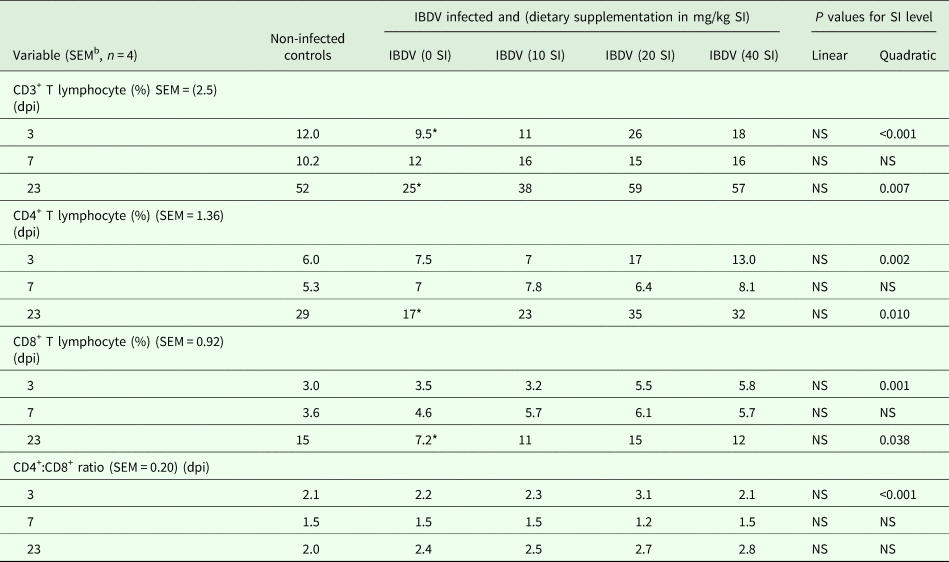
The percentages of peripheral T lymphocyte sub-populations are shown in Table 3. The proportions of CD3+, CD4+, CD8+ T lymphocytes and ratio of CD4+:CD8+ T lymphocytes were all affected significantly (P < 0.001) by dietary SI supplementation level, dpi and interactions between the two main effects.
Effect of soybean isoflavone (SI) on sub-populations of peripheral T lymphocytes (%) of Chinese yellow-feathered broilers challenged with infectious bursal disease virus (IBDV)a

a Peripheral CD3+, CD4+ and CD8+ T lymphocyte sub-populations (%) and CD4+:CD8+ ratio were examined at 3, 7 and 23 dpi. P values from each of 3 ANOVAs: SI supplementation < 0.001; dpi < 0.001; SI supplementation × dpi < 0.001. Data are means.
b SEMs are derived from ANOVA error mean square, for four replicates.
*IBDV compared with non-infected controls by t test (P < 0.05).
The proportions of CD3+, CD4+ and CD8+ T lymphocytes in IBDV-infected birds all increased quadratically with increasing supplementation with SI at 7 and 23 dpi. Diets supplemented with SI increased the percentage of CD3+ T lymphocytes; the response was quadratic with 20 mg/kg being maximal. At 23 dpi, there was a significant rise in the proportion of peripheral CD3+ T lymphocytes compared with those at 3 or 7 dpi. Birds inoculated with IBDV had a significant decrease in the percentage of peripheral CD3+ T lymphocytes compared with the non-infected birds, and infected birds receiving 20 or 40 mg/kg dietary SI had the same proportions as did non-infected controls. The percentages of peripheral CD4+ and CD8+ T lymphocyte sub-sets in those groups showed the same quadratic trends as for CD3+ T lymphocytes; again, infected birds at 23 dpi were significantly lower than non-infected birds.
No differences were observed in the CD4+:CD8+ T lymphocyte ratio between the non-infected and IBDV-infected birds at any sampling time. There was a quadratic effect (P < 0.001) of dietary SI at 3 dpi with maximal response with 20 mg/kg SI.
IgA, IgG, IgM antibody response
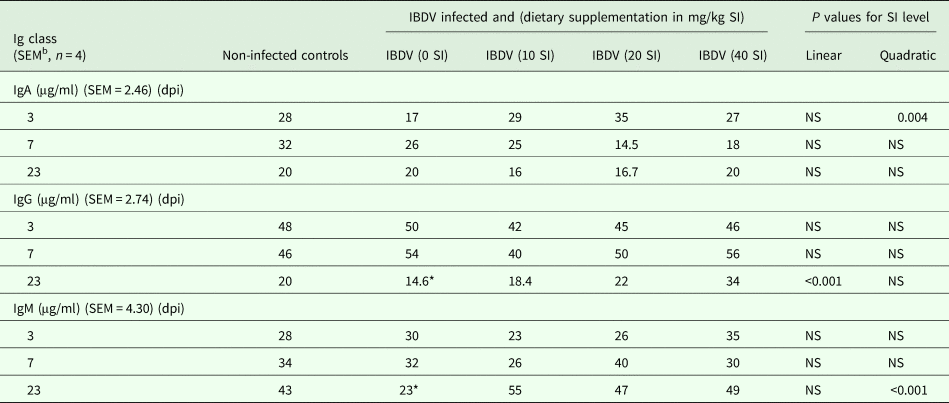
As shown in Table 4, dietary SI supplementation level, dpi and the interactions significantly affected serum immunoglobulin concentrations in IBDV-infected birds (P < 0.001). Serum IgA concentration of birds increased quadratically at 3 dpi only (P < 0.005). There were no significant differences in serum IgG and IgM contents between non-infected controls and IBDV-infected birds at 3 and 7 dpi, but concentrations at 23 dpi were reduced in infected birds. At this time, IgG showed a linear response to dietary SI (P < 0.001) while there was a quadratic response in IgM (P < 0.001).
Effect of supplemental soybean isoflavone (SI) on serum IgA, IgG, IgM of Chinese yellow-feathered broilers infected with infectious bursal disease virus (IBDV)a

a Serum IgA, IgG, IgM was measured at 3, 7 and 23 dpi. P values from each of three ANOVAs: SI supplementation < 0.001; dpi < 0.001; SI supplementation × dpi < 0.001. Data are means.
b SEMs are derived from ANOVA error mean square, for four replicates.
*IBDV compared with non-infected controls by t test (P < 0.05).
Infectious bursal disease virus antibody titres
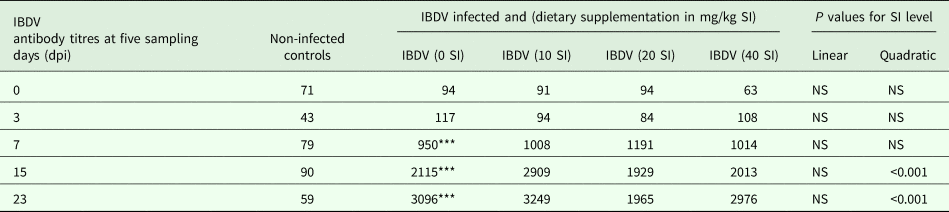
Dietary SI supplementation level, dpi and the interactions significantly affected (P < 0.001) serum titres of IBDV antibody in IBDV-infected birds (Table 5). Using the typical threshold for ‘positivity’ in the kit used (396), non-infected birds remained negative throughout, and infected birds had positive titres by 7 dpi and continued to increase to 23 dpi. At 15 and 23 dpi, the effect of SI level on titres was quadratic (P < 0.001), highest responses occurred with 10 mg/kg SI.
Effect of supplemental soybean isoflavone (SI) on IBDV antibody titres of Chinese yellow-feathered broilers infected with infectious bursal disease virus (IBDV)a

a IBDV antibody titres were measured at 0 (21-day-old before inoculation), 3, 7, 15 and 23 dpi. Titres >396 are considered to be positive, otherwise are considered to be negative. P values from ANOVA: SI supplementation < 0.001; dpi < 0.001; SI supplementation × dpi < 0.001. Results are means, the SEM was 51.76 for n = 4, based on ANOVA error mean square.
***IBDV compared with non-infected controls by t test (P < 0.001).
Discussion
Cellular immunity may have an important role in defence against IBDV infection (Kim et al., Reference Kim, You, Kim, Yeh and Sharma2000; Rautenschlein, Reference Rautenschlein, Yeh and Sharma2002a, Reference Rautenschlein, Yeh, Njenga and Sharma2002b; Yeh et al., Reference Yeh, Rautenschlein and Sharma2002). As the current results showed, the IBDV-infected broilers had a depressed T-cell mitogenic response, especially at 3 dpi. This may indicate an overall depression of T-cell function during viral infection (Sivanandan and Maheswaran, Reference Sivanandan and Maheswaran1981). The degree of depression appeared to be more severe at 3 dpi, probably because of the elevated numbers of viral particles compared with the other sampling times.
Soybean isoflavone has been demonstrated to be an immunomudulator on cell-mediated immunity (Cooke et al., Reference Cooke, Selvaraj and Yellayi2006; Morimoto et al., Reference Morimoto, Watanabe, Yamori, Takebe and Wakatsuki2009; Belcavello et al., Reference Belcavello, Dutra, de Freitas, Aranha, Batitucci and do2012). The present results showed that adding SI to the diet increased peripheral T lymphocyte proliferation of infected birds at 3 dpi, reflecting enhanced activation of lymphocytes at this acute stage of IBDV infection. The interaction between SI supplementation and dpi over 1–23 days period suggests that this positive effect of SI on peripheral T lymphocyte proliferation increased with time. A number of studies have reported that the effect of SI (or flavonoids generally) on lymphocyte proliferation was in a concentration or component-dependent manner (Wang et al., Reference Wang, Higuchi and Zhang1997; Zhang et al., Reference Zhang, Li and Wang1997). In the current study, all concentrations of dietary SI improved lymphocyte proliferation, with lower concentration (10 or 20 mg/kg) being significant during early stages of infection and higher concentrations (20 or 40 mg/kg) significant later. Previous studies have reported that SI affects cellular function through diverse receptors and enzymes including acting as selective oestrogen receptor modulators (Donovan et al., Reference Donovan, Andres, Mathai, Kuhlenschmidt and Kuhlenschmidt2009). The SI used in the current study, glycitein, did not have oestrogen-like activity (unpublished data): it may exert a regulatory effect on cellular immunity in some other way, which should be examined in future studies.
The percentages of peripheral T lymphocyte sub-sets including CD4+ and CD8+ of IBDV-infected birds increased slightly at 3 and 7 dpi, which suggested a probable compensatory role of the thymus when direct cytolysis of B lymphocytes was induced by IBDV in the bursa of Fabricius (Sivanandan and Maheswaran, Reference Sivanandan and Maheswaran1980). At 23 dpi, however, all of the examined peripheral T lymphocyte sub-sets (CD3+, CD4+, CD8+) were reduced in IBDV-infected birds, while in the non-infected birds, T lymphocyte sub-sets increased gradually and reached a peak at this sampling time. The results suggested that IBDV induced immunosuppression of cellular immunity. The impaired T-cell function may be related to the direct lytic effect of IBDV on thymic cells (Sivanandan and Maheswaran, Reference Sivanandan and Maheswaran1981).
In the present study, supplementation with SI increased the proportion of peripheral CD3+ T lymphocytes, especially at 20 or 40 mg/kg levels at 3 and 23 dpi. At this time, the IBDV-infected birds with no dietary SI had the lowest proportion of CD3+ T lymphocytes, while those on SI-supplemented diets had elevated proportions, even higher than that of the non-infected broilers. The same phenomenon was observed on CD4+ and CD8+ T lymphocytes. Most CD4+ T lymphocytes are helper or inflammatory T cells when responding to a viral attack. The fact that CD8+ T lymphocytes function as virus-specific cytotoxic T cells has shown to be important in the resolution of infection and elimination of viruses, both in chickens and in mammals (McNeal et al., Reference McNeal, Barone, Rae and Ward1995; Seo et al., Reference Seo, Wang, Smith and Collisson1997; Collisson et al., Reference Collisson, Pei, Dzielawa and Seo2000). Zhang et al. (Reference Zhang, Li and Wang1997) reported that lymphocyte proportion of peripheral blood was increased in Swiss mice fed daidzein at high doses (20 and 40 mg/kg). Guo et al. (Reference Guo, White, Brown, Delclos, Newbold, Weis, Germolec and McCay2002) found that exposure to genistein increased the number of splenic T cells and T-cell sub-sets in both male and female offspring of SD rats. Klein et al. (Reference Klein, Wisniewski, Marson, Glass and Gearhart2002) demonstrated that early exposure to genistein had long-lasting effects on the immune systems of their male offspring by inducing higher percentage of CD8+ T lymphocytes and total T lymphocytes in the spleen. Thus, the current study reflected that dietary supplementation of SI is beneficial in defence against IBDV infection and protecting T lymphocyte development from immunosuppression. The ratio of CD4+ and CD8+ T lymphocytes in the peripheral blood is an important indicator for evaluation of cellular immunity function. In the current study, a significant enhancing ratio of CD4+ and CD8+ lymphocytes was observed with 20 mg/kg SI at 3 dpi, which may indicate enhancement of T-cell-mediated immune response.
Humoral immunity is the primary mechanism of the protective immune response to IBDV (Kibenge et al., Reference Kibenge, Dhillon and Russell1988) and an effective way to prevent reinfection (Powell, Reference Powell1987). In the present study, SI addition at 10 mg/kg enhanced IBDV antibody titres at 15 and 23 dpi while 20 or 40 mg/kg SI had adverse effects. In order to further investigate the probable mechanism of SI on the production of specific antibody, titres of anti-AIV were measured at the same sampling times. There was no significant difference between SI-supplemented and non-supplemented birds in anti-AIV titres in response to routine vaccination (data not shown), which may indicate that the mechanism of SI for enhancement of antibody response is virus-specific, in this case against virulent IBDV.
A dramatic reduction in circulating IgM+ B cells (Sharma et al., Reference Sharma, Kim, Rautenschlein and Yeh2000) and complete lack of IgG (Saif, Reference Saif1998) was caused by IBDV infection. The current data demonstrated that serum IgM and IgG concentrations decreased in IBDV-infected birds (no dietary SI) at 23 dpi compared with non-infected controls. Dietary SI prevented inhibition of humoral immunity as the contents of IgM and IgG in serum were elevated and returned to normal at 23 dpi. Thus, it is proposed that alleviation of immunosuppression of humoral immunity may be due largely to the enhanced T-cell-mediated immune response involved in IBDV clearance, which finally could reduce the lesions of immunoglobulin-producing cells in the bursa of Fabricius otherwise caused by IBDV. IgA is the predominant form of antibody in bodily secretions and plays an important role in defence against many pathogens. In the current study, IBDV infection had no effect on serum IgA concentration, but there was a clear early (3 dpi) increase in IgA content of IBDV-infected birds in birds fed diets supplemented with SI. This may indicate that dietary SI might enhance the humoral immune response to IBDV.
In conclusion, dietary glycitein, a soy isoflavone, increased peripheral T lymphocyte proliferation and T lymphocyte sub-populations as well as serum antibody production in birds challenged with IBDV. These results suggest that SI may play an immunoenhancing effect on both T-cell-mediated and humoral immunity in protecting against IBDV infection and inhibiting the immunosuppression caused by IBDV. It may be of value to supplement diets with SI to improve disease resistance of broilers.
Acknowledgements
W. Bruce Currie (Emeritus Professor, Cornell University, Ithaca, NY, USA) made suggestions on presentation.
Financial support
This work was funded by the grant agreement (8451064001000853) from Guangdong Provincial Natural Science Fund Committee, the earmarked fund for Modern Agro-industry Technology Research System (CARS-41) from Ministry of Agriculture, ‘Twelve-Five’ national science and technology support program (2014BAD13B02), and scientific and technological project (201804020091 and 2017B020202003) from Guangzhou science technology and innovation commission and Guangdong province science and technology department, P. R. China.
Conflict of interest
None.
Ethical standards
The experimental protocol was reviewed and approved by the Institute of Animal Science, Guangdong Academy of Agricultural Sciences, China.