Background
Central line–associated bloodstream infections (CLABSIs) lead to increased patient morbidity, mortality, and length of stay and have been estimated to cost between $3,700 and $39,000 per infection.Reference Digiovine, Chenoweth, Watts and Higgins 1 – Reference Elward, Hollenbeak, Warren and Fraser 4 CLABSIs identified in intensive care unit patients are publicly reportable through the Centers for Disease Control and Prevention’s (CDC) National Healthcare Safety Network (NHSN) and affect reimbursement by the Centers for Medicare and Medicaid Services. 5 Given the increasing significance of this quality metric, the application of a valid, standardized surveillance definition is imperative. Limitations of the NHSN CLABSI surveillance protocol, especially when applied to immunocompromised patient populations, have been well described.Reference Steinberg, Robichaux, Chernetsky Tejedor, Dent Reyes and Jacob 6 – Reference Fraser and Gordon 10 Although evidence-based prevention guidelinesReference O’Grady, Alexander and Burns 11 – Reference Marschall, Mermel and Fakih 12 have led to significant reductions in CLABSI rates in recent years,Reference Pronovost, Needham and Berenholtz 13 many institutions continue to struggle with high CLABSI rates in hematology, oncology, and stem cell transplant patients.Reference Dudek, Weiner and Allen-Bridson 14 One possible explanation for elevated rates in this population is that treatment with cytotoxic chemotherapy regimens, or graft-versus-host disease, may compromise the mucosal barriers and lead to translocation of oral and gastrointestinal flora into the bloodstream.Reference Tancrede and Andremont 15 Although these events are usually unrelated to the presence of a central line, they are nonetheless classified as CLABSIs per the NHSN definitions. In response to concerns, the CDC convened a workgroup to optimize the CLABSI surveillance protocol. The workgroup developed a modified CLABSI definition and then evaluated it in a multicenter field test.Reference See, Iwamoto, Allen-Bridson, Horan, Magill and Thompson 16 Consequently, CDC released a revised NHSN surveillance protocol for CLABSI in January 2013. 17 In addition to the definition for laboratory-confirmed bloodstream infection (LCBI, hereafter referred to as non-MBI-LCBI), the revised protocol specified a new category of infection known as mucosal barrier injury laboratory-confirmed bloodstream infection (MBI-LCBI).
The main objective of this study was to evaluate the burden of MBI-LCBI among hematology, oncology, and stem cell transplant patients at a large academic medical center. Our specific aims were to (1) determine the proportion of CLABSIs classified as MBI-LCBI vs non-MBI-LCBI; (2) describe the clinical characteristics of patients who developed CLABSI, comparing MBI-LCBI cases with non-MBI-LCBI cases; and (3) evaluate how CLABSI prevention efforts affect rates of MBI-LCBI and non-MBI-LCBI.
Methods
Infection preventionists at our facility applied the revised 2013 NHSN CLABSI surveillance protocol to all CLABSI cases identified during the 14-month period from July 2012 through August 2013 on 2 inpatient hematology, oncology, and stem cell transplant units (72 total beds). The definition was retrospectively applied to CLABSI cases identified before January 2013; to reduce bias in retrospectively applying the new definition and ensure that all bloodstream infections were correctly classified, candidate blood cultures during this period were re-reviewed. Cases were classified as MBI-LCBI (mucosal barrier injury criteria met) or non-MBI-LCBI (mucosal barrier injury criteria not met). A retrospective review of medical records was conducted to collect demographic and clinical data on each case.
Because baseline data revealed that most infections occurred long after line insertion, targeted interventions to improve central line care and maintenance were initiated in January 2013. Interventions included re-education; implementation of a standardized schedule for central line dressing, tubing, and injection cap changes (ie, activities occurred on specified days of the week); weekly documentation and practice audits; and the introduction of alcohol impregnated port protectors. The baseline phase was defined as July 1, 2012, through January 31, 2013, and the postintervention phase was defined as February 1, 2013, through August 31, 2013. Monthly rates of total CLABSI, MBI-LCBI, and non-MBI-LCBI were calculated per 1,000 line-days.
Clinical characteristics of patients with MBI-LCBI and non-MBI-LCBI were compared using the Fisher exact test, Pearson χ2 test, or Mann-Whitney test, as appropriate. Poisson regression was used to calculate an incidence rate ratio (IRR) to compare baseline and postintervention CLABSI rates. Two-sided P values ≤.05 were considered statistically significant. Data analysis was performed using PASW Statistics, version 18.0 (PASW) and Stata, version 12 (StataCorp). This study was approved by Northwestern University’s Institutional Review Board.
Results
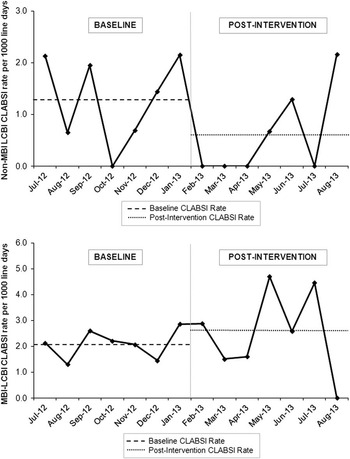
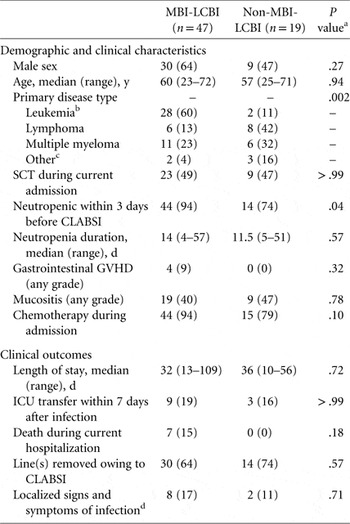
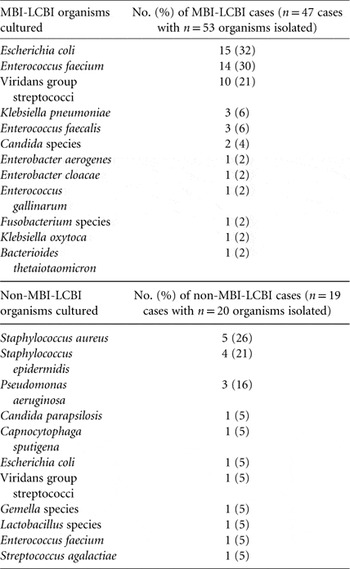
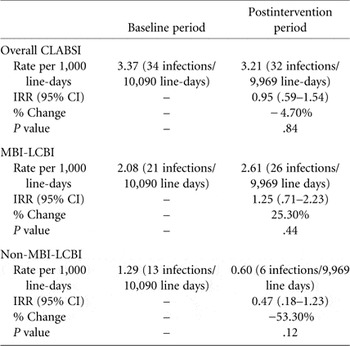
A total of 66 CLABSIs were identified during the study period; 47 (71%) were classified as MBI-LCBI and 19 (29%) were classified as non-MBI-LCBI (Figure 1). Of the 47 MBI-LCBI cases, 44 (94%) met the definition based on neutropenia criteria, while 3 (6%) met the definition based on the receipt of an allogeneic hematopoietic stem cell transplant in the previous year with grade 3–4 graft-versus-host disease or greater than 1 L of diarrhea documented in a 24-hour period. Per NHSN definitions based on the type of organisms isolated, among MBI-LCBI cases, 37 (79%) were classified as MBI-LCBI 1 (intestinal flora), 7 (15%) were classified as MBI-LCBI 2 (oral flora), and 3 (6%) were classified as both MBI-LCBI 1 and MBI-LCBI-2 (Figure 1). Most clinical and demographic characteristic were similar between MBI-LCBI and non-MBI-LCBI cases; however, significant differences were noted in regard to the presence of neutropenia (94% of MBI-LCBI cases vs. 74% of non-MBI-LCBI case, P=.04) and primary disease type (P=.002, Table 1). The most common organisms cultured from patients with MBI-LBCI were Escherichia coli (32%), Enterococcus faecium (30%), and viridans group streptococci (21%), whereas the most common organisms cultured from patients with non-MBI-LCBI were Staphylococcus aureus (26%), Staphylococcus epidermidis (21%), and Pseudomonas aeruginosa (16%) (Table 2). As shown in Table 3, between the baseline and postintervention periods, the overall CLABSI rate decreased from 3.37 to 3.21, the MBI-LCBI rate increased from 2.08 to 2.61, and the non-MBI-LCBI rate decreased from 1.29 to 0.60. Figure 2 shows the monthly rates of non-MBI-LCBI and MBI-LCBI, comparing baseline and postintervention periods. During the postintervention period, a non-MBI-LCBI rate of zero was achieved for 4 of 7 months.
Classification of central line–associated bloodstream infections (CLABSIs) as meeting mucosal barrier injury laboratory-confirmed bloodstream infection criteria (MBI-LCBI) or not meeting mucosal barrier injury laboratory-confirmed bloodstream infection criteria (non-MBI-LCBI). MBI-LCBI were further differentiated according to National Healthcare Safety Network definitions.

Monthly rates of central line–associated bloodstream infections (CLABSIs) that meet criteria as mucosal barrier injury laboratory-confirmed bloodstream infection (MBI-LCBI) and that do not meet such criteria (non-MBI-LCBI), comparing periods before and after the implementation of line maintenance interventions.

Characteristics of Central Line–Associated Bloodstream Infection (CLABSI) Cases Meeting Mucosal Barrier Injury Laboratory-Confirmed Bloodstream Infection Criteria (MBI-LCBI) or Not Meeting Such Criteria (Non-MBI-LCBI)

NOTE. Data are no. (%) of cases unless otherwise indicated. GVHD, graft-versus-host disease; ICU, intensive care unit; SCT, stem cell transplant.
a 2-sided P values were calculated using the Fisher exact test for binary variables, Pearson χ2 test for primary disease type, and Mann-Whitney test for continuous variables.
b Myelodysplastic syndrome is included in the leukemia category.
c Includes bladder cancer, Devic's disease, Crohn disease, aplastic anemia, and systemic amyloidosis.
d Includes documentation of redness, tenderness, and/or purulent drainage at central line insertion site.
Distribution of Organisms Cultured among Central Line–Associated Bloodstream Infection (CLABSI) Cases Meeting Mucosal Barrier Injury Laboratory-Confirmed Bloodstream Infection Criteria (MBI-LCBI) or Not Meeting Such Criteria (Non-MBI-LCBI)

Central Line–Associated Bloodstream Infection (CLABSI) Rates and Incidence Rate Ratios (IRRs) before and after the Implementation of CLABSI Reduction Interventions

NOTE. MBI-LCBI, mucosal barrier injury laboratory-confirmed bloodstream infection; Non-MBI-LCBI, not meeting mucosal barrier injury laboratory-confirmed bloodstream infection criteria.
Discussion
Our data show that MBI-LCBI cases account for most of the CLABSI cases identified in hematology, oncology, and stem cell transplant patient populations. Overall, clinical and demographic characteristics were similar between patients who developed MBI-LCBI and non-MBI-LCBI. As expected on the basis of the surveillance definition, neutropenia was more prevalent in patients with MBI-LCBI, but surprisingly, the majority of patients with non-MBI-LCBI were also neutropenic. Thus, in this population, the organism isolated from blood cultures was often the deciding factor in the classification of MBI-LCBI or non-MBI-LCBI.
After the implementation of CLABSI prevention interventions focused on improving line maintenance practices, we observed little change in overall CLABSI rate, an increase in the MBI-LCBI rate, and a substantial decrease in the non-MBI-LCBI rate. Although the reduction in non-MBI-LCBI did not reach statistical significance, likely in part owing to a small sample size, we believe that the reduction was clinically significant. On the basis of our experiences, we recommend that facilities separate MBI-LCBI from non-MBI-LCBI for internal tracking and data reporting purposes. Aggregating the 2 types of infections can mask reductions in arguably more preventable non-MBI-LCBI, lead to misinterpretation of intervention efforts, undermine credibility of infection preventionists, and reduce caregiver morale.
Although MBI-LCBI may not be amenable to line care interventions, these infections often still lead to significant patient morbidity and mortality. As demonstrated in our data, the prevalence of these infections is high in oncology patients, and the number of infections actually increased during the intervention period. Interventions that have shown some benefit in the prevention of gastrointestinal or oral mucositis, such as oral cryotherapy, low-level laser therapy, prophylactic drugs, probiotics, and basic oral and bowel care regimensReference Lalla, Bowen and Barasch 18 – Reference Gibson, Keefe and Lalla 19 may also hold promise in preventing MBI-LCBI. In order to improve patient outcomes, additional research into the prevention of MBI-LCBI is warranted.
In the era of public reporting and pay-for-performance programs, a thorough evaluation of the use and interpretation of the MBI-LCBI definition is necessary. Although CLABSIs identified outside intensive care units do not currently affect reimbursement, future inclusion is anticipated and could significantly impact hospitals with large oncology populations. Moreover, we often see MBI-LCBI “spill-over” to intensive care units: in a recent 22-month period 12% of intensive care unit CLABSIs were classified as MBI-LCBI at our institution. The CDC is currently evaluating preliminary MBI-LCBI data submitted to NHSN and stated their “intention to remove MBI-LCBI from CLABSI data used for public reporting starting in January 2015” (CLABSI workshop at Association of Professionals in Infection Control and Epidemiology Annual Conference, June 8, 2014, Katherine Allen-Bridson and Nicola Thompson, CDC). Additionally, since NHSN’s list of MBI-LCBI eligible organisms is likely not inclusive of all organisms that may cause bloodstream infection owing to translocation across compromised oral or gastrointestinal mucosa, careful review of this component of the definition is crucial to ensure data validity and accurate interfacility comparison.
The results of this retrospective study demonstrate the impact of the revised CLABSI surveillance protocol in hematology, oncology, and stem cell transplant patients and show that CLABSI prevention measures are unlikely to affect rates of MBI-LCBI. Although further analysis of national MBI-LCBI data is still necessary, our results lend support to CDC’s intention to separate MBI-LBCI data from CLABSI data used for reporting purposes.
Acknowledgments
We thank all individuals who participated in or supported the project team to reduce CLABSIs in the oncology population, including all oncology nurses and physicians.
Financial support. None reported.
Potential conflicts of interest. All authors report no conflicts of interest relevant to this article.