The Family Check-Up (FCU) model (Dishion & Kavanagh, Reference Dishion and Kavanagh2003; Dishion & Stormshak, Reference Dishion and Stormshak2007) is an adaptive, tailored, family-centered intervention that has been implemented in public middle schools to target risk factors common during this developmental period, such as increases in family conflict and decreases in parent–adolescent communication, involvement, and closeness (Hafen & Laursen, Reference Hafen and Laursen2009; Hill, Bromell, Tyson, & Flint, Reference Hill, Bromell, Tyson and Flint2007; Larson, Richards, Moneta, Holmbeck, & Duckett, Reference Larson, Richards, Moneta, Holmbeck and Duckett1996; Loeber et al., Reference Loeber, Drinkwater, Yin, Anderson, Schmidt and Crawford2000). During early adolescence, relatively innocuous levels of misbehavior may escalate into more severe forms of problem behavior, including delinquency, substance use, and risky sexual behavior, that may continue into later adolescence, particularly in families in which adolescents disengage from their parents (Dishion & Patterson, Reference Dishion, Patterson, Cicchetti and Cohen2006). Family disengagement provides youths with greater opportunity to engage in antisocial behavior and to become involved with deviant peers, which further promotes antisocial behavior (Barber, Stolz, & Olsen, Reference Barber, Stolz and Olsen2005; Barrera, Biglan, Ary, & Li, Reference Barrera, Biglan, Ary and Li2001; Dishion, Nelson, & Kavanagh, Reference Dishion, Nelson and Kavanagh2003; Galambos, Barker, & Almeida, Reference Galambos, Barker and Almeida2003; Hoeve et al., Reference Hoeve, Dubas, Eichelsheim, van der Laan, Smeenk and Gerris2009; Pettit, Laird, Dodge, Bates, & Criss, Reference Pettit, Laird, Dodge, Bates and Criss2001). Derived from the Oregon model of antisocial behavior (Dishion & Patterson, Reference Dishion, Patterson, Cicchetti and Cohen2006; Patterson, Reference Patterson1982; Patterson, Reid, & Dishion, Reference Patterson, Reid and Dishion1992), the FCU is designed to short-circuit coercive family interactions that function as a core risk process for problem behaviors and that involve escalating family conflict, followed by parental withdrawal of control and monitoring behavior.
Guided by an ecological assessment and motivational interviewing strategies, the FCU is used to identify relevant parenting skills to optimize family benefit in a brief intervention format (Stormshak & Dishion, Reference Stormshak and Dishion2009). Although intervention services are adapted according to family need (Collins, Murphy, & Bierman, Reference Collins, Murphy and Bierman2004), core behavioral parent training skills, such as reinforcing positive behavior, monitoring, limit setting, problem solving, and proactive parenting (Dishion, Stormshak, & Kavanagh, Reference Dishion, Stormshak and Kavanagh2011), are supported to help curtail risk for escalation of adolescent problem behavior. Effective family management practices are promoted to help parents break the coercive cycle and regain a degree of influence over adolescent behavior. Randomized trials of the FCU in public middle schools have documented its effectiveness in reducing levels of adolescent substance use, antisocial behavior, and depression, and improving adolescent school performance, engagement, and attendance (Connell & Dishion, Reference Connell and Dishion2008; Connell, Dishion, & Deater-Deckard, Reference Connell, Dishion and Deater-Deckard2006; Connell, Dishion, Yasui, & Kavanagh, Reference Connell, Dishion, Yasui and Kavanagh2007; Stormshak, Connell, & Dishion, Reference Stormshak, Connell and Dishion2009; Stormshak et al., Reference Stormshak, Connell, Véronneau, Myers, Dishion and Kavanagh2011; Stormshak, Fosco, & Dishion, Reference Stormshak, Fosco and Dishion2010).
Intervention scientists have begun to ask questions about the contextual factors that account for individual differences in response to interventions and about the mechanisms that account for intervention effects. This study examined the response to the FCU in a middle school sample and drew upon the assessment, intervention, and motivation principle (AIM; Dishion & Stormshak, Reference Dishion and Stormshak2007), which emphasizes the three interrelated processes that facilitate change in family process and child outcomes. It evaluated (a) the contextual factors that are assessed as part of the FCU and that underlie parenting practices and intervention effectiveness, (b) caregiver motivation to change, and (c) coercive family interactions that account for intervention effects on adolescent antisocial behavior.
Contextual Factors and Intervention Effectiveness
The first aspect of the AIM principle concerns family contextual factors. The FCU incorporates assessments of ecological, contextual, and family risk factors that help guide case conceptualization so the intervention may be adapted to the unique needs of each family (Dishion & Stormshak, Reference Dishion and Stormshak2007). Universal contextual factors include financial stress, social support, and caregiver characteristics such as depression, education, and substance use, all of which can affect parenting practices and intervention success (Dishion & Stormshak, Reference Dishion and Stormshak2007). The assessments also are used to examine aspects of ethnicity, ethnic identity, and experiences of discrimination to facilitate culturally competent intervention (Huey & Polo, Reference Huey, Polo, Weisz and Kazdin2010). These contextualized family assessments are a cornerstone practice of the FCU. They promote discussion with families about the implications of family strengths or risk factors and help tailor the intervention to suit the family's needs.
Researchers are seeking to understand how contextual factors contribute to parenting intervention effectiveness. Risk factors that may cause parenting skills interventions to be less effective include maternal depression (Hartman, Stage, & Webster-Stratton, Reference Hartman, Stage and Webster-Stratton2003; Kazdin, Reference Kazdin1995), low socioeconomic status (SES; Dumas, Reference Dumas1984; Lundahl, Risser, & Lovejoy, Reference Lundahl, Risser and Lovejoy2006; Patterson & Forgatch, Reference Patterson and Forgatch1995), and high initial levels of youth problem behavior (e.g., Kazdin & Wassell, Reference Kazdin and Wassell1999, Reference Kazdin and Wassell2000). Although only a few studies have examined each of these factors, meta-analyses suggest these findings are robust and stable (Lundahl et al., Reference Lundahl, Risser and Lovejoy2006; Reyno & McGrath, Reference Reyno and McGrath2006).
An important subset of intervention studies offers contrary findings, however. Beauchaine, Webster-Stratton, and Reid (Reference Beauchaine, Webster-Stratton and Reid2005) examined a large, multicohort sample of parents of 3- to 8-year-old children participating in the Incredible Years program. Mothers with higher levels of risk (e.g., depression, difficult marriages, or early or single parenthood) actually benefited more from the intervention than did those with lower levels of risk. Gardner, Hutchings, Bywater, and Whitaker (Reference Gardner, Hutchings, Bywater and Whitaker2010) replicated these findings for maternal depression and found that family disadvantage did not moderate intervention effectiveness. In a recent study of the FCU with caregivers of young children ages 2 through 4 years, risk factors either were unrelated to intervention outcomes or predicted stronger intervention benefits (Gardner et al., Reference Gardner, Connell, Trentacosta, Shaw, Dishion and Wilson2009). Each of these studies examined interventions with parents of younger children, with the advantage of having to address less-established family interactions and child problem behavior. Other interventions that target developmental risk periods, even those interventions used with older children, may also be positioned to draw from family risk factors as a source of motivation. Therefore, we expected that contextual factors, such as caregiver depression, low family resources, and youth problem behaviors, would be linked with greater caregiver motivation to change.
Caregiver Motivation
Following the AIM principle, caregiver motivation is recognized as a critical component of effective parenting intervention. Caregiver motivation is evaluated throughout the FCU assessment process and is emphasized during the feedback session (Dishion & Kavanagh, Reference Dishion and Kavanagh2003; Dishion & Stormshak, Reference Dishion and Stormshak2007; Stormshak & Dishion, Reference Stormshak and Dishion2009). Family feedback is delivered in a motivational interviewing framework, consistent with the Drinker's Check-Up procedure (Miller & Rollnick, Reference Miller and Rollnick2002; Miller & Sovereign, Reference Miller, Sovereign, Loberg, Miller, Nathan and Marlatt1989), to enhance caregivers’ desire to change their parenting practices. Feedback sessions conclude with family goal setting, and a menu of family-centered interventions is offered that supports parents in their efforts to improve their family management practices and communication skills.
Interventions that enhance parent motivation have been linked to improved attendance at parent training sessions, greater adherence to treatment (Nock & Kazdin, Reference Nock and Kazdin2005), and reduced caregiver perception of barriers to treatment (Nock & Photos, Reference Nock and Photos2006). In our study, we expected that caregiver motivation would be a key mechanism linking contextual risk factors (caregiver depression, low family resources, and high levels of youth problem behavior) and intervention response to the FCU. In addition to examining ecological risk factors, it is important to also test for possible disparities in intervention engagement. Caregivers from ethnic minority groups are more likely to drop out of treatment than their European American counterparts are, even when considering other potential risk factors, such as SES, severity of child behavior, and therapy process variables (Kazdin, Holland, & Crowley, Reference Kazdin, Holland and Crowley1997). In a clinical outpatient setting, African American youths are twice as likely to drop out of treatment prematurely than are European American youths (Miller, Southam-Gerow, & Allin, Reference Miller, Southam-Gerow and Allin2008). We suspected that motivation may at least partially account for ethnic differences in intervention engagement and consequently in intervention response, yet to date, no studies have examined levels of caregiver motivation to engage in FCU interventions as a function of ethnicity. In summary, ecological factors and ethnic minority status were tested as predictors of caregiver motivation to change, which in turn was expected to predict caregiver report of improved results from the FCU intervention.
A Family Mechanism of the FCU
To examine the intervention aspect of the AIM principle, we considered escalations in family conflict, a precursor to coercive family process, as a mediator by which the FCU may reduce risk for youth antisocial behavior. Carefully crafted studies by Forgatch and colleagues that evaluated the effectiveness of the Oregon Model of Parent Management Training (PMTOTM) demonstrated that these intervention effects are mediated through change in coercive family process (DeGarmo & Forgatch, Reference DeGarmo and Forgatch2005; DeGarmo, Patterson, & Forgatch, Reference DeGarmo, Patterson and Forgatch2004; Forgatch, DeGarmo, & Beldavs, Reference Forgatch, DeGarmo and Beldavs2005; Forgatch, Patterson, DeGarmo, & Beldavs, Reference Forgatch, Patterson, DeGarmo and Beldavs2009). Other studies have indicated that positive family relationships, as indexed by family cohesion, also mediate intervention effects on youth outcomes (Hagen, Ogden, & Bjørnebekk, Reference Hagen, Ogden and Bjørnebekk2011; Huey, Henggeler, Brondino, & Pickrel, Reference Huey, Henggeler, Brondino and Pickrel2000). Unfortunately, this type of mediational research is more the exception than the rule. Liddle (Reference Liddle2004) stated that “although several family-based treatments have demonstrated favorable outcomes, we have a limited understanding of how and why these outcomes are achieved” (p. 83), an opinion echoed by many (e.g., Farrington & Welsh, Reference Farrington and Welsh1999; Sandler, Schoenfelder, Wolchik, & MacKinnon, Reference Sandler, Schoenfelder, Wolchik and MacKinnon2011). Such research can guide the evolution of family-based interventions and provide evidence for the causal effects of parenting on youth behavior (Collins, Maccoby, Steinberg, Hetherington, & Bornstein, Reference Collins, Maccoby, Steinberg, Hetherington and Bornstein2000).
Only a couple of studies have examined the mechanisms by which the FCU influences adolescent outcomes. One study by Dishion et al. (Reference Dishion, Nelson and Kavanagh2003) found that participation in the FCU was associated with improved parental monitoring and supervision. In turn, parental monitoring mediated the impact of the FCU on adolescent substance use. More recently, Van Ryzin and Dishion (Reference Van Ryzin and Dishion2012) found that family conflict functioned as a mediator accounting for the effects of the FCU on late-adolescence antisocial behavior. This study provided the impetus for our study, which investigated the contextual factors of change and integrated short-term and long-term intervention processes in this mediational model.
This Study
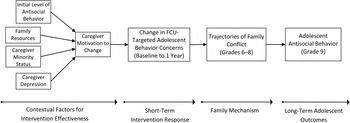
The goal of this study was to advance previous research that has established main effects of the FCU intervention for family conflict and antisocial behavior (e.g., Stormshak et al., Reference Stormshak, Connell, Véronneau, Myers, Dishion and Kavanagh2011; Van Ryzin, Stormshak, & Dishion, Reference Van Ryzin, Stormshak and Dishion2012) and family mechanisms (e.g., Van Ryzin & Dishion, Reference Van Ryzin and Dishion2012) by providing an analysis of the ecological context and processes of change for families that engaged in the FCU. This study conceptualized the change process as unfolding over time, starting with how family context influences short-term change, how these influences are related to broader, family-level change in family conflict during a 3-year period, and finally, how trajectories of family conflict in middle school predict antisocial behavior in Grade 9 (see Figure 1). Central to this analysis was the development of an index of short-term changes that occur within the context of FCU-targeted behaviors. To assess this change, we focused on caregivers’ concerns about common adolescent behavior concerns frequently identified by families engaging in FCU interventions in middle school: problem behavior, self-management, positive behavior, and internalizing behaviors. These categories are particularly relevant to the FCU intervention model because they are explicitly targeted by the family management skills in the positive behavior support, effective limit setting and monitoring, and family relationship building intervention components of the FCU.
The theoretical model of the progression of change. FCU, Family Check-Up.

The aims of this study were to (a) investigate the contextual factors and caregiver motivation that shape the effectiveness of the FCU intervention for families, and (b) examine trajectories of family conflict as a mediator of short-term intervention response with respect to long-term adolescent antisocial behavior outcomes. Relevant to the first aim, short-term intervention response was evaluated in terms of improvements in FCU-targeted adolescent behavior concerns. Specifically, improvement was defined as a decrease in the number of caregiver concerns, indicative of a positive response to the FCU intervention. We proposed that motivation may be a central process by which ecological factors affect the degree to which the FCU intervention can elicit change in targeted behaviors. Because of the exploratory nature of these analyses, we evaluated whether motivation functions as a mediator of contextual factors or whether it has an additive effect among ecological factors. In accordance with this aim, three hypotheses were examined.
-
1. Hypothesis 1 (H1): Contextual factors would predict the degree to which caregivers reported improvement in response to the FCU, measured in terms of change in caregiver intervention goals during the first year. Caregiver depression, SES, and youth antisocial behavior were expected to be linked with decreases in FCU-targeted adolescent behavior concerns as a result of the prevention focus of this model.
-
2. Hypothesis 2 (H2): caregivers’ motivation to change family functioning was expected to be greater when their circumstances were more problematic.
-
3. Hypothesis 3 (H3): In turn, higher levels of caregiver motivation were expected to be linked with decreases in the number of identified FCU-targeted adolescent behavior concerns, and caregiver motivation would account for the association between ecological factors and changes in adolescent behavioral concerns.
The second aim was to extend previous findings demonstrating FCU intervention effects with respect to reducing growth in antisocial behavior and family conflict (Van Ryzin et al., Reference Van Ryzin, Stormshak and Dishion2012), and the role of family conflict as a mediator of the effects of the FCU (Van Ryzin & Dishion, Reference Van Ryzin and Dishion2012). Specifically, we tested the hypothesis that changes in family conflict over 3 years would function as a mediator of 1-year changes in FCU-targeted behavior concerns and adolescent antisocial behavior 4 years later. As such, two mediation hypotheses were tested.
-
1. Hypothesis 4 (H4): Decreases in caregiver concerns related to FCU-targeted behaviors would be linked with lower levels of youth antisocial behavior in Grade 9, controlling for prior (Grade 6) levels of antisocial behavior. In addition, decreases in caregiver concerns were also expected to be linked with less growth in family conflict from Grade 6 through Grade 8.
-
2. Hypothesis 5 (H5): Growth in family conflict from Grade 6 through Grade 8 would mediate the association between changes in FCU-targeted behavior concerns and youth antisocial behavior.
Method
Participants
The overall sample included 593 adolescents and their families across three public middle schools in an urban area in the Pacific Northwest. All three middle schools served an at-risk population of youths and families, with 35% to 89% of families receiving free/reduced-price lunch. Youths and families were recruited in Grade 6 across two cohorts. Parents of all Grade 6 students were invited to participate, and 80% of all parents agreed to do so. The study was conducted in compliance with our institutional review board. Consent forms were mailed to families or sent home with the students, and only those with signed consent forms participated.
Among the 386 families randomly allocated to the intervention condition, caregivers chose to engage at variable levels of participation: 52% (n = 199) consulted with an interventionist and 47% (n = 180) engaged in the FCU intervention. Among the latter group, 91% (n = 163) received the full FCU intervention, of which 78% (n = 127) received additional follow-up support after the feedback session, such as parent skills training or development of a home-to-school plan. Analyses in this study were conducted on the sample that engaged in the FCU (n = 180). The average intervention family received 262 min (4.4 hr) of intervention time. With respect to youth sex, 47% of families who engaged in the FCU had a girl and 53% had a boy. Adolescent self-reported ethnicity was as follows: 36% (n = 64) European American, 21% (n = 37) Latino, 16% (n = 29) African American, 22% (n = 39) multiethnic, and 6% (n = 11) from other ethnic backgrounds.
Intervention protocol
The FCU is a component of an ecological approach to family intervention and treatment originally designed for delivery in school settings (Dishion & Kavanagh, Reference Dishion and Kavanagh2003). The FCU is an adaptive intervention designed to obtain maximum leverage from available resources (Collins et al., Reference Collins, Murphy and Bierman2004). Contrary to traditional intervention strategies in which all participants receive identical services, the FCU's adaptive intervention framework uses an assessment-driven approach to meet the different intervention needs of individual families. This technique enables intervention researchers to address problems of public health within a sensitive intervention framework that is also cost effective.
The FCU model was delivered in a tiered intervention program. The universal level included a family resource center in each school aimed at making parenting resources, referrals, and general information available to all families. The selected intervention was the FCU, a three-session ecological assessment and feedback process modeled on the Drinker's Check-Up (Miller & Rollnick, Reference Miller and Rollnick2002). Feedback was given using motivational interviewing strategies and a menu of relevant services that fit with caregiver interest in changing family management skills. These services included empirically validated interventions (Dishion & Andrews, Reference Dishion and Andrews1995) summarized in the Everyday Parenting curriculum (Dishion et al., Reference Dishion, Stormshak and Kavanagh2011), which targets family management practices in three broad categories: positive behavior support, effective limit setting and monitoring, and communication and problem solving. Other education-related concerns were addressed as needed, such as strategies for supporting success with homework, attendance, and grades; school behavior; or facilitating parent–teacher communication to support students. Because the FCU is a tailored intervention, emphasis on specific family management components varied. Of the 180 families, 36% received positive behavior support, 68% received support in limit setting and monitoring skills, and 73% received communication and problem-solving support. School-related support was received by 67%. If students changed schools, they were offered continuing services if they remained in the county.
Measurement Procedures
In the spring semester, from Grade 6 through Grade 9 (Waves 1–4), students were surveyed with an instrument developed by scientists at the Oregon Research Institute (ORI; Metzler, Biglan, Rusby, & Sprague, Reference Metzler, Biglan, Rusby and Sprague2001). Assessments were conducted primarily in the schools. If students moved out of their original school, they were surveyed at their new location. Each youth who participated received $20 for each year he or she completed the assessment. Parent data were collected by using an assessment battery developed for this study. Each family received $100 for completing the FCU assessment process.
Measures
Antisocial behavior
Youths’ reports of antisocial behavior were measured using the Antisocial Behavior Scale based on the ORI survey. It included 11 items used to assess the number of times in the past month they had (a) lied to parents, (b) stayed out all night without permission, (c) hit or threatened to hit someone, (d) skipped school, (e) stole things, (f) purposely damaged property, (g) panhandled, (h) carried a weapon, (i) spent time with gang members, (j) snuck into events without paying, or (k) got into a fight. Responses were recorded on a 7-point scale (0 = never, 6 = more than 20 times). Items were averaged to form a final score on the 0 to 6 metric. This scale had good reliability (α = 0.80–0.86). Previous studies have found these items to be correlated with other problem behaviors, such as deviant peer involvement and substance use, as well as with arrest records (Connell, Klostermann, & Dishion, Reference Connell, Klostermann and Dishion2012; Dishion & Kavanagh, Reference Dishion and Kavanagh2003; Fosco, Stormshak, Dishion, & Winter, Reference Fosco, Stormshak, Dishion and Winter2012). This scale also has been found to be sensitive to change (Stormshak et al., Reference Stormshak, Connell, Véronneau, Myers, Dishion and Kavanagh2011).
Family conflict
Youths’ reports of conflict with parents were measured by averaging across four items, drawn from the ORI scale. Items assessed youths’ reports of how often (a) family members got angry at each other, (b) family members argued, (c) a family member got mad and hit the other person, or (d) the child got their own way by getting angry. Responses were recoded on a 6-point scale (0 = never or almost never, 5 = always or almost always), and items were averaged to create a scale score in the 0 to 5 metric. Good reliability was found for this scale across waves (α = 0.80–0.82). This scale has demonstrated convergent validity with mother, father, and observed reports of family conflict (Fosco, Caruthers, & Dishion, Reference Fosco, Caruthers and Dishion2012) and has been shown to be sensitive to change and intervention effects (Van Ryzin et al., Reference Van Ryzin, Stormshak and Dishion2012).
FCU-targeted behavior concerns
As part of the FCU standardized assessment interview, caregivers were asked to identify youth behavioral issues that they found to be problematic in their family from a list of 22 adolescent behavioral concerns that are targeted by the FCU. Parents were asked to identify the areas of youth behavior in which they wanted to see change. Affirmative responses were coded as FCU-targeted behavior concerns that were summed to create a count of concerns in four categories. Youth behavior problem concerns were assessed with eight topics, including defiance toward parents and teachers, lying, stealing, and substance use. Internal consistency was adequate (α = 0.73–0.78). Youth self-management concerns focused on problems with completing and turning in homework on time, using good self-control with peers, managing feelings and emotions, and using self-planning during challenging tasks. This four-item subscale had adequate internal consistency (α = 0.68–0.70). Youth positive behavior concerns included items about problems with choosing activities that promote positive growth, making healthy choices focused on exercise and diet, showing consideration for others, and helping out around the house. This four-item scale had adequate internal consistency (α = 0.61–0.63). Finally, caregivers identified FCU goals having to do with concerns about youth internalizing behavior concerns, such as being fearful or anxious, sad or depressed, irritable or touchy, and jealous or demanding attention. This four-item scale showed adequate internal consistency (α = 0.65–0.73).
Caregiver motivation
Caregivers also responded to three questions to assess their motivation to improve their adolescent's behavior, their parenting practices, and their family interactions. Responses were given on a 10-point scale; anchors were no change needed, thinking about change, want to change, taking action to change, and working hard to change, consistent with Prochaska and DiClemente's (Reference Prochaska and DiClemente1982) stages of change formulation. The three items evidenced good internal consistency (α = 0.80). Because this is a new measure of motivation, it was examined in relation to the duration of time spent in the FCU intervention. The degree to which caregivers were motivated to see changes in their family was uncorrelated with the amount of time spent interacting with parent consultants (r = .06, p = .44). This is consistent with the FCU model, which is designed to support change to improve a broad spectrum of adolescent behaviors ranging in severity from self-management and school concerns to antisocial behavior and substance use. Caregivers may be highly motivated to change any of these behaviors, and thus, motivation does not necessarily reflect problem severity.
Caregiver depressive symptoms
Depression was assessed using the Center for Epidemiological Studies Depression Scale (Radloff, Reference Radloff1977). This is a widely used, established measure of depression consisting of 20 items used to assess levels of symptoms during the past week. Sample items include “I felt depressed,” “I could not get going,” and “I felt that everything I did was an effort.” This scale had good internal consistency (α = 0.88).
Family resources
This variable was created to capture aspects of the family regarding access to resources or stress involved in meeting basic needs, such as income, parent education, and reliance on financial aid. Similar to measures of SES, this assessment captured ecological aspects, such as family income, employment, education, and use of financial aid programs, and helps guide feedback about community resources that may benefit families. It comprised a combination of items, including parental employment status: full time or self-employed (coded 4); part time (3); seasonal (2); disabled, unemployed, temporary layoff, homemaker, retired, or student (1); parental education: graduate degree or college degree (coded 5); junior college or partial college (4); high school graduate (3); partial high school or junior high completed (2); and seventh grade or less or no formal schooling (1); family housing: own your home (coded 5); rent your home (4); hotel/motel (3); live with a friend or live with a relative (2); and emergency shelter or homeless (1); family income: $90K or more (coded 7); between $70K and $90K (6); between $50K and $70K (5); between $30K and $50K (4); between $20K and $30K (3); between $10K and $20K (2); and less than $10K (1); and financial aid: sum of dichotomous indicators of whether the family received food stamps, Aid to Dependent Children, other welfare, medical assistance, and Social Security death benefits, reverse coded. When data were available for both parents, the highest level of each variable between the two parents was chosen. These variables were standardized and averaged (α = 0.74) to create a single measure of family resources.
Caregiver minority status
Caregivers’ reported ethnicity was coded as 0 = European American and 1 = ethnic minority.
Analysis plan
Analyses were conducted in a sequence of steps following a model-building approach. The first step involved a three-step analysis of change in FCU-targeted behavior concerns. First, we studird change in each domain of FCU-targeted behavior concerns, using a paired-sample Wilcoxon signed rank test. Second, we conducted a confirmatory factor analysis to determine if the four dimensions of FCU-targeted behavior concerns loaded on a single construct. Third, we estimated a latent change model (McArdle & Nesselroade, Reference McArdle, Nesselroade, Cohen and Reese1994) to generate a latent score for change in intervention goals from Time 1 to Time 2.
Then, three structural equation models were estimated. The first model examined linkages of contextual and family processes with FCU intervention response, testing caregiver motivation to change as a mediator of context and FCU response. Building on this model, we proceeded to test mediational hypotheses regarding the role of family conflict as a mechanism linking FCU intervention response and antisocial behavior in Grade 9. Thus, models were tested to evaluate (a) whether changes in the FCU-targeted adolescent behaviors were associated with antisocial behavior in Grade 9, and (b) whether changes in FCU-targeted behavior concerns were related to family conflict growth over time. The third model then tested latent growth in family conflict over Grades 6, 7, and 8 as a mediator of FCU response and antisocial behavior.
Structural equation models were fitted using Mplus (Muthén & Muthén, Reference Muthén and Muthén2008). For each model, standard measures of fit are reported, including the chi-square (χ2), comparative fit index (CFI), nonnormed or Tucker–Lewis index (TLI), and root mean square error of approximation (RMSEA). CFI values greater than 0.95, TLI values greater than 0.90, RMSEA values less than 0.05, and a nonsignificant χ2 (or a ratio of χ2/df < 3.0) indicate good fit (Bentler, Reference Bentler1990; Bentler & Bonett, Reference Bentler and Bonett1980; Hu & Bentler, Reference Hu and Bentler1999). We report unstandardized coefficients, standard errors, and standardized estimates in text and present only standardized estimates in figures to maximize parsimony of presentation and interpretability. Our sample included some missing data (see Table 1); Little's test (Little, Reference Little1988) indicated that these data were missing completely at random, χ2 (90) = 111.12, p = ns, thus full information maximum likelihood estimation was used when computing structural equation models (Widaman, Reference Widaman2006). Limited group sizes in ethnic minority subgroups precluded tests of differential effects among specific groups.
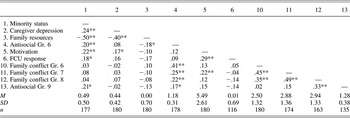
Correlations, means, and standard deviations
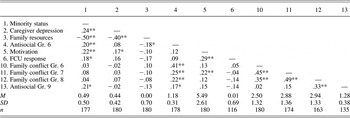
Note: Gr., Grade.
†p < .08. *p < .05. **p < .01.
Results
The first set of analyses evaluated the FCU goals identified by caregivers. Descriptive information is presented in Table 2. The median number of total goals identified by caregivers was seven; the median number of caregiver goals by category were as follows: two problem behavior goals, two self-management goals, two positive behavior goals, and one internalizing goal. In terms of change over time, 51.9% of caregivers reported fewer goals at 1-year follow-up, 20.2% reported no changes in goals, and 27.9% reported more goals at follow-up than at baseline. These patterns were generally similar for the subset categories of goals.
FCU-targeted adolescent behavior concerns descriptive statistics and change scores

Note: FCU, Family Check-Up.
†p < .10. *p < .05.
Change in FCU-targeted behavior concerns (intervention response)
The next step was to examine change in caregivers’ FCU-targeted behavior concerns from Wave 1 to Wave 2. To account for skew common to count-based data, we used a nonparametric, repeated-measures test. The paired-sample Wilcoxon signed rank test generates t values similar to those generated by a standard paired-sample t test; however, whereas the null hypothesis in a standard t test is that the mean difference is zero, the null hypothesis in a Wilcoxon test is that the median difference is zero. As shown in Table 2, there was a consistent pattern of statistically significant improvement over the course of the year following initiation of the FCU, indicated by decreases in FCU-targeted behavior concerns. This was true for the overall sum of FCU-targeted behavior concerns and for each of the four subsets of behavior concerns. Only positive behavior concerns did not meet the p < .05 criterion but was approaching significance at p < .10.
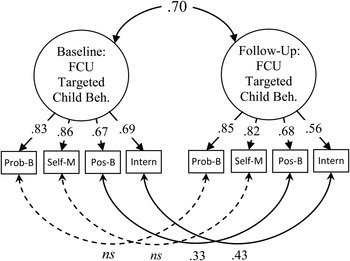
Next, we estimated a confirmatory factor analysis measurement model for FCU-targeted adolescent behavior concerns at baseline and 1-year follow-up. Correlations were estimated within measures. As shown in Figure 2, the model fit well with the data, χ2 (15) = 10.740, p = .77; CFI = 1.00, TLI = 1.00, RMSEA = 0.000. Factor loadings were statistically significant (p < .01) and greater than 0.50, indicating that all factors were positively associated with the latent construct, FCU-targeted adolescent behavior concerns.
Confirmatory factor analysis of Family Check-Up (FCU) targeted child behavior concerns. Model fit: χ 2 (15) = 10.740, p = .77; comparative fit index = 1.00, Tucker–Lewis index = 1.00, root mean square error of approximation = 0.00 (90%: 0.00–0.05).

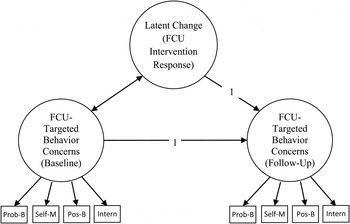
We then calculated a latent change score as specified by McArdle and Nesselroade (Reference McArdle, Nesselroade, Cohen and Reese1994). First, we created two latent constructs representing intervention goals at Time 1 and Time 2, with each containing the four indicators of goal change. Second, we constructed a latent change score that captured change in the latent construct across time (see Figure 3). In brief, a regression coefficient between the Time 1 and Time 2 latent variables was constrained to 1, and the relationship between Time 2 and the latent change score was also constrained to 1; as a result, the latent change score represented the nature of the change in the latent constructs from Time 1 to Time 2. We specified this variable such that higher scores represented decreases in FCU-targeted adolescent behavior concerns from baseline to 1-year follow-up. Thus, predictors that have a positive association with adolescent behavior concerns would indicate significant decreases in concerns over the course of that year.
A representation of the latent change model. FCU, Family Check-Up.

This model provided adequate fit with the data, χ2 (22) = 44.80, p < .01; χ2/df = 2.04, CFI = 0.96, TLI = 0.95, RMSEA = 0.08. In addition, this model revealed statistically significant variance in the degree of FCU intervention response across families (Var = 0.73, SE = 0.16, p < .001). Using this model, we calculated latent change scores for each family. This allowed us to include a manifest variable of latent change in our subsequent models, in order to conserve power (by estimating fewer parameters in larger models) and to avoid issues with multicolinearity that would arise from including both change in and mean levels of FCU-targeted behavior concerns. Rates of change in caregiver concerns about adolescent behavior were associated with FCU intervention response; a family's report of fewer concerns over time was seen as an indication of a positive response to the FCU intervention.
Context and family process mediators of FCU intervention response (change in FCU-targeted behavior concerns)
We then tested path models for the two research aims. Aim 1 focused on the contextual predictors that might predict change in FCU-targeted behavior concerns and the possible mediating role of caregiver motivation to change. Aim 2 focused on the link between FCU intervention response and youth antisocial behavior from Grades 6 to 9. In addition, change in family conflict from Grades 6 through 8 was tested as a mediating process linking the FCU response to reductions in antisocial behavior. In both aims, hypotheses of mediation were evaluated using the following criteria: (a) a significant direct effect of the predictor on the outcome, (b) a significant effect of the predictor on the presumed mediator (i.e., change in family conflict), (c) a significant effect of the mediator on the distal outcome, and (d) a significant indirect effect of the predictor on the outcome by means of the mediator (Judd, Kenny, & McClelland, Reference Judd, Kenny and McClelland2001; MacKinnon & Dwyer, Reference MacKinnon and Dwyer1993).
Aim 1: Contextual factors for FCU intervention response
For the first step (a), we tested a model in which caregiver ethnicity (dummy coded for minority status), caregiver depression, family resources, child antisocial behavior, and caregiver age were used to predict the amount of change in FCU-targeted behavior concerns. Because this is a just-identified model, relative fit statistics could not be estimated, but path coefficients were computed. None of the four predictors was associated with the degree to which caregivers reported improvement in their FCU goals; thus, the mediation hypothesis was not supported.
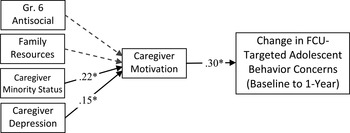
The next model evaluated caregiver motivation to change as a proximal process related to change in FCU-targeted behavior concerns and evaluated contextual factors as predictors of motivation (Hypotheses 2 and 3). This model yielded adequate fit with the data, χ2 (4) = 2.34, p = .67; CFI = 1.00, TLI = 1.00, RMSEA = −0.00 (90%: 0.00–0.09) and is presented in Figure 4. Related to the second hypothesis, two factors predicted caregiver motivation. Caregivers who reported higher levels of depression also reported greater motivation to change (B = 0.95, SE = 0.48, β = 0.15, p < .05). In addition, caregivers of ethnic minority status reported higher levels of motivation to change (B = 1.15, SE = 0.44, β = 0.22, p < .01) than did European American caregivers. However, family resources and levels of youth antisocial behavior were not associated with changes in FCU-targeted behavior concerns. Caregiver motivation, in turn, was associated with greater change (decreases) in FCU-targeted behavior concerns over the course of 1 year (B = 0.08, SE = 0.02, β = 0.30, p < .01), consistent with Hypothesis 3.
The ecology of change in Family Check-Up (FCU) goals. The path coefficients reflect standardized betas. All estimated paths are represented. Paths represented by solid lines were statistically significant (p < .05), and dashed lines were nonsignificant. Model fit: χ2 (4) = 2.340, p = .67; comparative fit index = 1.00; Tucker–Lewis index = 1.00; root mean square error of approximation = 0.00 (90%: 0.00–0.09). Gr., Grade.

Aim 2: Family conflict as a mediator of FCU intervention response
The next model tested growth in family conflict as a mediator of FCU goal improvement and Grade 9 adolescent antisocial behavior, following the steps described previously. Preliminary analyses were conducted in two steps. In the first step (a), the contextual model from Aim 1 was expanded to include a direct path from change in FCU-targeted behavior concerns to Grade 9 antisocial behavior, accounting for Grade 6 antisocial behavior. Caregiver ethnic minority status was included as a covariate predictor of Grade 9 antisocial behavior, because of the significant bivariate correlation. This model provided acceptable fit with the data, χ2 (7) = 5.89, p = .55; CFI = 1.00, TLI = 1.00, RMSEA = 0.00 (90%: 0.00–0.08). Consistent with Hypothesis 4, greater reduction in FCU-targeted behavior concerns was associated with lower adolescent antisocial behavior in Grade 9 (B = −0.12, SE = 0.06, β = −0.21, p <.05), accounting for previous levels.
In the second step (b), we examined growth in family conflict across Grades 6, 7, and 8. Preliminary examination of the unconditional growth model indicated marginal fit with the data, χ2 (1) = 3.33, p < .07; CFI = 0.97, TLI = 0.92, RMSEA = 0.11, but indicated that, on average, family conflict was increasing over time (M = 0.22, SE = 0.06, p < .01) and that there was statistically significant variance in the slope across families (Var = 0.26, SE = 0.12, p < .05). Then, we estimated the contextual model from Aim 1 to determine if change in FCU-targeted behavior concerns predicted rates of growth in family conflict over time. This model provided acceptable fit with the data, χ2 (13) = 13.82, p = .39; CFI = 0.99, TLI = 0.99, RMSEA = 0.02 (90%: 0.00–0.08). In this model, each of the baseline variables, motivation, and FCU response tested as predictors of initial levels and slope of family conflict. Consistent with predictions, changes in FCU-targeted behavior concerns were related to less rapid growth in family conflict over time (B = −0.20, SE = 0.09, β = −0.26, p < .05). Although motivation was not directly associated with changes in family conflict over time (B = 0.03, SE = 0.02, β = 0.13, p = .21), the indirect pathway from caregiver motivation to slope in family conflict via changes in FCU-targeted behavior concerns was statistically significant (standardized indirect effect = −0.08, p = .05).
The final model was estimated, including a latent growth model assessing initial levels and slope of family conflict across Grades 6, 7, and 8 as a mediator of FCU intervention response and Grade 9 antisocial behavior. The four baseline variables were estimated as predictors of caregiver motivation, which in turn predicted FCU intervention response. Each of the baseline variables, motivation, and FCU response tested as predictors of initial levels and slope of family conflict. In turn, intercept and slope, FCU intervention response, and baseline antisocial behavior were estimated as predictors of Grade 9 antisocial behavior. Youth sex was added to the model as a predictor of all variables to test for potential differences. In addition, because of a significant bivariate correlation, caregiver minority status was controlled for when estimating Grade 9 antisocial behavior.
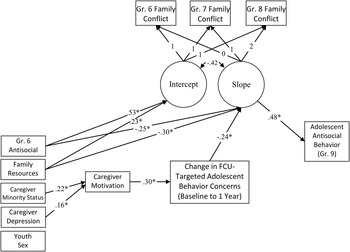
This model yielded good fit with the data, χ2 (17) = 19.45, p = .30; CFI = 0.99, TLI = −0.96, RMSEA = 0.028 (90%: 0.000–0.076). As shown in Figure 5, associations among contextual factors, motivation, and FCU intervention response remained consistent. Youth sex was not related to any of the endogenous variables. Of the contextual factors, only family resources and baseline antisocial behavior were related to family conflict. Specifically, youths in families with greater resources reported slightly higher initial levels of family conflict (B = 0.36, SE = 0.16, β = 0.23, p < .05) and less rapid growth in family conflict over time (B = −0.24, SE = 0.10, β = −0.30, p < .05). Baseline antisocial behavior was associated with higher initial levels of family conflict (B = 1.82, SE = 0.29, β = 0.53, p < .05) and decreases (or less rapid growth) in family conflict over time (B = −0.45, SE = 0.20, β = −0.25, p < .05). Given the negative correlation between slope and intercept (r = −.42), these findings indicate that those starting out at higher initial levels had less steep increases over time. To examine the effect of the negative correlation between intercept and slope, post hoc analyses were conducted by estimating the model with intercept predicting slope, but the results did not vary.
Family conflict as a mediator of Family Check-Up (FCU) goal change on antisocial behavior. Only statistically significant paths are depicted for ease of presentation. Path coefficients reflect standardized betas (*p < .05). Model fit: χ2 (17) = 19.45, p = .30; comparative fit index = 0.99, Tucker–Lewis index = 0.96, root mean square error of approximation = 0.03 (90%: 0.00–0.08). Gr., Grade.

Regarding Hypothesis 5, positing family conflict as a mediator of FCU response and youth antisocial behavior, we examined paths from change in FCU-targeted behavior concerns to family conflict slope and slope to antisocial behavior, controlling for initial levels of family conflict, FCU intervention response, and baseline levels of antisocial behavior. Families that reported improvements (decreases) in their FCU-targeted behavior concerns indicated less rapid increases (or possibly decreases) in family conflict over time (B = −0.19, SE = 0.09, β = −0.24, p < .05). In turn, family conflict slope was associated with Grade 9 antisocial behavior, such that more rapid increases in family conflict throughout the middle school years were associated with higher levels of adolescent antisocial behavior in Grade 9 (B = 0.32, SE = 0.12, β = 0.48, p < .05), accounting for previous levels in Grade 6. In this model, the direct path from FCU intervention response to Grade 9 antisocial behavior was not statistically significant (B = −0.04, SE = 0.06, β = 0.08, p = .51). The indirect path from change in FCU-targeted behavior concerns to antisocial behavior through growth in family conflict was then examined. The standardized indirect effect was marginally significant (−0.11, p < .10). Because of reduced sample size in the change in FCU-targeted behavior concerns variable, we suspected that this marginally significant indirect effect was the result of limited power. Thus, the direct, nonsignificant path from change in FCU-targeted behaviors to antisocial behavior was constrained to be zero, and the indirect effect was then statistically significant (−0.14, p < .05). Although this is not consistent with a strict test of mediation, it does provide support for the indirect pathway by which growth in family conflict links FCU intervention response and later antisocial behavior problems.
Discussion
Drawing from an ecological framework, the FCU targets parenting practices associated with coercive family process to reduce risk for behavioral, emotional, and substance use outcomes (Dishion & Stormshak, Reference Dishion and Stormshak2007). Despite the rich theoretical model that guides implementation of the FCU, caregiver motivation and coercive family mechanisms rarely are specifically examined outside of effectiveness trials relevant to child and adolescent outcomes. Thus, the aims of this study were to (a) investigate contextual and motivational processes as predictors of short-term response to the FCU intervention, and (b) examine trajectories of family conflict as a mechanism linking short-term FCU response and long-term adolescent antisocial behavior outcomes.
Understanding change in FCU-targeted behavior concerns: Family context and caregiver motivation
In the first aim, we examined the role of caregiver depression, family resources, caregiver ethnicity, and initial levels of youth antisocial behavior as predictors of FCU intervention response. None of these factors was directly associated with changes in FCU-targeted behavior concerns. Instead, caregiver depression and caregiver ethnic minority status each were associated with greater motivation to change, which was in turn associated with decreases in caregivers’ FCU-targeted adolescent behavior concerns. These findings are similar to those of a subset of studies that investigated parenting interventions with families with young children. The studies found a positive association between caregiver depression and better outcomes (e.g., Beauchaine et al., Reference Beauchaine, Webster-Stratton and Reid2005), including one that evaluated the FCU with a sample of young children (Gardner et al., Reference Gardner, Connell, Trentacosta, Shaw, Dishion and Wilson2009). Although our study findings diverge from those of studies of families with older children (e.g., Hartman et al., Reference Hartman, Stage and Webster-Stratton2003; Kazdin, Reference Kazdin1995), it may be that the FCU, delivered in a prevention framework, provides support to parents in distress before problems become long-standing patterns, as is often typical in clinical outpatient settings.
Caregiver motivation to change was the primary area in which ethnic differences emerged. Ethnic minority caregivers expressed higher levels of motivation to change their parenting, their child's behavior, and family functioning. Initial levels of motivation may have been enhanced by ethnic matching of interventionist and caregivers for African American and Latino families, the two largest ethnic minority groups in this study. This strategy may more rapidly facilitate a therapeutic alliance and cultural congruency for intervention services (Huey & Polo, Reference Huey, Polo, Weisz and Kazdin2010). Moreover, services were available in Spanish, which enabled us to effectively engage families that otherwise had few options when seeking support (Griner & Smith, Reference Griner and Smith2006). There were no differences between European American and ethnic minority families with respect to intervention response, consistent with previous research that found no differences between these groups in uptake of the intervention or outcomes related to the FCU (Stormshak et al., Reference Stormshak, Connell, Véronneau, Myers, Dishion and Kavanagh2011). Our findings are also consistent with meta-analytic findings from evidence-based treatments (Huey & Polo, 2008).
The lack of findings relevant to family resources and baseline youth problem behaviors was surprising, given past research that identified them as risk factors for diminished intervention response (Kazdin & Wassell, Reference Kazdin and Wassell1999, Reference Kazdin and Wassell2000; Lundahl et al., Reference Lundahl, Risser and Lovejoy2006; Reyno & McGrath, Reference Reyno and McGrath2006). This may have to do with the setting of intervention recruitment and delivery. Because the FCU was delivered in public middle schools, interventionists could more easily access and engage a broader population than personnel in typical clinical intervention studies can (e.g., Kazdin, Reference Kazdin1995; Kazdin et al., Reference Kazdin, Holland and Crowley1997; Nock & Photos, Reference Nock and Photos2006). Collaboration with school staff that is possible in a school-based intervention model may also reduce barriers to engagement related to family resources and youth problem behavior.
As expected, caregiver motivation to change was associated with greater intervention response, indicated by substantial reductions in caregiver reports of FCU-targeted adolescent behavior concerns over 1 year. This finding underscores the importance of assessing caregiver motivation to change at the onset of therapy, such that a foundation for goal setting and intervention delivery is established (Dishion & Kavanagh, Reference Dishion and Kavanagh2003; Dishion & Stormshak, Reference Dishion and Stormshak2007). With the FCU, intervention topics are identified in accordance with caregiver goals and motivation, to support change in the areas that are most relevant to the family's needs and interest. As such, caregivers are more likely to engage in the intervention services and implement newly acquired parenting skills at home (Nock & Kazdin, Reference Nock and Kazdin2005). From a prevention perspective, the FCU's focus on motivation may explain why this brief intervention has lasting effects on youth behavior.
Linking FCU response and distal outcomes: Escalating family conflict
The second aim of this study was to examine growth in family conflict as a mechanism that accounts for the link between FCU response and long-term youth antisocial behavior. Using latent growth curve modeling techniques, we found that caregiver-reported response to the FCU was associated with decreased rates of growth in child-reported family conflict from Grade 6 through Grade 8, which mediated the link with Grade 9 antisocial behavior. This finding offers a first look at the role of escalating family conflict in the FCU model and is consistent with other studies that found that skilled family management practices reduce risk for coercive family interactions, which mediates intervention effects on adolescent antisocial behavior (e.g., DeGarmo et al., Reference DeGarmo, Patterson and Forgatch2004; Forgatch et al., Reference Forgatch, Patterson, DeGarmo and Beldavs2009; Van Ryzin & Dishion, Reference Van Ryzin and Dishion2012).
Contextual factors also shaped family conflict over time. Families with greater family resources evidenced less growth in conflict, even when accounting for intervention effects. Kazdin and Wassell (Reference Kazdin and Wassell2000) found a similar pattern of results, in that parenting outcomes were associated with caregivers’ perceived barriers to treatment, but family-level change was predicted by family resources. These findings suggest that the socioeconomic context of a family may not affect short-term benefits from intervention (i.e., response to the FCU), but it may have longer term implications for the enduring effects of interventions because of the persistent stress imposed by economic hardship and lack of family resources (e.g., Conger, Patterson, & Ge, Reference Conger, Patterson and Ge1995). Consequently, a health-maintenance model with ongoing support and systematic follow-up that is implemented throughout the middle school years may be an effective tool for reducing risk for low-SES families (Dishion & Stormshak, Reference Dishion and Stormshak2007).
A couple of unexpected findings arose with respect to family resources. Youths in families with greater resources had higher initial levels of family conflict but lower rates of growth over time. Given the negative association between initial levels and growth, this finding likely reflects a regression to the mean. However, youths in families with greater resources also reported higher initial levels of antisocial behavior. This is consistent with findings by Luthar and D'Avanzo (Reference Luthar and D'Avanzo1999), who reported higher levels of substance use in suburban adolescents than among inner-city adolescents, and that the substance use was more strongly associated with maladjustment for suburban youths than for inner-city youths. These circumstances may be relevant to our study sample, because affluent families needing parenting support may mean greater access to substances and thus risk for problem behavior. However, it is important to note that in our study, levels of family resources were not related to rates of improvement in FCU-targeted behavior concerns or antisocial behavior in Grade 9. Similarly, our analyses did not unearth any associations between youth gender and intervention effectiveness or antisocial behavior. This may be because of the tailored approach of the FCU intervention, which allows for flexibility in delivery and adaptations to the unique needs of each family (Dishion & Stormshak, Reference Dishion and Stormshak2007). As such, it may be less likely to have differential effectiveness for boys and for girls.
Limitations and future directions
This study offers new insight into the family context of caregiver motivation and FCU response and the family mechanisms that account for the long-term benefits of the FCU. It also raises new questions and identifies limitations that require further research. Although this study incorporated several ecological factors associated with FCU intervention response and motivation, a host of other processes warrant investigation, such as provider-level factors, intervention-specific characteristics, and the modality of service delivery, all of which may affect family engagement in the FCU (Miller et al., Reference Miller, Southam-Gerow and Allin2008). One such factor in the FCU model is the option for home visitation, which has been found to improve rates of engagement in other interventions (Szapocznik & Kurtines, Reference Szapocznik and Kurtines1989).
The focus of this study was to examine processes within the intervention group. Although this approach allowed for a more process-oriented analysis of intervention change, it is also important to note that these changes were not compared with those in a control group, thereby reducing the level of inference possible from these findings. Although this study is an important first step for intervention process research, replication of findings related to contextual factors, motivation, and intervention response within a randomized controlled trial design would produce greater confidence in these findings.
Although motivation during the FCU predicted positive change over the course of 1 year of intervention engagement, it is useful to remember that caregiver motivation is a fluid process (Nock & Photos, Reference Nock and Photos2006), and change in caregiver motivation over time may also account for variability in intervention response, and family and youth outcomes. This study did not have data available to capture the dynamic nature of caregiver motivation over the course of the intervention in order to identify the change in motivation expected to occur in response to the FCU intervention. Future research is needed to examine how caregiver motivation may change over the course of interventions and to evaluate intervention strategies for effectively supporting motivation. In addition, the measures of motivation and FCU response are new measures that would benefit from replication in future studies.
A notable limitation of this study is statistical power. Because of the study's moderate sample size, it was necessary to conduct analyses in a sequential fashion rather than in one simultaneous model. Problems with limited statistical power presented challenges for tests of mediation within such a complex model. In addition, because of limited sample size, it was necessary to collapse a wide range of ethnic groups into a single category of ethnic minority families. Therefore, examinations of caregiver motivation, response to the FCU, and change in family conflict could not be conducted for specific ethnic groups. More research is needed to expand our knowledge of the ecology and mechanisms of culturally sensitive intervention delivery.
Additional research is needed on other core parenting mechanisms promoted by the FCU. Our study findings regarding coercive family process and previous findings regarding parental monitoring (Dishion et al., Reference Dishion, Nelson and Kavanagh2003) offer a promising start, but other parenting strategies also warrant investigation, such as effective limit setting and family problem-solving skills. These two dimensions may be particularly relevant because they are frequently addressed in the FCU intervention.
Conclusion
This study provides an informative picture of the context of caregiver motivation, intervention response, and mechanisms that account for enduring effects of the FCU. Previous studies have established that use of the FCU results in fewer antisocial behavior problems and family conflict (Stormshak et al., Reference Stormshak, Connell, Véronneau, Myers, Dishion and Kavanagh2011; Van Ryzin et al., Reference Van Ryzin, Stormshak and Dishion2012) and that family conflict functions as a mechanism explaining long-term effects of the FCU on adolescent antisocial behavior (Van Ryzin & Dishion, Reference Van Ryzin and Dishion2012) when intervention and control groups are compared in a randomized controlled trial. This study took a closer look at these change processes by focusing on change among the intervention engagers. Findings suggest that caregiver motivation plays a critical role in the degree to which the FCU is effective in reducing adolescent behavioral issues in the short term. These findings suggest that the FCU model successfully provides support to families despite a host of risk factors, such as low family resources, high initial levels of problem behavior, and caregiver depressive symptoms. In turn, these improvements in FCU-targeted behavior concerns translate to less escalation in family conflict over the course of middle school. This finding is consistent with the underpinnings of the FCU model that target coercive family process as a core mechanism underlying long-term risk for adolescent antisocial behavior.