Anomalous aortic origin of the coronary arteries is a congenital cardiac anomaly that is found in 0.1–1% of the population.Reference Hoffman 1 – Reference Tuo, Marasini and Brunelli 8 There are a number of anatomic variants of anomalous aortic origin of a coronary artery, some of which are benign and will never need surgical intervention or lifestyle modification; however, there are others that are potentially life-threatening and require surgical intervention. Despite the relatively small number of patients with this diagnosis, anomalous aortic origin of a coronary artery is the second leading cause of sudden cardiac death in young athletesReference Maron, Doerer and Haas 9 – Reference Taylor, Byers and Cheitlin 18 due to an increased risk of myocardial ischaemia,Reference Hoffman 1 especially during or immediately after exercise.Reference Basso, Maron and Corrado 12 , Reference Corrado, Thiene and Nava 16 – Reference Taylor, Byers and Cheitlin 18 Interarterial and commonly intramural anomalous aortic origin of the right coronary artery and anomalous aortic origin of the left coronary artery are the two most common variants. Despite a much higher prevalence of anomalous aortic origin of the right coronary artery, the risk of sudden cardiac death from anomalous aortic origin of the right coronary artery is significantly less than that of anomalous aortic origin of the left coronary artery.Reference Basso, Maron and Corrado 12
Most physicians recommend surgical intervention if a patient presents with signs or symptoms of myocardial ischaemia and/or if the patient has anomalous aortic origin of the left coronary artery,Reference Brothers, McBride and Seliem 19 , Reference Turner, Turek and Jaggers 20 because of the higher risk for sudden cardiac death. There are also a number of patients with anomalous aortic origin of the right coronary artery who elect surgical repair, even though they are asymptomatic, because of a desire to participate in competitive athletics, as the 36th Bethesda Conference guidelines recommended restricting most children with anomalous aortic origin of a coronary artery from engaging in competitive athletics.Reference Graham, Driscoll and Gersony 21 New guidelines released in a combined American College of Cardiology/American Heart Association Scientific StatementReference Van Hare, Ackerman and Evangelista 22 , Reference Van Hare, Ackerman and Evangelista 23 , on the other hand, no longer recommend restriction from competitive athletics in asymptomatic patients with anomalous aortic origin of the right coronary artery who have normal exercise stress tests. As evidenced by changing management recommendations, there has been a lack of consensus regarding management strategies for some of these anomalous coronary arteries because of the heterogeneity of the anatomic abnormalities and the fact that many of these patients are asymptomatic.Reference Davis, Cecchin and Jones 2 , Reference Brothers, Gaynor and Paridon 24 In addition, undergoing cardiac surgery is not without risk. A multi-institutional study documented the unadjusted outcome of early mortality – defined as less than 30 days after the procedure – as 2.3% with paediatric cardiac surgery. Furthermore, this study only looked at mortality and not morbidity, and therefore ostensibly the possibility of an adverse event is higher.Reference Vinocur, Menk and Connett 25
Although our group has published both short- and medium-term quality of life after surgery for anomalous aortic origin of a coronary artery,Reference Brothers, Mcbride and Marino 26 , Reference Wittlieb-Weber, Paridon and Gaynor 27 there are no data regarding quality of life in patients who do not undergo surgical repair. This information is pertinent because a new medical diagnosis and potential exercise restriction may have a negative impact on the patient’s quality of life.Reference Dean, Gillespie and Greene 28 In addition, exercise performance and its relation to quality of life has not been evaluated in this population; having objective data to give families when discussing treatment strategies will be helpful for counseling. Therefore, the purposes of this study were to evaluate quality of life in patients diagnosed with anomalous aortic origin of a coronary artery who did not undergo surgical correction and to evaluate for a correlation with their exercise capacity.
Materials and methods
Study design
This study was a cross-sectional study using patient and parent-proxy responses to quality of life questionnaires. The study protocol was approved by the Institutional Review Board of The Children’s Hospital of Philadelphia.
Study population
Patients with the diagnosis of anomalous aortic origin of a coronary artery were identified from queries of the electronic medical record available at The Children’s Hospital of Philadelphia using both keyword and International Classification of Disease, 9th edition diagnostic code searches from January, 2000 through January, 2016. Exclusion criteria included (1) having surgical repair for anomalous aortic origin of a coronary artery, (2) age <8 years because the quality-of-life assessment tools used in this study were not validated in that age range, (3) non-English speaking because they would be unable to complete the study questionnaires, and (4) other significant forms of congenital heart disease, except for haemodynamically insignificant atrial septal defect, ventricular septal defect, or patent ductus arteriosus.
Data collection
After informed consent was obtained, we performed a retrospective medical record review for pertinent demographic and clinical information. Standardised questionnaires were sent to patients who gave their consent.
Patients younger than 18 years of age completed a Child Health Questionnaire Child Form 87 (CHQ-CF87) and a PedsQLTM Pediatric Quality of Life Inventory, version 4.0, and their parents completed a Child Health Questionnaire Parent Form 50 (CHQ-PF50) and a PedsQLTM Parent Quality of Life Inventory, version 4.0. Patients aged 18 years or older completed a PedsQLTM Young Adult Quality of Life Inventory, version 4.0, and a QualityMetrics SF-36v2. The PedsQLTM questionnaire consists of 23 questions regarding core dimensions of health: physical, emotional, social, and school functioning. The CHQ form measures 14 unique physical and psychosocial concepts. The QualityMetrics SF-36v2 is a multipurpose, short-form health survey with 36 questions, yielding an eight-scale profile of functional health and well-being as well as psychometrically based physical and mental health component summaries.
A higher score signified better functioning in the respective categories, and all scores were generated on the basis of questionnaire protocol and compared with published standard values.Reference Waters, Salmon and Wake 7 , Reference Varni, Limbers and Burwinkle 29 – Reference Raat, Landgraf and Bonsel 38
Statistical analysis
Clinical characteristics were analysed using standard descriptive statistics. Quality-of-life assessment tool scores were compared with published standard values from healthy childrenReference Waters, Salmon and Wake 7 , Reference Varni, Limbers and Burwinkle 29 – Reference Varni, Burwinkle and Seid 34 , Reference Ware 36 – Reference Raat, Landgraf and Bonsel 38 using two-tailed Student’s t-tests with equal or unequal variances, as appropriate. The correlation between quality of life and exercise capacity as measured by maximum oxygen consumption (mVO2) on exercise stress test, age at diagnosis, and length of time from diagnosis were calculated and reported using Spearman’s correlation coefficients. Changes in exercise stress test results over time were also evaluated using paired Student’s t-tests; p values⩽0.05 were considered to be statistically significant when evaluating the results from the quality of life questionnaires. The Bonferroni correction was used when evaluating the secondary outcomes – namely, the relationship of quality of life variables to other variables, to avoid spurious positives. All statistical analyses were conducted with Stata 12 (StataCorp, College Station, Texas, United States of America).
Results
Medical record review between January, 2000 and January, 2016 identified 133 eligible patients. Of these, 92 (69.2%) agreed to participate in the study, and 56 (60.9%) of them completed the quality-of-life questionnaires.
Baseline characteristics
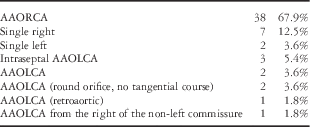
The average age of the patients was 14.7±6.5 years. There were 44 (78.6%) males and 12 females (21.4%). The average age at diagnosis was 10.5±7.5 years, and the average length of time from diagnosis to obtaining consent was 4.0±2.9 years. Of the 53 patients with available exercise-restriction status, more than half (n=36, 64.2%) of the patients were exercise restricted. The majority of patients had anomalous aortic origin of the right coronary artery (n=38, 67.9%) (see Table 1).
Anatomical Variants.

n=56. AAOLCA=anomalous aortic origin of the left coronary artery; AAORCA=anomalous aortic origin of the right coronary artery
Quality-of-life questionnaire results
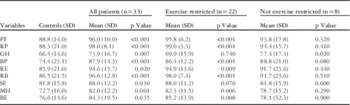
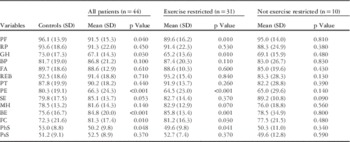
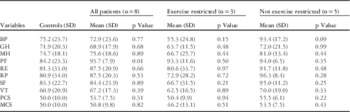
On average, patients had a normal quality of life on the CHQ-CF87 (see Table 2) and PedsQLTM Pediatric Quality of Life Inventory (see Table 3) with results either similar to or statistically higher than published norms. Their parents, however, experienced decreased quality of life in a number of categories. Looking at the CHQ-PF50 (see Table 4), Physical Functioning (91.5±15.3 versus 96.1±13.9, p=0.04), General Health Perception (67.1±14.3 versus 73.0±17.3, p=0.03), and Emotional Impact on Parent (66.3±24.3 versus 80.3±19.1, p<0.001) were all significantly lower than published norms. In addition, the composite Physical Summary score was also significantly decreased (50.2±9.8 versus 53.0±8.8, p=0.048). When dividing the patients into exercise-restricted versus not exercise-restricted categories, parents whose children had been exercise restricted had significantly decreased scores in the previously mentioned categories, whereas the parents of patients who were not exercise restricted had normal quality of life. All other categories were either similar to or statistically higher than published norms, and this held true with the PedsQLTM Parent Quality of Life Inventory (see Table 5) as well. Respondents to the SF-36v2 (see Table 6) also had results similar to or statistically higher than published controls.
Child Health Questionnaire Child Form 87.

BE=behaviour; BP=bodily pain and discomfort; GH=general health perception; MH=mental health; PF=physical functioning; RB=role/social limitations due to behavioural difficulties; RE=role/social limitations due to emotional difficulties; RP=role/social limitations due to physical health; SE=self-esteem
PedsQL Child Form.

Child Health Questionnaire Parent Form 50.

BE=behaviour; BP=bodily pain and discomfort; FA=family activities; FC=family cohesion; GH=general health perception; MH=mental health; PE=emotional impact on parent; PF=physical functioning; PhS=physical summary; PsS=psychosocial summary; PT=time impact on parent; REB=role/social limitations due to emotional/behavioural difficulties; RP=role/social limitations due to physical health; SE=self-esteem
PedsQL Parent Form.

SF-36v2.

BP=bodily pain; GH=general health; MCS=Mental Composite score; MH=mental health; PCS=Physical Component score; PF=Physical Functioning; RE=role emotional; RP=role physical; SF=social functioning; VT=vitality
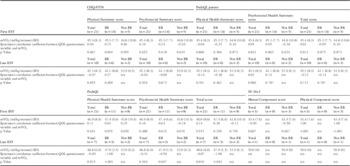
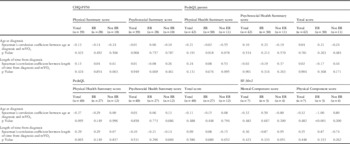
When evaluating for a relationship between quality of life variables and mVO2 on exercise stress test (see Table 7), in the total patient cohort as well as non-exercise-restricted patients, there was a positive correlation between Physical Component score on the SF-36v2 and mVO2 on the first exercise stress test (Pearson’s correlation coefficient of 1.0, p<0.001). In exercise-restricted patients, there was a negative correlation between Physical Health and Total score on the PedsQLTM Pediatric Quality of Life Inventory and mVO2 on the last exercise stress test (Pearson’s correlation coefficient of −1.0, p<0.001). When comparing the Physical Component score on the SF-36v2 and age at diagnosis (see Table 8), there was also a negative correlation (Pearson’s correlation coefficient of −1.0, p<0.001). There were a number of variables that had p values <0.05, but after using the Bonferroni correction these did not maintain their statistical significance. All other variables had no statistically significant correlation.
Exercise performance and correlation with quality of life questionnaires.

CHQ-PF50=Child Health Questionnaire Parent Form 50; mVO2=maximum oxygen consumption; EST=exercise stress test; ER=exercise restricted; n/a=unable to calculate correlation because all quality of life (QOL) variable scores in that particular group were the same
p value necessary to achieve statistical significance after Bonferroni’s correction <0.001
Age and length of time from diagnosis and correlation with quality of life questionnaires.

CHQ-PF50=Child Health Questionnaire Parent Form 50; mVO2=maximum oxygen consumption; EST=exercise stress test; ER=exercise restricted
p value necessary to achieve statistical significance after Bonferroni’s correction <0.001
Exercise stress test results
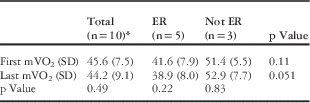
Of the 56 total patients, 26 (46.4%) had at least one exercise stress test where mVO2 was measured; the average mVO2 was 45.0±7.9 ml/kg/minute. In total, 10 patients (17.9%) had a second exercise stress test – in those patients, their average first exercise stress test mVO2 was 45.6±7.5 ml/kg/minute, and their average last exercise stress test mVO2 was 44.2±9.1 ml/kg/minute. This was not a statistically significant difference (p=0.49). Out of these 10 patients, eight had available exercise-restriction status (five were restricted and three were not restricted). In those who were exercise restricted, their average first exercise stress test mVO2 was 41.6±7.9 ml/kg/minute, and their average last exercise stress test mVO2 was 38.9±8.0 ml/kg/minute, again not statistically different (p=0.22). In those who were not restricted, their average first exercise stress test mVO2 was 51.4±5.5 ml/kg/minute, and their average last exercise stress test mVO2 was 52.9±7.7 ml/kg/minute (p=0.83). In addition, in the eight patients whose exercise-restriction status was known, the average mVO2s of the last exercise stress test between exercise restricted and unrestricted patients was compared, and although there was no statistical significance a trend was observed (p=0.051, see Table 9). We also performed the analysis on the first exercise stress test mVO2 between the two groups (p=0.11), but this finding is somewhat meaningless – at that point, none of the patients had been restricted yet, because it was part of their initial diagnostic workup. The average length of time between the first and the last exercise stress test was 2.2±1.2 years.
Change in mVO2.

mVO2=maximum oxygen consumption (ml/kg/minute)
* Two patients’ ER status was unavailable
Discussion
This is the first study to evaluate quality of life in unoperated patients with anomalous aortic origin of a coronary artery. We found that, although patients do not appear to have decreased quality of life, parents of the cohort who were exercise-restricted did in fact experience a diminished quality of life, notably in the Physical Functioning, General Health Perception, and Emotional Impact on Parent subcategories of the questionnaires. This finding may seem counterintuitive given the potentially life-threatening nature of this illness and the negative consequences that may occur with exercise restriction,Reference Dean, Gillespie and Greene 28 but we believe there are a number of potential explanations for this. There are some parents who choose not to share the true extent of the child’s diagnosis with their children to protect their emotional health. In addition, even if the parents have shared the diagnosis, some children, particularly younger children, may not be able to fully comprehend the magnitude of the diagnosis and the associated risks. The type of counselling given to families could also play an important role here. If there was an acknowledgement of the diagnosis, but the majority of the discussion surrounded maintaining a healthy and active lifestyle with a very low risk of a cardiovascular event, one could surmise that the patients may not have had decreased quality of life. On the other hand, this finding did not carry through to the parents of these patients, who as a whole had decreased quality of life as measured by lower Physical Functioning, General Health Perception, Emotional Impact on Parent, and Physical Summary scores on the CHQ-PF50 questionnaire compared with controls. When separated out, however, it appears that it is mainly the parents of children who were exercise restricted who experienced decreased quality of life, whereas parents of those who were not restricted appeared to enjoy a normal quality of life. It may be that the parents of exercise-restricted children perceived their child’s condition to be worse than those not restricted, as their previously healthy child now had to be removed from activities that he or she previously enjoyed. In addition, this seems to mirror the experience of many families, where the parents seem to be disproportionately affected by their child’s ailment compared with their child’s own perception of their illness.Reference Lindstrom, Aman and Norberg 39 , Reference Vance, Morse and Jenney 40
When looking at the secondary outcomes, in the total patient cohort and patients who were not exercise restricted, there was a positive correlation between the Physical Component score on the SF-36v2 questionnaire and their mVO2 on their first exercise stress test. This also intuitively makes sense in that young adults who scored well in that particular category may have increased exercise capacity; however, in exercise-restricted patients, Physical Health and Total score as measured on the PedsQLTM Pediatric Quality of Life Inventory had a negative correlation with mVO2 measured on their last documented exercise stress test. This may be explained by exercise-restricted patients having decreased exercise capacity, although, interestingly, there was no change in exercise capacity over time when looking at individual patients with multiple exercise stress tests. There was also a negative correlation between the Physical Component score on the SF-36v2 and the age at diagnosis, such that the older the patient was at diagnosis the lower the self-assessment of their physical functioning. This may be because, at a certain age, patients would have perceived themselves as healthy, and with a new diagnosis this may change their self-image.
Finally, there were no statistically significant changes noted when comparing the mVO2 between the first and the last exercise stress test in our patient cohort, but there was a trend towards significance (p=0.051) when comparing the mVO2 on the last exercise stress test of patients who were exercise restricted with those who were unrestricted. This seems intuitive because one could expect that patients who were exercise restricted may have a lower mVO2 compared with those who were not restricted because of possible deconditioning.
Limitations
We acknowledge certain limitations to this study. We were limited to a single centre with a small patient number, which may have implications on overall generalisability; however, for this anomaly, our patient numbers are quite robust. In addition, quality-of-life assessment was dependent on survey responses from patients and their parents/proxies. As such, the study could have been affected by response rate and the survey participants’ understanding of the question prompts. There were also a noticeable number of parents who declined participation in the study because they did not want their children to rehash the negative feelings or difficulties present with the initial diagnosis. This would seem to bias the study results towards having a higher quality of life. Ideally, the survey would be performed in a single sitting, but some families stated they did it over a period of time when changes in quality of life could have been possible. Another limitation was that this was a cross-sectional study, thus limiting the ability to state causality versus association. There were also incomplete records for a number of patients who were lost to follow-up.
Conclusions
Children and young adults with unoperated anomalous aortic origin of a coronary artery from the opposite sinus of Valsalva appeared to have normal quality of life, but in those who were exercise restricted their parents had decreased general health and emotional and physical quality-of-life scores. There was a positive correlation between physical health quality-of-life scores and exercise capacity in young adults and a negative correlation between physical and total health quality-of-life scores and exercise capacity in exercise-restricted patients. There was also a trend towards significance noted on the last exercise stress test when comparing mVO2 between exercise-restricted versus unrestricted patients. Improved counselling of families, focussing on both patient and parents, may help improve the quality of life for the entire family. In addition, the definition of exercise restriction should be discussed with the families, so that they understand that their child can participate in most activities. Indeed, under the new guidelines, any exercise restriction will likely become even less prevalent in this patient population. Future studies with larger number of patients, such as through the multi-institutional Anomalous Aortic Origin of a Coronary Artery Registry of the Congenital Heart Surgeons’ SocietyReference Brothers, Gaynor and Jacobs 41 should evaluate quality of life as well as exercise performance over time.
Acknowledgements
The authors acknowledge Xuemei Zhang for her assistance with the statistical analyses performed in this project.
Financial Support
Funding was received from the “Anthony’s Heroes for Hearts” fund (grant number: 27115-5263760000).
Conflicts of Interest
None.
Ethical Standards
The authors assert that all procedures contributing to this work comply with the ethical standards of the relevant national guidelines on human experimentation and with the Helsinki Declaration of 1975, as revised in 2008, and has been approved by the Institutional Review Board at The Children’s Hospital of Philadelphia.