Over the last quarter of a century the frequency of natural disasters has increased.Reference Hogan and Burstein 1 Of these, 88% have been the result of tropical cyclones (cyclones, hurricanes, and typhoons), floods, storms, tornadoes, and tsunamis, resulting in 76% of recorded deaths.Reference Goklany 2 , 3 A disaster often results in the destruction and deterioration of essential public health infrastructure (PHI), such as food, health services, power, sanitation, and shelter.Reference Martine and Guzman 4 , Reference Ryan, Franklin and Burkle 5 This jeopardizes access to treatment and medication, which can further increase the indirect morbidity and mortality during and after a disaster.Reference Jhung, Shehab and Rohr-Allegrini 6
As a result of population growth, density, and rapid urbanization of vulnerable populations, the risk disasters pose to PHI continues to rise. 7 - 9 For example, the southwestern United States is a fertile breeding ground for tornadoes.Reference Baird and Goble 10 Since 1950 there have been an average of 53 tornadoes and 5 deaths annually.Reference Baird and Goble 10 , Reference Fratinardo and Schroeder 11 In Oklahoma, the urban sprawl has resulted in an increased number of people living in high-risk tornado areas. 12 This risk will only increase as the population of Oklahoma is expected to increase from 3.9 million in 2013 to over 5 million by 2050. 12
There has been scant research into the priorities for PHI of people living in disaster-vulnerable areas. Understanding PHI priorities would benefit decision-makers, disaster and health planners, health systems, and the community by systematically informing preparation, response, and recovery.
To help address this problem, a qualitative research literature review was conducted to better define, describe, and categorize PHI according to the priorities for disaster management systems. The objectives included defining PHI in the context of tropical cyclone (cyclone, hurricane, and typhoon), flood, storm, tornado, and tsunami-related disasters and categorizing PHI priorities for these disaster types.
Methods
This qualitative research was completed by using an integrative review method. This methodology was selected owing to its effectiveness in defining concepts such as the definition, description, and categorization of PHI for disasters.Reference Whittemore and Knafl 13 , Reference Broome 14 The method also allowed specific aspects of previous research to be critically and methodically evaluated.Reference Torraco 15 To systematically achieve this, the research was completed in 4 stages: problem identification, literature search, data evaluation, and data analysis.Reference Whittemore and Knafl 13 The data evaluation and analysis were guided by the principles of qualitative research.Reference Creswell 16 Each stage is discussed in the following sections.
Problem Identification
PHI is not clearly defined, described, or categorized to effectively inform preparation, response, and recovery activities for tropical cyclone, flood, storm, tornado, and tsunami-related disasters. The focus on these events is because they account for 88% of disasters and result in 76% of disaster-related deaths.Reference Goklany 2 , 3
Literature Search
The literature search was conducted over 3 phases. The first focused on testing, refining, and finalizing the search terms in Medline. The second extended the search to other databases, and the final was the selection of articles for analysis on the basis of specific inclusion and exclusion criteria.
Testing, Refining, and Finalizing the Search Terms
The search terms were determined through a process of testing, refining, and finalizing in Medline between September 2013 and December 2014. The Medline database was selected because it is an essential tool for biomedical, allied health researchers and practitioners conducting literature searches.Reference Gasparyan 17 , Reference Lippi, Favaloro and Simundic 18
Based on this process of testing, refining, and finalizing, the following search terms and methodology were used: “public health infrastructure,” “public health” or “infrastructure”; and “define,” “describe” and “categorize”; and “flood,” “cyclone,” “storm,” “hurricane,” “tornado,” “tsunami” or “typhoon”; and “disaster.”
Databases
The databases searched were CINAHL, Medline, PsychINFO, Science Direct, Scopus, and Wiley Online. These databases were selected to maximize the literature searched and minimize the risk of missing relevant articles. An all-field search was conducted between March and May 2014 by using the search terms with a date limit of 31 December 2013. Consistent with other literature reviews, the search strategies used differed on the basis of the database functionality (see the table in the online data supplement).Reference Boehm, Franklin and King 19
Because this was a novel area of research, additional exclusions were required for some databases. The Medline search was limited to articles with abstracts and references, pharmacological actions, humans, and core clinical journals. The CINAHL, Scopus, and Science Direct searches were limited to Medicine; Nursing; Health Professions; Pharmacology, Toxicology, and Pharmaceutics; Dentistry; and Engineering. This approach ensured the search was tailored to each database, which increased the efficiency and accuracy.
Careful consideration was given to including Google Scholar. However, there are various concerns with its use. The retrieval and record management mechanisms are relatively unsophisticated and lack quality compared to other databases.Reference Walters 20 , Reference Aguillo 21 Results with Google Scholar are displayed in relation to times of visits from users, not in relation to quality of the publications.Reference Falagas, Pitsouni, Malietzis and Pappas 22 Also, this research was focused on peer-reviewed literature; gray literature was excluded. For these reasons, Google Scholar was used only to explore reference lists and citations of relevant literature.
Selection Strategy
The selection of articles was conducted over 3 stages after retrieval from a database. This included a selection of articles based on the title, followed by an abstract review and then a full text analysis. An article was considered valid if the inclusion criteria were achieved, which included defining, describing, or categorizing PHI for humans and discussing how tropical cyclone, flood, storm, tornado, and tsunami-related disasters impacted PHI. Articles were excluded if they did not define, describe, or categorize PHI and discuss tropical cyclone, flood, storm, tornado, and tsunami-related disasters.
Data Evaluation
The evaluation was conducted by organizing the data, reading, memoing, and data description.Reference Creswell 16 The methodology for each was as follows:
-
∙ Data organization: After being sourced, the data (articles) were saved electronically and, where appropriate, hard copies were stored on file.
-
∙ Reading and memoing: The data were read and memoing was conducted through a combination of electronic notes and by hand by using a highlighter and pen. The information gathered was captured electronically (a table embedded in a Microsoft Word [Microsoft Corp, Redmond, WA] document) and coded according to key phrases, ideas, and concepts.
-
∙ Data description: an individual description for each article was developed. This included categorizing the articles into 6 data types: opinion, description, literature review, qualitative, quantitative, and mixed methods. This was followed by describing each article’s key phrases, ideas, and concepts and grouping PHI identified into themes.
Data Analysis
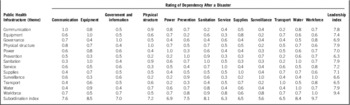
The data were thematically analyzed and then the degree of interdependency (or interdependency index) calculated.Reference Solari and Cimellaro 23 The thematic analysis included a grouping of PHI themes identified and a description of the key phrases, ideas, and concepts for each theme. The degree of interdependency was then calculated to prioritize PHI on the basis of its importance for maintaining health services for the community. This interdependency process was selected because it describes the relationship between 2 themes and the influences/correlation with the other.Reference Solari and Cimellaro 23 In other words, 2 themes are interdependent when each is dependent on the other.Reference Solari and Cimellaro 23
The degree of interdependency was evaluated by values between 0 and 1, where 0 represents the absence of interdependency and 1 represents maximum interdependency between the two themes.Reference Solari and Cimellaro 23 For example, a low independency was considered 0.3, medium 0.6, and high 1.0.Reference Solari and Cimellaro 23 , Reference Pederson, Dudenhoeffer, Hartley and Permann 24 The use of the terms low, medium, and high was based on Pederson et alReference Pederson, Dudenhoeffer, Hartley and Permann 24 and the 0.3, 0.6, and 1 scores used by Solari and Cimellaro.Reference Solari and Cimellaro 23
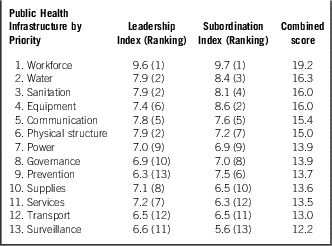
To rank the interdependency, the scores for each PHI theme were added. The total score for a row reflected the leadership index and the column score was the subordination index. The theme with the highest leadership index was considered the most important because if its functionality fails, the performances of health services for the community decrease dramatically. The theme with the highest subordination index had the greatest dependency on the other PHI within the community.Reference Solari and Cimellaro 23 Both index scores for each theme were then added to provide the ranking.
The interdependency ranking process was conducted by 4 assessors: 2 clinicians (one with a humanitarian focus), an environmental health/disaster health professional, and a public health practitioner/academic. The assessors were selected to ensure the process was completed by an interdisciplinary team (clinical practice, disaster management, policy, and research). The team members were chosen on the basis of independent recommendations, respected knowledge, and peer-reviewed publications. The scores by each assessor were aggregated and averaged to provide a prioritization of PHI.
Human Participation Protection
Study protocol approval was not needed because there was no direct human participation in the study.
Results
Literature Search
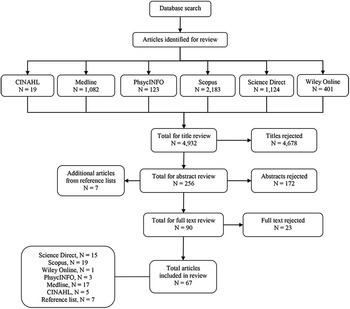
The search strategy identified 4932 potentially relevant articles. After we applied the inclusion and exclusion criteria, 90 full-text articles were analyzed. Of these, 23 were rejected because they did not define, describe, or categorize PHI and discuss cyclone, hurricane, typhoon, flood, storm, tornado, and tsunami-related disasters. The remaining 67 were identified as being relevant and data were extracted (Figure 1).
Literature Review Flow Chart.

Data Evaluation
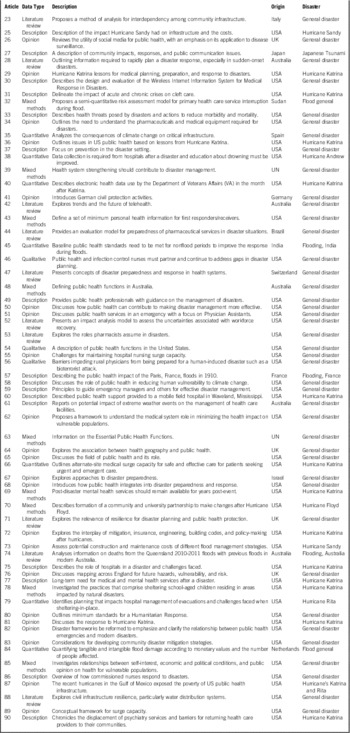
A matrix was developed to provide an individual case description for each article (Table 1). The most common data type was an opinion article (n=22, 33%). This was followed by description (n=16, 24%), literature review (n=10, 15%), mixed methods (n=9, 13%), quantitative (n=7, 11%), and qualitative (n=3, 4%). Thus, 57% of the articles were opinion or description related and 28% were scientific (mixed methods; quantitative and qualitative). The remaining 15% were literature reviews.
Individual Case Description

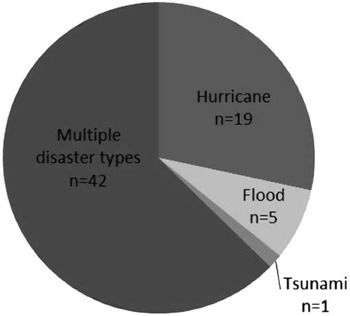
Of the 67 articles, 19 (28%) focused on hurricanes, 5 on floods (8%), 1 on tsunami (1.5%), and the remaining 42 (63%) on more than one disaster type: tropical cyclone, flood, storm, tornado, and tsunami (Figure 2). The most common disaster discussed was Hurricane Katrina (n=13), followed by Hurricanes Sandy (n=2), Rita (n=1), Andrew (n=1), and Floyd (n=1). One article discussed both Hurricanes Katrina and Rita. The articles also discussed flooding in Paris, France, in 1910 (n=1); Brisbane, Australia, in 2011 (n=1); Orissa, India, in 2008 (n=1); and the Japanese tsunami in 2011 (n=1). The remaining articles (n=45) focused more broadly on disasters related to tropical cyclones, floods, storms, tornadoes, and tsunamis.
Articles by Disaster Type.

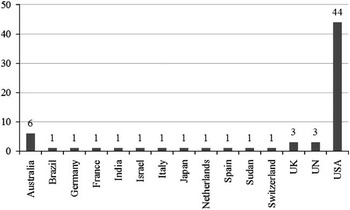
The majority of the articles (n=44, 66%) originated from the United States (Figure 3). The next most common origin was Australia (n=6, 13%) followed by the United Kingdom and other entities including the United Nations (n=3, 4%). The other origins of the articles were Brazil, Germany, France, India, Israel, Italy, Japan, Netherlands, Spain, and Switzerland (n=1).
Articles by Country or Organization of Origin.

Data Analysis: Thematic
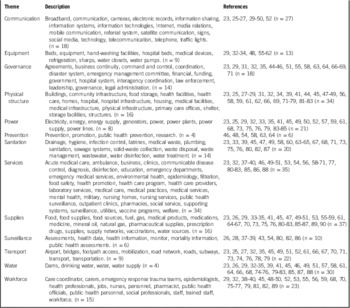
There were 158 different descriptions of PHI, which were grouped into 13 themes (Table 2). These included communication, equipment, governance, physical structure, power, prevention, sanitation, services, supplies, surveillance, transport, water, and workforce.
Public Health Infrastructure Themes and Description for Disasters

Each of the themes had varying descriptions and citations. The theme with the greatest number of descriptions was services (n=34), followed by communication (n=18) and workforce (n=15). The themes with the most citations was services (n=35), followed by physical structure (n=34). A description of the themes follows.
Communication
Communication included Internet and intranet systems, telephony (telephone and mobile communication), media, and more generally technologies used to communicate.Reference Solari and Cimellaro 23 , Reference Aerts, Botzen and de Moel 25 - Reference Noji 50 Communication also referred to traffic cameras, signs, and traffic lights.Reference Phalkey, Dash and Mukhopadhyay 45 , Reference Petersen and Allison 51 , Reference Akhtar and Santos 52 In a disaster situation, Internet and intranet systems allow access, monitoring, and transmission of information required to prepare and respond to a disaster.Reference Lenert, Kirsh and Griswold 30 , Reference Brown, Fischetti and Graham 40 , Reference Li and Wilson 42 , 48 , Reference Ford, Dallas and Harris 53 , Reference Health and Services 54 Telephony allows people to verbally discuss and share information.Reference Solari and Cimellaro 23 , Reference Aung and Whittaker 28 , 48 , Reference Noji 50 Media was identified as a mechanism for communicating on social networks, radio, television, and other means used to share information.Reference Kass-Hout and Alhinnawi 26
Equipment
Equipment was categorized into clinical, hygiene (hand-washing facilities and water closets), refrigeration, and water pumps.Reference Abbas and Routray 32 - Reference Pesik and Gorman 34 , 48 , Reference McHugh 55 - 63 Clinical equipment was considered items used to treat patients (for example, beds, medical devices, and disposable items).Reference Koenig 59 , Reference Runkle, Brock-Martin, Karmaus and Svendsen 62 Hygiene included practices used for infection control, and refrigeration ensured medicines and food were stored at appropriate temperatures.Reference Rebmann, Carrico and English 46 , Reference Keim 58 , Reference Sullivan and McDonald 60 , Reference McGeorge, Chow and Carthey 61 , Reference Curtis, Riva and Rosenberg 64 , Reference Winslow 65 Water pumps were identified as having a range of uses and were required to ensure water could be transported (for example, from a rainwater tank to the tap).Reference Abbas and Routray 32 , Reference Keim 58 More generally, equipment was found to allow patients to be treated and ensure hygiene standards were maintained.Reference Putzer, Koro-Ljungberg and Duncan 56 , Reference Koenig 59 , Reference Sullivan and McDonald 60 , 63
Governance
Governance was described as agreements, command, control and coordination (leadership), planning (business continuity and policy), disaster system, finance and funding, and laws (enforcement and administration).Reference Solari and Cimellaro 23 , Reference Rübbelke and Vögele 35 , 36 , Reference Miranda, Fitzgerald and Osorio-De-Castro 44 - Reference Rebmann, Carrico and English 46 , 48 , Reference Petersen and Allison 51 , Reference Ford, Dallas and Harris 53 , Reference Koenig 59 , 63 , Reference Curtis, Riva and Rosenberg 64 , Reference Eastman, Rinnert and Nemeth 66 - Reference Friedland and Gall 72 Agreements referred to arrangements and partnerships in place between agencies and organizations to prepare and respond to a disaster.Reference Rebmann, Carrico and English 46 , Reference Beinin 67 Command, control, and coordination was described as the systems and processes used to prevent duplication of activities and enhance efficiency of available resources (for example, military support). 36 , Reference Miranda, Fitzgerald and Osorio-De-Castro 44 , 48 , Reference Petersen and Allison 51 , Reference Curtis, Riva and Rosenberg 64 , Reference Eastman, Rinnert and Nemeth 66 - Reference Lee and Riley 68 Planning referred to preparations undertaken for disasters, including elements of the disaster system (for example, emergency management committee) and policy development.Reference Brown, Fischetti and Graham 40 , Reference Rebmann, Carrico and English 46 , Reference Ford, Dallas and Harris 53 , 63 , Reference Beinin 67 , Reference Olteanu, Arnberger and Grant 69 , Reference Friedland and Gall 72 Finance and funding referred to commodities and accessing funds required to ensure appropriate activities before, during, and after a disaster.Reference Solari and Cimellaro 23 , Reference Rübbelke and Vögele 35 , Reference Phalkey, Dash and Mukhopadhyay 45 Laws were described as the legislative frameworks to protect and gather information, enforce standards, maintain hospital safety, and ensure accurate record keeping.Reference van Aalst, Strauss and Fox 31 , Reference Miranda, Fitzgerald and Osorio-De-Castro 44 , Reference Phalkey, Dash and Mukhopadhyay 45 , Reference Health and Services 54 , 63 , Reference Curtis, Riva and Rosenberg 64 , Reference Lee and Riley 68 , Reference Castleden, McKee and Murray 71
Physical Structure
Physical structure was categorized as buildings, storage facilities, health facilities, shelters, and general infrastructure.Reference Solari and Cimellaro 23 , Reference Aerts, Botzen and de Moel 25 , Reference Aung and Whittaker 28 , Reference Darsey, Carlton and Wilson 29 , Reference Abbas and Routray 32 , Reference Fekete, Lauwe and Geier 41 , Reference Miranda, Fitzgerald and Osorio-De-Castro 44 , Reference Phalkey, Dash and Mukhopadhyay 45 , 48 , Reference Noji 49 , Reference Putzer, Koro-Ljungberg and Duncan 56 , Reference Keim 58 , Reference McGeorge, Chow and Carthey 61 , Reference Runkle, Brock-Martin, Karmaus and Svendsen 62 , Reference Curtis, Riva and Rosenberg 64 , Reference Eastman, Rinnert and Nemeth 66 , Reference Olteanu, Arnberger and Grant 69 , Reference Castleden, McKee and Murray 71 - 80 Buildings included accommodation and more generally shelters used to protect people from the elements.Reference Aung and Whittaker 28 , Reference Castleden, McKee and Murray 71 , Reference Zhong, Clark and Hou 74 Storage facilities included sites used to house goods, supplies, and equipment.Reference Tekeli-Yeşil 47 , Reference McGeorge, Chow and Carthey 61 Health facilities referred to those aspects of buildings used for delivering health services (for example, hospitals, medical facilities, and primary care offices). Reference Aung and Whittaker 28 , Reference Darsey, Carlton and Wilson 29 , Reference Abbas and Routray 32 , Reference Fekete, Lauwe and Geier 41 , Reference Miranda, Fitzgerald and Osorio-De-Castro 44 , Reference Phalkey, Dash and Mukhopadhyay 45 , 48 , Reference Noji 49 , Reference Keim 58 , Reference Koenig 59 , Reference McGeorge, Chow and Carthey 61 , Reference Runkle, Brock-Martin, Karmaus and Svendsen 62 , Reference Olteanu, Arnberger and Grant 69 , Reference Friedland and Gall 72 Shelter included housing and homes, which can be temporary (such as schools) or permanent structures (such as houses).Reference Becker 27 - Reference Darsey, Carlton and Wilson 29 , Reference Pesik and Gorman 34 , Reference Bayntun, Rockenschaub and Murray 39 , Reference Noji 49 , Reference Noji 50 , Reference Keim 58 , Reference Oven, Curtis and Reaney 76 , Reference Madrid, Sinclair and Bankston 77 , Reference Loewenberg 81 Shelter provided a mechanism for people to stay safe and healthy.Reference Darsey, Carlton and Wilson 29 , Reference Health and Services 54 , Reference Curtis, Riva and Rosenberg 64 , Reference Loewenberg 81 , Reference Burkle and Greenough 82 It was also identified as being particularly important for vulnerable populations.Reference Darsey, Carlton and Wilson 29 , Reference Pesik and Gorman 34 , Reference Bayntun, Rockenschaub and Murray 39 , Reference Keim 58 , Reference Burkle and Greenough 82 Finally, the impact of a disaster on physical structures included a loss of hospital-style care and basic services for treating patients and maintaining community well-being.Reference Darsey, Carlton and Wilson 29 , Reference Phalkey, Dash and Mukhopadhyay 45 , Reference Putzer, Koro-Ljungberg and Duncan 56 , Reference Keim 58 , Reference Runkle, Brock-Martin, Karmaus and Svendsen 62 , Reference Olteanu, Arnberger and Grant 69 , Reference Madrid, Sinclair and Bankston 77
Power
The descriptions of power included electricity, power lines, and energy supply (generators and power plants).Reference Solari and Cimellaro 23 , Reference Aerts, Botzen and de Moel 25 , Reference Darsey, Carlton and Wilson 29 , Reference Abbas and Routray 32 , Reference Rübbelke and Vögele 35 , Reference Fekete, Lauwe and Geier 41 , Reference Phalkey, Dash and Mukhopadhyay 45 , Reference Noji 49 - Reference Akhtar and Santos 52 , Reference Keim 58 , Reference McGeorge, Chow and Carthey 61 , Reference Lee and Riley 68 , Reference Aerts, Botzen and de Moel 73 , Reference Chaffee and Oster 75 , Reference Oven, Curtis and Reaney 76 , Reference Downey, Andress and Schultz 79 , Reference Kennedy, Richards and Chicarelli 83 - Reference Connolly 85 Electricity was identified as being used to power lights, medical devices, and water treatment plants.Reference Solari and Cimellaro 23 , Reference Clements 33 , Reference Phalkey, Dash and Mukhopadhyay 45 , Reference Noji 49 , Reference Curtis, Riva and Rosenberg 64 , Reference Aerts, Botzen and de Moel 73 , Reference Oven, Curtis and Reaney 76 , Reference Downey, Andress and Schultz 79 Power lines were identified as the infrastructure used to transfer electricity, and energy supply referred to items used to generate power.Reference Fekete, Lauwe and Geier 41 , Reference Noji 50 , Reference Akhtar and Santos 52 It was identified that without power the services and equipment required to provide health care were limited.Reference Noji 49 , Reference Petersen and Allison 51 , Reference Oven, Curtis and Reaney 76 , 80 , Reference Connolly 85 This was due to the heavy reliance of medical devices on power.Reference Clements 33 , Reference Phalkey, Dash and Mukhopadhyay 45 , Reference Petersen and Allison 51 , Reference Chaffee and Oster 75 , Reference Oven, Curtis and Reaney 76 Communication, sanitation systems, food safety, and water supply infrastructure were also identified as dependent on power.Reference Solari and Cimellaro 23 , Reference Abbas and Routray 32 , Reference Clements 33 , Reference Rübbelke and Vögele 35 , Reference Phalkey, Dash and Mukhopadhyay 45 , Reference McGeorge, Chow and Carthey 61 , Reference Curtis, Riva and Rosenberg 64 , Reference Lee and Riley 68 , Reference Oven, Curtis and Reaney 76 , 80 , Reference Debisette, Martinelli and Couig 86
Prevention
Prevention was described as health promotion, research, and public health programs. 48 , Reference Health and Services 54 , Reference Keim 58 , 63 , Reference Curtis, Riva and Rosenberg 64 , Reference Olteanu, Arnberger and Grant 69 Health promotion incorporates activities focused on encouraging the community to maintain healthy lifestyles and promote strategies to avoid contracting communicable diseases.Reference Solari and Cimellaro 23 , Reference Rebmann, Carrico and English 46 , Reference Health and Services 54 , 63 - Reference Winslow 65 Research ensured the strategies implemented were based on evidence. 48 , Reference Health and Services 54 , 63 , Reference Curtis, Riva and Rosenberg 64 Public health programs included governance and legal means to protect the health and well-being of individuals and the community.Reference Health and Services 54 , Reference Curtis, Riva and Rosenberg 64 , Reference Olteanu, Arnberger and Grant 69
Sanitation
Sanitation included drainage (plumbing), hygiene (infection control), sewage (latrines), solid-waste management, general waste management (medical and nonmedical), and water treatment.Reference Clements 33 , Reference Bayntun, Rockenschaub and Murray 39 , Reference Phalkey, Dash and Mukhopadhyay 45 - Reference Tekeli-Yeşil 47 , Reference Noji 49 , Reference Keim 58 , Reference Sullivan and McDonald 60 , Reference McGeorge, Chow and Carthey 61 , 63 - Reference Winslow 65 , Reference Beinin 67 , Reference Lee and Riley 68 , Reference Castleden, McKee and Murray 71 , Reference Aerts, Botzen and de Moel 73 , Reference Chaffee and Oster 75 , Reference Oven, Curtis and Reaney 76 , 80 , Reference Burkle and Greenough 82 , Reference Milio 87 Drainage referred to mechanisms for removing water and other waste products.Reference Tekeli-Yeşil 47 , Reference Curtis, Riva and Rosenberg 64 , Reference Chaffee and Oster 75 Hygiene was identified as the processes in place to prevent disease outbreaks (for example, hand washing and sanitization of equipment). 63 , Reference Winslow 65 , Reference Lee and Riley 68 Sewage was described as the systems used to separate contaminants and waste treatment.Reference Solari and Cimellaro 23 , Reference Clements 33 , Reference Noji 49 , Reference Keim 58 , Reference McGeorge, Chow and Carthey 61 , Reference Curtis, Riva and Rosenberg 64 , Reference Lee and Riley 68 Waste management referred to the systems used to manage refuse from households, hospitals, and the general community.Reference Phalkey, Dash and Mukhopadhyay 45 , Reference Sullivan and McDonald 60 , Reference Curtis, Riva and Rosenberg 64 Water treatment and disinfection included treating water to ensure it was free from contaminations and microorganisms.Reference Phalkey, Dash and Mukhopadhyay 45 , Reference Sullivan and McDonald 60 , Reference Beinin 67 , Reference Aerts, Botzen and de Moel 73 , Reference Oven, Curtis and Reaney 76 , Reference Loewenberg 81
Services
The descriptions for services included business, hygiene (disinfection and filtration), medical (clinics, pharmacies, and utilities), public health, military, and social.Reference Solari and Cimellaro 23 , Reference Abbas and Routray 32 , Reference Weinstein 37 - Reference Brown, Fischetti and Graham 40 , Reference Phalkey, Dash and Mukhopadhyay 45 , Reference Rebmann, Carrico and English 46 , Reference Noji 50 , Reference Petersen and Allison 51 , Reference Ford, Dallas and Harris 53 , Reference Health and Services 54 , Reference Putzer, Koro-Ljungberg and Duncan 56 , Reference Keim 58 , Reference Sullivan and McDonald 60 - Reference Castleden, McKee and Murray 71 , Reference Madrid, Sinclair and Bankston 77 , 80 , Reference Burkle and Greenough 82 , Reference Kennedy, Richards and Chicarelli 83 , Reference Connolly 85 , Reference Debisette, Martinelli and Couig 86 , Reference Gay and Sinha 88 Business referred to the functionality of health companies including food businesses.Reference Solari and Cimellaro 23 , Reference Farquhar and Dobson 70 Hygiene was the need to prevent infection and spread of disease.Reference Keim 58 , Reference McGeorge, Chow and Carthey 61 , Reference Eastman, Rinnert and Nemeth 66 , Reference Beinin 67 Medical was the provision of medical services and treatment (for example, hospital care, immunization programs, and outpatient services).Reference Ogden, Gibbs-Scharf, Kohn and Malilay 38 - Reference Brown, Fischetti and Graham 40 , Reference Phalkey, Dash and Mukhopadhyay 45 , Reference Noji 49 - Reference Petersen and Allison 51 , Reference Keim 58 , Reference Curtis, Riva and Rosenberg 64 , Reference Winslow 65 , Reference Beinin 67 , Reference Castleden, McKee and Murray 71 , Reference Burkle and Greenough 82 , Reference Connolly 85 Public health was closely linked with prevention and focused on intervening or preventing disease at a community level.Reference Ford, Dallas and Harris 53 , Reference Runkle, Brock-Martin, Karmaus and Svendsen 62 The military referred to emergency health services provided by a nation’s armed forces.Reference Solari and Cimellaro 23 , Reference Petersen and Allison 51 , Reference Lee and Riley 68 Social was identified as psychological care and services provided outside a medical facility.Reference Farquhar and Dobson 70 , Reference Gay and Sinha 88
Supplies
Descriptors for supplies were grouped into fuel (gas and oil), medical products (medicines, pharmaceuticals, and vaccinations), food, supply networks, and water sources.Reference Solari and Cimellaro 23 , Reference Darsey, Carlton and Wilson 29 , Reference Pesik and Gorman 34 , Reference Rübbelke and Vögele 35 , Reference Bayntun, Rockenschaub and Murray 39 , Reference Fekete, Lauwe and Geier 41 , Reference Phalkey, Dash and Mukhopadhyay 45 , Reference Tekeli-Yeşil 47 , Reference Noji 49 , Reference Ford, Dallas and Harris 53 , Reference McHugh 55 , Reference Putzer, Koro-Ljungberg and Duncan 56 , Reference Keim 58 , Reference Koenig 59 , Reference McGeorge, Chow and Carthey 61 , Reference Runkle, Brock-Martin, Karmaus and Svendsen 62 , Reference Winslow 65 , Reference Oven, Curtis and Reaney 76 , Reference Burkle and Greenough 82 , Reference Kennedy, Richards and Chicarelli 83 , Reference Connolly 85 , Reference Bonnett, Peery and Cantrill 89 , Reference Griffies 90 Fuel was described as being used to generate power for houses, business, water treatment, sewage systems, and vehicles.Reference Solari and Cimellaro 23 , Reference Aung and Whittaker 28 , Reference Darsey, Carlton and Wilson 29 , Reference Fekete, Lauwe and Geier 41 , Reference Noji 49 , Reference Keim 58 , Reference McGeorge, Chow and Carthey 61 , Reference Beinin 67 , Reference Lee and Riley 68 , Reference Aerts, Botzen and de Moel 73 , Reference Chaffee and Oster 75 , Reference Oven, Curtis and Reaney 76 , Reference Burkle and Greenough 82 Medical products were used to treat existing and acute conditions, including the delivery of immunization programs.Reference Bayntun, Rockenschaub and Murray 39 , Reference Phalkey, Dash and Mukhopadhyay 45 , Reference Ford, Dallas and Harris 53 , Reference McHugh 55 , Reference Griffies 90 Food related to agricultural crops and the supply of nutritious meals.Reference Solari and Cimellaro 23 , Reference Kass-Hout and Alhinnawi 26 , Reference Clements 33 , Reference Pesik and Gorman 34 , Reference Noji 49 - Reference Petersen and Allison 51 , Reference Keim 58 , Reference Curtis, Riva and Rosenberg 64 , Reference Eastman, Rinnert and Nemeth 66 , Reference Farquhar and Dobson 70 , Reference Oven, Curtis and Reaney 76 , 80 - Reference Kennedy, Richards and Chicarelli 83 , Reference Connolly 85 - Reference Milio 87 Nutritious food was also identified as important to ensure people can stay healthy and have the energy required to respond to a disaster.Reference Bayntun, Rockenschaub and Murray 39 , 80 , Reference Burkle and Greenough 82 , Reference Connolly 85 Supply networks were identified as mechanisms to distribute supplies through communication and transport.Reference Bonnett, Peery and Cantrill 89 Water sources provided drinking water and hygiene capabilities.Reference Clements 33 , Reference Keim 58
Surveillance
Surveillance included assessment, monitoring, gathering health data, and health information systems.Reference Kass-Hout and Alhinnawi 26 , Reference Aung and Whittaker 28 , Reference Weinstein 37 , Reference Ogden, Gibbs-Scharf, Kohn and Malilay 38 , Reference Brown, Fischetti and Graham 40 , Reference Irmiter, Subbarao and Shah 43 , Reference Noji 49 , Reference Health and Services 54 , Reference Curtis, Riva and Rosenberg 64 , Reference Lee and Riley 68 , 80 , Reference Burkle and Greenough 82 Assessment referred to epidemiology and statistical analysis of data.Reference Aung and Whittaker 28 , Reference Weinstein 37 , Reference Noji 49 Monitoring included public health assessments to gather information and inform response and recovery operations.Reference Brown, Fischetti and Graham 40 , 80 Health data were used to understand the situation, including monitoring disease trends.Reference Kass-Hout and Alhinnawi 26 , Reference Ogden, Gibbs-Scharf, Kohn and Malilay 38 , Reference Noji 49 , Reference Health and Services 54 , 63 , Reference Debisette, Martinelli and Couig 86 Health information incorporated mortality, morbidity, and general information relating to health services. This infrastructure informed early detection of disease outbreaks and provided an understanding of disaster impacts and a mechanism for evaluating interventions.Reference Weinstein 37 - Reference Bayntun, Rockenschaub and Murray 39 , Reference Curtis, Riva and Rosenberg 64 , Reference Lee and Riley 68 , Reference Burkle and Greenough 82
Transport
Transport was categorized as airports, bridges, logistics, mobilization, public transport (subways), roads, and transportation.Reference Solari and Cimellaro 23 , Reference Becker 27 , Reference Aung and Whittaker 28 , Reference Rübbelke and Vögele 35 , Reference Fekete, Lauwe and Geier 41 , Reference Phalkey, Dash and Mukhopadhyay 45 , Reference Noji 49 - Reference Petersen and Allison 51 , Reference McGeorge, Chow and Carthey 61 , Reference Eastman, Rinnert and Nemeth 66 , Reference Beinin 67 , Reference Farquhar and Dobson 70 , Reference Castleden, McKee and Murray 71 , Reference Zhong, Clark and Hou 74 , Reference Oven, Curtis and Reaney 76 , Reference Anderson 78 , Reference Downey, Andress and Schultz 79 Airports were used for planes and helicopters, which provided a vital means for transporting patients. Bridges were identified as a key part of transport infrastructure along with roads.Reference Becker 27 , Reference Phalkey, Dash and Mukhopadhyay 45 , Reference Noji 50 , Reference Akhtar and Santos 52 , Reference McGeorge, Chow and Carthey 61 , Reference Castleden, McKee and Murray 71 , Reference Aerts, Botzen and de Moel 73 , Reference Zhong, Clark and Hou 74 This included highways, state roads, and local roads. If damaged, transport, logistic, and mobilization options for patients, the community, and disaster management systems are affected.Reference Abbas and Routray 32 , Reference Curtis, Riva and Rosenberg 64 , Reference Anderson 78 Public transport included subways, buses, trams, and footpaths.Reference Aerts, Botzen and de Moel 25 , Reference Oven, Curtis and Reaney 76 This infrastructure provided mass transit options for the community and was identified as vital before and after a disaster. Generally, transportation included ambulances, cars, and motorcycles.Reference Loewenberg 81
Water
Water was described as water storage, drinking water, and water supply.Reference Solari and Cimellaro 23 , Reference Darsey, Carlton and Wilson 29 , Reference Abbas and Routray 32 - Reference Pesik and Gorman 34 , Reference Fekete, Lauwe and Geier 41 , Reference Phalkey, Dash and Mukhopadhyay 45 , Reference Rebmann, Carrico and English 46 , Reference Noji 49 , Reference Petersen and Allison 51 , Reference Keim 58 , Reference McGeorge, Chow and Carthey 61 , Reference Curtis, Riva and Rosenberg 64 , Reference Eastman, Rinnert and Nemeth 66 , Reference Lee and Riley 68 , Reference Zhong, Clark and Hou 74 - Reference Oven, Curtis and Reaney 76 , Reference Downey, Andress and Schultz 79 - Reference Kennedy, Richards and Chicarelli 83 , Reference Connolly 85 , Reference Gay and Sinha 88 Water storage referred to a community, farm, or household (rainwater tank) storage.Reference Zhong, Clark and Hou 74 , Reference Oven, Curtis and Reaney 76 Drinking water was used for food preparation, hydration, hygiene, and medical treatment.Reference Kass-Hout and Alhinnawi 26 , Reference Clements 33 , Reference Bayntun, Rockenschaub and Murray 39 , Reference Phalkey, Dash and Mukhopadhyay 45 , Reference Rebmann, Carrico and English 46 , Reference Noji 49 , Reference Keim 58 , Reference McGeorge, Chow and Carthey 61 , Reference Lee and Riley 68 , Reference Oven, Curtis and Reaney 76 , 80 - Reference Burkle and Greenough 82 , Reference Connolly 85 Water supply referred to reticulation systems and storage.Reference Solari and Cimellaro 23 , Reference Darsey, Carlton and Wilson 29 , Reference Abbas and Routray 32 , Reference Fekete, Lauwe and Geier 41 , Reference Phalkey, Dash and Mukhopadhyay 45 , 57 Without water, hydration cannot occur and the capability for effective hygiene practices would be limited.Reference Keim 58 , Reference Lee and Riley 68 Also, this prevented sanitation systems from effectively working along with medical treatments such as dialysis.Reference Rebmann, Carrico and English 46 , Reference McGeorge, Chow and Carthey 61 , Reference Lee and Riley 68 , Reference Burkle and Greenough 82 , Reference Milio 87
Workforce
Workforce was described as carers, public health professionals, medical professionals, social professionals, and staff.Reference Abbas and Routray 32 , Reference Ogden, Gibbs-Scharf, Kohn and Malilay 38 - Reference Brown, Fischetti and Graham 40 , Reference Phalkey, Dash and Mukhopadhyay 45 , 48 - Reference Noji 50 , Reference Akhtar and Santos 52 , Reference Ford, Dallas and Harris 53 , Reference McHugh 55 , Reference Putzer, Koro-Ljungberg and Duncan 56 , Reference Koenig 59 , Reference Lee and Riley 68 , Reference Farquhar and Dobson 70 , Reference Chaffee and Oster 75 - Reference Madrid, Sinclair and Bankston 77 , Reference Downey, Andress and Schultz 79 , Reference Loewenberg 81 , Reference Bonnett, Peery and Cantrill 89 A carer looks after the elderly and family members who are unwell or disabled.Reference Brown, Fischetti and Graham 40 , Reference Oven, Curtis and Reaney 76 Public health professionals work at the population level and included environmental health professionals, epidemiologists, public health officials, and health promotion officers.Reference Weinstein 37 , Reference Ogden, Gibbs-Scharf, Kohn and Malilay 38 , Reference Noji 49 , Reference Noji 50 , Reference Ford, Dallas and Harris 53 , 63 , Reference Lee and Riley 68 , Reference Madrid, Sinclair and Bankston 77 , Reference Burkle and Greenough 82 Medical professionals were identified as providing individual ongoing acute treatment and included doctors and nurses.Reference Koenig 59 , Reference Curtis, Riva and Rosenberg 64 , Reference Oven, Curtis and Reaney 76 , Reference Madrid, Sinclair and Bankston 77 , Reference Loewenberg 81 Social professionals provided mental health and other support activities for those in need.Reference Koenig 59 , Reference Oven, Curtis and Reaney 76 , Reference Madrid, Sinclair and Bankston 77 If the workforce is disrupted, the quality and safety of health care services for patients and the broader community was found to be negatively impacted.Reference Darsey, Carlton and Wilson 29
Data Analysis: Degree of Interdependency
The 4 assessors conducted an evaluation of each theme and averaged the scores (Table 3). Workforce was identified as the most important. It was the highest ranked on the leadership index (9.4) and had the greatest dependency on other PHI (9.7). The next 5 highest themes on the leadership index were physical structure (7.9), sanitation (7.9), water (7.9), communication (7.8), and equipment (7.4). The 5 themes after workforce with the greatest dependency on others were equipment (8.6), water (8.4), sanitation (8.1), communication (7.6), and prevention (7.5).
Public Health Infrastructure Interdependency Matrix for Disasters

An aggregation of the leadership and subordination index scores provided a ranking for PHI (Table 4). On this basis, the following PHI priorities were identified: 1, workforce; 2, water; 3, sanitation; 4, equipment; 5, communication; 6, physical structure; 7, power; 8, governance; 9, prevention; 10, supplies; 11, service; 12, transport; and 13, surveillance.
Ranking and Categorization of Public Health Infrastructure in a Disaster

Discussion
Workforce can be considered the most important of the 13 thematic areas related to PHI and disasters. If its functionality fails, it has the greatest impact on the performance of health services and is highly dependent on the other PHIs. If workforce issues are overcome post-disaster, the remaining 12 forms of PHI will then be progressively addressed. The next priority PHI is water, followed by sanitation, equipment, communication, physical structure, power, governance, prevention, supplies, service, transport, and surveillance. Based on this description, PHI should be defined as “the workforce, equipment, supplies, and services required to maintain the health and well-being of individuals and the community.”
The ranking of communication (number 5) reflects the rapid progress in telecommunication technology. Communication no longer needs to be a major limiting factor before, during, and after a disaster. For example, in the 1990s and before, a lack of communication was considered the paralyzing factor in 80% or more of disaster scenarios.Reference Garshnek and Burkle 91 This shift highlights the need to tailor disaster activities to reflect modern-day priorities.
An interesting finding was surveillance being ranked as number 13. Surveillance is an important aspect of the health system. However, this ranking reflects that the functionality will be regained once the other PHI themes are addressed after a disaster. It is important that all themes identified are required to maintain the health and well-being of individuals and the community.
The application of the interdependency method used by Solair and CimellaroReference Solari and Cimellaro 23 allowed the relation between the 2 forms of PHI and the influences/correlation with the other to be explored. Although the degree of interdependency measurement used is subjective (in which low is 0.3, medium 0.6, and high 1.0), it provides a framework for systematically ranking and prioritizing PHI.
The findings support the mainstreaming of health into the Sendai Framework for Disaster Risk Reduction 2015–2030. 92 PHI is linked to all disaster risk reduction priority actions. The rankings of PHI presented could be used as a guide to progressively increase resilience, particularly for at-risk populations. This could result in an expansion from the traditional disaster approaches (physical capacity and material disaster relief) to a focus more on community resilience through PHI.Reference Morton and Lurie 93
Overall, this research will help disaster management and health systems prepare, respond, and recover from the PHI aspects of disasters. Ensuring the workforce is available should be the first priority for disaster and health planners. This could include providing an emergency child minding service to facilitate the return to work of health care staff.Reference Lawlor, Franklin and Aitken 94 Once planning and preparations for workforce issues are addressed, the next focus should be maintaining water, followed by the remaining PHI themes in order of priority. Ultimately, this provides a platform to help disaster preparation, response, and recovery encompass the entire PHI spectrum.
Limitations
The research was influenced by the lead author’s studies and work in public health and disaster management in Australia at local, state, and national levels and across the Asia-Pacific region. To address this, the themes identified were checked by the second author and the results reviewed by all authors.
A potential limitation is that all disasters and events of interest may not have been in the literature available for review. This is a limitation for studies such as this that are focused on peer-reviewed literature. However, the research still provides a basis to start the discussion about PHI priorities before, during, and after a disaster.
The interdependency ranking process for the PHI themes is also a limitation. To minimize the impact of this limitation, the interdependency ranking was completed by the first 4 authors. This included 2 clinicians (one with a humanitarian focus), an environmental health/disaster health professional, and a public health practitioner/academic. The scores by each assessor were then aggregated and averaged to provide a prioritization of PHI. The results may still be relevant to other disaster health audiences; however, the next step should be a process of validation. This should include a broader cohort of disaster responders, health professionals, government officials, and community representatives ranking and prioritizing PHI.
Another potential limitation is transferability of the findings outside high-income country settings. The review and subsequent analysis was limited to articles that predominantly originated from high-income countries (United States, Australia, and United Kingdom). Caution should be taken in applying the results to low- and middle-income countries because the PHI priorities may change.
Conclusions
The workforce was identified as the most important of the 13 thematic areas related to PHI and disasters. If its functionality fails, it has the greatest impact on the performance of health services and is highly dependent on the other PHI themes. If workforce issues are overcome post-disaster, the remaining 12 forms of PHI will then be progressively addressed. The next priority PHI is water, followed by sanitation, equipment, communication, physical structure, power, governance, prevention, supplies, service, transport, and surveillance. The research also supports the mainstreaming of health into the Sendai Framework for Disaster Risk Reduction 2015–2030. PHI is linked to all disaster risk reduction priority actions. Overall, the findings presented are a step toward providing an evidence base to inform PHI priorities in the disaster setting.
Acknowledgments
Australian Health Service Innovation Fund; Cunningham Centre/Toowoomba Hospital Foundation, Australia; James Cook University, Australia; Cairns and Hinterland Hospital and Health Service, Queensland, Australia.
Supplementary Material
To view supplementary material for this article, please visit http://dx.doi.org/10.1017/dmp.2016.3