INTRODUCTION
Organotin compounds were widely used in the manufacture, agriculture, transportation and health industries (de Mora & Pelletier, Reference de Mora and Pelletier1997). Among them, tributyltin (TBT) and triphenyltin (TPT) were commonly used as antifouling paints (Dowson et al., Reference Dowson, Bubb and Lester1993). These compounds were toxic to non-target organisms and have been considered among the most harmful substances introduced to the marine environment by humans (de Mora & Pelletier, Reference de Mora and Pelletier1997). Numerous field surveys and laboratory toxicity studies have shown that organotin compounds, especially TBT and TPT, can lead to the growing of male sexual organs (penis and/or vas deferens and prostate tissue) on the reproductive system of female marine gastropods, a phenomenon termed imposex (Smith, Reference Smith1971). Marine gastropod populations in many areas with heavy concentrations of organotin compounds have been seriously impacted, even resulting in local extinctions (Gibbs & Bryan, Reference Gibbs, Bryan and de Mora1996). Consequently, many countries and regions have banned the use of organotin in antifouling boat-bottom paints and alternative tin-free antifoulants are under investigation (Omae, Reference Omae2003). Except for Hong Kong, similar bans or legislative restrictions on the use of the organotin compounds in mainland China are lacking (Wei & Hu, Reference Wei and Hu2006).
Our group has, for the first time, conducted a large-scale survey on organotin pollution and imposex of gastropods along the coast of mainland China between November 1999 and December 2005. Among the 60 species (17 families) of marine gastropods found in China, we have documented the occurrence of imposex in 40 species of 10 families, with 28 species reported for the first time, raising the total number of known imposex-affected species in the world to more than 200 (Shi et al., Reference Shi, Huang, Zhu, Yu and Xie2005b; Zhu, Reference Zhu2005). In our previous studies, we have characterized the imposex expression: organ morphology, structure, degree and resulting sterility and their relationships with organotin pollution, distribution and habitat of many gastropod species, for example, Babylonia formosae habei (Shi et al., Reference Shi, Huang and Lei2003), Thais clavigera (Yu et al., Reference Yu, Huang, Zhu, Shen and Dong2004), Chicoreus brunneus and C. asianus (Shi et al., Reference Shi, Huang, Yu and Zhu2004a), Nassarius siquijorensis, N. thersites, and N. hepaticus (Shi et al., Reference Shi, Huang, Yu, Zhu and Zhang2004b), Conus betulinus and C. vexillum (Zhu et al., Reference Zhu, Dong, Shen, Yu, Du and Huang2005), and Cantharus cecillei (Shi et al., Reference Shi, Huang, Yu and Zhu2005a). Based on these findings, we have expanded the imposex classification scheme proposed by Fioroni et al. (Reference Fioroni, Oehlmann and Stroben1991) and continuously modified by Oehlmann et al. (Reference Oehlmann, Stroben and Fioroni1991, Reference Oehlmann, Stroben and Fioroni1992) and Stroben et al. (Reference Stroben, Oehlmann and Fioroni1992) (Shi et al., Reference Shi, Huang, Zhu, Yu and Xie2005b).
The present study continues our efforts to report the occurrence of imposex in gastropods along the coast of mainland China. Specifically, we investigated the morphological expression and classification scheme of imposex in Mauritia arabica Linnaeus (Mesogastropoda: Cypraeidae), and explored its potential as an indicator species to improve the bio-monitoring system for marine organotin pollution along the China coast. To our knowledge, this is the first detailed description of imposex development in M. arabica.
MATERIALS AND METHODS
Sampling sites
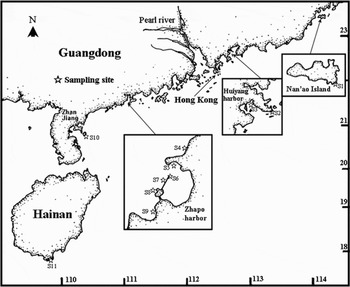
We surveyed 52 sites along the coast of mainland China between March 2001 and June 2005 (Zhu, Reference Zhu2005), and specimens of M. arabica were found at 11 sites in Hainan and Guangdong provinces (Figure 1). Site 1 is located inside the fishing port of Nanao Island. It faces and has good water exchange with the South China Sea. Site 2 (outside of the harbour) and 3 (inside) are located at the Huizhou Port, a large port with heavy cargo and oil traffic. Sites 4–9 are located at Yangjiang-Zapo Fishing Port, one of the 10 largest fishing ports in China. Site 10 is located at Qiongzhou Island Fishing Port, approximately 20 km away from Zhanjiang, a large city. Site 11 is located at Sanya Port, an important port at the southern tip of Hainan province.
Map of south-eastern China showing the sampling sites.

Specimen preparation
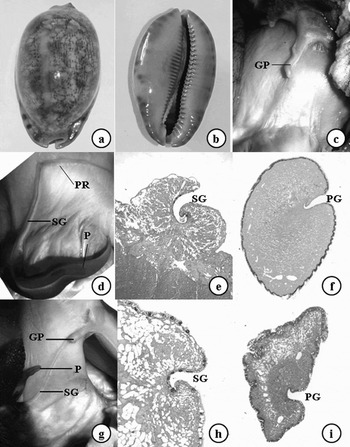
A total of 529 specimens (Figure 2a, b) were collected from rocks during low tide, and shell length was measured with a caliper to the nearest 0.1 mm. The animals were anaesthetized in 7% MgCl2 for 12 hours, the shells were cracked with a small hammer, and the penis length was measured with a caliper to the nearest 0.1 mm. The soft bodies were fixed in 4% formaldehyde and observed with a Carl Zeiss Stemi SV11 dissecting microscope. Specimens were classified into normal male (with testes, a penis, vas deferens and a prostate), normal female (with ovaries, a capsule gland, an albumen gland and a sperm-ingesting gland), and female exhibiting the imposex phenomenon (superimposition of additional male sexual characteristics, i.e. a penis and/or vas deferens). Thirty specimens fixed in formaldehyde were embedded in paraffin and thin-sectioned (5 µm). After being stained with haematoxylin–eosin, the sections were analysed under a Carl Zeiss Axioplan 2 microscope. All photographic work under the microscope was performed with a Carl Zeiss Axiocam and analysed using Axio Vision 3.0. Shell lengths of male and female animals were compared using a Student's t-test with unequal sample sizes.
Mauritia arabica: shell morphology (a, b); genital papilla (GP) of normal female (c, ×6); the prostate (PR), seminal groove (SG), and penis (P) of normal male (d, ×8); transverse histological section of the seminal groove (e, ×100), and penis (f, ×40); imposex affected female showing genital papilla, seminal groove, and penis (g, ×6); and transverse histological section of its seminal groove (h, ×100) and penis (i, ×40).

Imposex classification and indices
Description of imposex was based on the updated scheme proposed by Shi et al. (Reference Shi, Huang, Yu and Zhu2005a, Reference Shi, Huang, Zhu, Yu and Xieb). Briefly, the development of imposex was classified into seven stages (0–6, with S0 as normal female) and six types. Additional indices used include: (1) the average female penis length (FPL) of a sample; (2) the percentage of imposex affected females in a sample (%I); (3) the relative penis length (RPL, [(mean length of female penis)/(mean length of male penis) × 100]) (Bryan et al., Reference Bryan, Burt, Gibbs and Pascoe1993); (4) the relative penis size (RPS, the cubed form of RPL); and (5) the vas deferens sequence index (VDS, the imposex stage average in a sample) (Gibbs et al., Reference Gibbs, Pascoe and Burt1988). It is worth noting that the male genital duct in M. arabica is represented by an open seminal groove, instead of a vas deferens observed in many neogastropods. The majority of imposex species are neogastropods, so the VDS has been widely used in the literature. To facilitate comparison, the VDS was used in this study in lieu of creating a seminal groove sequence index. Values presented were mean ± SD.
RESULTS
The female reproductive system in M. arabica exhibits the morphological and histological structure which is typical for Mauritania-type Cypraeinae (Kay, Reference Kay1960). It includes: ovary, renal oviduct, albumen gland, seminal receptacle, capsule gland, genital papilla and vaginal opening. In the normal female, the ovary spreads over the visceral mass anteriorly from the tip of the spire. The renal oviduct leaves the gonad near the kidney aperture and joins the glandular pallial oviduct which extends over the visceral mass to the right body wall. The renal oviduct opens into the albumen gland, an elongated, bilobed structure which joins the large capsule gland, distinguished by its thick lateral walls. Dorsally, a short duct leads from the albumen gland to the seminal receptacle, a diverticulated sac, which lies over the albumen gland and the posterior portion of the capsule gland. The vaginal opening is at the tip of an elongated genital papilla (Figure 2c). A bursa copulatrix is absent in M. arabica.
The male genitalia consists of, from the proximal to the distal zone: the testis, the seminal vesicle (a coiled proximal portion), the prostate gland (a glandular distal portion), the seminal groove, and the penis (Figure 2d). The prostate is characterized by an elongated tube structure with sperm present in the lumen during the breeding season. Like all species in the subfamily of Cypraeinae, the duct connecting from the prostate to the penis is represented by a deep groove running along a raised muscular ridge (Figure 2e). Similarly, the channel leading up the penis to its tip is also opened (Figure 2f). The penis is slightly flattened dorso-ventrally and extends from the head posterior to the right cephalic tentacle. Length of the penis ranged from 7.5 to 17.0 mm, with an average of 14.38 ± 2.56 mm (N = 226).
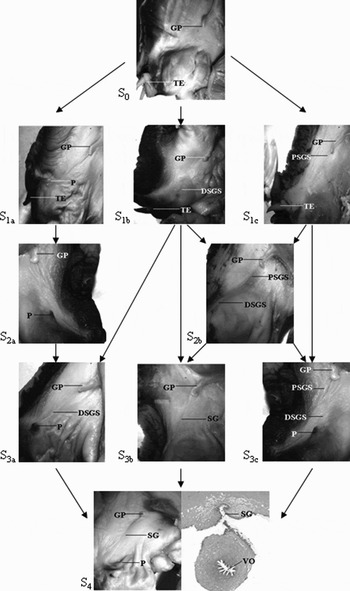
The position, morphology and structure of the penis in imposex affected females (Figure 2g) are similar to those in normal male, but the penis length (5.99 ± 3.68 mm; N = 258) was less than half of that of the normal male. The seminal groove (Figure 2h) and penis groove (Figure 2i) in imposex affected females also resemble that of the normal male but are less pronounced. Mauritia arabica demonstrated all 6 imposex stages with three different types (a, b and c) of expression in stages 1 and 3, two types (a and b) in stage 2, and one type in stages 4, 5 and 6. The stages and types are defined as follows:
Stage 0: Normal female without any male sexual characteristics (Figure 3, S0).
Stage 1: Type a: tiny penis without penis groove behind the right tentacle (Figure 3, S1a); Type b: no penis but a short, distal seminal groove section (DSGS) behind the right tentacle (Figure 3, S1b); Type c: no penis but a short, proximal seminal groove section (PSGS) at the vaginal opening (Figure 3, S1c).
Stage 2: Type a: penis with a penis groove behind the right tentacle (Figure 3, S2a); Type b: appearance of DSGS behind the right tentacle and PSGS at the vaginal opening (Figure 3, S2b).
Stage 3: Type a: small penis continuing in an incomplete distal seminal groove section that is growing out successively towards the vaginal opening (Figure 3, S3a); Type b: seminal groove running continuously from the right tentacle to the vaginal opening (Figure 3, S3b); Type c: penis with a penis groove continuing in a distal portion of seminal groove, and meanwhile a short PSGS portion beginning from the vaginal opening (Figure 3, S3c).
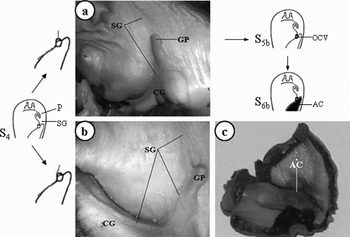
Stage 4: penis with a penis groove and a continuous seminal groove from the penis up to the vaginal opening (Figure 3, S4). The seminal groove joined the genital papilla right beneath (Figure 4a) or connected laterally (Figure 4b) to the vaginal opening without blocking it (Figure 3, S4).
Stage 5: Type b: vaginal opening occluded by proliferating seminal groove tissue, often forming ‘nodules’ (see diagram in Figure 4, S5b, picture is not available).
Stage 6: Type b: in addition to the phenomenon observed for S5b, there were aborted egg capsules present in the oviduct (Figure 4c).
Imposex development scheme in Mauritia arabica (GP, genital papilla; P, penis; TE, tentacle; SG, seminal groove; SGS, seminal groove section; DSGS, distal seminal groove section; PSGS, proximal seminal groove section; VO, vaginal opening).

Imposex development scheme in Mauritia arabica (continued). Seminal groove (red) passes right beneath the genital papilla (a) or connect to genital papilla laterally (b); aborted capsules in S6 (c) (AC, aborted capsules; CG, capsule gland; GP, genital papilla; OCV, occlusion of the vulva; P, penis; SG, seminal groove).

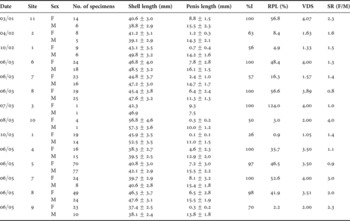
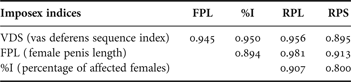
Among the 529 specimens collected, 303 were females and 226 were males. Mean male shell length (42.9±4.87 mm) was similar to that of the female (44.5±5.82 mm) (P > 0.05). Female/male ratio from each sample varied widely from 0.8 to 4.0 (Table 1). Imposex individuals were found in every site sampled, and the %I ranged from 26 to 100%, with lower values being observed at sites 1, 2 and 10 (Table 1). The imposex affected individuals not only varied among locations, but also over time. For example, at site 7, it was 57% in 2003, but reached 100% in 2005 (Table 1). Excluding the data from site 3 (with only one female and one male analysed), the RPL value varied from 0.9 (site 1) to 56.8 (site 11), and the VDS score ranged from 1.05 (site 1) to 4.07 (site 11), with an average of 2.86. There were high correlations among VDS, FPL, %I, and the RPL and RPS (Table 2).
Biometric data of males, normal and imposex affected females of Mauritia arabica.

F, female; M, male; %I, percentage of affected females; RPL, relative penis length; VDS, vas deferens sequence index; SR, sex ratio.
Correlations (r, correlation coefficient) among various imposex indices.
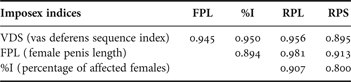
RPL, relative penis length; RPS, relative penis size (the cubed form of RPL).
Note: data from site 3 were excluded for correlation calculation because the small sample size (one male and one female).
DISCUSSION
Mauritia arabica is mainly distributed on the coast of south-eastern China, in rocky or coral reef substrate around the low tide zone. It is a dioecious species with internal fertilization. After copulation, the fertilized eggs develop into embryos inside the female body before being released into the environment where the embryos further develop into veliger larvae in about two weeks. The larvae hatch and spend several months in plankton before attaching to benthic substrate and metamorphosing into juveniles, which then grow into adults in several months (Len, Reference Len1991). Species from the subfamily Cypraeinae are characterized by an open vas deferens (seminal groove) and penis channel (Kay, Reference Kay1960), which is believed to be more primitive than the closed type (Fretter, Reference Fretter1941). Our observations of the male and female genital system in M. arabica confirm the description by Kay (Reference Kay1960). The elongated vagina in female M. arabica may have evolved to compensate for the less efficient sperm transfer via an open seminal groove and penis channel in the male.
Our survey shows that imposex is common in M. arabica along the south-eastern coast of China. Imposex occurred in all sampling sites and on average 85% of the females collected were affected. The position, morphology and structure of the seminal groove and penis of imposex individuals of M. arabica at stage 4 or above are similar to those of the normal males, but not as well developed. This suggests that the male organ development process is the same for both male and imposex affected female (Gibbs, Reference Gibbs1993). However, imposex individuals cannot function as male because their male system is defective, e.g. incomplete seminal groove, lack of prostate and testis. Though all six stages of imposex were found in M. arabica, stage S4 represented the end of imposex development in most sites. In the present study, females at S4 have shown that the seminal groove connects to the pallial oviduct laterally or right beneath it without blocking the vaginal opening, and then continues along the edge of the capsule gland. This suggests that an S4 female will not be sterile. Samples in a more severe stage of imposex (S5 and S6) were only observed at the beginning of our investigation at site 11, which is a large and busy harbour at the southern tip of Hainan province. Due to the lack of image processing equipment when we first initiated this project, pictures of females at S5 captured with a regular digital camera showed poor quality (thus not shown). Subsequent attempts to sample at the same site were hampered by the harbour construction.
Similar to all previous studies, high imposex indices were observed at the major harbours with heavy naval traffic (sites 6, 7 and 11), while low imposex indices were found in the sites with less shipping activities and better water exchange (site 2) or away from coastal areas (sites 1 and 10). Future studies should correlate the imposex severity with the organotins contents in snails' tissues as well as in the water and sediment. Imposex indices varied temporally as well as spatially. In the present study, sites 1, 7, and 8 were sampled twice 1–2 years apart. No amelioration of imposex incidence was found at these sites over time, while increased FPL, %I, RPL, and VDS were found at site 7 in 2005. This was expected because there were no legislative restrictions on the use of the organotin compounds in mainland China.
Among various imposex indices, the VDS is recommended as the most suitable biological parameter for effective monitoring because this index is characterized by the lowest deviation from the calculated concentration-effect-equations and shows no seasonal variations (Stroben et al., Reference Stroben, Oehlmann, Schulte-Oehlmann and Fioroni1996). However, in the present study, high correlations were found among VDS, FPL, %I, RPL, and the RPS. This suggests that any of these could be used as a valid index in M. arabica. It also implies that there is less individual variation (within the same sites) and population variation (among different geographical sites) of female M. arabica response to orgonotins contamination, or their specificity to one particular type of orgonotin compound. This has the additional advantage that this species could be used as a bioindicator for organotin pollution, because a smaller sample size could be used for an accurate estimate, thus also minimizing the effect of sampling on the population. Although the RPS has been considered as an invalid index for Hinia reticulate because of its great seasonal variations (Stroben et al., Reference Stroben, Oehlmann and Fioroni1992), findings with M. arabic (the present study) and Cronia konkanensis (Vishwa kiran & Anil, Reference Vishwa kiran and Anil1999) all showed high correlations between RPL, RPS, and VDS. This discrepancy mainly resulted from the seasonal variation of normal male penis length. For example, in the present study, the male penis length varied little over time with the exception of July 2003 (this data point was excluded from correlation analysis because of the small sample size). The collection of imposex C. konkanensis was confined to April and May (Vishwa kiran & Anil, Reference Vishwa kiran and Anil1999). On the contrary, studies with H. reticulate have shown great seasonal variations of normal male penis length (Stroben et al., Reference Stroben, Oehlmann and Fioroni1992). Thus, whether RPL or RPS is a valid imposex index depends on whether a species exhibits seasonal variation of male penis length. In addition, appropriate imposex indices may vary with species as well (see below). For M. arabica, more research is needed to determine if there is seasonality of male penis length.
Similar to the dog whelk Nucella lapillus in Europe, the rock shell, Thais clavigera is very sensitive to TBT/TPT. It is also widespread and abundant in Asia, thus it has been used as a bioindicator for organotin pollution in the coastal waters of Singapore (Tan, Reference Tan1997), Japan (Horiguchi et al., Reference Horiguchi, Hyeon-Seo, Shiraishi, Shibata, Soma, Morita and Shimizu1998), Korea (Shim et al., Reference Shim, Kahng, Hong, Kim, Kim and Shim2000), Hong Kong (Blackmore, Reference Blackmore2000), Taiwan (Hung et al., Reference Hung, Hsu, Mang and Chuang2001), and mainland China (Yu et al., Reference Yu, Huang, Zhu, Shen and Dong2004). Despite this, studies have reported the unclear and variable development of the vas deferens in females of this species making the use of VDS an inappropriate index (Tan, Reference Tan1997). Instead, most studies use RPL for imposex expression in T. clavigera, which is considered to be inferior to VDS due to its seasonal variation (Oehlmann et al., Reference Oehlmann, Stroben, Schulte-Oehlmann and Bauer1998). In addition, our previous reports have revealed the absence of T. clavigera in many sites, especially those with heavy organotin contamination, possibly indicating a population decline (Zhu, Reference Zhu2005). Mauritia arabica is common and widely distributed along the coast of south-eastern China. The present study has shown that it exhibits imposex development comparable to T. clavigera but may be more tolerant to high organotin concentrations as evidenced by the absence of advanced imposex stages of S5 and S6 in most sites. As indicated above, various indices could be used as valid estimates for imposex expression in this species. In those sites where T. clavigera was absent, the biological effects of organotin pollution could be assessed using M. arabica.
In addition to the attributes and advantages mentioned above, M. arabica is also one of the few large snails that are not consumed by humans in China; therefore its populations are not likely to be over-fished. The species, sex and degree of imposex are relatively easy to identify. It normally inhabits a rocky or coral reef substrate and is easy to collect. Therefore, we propose that M. arabica can be used in conjunction with T. clavigera to provide a more complete organotin pollution bio-monitoring system for south-eastern China. Analysis of multiple species in biomonitoring programmes would result in a broader data base, and may eventually lead to implementation of legislative restrictions on TBT use in China.
ACKNOWLEDGEMENTS
We thank S. Rodenburg for English editing and critical review. This work was supported in part by funding from the ‘5010’ President's Key Research Project from Wenzhou Medical College (XNK06012), and the Wenzhou Medical College Faculty Research Grant Program to Q.D. (QTJ05011).