Introduction
Transmissible spongiform encephalopathies (TSEs) are a group of fatal, infectious, neurodegenerative diseases that afflict a variety of mammalian species (Watts et al. Reference Watts, Balachandran and Westaway2006). Some TSEs include bovine spongiform encephalopathy, transmissible mink encephalopathy, human Creutzfeldt-Jakob disease, sheep scrapie and cervid chronic wasting disease (CWD). Scrapie and CWD are unique among TSEs in that they are laterally transmitted from infected to uninfected hosts, either through direct animal-to-animal contact or following contact with contaminated environments (Detwiler Reference Detwiler2003; Sigurdson Reference Sigurdson2008). The infectious agent responsible for TSEs is referred to as a ‘prion’ and is thought to be composed solely of a misfolded form of the prion protein (PrPTSE), which is derived from a normal, cellular form of the protein (Colby & Prusiner Reference Colby and Prusiner2011). Treatments that inactivate other pathogens are typically ineffective in eliminating TSE infectivity (Taylor Reference Taylor2000). The extreme stability of prions is presumably responsible for allowing scrapie and CWD infectivity to persist in the environment and cause disease in previously healthy animals (Gough & Maddison Reference Gough and Maddison2010). Soil is a likely reservoir of scrapie and CWD infectivity, and understanding natural processes or developing procedures to degrade prions in the environment is critical to our limiting the spread of these diseases (Smith et al. Reference Smith, Booth and Pedersen2011).
In a previous study, we found that acetone extracts of several lichen species were capable of degrading PrPTSE in brain homogenates, as well as purified PrPTSE (Johnson et al. Reference Johnson, Bennett, Biro, Duqu-Velaszuez, Rodriguez, Bessen and Rocke2011). We found activity in extracts from Parmelia sulcata, Cladonia rangiferina and Lobaria pulmonaria, but surprisingly, not in extracts of the closely related species P. squarrosa, C. stellaris and L. oregana or L. quercizans. Using specific inhibitors, a serine protease was found to be responsible for PrPTSE degradation and lichen secondary metabolites, and other enzymes were not effective in degrading the protein. Extracts of isolated lichen photobionts were not found to have any anti-prion protein (PrP) activity, suggesting the lichen mycobionts were responsible for the protease activity (Johnson et al. Reference Johnson, Bennett, Biro, Duqu-Velaszuez, Rodriguez, Bessen and Rocke2011).
In further studies, we have found varying levels of anti-PrP activity in a sampling of lichens from more than 10 genera, suggesting activity is widespread, but not evenly distributed in lichen genera (Rodriguez et al. Reference Rodriguez, Bennett and Johnson2012). Hundreds of proteases are known in fungi (North Reference North1982), and have been found to have roles in pathogenesis, pathogen resistance, protein digestion, nutrition, morphogenesis, reproduction, germination, and more. The broad diversity of species in our previous studies with proteolytic activity capable of PrP degradation led us to investigate the phylogenetic basis of the character.
The genus Cladonia is one of the largest genera of lichens, with c. 450 species worldwide, and about 175 in North America (Ahti & Hammer Reference Ahti, Hammer, Nash, Ryan, Gries and Bungartz2002; Esslinger Reference Esslinger2011). Species of Cladonia typically grow on soil and rotting wood, are found in many different habitats, and are known to produce secondary metabolites with bioactive properties (Thomson Reference Thomson1967). Members of the genus Cladonia grow naturally in areas where scrapie or CWD are endemic, and the soil habitat is of interest due to the potential for scrapie and CWD to persist in soils. Fresh Cladonia material of many species is easy to collect in a small number of localities, facilitating sampling of a large number. In addition, recent phylogenetic studies of the genus based on 73 species (Guo & Kashiwadani Reference Guo and Kashiwadani2004) and 168 species (Stenroos et al. Reference Stenroos, Hyvönen, Myllys, Thell and Ahti2002) have provided data for grouping species based on molecular, morphological and chemical data.
The objectives of our present study were to determine the PrP degradation activities of Cladonia species and then determine the correlations of the activities to known phylogenies. In addition, PrP degradation activity correlations with classical taxonomic characters would also be established. We tested the hypotheses that species with the activity were closely, rather than distantly related, and that activity would be related to classical taxonomic characters which are genetically based. We therefore screened the anti-PrP protease activity in 44 species of one genus to look for the emergence of hereditary patterns.
Materials and Methods
Lichens and extracts
During 2010 we collected specimens of 44 species of Cladonia at localities in Wisconsin, Michigan, Louisiana and New Brunswick, Canada (see Appendix). We were also provided with a fresh collection of C. jaliscana from Mexico by T. Nash, and we included three specimens recently collected from Alaska, deposited in WIS. Specimens were chosen to represent all major phylogenetic groups of the genus. Specimens were cleaned of extraneous material under a dissecting microscope and small pieces of both squamules and podetia were selected for extraction. Not knowing a priori if the agent of activity was localized in the thallus, we sampled the entire lichen thallus. All specimens had been dried after collection and identified before extraction. Species identifications were based on Ahti & Hammer (Reference Ahti, Hammer, Nash, Ryan, Gries and Bungartz2002), Hinds & Hinds (Reference Hinds and Hinds2007), Brodo et al. (Reference Brodo, Sharnoff and Sharnoff2001) and Thomson (Reference Thomson1967) keys. Original specimens are deposited in WIS.
We selected three classical taxonomic characters for tabulating and comparing with anti-prion activity: apothecial colour, presence/absence of a cortex, and presence/absence of usnic acid. These were selected because they are traditionally used in dividing major groups of Cladonia species, and are easily determined both from specimens and the literature.
Dried lichens were then powdered by bead-beating with 2·8 mm ceramic beads (MoBio, Carlsbad, CA). Extracts were produced by suspending lichen powders in acetone at 10% (w/v) and incubating at 37°C for 24 h with vigorous shaking. Following incubation, solid particles were removed by filtration through Whatman filter paper (Grade #1, Piscataway, NJ), and the acetone in the filtrate was evaporated. The remaining residue was resuspended in dimethyl sulfoxide (DMSO) (ThermoFisher Scientific, Rockford, IL) so that each g of lichen powder starting material would yield 1 ml of product. Our testing was based on the weight of the lichen samples, not the residues, so that the results would be relevant to the activities of the individual specimens.
Lichen extract-prion protein reactions
All experiments used brain homogenate derived from clinically-affected CD-1 mice, experimentally inoculated with mouse-passaged RML scrapie agent. Animal work was conducted with the approval of the National Wildlife Health Center Institutional Animal Care and Use Committee (Protocol #EP080716). Brain homogenate was generated by adding brain tissue to a final concentration of 10% (w/v) in deionized H2O and disrupting with a Dounce homogenizer. Degradation of PrP by lichen extracts was assessed by incubating brain homogenate (10 μl; 1 mg brain equivalent) with 10 μl of lichen extract in DMSO (10 mg of lichen equivalent), or DMSO vehicle as a control in a solution of 10 mM sodium acetate pH 5·0 in a total volume of 30 μl. Reactions proceeded for 1 h at 37°C and were halted by the addition of 4× lithium dodecyl sulphate (LDS) sample buffer and 10× NuPAGE reducing agent (Invitrogen, Carlsbad, CA), each to final concentrations of 1×. Samples were then heated at 95°C for 5 min.
NuPAGE and immunoblotting
Samples were subjected to 12% NuPAGE gel electrophoresis using MOPS running buffer and electroblotted to polyvinyl difluoride membranes. Membranes were then immunoblotted using monoclonal antibody SAF83 (1:5000) (Chemicon, Billerica, MA). Immunoreactivity was visualized using an anti-mouse secondary antibody conjugated with horseradish peroxidase (Santa Cruz Biotech, Santa Cruz, CA), Pierce SuperSignal West Pico Chemiluminescent Substrate System (Rockford, IL) and an EC3 imaging system (UVP, Upland, CA). Densitometric measurements were made using UVP VisionWorks®LS software. All immunoblot results were confirmed by at least three independent experimental replicates done in separate reaction tubes.
Data analyses
Species frequencies (i.e. counts) were cross-tabulated by PrP degradation activity and character states and analyzed by log-likelihood significance tests. The resulting Chi-Square probabilities were calculated using JMP version 8 software to test null hypotheses about the frequency distributions in the tables (SAS Institute 2009).
Results
PrP degradation conditions
We tested extracts prepared from 44 Cladonia species for their ability to reduce PrP immunoreactivity in samples of TSE-infected brain homogenate as compared to a control treatment with DMSO alone. Conditions for reactions were previously optimized and were conducted at pH 5·0 (Johnson et al. Reference Johnson, Bennett, Biro, Duqu-Velaszuez, Rodriguez, Bessen and Rocke2011). When reactions were buffered to pH 7·0 with either HEPES or Tris, no degradation was observed for any lichen tested (data not presented). The current pH findings are consistent with our previous work indicating that low pH favours PrP degradation by an extract of the lichen Parmelia sulcata.
Categorizing Cladonia lichens by activity levels
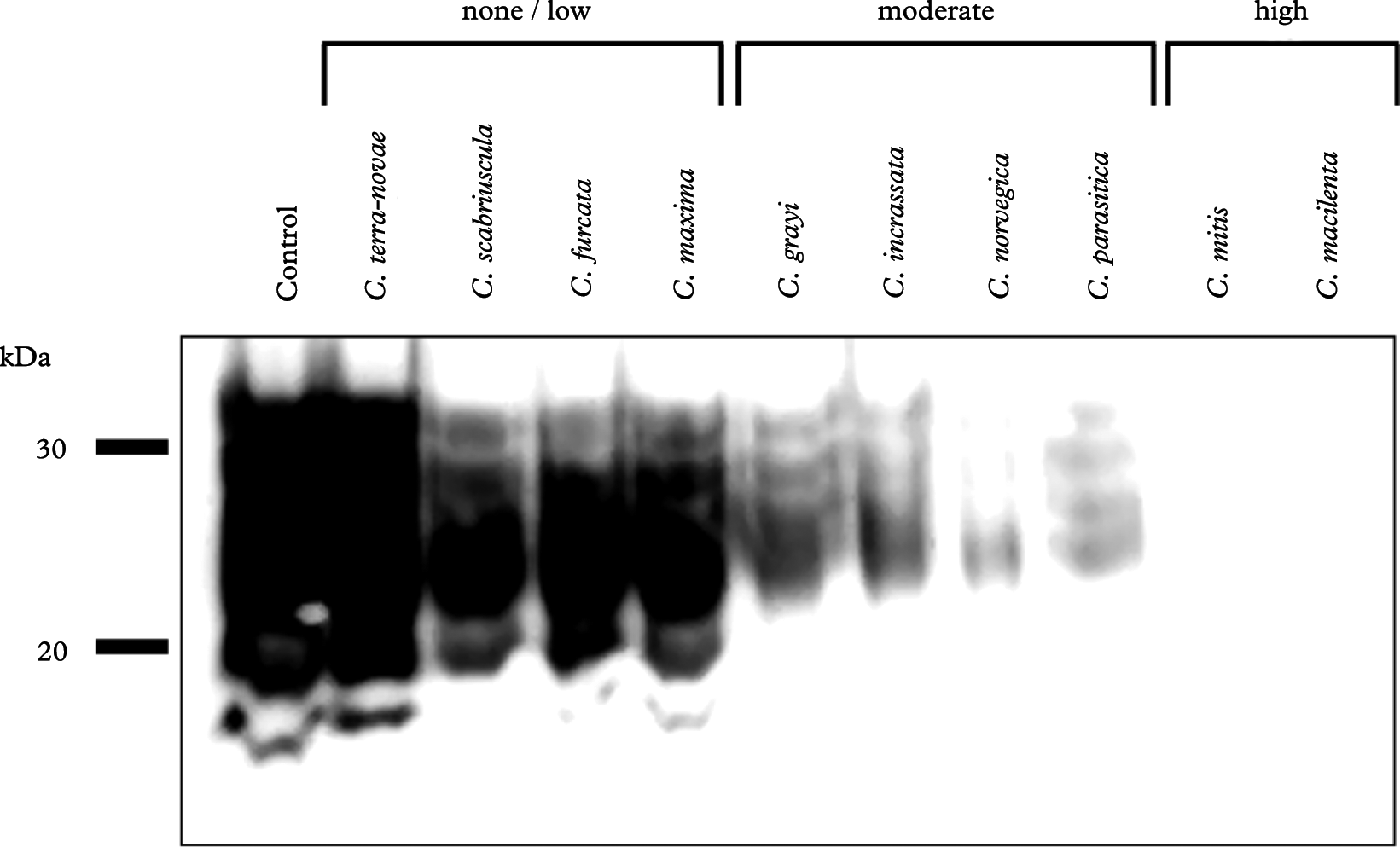
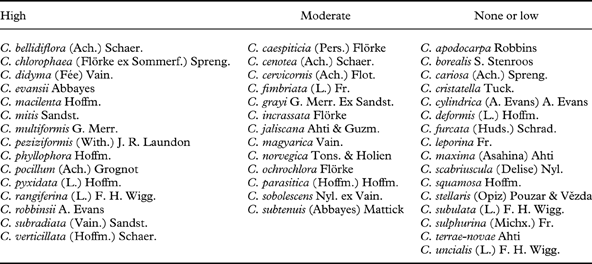
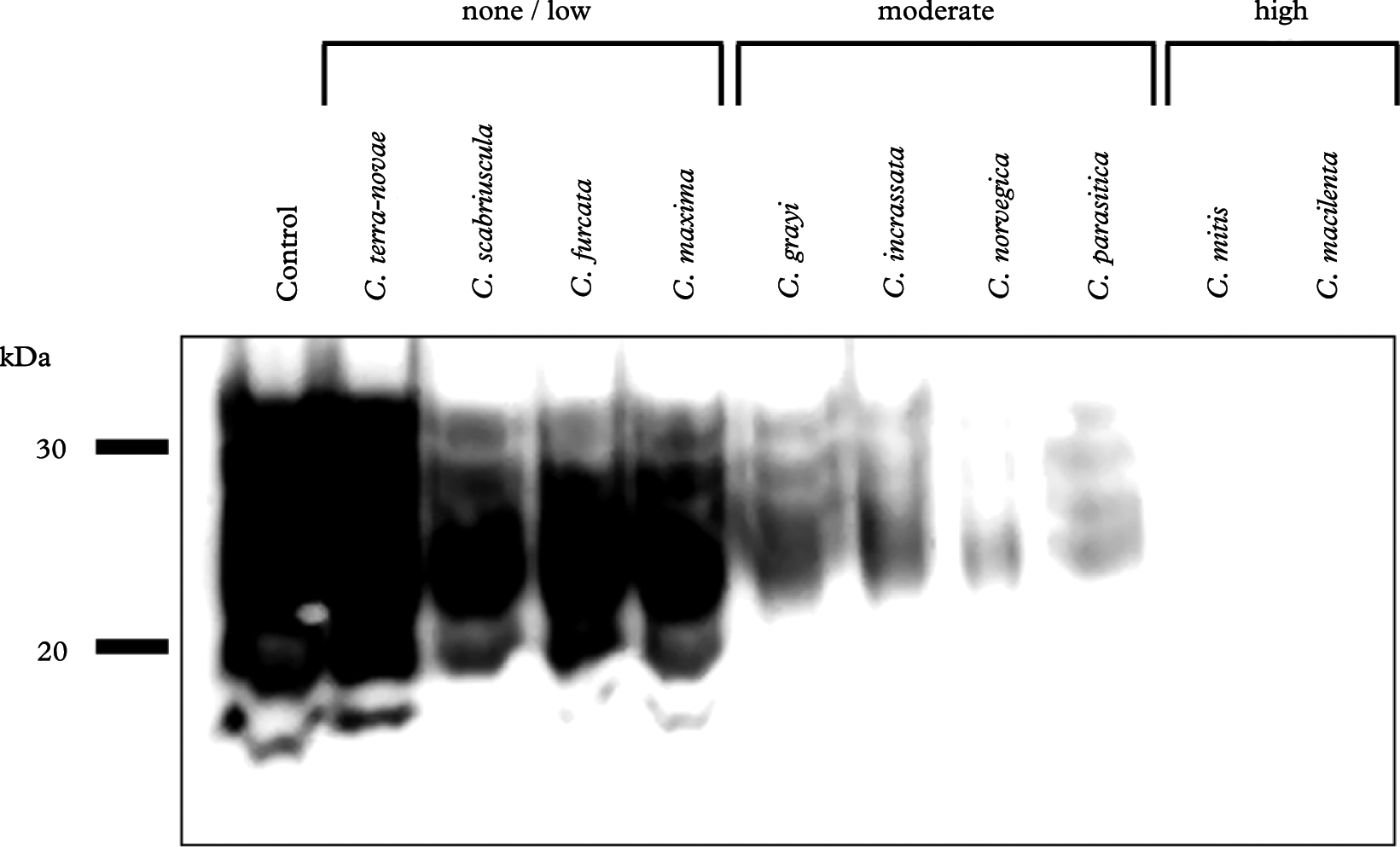
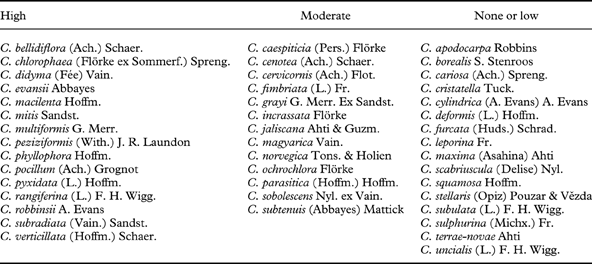
We have previously assigned lichen species to three PrP degradation levels: 1) below the limit of immunoblot detection, 2) some ability to reduce PrP levels, and 3) no activity (Johnson et al. Reference Johnson, Bennett, Biro, Duqu-Velaszuez, Rodriguez, Bessen and Rocke2011; Rodriguez et al. Reference Rodriguez, Bennett and Johnson2012). For our experiments of PrPTSE with Cladonia extracts, we used slightly modified categories for the amount of remaining immunoreactivity present: 1) none/low, indicating a range of no reduction in immunoreactivity to <50% reduction; 2) moderate, indicating >50% reduction in immunoreactivity but some remaining signal; and 3) high, indicating no detectable PrP immunoreactivity remaining. In Fig. 1, we present a representative immunoblot showing 10 species at the various levels of activity used for categorizing the Cladonia lichens in our study. Using the detection method shown in Fig. 1, we grouped the 44 Cladonia species into the three activity categories (Table 1). We found 15 species with high anti-PrP proteolytic activity, 13 with moderate, and 16 with none/low activity.
Immunoblot indicating varying degrees of PrP degradation by different Cladonia species.
Forty four Cladonia species categorized by PrP degradation activity
Comparison of degradation activity with phenotypic characters and ecological factors
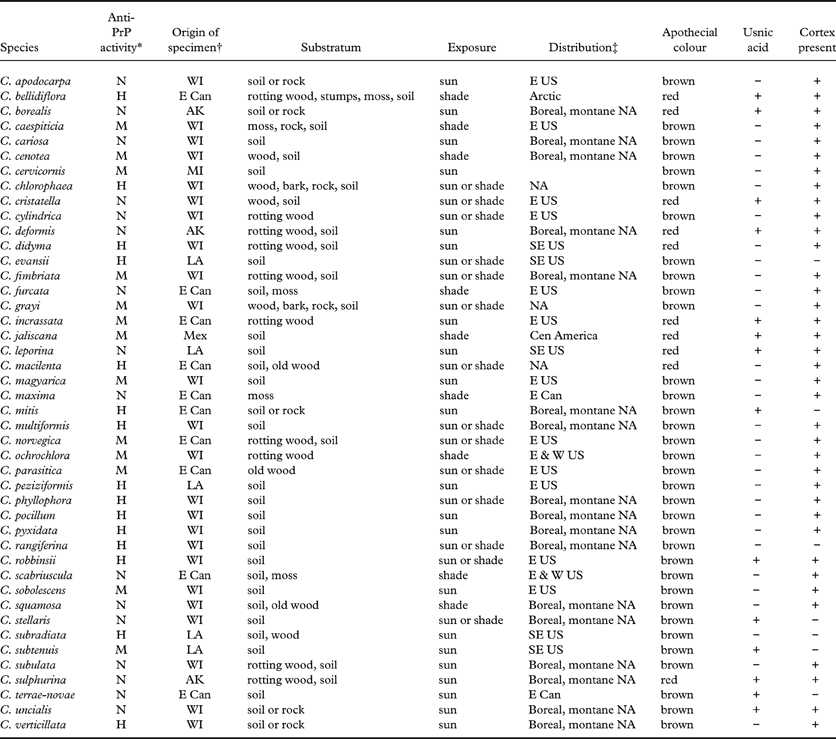
A little over half of our specimens were from Wisconsin, and they were almost evenly divided among the three PrP degradation categories. The remaining specimens from North America were too few to draw conclusions about the effect of specimen origin on PrP degradation activity. Almost 40% of the species are considered boreal or montane species, and these were almost evenly divided between having and not having PrP degradation activity. Our sampled Cladonia species grow mostly on soil and rotting wood, and there was no obvious relationship between substratum and PrP degradation activity. Half of the 44 species grow on soil or rock, while the other half occur mainly on rotting wood. About half of the species studied prefer sunny exposures, while about one fifth prefer shade, and the remainder can tolerate sun or shade. Over half of the sun species have PrP degradation activity, while the shade species were evenly split between having PrP degradation activity and not having it.
Of the 34 species we studied that have brown apothecia, 22 have PrP degradation activity, while 5 of the 10 species with red apothecia have PrP degradation activity. Of the 15 species with high PrP degradation activity, brown fruited species outnumber the red fruited species by 4 to 1. The log-likelihood ratio for this pattern was not statistically significant, probably due to the small sample sizes.
Half of the species studied (22) with PrP degradation activity do not produce usnic acid. Of the 14 species that do produce usnic acid, 6 have PrP degradation activity and 3 have high PrP degradation activity. Species with high PrP degradation activity without usnic acid outnumber those with usnic acid by 4 to 1. The log-likelihood ratio for this pattern of 1·9 resulted in a Chi-square value of 3·8, which had a probability of occurring due to chance of 0·15.
Twenty-two of the 37 species with a cortex on the thallus (based on the literature) have PrP degradation activity, compared with five of the seven without a cortex. Even though the sample sizes of species with and without a cortex are uneven, the ones with PrP degradation activity outnumber those without it by 4 to 1. However, this pattern was not statistically significant due to the small sample sizes.
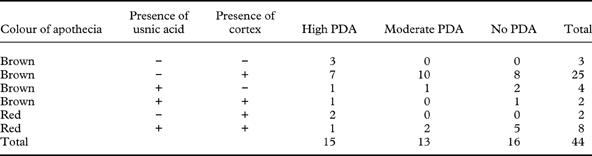
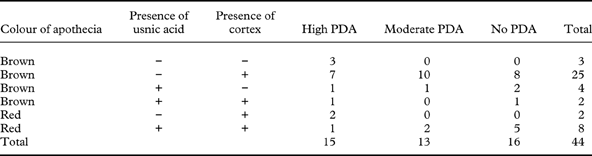
A tabulation of the frequencies of 44 Cladonia species categorized by three taxonomic characters and PrP degradation activity is shown in Table 2. When the latter three characters were combined into one analysis, 17 of the 44 species (39%) with either high or moderate PrP degradation activity have brown apothecia, no usnic acid, and a cortex present, the largest frequency of any combined group of characters. The log-likelihood ratio Chi-square of 16·5 had a probability of 0·087 of this pattern being due to chance.
Frequencies of forty four Cladonia species grouped by taxonomic characters and PrP degradation activity (PDA)
Thirty-seven of the 44 species studied were included in the phylogeny of Stenroos et al. (Reference Stenroos, Hyvönen, Myllys, Thell and Ahti2002), and 30 were included in Guo & Kashiwadani's (Reference Guo and Kashiwadani2004) phylogeny. Of the high PrP degradation activity species, 13 were included in Stenroos et al. and 11 in Guo & Kashiwadani. Of the moderate PDA species, 8 were included in Stenroos et al. and 6 in Guo & Kashiwadani. Of those that had no PDA, 16 were in Stenroos et al. and 13 in Guo & Kashiwadani. In both phylogenies, there was a complete overlap of the three PrP degradation activity categories across the entire tree, and no clustering of the character in any one clade. In some instances, all three PrP degradation activity categories occurred next to one another in the tree, for example C. cylindrica (none), C. grayi (moderate), and C. phyllophora (high) in Stenroos et al (Reference Stenroos, Hyvönen, Myllys, Thell and Ahti2002). No phylogenetic association of the PrP degradation activity character could be detected in either study, nor was any association found when compared with the phylogeny of Lendemer & Hodkinson (Reference Lendemer and Hodkinson2009) for apodetiate Cladonia species.
Selected algal partners of 17 of our 44 species studied were examined phylogenetically by Piercey-Normore & DePriest (Reference Piercey-Normore and DePriest2001). No patterns of association among the three PrP degradation activity categories and the algal clades were evident. As above, pairs of algal species with opposing PrP degradation activities were sometimes paired in the same clade, for example algae from C. grayi and algae from C. robbinsii.
Discussion
The frequencies of the three PrP degradation activity categories are about evenly divided among the 44 species, indicating that the protease involved is either potent in a species, completely absent, or has some degree of potency in between the two. This could mean that there is more than one protease involved and they have different potencies. It could also be interpreted that other factors regulate the protease activity or modulate PrPTSE structure to promote PrP degradation. Nevertheless, a species of Cladonia has about a one third chance of having the protease in a potent form, not at all, or a moderate expression of the activity. However, if the high and moderate categories are merged, then 18/44 Cladonia species surveyed (41%) have some form of PrP degradation activity. If this result were extrapolated to the entire genus, it might suggest that a species of Cladonia has a 2·5:1 chance of having PrP degradation activity of some potency.
Our data do not provide evidence to support the hypothesis that phylogeny determines PrP degradation activity. No patterns of association of the 44 species were found with recently published Cladonia phylogenies. Although our sample of 44 species is about one tenth of the 450 Cladonia species described, they represent important phylogroups in the genus, including four type species at the group or supergroup levels according to a recent phylogenetic study by Stenroos et al. (Reference Stenroos, Hyvönen, Myllys, Thell and Ahti2002), and each of them were categorized in different PrP degradation activities. Cladonia rangiferina (type species for the Cladinae group) has high PrP degradation activity, C. cenotea (type species for the supergroup Perviae) has moderate activity, and C. uncialis and C. subulata (type species for the group Unciales and supergroup Cladonia, respectively) have no activity. No phylogenetic relationships were found with selected photobionts of Cladonia species, suggesting that the protease may be a component of the mycobiont instead. This remains to be determined, however, because some enzymes in lichens are from the mycobiont or photobiont exclusively, and some are found in both bionts (Legaz et al. Reference Legaz, Fontaniella, Millanes and Vicente2004).The concept that the protease is derived from the mycobiont is consistent with our previous data, in which we failed to identify anti-PrP protease activity in extracts of a small group of isolated photobionts (Johnson et al. Reference Johnson, Bennett, Biro, Duqu-Velaszuez, Rodriguez, Bessen and Rocke2011). However, since no relationships were found with the Cladonia species, which are taxonomically the mycobionts, the location of the protease or PrP degradation activity in either symbiont is still an open question.
We attempted to relate PrP degradation activity to three characters that are used in classical Cladonia taxonomy: apothecial colour, presence/absence of usnic acid, and presence/absence of a cortex. The strength of the association of PrP degradation activity with these characters increased in the order apothecial colour, cortex presence, and finally usnic acid presence, but none of these were statistically significantly associated below the 0·10 probability level. When combined into one multivariate cross-tabulation, however, the association had a 0·09 probability of occurring by chance, suggesting that PrP degradation activity is associated with many characters. Cladonia species with brown apothecia, no usnic acid, and a cortex are most likely to have some PrP degradation activity based on this data set. Curiously, C. subulata, which is the type species of the genus (Ahti & Hammer Reference Ahti, Hammer, Nash, Ryan, Gries and Bungartz2002), has these characters but does not have PrP degradation activity.
No associations were found between PrP degradation activity and the geographic origin or habitat of the specimens examined. This suggests that PrP degradation activity is not determined by environmental or geographical factors, at least in this sample of 44 species. We still believe that this should be studied further, however, as some enzymes in lichens, such as urease, are present in some species only in the winter and disappear in the summer (Legaz et al. Reference Legaz, Fontaniella, Millanes and Vicente2004). All of our specimens were collected during warm season months.
Although neither environment nor phylogeny explain the presence of the PrP degradation protease in these 44 species, we remain convinced that there is a genetic basis for it because the property was demonstrated repeatedly with different samples of a given species. We screened many isolates of several species and the activity was always present or absent depending on the species (Rodriguez et al. Reference Rodriguez, Bennett and Johnson2012). For example, over ten C. rangiferina isolates all behaved the same in our tests. Although we do not know the chemical nature of the activity, we believe it is an inherent and species-specific character of certain lichens, not related to secondary compound production.
In conclusion, our hypothesis that closely related species of Cladonia would have PrP degradation activity, and distantly related species would not, was not supported by the results of this study. However, they did indicate that this property is widespread among Cladonia species, probably inherent and probably a characteristic of the mycobiont. As more lichens are surveyed for PrP degrading ability, it may be possible to determine the chemical basis for this property and its mode of action.
This work was funded by the US Geological Survey, Wildlife, Terrestrial and Endangered Resources Program. We thank Dr T. Nash (University of Wisconsin-Madison) for the gift of Cladonia jaliscana and Dr Michele Piercey-Normore (University of Manitoba) for her valuable comments. We also thank two anonymous reviewers and Dr James Lawrey for their reviews and editing. Any use of trade, product, or firm names is for descriptive purposes only and does not imply endorsement by the US Government.
Appendix
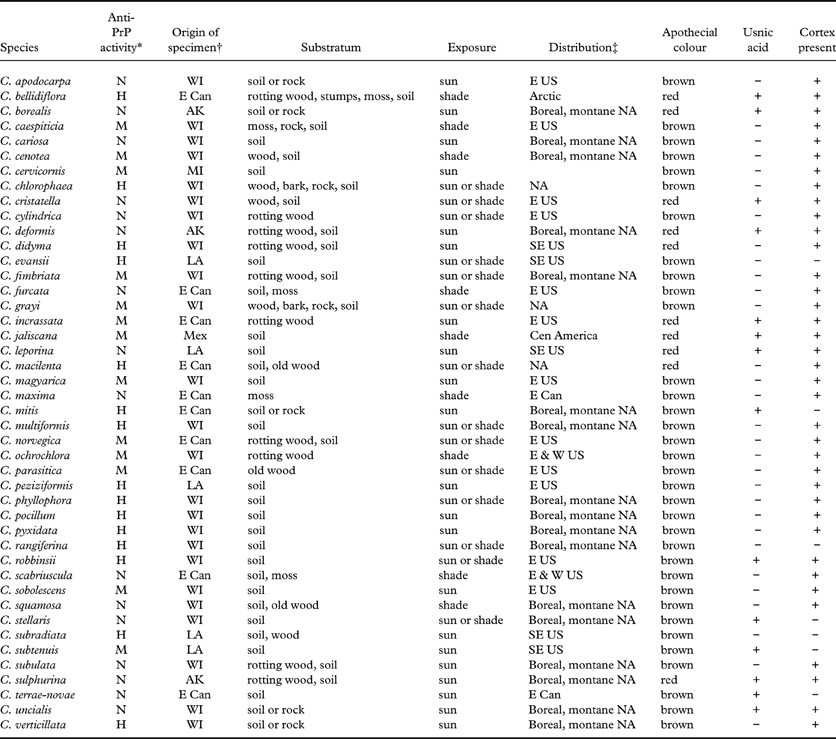
* N=none/low, M=moderate, H=high;
† AK=Alaska, E Can=Eastern Canada, LA=Louisiana, Mex=Mexico, MI=Michigan, WI=Wisconsin;
‡ NA=North America, E, SE are cardinal directions, US=United States, Can=Canada, Cen=Central