Introduction
Inflammatory nasal polyps are benign masses of the paranasal sinuses and nasal cavity characterised by inflammatory cell infiltration, squamous metaplasia of the surface epithelium, thickening of the basement membrane and oedematous stroma.Reference Pawankar1, Reference Pawankar and Nonaka2 Histologically, they can be divided into four different types: eosinophilic oedematous, chronic inflammatory or fibrotic, seromucinous gland, and atypical stromal.Reference Pawankar1 More than 85 per cent of cases demonstrate predominant eosinophilic infiltration.Reference Coffey, Mulligan and Schlosser3
Nasal polyps affect 1–4 per cent of the population. They cause significant morbidity, with nasal obstruction, anosmia and nasal discharge. Patients with nasal polyps can also have co-morbid diseases such as asthma, acetyl salicylic acid hypersensitivity, cystic fibrosis and sinobronchial syndrome.Reference Pawankar and Nonaka2 Although allergy was presumed to be a predisposing factor, recent literature does not support any evidence-based association between allergic rhinitis and nasal polyps development, recurrence or disease severity.Reference Terzakis and Georgalas4, Reference Li, Cheng, Wang and Zhou5 The underlying pathogenesis of nasal polyps has not been fully elucidated; infections, genetic susceptibility, mucociliary dysfunction and vasomotor imbalance have been hypothesised to be the contributing factors.Reference Aversa, Ondolo, Abbadessa, Piccione, Carriero and Fulcheri6, Reference Ozcan, Tamer, Ates and Gorur7 The underlying pathogenesis should be precisely enlightened to pave the way for new therapeutic options.
Some non-immunological factors also aggravate nasal inflammatory reactions, including smells, smoke and environmental pollutants. It is unclear how these trigger factors aggravate the inflammatory response in chronic rhinosinusitis with or without nasal polyps.Reference Coffey, Mulligan and Schlosser3 Neurogenic inflammation is the vicious cycle of neuroimmune reactions that contribute to airway inflammation. Stimulated nasal nociceptive type C fibres are capable of inducing local expression of neuropeptides such as substance P, neurokinin A and calcium gene-related peptide. These neuropeptides in turn cause plasma extravasation, glandular secretion, and activation and differentiation of inflammatory cells, all of which contribute to airway inflammation and nasal hyper-responsiveness.Reference Coffey, Mulligan and Schlosser3, Reference Nockher and Renz8
Neurotrophins are a group of nerve growing factors with homologous targets and effects. Nerve growth factor, brain-derived neurotrophic factor, neurotrophin-3 and neurotrophin-4/5 are members of the neurotrophin family in humans. Their primary function is the growth and differentiation of nervous tissue, but they are also able to stimulate the nociceptive fibres to secrete neuropeptides and contribute to neurogenic inflammation of the nasal tissues.Reference Jornot, Grouzmann, Lacroix and Rochat9, Reference Ismi, Ozcan, Karabacak, Polat, Vayisoglu and Gucluturk10 Nerve growth factor and brain-derived neurotrophic factor expressions have been demonstrated in the nasal mucosa of allergic rhinitis patients.Reference Raap, Fokkens, Bruder, Hoogsteden, Kapp and Braunstahl11 Nerve growth factor has also been shown to be overexpressed in the nasal mucosa of idiopathic rhinitis patients.Reference Gelincik, Aydin, Ozerman, Erguven, Aydın and Bilir12
There have been two published articles investigating the effect of nerve growth factor and brain-derived neurotrophic factor on nasal polyps pathogenesis in the English-language literature.Reference Coffey, Mulligan and Schlosser3, Reference Jornot, Grouzmann, Lacroix and Rochat9 This study aimed to investigate the possible role of neurotrophin-3 on nasal polyps pathogenesis. As the effect of neurotrophin-3 on allergic rhinitis pathogenesis has been presented before, we studied non-allergic nasal polyps patients to exclude the effect of atopy on our study results.Reference Ismi, Ozcan, Karabacak, Polat, Vayisoglu and Gucluturk10
Materials and methods
Local ethical committee approval was obtained for the current study. The study group comprised 70 patients with non-allergic nasal polyps who underwent functional endoscopic sinus surgery. The control group consisted of 53 patients with bulbous or extensive type middle turbinate concha bullosa, who underwent lateral marsupialisation. All procedures were performed under general anaesthesia, from December 2013 to April 2017, in our tertiary centre otorhinolaryngology department.
The diagnosis of nasal polyps was made according to the European position paper on rhinosinusitis and nasal polyps 2012.Reference Fokkens, Lund, Mullol, Bachert, Alobid and Baroody13 Eleven patients in the nasal polyps group had co-morbid asthma according to Global Initiative for Asthma guidelines.Reference Bateman, Hurd, Barnes, Bousquet, Drazen and FitzGerald14 The remaining 59 patients were allocated to the nasal polyps without asthma group. The control group patients had no atopy history or rhinitis symptoms except nasal obstruction. The atopy status of the nasal polyps group was assessed using a skin prick test with a standardised allergen prick test panel (Stallergenes, Antony, France) (Table 1) and serum specific immunoglobulin E (IgE) levels. The nasal polyps patients with positive skin prick test results or high specific IgE levels were excluded to eliminate the effect of atopy on the study results. Topical and systemic steroids were discontinued four weeks prior to surgery. Patients were excluded from the study if they had been diagnosed with any of the following: allergic fungal sinusitis, systemic disorders such as rheumatoid arthritis, diabetes mellitus, hypothyroidism or hyperthyroidism, systemic hypertension and neurological disorders including multiple sclerosis, parkinsonism and epilepsy.
Allergens in skin prick test panel

The demographic characteristics of the study population are summarised in Table 2. The Lund–Mackay staging systemReference Lund and Mackay15 was used to assess the extent of disease in nasal polyps patients.
Demographic characteristics

*n = 70; †n = 53. M = males; F = females; SD = standard deviation
Immunohistochemistry of tissue specimens
All tissue specimens were collected under general anaesthesia during the surgical procedure. Specimens were taken from the ethmoid sinus nasal polyps in the nasal polyps group and from the lateral part of the middle turbinate concha bullosa in the control group.
The nasal polyps biopsy and concha bullosa mucosa specimens were fixed in 10 per cent formalin solution. Sections of 5 µm thickness were obtained from the formalin-fixed, paraffin embedded tissues of all biopsies, and routine haematoxylin and eosin staining was performed. The sections were immunostained for neurotrophin-3 (dilution 1:200; Santa Cruz, Texas, USA) according to the instructions of the manufacturer, as described by Barcena de Arellano et al.Reference Barcena de Arellano, Wagner, Oldeweme, Arnold, Ebert and Schneider16 For the negative control, specimens were processed in the absence of a primary antibody.
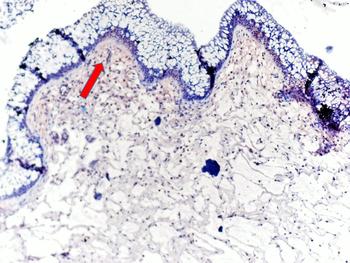
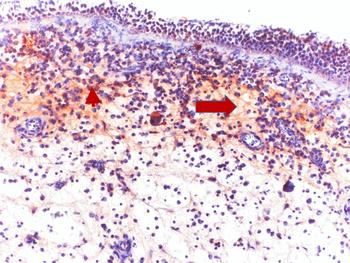
The staining of neurotrophin-3 was observed in the interstitial matrix and the cytoplasm of the inflammatory cells. Briefly, the intensity of immunostaining was analysed. The staining intensity was scored semi-quantitatively in terms of five groups: absent (0), weak (+1), moderate (+2), strong (+3) and very strong (+4), as outlined by Raap et al.Reference Raap, Fokkens, Bruder, Hoogsteden, Kapp and Braunstahl11 The pathologist was unaware of the tissue sample group during immunohistochemical analysis. Weak (+1) and very strong (+4) staining levels in the tissue specimens are shown in Figures 1 and 2, respectively.
Weak (+1) staining with neurotrophin-3 in the interstitial matrix (arrow) of a nasal polyps patient without asthma. (Neurotrophin-3; ×100)

Very strong staining (+4) with neurotrophin-3 in the interstitial matrix (arrow) and the cytoplasm of eosinophils (arrowhead) in a nasal polyps patient without asthma. (Neurotrophin-3; ×200)

Enzyme-linked immunosorbent assay
Blood samples from all subjects were collected by venepuncture in plain tubes, and immediately centrifuged at 4000 g for 10 minutes at 4 °C. The serum samples were stored at −20 °C until analysis. Neurotrophin-3 levels were determined in the DSX four-plate, automated enzyme-linked immunosorbent assay processing system (Dynex Technologies, Chantilly, Virginia, USA), using the Human NT-3 ELISA Kit (YH Biosearch Laboratory, Shanghai, China) according to the manufacturer's instructions. The results are given in units of pg/ml.
Statistical analysis
Statistical analysis was performed using SPSS software, version 23.0 (2015; IBM, Armonk, New York, USA). The chi-square test was used to compare the gender frequencies between groups. The student's t-test was used to analyse age differences between groups. Data were controlled for normal distribution with the Shapiro–Wilk test. The Mann–Whitney U test was used to compare serum neurotrophin-3 levels between groups. Tissue neurotrophin-3 staining intensities were also compared using the Mann–Whitney U test as a non-parametric test. Correlation coefficients were used to assess the relationship between tissue staining scores and Lund–Mackay scores in the nasal polyps group. A p-value of less than 0.05 was regarded as statistically significant.
Results
There were 48 males in the nasal polyps group and 34 males in the control group. The mean age of the nasal polyps group was 32.9 ± 8.58 years; the mean age of the control group was 31.6 ± 5.3 years. There were no statistically significant differences regarding sex (p = 0.607) and age (p = 0.337) between the groups (Table 2).
The mean tissue staining scores of the nasal polyps, nasal polyps without asthma, and control groups were 2.47 ± 0.94, 2.35 ± 0.9 and 1.41 ± 1.33, respectively. The nasal polyps patients and nasal polyps without asthma patients had statistically significant higher tissue neurotrophin-3 staining scores compared to the control group patients (p < 0.001 for both). A comparison of tissue staining scores between the three groups is demonstrated in Figure 3.
Comparison of tissue neurotrophin-3 (NT-3) staining scores between groups. CI = confidence interval; NP = nasal polyps; w/o = without

The mean serum neurotrophin-3 levels of the nasal polyps, nasal polyps without asthma, and control groups were 987.9 ± 1414.2 pg/ml, 943.3 ± 1359.5 pg/ml and 850.15 ± 1305.38 pg/ml, respectively. There was no statistically significant difference between the groups regarding serum neurotrophin-3 levels (Table 3).
Comparison of serum neurotrophin-3 levels between groups

NT-3 = neurotrophin-3; SD = standard deviation; CI = confidence interval
Regarding Pearson correlation coefficients, there was no statistically significant association between tissue neurotrophin-3 staining scores and Lund–Mackay scores in the nasal polyps group (p = 0.792) (Figure 4).
Association of tissue neurotrophin-3 (NT-3) staining scores and Lund–Mackay scores in the nasal polyps group.

Discussion
In the current study, we found that nasal neurotrophin-3 tissue staining scores were higher in the nasal polyps group compared to the control group, regardless of the presence of asthma, but tissue staining intensity had no correlation with the extent of disease.
Regarding pathogenesis, nasal polyps are benign but complex structures. The underlying aetiology is multifactorial, including host factors (genetics, cystic fibrosis, immotile cilia syndrome, anatomical variations) and environmental factors (infections, trauma and chemical irritants).Reference Pawankar and Nonaka2, Reference Ozcan, Tamer, Ates and Gorur7, Reference Ozcan, Zeren, Talas, Kucukoglu and Gorur17 Whatever the initial insult, the cascade of events in the paranasal sinuses and nasal cavity mucosa result in chronic ongoing inflammation.Reference Pawankar1
When the inflammatory profile of nasal polyps is investigated, nasal polyps have eosinophil-dominant inflammatory cells in more than 80–85 per cent of cases. In addition to eosinophils, mast cells, basophils and T helper 2 cells are also present in the inflammatory reactions. The cytokine profile of nasal polyps is characterised by type 2 cytokines, including interleukins (ILs) 4, 5 and 13 as the major cytokines. Interleukin 4 is responsible for B cell activation and IgE synthesis, whereas IL-5 stimulates the survival and development of eosinophils. Interleukins 4 and 13 can upregulate vascular adhesion molecule-1 expression and eosinophil chemotaxis. Eosinophils can secrete tumour growth factor β in the inflammatory reactions. Tumour growth factor β increases the secretion of IL-4.Reference Pawankar1, Reference Dennis, Lam and Luong18 This vicious cycle enhances the autonomy of eosinophils in nasal polyps pathogenesis.
Neurotrophins are homologous proteins regarding their receptor affinities and physiological assignments. They were originally determined by their important roles in the development and differentiation of the nervous system. The prototype of neurotrophins is nerve growth factor. Other members of the neurotrophin family in humans are brain-derived neurotrophic factor, neurotrophin-3 and neurotrophin-4/5. They accomplish their effects by their high-affinity tyrosine kinase receptors and the low-affinity common p75NTR receptor.Reference Nockher and Renz8, Reference Raap and Braunstahl19 In addition to their important physiological effects on neuronal tissues, neurotrophins also participate in the inflammatory reactions of allergic diseases such as allergic rhinitis and asthma.Reference Nockher and Renz8, Reference Ismi, Ozcan, Karabacak, Polat, Vayisoglu and Gucluturk10, Reference Manti, Brown, Perez and Piedimonte20
The source of neurotrophins in the nasal mucosa is airway epithelial and inflammatory cells, including eosinophils, neutrophils and mast cells.Reference Nockher and Renz8, Reference Raap and Braunstahl19 Of these, the main inflammatory cells that produce neurotrophins are eosinophils. Noga et al.Reference Noga, Englmann, Hanf, Grützkau, Seybold and Kunkel21 and Kobayashi et al.Reference Kobayashi, Gleich, Butterfield and Kita22 demonstrated that eosinophils can produce, store and release neurotrophins in cases of inflammatory reactions and immunological stimulation. Wu et al. reported that 62.2 per cent of activated eosinophils showed nerve growth factor expression, compared to 2 per cent of mast cells in nasal mucosa.Reference Wu, Myers, Goldstone, Togias and Sanico23 Nerve growth factor receptors were found to be present in the submucosal glands and surface epithelium, in addition to nerves, in their study. These findings may demonstrate the autocrine and paracrine immunomodulatory effects of this neurotrophin.
Neurotrophins have multiple mechanisms of action in the cascade reactions of inflammation. They can stimulate the nasal nociceptive type C fibres, and lead to the secretion of neuropeptides such as substance P, calcium gene-related peptide and neurokinin A. These tachykinins in turn contribute to the inflammatory reactions of: mast cell degranulation, increased vascular permeability, mucus secretion, cytokine synthesis and eosinophil chemotaxis.Reference Ismi, Ozcan, Karabacak, Polat, Vayisoglu and Gucluturk10 Furthermore, neurotrophins increase the secretion of IL-4 from eosinophils and inhibit their apoptosis.Reference Raap and Braunstahl19
Neurotrophins have been investigated for their effects on inflammation in nasal polyps development. Jornot et al. demonstrated that nasal polyps epithelial cells expressed a higher amount of brain-derived neurotrophic factor compared to turbinate cells, and proinflammatory cytokines increased brain-derived neurotrophic factor expression in cell cultures.Reference Jornot, Grouzmann, Lacroix and Rochat9 The results of Coffey et al. were discordant with this study.Reference Coffey, Mulligan and Schlosser3 They found that the mean sinus tissue brain-derived neurotrophic factor concentration was lower in the nasal polyps group compared to the control group, but the nerve growth factor concentration was significantly higher in the nasal polyps group. The serum concentrations of neurotrophins were not investigated in nasal polyps patients in these studies.
Neurotrophins are regarded as autocrine or paracrine proteins. They act on the surface receptors of the cell from which they are synthesised or from an adjacent cell.Reference Nockher and Renz8, Reference Manti, Brown, Perez and Piedimonte20 Our study results demonstrated that neurotrophin-3 may have a local effect in non-allergic nasal polyps pathogenesis, regardless of asthma co-morbidity, without joining the systemic circulation. These proteins are likely to have multiple routes of action in nasal polyps development. Neurotrophins can inhibit apoptosis and elicit chemotaxis of the eosinophils.Reference Ismi, Ozcan, Karabacak, Polat, Vayisoglu and Gucluturk10, Reference Raap and Braunstahl19 Activated eosinophils represent a major source of new neurotrophin production in the inflammation site, which triggers a repetitive cycle of pathological events and much more neurotrophin production.Reference Manti, Brown, Perez and Piedimonte20
The findings of recent literature and of our study indicate that the relationship between neurotrophins and eosinophilic inflammation can be the underlying cause of high levels of neurotrophins in nasal polyps tissue.Reference Coffey, Mulligan and Schlosser3, Reference Wu, Myers, Goldstone, Togias and Sanico23 Furthermore, neurotrophins can stimulate the synthesis of tachykinins (substance P, neurokinin A, calcium gene-related peptide). These tachykinins have numerous tasks in the inflammation site, such as leukocyte chemotaxis, increased vascular permeability and cytokine synthesis from cells,Reference Ismi, Ozcan, Karabacak, Polat, Vayisoglu and Gucluturk10 all of which are also seen in the inflammatory reactions of nasal polyps development.
• Neurotrophins are neurotrophic factors that have fundamental effects in the nervous system
• Nerve growth factor is the prototype of neurotrophins
• Brain-derived neurotrophic factor, neurotrophin-3 and neurotrophin-4/5 are other members of the neurotrophin family in humans
• These neuropeptides have important roles in allergic inflammation
• Nerve growth factor and brain-derived neurotrophic factor play an active role in nasal polyps pathogenesis
• This study demonstrated that neurotrophin-3 may have a local effect in nasal polyps pathogenesis, without joining systemic circulation
One can expect that if neurotrophins play a role in nasal polyps pathogenesis, substance P, calcium gene-related peptide and neurokinin A should also logically increase in nasal polyps tissue or the nasal secretions of nasal polyps patients with neurotrophins. Recurrent nasal polyps tissue samples expressed large amounts of substance P in the study of Beatrice et al.Reference Beatrice, Aluffi, Bottomicca, Perlasco and Sartoris24 In contrast, Gungor et al. reported that the nasal secretion of nasal polyps patients contained a lower amount of these neuropeptides compared to controls.Reference Gungor, Baroody, Naclerio, White and Corey25 These different results can be explained by the physiological properties of the tachykinins. These neuropeptides are short-lived mediators that are rapidly degraded, so they have time-limited effects in inflammation.Reference Nockher and Renz8 The timing of obtaining the samples can easily affect the study results. In contrast to the abovementioned mediators, neurotrophins are permanently produced in the inflammatory site; hence, they act as long-term modulators during the cascade reactions of inflammation.Reference Nockher and Renz8
A limitation of this study was the lack of identification of the endotypes in nasal polyps patients. Future studies should assess the serum and tissue neurotrophin-3 levels in different inflammatory profile dominant nasal polyps patients.
In conclusion, neurotrophin-3-induced neuronal inflammation may have a local effect in non-allergic nasal polyps pathogenesis. The results of the forthcoming enhanced studies investigating tissue RNA and protein levels may be more supportive for demonstrating the effect of neurotrophin-3 in nasal polyps pathogenesis.
Acknowledgement
This study was funded by Mersin University Academic Research Unit (grant number: 2015-AP2-1341).
Competing interests
None declared