Anxiety disorders are among the most common psychiatric disorders in children (Polanczyk, Salum, Sugaya, Caye, & Rohde, Reference Polanczyk, Salum, Sugaya, Caye and Rohde2015), and early intervention efforts may be of particular importance, as many children develop anxiety symptoms during the preschool years (Egger & Angold, Reference Egger and Angold2006; Paulus, Backes, Sander, Weber, & Gontard, Reference Paulus, Backes, Sander, Weber and Gontard2015). Further, anxiety disorders in young children tend to persist and lead to impairment in a number of areas of functioning (Bufferd, Dougherty, Carlson, Rose, & Klein, Reference Bufferd, Dougherty, Carlson, Rose and Klein2012; Hirshfeld-Becker & Biedermann, Reference Hirshfeld-Becker and Biederman2002; Towe-Goodman, Franz, Copeland, Angold, & Egger, Reference Towe-Goodman, Franz, Copeland, Angold and Egger2014; Wichstrøm, Belsky, & Berg‐Nielsen, Reference Wichstrøm, Belsky and Berg‐Nielsen2013). Despite the relatively high prevalence, persistence, and level of impairment associated with anxiety in young children, surprisingly few studies have focused on anxiety in this population.
Cognitive-behavioural therapy (CBT) has been identified as the gold standard of child and adolescent anxiety treatment (Barrett, Lowry-Webster, & Turner, Reference Barrett, Lowry-Webster and Turner2000; James, Soler, & Weatherall, Reference James, Soler and Weatherall2009; Kendall, Reference Kendall1990, Reference Kendall1994). Although these treatments have been well established in school-aged children, relatively few studies have focused on the treatment of anxiety in preschool-aged children. Recently, Hirshfeld-Becker et al. (Reference Hirshfeld-Becker, Masek, Henin, Blakely, Pollock-Wurman, McQuade and Biederman2010) examined the effectiveness of a CBT program for 4- to 7-year-old children diagnosed with an anxiety disorder. The intervention included direct parent- and child-based intervention, and significant clinical improvements were found from pre- to immediate postintervention. In a second study, Donovan and March (Reference Donovan and March2014) examined the efficacy of an online CBT program to treat anxiety in preschool children. This parent-based intervention also yielded positive results. Finally, Monga, Rosenbloom, Tanha, Owens, and Young (Reference Monga, Rosenbloom, Tanha, Owens and Young2015) compared the effectiveness of a parent-only treatment to a combined parent- and child-treatment condition. Although treatment gains were found in both groups, the parent-child treatment group exhibited greater gains at immediate postintervention and follow-up. The findings from Monga et al. highlight the importance of child-based intervention in this age group.
Overall, although results from initial trials are promising, more research is needed to assess the effectiveness of CBT for anxiety disorders in preschool-aged children. One possible treatment option is the Fun FRIENDS program, which was developed as a downward extension of the FRIENDS for Life program for 4- to 7-year-old children (Barrett, Reference Barrett2007a, Reference Barrett2007b). Five areas of social and emotional learning are addressed during the program: (1) developing a sense of self, (2) social skills, (3) self-regulation, (4) responsibility for others, and (5) prosocial behavior. Further, this program was designed so that it can be delivered across the prevention-treatment spectrum, ranging from universal prevention intervention to treatment for children diagnosed with anxiety disorders.
A number of differences between the Fun FRIENDS program and the above-mentioned preschool anxiety CBT programs are noteworthy. First, clinical interventions for anxiety in young children focus primarily on strategies to reduce current symptomology. In contrast, the Fun FRIENDS program has a dual focus on reducing current symptomology and promoting protective factors in order to prevent the onset and progression of future psychopathology, including the promotion of resilience and wellbeing. Second, although the program does include two parent sessions, a unique component of the program is that it is primarily a child-based intervention. Further, the Fun FRIENDS program was designed for dissemination and widespread use (Barrett, Reference Barrett2007a).
Two published studies have examined the effectiveness of Fun FRIENDS as a universal prevention intervention. Consistent with the concept of universal prevention, both of these studies included children, regardless of risk status. In the first study, Pahl and Barrett (Reference Pahl and Barrett2010) evaluated the efficacy of the Fun FRIENDS program in 263 preschool children. The program, implemented by teachers trained to administer the program, was conducted in nine preschools across Brisbane, Australia. While the study showed no significant differences between the intervention group and waitlist condition at immediate postintervention, the intervention group demonstrated significant improvements in anxiety symptomology, behavioural inhibition, and socio-emotional competence at 12-month follow-up. Non-significant findings at immediate postintervention may be explained by the observation that universal programs (programs administered to individuals regardless of risk status) often yield small effect sizes at immediate postintervention (Neil & Christensen, Reference Neil and Christensen2009). In particular, many participants in universal programs exhibit minimal symptomology at the onset of the study, and long-term follow-up may be needed to assess the ability of a program to prevent the gradual emergence of symptoms in some participants over time (Gillham, Shatté, & Reivich, Reference Gillham, Shatté and Reivich2001).
More recently, Anticich, Barrett, Silverman, Lacherez, and Gillies (Reference Anticich, Barrett, Silverman, Lacherez and Gillies2013) completed a randomised trial with 488 preschool-aged children. Participants in the Fun FRIENDS group exhibited significantly greater improvements in behavioural inhibition, behavioural difficulties, and socio-emotional competence relative to comparison groups at immediate postintervention and at 12-month intervention.
Overall, despite promising results of the Fun FRIENDS program, the two trials to date were universal interventions in school settings, and the effectiveness as a treatment in a community setting has yet to be examined.
The purpose of the current study was to examine the effectiveness of the Fun FRIENDS program as a CBT treatment for preschool-aged children diagnosed with an anxiety disorder. It was hypothesised that, based on the results of an open trial, children would demonstrate improvement in measures of child anxiety, shyness, and resilience. Exploratory analyses were also planned, including examination of the predictors of treatment outcome and the impact of the program on parental functioning.
Method
Participants
Families enrolling in the Fun FRIENDS program at a community clinic were approached to participate in the study. In order to be included in the study, children were required to be between the ages of 4 and 7 and were required to meet criteria for at least one anxiety disorder, based on a semistructured clinical interview. Utilising this inclusion criteria, a total of 31 children and their parents were recruited and agreed to participate. An additional 18 children were treated at the clinic but not included in the trial as they did not meet diagnostic criteria for an anxiety disorder. The mean age of the participants in the program was 5.68 (SD = 0.54), and the group comprised of 12 females and 19 males. The age range of participants was 5–7 years. Participation was voluntary, and the study was conducted in accordance with ethical standards for human subject's research in Australia.
Measures
In addition to a demographics questionnaire, a semi-structured diagnostic interview and a number of self-report measures to assess parent and child functioning were completed by parents at three different time points (preintervention, immediate postintervention, and 12-month follow-up). These measures are listed below.
Measures Child Functioning
Anxiety Disorders Interview Schedule for Children (ADIS-C)
The ADIS-C (Silverman & Nelles, Reference Silverman and Nelles1988) is a semi-structured diagnostic interview designed to assess the presence of an anxiety disorder or other internalising disorder based on DSM-IV-TR criteria. The ADIS-C has been found to possess strong interrater reliability regarding determination of principal diagnosis (α = 0.92) and individual anxiety disorders (α = 0.8–1.0; Lyneham, Abbott, & Rapee, Reference Lyneham, Abbott and Rapee2007). The ADIS-C interviews were conducted with the parents by trained clinical psychologists or masters’ level clinicians via telephone. In order to reduce experimenter bias, participant pre- and postintervention interviews were not conducted by the same interviewer.
The Preschool Anxiety Scale (PAS)
The PAS is a 34-item parent-rating scale assessing childhood anxiety symptoms in younger children (Spence, Rapee, McDonald, & Ingram, Reference Spence, Rapee, McDonald and Ingram2001). The PAS is a modified version of the Spence Children's Anxiety Scale (Spence, Reference Spence1997). A total score calculated from the PAS, along with five subscale scores (separation anxiety, physical injury fears, social anxiety, obsessive compulsive disorder, and generalised anxiety). The PAS also includes six items to assess trauma and posttraumatic stress symptomology, which are not included in the total score. The PAS is scored on a continuous scale, and higher scores are indicative of higher levels of anxiety-related symptoms. Psychometric studies have demonstrated support for the five factor model of preschool anxiety, and the instrument has demonstrated strong correlations with other measures of internalising problems (Spence et al., Reference Spence, Rapee, McDonald and Ingram2001).
The Behavioral Inhibition Questionnaire (BIQ)
The BIQ is a parent-report instrument measuring behavioural inhibition in their children (BI; Bishop, Spence, & McDonald, Reference Bishop, Spence and McDonald2003). The BIQ has been found to possess strong internal consistency (α = .96 for parent report and teacher report) and strong convergent validity with the Preschool Age Psychiatric Assessment — Behavioral Inhibition subscale and the Children's Behavior Questionnaire — Shyness subscale (Kim et al., Reference Kim, Klein, Olino, Dyson, Dugherty and Durbin2011).
Behavioral and Emotional Rating Scale (BERS)
The BERS is a parent-report measure designed to assess children's emotional and behavioural strengths (Epstein & Sharma, Reference Epstein and Sharma1998). The 52-item instrument evaluates the five domains of functioning, including interpersonal strength, family involvement, intrapersonal strength, school functioning, and affective strength. The BERS has been found to have excellent interrater reliability (r > .83) and moderate-to-excellent test–retest reliability ranging from .53 to .99 (Epstein, Harniss, Ryser, & Pearson, Reference Epstein, Harniss, Ryser and Pearson1999).
The Strengths and Difficulties Questionnaire (SDQ)
The SDQ is a brief screening measure that assesses behavioural difficulties and competencies in children aged 3–16 years (Goodman, Reference Goodman1997). The instrument evaluates attributes across the five domains of emotional difficulties (conduct problems, hyperactivity/inattention, peer relationship problems, and prosocial behavior). The SDQ has been shown to possess good specificity and moderate sensitivity in identifying psychiatric diagnoses for both community and clinical populations (Goodman, Ford, Simmons, Gatward, & Meltzer, Reference Goodman, Ford, Simmons, Gatward and Meltzer2000; Goodman, Renfrew, & Mullick, Reference Goodman, Renfrew and Mullick2000).
Measures of Parent Functioning
The Hospital Anxiety and Depression Scale (HADS)
The HADS is a 14-item measure assessing symptomology related to anxiety and depression over the previous week (Zigmond & Snaith, Reference Zigmond and Snaith1983). Originally developed as a brief screening measure for physicians, the instrument assesses items related to depression (predominantly experiences of anhedonia) and generalised anxiety (Snaith, Reference Snaith2003). The HADS has demonstrated good internal consistency and has been found to be a robust measure across both clinical and community samples (Mykletun, Stordal, & Dahl, Reference Mykletun, Stordal and Dahl2001).
The Parenting Stress Index-Short Form (PSI-SF)
The PSI-SF (Abidin, Reference Abidin1995) is comprised of 36 items and is designed to assess levels of stress within the parent–child relationship. The measure consists of the three subscales of parental distress, parent–child dysfunctional interaction, and difficult child. The PSI-SF has demonstrated high internal consistency as well as construct validity with other measures related to parental stress (Reitman, Currier, & Stickle, Reference Reitman, Currier and Stickle2002).
Procedure
Once enrolled in the study, parents were asked to complete the above-mentioned measures at preintervention, immediate postintervention, and at 12-month follow-up. The Fun FRIENDS program was implemented by three clinical psychologists at a community health clinic. Following completion of the intervention, parents were provided with a psychological report presenting results from pre and post responses on the ADIS-C. At the 12-month follow-up, parents were offered a free booster session with a clinical psychologist to discuss any progress or difficulties they had experienced. The program took place over a time period of approximately 2.5 months.
Intervention
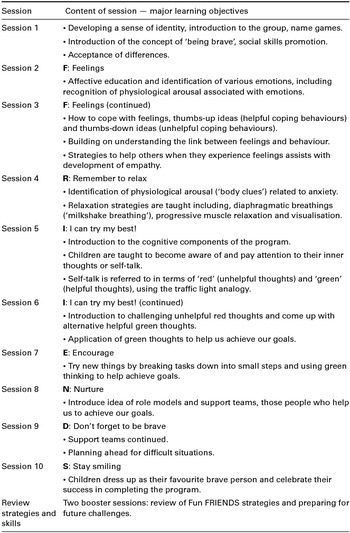
The Fun FRIENDS program (Barrett, Reference Barrett2007a, Reference Barrett2007b) was conducted over 10 weekly sessions. Utilising play-based activities, skills were delivered via developmentally appropriate methods over the 1½-hour sessions. In the final 20 minutes of each session, clinicians met separately with parents to discuss skills introduced during the session, appropriate reinforcement at home, as well as answer any questions. Each group was led by one facilitator, and sessions were conducted as outlined in the Fun FRIENDS Group Leader Manual (Barrett, Reference Barrett2007a). The sessions were delivered in groups of eight to twelve children. Furthermore, parents were encouraged to attend two information sessions outlining the program and providing skills to enhance positive development and reinforce skills taught at home. Each family was provided with the Family Learning Adventure Workbook (Barrett, Reference Barrett2007b) containing session-by-session activities. An overview of the interactive group-based activities is provided in Table 1.
Outline of the Fun FRIENDS Session Content

Results
Child Anxiety and Shyness
A repeated measures t test was conducted to assess for changes in PAS-total scores from pre- to immediate postintervention, and a significant decrease in PAS scores was observed, t(29)= 5.14, p < .01, indicating lower levels of anxiety following intervention. Due to attrition, a smaller sample size was available at 12-month follow-up and, as a result, a separate analysis was conducted to examine change in PAS total scores from preintervention to 12-month follow-up. Based on this analysis, gains were maintained at 12-month follow-up, t(11) = 4.08, p < .001.
Data from the ADIS were examined as a measure of the presence of anxiety disorder diagnoses from pre- to immediate postintervention. The mean number of diagnoses decreased significantly from preintervention, t(29) = 3.80, p < .01; and again, based on available follow-up data, the effect remained significant from preintervention to 12-month follow-up, t(15) = 5.96, p < .001.
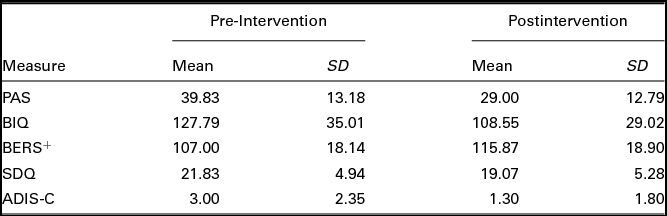
Finally, scores on the BIQ were examined to assess changes in shyness/inhibition over time. Scores on the BIQ also decreased significantly from pre- to immediate postintervention, t(28)= 423, p < .001, and the results were maintained at 12-month follow-up, t(13)= 4.54, p < .01 (see Table 2 for group means). Scores are provided in Table 2.
Means and Standard Deviations for Outcome Variables
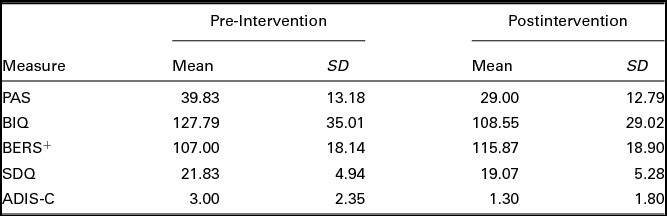
Note: PAS = total scores on the Preschool Anxiety Scale; BIQ = total scores on the Behavioral Inhibition Scale; BERS = Behavioral and Emotional Rating Scale; SDQ = Strengths and Difficulties Questionnaire; ADIS-C = Anxiety Disorder Interview Schedule for Children (value denotes average number of anxiety disorder diagnoses). +Higher scores indicate improved functioning.
Measures of Child Resiliency
Potential changes in levels of resiliency were assessed with the BERS and SDQ. Based on an independent samples t test, BERS scores significantly improved from pre- to immediate postintervention, t(29)= 4.45, p < .001. Although not significant, scores from pre- to 12-month-follow-up approached significance, t(13) = 1.92, p = .07. Scores on the SDQ also improved from pre- to postintervention, t(29) = 3.74, p < .01. Results were maintained at 12-month follow-up, t(13) = 2.88, p < .05. Means are provided in Table 2.
Predictors of Treatment Outcome
Demographic variables
Demographic variables, including child gender, child age, and family income were examined as potential predictors of treatment outcome at immediate postintervention. In particular, a multiple regression analysis was conducted and each of the predictor variables were entered simultaneously, and the PAS-total was the designated criterion variable. The model was not significant, R 2 = .047, F(3,26) = .43, p = .73, indicating that child gender, age, and family income were not associated with treatment outcome at postintervention.
Parent functioning
A series of hierarchical regression analyses were conducted to examine the degree to which measures of parent functioning at preintervention predicted level of child anxiety at immediate postintervention, after controlling for preintervention levels of child anxiety. More specifically, separate regression analyses were conducted for mothers and fathers, and the PAS-total was the designated criterion variable. Preintervention scores of the PAS were entered as the predictor variable in the first step of the equation as a covariate, and parent HADS Depression, HADS-Anxiety, and PSI scores were entered in the second step of the equation. Regarding maternal functioning, the second step did not lead to significant improvement in the model, ∆R 2 = .05, F(3, 25) = .65, p = .59, indicating that maternal depression, anxiety, and stress related to the mother–child relationship at preintervention were not predictors of treatment outcome. Regarding paternal functioning, the second step did not lead to significant improvement in the model, ∆R 2 = .02, F(3, 19) = .27, p = .84, indicating that paternal depression, anxiety, and stress related to the father–child relationship at preintervention did not predict treatment outcome.
The above procedures were repeated to assess the degree to which parent functioning was associated with potential improvements in child resiliency. In particular, the designated criterion variable was the BERS-total at immediate postintervention. Preintervention BERS total scores were entered in the first step of the equation as a covariate, and the HADS-Depression, HADS-Anxiety and PSI-total scales were entered in the second step of the regression equation. Regarding mother functioning, the addition of mother HADS and PSI scores did not lead to significant improvement in the model, ∆R 2 = .046, F(3,25) = 01.44, p = .25. The analysis was repeated with father HADS and PSI scores entered in the second step of the regression equation. Again, the addition of second step did not lead to significant improvement in the model, ∆R 2 = .063, F(3,19) = 2.39, p = .11.
Child anxiety at preintervention
Anxiety severity was examined as a potential predictor of treatment outcome. In particular, an independent samples t test was conducted to determine if children in the intervention condition with higher levels of anxiety exhibited greater decreases in anxiety from pre- to postintervention, when compared to children with lower levels of anxiety. First, a median split on the PAS was conducted to classify children as either high or low anxiety. Next, change scores were calculated by subtracting PAS total scores at preintervention from PAS total scores at immediate postintervention. A significant difference was found for change scores in the high when compared to the low anxiety groups, t(28) = -2.09, p < .05. In particular, the higher anxiety group exhibited a greater reduction in PAS scores from pre- to postintervention, with mean change from pre- to postintervention of 15 points (SD = 12.30) when compared to the change exhibited by lower anxiety group, with a mean change of 6.67 points (SD = .37). These findings suggest that the intervention was particularly beneficial for children with more severe anxiety.
The above analysis was repeated to determine whether level of anxiety predicted the magnitude of change in resilience from pre- to postintervention, as measured by the BERS. The differences in the magnitude of change scores was not significant, t(44) = 1.74, p = .09, suggesting participants in the intervention group experienced equal improvements in resilience regardless of level of resilience at baseline.
Discussion
The purpose of this study was to evaluate the effectiveness of the Fun FRIENDS program in the treatment of clinically anxious preschool-aged children. It was hypothesised that significant decreases in child anxiety symptoms and shyness and improvements in resilience would be observed following the completion of the intervention. This hypothesis was supported, as significant decreases in anxiety and shyness were reported from pre- to immediate postintervention. In addition, a significant decrease in the number of anxiety disorder diagnoses, as measured by the ADIS-C, was reported from pre- to immediate postintervention. Further, improvements were found in children's resiliency from pre- to immediate postintervention, as measured by the BERS and SDQ. Attrition led to limitations on the conclusions that can be made about the efficacy of the program at 12-month follow-up; however, based on the available data, gains were maintained over this time interval. Finally, based on an examination of predictors of treatment outcome, the program was found to be particularly beneficial to children with higher levels of anxiety.
It is noteworthy that these findings add to a surprisingly relatively small number of studies focused on the treatment of anxiety disorders in young children (Donovan & March, Reference Donovan and March2014; Hirshfeld-Becker et al., Reference Hirshfeld-Becker, Masek, Henin, Blakely, Rettew, Dufton and Biederman2008; Monga et al., Reference Monga, Rosenbloom, Tanha, Owens and Young2015). In addition to adding to a relatively small body of research, the findings from this study provide a number of unique contributions to the research literature. More specifically, in addition to the focus on the reduction of current anxiety symptomology, the Fun FRIENDS program is unique because it also focuses on the promotion of protective factors, including resilience and wellbeing. This is relevant, as resilience and general wellbeing may be key factors to improving mental health trajectories and maximising the effects of intervention over longer periods of time (Barrett, Cooper, & Teoh, Reference Barrett, Cooper and Teoh2014). Further, this program is unique as the first program to be primarily a child-based intervention, and although more research is needed, it appears that direct intervention with children may be an effective strategy for the reduction of anxiety in anxious preschool-aged children. Finally, another noteworthy advantage of this program is the availability for dissemination (Barrett, Reference Barrett2007a).
The results of the current study also add to the evidence for the effectiveness of the Fun FRIENDS program across the prevention-treatment spectrum. In particular, the first two published studies focused on the potential effectiveness of the Fun FRIENDS program as a school-based, universal prevention intervention, meaning that the program was provided to young children regardless of risk status (Anticich et al., Reference Anticich, Barrett, Silverman, Lacherez and Gillies2013; Pahl & Barrett, Reference Pahl and Barrett2010), while the current study is the first to examine the efficacy of this program as a treatment for clinically anxious children in a clinical setting.
Despite the strengths and unique contributions of this study, a number of limitations and directions for future research are noteworthy. First, the absence of a comparison group leads to some limitations in the interpretation of the results. In particular, regarding pretest–posttest design, certain threats to validity cannot be completely ruled out, including statistical regression (Shadish, Cook, & Campbell, Reference Shadish, Cook and Campbell2002). Consequently, although the results of the current study are promising, follow-up studies with comparison groups are needed. In addition, the study relied primarily on parent report. Although practical limitations provide challenges to the inclusion of other measures of treatment outcome in community mental health settings, it is recommended that future studies include other strategies to assess treatment outcome, including child-report, teacher-report, and observational report. Additionally, this study would have been improved with the utilisation of measures of treatment fidelity and social validity, as inclusion of these measures in future studies will ensure consistency and accurate adherence to program structure and acceptance of the program. With this said, it is noted that the Fun FRIENDS program is a manualised program requiring facilitators to complete a one-day training prior to conducting the program, and all facilitators were highly trained clinical psychologists. Consequently, the intervention was unlikely to deviate greatly from the intended structure.
It is also recommended that future research include a larger sample, which may allow for a more stable assessment of moderators of treatment outcome. Finally, both parent-based and child-based interventions have been utilised to treat anxiety in preschool-aged children, and it is recommended that follow-up studies are conducted to examine the most effective combination of these interventions. Overall, despite the above-mentioned limitations, the results of this study provide a promising direction for the treatment of anxiety in young children.
Acknowledgments
The authors would like to first and foremost thank all of the families who gave their time and support to complete all of the research questionnaires and processes.
Declaration of Interest
The first author is the program developer for the FRIENDS protocols, including the Fun FRIENDS program. To manage this conflict, the first author was included only in supporting the study design process and throughout the writing and editing procedures. All collection and analysis of data, as well as delivery of the intervention, were conducted by the remaining authors and research staff.