Introduction
Chronic kidney disease (CKD) is a common and debilitating illness. The Centers for Disease Control and Prevention reported that the prevalence of CKD in the U.S. population aged 20 and older has increased between 1988 and 1994 and 1999 and 2004 from 14.5% to 16.8% (CDC, 2007; Coresh, Astor, Greene, Eknoyan, & Levey, Reference Coresh, Astor, Greene, Eknoyan and Levey2003), and in Latin America, the prevalence rate of patients with renal replacement therapies (dialysis or renal transplants) increased from 119 to 352 patients per million between the years of 1991 and 2001 (Cusumano et al., Reference Cusumano, Di Gioia, Hermida and Lavorato2005). In addition to the physical limitations associated with CKD, investigations have suggested that it also impacts neurocognitive function (Kurella, Chertow, Luan, & Yaffe, Reference Kurella, Chertow, Luan and Yaffe2004; Kutlay et al., Reference Kutlay, Nergizoglu, Duman, Atli, Keven, Ertrük and Karaton2001).
Research suggests that CKD results in substantial impairment in many neurocognitive domains including attention, processing speed (Jassal, Roscoe, LeBlanc, Devins, & Rourke, Reference Jassal, Roscoe, LeBlanc, Devins and Rourke2008; Lass, Buscombe, & Harber, Reference Lass, Buscombe and Harber1999; Pliskin, Yurk, Ho, & Umans, Reference Pliskin, Yurk, Ho and Umans1996), executive functions (Kurella et al., Reference Kurella, Chertow, Luan and Yaffe2004), motor function (Pliskin et al., Reference Pliskin, Yurk, Ho and Umans1996), and memory (Gilli & De Bastiani, Reference Gilli and De Bastiani1983; Pliskin et al., Reference Pliskin, Yurk, Ho and Umans1996; Williams, Sklar, Burright, & Donovick, Reference Williams, Sklar, Burright and Donovick2004). However, cautious interpretation of those results are warranted as many of those studies had methodologic limitations including small sample sizes and not controlling for confounding variables (e.g., anxiety, depression, somnolence). Furthermore, there has been limited exploration of the relationship between cognitive function, CKD severity, and impact of therapeutic interventions. There may be a relationship between CKD severity and neurocognitive impairment. For example, Madan, Kaalra, Agarwal, and Tandon (2007) compared P300 potential using the oddball paradigm between 15 CKD patients (stages 3, 4, and 5) without neurologic diseases and 15 healthy subjects (matched for age and gender). Their findings demonstrated a significant association between CKD severity and cerebral cognitive function, with an incremental trend in P300 latencies as the severity of CKD increases. Importantly, patients with stage 3 CKD had similar P300 relative to the healthy control cohort indicating a lack of cognitive impairment. Similarly, Kurella-Tamura et al. (Reference Kurella-Tamura, Wadley, Yaffe, McClure, Howard, Go and McClellan2008) found a graded rise in the prevalence of cognitive impairment at lower estimated glomerular filtration rate (eGFR), a measure of kidney function, in a representative national sample (N = 23,405) of participants. Moreover, a study by Elias et al. (Reference Elias, Elias, Seliger, Narsipur, Dore and Robbins2009) examined the relationship between CKD severity and cognitive function in a large, dementia-free, community-based sample (n = 923). Their results suggested that severe CKD was related to poor cognitive performance on measures of visual-spatial organization, memory, scanning and tracking functions, even after adjustments were made for cardiovascular disease risk factors.
Regarding the impact of CKD therapeutic interventions on cognitive function, the majority of research has centered around the effects of hemodialysis (HD) (Gilli & De Bastiani, Reference Gilli and De Bastiani1983; Kutlay et al., Reference Kutlay, Nergizoglu, Duman, Atli, Keven, Ertrük and Karaton2001; Murray et al., Reference Murray, Tupper, Knopman, Gilbertson, Pederson, Li and Kane2006; Pliskin et al., Reference Pliskin, Yurk, Ho and Umans1996; Williams et al., Reference Williams, Sklar, Burright and Donovick2004; Wolcott et al., Reference Wolcott, Wellisch, Marsh, Schaeffer, Landsverk and Nissenson1988). Compared to control groups (Murray et al., Reference Murray, Tupper, Knopman, Gilbertson, Pederson, Li and Kane2006) and those patients treated with peritoneal dialysis (PD) therapy (Wolcott et al., Reference Wolcott, Wellisch, Marsh, Schaeffer, Landsverk and Nissenson1988; Griva et al., Reference Griva, Newman, Harrison, Hankins, Davenport, Hansraj and Thompson2003), HD tends to negatively impact cognitive function. There are multiple other factors relevant when evaluating the impact of CKD on cognitive function including the presence of anemia (Pickett, Theberge, Brown, Schweitzer, & Nissenson, Reference Pickett, Theberge, Brown, Schweitzer and Nissenson1999), hypertension (Delanty, Vaughan, Frucht, & Stubgen, Reference Delanty, Vaughan, Frucht and Stubgen1997), diabetes (Cukierman, Gerstein, & Williamson, Reference Cukierman, Gerstein and Williamson2005), depression (Shenal, Harrison, & Demaree, Reference Shenal, Harrison and Demaree2003), somnolence (Kurella, Luan, Lash, & Chertow, Reference Kurella, Chertow, Fried, Cummings, Harris, Simonsick and Yaffe2005; Kutner, Zhang, Huang, & Bliwise, Reference Kutner, Zhang, Huang and Bliwise2007), creatinine levels (Elias et al., Reference Elias, Elias, Seliger, Narsipur, Dore and Robbins2009; Wolcott et al., Reference Wolcott, Wellisch, Marsh, Schaeffer, Landsverk and Nissenson1988), albumin levels (Barzilay et al., Reference Barzilay, Fitzpatrick, Luchsinger, Yasar, Bernick, Jenny and Kuller2008; Kutlay et al., Reference Kutlay, Nergizoglu, Duman, Atli, Keven, Ertrük and Karaton2001), and cardiovascular risk factors (e.g., high cholesterol levels) (Kurella-Tamura et al., Reference Kurella-Tamura, Wadley, Yaffe, McClure, Howard, Go and McClellan2008). A recent body of evidence has been generated from various investigations regarding the above factors (Hailpern, Melamed, Cohen, & Hostetter, Reference Hailpern, Melamed, Cohen and Hostetter2007; Kurella-Tamura et al., Reference Kurella-Tamura, Wadley, Yaffe, McClure, Howard, Go and McClellan2008; Seliger et al., Reference Seliger, Siscovick, Stehman-Breen, Gillen, Fitzpatrick, Bleyer and Kuller2004; Yaffe et al., Reference Yaffe, Ackerson, Tamura, Le Blanc, Kusek and Sehgal2010). However, those studies varied in methodologic design and rigor, thus minimizing definitive conclusions. For example, the neuropsychologic batteries were comprised of only neurocognitive screening instruments, a single measure of global cognitive function, or computerized measures of global cognitive functions. Also, the majority studies only included elderly participants (>65 years), which limit the generalization of their results to other CKD population.
The purpose of this study was to determine the impact of CKD on neurocognitive function through specific examination of the effects of CKD severity (disease stage) and therapeutic interventions (HD, peritoneal dialysis, or no dialysis). Furthermore, we explored which comorbid medical and psychological factors were associated with impaired cognitive performance.
Method
Study Design
This was a prospective, cross-sectional study that compared subjects with CKD to a healthy control cohort. The investigation was carried out in accordance with the latest version of the Declaration of Helsinki and the project was approved by the local Institutional Review Board.
Participants
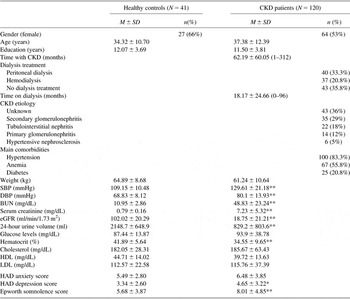
Participants were outpatients who were recruited from January 2006 to August 2008 from the departments of Nephrology and Transplants of the Salvador Zubirán National Institute of Medical Sciences and Nutrition. Patients were included in the study if they were between the ages of 17 and 65 years, were diagnosed with stage 3, 4, or 5 CKD, had intact sensory and motor functions necessary to complete neuropsychologic assessments, and provided informed consent. Participants were excluded if they had mental retardation, severe learning disabilities, severe psychiatric disorders, or neurological disorders. The healthy control group consisted of kidney donors who also met the same inclusion (except for the diagnosis of CKD) and exclusion criteria. We assessed a total of 120 CKD patients [43 no dialysis, 40 peritoneal dialysis (PD), and 37 hemodialysis (HD)] and 41 healthy donors (controls). Sixty-four (53%) of the CKD patients and 27 (66%) of controls were female. Sociodemographic and medical characteristics of the study sample are shown in Table 1. The most prevalent associated disorders were hypertension (present in 83.3% of patients) and anemia (in 58.8%). Patients with these disorders were taking their respective pharmacological treatment.
Characterization of study sample

Note. Continuous variables are mean (standard deviation) with p values calculated by independent samples T test. Categorical variables are sample size (percentages) with p values calculated by χ2. CKD, chronic kidney disease; SBP, systolic blood pressure; DBP, diastolic blood pressure; BUN, blood urea nitrogen; eGFR, estimated glomerular filtration rate; HDL, high-density lipoprotein; LDL, low-density lipoprotein; HAD, Hospital Anxiety and Depression Scale.
*p < .05, **p < .01.
Measures
Sociodemographic variables
We collected comprehensive demographic information including age, gender, and education through direct questions to participants.
Clinical measures
We reviewed medical charts and collected information regarding dialysis, treatment, and laboratory analysis (this data was obtained from medical records available ± 1 month around the day of baseline assessment).
Staging of CKD was codified per the National Kidney Foundation criteria (USA K-DOQI; 2002). Overall measure of kidney function was based on the GFR, which we calculated using the Modification of Diet in Renal Disease equation (Levey et al., Reference Levey, Bosch, Lewis, Greene, Rogers and Roth1999). The CKD stages according to this classification are: stage 1 (GFR ≥ 90 mL/min per 1.73 m2), slightly diminished function; stage 2 (GFR = 60–89 mL/min per 1.73 m2), mild decrease in GFR; stage 3 (GFR = 30–59 mL/min per 1.73 m2), moderate decrease in GFR; stage 4 (GFR = 15–29 mL/min per 1.73 m2), severe decrease in GFR; stage 5 (GFR<15 or dialysis), kidney failure. Blood pressure was obtained the day of neuropsychologic assessment. Hypertension was defined as a systolic blood pressure >140 mmHg, a diastolic blood pressure >90 mmHg, or self-reported current treatment for hypertension. Anemia was defined by the World Health Organization’s (WHO’s) hemoglobin thresholds (2008), or self-reported current treatment for anemia. Diabetes was defined as fasting glucose ≥126 mg/dL (glucose in mg/dL was converted to mmol/L by multiplying by 0.05551), nonfasting glucose ≥200 mg/dL, or self-reported current treatment for diabetes. As many participants underwent dialysis at other institutions, it was not possible to determine levels of Kt/V, an indicator of dialysis adequacy.
Anxiety, depression, and somnolence assessment
This study used the Hospital Anxiety and Depression Scale (HADS) (López-Alvarenga et al., Reference López-Alvarenga, Vázquez-Velázquez, Arcila-Martínez, Sierra-Ovando, González-Barranco and Salín-Pascual2002; Zigmond & Snaith, Reference Zigmond and Snaith1983), a 14-item self-report instrument to measure the presence of anxiety and depressive symptoms for patients in a medical outpatient clinic setting. The HADS is advantageous for the CKD population as it excludes those anxious and depressive symptoms that may be attributable to coexisting general medical conditions (e.g., weight loss, hypophagia). To measure somnolence, participants completed the Epworth Sleepiness Scale (Johns, Reference Johns1991), which is a brief, self-report 8-item questionnaire used to measure daytime sleepiness.
Neuropsychologic assessment
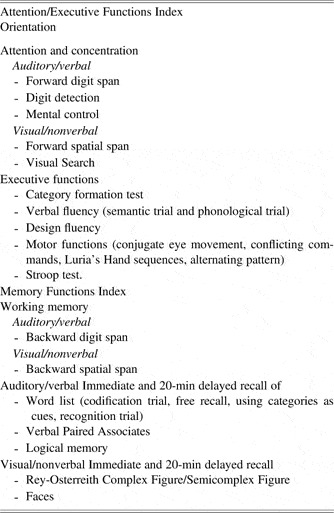
To comprehensively measure neurocognitive functions, we used the NEUROPSI Attention and Memory (Ostrosky-Solís et al., Reference Ostrosky-Solís, Gómez-Pérez, Matute, Rosselli, Ardila and Pineda2007) battery, which measures attention, memory, and executive functions. The test has been standardized and validated in Spanish-speaking subjects between 6 and 85 years of age, and yields demographic (age and education) adjusted standard scores (mean = 100 and SD = 15). The NEUROPSI tasks are sensitive to Hispanic populations and can be used with subjects who are illiterate. Scores were computed for individual subtests (see Table 2) and three Index scores including Attention/Executive Functions, Memory Processes, and a Total Attention and Memory. Attention/Executive Functions Index comprises subtests that assess orientation, attention and concentration (auditory/verbal and visual/nonverbal) as well as some executive function tasks. Memory Functions Index includes subtests for working memory, and tasks that assess immediate and 20-min delayed recall for auditory/verbal and visual/nonverbal material. Total Attention and Memory Index is a global index across all parts of the NEUROPSI. Standard scores between 70 and 84 indicate mild/moderate impairment; scores lower than 69 indicate severe impairment.
Neuropsychologic battery measures

Procedure
The NEUROPSI Attention and Memory battery was administered by a trained clinical psychologist, and all other data were collected by a physician.
For HD patients, the NEUROPSI Attention and Memory battery was administered approximately 24 hr after the last HD session to minimize the effects of fluctuations in uremic symptoms and/or blood pressure. PD patients were assessed in a time between exchanges (cycles of draining and refilling).
Statistical Analysis
Means and standard deviations are presented for continuous variables; percentages are presented for discrete variables. Independent t tests or χ2 tests (for categorical data) were performed to compare sociodemographic, clinical, and neuropsychologic characteristics between the CKD and healthy cohorts.
To determine whether age, education, HADS, or Epworth scores significantly differed by CKD stages or therapeutic interventions, we computed one-way analysis of variance followed by post hoc analyses. We adjusted the analyses using Bonferroni’s correction for equal variances and Games-Howell’s test for unequal variances. Analyses of covariance (ANCOVA) were used to compare neuropsychologic performance among the subgroups. We calculated Pearson correlation coefficients between concurrent variables and neuropsychologic scores. Variables used for the correlations were: (1) related with kidney function (time with CKD, blood urea nitrogen, serum creatinine, eGFR, 24-hr urine volume); (2) related with treatment (time on dialysis); (3) related with cardiovascular risk factors (systolic blood pressure, diastolic blood pressure, cholesterol, high-density lipoprotein, low-density lipoprotein); and (4) related with nutritional status (hematocrit). Partial correlations were used for controlling for age, somnolence and HADS depression score. We also performed hierarchical multiple regressions to examine associations among Total Attention and Memory Indexes and those variables that got significant associations in bivariate analyses. When two or more variables were strongly associated between them, we chose the variable that was strongly associated with the dependent variable to minimize multicollinearity issues. Enter method was used within blocks. Statistical significance was set at a p value <.05. All statistical analyses were performed using SPSS version 16.0 for Windows (SPSS Inc., Chicago, IL).
Results
Sociodemographic Variables, Clinical Measures, Anxiety, Depression, and Somnolence Scores
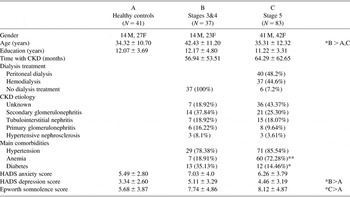
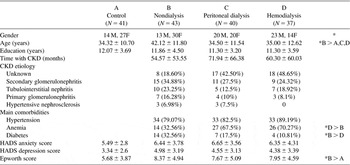
Table 3 shows the sociodemographic and clinical characteristics of the study sample divided according to CKD stage. As age, HADS depression and Epworth somnolence scores were significantly different between the CKD and healthy control groups, these variables were controlled in subsequent analysis. Patients in stage 5 showed a greater proportion of anemia relative to patients in stages 3 and 4 (combined for analysis purposes as there were no significant differences between them), though patients in stages 3 and 4 exhibited a greater proportion of diabetes than those in stage 5. The sample was also divided by therapeutic intervention [see Table 4; no intervention (healthy control only), nondialysis, peritoneal dialysis, and hemodialysis] to determine the impact, if any, on neurocognitive function. The nondialysis CKD group was significantly older than the other groups (p < .05). Anemia was more prevalent for HD patients, and a greater proportion of the nondialysis had diabetes. The subgroups showed similar HADS scores, but the nondialysis group exhibited greater somnolence than controls as evidenced by higher Epworth scores.
Descriptive characteristics of study sample according to CKD stage

Note. Continuous variables are mean (standard deviation) with p values calculated by independent samples T test. Categorical variables are sample size (percentages) with p values calculated by χ2.
CKD, chronic kidney disease; HADS, Hospital Anxiety and Depression Scale.
*p < .05, **p < .01.
Descriptive characteristics of study sample according to therapeutic intervention

Note. Continuous variables are mean (standard deviation) with p values calculated by independent samples T test. Categorical variables are sample size (percentages) with p values calculated by χ2. CKD, chronic kidney disease; HADS, Hospital Anxiety and Depression Scale.
*p < .05, **p < .01
NEUROPSI Attention and Memory Results for the Full CKD Group
An analysis of variance showed that the effect of belonging to the CKD group was significant, F(4, 158) = 5.13, p = .025, after controlling for the effect of age, HADS depression and Epworth somnolence scores. CKD group showed lower scores on the Total Attention and Memory Index (M = 94.31, SD = 18.00) than the control group (M = 100.1, SD = 13.99). The CKD group also showed lower scores (M = 93.10, SD = 16.96) than the control group (M = 100.2, SD = 13.85) on the Attention/Executive Functions Index, F(4, 158) = 4.83, p = .03. The control group (M = 100.25, SD = 13.21) did not differ significantly from CKD group (M = 96.99, SD = 18.26) on Memory Index score (F(4, 158) = 2.46, p > .05).
Individual analysis of neuropsychologic performance of the total sample revealed that 77% (n = 92) of CKD patients showed normal scores on the Total Attention and Memory Index, 16.6% (n = 20) showed mild to moderate impairment, and 6.6% (n = 8) evidenced severe impairment. For the Attention/Executive Functions index, 28.3% (n = 34) of patients evidenced mild to moderate impairment and 4.2% (n = 5) severe impairment. When the Memory index was analyzed, 18.3% (n = 22) of patients showed mild to moderate impairment and 5.8% (n = 7) severe impairment.
NEUROPSI Attention and Memory Results Based on CKD Severity Indicators
There was a significant effect of kidney disease stage on Attention/Executive Functions Index score, F(3, 153) = 4.85, p < .01, partial η2 = .06, Memory Index score, F(3, 153) = 3.81, p < .05, partial η2 = .05, and Total Attention and Memory Index score, F(3, 153) = 5.27, p < .01, partial η2 = .07, after controlling for the effect of age, HADS depression score, and Epworth somnolence score. Table 5 shows the Bonferroni corrected post hoc comparisons of the NEUROPSI Total index scores obtained for the CKD and control cohorts. Patients with stage 5 exhibited lower scores than controls on the Attention/Executive Functions, Memory Index and Total Attention and Memory Indices. No significant differences on the latter were found between stage 3 and 4 patients and controls.
NEUROPSI index scores according to CKD stage

*p < .05, ** p < .01.
NEUROPSI Attention and Memory Results Based on Therapeutic Intervention
Table 6 presents scores for Attention/Executive Functions index, Memory index, and Total Attention and Memory index. Age depression and somnolence effects were included as covariates in the ANCOVA model. After controlling for these covariates, we found a significant effect of therapeutic intervention on the Memory Index Score, F(3, 153) = 3.84, p < .05, partial η2 = .07, and Total Attention and Memory Index score, F(3, 153) = 3.83, p < .05, partial η2 = .07. Bonferroni corrected post hoc comparisons showed that HD group had significantly lower scores than controls on the Memory index and the Total Attention and Memory index. The PD group did not differ from the other groups on any NEUROPSI index.
NEUROPSI index scores according to therapeutic intervention

* p < .05.
Individual analysis revealed no differences in proportion of subjects with dialysis and Attention/Executive Functions impairment (38%, n = 29) than those without dialysis and Attention/Executive functions index impairment (23%, n = 10), χ2 (1, N = 120) = 2.61, p = .106. However, more patients in the dialysis groups (PD and HD) showed a tendency for (30%, n = 23) poorer performance on the Memory index than nondialysis patients 14%, (n = 6) χ2 (1, N = 120) = 3.184, p = .051.
NEUROPSI Attention and Memory Results Based on Comorbidities
As diabetes, hypertension, and anemia are some of the main comorbid conditions that can affect CKD patients and are related to cognitive function (Chamney, Pugh-Clarke, and Kafkia, 2009), independent samples t tests were performed to compare neuropsychologic profiles of patients based on the presence or absence of hypertension, anemia, and diabetes. There were no significant differences across each of the three cognitive index scores related to the presence or absence of hypertension and diabetes. However, participants with anemia compared to those without showed lower scores on the Memory index (M = 91.49, SD = 16.95 vs. M = 101.51, SD = 16.72), t(128) = 3.07, p = .003, and on Total Attention and Memory index (M = 90.14, SD = 18.27 vs. M = 99.57, SD = 16.37), t(128) = 2.92, p = .004. No differences were found in Attention/Executive Functions index related to the presence or absence of anemia. To determine if group differences for the anemia comparison could be explained by other group differences, education, dialysis treatment, and CKD stage were used as covariables as they showed differences in bivariate analyses for patients with and without anemia. The effect of belonging to the anemia group was significant after controlling for the effect of these covariables for Memory index, F(1, 118) = 4.97, p = .028, but not for the Total Attention and Memory index, F(1, 118) = 3.15, p = .079.
Relationship Between Medical/Physiological Variables and Neurocognitive Performance
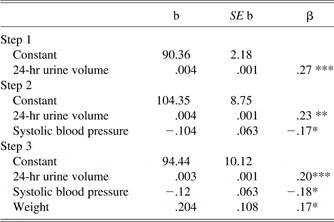
Bivariate correlations between medical and physiological variables and NEUROPSI Total Attention and Memory Index scores with control and CKD groups pooled together were computed. Significant associations even after controlling for age, somnolence, and HADS depression score were found between Total Attention and Memory Index scores and 24-hr urine volume (r = .285, p < .01), systolic blood pressure (r = −.201, p < .05), glomerular filtration rate (r = .22, p < .01), weight (r = 0.196, p < .05), and time in dialysis treatment (r = −.193, p < .05). Using hierarchical multiple regression analysis to predict participants’ total Attention and Memory function index scores, a model that integrated the variables 24-hr urine volume, systolic blood pressure, and weight was obtained, R 2 = .112, F(1, 145) = 6.11, p < .01 (Table 7). The multiple regression analysis found that 24-hr urine volume predicted Total Attention and Memory index scores (β = 0.20, p < .001), as did systolic blood pressure (β = −0.18, p < .05) and weight (β = 0.17, p < .05).
Hierarchical multiple linear regression analysis and the prediction of total attention and memory index

Note. R 2 = .073 for Step 1, ΔR 2 = .017 for Step 2, ΔR 2 = .112 for Step 3 (ps < .05).
*p < .05, **p < .01, ***p < .001.
Discussion
This study systematically examined the neurocognitive profile of adults with CKD. We found that 23% of patients with CKD showed impairment in global cognitive function, 32% showed impairment in attention and executive functions, and 24% showed impaired memory functions. Attention and coding abilities were found to be impaired in CKD stage 5 patients and memory functions were impaired for those who received HD treatment.
The impact of CKD disease severity on neurocognitive function was examined. We found that patients with stage 5 CKD showed lower performance than controls on the NEUROPSI Attention/Executive function and Memory indices. This finding was both statistically and clinically significant as the difference between the stage 5 CKD cohort and the controls on those indices was approximately 10 points. Even when compared to patients with stage 3 or 4 CKD, those patients with stage 5 showed poorer performance on the Attention/Executive index. Collectively, this evidence suggests that CKD stage 5 is associated with impaired attention, inhibition, and coding abilities. Moreover, this suggests that higher levels of CKD disease severity may be associated with greater impairment in neurocognitive functions. Prior research has also indicated that there may be a direct relationship between CKD severity and neurocognitive impairment. For example, Madan et al. (Reference Madan, Kalra, Agarwal and Tandon2007) found that P300 latencies, a measure of cognitive processing speed and memory, were significantly associated with CKD severity. Specifically, patients with stage 3 CKD showed similar P300 latencies to a control group, but patients with stage 4 and 5 CKD showed prolonged P300 latencies. With similar results, Hailpern et al. (Reference Hailpern, Melamed, Cohen and Hostetter2007) used data from the Third National Health and Nutrition Examination Survey (a representative sample of the U.S. population). They compared the cognitive function in three computerized tests of those with moderate kidney disease (n = 31) with those without kidney disease (n = 4818), and found that CKD was associated with poor cognitive function in two of the tests: Symbol Digit Substitution Test and Serial Digit Learning Test, both associated with attention and learning/concentration.
Therapeutic interventions for CKD could affect neurocognitive function. We found that patients treated with HD had lower NEUROPSI Memory index scores. These findings have substantial clinical implications as HD treatment may impact cortical areas that govern memory functions, particularly verbal learning and memory. This finding is supported by an earlier study (Williams et al., Reference Williams, Sklar, Burright and Donovick2004) that found patients treated with HD exhibited greater impairment on immediate and delayed verbal recognition tasks than patients treated with PD. Also, Murray et al. (Reference Murray, Tupper, Knopman, Gilbertson, Pederson, Li and Kane2006) found in a large sample of patients aged 55 years or older with CKD and treated with HD (n = 374), that 90% of the cohort had impairment on select neuropsychologic measures of global cognitive function, verbal and visual learning and memory, and inhibition. Combined with our findings, the data suggest that as CKD patients continue in HD treatment over their life span, there may be more risk of developing severe cognitive impairment. Possible explanations of this are the hemodynamic changes related to HD including a decline in blood pressure, acute metabolic and fluid changes, and high incidence of hypertensive intracerebral hemorrhage in patients treated with HD (Iseki, Kinjo, Kimura, Osawa, & Fukiyama, Reference Iseki, Kinjo, Kimura, Osawa and Fukiyama1993). Moreover, it has been found that patients with CKD undergoing treatment with HD increases the prevalence of silent cerebral infarction or stroke (Nakatani et al., Reference Nakatani, Naganuma, Uchida, Masuda, Wada, Sugimura and Sugimura2003; Toyoda et al., Reference Toyoda, Fujii, Fujimi, Kumai, Tsuchimochi, Ibayashi and Iida2005). Although we found a slight negative correlation between time in dialysis and global cognitive function, we were unable to determine if impairment in patients treated with HD was due to dialysis treatment per se, a selection bias regarding why patients received HD treatment, or the presence of comorbidities (e.g., anemia) that could affect cognitive function.
In addition to the presence of CKD, other comorbid conditions can impact neurocognition. Prior research suggests that systolic blood pressure (Kurella et al., Reference Kurella, Chertow, Luan and Yaffe2004), glomerular filtration rate (Kurella et al., Reference Kurella, Chertow, Luan and Yaffe2004), lower levels of Kt/V (a method used to assess dialysis adequacy) (Wolcott et al., Reference Wolcott, Wellisch, Marsh, Schaeffer, Landsverk and Nissenson1988), urea levels (Wolcott et al., Reference Wolcott, Wellisch, Marsh, Schaeffer, Landsverk and Nissenson1988), albumin (Barzilay et al., Reference Barzilay, Fitzpatrick, Luchsinger, Yasar, Bernick, Jenny and Kuller2008; Kutlay et al., Reference Kutlay, Nergizoglu, Duman, Atli, Keven, Ertrük and Karaton2001), hemoglobin (Madan et al., Reference Madan, Kalra, Agarwal and Tandon2007), and parathyroid hormone levels (Gilli & De Bastiani, Reference Gilli and De Bastiani1983) are predictors of cognitive function in patients with CKD. Our findings suggest that, even though multiple variables were correlated with global cognitive function scores, only the variables of 24-hr urine volume, weight, and systolic blood pressure best explained cognitive function. However, these combined variables only explained 11.2% of the variance, and based on the r and β values, only urine volume appeared to be an appropriate predictor. This demonstrates that there are other factors closely related to cognitive functions of patients with CKD. One such factor that mediates cognitive function may be anemia. This study found that anemia was more prevalent in patients with stage 5 CKD and those treated with HD, all of whom showed worse performance on neurocognitive measures. Furthermore, anemia patients had lower scores in Memory Index score independent of education, dialysis treatment and CKD stage. Anemia has been proposed as a risk factor for functional and cognitive decline in other investigations (Denny, Kuchibhatla, & Cohen, Reference Denny, Kuchibhatla and Cohen2006; Lucca et al., Reference Lucca, Tettamanti, Mosconi, Apolone, Gandini, Nobili and Riva2008). Fatigue and weakness are common consequences of anemia (Agnihotri et al., Reference Agnihotri, Telfer, Butt, Jella, Cella, Kozma and Akamah2007). Moreover, the hypoxic condition caused by anemia may not only negatively affect physical function but also cognitive performance, mood, and quality of life (Lucca et al., Reference Lucca, Tettamanti, Mosconi, Apolone, Gandini, Nobili and Riva2008). Kuwabara et al. (Reference Kuwabara, Sasaki, Hirakata, Koga, Nakagawa, Chen and Fujishima2002) measured the CO2 response in patients with anemia secondary to CKD using positron emission tomography. That study found a reduced cerebral vasodilatory capacity in anemic patients with CKD and suggested that chronic hypoxic brain damage might play a role in the impaired cerebrovascular response to CO2. These findings may explain neuropsychologic deficits found in our sample.
Some other factors that have been found to strongly contribute to the presence of cognitive impairment in patients with CKD are cerebral metabolism disorders (Okada, Yoshikawa, Matsuo, Kanno, & Oouchi, Reference Okada, Yoshikawa, Matsuo, Kanno and Oouchi1991), cerebral edema (Chen et al., Reference Chen, Lai, Chou, Lee, Chung and Fang2007), silent brain infarction (Kobayashi et al., Reference Kobayashi, Hirawa, Yatsu, Kobayashi, Yamamoto, Saka and Umemura2009), cerebral small vessel disease (Ikram et al., Reference Ikram, Vernooij, Hofman, Niessen, Van der Lugt and Breteler2008), decreased cerebral blood flow during interdialytic period (Prohovnik et al., Reference Prohovnik, Post, Uribarri, Lee, Sandu and Langhoff2007), and the accumulation of uremic neurotoxins (Vanholder et al., Reference Vanholder, De Smet, Glorieux, Argiles, Bourmeister and Brunet2003). Recently, it has been suggested that renal-associated cognitive impairment is more vascular in origin than neurodegenerative, and that the domains of cognitive impairment may vary between patients (Murray, Reference Murray2009). However, most of these conclusions require further confirmatory evidence.
This study was limited in that it is cross-sectional; therefore, the data cannot be used to infer causal relationships. Longitudinal studies with a follow-up of patients along the impairment of renal function and/or after renal transplant may help elucidate if causal relationships do exist for factors such as anemia or CKD severity. Also, information on medical and physiological variables was obtained from medical records available on the day of assessment. Although we attempted to use information from the days nearer to neuropsychological assessment, in some cases, it was not possible to obtain medical information for the same day as the neuropsychological evaluation. As such an important variable we were unable to obtain was Kt/V level. Because many patients underwent HD in other institutions, it was not possible to determine and, therefore, control for levels of Kt/V, a variable that should be controlled in HD patients (Pliskin et al., Reference Pliskin, Yurk, Ho and Umans1996) when analyzing cognitive functions. We also were unable to collect information about the etiology of kidney failure that was documented in medical records as “unknown” as kidney biopsy was not conducted on all patients who visited an outpatient nephrology clinic. Lastly, we had small sample sizes, particularly for patients with stage 3 (n = 21) and 4 (n = 16) CKD, which may have limited our ability to detect significant findings for certain analyses. When analyzing total scores of NEUROPSI Attention and Memory, we could not find differences between stage 3 and 4 patients and controls in global indices, so we could not conclude with our results that as CKD progresses cognitive functions decline.
These limitations are mitigated by the strengths of this study that include the characterization of CKD and severity stages based on published diagnostic criteria, comparison of patients with CKD to an age and gender matched healthy control group, a comprehensive neurocognitive battery and analysis of demographic-adjusted data, and controlled analyses with adjustments for confounding factors and multiple comparisons.
In conclusion, this study demonstrated that patients with stage 5 CKD may present with impaired cognitive functions that may become more evident during HD treatment. Furthermore, the neuropsychologic profiles obtained for each group suggests that CKD affects cortical areas related mainly to attention and executive functions and may be attributable to uremia-related mechanisms. Dialytic therapies are useful for improving uremia-related symptomatology; however, we found detrimental effects on the cognitive profile. Also, our findings indicate that HD and anemia affect cerebral areas involved with memory functions. We did not systematically examine for the presence of dementia or its impact on daily life activities. However, memory impairment could negatively affect the patients’ ability to adhere to their treatments, so memory functions and the presence of dementia should be assessed continuously for HD and anemic patients. Because increasing evidence suggests that impaired kidney function is associated with a more rapid rate of cognitive decline in the elderly (Buchman et al., Reference Buchman, Tanne, Boyle, Shah, Leurgans and Bennett2009; Kurella, Chertow, et al., Reference Kurella, Luan, Lash and Chertow2005), it may be prudent to conduct future longitudinal investigations of CKD to determine if a causal relationship exists and the trajectory of impairment.
Acknowledgements
Sofia Sánchez-Román, Departments of Neurology and Psychiatry, Salvador Zubirán National Institute of Medical Sciences and Nutrition, Mexico City, Mexico; Feggy Ostrosky-Solís, Laboratory of Neuropsychology and Psychophysiology, Faculty of Psychology, National Autonomous University of Mexico, Mexico City, Mexico; Luis E. Morales-Buenrostro, Department of Nephrology, Salvador Zubirán National Institute of Medical Sciences and Nutrition, Mexico City, Mexico; M.G. Nogués-Vizcaíno, Department of Transplantation, Salvador Zubirán National Institute of Medical Sciences and Nutrition, Mexico City, Mexico; Shawn M. McClintock, Department of Psychiatry, University of Texas Southwestern Medical Center, Dallas, Texas, and Department of Psychiatry, Division of Brain Stimulation and Therapeutic Modulation; Department of Psychiatry, New York State Psychiatric Institute/Columbia University, New York, New York; J. Alberú, Department of Transplantation, Salvador Zubirán National Institute of Medical Sciences and Nutrition, Mexico City, Mexico.
The present study was supported by “Fondo Institucional para el fomento de la Ciencia, el fomento de la Tecnología y el fomento, desarrollo y consolidación de científicos y tecnólogos (SEP-CONACYT)” Project 24124-CB-2005-01-51560. All authors declare that there is no conflict of interest affecting this manuscript. We thank Lorena González de Jesús and Alma Mestas for their help with the assessments.