Management Implications
Soil legacies of cultivated lands may affect the establishment of both native and invasive plant species during restoration. We found that root fungal pathogens that occur in abandoned citrus fields decreased biomass of some native species as well as the invasive grass Bromus diandrus (ripgut brome). This indicates that applications of fungicides during restoration may increase performance of invasive species while simultaneously benefiting some native species. Therefore, the use of fungicides like fludioxonil may be beneficial in restoration only when invasive species have lower impact from fungal pathogens relative to native species. This was not the case for B. diandrus, which responded to fungicide application with increased growth.
Introduction
Conversion of natural habitat to agriculture is one of the dominant forms of land degradation and loss of biodiversity throughout the world. Subsequent abandonment of agricultural lands has led to some of the most dramatic plant invasions (MacDonald et al. Reference MacDonald, Crabtree, Wiesinger, Dax, Stamou, Fleury, Lazpita and Gibon2000). In the United States, there are 68 million hectares of abandoned agricultural fields (Zumkehr and Campbell Reference Zumkehr and Campbell2013). The process of returning these abandoned agricultural lands to native vegetation may require intensive management of soils, seedbanks, and vegetation (Cramer et al. Reference Cramer, Hobbs and Standish2008; Marushia and Allen Reference Marushia and Allen2011; Pywell et al. Reference Pywell, Bullock, Tallowin, Walker, Warman and Masters2007; Standish et al. Reference Standish, Cramer, Wild and Hobbs2007; Walker et al. Reference Walker, Stevens, Stevens, Mountford, Manchester and Pywell2004). Previous studies of abandoned agricultural lands increase our understanding of ecosystem recovery and successful restoration practices (Allen et al. Reference Allen, Cox, Tennant, Kee and Deutschman2005a; Bonet Reference Bonet2004; Marushia and Allen Reference Marushia and Allen2011; Pywell et al. Reference Pywell, Bullock, Tallowin, Walker, Warman and Masters2007, Reference Pywell, Meek, Webb, Putwain and Bullock2011). However, the majority of studies focused on aboveground processes, and less is known about how the soil microbial community of abandoned agricultural lands affects restoration success.
Conventional industrial agricultural practices such as tillage, fertilization, pesticides, and monoculture cropping contribute to soil legacies that limit restoration of abandoned fields (Cramer et al. Reference Cramer, Hobbs and Standish2008; Filser et al. Reference Filser, Fromm, Nagel and Winter1995; Kulmatiski et al. Reference Kulmatiski, Beard and Stark2006). These traditional practices lead to low mycorrhizal inoculum potential (Miller Reference Miller2002) as well as higher loads of aggressive soilborne pathogens (Mills and Bever Reference Mills and Bever1998). Arbuscular mycorrhizal fungi (AMF) significantly influence plant growth and diversity (Hilbig and Allen Reference Hilbig and Allen2015; Pringle et al. Reference Pringle, Bever, Gardes, Parrent, Rillig and Klironomos2009; van der Heijden et al. Reference van der Heijden, Boller, Wiemken and Sanders1998) and the outcome of restoration in old fields (Richter and Stutz Reference Richter and Stutz2002). Additionally, AMF increase the ability of plants to withstand pathogen infections (Borowicz Reference Borowicz2001; Hilbig and Allen Reference Hilbig and Allen2015; Newsham et al. Reference Newsham, Fitter and Watkinson1995). Mycorrhizal fungi inoculations have improved success in restoration of native prairie in abandoned agricultural lands with low mycorrhizal potential (Middleton and Bever Reference Middleton and Bever2012; Miller Reference Miller2002; Richter and Stutz Reference Richter and Stutz2002), suggesting low mycorrhizal inoculum limits restoration of abandoned agricultural fields.
Pathogens in agricultural lands may be less diverse than in wildlands, but more aggressive in their impacts on crop plants (Altieri Reference Altieri1999). Many crop pathogens are host-specific (Bullock Reference Bullock1992) and do not impact native plants, while others are generalists that may affect crop and non-crop species (Hersh et al. Reference Hersh, Vilgalys and Clark2012). Furthermore, pathogens of abandoned agricultural lands differentially affect native and invasive species establishment and growth during restoration. Allen et al. (Reference Allen, Allen and Gomez-Pompa2005b) showed that the local pathogen Fusarium semitectum (Berk. & Ravenel) limited plant species distribution during restoration of simulated slash and burn agriculture in a tropical dry forest. Kulmatiski et al. (Reference Kulmatiski, Beard and Stark2006) used the fungicide benomyl to control soil fungi in an abandoned agricultural site and showed agricultural soil fungi enhance exotic plant cover. Hilbig and Allen (Reference Hilbig and Allen2015) found oomycete pathogenic hyphae infecting the roots of native forbs of coastal sage scrub vegetation, but not the invasive grass ripgut brome [Bromus diandrus (Roth.)], when plants were inoculated with abandoned agricultural soils conditioned by B. diandrus. However, to date, evidence for the activity of soilborne fungal pathogens comes primarily as inference from plant–soil feedback studies (Bever Reference Bever1994; Callaway et al. Reference Callaway, Thelen, Barth, Ramsey and Gannon2004a; Kardol et al. Reference Kardol, Cornips, van Kempen, Bakx-Schotman and van der Putten2007; Mangan et al. Reference Mangan, Schnitzer, Herre, Mack, Valencia, Sanchez and Bever2010; Yelenik and Levine Reference Yelenik and Levine2011). It remains unclear whether pathogens in abandoned agricultural lands affect the reestablishment of native plant species and the success or failure of restoration in these systems.
Control of soilborne pathogens using different pesticides, a common agricultural practice but seldom done in restoration, can determine whether certain pathogens are affecting target restoration species. Fludioxonil is a nonsystemic, broad-spectrum fungicide with long residual activity (Rosslenbroich and Stuebler Reference Rosslenbroich and Stuebler2000) that is commonly used in seed and postharvest treatments of citrus fruits (Zhang Reference Zhang2007). It effectively controls many noxious agricultural pests of the genera Penicillium, Fusarium, and Lasiodiplodia (Zhang Reference Zhang2007). Metalaxyl is an oomyceticide that is used to protect more than 100 agricultural crops through the control of Pythium and Phytophthora species (Davidse et al. Reference Davidse, Gerritsma, Ideler, Pie and Velthuis1988; Fisher and Hayes Reference Fisher and Hayes1982). Pythium and Phytophthora are common in citrus roots and cause a number of diseases leading to reduced production and mortality (Cohen and Coffey Reference Cohen and Coffey1986). In addition to controlling oomycete pests, metalaxyl has been shown to stimulate AMF colonization when applied at low levels effective at controlling oomycetes (Afek et al. Reference Afek, Menge and Johnson1991; Hetrick and Wilson Reference Hetrick and Wilson1991).
To gain a better understanding of the role of pathogens remaining in an abandoned citrus orchard undergoing restoration as habitat for native species, we manipulated soil fungal communities in controlled greenhouse studies using fludioxonil and metalaxyl. Through the use of different fungicides, we determined whether the suppression of different fungal functional groups present in these fields affects native forb and invasive grass establishment and growth. Here, we used two lines of evidence to show that pathogens were present and active in these soils: (1) plant growth response to fludioxonil and metalaxyl and (2) direct microscopic morphological identification of pathogens and AMF.
Material and Methods
Field Site
The study site was at the Lake Mathews Reserve located in western Riverside County, CA (33°36′29.80N, 117°02′00.81W). The area has a Mediterranean-type climate that receives an average of 262 mm precipitation each year, mostly during the winter–spring growing season (November to May). The reserve has approximately 12,000 ha of historically disturbed coastal sage scrub and annual forbland (Minnich Reference Minnich2008). Nearly 500 ha were converted to a citrus orchard beginning in the early 1900s. Citrus agriculture at Lake Mathews Reserve was abandoned in the early 1990s when irrigation ceased due to high cost, but restoration planning and permitting did not begin until 2004. Removal of citrus trees and agricultural infrastructure started in 2006 and was still underway at the time of this research. Since abandonment, the land has been heavily invaded by B. diandrus and has transitioned to exotic annual grassland. Previous studies at this site found oomycete hyphae infecting the roots of native forb species (Hilbig and Allen Reference Hilbig and Allen2015), and the soilborne fungal pathogens Pythium heterothallicum (W.A. Campb. & F.F. Hendrix), Fusarium equiseti [(Corda) Sacc.], Fusarium pseudograminearum (O’Donnell & T. Aoki), Penicillium brevicompactum (Dierckx), and Mortierellales sp. were isolated from field soils and roots (Hilbig Reference Hilbig2015). Field experiments in two sequential winter growing seasons (2011 to 2012 and 2012 to 2013) to test the effects of a fungicide and an oomyceticide on soil organisms failed due to extreme drought (<55% of average precipitation), which caused most native and exotic annuals that germinated to die before maturity in both years (Hilbig Reference Hilbig2015). The experiment was therefore conducted in a controlled greenhouse environment.
Greenhouse Experiment
Field soil was collected in fall 2013 to a 10-cm depth along remnant dead, cut citrus rows under stands of B. diandrus from 10 randomly selected locations across a site of ~1 ha and homogenized. The site is representative of lands undergoing restoration of native species but currently dominated by exotic grass. The soil of the abandoned orchard was a Porterville cobbly clay (classified as fine, smectitic, thermic Aridic Haploxererts; Nelson et al. Reference Nelson, Zinn, Strahorn, Watson and Dunn1919), cut 50% with silica sand to create a sandy clay for better drainage; this is a common practice for inoculum studies in fine-textured soil (e.g., Hilbig and Allen Reference Hilbig and Allen2015; Johnson et al. Reference Johnson, Rowland, Corkidi and Allen2008). From the field-collected soils four soil treatments were created: untreated, sterile, metalaxyl-treated soils, and fludioxonil-treated soils. Soil for the potting mix was steam sterilized for 24 h, held at room temperature for 24 h, and sterilized for another 24 h. The resulting soil contained total KCl-extractable nitrogen (NO3−-N plus NH4+-N) of 17.0 µg g−1 soil, and 18.1 µg g−1 bicarbonate-extractable phosphorus.
In February 2014, the greenhouse study began. Twenty 15 L rectangular pots (38.7 by 29.2 by 18.4 cm deep) were filled with the sterilized soil described earlier. Sterile pots had no live inoculum added; all other treatments received 4 cm of live inoculum (unsterilized soil) added to the top. This approach was used to minimize differences in soil nutrients among treatments due to potential nutrient release by sterilization techniques. Live inoculum consisted of the original field-collected soil cut 50% with silica sand. Cannonoball®WP (Syngenta, Riverside, CA) was applied immediately to pots with the fludioxonil soil treatment and biweekly throughout the experiment at the manufacturer’s recommended rate (3.8 mg ai pot−1, total application). Metalaxyl-treated pots received a single application of Subdue® (Judelson H, Riverside, CA) at the beginning of the experiment at the manufacturer’s recommended rate (1.9 mg ai pot−1). To test for potential non-target effects of these pesticides on plants, previous greenhouse trials included sterile soils with metalaxyl and fludioxonil applications. These trials showed that biomass did not differ significantly between sterile soil and sterile soils treated with either pesticide, demonstrating that metalaxyl and fludioxonil did not have any direct toxicity to plants (Hilbig Reference Hilbig2015).
At the same time as soil treatments, three native forb species associated with coastal sage scrub and the invasive grass B. diandrus were seeded in the 15 L-pot mixture and grown in a controlled greenhouse condition (~24 C daytime, 18 C night, ambient daylight appropriate to the winter growing season) for 5 wk after seedling emergence. The common native forbs common fiddleneck [Amsinckia intermedia Fisch. & C.A. Mey.], California goldfields [Lasthenia californica DC. ex Lindl.], and coastal tidytips [Layia platyglossa (Fisch. & C.A. Mey.) A. Gray] were chosen based on vegetation surveys conducted at Lake Mathews Reserve in 2010 (EB Allen, unpublished data). Native grasses are very sparse; therefore, only dominant native annual forbs were chosen. Before the start of the experiment, all pots were watered for 2 wk to promote germination of seeds that might have been viable and present in the live inoculum. Seedlings were removed, and seeds of the three native forbs and B. diandrus were added. Amsinckia intermedia germinates a week after other species, and was therefore seeded a week earlier. Pots contained a constant density of 24 plants across all treatments with six individuals of each species and were arranged in a randomized complete block design with five replicates per soil treatment.
Plants were harvested after 5 wk for aboveground biomass and root biomass. Aboveground biomass was determined after drying at 60 C for 48 h. With the exception of a small subsample of root collected from each species for the assessment of percent fungal colonization, the root biomass of all species per pot was combined. This is due to the fact that it was not possible to untangle the fine roots of individual species within the pots. Roots were washed of soil, and biomass was determined after drying at 60 C for 48 h.
Fungal Root Colonization
Roots were examined for structures of both AMF and non-mycorrhizal fungi of Ascomycota and Basidiomycota as described by Hilbig and Allen (Reference Hilbig and Allen2015). Dried roots were rehydrated, cleared in 2.5% KOH, acidified in 1% HCl, and stained with 0.05% trypan blue (Kormanik and McGraw Reference Kormanik, McGraw and Schenck1982; Koske and Gemma Reference Koske and Gemma1989). Previous studies confirmed that drying did not change percent colonization of mycorrhizal or potential pathogenic fungi (Hilbig and Allen Reference Hilbig and Allen2015). Root fragments were then mounted in PVLG on slides, and 80 observations at 400× were made for the root system of each individual per pot (24 individuals pot−1).
Statistical Analyses
Aboveground biomass was analyzed using separate one-way ANOVA for each species with soil treatment as a fixed factor. Root biomass was analyzed across pots using a one-way ANOVA with soil treatment as a fixed factor. Soil treatments were compared using least significant difference (LSD0.05). All data were checked for homogeneity of variances using Levene’s tests and for normality using the Shapiro-Wilk test. Ratios of percent AMF root colonization to percent ascomycete root colonization were calculated for each species by soil treatment. Percent root colonization data and ratios failed to meet the normality assumption even after a log transformation and were analyzed using Kruskal-Wallis rank-sum test for each species with soil treatment as a fixed factor. Soil treatments were compared using Nemenyi’s test with chi-square approximation for independent samples. Box-and-whisker plots were used to detect outliers, and one metalaxyl pot was removed before statistical analyses because of a high biomass >180% of the mean. All statistical analyses were performed using R v. 3.0.2 (R Development Core Team 2013).
Results and Discussion
Total native forb aboveground biomass varied across soil treatments for each of the species (P = 0.016 Figures 1A–4A). Total root biomass per pot was highly variable within treatment and not significantly different across soil treatments (grand mean = 2.83g pot−1, SE = 0.46). Roots of native and invasive species were colonized by both AMF and ascomycetes, which included potential pathogen species. No basidiomycetes were observed microscopically from greenhouse-grown roots (no hyphae with clamp connections). Oomycetes were observed in the field soils as described earlier and in previous greenhouse studies (Hilbig and Allen Reference Hilbig and Allen2015), but were not observed in the roots of plants grown in this greenhouse study.
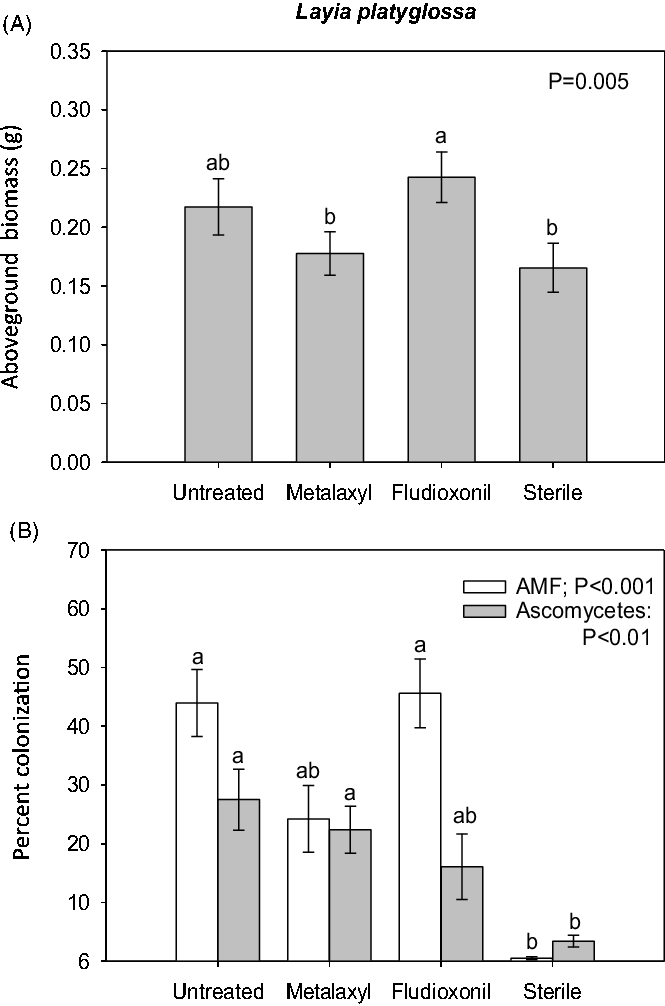
(A) Aboveground biomass and (B) percent root colonization of arbuscular mycorrhizal fungi (AMF) and ascomycete fungi in Layia platyglossa at week 5 in untreated, nonsterile field soil, sterile soil, and soils treated with fludioxonil or metalaxyl. Separate Kruskal-Wallis tests were run for each fungal group with treatment as a fixed factor. Significance was determined at α = 0.05. Superscript letters denote significant difference across soil treatments.

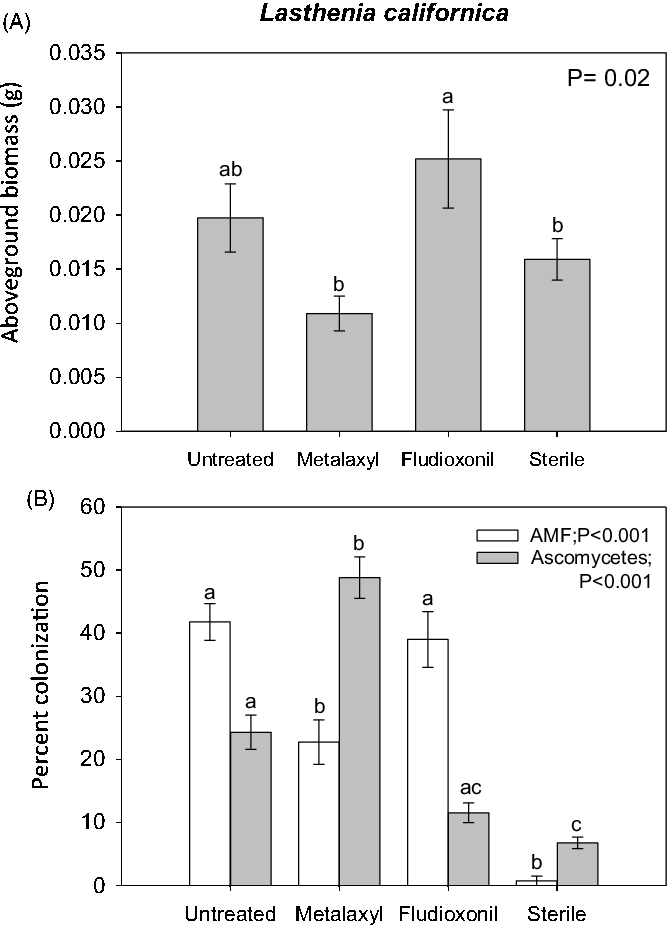
(A) Aboveground biomass and (B) percent root colonization of arbuscular mycorrhizal fungi (AMF) and ascomycete fungi in Lasthenia californica at week 5 in untreated, nonsterile field soil, sterile soil, and soils treated with fludioxonil or metalaxyl. Note values on y axis, with L. californica biomass an order of magnitude lower than other species. Separate Kruskal-Wallis tests were run for each fungal group with treatment as a fixed factor. Significance was determined at α = 0.05. Superscript letters denote significant difference across soil treatments.

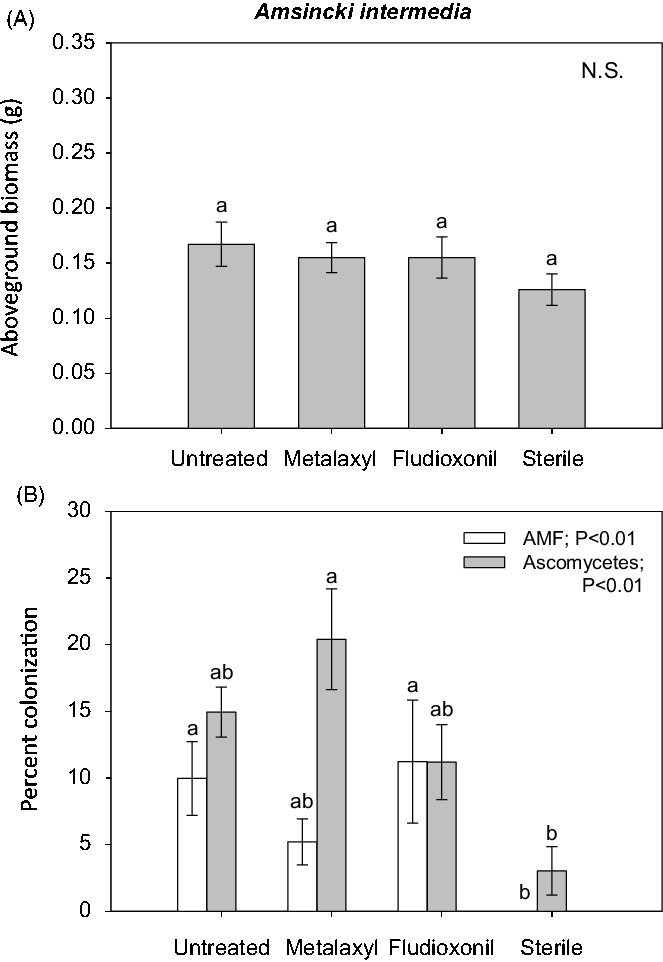
(A) Aboveground biomass and (B) percent root colonization of arbuscular mycorrhizal fungi (AMF) and ascomycete fungi in Amsinckia intermedia at week 5 in untreated, nonsterile field soil, sterile soil, and soils treated with fludioxonil or metalaxyl. Separate Kruskal-Wallis tests were run for each fungal group with treatment as a fixed factor. Significance was determined at α = 0.05. Superscript letters denote significant difference across soil treatments.

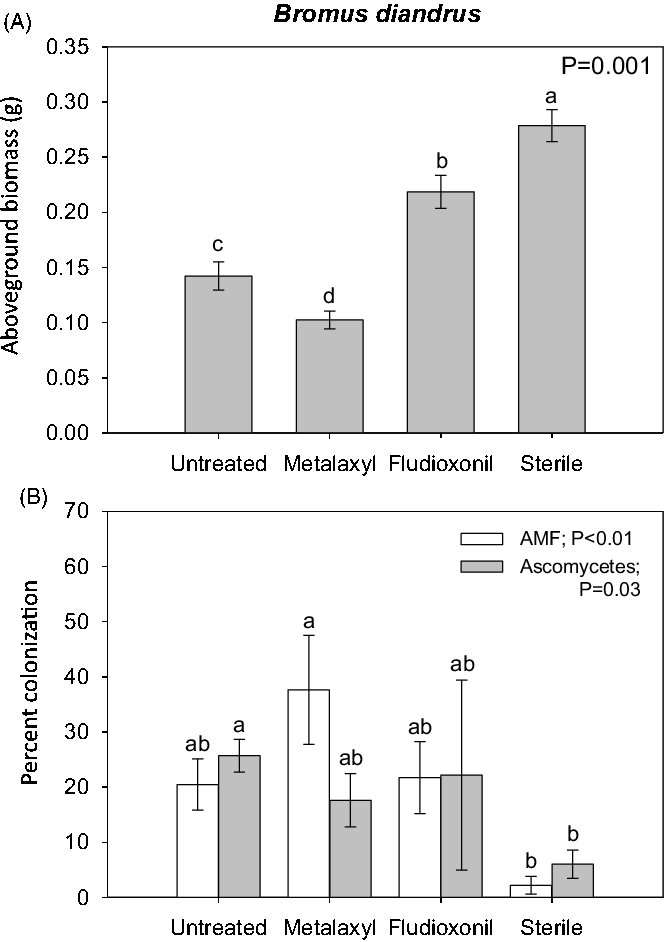
(A) Aboveground biomass and (B) percent root colonization of arbuscular mycorrhizal fungi (AMF) and ascomycete fungi in Bromus diandrus at week 5 in untreated, nonsterile field soil, sterile soil, and soils treated with fludioxonil or metalaxyl. Separate Kruskal-Wallis tests were run for each fungal group with treatment as a fixed factor. Significance was determined at α = 0.05. Superscript letters denote significant difference across soil treatments.

Pots treated with fludioxonil had greater native forb biomass than those with sterile soil or soil treated with metalaxyl due to increased biomass in two of three forb species. More specifically, the application of fludioxonil increased aboveground biomass of L. platyglossa (P = 0.005; Figure 1A) and L. californica (P = 0.020; Figure 2A), but had no effect on A. intermedia biomass (Figure 3A). The aboveground biomass is likely related to root fungal colonization of the different fungal functional groups, where greater percent colonization of AMF compared with ascomycetes, which may be primarily pathogens (Hilbig Reference Hilbig2015), confers greater aboveground biomass due to the increased nutrient status.
Root colonization data for L. platyglossa and L. californica demonstrate that individuals treated with fludioxonil had higher percent AMF colonization to percent ascomycete (AMF:ascomycete fungi; Table 1). While AMF:ascomycete ratios varied across treatments and species (Table 1), in all species the highest AMF:ascomycete ratio was found in fludioxonil-treated soils (Table 1). Fludioxonil increases root colonization by AMF (Murillo-Williams and Pedersen Reference Murillo-Williams and Pedersen2008) while being effective against pathogens such as Fusarium species. AMF interact in the rhizosphere and compete with co-occurring pathogens for the same colonization sites (Newsham et al. Reference Newsham, Fitter and Watkinson1995; Smith and Read Reference Smith and Read2008). Increases in AMF colonization with fludioxonil may be due to reduced competition with aggressive pathogens for those colonization sites (Murillo-Williams and Pedersen Reference Murillo-Williams and Pedersen2008). Here, increased biomass with fludioxonil application is most likely due to a reduction in infection by soilborne root pathogens while having no negative effect on AMF, so the ratio of AMF to non-mycorrhizal fungi is increased, as seen in L. californica and L. platyglossa.
Ratio of percent root colonization of arbuscular mycorrhizal fungi (AMF) to percent root colonization of ascomycetes in all four plant species × four soil treatments.

abcSuperscript letters denote significant difference across rows and columns.
Conversely, application of metalaxyl reduced biomass compared with biomass of plants treated with fludioxonil. While we did not observe oomycetes in our greenhouse roots, previously cultured and sequenced oomycete (Pythium and Phytophthora) and ascomycete (Fusarium) pathogens from the field (Hilbig Reference Hilbig2015; Hilbig and Allen Reference Hilbig and Allen2015) lent credibility to the use of both a fungicide and an oomyceticide to manipulate soilborne pathogen communities in this abandoned citrus orchard. However, microscopic observation indicated metalaxyl targeted mycorrhizal fungi. AMF colonization was reduced in L. californica when soils were treated with metalaxyl compared with the untreated and fludioxonil-treated agricultural soils (P << 0.001; Figure 2B). Layia platyglossa showed similar trends of decreased AMF colonization with the application of metalaxyl (Figure 1B). Lasthenia californica plants grown in metalaxyl and untreated agricultural soil had significantly higher ascomycete colonization compared with plants grown in the sterile soil (P << 0.001; Figure 2B). Overall, A. intermedia had lower AMF colonization than other native forbs in untreated agricultural soils, with an average of 12% colonization compared with ~40% in other native forbs grown in fludioxonil-treated soils (Figure 3B). Additionally, the reduction in AMF with metalaxyl seen in the other native forbs did not occur in A. intermedia (Figures 1B, 2B, and 3B). Hilbig and Allen (Reference Hilbig and Allen2015) demonstrated that A. intermedia is less colonized by AMF than other native forbs in this system; therefore the application of metalaxyl might not negatively affect A. intermedia growth as it does native forb species more heavily colonized by, or dependent upon, AMF.
The observed negative effects of metalaxyl on plant growth might better be explained by non-target effects on AMF, as AMF colonization was significantly reduced with this treatment in L. californica and trending in L. platyglossa (P < 0.1) compared with untreated agricultural soils and fludioxonil. The reported effects of metalaxyl on AMF are highly variable. Most studies have demonstrated that low levels of metalaxyl, such as the 1.9 mg ai pot−1 used in our study, increase AMF colonization (Afek et al. Reference Afek, Menge and Johnson1991; Groth and Martinson Reference Groth and Martinson1983; Hetrick and Wilson Reference Hetrick and Wilson1991; Johnson and Pfleger Reference Johnson, Pfleger and Bethlenfalvay1992; Shetty and Magu Reference Shetty and Magu1997). The beneficial effects of metalaxyl on mycorrhizal colonization could be due to the suppression of organisms, such as oomycetes, that are antagonistic towards AMF (Johnson and Pfleger Reference Johnson, Pfleger and Bethlenfalvay1992). Alternatively, metalaxyl has been demonstrated to restrict AMF when applied as soil drenches (Carrenho et al. Reference Carrenho, Bononin and Graciolli2000; Jabaji-Hare and Kendrick Reference Jabaji-Hare and Kendrick1987). Jabaji-Hare and Kendrick (Reference Jabaji-Hare and Kendrick1987) found that soil drench applications of metalaxyl, or applications directly to the base of the plant, reduced mycorrhizal colonization in leeks [Allium ampeloprasum (L.)] at 0.5, 1.0, and 2.0 mg ai per plant. Similarly, Oliveira (Reference Oliveira1992) found low levels of mycorrhizal colonization in Rangpur lime [Citrus limonia (Osbeck)] when metalaxyl was applied at 1.0 and 2.0 mg ml−1.
The mechanisms behind suppression or enhancement of mycorrhizal colonization with applications of metalaxyl or other pesticides to control root pathogens are poorly understood (Johnson and Pfleger Reference Johnson, Pfleger and Bethlenfalvay1992). It has been suggested that response to fungicide is AMF species specific and specific to host plant species (Jabaji-Hare and Kendrick Reference Jabaji-Hare and Kendrick1987). Additionally, the chemical used, the rate of application, and method of application account for the observed different AMF responses to metalaxyl. In this study, Subdue® was applied as a soil drench at the manufacturer’s recommended level at the beginning of the experiment. The benefits of oomycete pathogen protection from metalaxyl were offset by its detrimental effects on AMF in these highly mycorrhizal native forbs (Hilbig and Allen Reference Hilbig and Allen2015), as seen in L. californica andL. platyglossa, and the subsequent reduction in the ratio of AMF:ascomycetes in both species (P < 0.001 and P < 0.001, respectively). Soil-drench applications of metalaxyl could have resulted in the accumulation of the fungicide within the root zone of soils. This systemic pesticide is taken up by plant roots at the application site and affects timing of AMF infection.
In contrast to the forbs, B. diandrus had varying aboveground biomass across all soil treatments (P << 0.001; Figure 4A). Aboveground biomass was greatest in sterile soil and lowest in soils treated with metalaxyl (P << 0.001; Figure 4A). Individuals grown in metalaxyl-treated soils had the highest colonization of AMF, which was significantly greater than AMF colonization in sterile soils but not untreated agricultural soils or fludioxonil soils (P = 0.004; Figure 4B). Bromus diandrus grown in untreated agricultural soils had significantly greater ascomycete colonization than in sterile soil, but not in fludioxonil- or metalaxyl-treated soils (P = 0.03; Figure 4B).
Pesticides have both negative and positive effects on mycorrhizal fungi due to differences in their modes of action, chemical structures, release of soil mineral nutrients, and methods of application (Jin et al. Reference Jin, Germida and Walley2013; Johnson and Pfleger Reference Johnson, Pfleger and Bethlenfalvay1992). Release of soil nutrients following ascomycete mortality due to fludioxonil was likely minimal in this study, because only a thin layer of live soil inoculum was used. Additionally, if increased nutrient availability from fludioxonil application was driving plant growth responses, we would expect greater plant biomass in fludioxonil-treated soils compared with sterile soils in all species. However, B. diandrus had highest aboveground biomass in sterile soils. This suggests that the changes in plant biomass among soil treatments were due to differential effects of fludioxonil on the soil biota and not nutrient availability.
The use of fludioxonil during restoration of abandoned agriculture might result in increased establishment and growth of native forb species. However, B. diandrus also had increased biomass in soils treated with fludioxonil and in sterile soils, suggesting the release of B. diandrus from soilborne pathogens with the application of fludioxonil. Yet root colonization by ascomycetous fungi was not significantly reduced in B. diandrus with fludioxonil. The observed B. diandrus biomass response to fludioxonil could be due to decreased colonization by aggressive pathogens targeted by fludioxonil, while other non-mycorrhizal fungi were not affected by fludioxonil applications.
We believe our study is the first of its kind to determine that soilborne pathogenic fungi in abandoned agricultural fields impact native species during restoration efforts in these fields. The emphasis in other studies has been to identify potential rhizosphere pathogens in plant–soil feedback studies (Callaway et al. Reference Callaway, Bedmar, Reinhart, Silvan and Klironomos2011; Klironomos Reference Klironomos2002). Kulmatiski et al. (Reference Kulmatiski, Beard and Stark2006) used the fungicide benomyl to control soil fungi in an abandoned agricultural site and showed abandoned agricultural soil fungi enhance exotic plant cover. Benomyl is a general fungicide that is effective on ascomycetes and AMF, but is considered to affect mutualistic mycorrhizal fungi more negatively (Callaway et al. Reference Callaway, Thelen, Rodriguez and Holben2004b). Through the application of different pesticides, we were able to show the potential of some soilborne fungal pathogens to inhibit both native and invasive plant growth. Therefore, applications of fungicides such as fludioxonil during restoration may benefit the already competitively superior invasive species at the same time it benefits some native species. Fludioxonil may be beneficial in restoration when invasive species have no naturalized enemies. Successful restoration of abandoned agricultural fields may rely on a greater understanding of soil biotic legacy effects on native reestablishment and the successful control of soilborne pathogens that target native species more heavily than invasive species.
Author ORCIDs
Bridget E. Hilbig, 0000-0002-6201-5350
Acknowledgments
This study was supported by grants awarded to E.B.A. and B.E.H. (Riverside County Habitat Conservation Agency, Shipley-Skinner Reserve- Riverside County Endowment). Seed was donated by S & S Seeds (Carpinteria, CA) and the Riverside County Habitat Conservation Agency, Cannonball®WP was donated by Syngenta (Riverside, CA), and Subdue® was donated by Howard Judelson. We thank Michael Allen, Akif Eskalen, Jodie Holt, and Lou Santiago for valuable comments during the development of experiments. We also thank Violet Khin and Amanda Haraksin for laboratory and greenhouse assistance, and Chelsea Carey, Amanda Swanson, and Justin Valliere for valuable comments on the article. No conflicts of interest have been declared.