Introduction
Suriano and Martorelli (Reference Suriano and Martorelli1983) described a digenean found in the flounder Paralichthys orbignyanus Valenciennes (the authors mistakenly referred to Paralichthys brasiliensis (Ranzani) a species found in northern of Brazil, not Argentina (INIDEP 2024)) from the Mar Chiquita Lagoon, naming Steringotrema microacetabularis (Suriano & Martorelli, Reference Suriano and Martorelli1983). This genus belongs to the family Fellodistomidae, primarily characterized by a body surface usually lacking spines, a subterminal oral sucker, short to apparently absent prepharynx, a well-developed globular to elongate pharynx, a short or long oesophagus, caeca extending to the testes level or beyond, oval or lobed postovarian testes, a well-developed cirrus sac containing usually bipartite seminal vesicle, and an ovary that is entire to multilobate and located in the hindbody. The uterus extends posteriorly to the testes, and the numerous small, operculate eggs, are surrounded by restricted fields of vitelline follicles (Bray Reference Bray, Bray, Gibson and Jones2008b).
Bray (Reference Bray, Bray, Gibson and Jones2008a) suggested that S. microacetabularis should be reassigned to the genus Bacciger (Baccigeridae), based on the characteristics observed in the description by Suriano and Martorelli (Reference Suriano and Martorelli1983). Subsequently, Alarcos et al. (Reference Alarcos, Etchegoin and Cremonte2008) redescribed the species as Bacciger microacetabularis based on new material collected from the same host and location, but without reviewing the type material of the species. The genus Bacciger, part of the family Baccigeridae, is primarily characterized by a spinous tegument, the absence of a uterine seminal receptacle, the presence of a canalicular seminal receptacle that forms part of Laurer’s canal, and a Laurer’s canal that opens near the posterior extremity (Cribb et al. Reference Cribb, Anderson and Bray1999; Hall et al. Reference Hall, Cribb and Barker1999).
Now, through the study of the type material of S. microacetabularis and the discovery of new specimens in P. orbignyanus as part of the studies on the south of the Samborombon Bay, we explore the affiliation of this digenean using molecular analysis.
Materials and methods
Three flounders (P. orbignyanus) were purchased in San Clemente (36°20′24′′S; 56°46′00′′W) from local fishermen. The fish were examined for parasites, and the digeneans found were preserved in 96% ethanol for molecular studies. Additional specimens were relaxed in hot water and then fixed in 10% formalin for morphological analysis.
DNA extraction, amplification, and sequencing
Genomic DNA was extracted from three digeneans found in the intestine of flounders using Wizard® Genomic DNA Purification Kit (Promega), following the manufacturer’s protocol. The 28S rDNA fragment and ITS2 were amplified by polymerase chain reaction (PCR) on an Epppendorf Mastercycler thermal cycler using the forward primer LSU-5 (5′-TAG GTC GAC CCG CTG AAY TTA AGC A-3′) (Littlewood et al. Reference Littlewood, Curini-Galletti and Herniou2000) and the reverse primer 1500R (5′-GCT ATC CTG AGG GAA ACT TCG-3′) (Olson et al. Reference Olson, Cribb, Tkach, Bray and Littlewood2003) for the former, and 3S forward primer (5′-GGT ACC GGT GGA TCA CGT GGC TAG TG-3′) (Bowles et al. Reference Bowles, Hope, Tiu, Liu and McManus1993) and the ITS2.2 reverse primer (5′-CCT GGT TAG TTT CTT TTC CTC CGC-3′) (Anderson and Barker Reference Anderson and Barker1993) for the latter. The thermocycling conditions for the 28S gene followed those proposed by Tkach et al. (Reference Tkach, Littlewood, Olson, Kinsella and Swiderski2003), and for ITS, those proposed by Muñoz and George-Nascimento (Reference Muñoz and George-Nascimento2019).
Additionally, a partial fragment of the mitochondrial COI gene was amplified using the primer pair DICE 1F (5′-ATT AAC CCT CAC TAA ATT WCN TTR GAT CAT AAG-3′) and DICE 14R (5′-TAA TAC GAC TCA CTA TAC CHA CMR TAA ACA TAT GAT G-3′) as described by Van Steenkiste et al. (Reference Van Steenkiste, Locke, Castelin, Marcogliese and Abbott2015).
PCR reaction were carried out with GoTAQ Master Mix (Promega) according to the manufacturer’s protocol. The PCR products were sequenced at Macrogen Inc. (Korea). Sequences were edited using the Geneious 11 platform under a free trial (http://www.geneious.com). The consensus sequences were assembled and then used to search homologous sequences in GenBank.
The new sequences and those obtained from GenBank were aligned using the online version of MAFFT v.7 (Katoh et al. Reference Katoh, Rozewicki and Yamada2019). The best partitioning scheme and substitution model for the DNA partition was selected under the Bayesian Information Criterion (BIC) (Schwarz Reference Schwarz1978) using the ‘greedy’ search strategy in Partition Finder v.1.1.1 (Lanfear et al. Reference Lanfear, Calcott, Kainer, Mayer and Stamatakis2014).
The appropriate nucleotide substitution models implemented were the general time-reversible model with invariant sites and gamma distribution (GTR + G + I) for the 28S matrix, the symmetrical model with gamma distribution (SYM+G) for the ITS, and the general time-reversible model with invariant sites (GTR+I), the Felsenstein 81 model with gamma distribution (F81+G), and the Hasegawa-Kishino-Yano model with gamma distribution (HKY+G) for the first, second, and third positions of the COI mtDNA, respectively.
Phylogenetic reconstruction was carried out using Bayesian Inference (BI) through MrBayes v.3.2.3 (Ronquist et al. Reference Ronquist, Teslenkovan, van der Mark, Ayres, Darling, Hohna, Larget, Liu, Suchard and Huelsenbeck2012). Phylogenetic trees were constructed using two parallel analyses of Metropolis-Coupled Markov Chain Monte Carlo (MCMC) for 20 million generations each, to estimate the posterior probability (PP) distribution. Topologies were sampled every 1,000 generations, and the average standard deviation of split frequencies was observed to be less than 0.01, as suggested by Ronquist et al. (Reference Ronquist, Teslenkovan, van der Mark, Ayres, Darling, Hohna, Larget, Liu, Suchard and Huelsenbeck2012). The robustness of the clades was assessed using Bayesian PP, where PP > 0.95 was considered strongly supported. A majority consensus tree with branch lengths was reconstructed for each run after discarding the first 25% sampled trees. Additionally, uncorrected p-distance were calculated with gaps/missing data treated as partial deletion using MEGA X. Newly generated sequences were submitted to GenBank.
Specimen preparation for morphological study
Specimens fixed in 10% formalin were stained with hydrochloric carmine, dehydrated through a graded series of ethanol solutions, cleared in eugenol, and mounted in Canada balsam for observation under light microscopy. Photographs were taken using an Olympus Bx51 (Tokyo, Japan) microscope equipped with an AmScope MU 1000 10 MP digital camera (Irvine, USA) and structures were measured (in μm) using ImageJ software (Schneider et al. Reference Schneider, Rasband and Eliceiri2012).
Results
Molecular and phylogenetic analysis
We obtained one 28S, three ITS, and one COI sequence from the digeneans found in the flounder. A BLASTn search aligned our sequences primarily with species of Cryptogonimidae.
The 28S tree (Fig. 1) constructed with Cryptogonimidae sequences shows that the digeneans from the flounder clustered with Oligogonotylus manteri Watson, 1976, Tabascotrema verai Lamothe-Argumedo & Pineda-López, 1990, and Caecincola parvulus Marshall & Gilbert, 1905. Table 1 presents the genetic distances and nucleotide differences with the most closely related species, showing the lowest values with T. verai, Cryptogonimidae 2, and Stemmatostoma pearsoni Cribb, 1986.
Phylogram resulting from Bayesian Inference (20,000,000 generations) of partial 28S rDNA gene sequences showing the relationships of Surianotrema microacetabularis n. gen. n. comb. (Suriano & Martorelli, Reference Suriano and Martorelli1983) with other genera of the Cryptogonimidae. Branch support values indicate posterior probabilities. Abbreviations (1) = PQ963364

Genetic divergence and nucleotide difference using the 28S rDNA among Cryptogonimidae species closely related with Surianotrema microacetabularis n. gen. n. comb. used in the phylogenetic. Below the black diagonal, the genetic distance estimated through uncorrected p-distances with gaps/missing data treatment as partial deletion using MEGA X, and above, the nucleotide differences. The new genus is in bold

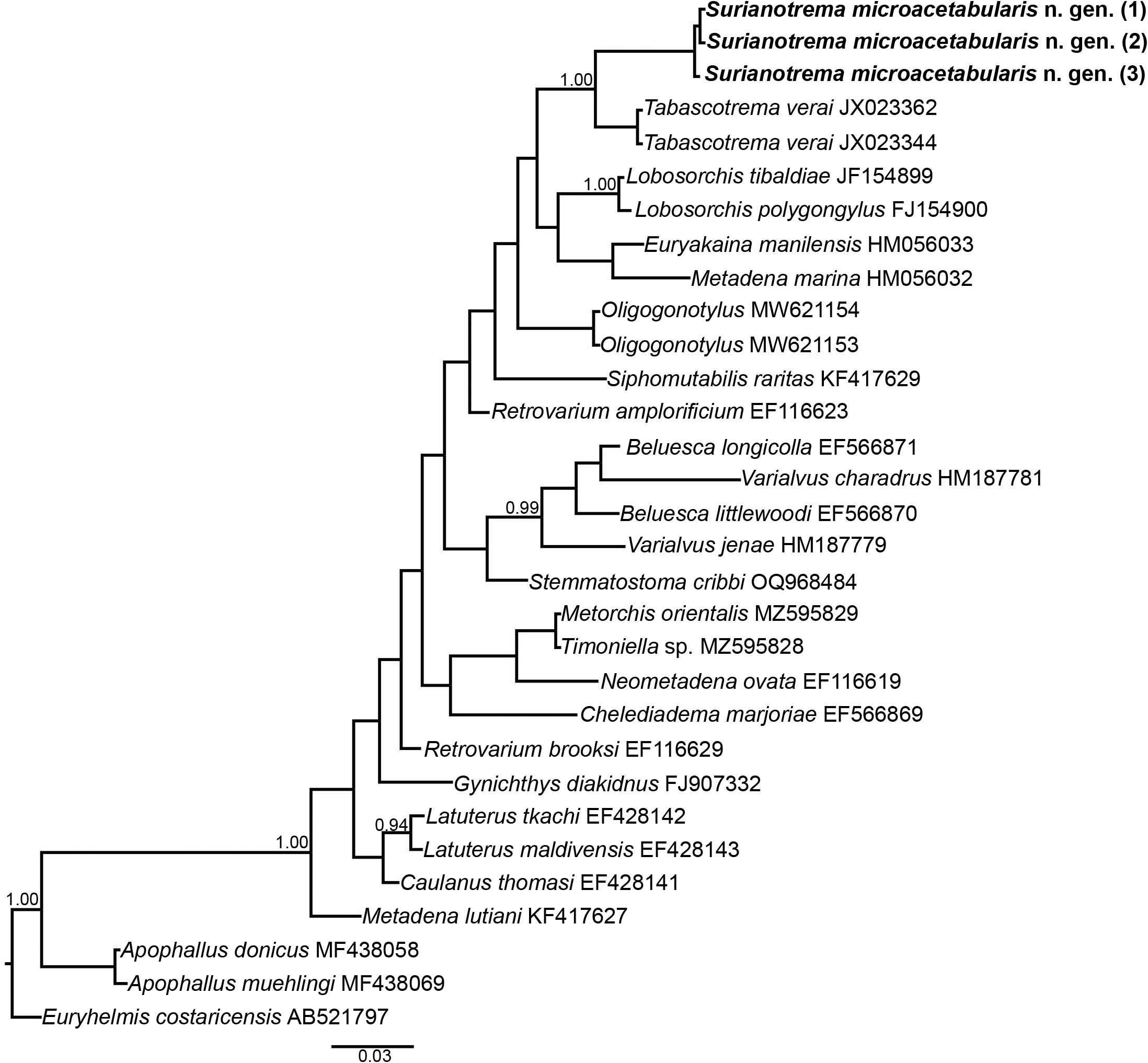
The ITS sequences grouped the present species (Fig. 2) closely with T. verai, followed by Lobosorchis tibaldie Miller & Cribb, 2005; Lobosorchis polygongylus Miller, Downie & Cribb, 2009; Euryakaina manilensis (Velasquez, 1961) Miller, Adlard, Bray, Justine & Cribb, 2010; and Metadena marina (Haffezullah & Siddiqi, 1970) Miller & Cribb, Reference Miller, Cribb, Bray, Gibson and Jones2008. Table 2 presents the genetic distances and nucleotide differences with the most closely related species, showing lower values with T. verai and Oligogonocotylus sp.
Phylogram resulting from Bayesian Inference (20,000,000 generations) of partial ITS1-5.8S-ITS2 rDNA gene sequences showing the relationships of Surianotrema microacetabularis n. gen. n. comb. (Suriano & Martorelli, Reference Suriano and Martorelli1983) with other genera of the Cryptogonimidae. Branch support values indicate posterior probabilities. Abbreviations (1) = PQ963361, (2) = PQ963362, (3) = PQ963363

Genetic divergence and nucleotide difference using the ITS rDNA among Cryptogonimidae species closely related with Surianotrema microacetabularis n. gen. n. comb. used in the phylogenetic. Below the black diagonal, the genetic distance estimated through uncorrected p-distances with gaps/missing data treatment as partial deletion using MEGA X, and above, the nucleotide differences. The new genus is in bold

The COI sequence (PQ966569) grouped the present species with Siphoderina hustoni Martin & Cutmore, 2022, and Siphoderina nana Yong, Martin & Smit, 2023. Table 3 presents the genetic distance and nucleotide difference with the most closely related species, S. hustoni and S. nana. There are another COI sequences of cryptogonimids deposited in GenBank, but the alignments show that there are not homologues to the one obtained here.
Genetic divergence and nucleotide difference using the COI mtDNA among Cryptogonimidae species closely related with Surianotrema microacetabularis n. gen. n. comb. used in the phylogenetic. Below the black diagonal, the genetic distance estimated through uncorrected p-distances with gaps/missing data treatment as partial deletion using MEGA X, and above, the nucleotide differences. The new genus is in bold

Surianotrema n. gen. Montes, Barneche, Martorelli.
Zoobank: urn:lsid:zoobank.org:act:853A82A3-F510-4BE8-AC03-5FCC9C9DF785
Diagnosis: Body oval to elongate-oval with spines; length:width ratio c. 1.40–2.16. Oral sucker transversely elongated, shorter than wide, without enlarged oral spines, opens terminally. Sucker-width ratio c. 1:0.40–0.71. Forebody c. 22–37% of body-length. Prepharynx and oesophagus very short. Intestinal bifurcation anterior to ventral sucker. Caeca blind, end in mid-hindbody posterior to testes. Testes two, symmetrical, in last third of hindbody. Seminal vesicle saccular. Gonotyl absent. Ovary deeply lobed, anterior to testes in anterior hindbody. Uterus in hindbody, reaching posterior extremity. Vitelline follicles between pharynx and ventral sucker. Excretory vesicle Y shaped. In brackish waters (Pleuronectiformes: Paralichthyidae). Type-species Surianotrema microacetabularis (Suriano & Martorelli, Reference Suriano and Martorelli1983) n. comb.
Surianotrema microacetabularis n. comb. Montes, Barneche, Martorelli (Supplementary Material)
Syn. Steringotrema microacetabularis Suriano & Martorelli, Reference Suriano and Martorelli1983,
Bacciger microacetabularis (Suriano & Martorelli, Reference Suriano and Martorelli1983) Alarcos, Etchegoin & Cremonte, Reference Alarcos, Etchegoin and Cremonte2008
Description
Measurements (Table 4) based on 14 whole mounted specimens. Body ovoid, elongate (Fig. 3a), length:width ratio 1.94–2.41, Body-surface spined. Eye-spot pigment present. Oral sucker subglobular, subterminal. Prepharynx short, not observed in all specimens. Pharynx present. Oesophagus very short. Intestinal bifurcation anterior to ventral sucker. Intestinal caeca blind, parallel to lateral margins of body, ending near posterior end of body. Forebody smaller than hindbody. Ventral sucker smaller than oral sucker. Sucker-width ratio 1,5–2,0. Forebody 32–38 % of body length. Testes rounded to oval, symmetrical to slightly oblique, in mid-hindbody. Seminal vesicle tri-partite. Gonocotyl absent. Genital pore ventro-medial, close to anterior margin of ventral sucker (Fig. 3b). Ovary lobate, pretesticular. Uterus mainly posttesticular. Metraterm weakly developed. Vitelline follicles in separate lateral groups, extending from oesophagus to ovarian region. Eggs numerous, operculate. Excretory vesicle Y-shaped. Excretory pore terminal (not drawn).
Comparison among measurement of digeneans found in Paralichthys orbignyanus Valenciennes, according to the different names proposed by Suriano and Martorelli (Reference Suriano and Martorelli1983), Alarcos et al. (Reference Alarcos, Etchegoin and Cremonte2008) and this study

(a) Surianotrema microacetabularis n. gen. n. comb. ventral view; (b) terminal genitalia. Scale bars: (a) = 65 μm (b)=50 μm

Taxonomic summary
Type host: Flounder, Paralichthys orbignyanus Valenciennes(Pisces, Paralichthyidae).
Site: Intestine.
Type Locality: Mar Chiquita coastal lagoon, Buenos Aires Province, Argentina (37°32´ to 37°45´S, 57°19´ to 57°26´W).
Other Locality: San Clemente (Tapera de Lopez), Buenos Aires Province, Argentina ((36°19´S, 56°45´W).
Prevalence: 68% (according to Alarcos et al. Reference Alarcos, Etchegoin and Cremonte2008) and 100% (N=3, this study)
Mean intensity and range: 187 (1–1782, according to Alarcos et al. Reference Alarcos, Etchegoin and Cremonte2008).
Type material: Collection of Helminthology of the Museo de La Plata (MLP-He), La Plata, Argentina, MLP-He 6424 Steringotrema microacetabularis Suriano & Martorelli, Reference Suriano and Martorelli1983. Specimens examined: Voucher specimens deposited under the numbers MLP-He No. 5866 (Alarcos et al. Reference Alarcos, Etchegoin and Cremonte2008), 8133 (new material from Suriano and Martorelli Reference Suriano and Martorelli1983), 8134 (this study).
Etymology: The genus name honours Dra. Mabel Suriano, the PhD advisor of Sergio Martorelli, founder of the Laboratory of Fish, Mollusk, and Crustacean Parasites at CEPAVE.
Remarks
The new specimens found in the flounder from Tapera de López fall within the range of the measurements provided by Alarcos et al. (Reference Alarcos, Etchegoin and Cremonte2008) in their redescription and reclassification of Steringotrema microacetabularis to Bacciger microacetabularis.
Suriano and Martorelli (Reference Suriano and Martorelli1983) originally classified these digeneans as belonging to the family Fellodistomidae based on several morphological characteristics: smooth tegument lacking spines, a subterminal oral sucker, absence of a prepharynx, a well-developed pharynx, a short oesophagus, two caeca reaching the testes, two oval postovarian testes, a well-developed cirrus sac containing a bipartite seminal vesicle, a median trilobate ovary posterior to the ventral sucker, a uterus extending posteriorly to the testes, and numerous small operculate eggs. The vitelline follicles were limited in their distribution.
Alarcos et al. (Reference Alarcos, Etchegoin and Cremonte2008) redescribed the species, transferring it to the genus Bacciger within the family Faustulidae (now Baccigeridae). They added or modified several traits from the original description by Suriano and Martorelli (Reference Suriano and Martorelli1983), including a spinose tegument, a short prepharynx, intestinal caeca extending near the posterior end of the body (rather than the testicular level), and vitelline follicles extending from the oesophagus to the ovarian region (as opposed to being restricted to the preovarian region). Additionally, Alarcos et al. (Reference Alarcos, Etchegoin and Cremonte2008) noted differences between the digeneans they found and other Bacciger species, such as longer intestinal caeca reaching the posterior end of the body, vitelline follicles extending into the ovary region rather than being restricted to the forebody, testes located in the posterior half of the hindbody rather than being confined to hindbody, and an elongated cirrus sac rather than an oval one. The new fresh specimens, and the reevaluation of the type material of Suriano and Martorelli (Reference Suriano and Martorelli1983) and Alarcos et al. (Reference Alarcos, Etchegoin and Cremonte2008), the cirrus sac is not observed, and we reinterpreted the ‘seminal receptacle’ as part of the seminal vesicle. These characteristics suggest a closer affinity with the Cryptogonimidae.
Within the Cryptogonimidae family, the species should be compared with genera lacking spines in the oral sucker, as described in Miller and Cribb (Reference Miller, Cribb, Bray, Gibson and Jones2008) and subsequent publications. The new genus has two testes, differentiating it from Retrobulla Cribb, 1985, which has only one testis, as well as Grandifundilamena Bray, Kmentová and Georgieva, 2020; Iheringtrema Travassos, 1947; Polyorchitrema Srivastava, 1939; Siphodera Linton, 1910; and Siphomutabilus Miller & Cribb 2013, all of which have more than two testes.
Surianotrema n. gen has blind caeca, in contrast to those with caeca opening separate in an ani or via uroproct, such as Mitotrema Manter, 1963; Opistognathotrema Machida, 2009; and Orientodiploproctodaeum Bhutta & Khan, 1970. Additionally, the caeca of the new genus extend posterior to the testes, contrasting with Caecincola Marshall & Gilbert, 1905; Campechetrema Lamothe-Argumedo, Salgado-Maldonado & Pineda-López, 1997; Centrovarium Stafford, 1904; and Tabascotrema Lamothe-Argumedo & Pineda-López, 1990, where the caeca end anterior to or at the same testes level.
Surianotrema n. gen. lacks a gonotyl, distinguishing it from Andrincola Zhang and Yang, 1993; Cicesetrema Pérez-Ponce de León, Castillo-Sanchez & Rosales-Casián 1999; Cryptogonimus Osborn, 1903; Gonacanthella Sogandares-Bernal, 1959; Gynichthys Miller & Cribb, 2009; Multigonotylus Prembati, 1967; Oligogonocotylus Watson, 1976; and Turgecaecum Sullivan, 1975.
The new genus has an oval to elongate body, and the uterus is not extensive in the forebody, separating it from Allometadena Madhavi, 1976 and Stegopa Linton, 1910.
The lobed ovary of Surianotrema n. gen. contrasts with the entire ovary of Claribulla Overstreet, 1969, and Neocladocystis Manter & Pritchard, 1969, and the acinous ovary of Mehravermis Machida, 2009. The median position of the ovary further differentiates Surianotrema n. gen. from Andritrema Zhang & Yang, 1993. The uterus in the new genus extends well into the post-testicular zone, distinguishing it from Aphalloides Dollfus, Chabaud & Golvan, 1957; Isocoelium Ozaki, 1927; and Paraisocoelium Ozaki, 1932.
The symmetrical to slightly oblique testes of Surianotrema n. gen. contrast with the tandem arrangement found in Aphallus Poche, 1926; Biovarium Yamaguti, 1934; Bolbogonotylus Font, 1987; Diplopharyngrema Yamaguti, 1958; Isocoelioides Zhukov, 1971; Perlevilobus Bray 2008; Serpentoanisocladium Tkach & Bush, 2009; Tanganyikatrema Kmentová, Georgieva & Bray, 2020; and Textrema Dronen, Underwood & Suderman, 1977.
The anterior margin of the testes does not enter the forebody and is not extracecal in the new genus, unlike Exorchis Kobayashi, 1921. The eggs of Surianotrema n. gen, are not triangular and lack polar filament as seen in Mehrailla Srivastava, 1939.
The oral sucker is nearly round and <70% of body within Surianotrema n. gen. differentiates it from Pseudocryptogonimus Yamaguti, 1958. The forebody of the new genus is less than 45% of the body length, contrasting with Olmeca Lamothe-Argumedo & Pineda-López, 1990, where the forebody exceeds 50%. In Surianotrema n. gen., the ventral sucker is smaller than the oral sucker, unlike in Pseudometadena Yamaguti, 1952, where the ventral sucker is slightly larger. Finally, Metadena Linton, 1919, with caeca extending well posterior to the testes, and Palaeocryptogonimus Szidat, 1954, with caeca ending slightly posterior to the testes and vitelline follicles confined to the region around the ventral sucker in freshwater fishes, are distinct from Surianotrema n. gen. While the last genus is more similar to the new genus, its uterus does not extend to the posterior extremity, and parasitizes freshwater cichlids and doradids.
According to genetic data, the closest genera to the newly described genus Surianotrema are Oligogonotylus, Orientodiploproctodaeum, Caecincola, and Tabascotrema. Therefore, we analysed in detail the morphological and ecological differences among these genera. The body length-to-width ratio is greater in Oligogonotylus and Tabascotrema (greater than 2.5) compared to Surianotrema n. gen. (less than 2.5). The forebody, as a percentage of total body length, is larger in Tabascotrema (40%) than in Oligogonotylus, Orientodiploproctodaeum, and Caecincola, which overlap with the range observed in the new genus (32–38%). The ventral sucker is embedded within the ventrogenital sac in Orientodiploproctodaeum and Caecincola, but this feature is absent in Tabascotrema and Surianotrema n. gen. The sucker width ratio is smaller in Oligogonotylus (1–1.5) and Tabascotrema (1.0), larger in Orientodiploproctodaeum (2–3) and Caecincola (3–3.5), and intermediate in the new genus (1.5–2.0). The testes are arranged in tandem in Oligogonotylus, intracaecal and oblique in Orientodiploproctodaeum, and oblique in Tabascotrema, whereas they are symmetrical to slightly oblique in Caecincola and Surianotrema n. gen. The seminal vesicle is tubular-saccular in Oligogonotylus, tubular in Orientodiploproctodaeum, and saccular in Caecincola, Tabascotrema, and Surianotrema n. gen. The saccular vesicle is bipartite in Caecincola but tripartite in the new genus. The gonocotyl is present in Oligogonotylus but absent in Caecincola, Tabascotrema, and Surianotrema n. gen. In Orientodiploproctodaeum, the gonocotyl may be absent or present as a muscular lobe. The vitelline follicles extend from the posterior testis to the anterior ventral sucker in Oligogonotylus, are extracaecal and run from the posterior extremity to slightly anterior to the ventral sucker in Orientodiploproctodaeum, and extend from the oral sucker to the posterior margin of the ventral sucker in Caecincola. In Tabascotrema, they extend from the posterior margin of the ventral sucker to the level of the oesophagus. In contrast, in Surianotrema n. gen., the vitelline follicles extend from the anterior margin of the testis to the caecal bifurcation, just posterior to the pharynx. Orientodiploproctodaeum is further distinguished by the oral sucker being surrounded by a large collar and opening terminally (versus subterminally in other genera), as well as by the caeca opening via separate ani at the posterior extremity. In the other genera, the caeca are blind. Caecincola differs by having a constriction immediately posterior to the oral sucker, which is funnel-shaped and wider than long. The caeca are blind and do not extend posteriorly beyond the testes. Tabascotrema is differentiated by the intestinal bifurcation occurring in the mid-forebody, the caeca ending at the level of the testes, a deeply lobed ovary forming a transverse band, and occupying more than half of the body width.
The hosts parasitized by these digeneans, and localities, are also distinct. Caecincola is found in freshwater fishes (Centrarchidae) from North America. Oligogonotylus infects freshwater fishes (Cichlidae and Characidae) in Middle America. Orientodiploproctodaeum occurs in marine and euryhaline fishes (Lutjanidae, Sciaenidae, and Scombridae) from the Indian Ocean and adjacent rivers, and Tabascotrema parasitizes only cichlids in Middle America. In contrast, Surianotrema n. gen. was discovered in a brackish or marine fish from South America.
Discussion
This study clarifies the correct affiliation of this parasite, illustrating how new information can shift perspectives and how poorly preserved material can lead to misclassification. The conclusion reached by Suriano and Martorelli (Reference Suriano and Martorelli1983), placing the species in Steringotrema within the family Fellodistomidae, was logical based on the available specimens in which the spines had not been observed. Later, Alarcos et al. (Reference Alarcos, Etchegoin and Cremonte2008), examining better-preserved specimens, identified additional features like a spinous tegument, prompting their reclassification of the species as Bacciger in the Baccigeridae family. Up to the present study, the parasite’s taxonomic placement remained uncertain until molecular analyses were conducted. Now, the new data revealed that its characteristics align with the Cryptogonimidae family, leading to the proposal of a new genus.
This study increases the number of known genera in the Cryptogonimidae family in South America to seven: three in freshwater environments (Iheringtrema from Brazil, Parspina Pearse, 1920 found in Argentina, Brazil, and Venezuela, and Palaeocryptogonimus from Argentina and Brazil) and four in marine environments (Annakohniella Fernandes, Cohen, Mendonça & Justo, 2013 from Brazil, Metadena from Venezuela, Brazil, and Colombia, Siphodera from Colombia and Venezuela, and Surianotrema n. gen.).
However, the number of sequenced genera of Cryptogonimidae family from South America remains limited. Among these, Surianotrema n. gen. is the only genus that has been sequenced. Obtaining more molecular data is crucial to better understand the phylogenetic relationships between genera within this family, and particularly in South America.
Considering the ecological niche of the definitive host, P. orbignyanus, infection likely occurs due to active predation on the intermediate host. This flounder inhabits sandy bottoms at depths of up to 20 m and is the largest species in its genus in the South Atlantic Ocean (Bianchini et al. Reference Bianchini, Robaldo and Sampaio2010, Figueiredo and Menezes Reference Figueiredo and Menezes2000). It has a wide range of prey, being opportunistic and feeding on fish, shrimp, and crabs (Cazorla and Forte Reference Cazorla and Forte2005). While the use of other food items, such as jellyfish, is not documented, they are easily digested and may serve as potential intermediate hosts for Surianotrema n. gen. metacercariae (Aria et al. Reference Aria, Welch, Dumsmuir, Jacobs and Ladouceur2003; Marques et al. Reference Marques, Bouvier, Darnaude, Molinero, Przybyla, Soriano, J-A and Bonnet2016).
In conclusion, the reexamination of Bacciger microacetabularis – previously classified as Steringotrema – through molecular tools, including sequencing of the 28S, ITS, and COI genes, has provided insights that support the establishment of a new genus, Surianotrema, within the Cryptogonimidae family. This reclassification contrasts with its former placements in the families Fellodistomidae and Baccigeridae.
Supplementary material
The supplementary material for this article can be found at http://doi.org/10.1017/S0022149X25000239.
Availability of data and material
All the material will be deposited in Museums and the sequences deposited on GenBank.
Code availability
Not applicable.
Acknowledgements
We are grateful to CEPAVE for providing laboratory facilities, to CONICET and FONCYT for providing grants to the authors, and to Ministerio de Medio Ambiente de la Provincia de Buenos Aires for providing collection permits (DI-2019-49-GDEBA-DANPOPDS).
Author contribution
Martin Miguel Montes: conceptualization, writing original draft; Jorge Barneche: data curation, investigation, methodology; Tomas Acuña Gonzalez: investigation; Gaston Cavallo: methodology; Marina Ibañez Shimabukuro: formal analysis, writing review and editing; Melisa Moncada: formal analysis, writing review and editing; Sergio Martorelli: supervision, writing review and editing.
Financial support
This research was supported by the Consejo Nacional de Investigaciones Científicas y Técnicas (M.M.M grant number PIP 11220200101713CO) and Fondo para la Investigación Científica y Tecnológica (FONCyT) (M.M.M., grant number PICT-2020-SERIEA-01531).
Competing interest
On behalf of all authors, the corresponding author states that there is no conflict of interest.
Ethical standard
The authors assert that all procedures contributing to this work comply with the ethical standards of the relevant national and institutional guides on the care and use of laboratory animals.
Consent to participate
All the authors give their consent to participate in this work.
Consent for publication
All the authors give their consent to the publication of this work.