Introduction
States use access to the labour market not only as a labour market policy instrument, but also as a tool in asylum policies, i.e. to deter potential asylum seekers, incentivise those who arrived to obtain identity documents and unsuccessful claimants to return (cf. Valenta and Thorshaug, Reference Valenta and Thorshaug2013). The common practice of receiving countries to restrict the right to work for asylum seekers comes at individual and societal costs: for instance, employment bans have been found to be detrimental for integration (Marbach et al., Reference Marbach, Hainmueller and Hangartner2018). This article argues that in order to understand the extent to which access to the labour market has become a token in asylum and return policies we need to study local policy implementation. This article investigates labour market access policies for migrants with precarious legal status and their implementation, and specifically the under-researched role that ideas of deservingness play in this field. It uses deservingness criteria as a heuristic tool to trace immigration officials’ legitimations of how they sort migrants into hierarchies of opportunities to remain and regularise via employment.
Deservingness has featured more or less prominently in parts of the migration attitudes and ethnic discrimination literature (e.g. Bansak et al., Reference Bansak, Hainmueller and Hangartner2016; Thomann and Rapp, Reference Thomann and Rapp2018) as well as in the literature on migration policy implementation (e.g. Asad, Reference Asad2019; Ataç, Reference Ataç2019). It is also well established that deservingness is a central motif of public and political debates on migration; and political and media discourse regularly classifies ‘good’ vs. ‘bad’ migrants (Holmes and Castañeda, Reference Holmes and Castañeda2016; Holzberg et al., Reference Holzberg, Kolbe and Zaborowski2018; Laubenthal, Reference Laubenthal2019). Previous studies also highlight how migration law has inbuilt ideas of deservingness, functioning as moral yardsticks differentiating who should ‘belong’ (Ellermann, 2014; Schammann, Reference Schammann2017; Will, Reference Will, Arslan and Bozay2019). Yet, the question of how this translates into practice, i.e. how this shapes policy implementation, has been side-lined by most studies (Eule et al., Reference Eule, Borrelli, Lindberg and Wyss2019). This article aims at addressing this lacuna. In particular, it seeks to answer the research questions: which conceptions of deservingness accompany the implementation of labour market access policies; and how do immigration officials frame the (un)deservingness of work permit applicants?
Thereto, the article applies deservingness criteria originally developed in the context of welfare receipt (van Oorschot, Reference van Oorschot2000) to the case study of labour market access for migrants in Germany. As a major receiving country of asylum applications and with an institutional set-up of relatively autonomous municipal immigration offices, Germany seems an apt case. Deciding about work permit applications constitutes a central part of the day-to-day work of officials in German immigration offices. As employment can constitute a step toward legalisation of status, the decision is essentially about a chance of societal membership (Schultz, Reference Schultz2020b). The article takes into account the wider public and political discourse around asylum policies and regularisation of rejected asylum seekers in Germany, arguing that this context is crucial for understanding how ideas about deservingness shape implementers’ work (Lipsky, Reference Lipsky2010). It then analyses deservingness conceptions built into the relevant parts of the law, and, using interview data collected in late 2017, investigates how immigration officials refer to ideas of deservingness.
The article seeks to contribute to the literature on migration politics in several ways: theoretically, it argues for connecting research on deservingness conceptions in public discourse, legal texts and policy implementation. Methodologically, its qualitative research design offers in-depth insights into the otherwise hard-to-access world of immigration officials, who are responsible for deciding about labour market access of certain migrant groups. Empirically, it offers novel evidence for the role of deservingness conceptions in such implementation environments. It finds that immigration officials frequently refer to applicants’ law-abidingness and economic self-reliance as deservingness criteria, which already appear in the relevant parts of the law. However, deservingness frames employed by immigration officials go beyond those laid down in the law that they have to implement. The article shows how looking at migration policy implementation from the angle of (un)deservingness without losing sight of the broader legal and discursive context can help advance understanding of the complex processes of differential in- and exclusion in countries of immigration.
Conceptualising deservingness and its role in migration politics and the Residence Law
Conceptions about what is fair and who deserves what are central to human cognition and shape human behaviour, and likely also the work of immigration officials. In his seminal book, Lipsky (Reference Lipsky2010) emphasised that clients are socially constructed in the interaction with bureaucrats; his account of officials carrying expectations about ‘proper’ client behaviour hints at the potentially decisive role of deservingness conceptions in policy implementation. Footnote 1 Surprisingly, however, most research on migration policy implementation hardly addresses the question of deservingness. Eule et al. (Reference Eule, Borrelli, Lindberg and Wyss2019: 214–9), however, found ‘selective shifting between deeming migrants worthy and unworthy […] in all studied agencies’ in their ethnography of migration control in eight European countries. They provide illustrative insights into how deservingness categorisations of street-level bureaucrats are informed by their societally shaped ideal conception of appropriateness and at the same time challenge their ideals of professionalism that prescribe unbiased decision-making. It is unclear how these conceptions of appropriateness link with the five criteria famously spelled out by van Oorschot (Reference van Oorschot2000) in the context of welfare receipt, i.e. control, attitude, reciprocity, identity, and need (CARIN). This article seeks to shed light on this question, comparing the deservingness conceptions emerging from qualitatively collected data with the mostly deductively emerged CARIN criteria.
The case study used here concerns deservingness perceptions regarding migrants’ labour market integration and regularisation, i.e. more broadly, civic membership. As Ellermann (2014: 296) denotes, ‘notions of civic membership typically reflect moral and behavioural assumptions about who is—and who is not—a good citizen.’ In Europe, the ideal of the ‘good citizen’ seems incorporated by the economically self-reliant individual contributing to society (cf. Bonjour and Duyvendak, Reference Bonjour and Duyvendak2018). Self-reliance and economic usability is a key driver of increased integration policy efforts in European countries in line with neoliberal activation policies (Joppke, Reference Joppke2007). The idealised image of the diligent, contributing citizen that non-citizens should resemble shows that the broader socio-political context matters for how conceptions of (un)deservingness develop (cf. Willen, Reference Willen2012).
How policy implementers respond to their clients may be shaped by how these clients are socially constructed as a group (Schneider and Ingram, Reference Schneider and Ingram1993). In the words of Lipsky (Reference Lipsky2010: 109), ‘there is every reason to think that the general evaluations of social worth that inform the society will also inform the decisions of street-level bureaucrats’. The social worth of immigrants is often framed dichotomously. One and the same person crossing the Mediterranean Sea can be called an ‘economic migrant’ and hence undeserving or a ‘war refugee’ deserving of help and protection (cf. Holmes and Castañeda, Reference Holmes and Castañeda2016). In Germany, narratives alternately emphasising ‘good’ vs. ‘bogus’ asylum seekers already prevailed in the 1990s in the context of rising asylum applications during the Balkan Wars (Laubenthal, Reference Laubenthal2019). More recently, German discourse and practice regarding the reception of asylum seekers in and beyond the 2015/2016 ‘refugee crisis’ have been described as ambivalent and dynamic (Holmes and Castañeda, Reference Holmes and Castañeda2016; Vollmer and Karakayali, Reference Vollmer and Karakayali2018). The discourse in German media and politics focused primarily on what refugee reception would mean for the country, i.e. security concerns and, more prevalently, the economic usability of asylum seekers and refugees (Holzberg et al., Reference Holzberg, Kolbe and Zaborowski2018). In recurring statements, leading politicians and economic actors stressed that refugees would mean an asset to the German labour market, with business associations actively lobbying for liberalising asylum seekers’ access to work and vocational training (Laubenthal, Reference Laubenthal2019). Footnote 2
Ideas of (un)deservingness can also be found in the relevant parts of German immigration law. This starts with the use of labels for target groups of policies: as Schneider and Ingram (Reference Schneider and Ingram1993: 334) claimed, ‘the social construction of target populations has a powerful influence on public officials’. In the present case study, the official legal term ‘toleration’ (Duldung) already entails a notion of undeservingness – ‘tolerated’ persons’ residence in Germany is endured, not welcome. Labels matter for how obligated societies and individuals feel toward asylum seekers (Sigona, Reference Sigona2018), they make way for a ‘moral demarcation’ (Holmes and Castañeda, Reference Holmes and Castañeda2016: 17) between the deserving and the undeserving. Recent reforms to streamline the German asylum system arguably exacerbated this trend. Since 2009, and more thoroughly 2014, several legislative changes have selectively facilitated labour market access of certain subgroups of asylum seekers and refugees. Thereby, a ‘hierarchy of deservingness’ (Holmes and Castañeda, Reference Holmes and Castañeda2016: 19) became established. For instance, the administrative category of the ‘prospect of staying’ differentiates asylum applicants according to their country of origin in those likely to be granted a protection status and those likely not (Schultz, Reference Schultz2020a). While the first receive earlier access to (economic) integration measures, several restrictive measures were introduced for the latter (Will, Reference Will, Arslan and Bozay2019).
The increasingly apparent focus on employability and integration of those likely to stay had its precedent in earlier changes in integration and labour migration policies. Discursive concepts previously used in labour immigration contexts were now applied to the refugee population, such as ‘welcome culture’; and the objective to select based on usability, inherent in German labour immigration policies since the 2000s, has spilled over to the asylum realm (Laubenthal, Reference Laubenthal2019). Holzberg et al. (Reference Holzberg, Kolbe and Zaborowski2018: 536) argue that this even culminated in ‘the pursuit of the national economic interest [being] now reframed as a humanitarian issue, and thus recast[ing] employment as a charitable action towards people in need of protection’. Already since 2005, utility considerations and meritocracy have increasingly played an important role in German asylum and foreigners law, with integration efforts and achievements being remunerated with residence rights (Schammann, Reference Schammann2017; Will, Reference Will, Arslan and Bozay2019). Several policy reforms aimed at reducing the number of persons in the precarious ‘toleration’ status. While the driving forces behind the first ‘right-to-remain regulations’ (Bleiberechtsregelungen) introduced in the middle of the 2000s were primarily humanitarian, applicants already needed to fulfil criteria of economic self-sustainability (Ellermann, 2014). Footnote 3 Since then, the focus of regularisation programmes on economic objectives has arguably become stronger (Kraler, Reference Kraler2019).
In short, German immigration law and public discourse regarding migrants exhibit a strong emphasis on economic usability criteria and reciprocity, and this seems neither detached from the general European discourse unfolding in the wake of the ‘refugee crisis’ nor from the country’s own immigration history. The example shows how deservingness conceptions are intricately linked to processes of sorting and othering inherent to migration policies.
Case and methodology
The target group of this case study are two subgroups of migrants with precarious legal status, asylum seekers whose application is still pending, and persons holding a so-called ‘toleration’, i.e. a temporary suspension of deportation. Of the latter, many are former asylum seekers whose application has been finally rejected, but who cannot be returned to their country of origin (see for details regarding this status in Germany and elsewhere FRA, 2011; Rosenberger and Küffner, Reference Rosenberger, Küffner, Hsu and Reinprecht2016; Schultz, Reference Schultz2020b). At the end of 2018, 296,060 persons with asylum decision pending and 180,124 ‘tolerated’ persons lived in Germany (publication of the German Parliament no. 19/8258; stock figures from 31/12/2018). I focus on asylum seekers and ‘tolerated’ persons as they do not have a prima facie right to work, but may receive a work permit for a specific position if they fulfil certain criteria. Thereto, they need to apply at their local immigration office, which processes each application individually. If the office does not object, it passes the application on to the federal agency of employment, which checks for labour market relevant reasons to then approve or deny the application. In 2017, the federal agency for employment decided about 14,401 applications for work permits by ‘tolerated’ persons (2016: 13,594), and about 117,601 by asylum seekers (2016: 102,793) (Bundesagentur für Arbeit, 2017). Footnote 4 German immigration offices have relatively high administrative autonomy, and previous research found considerable variation in how they implement immigration law (Eule, Reference Eule2014; Bauer and Schreyer, Reference Bauer and Schreyer2019).
The empirical data used in this article was collected primarily in autumn 2017, when semi-structured interviews were conducted face-to-face with heads of departments or senior officials in eleven municipal immigration offices in a selected Eastern German Land. Footnote 5 Twenty-five interviews were conducted, fourteen of which were additional background interviews with stakeholders and experts. Despite the relatively small sample size of eleven core interviews, interviewees’ mostly congruent answers to many questions provide a basis to assume saturation was reached (Barglowski, Reference Barglowski, Zapata-Barrero and Yalaz2018). Footnote 6 Confidentiality was ensured to interviewees; therefore, the exact places of research are not disclosed. Footnote 7 The general topic of the interviews was labour market integration of asylum seekers and ‘tolerated’ persons; interviewees were not directly asked any deservingness-related questions. Interviews were recorded, transcribed and coded with MAXQDA using a mixed approach, applying both theory-derived pre-given and open codes generated in the process. The CARIN criteria were used as pre-defined codes. Interviews were conducted in German, and quotations used as illustrations in this article were translated into English by the author.
Deservingness conceptions in immigration offices
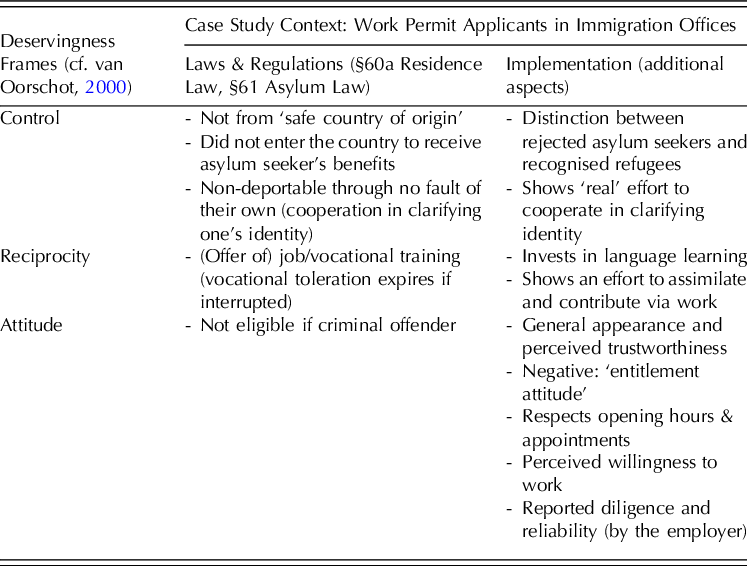
Both in the relevant legal texts and in policy implementation, deservingness conceptions resembled the CARIN criteria. For the purpose of this article, I focus on three of them: control, i.e. to what extent can the person be blamed for being in their current position; reciprocity, i.e. to what extent does the person contribute to societal goods; and attitude, i.e. how does the person appear, how compliant, likeable or thankful are they. Table 1 details how these three deservingness frames figure both in the relevant legal regulations and in the implementation context beyond.
Deservingness Criteria and Operationalisation in Case Study Context

Source: own compilation.
Deservingness conceptions consistent with legal requirements
Whether a person is considered responsible for the situation that they are in (control) matters in the parts of the Residence Law relevant for this case study. One of the conditions in particular is described as of major importance by officials; it requires careful individual judging: the condition of cooperation with return, a central tool in internal migration control implementation (Rosenberger and Koppes, Reference Rosenberger and Koppes2018). A ‘tolerated’ person is only eligible for a work permit if the reason why they cannot be deported is not self-inflicted, i.e. if they cooperate in clarifying their identity and obtaining identity papers. The right to work has become instrumental in asylum and return policy here, used as a motivation for migrants to document their identity, a precondition for enforcing their return (cf. Valenta and Thorshaug, Reference Valenta and Thorshaug2013). A typical description of how this conditionality-approach is implemented reads as follows:
If they want something, then we will make it possible for them, but we tell them, you have to participate if you want anything. (Off9)
Evaluating whether someone exhausts all available and reasonable options to receive identity documents is not a trivial task, however. The overwhelming majority of immigration officials interviewed identified cooperation with return as the major obstacle in work permit application cases by ‘tolerated’ persons, and several described determining whether someone cooperates sufficiently as challenging and tainted with insecurity (Off2, Off3, Off5, Off6, Off8). It emerges from the interviews that immigration officials seem to judge whether someone has made a ‘real’ effort to obtain identity documents. They acknowledge, however, that because of individual or institutional obstacles this effort does not always lead to success. There seem to be more and less generous approaches toward this issue, with one official explaining that ‘the defendant shall be given the benefit of the doubt’ (Off8). Other officials (Off4, Off6, Off7, Off10) mention that they require proof – for instance, a witness’ account – to demonstrate e.g. that the embassy sent the person away empty-handed. Another requirement in the law that is similarly hard to prove or disprove is that a person cannot receive a work permit if they entered the country to receive asylum seeker’s benefits, so in other words, if the asylum application is fraudulent. The criterion of control hence seems to be closely interlinked with the attitude frame (see below), in that the demeanour of the client and their perceived credibility seems to play a role for officials’ assessment of whether or not the client has done enough for them to be able to check the ‘cooperation with identity clarification’ box.
Next to control, the reciprocity criterion proved important in the case study context. Just as the control criterion, the focus on reciprocity derives from the law, which requires a concrete job offer or a vocational training placement as a precondition for obtaining a work permit. One immigration official shares their ‘personal opinion [… that] being employed means that they don’t live off welfare anymore’, which is why said official would be ‘always open-minded toward the topic [of the work permit]’ (Off8). Similarly, several of the officials interviewed say they acknowledge efforts to invest in language training and finding a job or vocational training placement, and that this indeed weighs in favour of an applicant’s work permit application (Off4, Off5, Off6, Off9, Off10). A typical remark about this connection reads as follows:
If someone really tries […], they also voluntarily participate in German language courses. Those who demonstrate, they want to integrate somehow and then also has already spoken to an employer, […] then that is all fine in my view. (Off10)
Investing in language training seems to be taken as a sign for making an effort and the client’s general ‘willingness’ to integrate (Off2, Off3, Off4, Off7, Off8, Off10), which is in line with earlier research on individual attitudes toward migrants (Hopkins, Reference Hopkins2015). Immigration officials seem to have adopted the ideal of the hard-working person contributing to society; shown above to be a central motif of both asylum and foreigners’ policies and the public discourse.
Deservingness conceptions beyond legal requirements
The interview data revealed that not only criteria deriving from the legal text play a role for officials’ deservingness conception. Although hardly featuring in the relevant law, the attitude criterion seemed decisive for shaping ideas about whether migrants deserve access to the labour market. A client’s demeanour and their perceived credibility appeared to co-determine officials’ assessment of whether a client has done enough to meet criteria mentioned above, such as ‘cooperation with identity clarification’. The case study data thus confirmed that street-level bureaucrats have expectations about the ‘proper’ behaviour of their clients (Lipsky, Reference Lipsky2010). ‘Attitude’ as a deservingness criterion came up in all core interviews. This entails remarks on how clients should adhere to general rules such as opening hours and keeping appointments (Off2, Off3, Off4), and on how clients are expected to be compliant, i.e. ‘play by the rules’ and demonstrate that they want to integrate and make an effort to assimilate, as highlighted in the following quotation:
We also have to do a lot for this, the colleagues receive intercultural training […], a welcome culture is being expected and we do all that willingly, but it has to come from the other side as well, it cannot be a one-way street. (Off5)
Similarly, officials criticise being put under too much pressure by clients and by potential employers; and two (Off4, Off10) report to find fault with what they perceive to be an ‘entitlement attitude’ of their clients. The quotation above also illustrates that when expressing behavioural expectations toward the client, several of the officials interviewed justify these with norms of reciprocity, which shows that it is often difficult if not arbitrary to distinguish neatly between the CARIN criteria. One of the senior officials reflects upon how behaviour and appearance make a difference:
There the human-factor comes into play. Depending on how the client asks, what he asks, you will have a different quality of answers. (Off11)
As mentioned above, several officials also speculated about migrants’ actual willingness to work (Off1, Off2, Off4, Off5). Some mention that they sometimes think finding employment or vocational training would be only a ‘sheet anchor’ to secure one’s residence rights (Off5, similarly Off10). One official, however, emphasises their impression that the majority of clients ‘really want to work’ (Off6, similarly Off1). These speculations allude to the perceived trustworthiness of clients, which seems to be another central element of the ‘attitude’ criterion. Officials expect clients to be credible and honest, this includes, for instance, their stated age (Off11) and the information they provide in respect to identity clarification (Off4). The thus partially insinuated strategic behaviour might be legal as in the case of applying for a work permit with the motive of securing one’s residence, but still appears to be judged by some immigration officials as morally less worthy than having incorporated the ideal of the hard-working, endeavouring citizen who quickly tries to find work or training. It seems that being intrinsically motivated to find employment is deemed morally superior to using work as a possibility to stabilise one’s residency status. This ‘suspicion of deceit’ was also found to be present in media and political discourse in the wake of the ‘refugee crisis’ in Germany (Holmes and Castañeda, Reference Holmes and Castañeda2016: 19), and links to accounts of the role of suspicion in migration policy implementation (cf. also Griffiths, Reference Griffiths2012; Magalhaes, Reference Magalhaes2016).
Strikingly, employers can play a role as mediators for immigration officials’ forming of deserving conceptions vis-à-vis their clients, with officials commending clients for being diligent and reliable employees according to their employers (Off6, Off11). Apparently, trustworthiness is less of an issue in bureaucrat-employer than in bureaucrat-client interactions, which might be explained by the shared socio-economic and ethno-cultural ‘identity’ of the latter. Employers can also support to solve deadlocks regarding identity clarification by establishing trust between immigration officials and migrants (Schultz, Reference Schultz2020b).
The following excerpt illustrates that welfare chauvinism may play a role in immigration officials’ considerations, too:
After the microphone was switched off, accompanying me to the building’s exit, the interviewee started speaking about the ‘social security hammock’ in which many clients would rest. The problem (i.e. the reason for the right-wing populist AfD’s electoral success) would be that many natives observe how asylum seekers are sitting around on park benches all day long, while they themselves work eight hours a day for little money. Among asylum seekers, many would re-consider when being told (by the immigration officials): ‘I am paying for your social benefits, not Angela Merkel.’ (Fieldnotes Off5)
Conclusion
It has been established that deservingness conceptions are inbuilt into law in general, and migration law in particular (Ellermann, 2014; Schammann, Reference Schammann2017; Will, Reference Will, Arslan and Bozay2019). This article shows how this translates into practice, i.e. into how immigration officials implement the law on the ground, and thereby contributes to this literature. Using the case study of labour market access for asylum seekers and ‘tolerated’ persons in Germany, the article finds that how officials apply these regulations for individual clients is conditional on legal requirements, but also on subjective factors informed by deservingness conceptions. When speaking about their work regarding work permit applications, immigration officials employed several deservingness frames. While some of these are already inbuilt in the law that they have to implement, they also refer to behavioural norms that go beyond the legal text. I conclude that moral evaluations about who deserves a work permit and therewith a chance to continue on a path toward civic membership matter in migration policy implementation. Having taken into account the broader societal context, I argue that the deservingness frames most commonly employed by immigration officials do not emerge in a vacuum, but reflect societal stereotypes and norms (Lipsky, Reference Lipsky2010), in particular an economic usability logic dominant in public and political discourse and built into the law. The case study presented also illustrates the extent to which work has become a tool in asylum and return policies, a circumstance which has previously been described mostly in a theoretical way (cf. Valenta and Thorshaug, Reference Valenta and Thorshaug2013; Schammann, Reference Schammann2017). It thereby contributes to literature on conditionality as an ordering principle in migration policy (Landolt and Goldring, Reference Landolt and Goldring2015; Ataç and Rosenberger, Reference Ataç and Rosenberger2018). Moreover, it brings the CARIN criteria to an empirical test, highlighting both their usefulness as heuristic tools and their limitations, as they suggest that deservingness criteria can be neatly disentangled, which in reality seems hardly applicable.
One of the limitations of this article is that the research design employed does not allow for linking immigration officials’ deservingness conceptions directly to implementation outcomes. Experimental surveys with immigration officials could provide deeper insights into this question; although the fact that sites of migration control implementation are generally hard to access has to be kept in mind. However, the strength of this article lies in uncovering how idealised images present in law and societal discourse appear to inform administrative practices on the ground. One of its key results is that (un)deservingness frames present in larger societal contexts matter in the implementation of migration control in German immigration offices. How asylum seekers and ‘tolerated’ persons are socially constructed in political and media debates has impacts beyond the discursive, which is why the responsibility of societal actors to reflect upon and cautiously employ labels and narratives can hardly be overstated.
Acknowledgements
I am indebted to the interviewees who made this research possible. Moreover, I am thankful for valuable comments by the participants of the 2019 BAGSS Research Workshop ‘Current Issues in Asylum and Migration’, the IMISCOE Conference Malmö 2019, and the workshop ‘The (un)deserving migrant?’ at the Collège d’études mondiales, Fondation Maison des sciences de l’homme in Paris in 2019. Thank you also to the editors of this themed section and the two anonymous referees whose valuable comments helped to improve the article.