



1 Introduction
Morphological marking of negation through verbal reduplication and tone is an extremely rare phenomenon (see Dahl Reference Dahl1979, Dryer Reference Dryer, Moravcsik, Wirth and Hammond1989, Payne Reference Payne and Shopen1985, Miestamo Reference Miestamo2005) attested in certain negative predicates in Eleme (Niger-Congo; Nigeria). For instance, while Habitual predicates are distinguished by the presence of a Habitual suffix -a on the lexical verb stem, as in (1a), Negative Habituals are formed through the obligatory pre-reduplication of the first mora of the verb stem, as in (1b). The presence of the Habitual suffix -a is not attested in Negative Habituals.Footnote [2]

While verb-stem reduplication is fairly pervasive throughout the negation system of Eleme, it is not obligatory in all negative constructions. For instance, although permitted in Negative Perfectives, reduplication is not necessarily present in such constructions (see Section 2.1). Similarly, reduplication is not employed in the negation of non-verbal predicates or in prohibitions.Footnote [3]
Negation marked by reduplication is interesting from a theoretical viewpoint because different approaches to the role of morphology as an autonomous part of the grammatical architecture will make radically different predictions about the consequences of marking negation through (non-concatenative) stem modification. Theoretical formalisms that equate morphology and syntax need to account for productively reduplicated stems using the same general principles that account for syntactic structure. In lexicalist theories of grammar such as Lexical Functional Grammar (LFG), where morphology and syntax are distinct components of grammar, the division of labour between the two is such that either should be able to realise functional features such as negation (Börjars, Vincent & Chapman Reference Börjars, Vincent, Chapman, Booij and van Marle1997, Bresnan Reference Bresnan, Barbosa, Fox, Hagstrom, McGinnis and Pesetsky1998, Nordlinger Reference Nordlinger1998, Bresnan Reference Bresnan2001, Nordlinger & Bresnan Reference Nordlinger, Bresnan, Borsley and Böjars2011). Despite ongoing work into the interface between morphology and syntax, exactly how morphology should be modelled within LFG remains an open question. However, the most descriptively adequate treatments of morphology posited so far have favoured an inferential–realisational approach to morphological structure (see contributions in Sadler & Spencer Reference Sadler and Spencer2004).
The descriptive aim of this paper is to give an account of several disparate negative (and affirmative) constructions from Eleme in order to explain and model the typologically unusual use of reduplication and tone to realise negative verb forms. Specifically, I argue that reduplication in Eleme is not an exponent of negation per se, but results from an asemantic stem selection process internal to the morphological component of grammar. As a consequence, I argue that negation is realised across a morphomic stem through the application of tone rules indexed to a set of feature values. This analysis will account for the obligatory occurrence of reduplication in (1b) and the optional occurrence of reduplicated stems in other negatives (described in Section 2). The theoretical aim of the paper is to demonstrate that, while the use of reduplication to form negative verb forms is cross-linguistically rare, the use of such forms arises as a result of commonly encountered morphology-internal principles, formalisable in the morphological component of grammar. In doing so, I argue that the relationship between morphological realisations achieved in m(orphological)-structure and their content-featural information relevant to other parallel structures is best modelled within LFG architecture using Ackerman & Stump’s (Reference Ackerman and Stump2004) distinction between a lexical item’s content-paradigm and its corresponding root’s form-paradigm (Section 3.1).
In accounting for the morphological representations of m-structure within LFG, I use Paradigm Function Morphology (PFM) to construct a set of realisation rules that interface with f(unctional)-structure, c(onstituent)-structure and s(semantic)-structure through correspondences between sub-parts of the lexicon, characterised in turn by correspondences between content-paradigms and form-paradigms (Section 4). In doing so, I provide the first detailed account of the morphological expression of negation within LFG, an account of reduplication and tone in PFM and the first formal analysis of reduplication as an obligatory part of negation constructions.
The rest of the paper is structured as follows. In Section 2, I provide an overview of negation in Negative Perfective and Negative Habitual clauses. Then, in Section 3, I examine previous treatments of negation within LFG. In Section 4, I present a set of realisation rules modelled in PFM to account for the disparate expression of negation across different constructions, before summarising the implications the analysis has for the interface between m-structure and other components of the LFG architecture in Section 5.
2 Negation in Eleme
Eleme is an Ogonoid language (Cross River, Benue-Congo, Niger-Congo) spoken in Rivers State in South-east Nigeria. It is characterised by a dominant SVO word order, pervasive verbal inflection and a complex system of participant reference marking. The Eleme negation system comprises a wide variety of negative strategies including the use of inherently negative verbs, a negative copula and negative enclitics.Footnote [4] In this paper, I restrict the analysis to those strategies used to express Negative Perfectives and Negative Habituals. These predicates involve a range of morphological means for expressing negation including affixation, reduplication and tone, on simplex and periphrastic stems, providing an ample sandbox for exploring different facets of the exponence of negation within a single language. I begin by outlining the more conventional aspects of negative predicate formation before spelling out the challenges the data pose for the theoretical analysis.
2.1 Negative Perfectives
The most straightforward expression of morphological negation (not involving reduplication) in Eleme is found in certain Negative Perfectives, using a set of prefixes with the shape rV́-. The realisation of the negative prefix is dependent on several factors, namely (i) the person and number of the subject, (ii) vowel harmony with the initial segment of the reduplicated stem and (iii) apparently free variation in the realisation of the initial consonant, which varies between an alveolar nasal and alveolar approximant. Variants with alveolar approximants are used significantly more often than their nasal counterparts.Footnote [5] A paradigm of these prefixes is provided in Table 1.
Negative prefix paradigm in Eleme.

An example of a Negative Perfective predicate is provided in (2), where the verb of the second clause,  ‘hear’, bears the high-tone harmonic negative third-person prefix rɛ́-.Footnote [6] This clause describes a specific hearing event that did not occur, allowing the listener to infer that the passers-by referred to by the speaker would not have been able to help him.

Expression of negation by affixation (particularly prefixation) is extremely common across the world’s languages. For instance, in the 1159 languages investigated by Dryer (Reference Dryer2011b), negation is expressed by an affix in 396 languages (34.2%), second in number only to the 502 languages employing negative particles (43.3%).
The negative prefix is obligatorily realised on Negative Perfective verb forms.Footnote [7] It is the only clear exponent of negation in (2). However, in certain discourse contexts, prefixation is accompanied by pre-reduplication of the initial mora of the verb stem. This results in full reduplication of monomoraic stems and partial reduplication of bimoraic stems, as in (3) and (4).


In Negative Perfectives, the verb stem retains the tonal pattern associated with (affirmative) finite forms for its tone class (i.e. its default tone pattern) and the reduplicant does not bear a tone. This variation results in an instance of overabundance ‘where two or more forms are available to realise the same cell in an inflectional paradigm’ (Thornton Reference Thornton2012). The ‘optionality’ of reduplication – indicated with parentheses in (3b) and (4b) – demonstrates that it is not an obligatory exponent of negation in predicates of this kind; however, reduplication is possible with all lexical verbs.
An example of a reduplicated Negative Perfective verb form from discourse is provided in (5), where the verb stem ʤu ‘come’ is reduplicated and prefixed by the third-person negative prefix rÉ- (in the harmonic form rɛ́-).

Unprimed, decontextualised elicited constructions nearly always exhibit reduplication, indicating that it is a highly salient feature of negation for speakers (or for the context they construct for non-primed negatives). The use of non-reduplicated Negative Perfectives such as (2) is nevertheless fairly common, indicating that reduplication is not an obligatory component of this negation strategy. Both reduplicated and non-reduplicated forms are apparent in the speech of all age groups/dialects. Introspection leads speakers to claim that stems without reduplication are stylistically less conservative than reduplicated ones. Constraints on the use of reduplication in Negative Perfectives remain unclear. Either the alternation between stems is a genuine case of systematic overabundance or the difference is motivated by a highly subtle information-structural or illocutionary property of the clause. Note that if distributional differences were found between the two competing ‘overabundant’ forms, the burden of describing the difference would fall back on the feature geometry that creates the description of the paradigm cells. In such a case, we would still not be dealing with an exponent of negation, since the inflected stems are used for negation whether reduplicated or not.Footnote [8]
These data provide a number of challenges for a theoretical account of morphological marking of negation. The first concerns how to best model the variation between the use of the bare stem and ‘optional’ reduplication in Negative Perfectives. The task of accounting for variability in the selection of stems is complicated by the presence of obligatory pre-reduplication of the verb stem in Negative Habituals (Section 2.2) and elsewhere. I propose that an adequate formalisation will need to offer different stem selection principles to account for this variation. I argue in Section 4.3 that this optionality is a natural consequence of the existence of morphomic stems selected by rules in the morphological component of grammar.
2.2 Negative Habituals
Negative Habituals in Eleme are formed through pre-reduplication of the first mora of the verb stem and do not involve any other segmental exponence of negation. Instead, their polarity and aspect values are indicated by a tonal pattern across the stem that distinguishes them from other segmentally identical verb forms. For instance, in (6a) the verb stem dé ‘eat’ is reduplicated to form the Negative Habitual form of the verb. Unlike in Negative Perfectives, there is no negative prefix in the Negative Habitual construction, and the inclusion of such a prefix renders the construction ungrammatical. In (6b), the same reduplicated stem is employed in an affirmative predicate with Future tense. The HL tone pattern on the reduplicated stem in (6a) distinguishes the Negative Habitual form from the Future verb form in (6b) which has a HH pattern (see Section 4.1 for further details).

Negative clauses of the type in (6a) are highly unusual from a cross-linguistic perspective because (i) there is no dedicated segmental negator and (ii) they make use of a rare means of marking negation, namely tone, and a productive and predictable stem alternation involving reduplication. Dryer (Reference Dryer2011a, Reference Dryerb) indicates that of 1326 languages investigated for a study of minor morphological means of signalling negation, only 10 languages involve non-concatenative morphological processes. Seven languages used tone as part of their strategy to mark negation, and all of these languages were spoken in a contiguous zone stretching from West to East Africa; other minor strategies used in the formation of negatives listed by Dryer (Reference Dryer2011b) include infixation (two languages) and stem changes (one language). Although apparently rare, (partial or total) reduplication is found as a process in the formation of negative verb forms in a diverse range of languages. It was first reported in the typological literature by Dahl (Reference Dahl1979) for Tabassaran (Lezgic, Nakh-Daghestanian; Russia), as described in Xanmagomedov (Reference Xanmagomedov1967), and later reported for Eleme (Cross-River, Niger-Congo; Nigeria) by Anderson & Bond (Reference Anderson and Bond2003). Other languages exhibiting this property include Chepang (Bodic, Tibeto-Burman; Nepal), Coast Tarangan (Central Malayo-Polynesian, Austronesian: Indonesia), Linda (Ubangi, Niger-Congo; Central African Republic) and Mono (Ubangi, Niger-Congo; Democratic Republic of Congo) (Bond Reference Bond2012, Reference Bond2013).
It is not straightforward to provide a coherent (morphological) feature based analysis that could account for the stems in (6). For instance, there is no independent evidence for associating the HL tonal pattern or reduplication only with a feature for Habitual aspect since it is not apparent in affirmative Habituals (e.g. (1a)); the same line of argumentation holds in relation to negation, since the same HL tonal pattern is not used in all types of negatives (e.g. (3b)) and verbal stem reduplication is found in some affirmative constructions (e.g. (6b)). There is likewise no independent evidence to motivate a feature value such as irrealis to link together the reduplicated verb forms like (6a) and (6b). This is supported by the shape of the Negative Future forms, which do not have reduplicated stems, but do realise the negative prefix found in Negative Perfectives (see Section 4.2.3 for discussion).
Consequently, I shall argue, in Section 4, that verbal reduplication in Eleme negatives is not determined directly by rules of exponence realising feature values, but by morphomic stem selection rules. First, in Section 3, I provide an overview of existing treatments of negation in LFG and spell out some of the consequences of morphological negation within the framework, based on the Eleme data examined.
3 Negation in LFG
As a parallel-constraint based grammar, representations of negation as a feature or unit of meaning are apparent in multiple structures of the LFG architecture. The literature review in Section 3.1 discusses major contributions to the topic and the consequences they have for the representation of synthetic negation. Possible applications of existing analyses of negation to Eleme data are explored in Section 3.2.
3.1 Previous accounts of negation in LFG
Most analyses of negation in LFG to date, such as Niño (Reference Niño, Corblin, Godard and Marandin1997), Sells (Reference Sells, Butt and Holloway King2000) and Alsharif & Sadler (Reference Alsharif, Sadler, Butt and Holloway King2009), have focused on the syntactic properties of negation constructions by examining the role of negation as a feature at f-structure (Section 3.1.1). Dalrymple & Nikolaeva (Reference Dalrymple and Nikolaeva2011) discuss the semantic contribution of negation (Section 3.1.2), while Ackerman & Stump (Reference Ackerman and Stump2004) examine issues related to morphology and the lexicon (Section 3.1.3).
3.1.1 Negation in c-structure and f-structure
Niño (Reference Niño, Corblin, Godard and Marandin1997) discusses negation within a broader exposition of controversies surrounding the multiple expression of the same grammatical information split across different nodes of a constituent structure. In her paper she provides an account for the distribution of subject agreement in Finnish Negatives, arguing that the syntactic patterns observed result from the interaction between morphology and syntax. In her representation of negative predicates, [polarity] is present in the f-structure as an attribute with a minus value [–], and thus negation is represented by an f-structure feature with binary values. Since negation is found in every language (unlike other feature value sets such as tense and aspect) this representation suggests that within each clausal f-structure, the polarity feature must be expressed. A similar representation of [pol –] within f-structure is used by Bresnan (Reference Bresnan2001: 183). Niño carefully argues for a lexicalist approach to syntax in which the unification of information ensures that inflectional information marked on different co-heads unifies into a single f-structure value.
In Sells’ (Reference Sells, Butt and Holloway King2000) account of negation in Swedish, word forms identified as negative by virtue of restrictions on their participation in negative constructions (e.g. negative particles, negative indefinite pronouns) bear the attribute-value pair [NegForm:+]. Sells (Reference Sells, Butt and Holloway King2000: 13) explicitly describes this as ‘c-structure information’, and indeed represents this information in c-structure annotations, although the accompanying discussion suggests that this is perceived to be a ‘morphological feature’ associated with a negative word form, projected from f-structure information.Footnote [9]
He distinguishes between two distinct instances of negation with different scope properties. Constituent negation occurs when a word form identified as [NegForm:+] (i.e. negative) has narrow scope over a constituent that it immediately dominates; clausal negation occurs when a word form identified as [NegForm:+] has ‘clausal’ scope. According to Sells, both constituent negation and clausal negation involve the presence of [neg +] in f-structure and that there may be only one instantiation of [neg +] in each f-structure nucleus. To account for the scopal differences between the two different types of negation he invokes a set of projection principles (from f-structure to ‘morphological expression’). These principles are used to account for the specific language facts of Swedish, essentially by listing correspondences between f-structure properties, the syntactic constituency of the clause and the position of a [NegForm:+] node in c-structure.
This account has several important consequences. Sentences that involve multiple negation (i.e. ‘double negation’ of the kind exhibited by Standard British English I’m not doing nothing) have more than one f-structure nucleus with the [neg +] specification. Crucially, they have a strict match between the number of semantic occurrences of [neg +] and the number of constituents that have the morphological specification [NegForm:+] as part of their c-structure information (Sells Reference Sells, Butt and Holloway King2000: 16). Such sentences contrast with constructions exhibiting negative concord, which do not exhibit this strict match (accounted for using a constraining equation).Footnote [10]
Although not discussed in his paper, Sells’ (Reference Sells, Butt and Holloway King2000) analysis has an important consequence for the synthetic realisation of negation too; since inflecting negative verb forms are generated in the morphological component of grammar, the multiple exponence of negation in a paradigm cell will only ever count as one instance of the specification [NegForm:+] (and not multiple instances). This view of morphological negation predicts that there will never be an instance where multiple negation (which must involve multiple [neg +] specifications) is expressed by two inflectional expressions of negation on the same verb form without the presence of a further [NegForm:+] with a [neg +] specification at f-structure.
Alsharif & Sadler (Reference Alsharif, Sadler, Butt and Holloway King2009) examine negation in Modern Standard Arabic. They propose that the negative particles laa, lam and lan and the negative auxiliary laysa each have the [pol] specification [neg] in their lexical entries, and demonstrate how the particles differ from the auxiliary in terms of their syntactic behaviour. In their analysis, Alsharif & Sadler (Reference Alsharif, Sadler, Butt and Holloway King2009) argue that laysa is a fully projecting I, taking a range of complements, and is not subject to verb-adjacency restrictions. The particles, conversely, are proposed to be non-projecting categories (Toivonen Reference Toivonen2003) that are not heads of phrases, but adjoin to heads. Their analysis demonstrates that while the auxiliary and particles share the same f-structure specification for polarity, they exhibit different behaviour in c-structure. Like other attributes in the f-structure such as [tns] and [asp], the [pol] specification has more than one possible value, i.e. [aff] and [neg]. Such a view clearly permits the possibility that equations linking f-structure to other components of the grammar reference these values.
While each of the accounts discussed so far provides useful insight into how to best model negation within LFG, it is clear that a variety of means have been adopted to represent the presence of negation in f-structure, with the most popular approach positing a [pol] attribute, with binary ± values. In each case, the predicate negators discussed are inherently negative lexemes; they always contribute the specification [pol –] to f-structure. To avoid unnecessary confusion around my view of polarity, I adopt Alsharif & Sadler’s (Reference Alsharif, Sadler, Butt and Holloway King2009) notation convention on the basis that affirmative and negative polarity are members of a (binary valued) opposition, not a unary feature, and that rules can make reference to either value (see Corbett Reference Corbett2012 for discussion of the distinction between unary, binary and multivalued features).
3.1.2 Negation in s-structure
While most discussions of negation in LFG concern the representation of the syntactic properties of negative clauses, Dalrymple & Nikolaeva (Reference Dalrymple and Nikolaeva2011: 86–90) provide insight into how the semantics of verbal predicate negation might be formalised in a discussion of topic and focus in English.Footnote [11] They propose that the semantics of negative formatives are represented in s(emantic)-structure using meaning constructors. Their meaning constructor for English not is provided in (7) (Dalrymple & Nikolaeva Reference Dalrymple and Nikolaeva2011: 88).Footnote [12] The label of this meaning constructor appears in boldface to the left of the notation, and the meaning constructor itself appears on the right.

A meaning constructor consists of two parts: a meaning expression to the left of the colon and an expression relating to semantic structure (i.e. how to combine meanings) to the right of the colon.Footnote [13]
The meaning expression identifies that not modifies the meaning of its argument P, where P stands for the (unmodified) propositional meaning of a semantic predicate (the predicate with which not combines). For instance, in the sentence John didn’t love Rosa, not takes the meaning love(john,rosa) as its argument P. Now, consider the semantic structure information to the right of the colon. In the notation,  $l_{{\it\sigma}}$ represents the semantic structure associated with the f-structure l (for instance, for the example discussed above, l is the f-structure whose pred is ‘love’), while
 $\multimap$ expresses the linear logic operator linear implication. Therefore,
 $l_{{\it\sigma}}\multimap l_{{\it\sigma}}$ indicates that the semantic structure of an affirmative proposition (linearly) implies a semantic structure associated with the corresponding proposition negated by ‘not’. Put another way, the meaning constructor in (7) indicates that the modified propositional meaning of the predicate not (P) is associated with the semantic projection of the f-structure l, just as the unmodified propositional meaning of the predicate P is associated with the semantic projection of the f-structure l (Mary Dalrymple, personal communication). Consequently, it is not possible to structure the meaning of the negative clause containing not without knowing the semantic structure contributed by the verb. A semantic analysis that separates semantic ‘meaning’ from semantic ‘structure’ in this way allows for the possibility that (in some languages) negators can restructure the semantics of a clause, as well as bring meaning to it. An important consequence of this analysis for the semantic projection of negative formatives is that negative and affirmative forms of the same verb must have different meaning constructors.
3.1.3 Negation and the structure of the lexicon
Arguably, the most important contribution to the LFG literature on the expression of negation as part of a verb’s inflectional paradigm is presented by Ackerman & Stump (Reference Ackerman and Stump2004). In their paper on the periphrastic expression of negation, they propose a radical rethinking of the structure of the lexicon, proposing that it has a bipartite structure with respect to its content and form. Building on ideas first presented in Stump (Reference Stump, Booij and van Marle2002), they distinguish between two component parts, the lexemicon and the radicon, each with its own set of entries. The lexemicon’s entries consist of lexemes, bearing lexical meanings.
Each entry L in a language’s lexemicon is associated with a content-paradigm consisting of cells in which L is paired with a complete set of morphosyntactic features,  ${\it\sigma}$. These content cells contain values from which the semantically interpretable functional features’ relevant f-structure are projected (Ackerman & Stump Reference Ackerman and Stump2004: 123). The lexical information associated with each cell also provides information in the form of meaning constructors (i.e. the semantic contribution of an item consisting of meaning expressions and semantic structures that are combined in s-structure to derive sentence meaning). For instance, the content-paradigm for the Eleme lexeme SI ‘go’ pairs the meaning of the lexeme L with each possible combination of (semantically interpretable) functional features relevant for that lexeme. A fraction of the content-paradigm for SI ‘go’ is provided in (8).

Within a language’s radicon, each entry r is a root associated with a form-paradigm consisting of form cells. In these cells, r is paired with the set of feature values,  ${\it\sigma}$, required to realise the form of the cell using realisation rules. The need for two sets of feature values (i.e. the content feature value set and the form feature value set) is motivated by a range of independent morphological evidence that is not directly relevant to the discussion here (see Ackerman & Stump Reference Ackerman and Stump2004 for details).
A fraction of the form-paradigm for the root si is given in (9). Since information about the tone class (i.e. inflectional class) of a root is not predictable based its phonological properties, yet affects the formal realisation of a stem, I assume that this is part of the information specified in the form-paradigm of an Eleme root (as specified by the index [tc1] for tone class 1 in (9)).

Each cell in the content-paradigm of a lexeme  $\langle \text{L},{\it\sigma}\rangle$ corresponds to a cell in the form-paradigm of a root
 $\langle \text{r},{\it\sigma}\rangle$, referred to as the form-correspondent (FC) of
 $\langle \text{L},{\it\sigma}\rangle$. In most cases of synthetic morphology, the correspondence between a content cell and its form cell is straightforwardly defined by a universal default rule of paradigm linkage, given in (10).

This conception of the lexicon is particularly pertinent when there are mismatches between the features that are relevant to morphology and those that are relevant to syntax and semantics. For instance, the default rule of paradigm linkage may be overridden when dealing with certain morphological phenomena such as heteroclisis and deponency (Ackerman & Stump Reference Ackerman and Stump2004: 121–122). However, for the present example, the FC between content and form-paradigms is the default, such that the FC of the content cell in (8a) is (9a), and (8b) corresponds to (9b), and so on. The form cells in (9), consisting of a root r and a complete set of feature values relevant for realising that form, comprise the input to PFM rules, to be discussed in Section 4.
A schematic representation of the lexicon is provided in Figure 1 to help to elucidate these linkages. The dotted line surrounds the elements of architecture that contain the information usually associated with the lexicon. The lexemicon is an inventory of lexemes (L1, L2, L3, etc.) and the radicon is an inventory of roots (r1, r2, r3, etc.). In the most straightforward cases there is a one-to-one correspondence between a lexeme (e.g. L15) and a root (e.g. r15). Similarly, each lexeme is linked to its own content-paradigm (i.e., L15 and L16 have their own content-paradigms), and each root r is linked to its own form-paradigm. For simplicity, only one relation of this kind is shown in Figure 1. In the conception of the LFG architecture favoured in this paper, the form-paradigm of a root r interfaces with the morphological component of grammar that processes realisation rules (i.e. m-structure). The content-paradigm interfaces with the other structures of grammar.
Schematic representation of the lexicon, with linkages between component parts and interfaces with parallel structures.

This view of the lexicon is useful because it naturally provides a mechanism by which to make the notion of the paradigm central to our conception of inventories of lexemes and roots, and provides the mechanism to separate the form of a word (determined by morphological realisation rules) from its semantically interpretable content. This separation of meaning and form is central to Ackerman & Stump’s (Reference Ackerman and Stump2004) analysis.
Adopting a bifurcated view of the lexicon also has consequences for the interpretation of previous analyses of negation within LFG. For instance, considering the analysis of negation proposed by Sells (Reference Sells, Butt and Holloway King2000), one might assume that inherently negative items listed in the lexicon that do not show evidence of having a paradigm (e.g. negative particles and negative indefinite pronouns) nevertheless have a content cell (or equivalent), including a feature value pair [pol neg] that projects to f-structure. However, since the bifurcated lexicon approach advocates distinguishing content from form, any morphological feature value pair (such as the purportedly morphological [NegForm:+]) could not genuinely be relevant for accounting for properties of constituent and clausal negation because feature values of this kind are projected from the lexicon (not f-structure), and feature values in the form-paradigm cells of the lexicon are only relevant for correctly determining the form of a word, not its role in syntax or semantics.
Issues of analysis also arise in dealing with the semantics of synthetic verbal negation (i.e. when a verb’s paradigm includes both affirmative and negative forms), which requires a slightly different analysis to analytic verbal negation (where the verb and its negator occupy different nodes in c-structure). In the model favoured here, content cells (but not form cells) contain semantically interpretable functional features such as [pol] (with values [aff] or [neg]). They also provide semantic information associated with a lexeme in the form of a meaning constructor. In languages with an analytic negator (such as a negative particle), the semantics of negation and the (otherwise affirmative) predicate are combined in s-structure, as proposed by Dalrymple & Nikolaeva (Reference Dalrymple and Nikolaeva2011). However, when languages have synthetically negative and affirmative verb forms in the same paradigm, various different possibilities could be considered to arrive at the correct s-structure representation. One might assume that (in straightforward cases) the negative semantics of a negative verb form is provided directly by the lexicon – i.e. that the meaning constructor is listed in the verb’s lexical entry. An alternative position favours a more compositional view. In this approach the lexemicon provides the same basic semantic information associated with a pred relevant for s-structure, but the pairing of this meaning constructor with the negative polarity feature in the content-paradigm (and consequently at f-structure) is responsible for the correct interpretation of the negative semantics in s-structure.Footnote [14]
With these claims in mind, I propose that the negative clauses discussed in Section 2 only appear to be unusual because of the morphological processes that realise their forms. There is a straightforward pairing between the lexemes (L) listed in the lexicon and the roots (r) listed in the radicon. The content-paradigm of each lexeme interfaces with f-structure, c-structure and s-structure in a regular way.
3.2 Modelling Eleme Negatives in LFG
As part of the model of Eleme Negatives proposed here, the following assumptions will be made.
(i) Polarity is a binary feature that can have either of its values [neg] or [aff] referenced by rules of grammar.
(ii) Negative clauses have the attribute-value pair [pol neg] in their f-structure.
(iii) Only one specification of the polarity attribute can be made in each f-structure nucleus.
(iv) Syntactic constraints imposed by negation are attributable to the specification of these properties in f-structure and c-structure.
(v) The semantic scope of negation is determined in s-structure.
(vi) M-structure comprises the rules that realise word forms.
(vii) The lexicon is composed of two inventories – a lexemicon and a radicon – linked by form correspondences.
(viii) Each entry L in the lexemicon corresponds to a content-paradigm, while each entry r in the radicon corresponds to a form-paradigm.
(ix) Content-paradigms interface with f-structure, c-structure and s-structure, while form-paradigms interface with m-structure.
To illustrate how these principles map to real data, consider the examples from Eleme in (11).

In (11a) the predicate in the embedded clause is negated while the matrix clause is affirmative. Since the non-occurrence of this event is a persistent (i.e. a habitual) characteristic of an extended temporal period, the verb form is characterised by a reduplicated stem and a tonal pattern associated with the [asp hab, pol neg] feature value pairs. In (11b), the predicate of the matrix clause is negated. Since this clause refers to the non-occurrence of a specific bounded event, i.e. it is Negative Perfective, negation is manifested through (optional) reduplication, tone and the negative prefix preceding the verb.
I assume that (for most languages) the syntactic domain of negation is limited to the clausal f-structure in which [pol neg] is located. This assumption allows me to posit the f-structure in (12) for sentence (11a) and the one in (13) for (11b).
The f-structure in (12) has a [pol aff] specification in the f-structure of the matrix clause and a [pol neg] in the complement clause, while the reverse is true of (13).
Annotated c-structures are provided in (12 $^{\prime }$) and (13
 $^{\prime }$) respectively. The c-structures in (12
 $^{\prime }$) and (13
 $^{\prime }$) demonstrate that the inflected negative verb forms occupy a single node in a syntactic tree. Note that since the specification [NegForm:+] has no consequences here, it is not marked in the tree.Footnote [15]
While the f-structures in (12) and (13) differ in terms of their attributes and values, the phrase structure of the trees is identical. In Section 4 I outline m-structure using a inferential–realisational model of morphology, in order to explain the exponence of tense–aspect and negation in these Eleme sentences.


4 Negation in PFM
Paradigm Function Morphology (PFM) is an inferential–realisational theory of morphology. In realisational approaches to the formation of inflected word forms the association between a ‘word’ (i.e. a root paired with a lexeme) and a particular set of morphological feature value pairs licences the inflectional exponents of those properties (Stump Reference Stump2001: 2).Footnote [16] In an inferential morphological model such as PFM, inflectional affixes are not lexical entries that contribute a meaning of their own, but the exponents of morphosyntactic feature sets, realised as part of a word form constructed using realisational rules. In the view of LFG architecture adopted here, m-structure is the component of grammar responsible for the realisation of inflected word forms. These rules are enacted once a root is paired with a complete set of morphosyntactic feature values to realise that form (as specified in a root’s form-paradigm).
In my analysis of m-structure, I treat reduplication in Eleme as a morphology-internal stem formation process, while affixation, periphrasis and tone are treated as exponents of morphological feature sets. Such an analysis results in the conclusion that reduplication in Eleme is not a genuine exponent of negation, but that the rule of exponence that realises negation is indexed to a morphomic reduplicated stem. In Section 4.1, I introduce the general principles of stem formation pertinent to the analysis. In Section 4.2, I discuss the rules required to account for the exponence of concatenative morphology, before discussing the selection of morphomic stems in Section 4.3 and the paradigm function in Section 4.4. In Section 5, I summarise the contribution these data and the analysis can make to understanding the interface between m-structure and the lexicon.
4.1 Stem formation
The central claim of this paper is that reduplication in Eleme does not result from the application of a morphological realisation rule, but results from a morphology-internal process that is not directly associated with the neg feature value. Following Aronoff (Reference Aronoff and Aronoff1992, Reference Aronoff1994) and Stump (Reference Stump2001), I propose that reduplicated stems in Eleme are formed through an asemantic process, and that the reduplicated stems have the same featural and lexical content as non-reduplicated stems. Crucially, although both Negative and Future predicates have reduplicated verbal stems, this cannot be synchronically attributed to the forms sharing a morphological feature value (see Section 2.2). Instead, the stems are formed and selected using morphomic rules – those that have ‘no role in the grammar beyond the autonomous workings of the morphological component’ (Stump Reference Stump2001: 169).Footnote [17] Stump (Reference Stump2001) argues that the occurrence of morphomic stems is not an unusual property of word formation:
...it frequently happens that the distributional difference between two stems follows neither from any systematic difference between meaning or morphosyntactic feature content, nor from phonological considerations. In view of the widespread incidence of such cases, one must simply assume that a lexeme’s stems often carry indices whose sole function is to distinguish their mode of interaction with realizational rules (and, more broadly, with rules of derivation and compounding). (Stump Reference Stump2001: 169)
With this in mind, I propose that the stem inventory for each verb root in Eleme consists of two stems which belong to distinct morphomic categories (i.e. categories internal to morphology). I call these categories Default and Redup, and propose that certain realisation rules index these labels to ensure that the correct stem is realised in any given cell of a paradigm.
These stems (and the label acting as their index) are not listed as roots in the radicon; instead Stump (Reference Stump2001: 169–173) argues that where members of the same stem inventory are related through generalisable (morpho)phonological regularities, they are described by stem-formation rules. This captures the fact that relationships between two different realisations of the same root of a lexeme are often predictable and generalisable across a class of lexemes (rather than being idiosyncratic and necessarily listed in the lexical entry). Therefore, while roots of lexemes are listed in the radicon (itself part of the bifurcated lexicon), stems are formed from roots (or other stems) within the morphological component of grammar. In LFG terms, inflectable stems are realisations of roots formed in m-structure. There are two general stem formation rules for Eleme verbs, provided in (14).

Rule (i) is a default identity rule that ensures identity between a root r (listed in the radicon) and a stem X. For instance, the tone class 1 root si associated with the lexeme SI ‘go’ can be used as the input to other morphological rules without further modification. This is known as the Default stem. While the first rule ensures identity between r and X, the second rule forms a new stem type from X. Rule (ii) states that the reduplicated stem of a root r, called Redup, is formed through pre-reduplication (indicated in the notation with a pre-stem  ${\sim}$) of the leftmost (LM) mora (
 ${\it\mu}$) of the stem X (i.e. the Default stem for a given root). This ensures that the regular formation pattern of Redup stems from the Default stems regardless of their tone class. Some examples of the application of this rule to verbs with different moraic structures are provided in (15).

While most concatenative morphological processes that occur at stem boundaries (i.e. prefixation and suffixation) do not require a notation device (such as a hyphen) in traditional PFM rules, the tilde is adopted here to signify that the segmental material added at the left boundary of X is determined based on the phonological structure of the stem X. It takes an argument that identifies the type of unit (in this case a mora,  ${\it\mu}$) that is reduplicated and that unit’s absolute position. The position of the tilde itself is important as it indicates where the segmental material occurs relative to the stem X; post-reduplication would be indicated with a tilde after the stem X. Since the phonological constituency of the stem is opaque to strictly morphological rules, I propose that this formation rule provides instructions for the phonological component of grammar to enact. With this in mind, I propose that where only the reduplicated stem is found with a given feature specification, selection of the correct stem is achieved through indexation of the stem within the relevant realisation rule, and that the non-reduplicated stem is selected by default in all other circumstances. While the reduplicated stem formation process follows a regular morphophonological rule, and therefore is entirely predictable, the tonal pattern associated with negation is determined by the combination of features associated with the stem in relation to the tonal class (i.e. tonal conjugation class) of the verb.
In PFM, stem formation rules such as those in (14) are listed in a special rule block called Rule Block 0 (Stump Reference Stump2001: 175). The stems formed in this rule block are available as the realisation of a root to which subsequent blocks of rules may apply. In order for a stem formed through a stem formation rule to be selected, realisation rules may either specifically index the (morphomic) stem over which they operate, or operate over the Default stem. In Section 4.3, I propose that realisation rules for both Future and Negative Habitual verb forms index the same Redup stem defined in (14), and that certain rules allow disjunction between the Default and Redup stems, with the Default used (by default) in all other instances.
4.2 Exponence of morphological feature sets
Within PFM, the realisation of morphological exponents is determined by realisation rules that operate over an input. A viable input consists of a stem (i.e. an inflected or uninflected realisation of the root defined in Rule Block 0) paired with a set of feature values, as defined in the form paradigm of that root. By way of example, consider the form cell for the root si associated with the lexeme SI ‘go’ given in (16). By default, the tone class 1 root si will be realised using the Default stem sí defined in Rule Block 0. The feature set contains those values that will be relevant for determining whether a realisation rule should apply to a given input.

Rules of exponence are organised into rule blocks in PFM. Rules contained within the same rule block are mutually exclusive operations that apply as alternatives in the formation of a form. The rules within a block are not ordered in a particular way, rather the most specific rule always applies. A PFM principle known as the Identity Function Default ensures that stems that do not have the values specified in the rules (and thus do not undergo the relevant morphological operations) have identical inputs and outputs. The outputs of rules (i.e. inflected or uninflected stems paired with a set of feature values) are the input to the subsequent rule block. The relative order of rule blocks (and thus the order of morphological exponence) is determined by the paradigm function, a formal device that determines a word form by specifying the sequence in which blocks of rules apply to an input. In the most uncontroversial cases of concatenative morphology, the paradigm function determines that rules within Block A apply to a stem (formed in Block 0) before those in Rule B, and rules in Blocks 0, A and B apply before those in Block C. For instance, in Eleme, exponents realising aspect occur closer to the verb stem than any other type of concatenative morphology in the language, and the rules of exponence that realise aspect affixes sequentially precede all other morphological rules other than the stem formation rules in Rule Block 0. In Eleme, rules of exponence for tense–aspect–mood (TAM) categories (Section 4.2.1) apply before rules that realise negation and subject feature values (Section 4.2.2). Examples to support the relative ordering of these rules are provided in Section 4.2.3.
4.2.1 Exponence of TAM
TAM categories in Eleme are expressed using a range of morphological exponents, including affixation, periphrasis and tone. The rule block in (17) contains three different rules for realising aspectual exponents through affixation. The notation XV indicates that the rule applies to realisations of verbal roots. The set of features ( ${\it\sigma}$) contained in braces indicates which set of feature value pairs must be associated with the root for the rule to apply.Footnote [18]
For instance, if the form cell pairing in (16) were the input to this rule block, TAM1(i) would apply because sí is the default realisation of a verbal root, and has the feature values {asp: hab, pol: aff} in its feature specification. The output of rule TAM1(i) is given after the arrow to the right of the notation, where the variable X stands for the input to the rule. In this case, the Default stem of verb, i.e. sí, is the input, paired with the feature value set in (16). The rule output is sía. The stem outputs of rules TAM1(ii) and TAM1(iii) would be kasí and kísí respectively. The outputs to the rules in (17) demonstrate that aspect may be indicated through suffixation (as with the Habitual aspect) or prefixation (as with Proximative and Continuous aspects). Since the rules specify the polarity feature value {pol: aff}, these exponents only occur in affirmative predicates. Therefore, the first rule in (17) ensures that the suffix -a is found in Affirmative Habituals but not in Negative Habituals.

A second rule block provided in (18) is applied after the one in (17). This rule block introduces periphrastic forms consisting of the stem input plus bere for anteriors or bá for negative future stems. The rule for the anterior stem does not specify a particular polarity value as it applies in the formation of negative and affirmative verb forms. The rule in this block applies to the outputs of the TAM1. Given the feature specification in (16), the input sía would be realised as bere sía following the application of rule TAM2(i).

Examples of outputs from each of these rules will be provided in Section 4.2.3 after discussion of the rules that determine the exponence of negation and the person–number features of the subject in Section 4.2.2.
4.2.2 Exponence of negation and subject feature values
Having discussed the realisation of aspect, consider now the (simplified) realisation rule for negation in (19). This rule indicates that if a stem X, belonging to the lexical category of verbs V, has the polarity feature value {pol: neg}, then the combination of that stem with its feature specification  ${\it\sigma}$ (i.e. whatever features and values are associated with a given form cell) will result in an output consisting of the same stem X, with a prefix comprised of an alveolar approximant and some underspecified vowel with a high tone (V́). Note that this rule is not sensitive to the shape of the stem; this is important because it may apply to both reduplicated and non-reduplicated stems in Eleme (as discussed in Section 2.1 and then formalised in Section 4.3).

The vocalic properties of the negative prefix in Eleme are determined by the person and number values of the subject and partly by vowel harmony with the stem, as first illustrated in Table 1. Consequently, this broad rule would be better replaced by a rule block, consisting of a set of four mutually exclusive rules to account for the four different negative prefixes attested. Given that PFM is an inferential theory of morphology (as opposed to a ‘lexical’ one), I do not need to propose that there are four distinct negative prefixes listed in the lexicon (as realised by the rules of exponence in (21a)).Footnote [19] This fact makes the morphological expression of negation different from analytic types of negation already discussed in the LFG literature where each negative particle or negative verb has its own lexical entry.
Differences in the morphological form of targets based on the properties of their controllers can be accounted for in PFM by specifying the morphosyntactic features relevant for agreement with the subject as a set of permissible values for agreement AGR (su), as defined in (20), based on Stump (Reference Stump2001).

With this in mind, the following rule block for negation (Neg) contains a number of rules of exponence that account for the distribution of negative prefixes in Eleme. Vowel harmony is dealt with by a further general phonological rule (not discussed here). Note that the upper case É and Ó in the rules for second-person and third-person in (21) indicate harmonic variation between front and back, and the open and close vowels (i.e. é/ɛ́ and  ). The rule block also contains a rule of referral, acting as a default, which indicates that the subject agreement pattern for verb stems with any other combination of feature values is determined in a different rule block, namely Agr1, given in (22).


The exponents in the Neg rule block and the Agr1 rule block exhibit a degree of overlap in terms of their form. This suggests that it would be possible to distinguish separate sequential rules for the realisation of person and number marking and negative polarity. In such an analysis, Agr1 rules would apply first, in all relevant cases, followed by a single negative prefix realised as an alveolar consonant with a following floating tone that over-rides the tone properties of the Agr1 prefix. To arrive at the correct realisation, further phonological rules would be required to resolve the form of the first-person singular and plural forms. For instance, in the case of the first-person plural, this would require reference to a rule that deals with haplology. Such an analysis would be diachronically well motivated, as fusion between a negative particle and subject prefixes is almost certainly the source of the negative forms. The benefit of such an analysis would be the retention of iconicity in the morphological system through linear sequencing of feature realisations. However, this would create some problems in terms of the broader analysis proposed here without introducing any explanatory power about the distribution of the forms attested in the language. There are a number of reasons to believe that the negative subject agreement prefixes are realised by a single rule, not a sequence of rules.
(i) The negative prefixes (as defined) never co-occur with (i.e. are in complementary distribution with) the other types of agreement affixes attested in the language.
(ii) Negative prefixes in the third-person have a different distribution from the default prefixes in terms of their co-occurrence with an NP subject. Third-person default subject prefixes are usually absent when an NP or independent pronoun is used as the subject. This is not the case with the negative prefixes, as illustrated in (5) and (11).
(iii) Not all negative verbal constructions in Eleme have a prefix from the Neg rule block (e.g. Negative Habituals), but those that do are linked by no other common feature value than their negative polarity. Consequently, rule block ordering combined with feature specification appears to be an important factor in arriving at the correct morphological realisations in Eleme because featural specification alone would not realise the correct forms.Footnote [20]
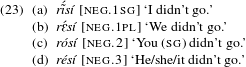
The Neg and Agr1 rule blocks account for the distribution of the negative agreement prefixes and the default agreement prefixes on subjects.Footnote [21] For instance, each of the inflected stems in (23) corresponds to a rule output for the realisation rules in (21) with the non-reduplicated stem of sí ‘go’ (after the application of a vowel harmony rule not discussed here). These realisation rules will apply to any stem provided that (i) this rule block applies to that input (as defined in the paradigm function, discussed in Section 4.4) and (ii) the input meets the featural specification for the rule. For explicitness, the relevant featural specification of the subject is provided in square brackets after the stem in (23). Since these are also viable predicates, a translation is also provided after the feature specification. Note that unless otherwise morphologically specified, Perfective is the default aspectual characterisation of verbs in Eleme. Plural number of second- and third-person subjects is not marked by this series of prefixes; these properties are therefore not relevant for this rule. The examples in (23c) and (23d) are therefore well-formed predicates if the subject is singular (but not if the subject is plural).
The rule of referral in (21b) ensures that verb forms that do not have the negative polarity feature value are referred to rule block Agr1 in (22) for the exponence of subject agreement morphology. Since the rule of referral in (21b) is a default rule in the Neg rule block, any input that meets the criteria set out in rules (i–iv) in (21a) will not be directed to this rule block. In this way, double realisation of subject agreement exponents (e.g. *èrésí for ‘He/she/it didn’t go.’) is avoided. The stems in (24) correspond to a rule output for the realisation rules in (22). These are also well-formed predicates in Eleme, and thus translations are provided after the relevant feature specification.

Since plurality of second-person subjects is marked by a verbal suffix -i, a further rule block applicable to both negatives and affirmatives, namely Agr2, is provided in (25) to account for its distribution. This is treated as a separate rule, in a separate rule block, as the realisation of this affix is independent from the prefixes. Similarly, it does not have the same distribution as the clitic =ri used to mark third-person plural subjects. For detailed discussion of the distribution of the plural subject agreement markers and their different properties, see Bond (Reference Bond2010).

The rule in (25) ensures that verb forms that agree with a second-person plural subject bear the exponent -i. We will examine the relative order of the application of these rule blocks (and others) in Section 4.2.3 below and again in Section 4.4 when discussing Eleme’s paradigm function, but for the time being, there are two possible realisations for verb forms with second-person plural subjects to which both Neg (and thus Agr1 if relevant feature specifications for Neg rules are not met) and Agr2 apply. The stems in (26) correspond to the rule output for the realisation rules in (21), (22) and (25). Translations are provided after the feature specification relevant for the realisation rules responsible for the formation of these verb forms.

Given the potential complexity of the analysis, I will not discuss the distribution of the third-person clitic here; instead, see Bond (Reference Bond2010) for a detailed account. For clarity, the negative and affirmative verb forms that complete the paradigm are given in (27), with their feature specifications and translations.

4.2.3 The relative ordering of rule blocks
The ordering of rules blocks in PFM is formally constrained by the paradigm function. An informal characterisation of this can be achieved by exploring the order in which morphological exponents are realised. In Eleme, rules relating to the realisation of person and number values of the subject and negation given in (21) and (22) apply after the rules in (17) and (18), as demonstrated by the examples in (28), from Bond (Reference Bond2006: 187, 195, 189). The reason for positing two separate TAM rule blocks (TAM1 and TAM2) is made clear by (28c), where the habitual suffix and periphrastic anterior stem co-occur.

The examples in (29) demonstrate that the negative prefixes can be used on the periphrastic verb stems.

To summarise, the realisation rules proposed here apply to stems formed in Rule Block 0, given in (14), in a fixed sequence, such that TAM1 rules in (17) precede TAM2 rules in (18). Person and number agreement morphology is realised next through the application of the realisation rules in the Neg rule block in (21), where applicable, or by the Agr1 rule block in (22) by default. The application of these rules is followed by the Agr2 rule block in (25). The explicit ordering of rules blocks is constrained by the paradigm function, to be discussed in Section 4.4. Having described how PFM rules blocks can be used to correctly produce affirmative and negative stems through concatenation, in Section 4.3 we will explore the principles of stem selection and how they relate to the morphomic use of reduplication in Eleme.
4.3 Stem selection and tone
While the rules of exponence in Eleme exemplified in Section 4.2 each apply to the Default stem, several rules index its morphomic Redup stem, defined in (14). In such cases, the morphomic stem can only be selected provided that the Default stem variant has not already been operated on by an earlier realisation rule. Although rules in PFM are ‘blind’ to the internal morphological structure of an input, rules that select particular stems appear to be sensitive to some sort of index on inputs that flags when they have already undergone a morphological operation outside of Rule Block 0 (thus blocking selection of a particular stem from the stem inventory).
Both Future and Negative Habitual verb forms index the same Redup stem defined in (14) and in each case the tonal pattern of the stem is different, as first illustrated in (6). For instance, for a tone class 1 verb, like si ‘go’, the reduplicated stem will bear a HH tone pattern when it is associated with the feature values {tns: fut, pol: aff}, i.e. sísí, and have a HL pattern when associated with the feature values {asp: hab, pol: neg}, i.e. sísì.
This difference is accounted for in the Tone rule block in (30). This block contains realisation rules that ensure the application of the correct tonal pattern to a (reduplicated) stem, given the verb’s conjugation class and the feature values of the form cell. For simplification, I show only tone class 1 here. Since different tonal patterns are at play across one and the same conjugational tone class, two distinct tone rules are required within this block for tone class 1 verbs.

In (30), the two realisation rules index distinct tone rules (i.e. the phonological rules T1 and T2) as well as the type of stem required for this rule (i.e. stem Y of X). The tone rules are indicated using a tiebar ⌢ and take a suprasegmental phonological rule as an argument (T1, T2, etc.). The first realisation rule in this rule block ensures that if a verb stem belonging to tone class 1 is associated with the feature values {tns: fut, pol: aff} then it will have the tonal pattern provided by the phonological rule T1. The second rule ensures that if a verb stem belonging to tone class 1 is associated with the feature values {asp: hab, pol: neg} it will have the tonal pattern provided by the phonological rule T2. In this analysis there is nothing to stop T1 and T2 from being general tone rules, or being specific to only this morphological environment, however, T1 ensures that the stem has a HH pattern across the stem, while T2 ensures a HL pattern.
The rule block for tone appears to apply only after the two TAM rule blocks. One reason to claim this is that stems associated with the feature values {tns: ant, asp: hab, pol: neg} do not have reduplicated stems, as illustrated by (29a). Assuming that stems that have already undergone operations do not participate in rules that index other stems, the inflected outputs from TAM1 and TAM2 cannot participate in the Tone rule block even when their feature values are relevant for the rules therein.
While the Redup stem is always indexed by the rules in the Tone rule block, reduplicated stems in Negative Perfectives are not selected in exactly the same way because both Default and its morphomic stem Redup can occur with the negative prefixes without a difference in feature specification. One possible way to model asemantic variation between stems selected by a single rule would be to allow disjunction between X (the Default stem) and Y (the Redup stem). In a rule this could be represented by a notation device such as X $\vee$Y . Since X and Y are semantically identical, and the differences in their form are not determined by variation in their feature values, optionality here is purely morphological. A revised set of rules for the Neg rule block that includes the possibility of disjunction between stems is provided in (31).

Again, such an analysis assumes that rules that choose between stems through indexation are free to do so provided that a previous rule has not already determined which stem from Rule Block 0 has been selected. That is, rules that index optional stems are able to choose between Rule Block 0 stems only if the input to the rule has not undergone any rules of exponence in earlier rule blocks and is identical to one of the Rule Block 0 stems. This accounts for why reduplication is optional in Negative Perfectives but not attested in the negative periphrastic stems exemplified in (29).
4.4 Portmanteau rules and the paradigm function
While the ordering of rule blocks outlined in Section 4.2.3 can successfully account for the form of Habituals, Perfectives and Negative Perfectives (with and without reduplication), it is not sufficient to account for the morphological form of Negative Habituals because there is no clear point at which adding the Tone rule block to this sequence of blocks would result in the attested Eleme forms. For instance, if the Tone rule block in (30) were added to this linear sequence at the stage after the TAM rule blocks and immediately before the application of the Neg rule block, then a verb stem with the feature value set {asp: hab, pol: aff, per: 3} would have the form sía as input to the Neg block, while a stem with the feature value set {asp: hab, pol: neg, per: 3} would have the form sísì at the same stage. The subsequent application of the Neg rules would wrongly ensure that Negative Habituals with the feature specification {asp: hab, pol: neg, per: 3} receive a prefix from the rule block for negation in (31) through application of rule Neg(iv) rather than Agr1(iv) from the rule block for default subject agreement in (22), because specification of the {pol: neg} feature value (together with appropriate values for person, and possibly number of the subject) would ensure that the more specific rule is applied. This would result in the ungrammatical stem *résísì instead of the attested èsísì ‘s/he doesn’t (usually) go’.
To account for this, I propose that there is a highly specific portmanteau rule block for the formation of Negative Habitual and Future verb stems that stands in paradigmatic opposition to the Neg rule block proposed above. Portmanteau rule blocks contain specific rules that default to a sequence of more general rules contained in the (set of) block(s) over which they span (Stump Reference Stump2001: 141–142). If the input to a portmanteau rule block satisfies a rule that results in the exponence of a set of feature values, an output of the rule is generated. If it does not satisfy any of the rules of exponence within the portmanteau block, a rule of referral redirects the input to the block(s) over which the portmanteau block spans. Consequently, the rules in portmanteau rule blocks will always be more specific than the rules that they are in paradigmatic opposition to. This behaviour is formally characterised by Stump’s (Reference Stump2001: 142–143) Function Composition Default and the Identity Function Default.
The portmanteau rule for Future is given in (32i), while the portmanteau rule for Negative Habituals is given in (32ii). Port(i) indicates that if the input to a rule has the feature specification {tns: fut, pol: aff} then the Tone block should be applied, followed by the Agr1 block. For Port(ii) the relevant feature specification is {asp: hab, pol: neg}. This ensures that a reduplicated stem is selected from Rule Block 0 and that a HL tone pattern applies to tone class 1 verbs like si ‘go’. The output of this rule (i.e. sísì) is the input to the Agr1 block.
In summary, the rules within the Tone rule block given in (30) index the Redup stem and a distinct phonological tone rule for each set of feature values. Application of the Agr1 rule block ensures that the correct default agreement prefix is realised. If the input to the portmanteau block does not meet the feature specification of Port(i) or Port(ii), it defaults to the rule blocks over which Port(iii) spans. In this case the spanned block is Neg. Note that there is an empty set of features for Port(iii) because any input that meets the specification for Port(i) or Port(ii) will already have redirected, and rule blocks spanned by Port(iii) will apply to all other inputs.

Portmanteau rules like those in (32) form part of the paradigm function in Eleme, which can be (partially) characterised by the notation in (33).Footnote [22]

The paradigm function specifies that the TAM1 and TAM2 rule blocks apply first, followed by the Port rule block. The Port rule block (consisting of the Tone and Agr1 blocks) defaults to the Neg rule block, which in turn defaults to the Agr1 rule block. The final rule block is Agr2. The realisation rules in each block apply to the Default stem, except where a realisation rule indexes the morphomic stem Redup (as in Port) or allows disjunction between the two morphomic stems (as in Neg).
5 Conclusions
Not all morphological operations are directly associated with the exponence of morphological feature sets. Despite superficially appearing to be an exponent of negation in Eleme, I have argued that reduplication is a regular morphophonological process used for morphomic stem formation throughout the language; this is a purely asemantic process: default and reduplicated stems have identical semantic and lexical content. Asemantic relationships between stems give rise to the possibility that optionality between stems may be encountered if rules of exponence permit variability in the selection of morphomic stems.
Within a lexicalist theory of grammar like LFG, the contribution that a verb form makes to a structure can be evaluated in terms of the featural content it provides, not the morphology-internal processes responsible for word formation.Footnote [23] Following Ackerman & Stump (Reference Ackerman and Stump2004), I propose that the information associated with a lexeme’s f-structure representation is projected from the information in its content-paradigm, specifically from the cell  $\langle \text{L},{\it\sigma}\rangle$ in the content-paradigm of the lexeme L. Consequently, a lexeme paired with its feature set will provide f-structure, c-structure and s-structure with the appropriate attributes and values associated with a pred. The form-paradigm of the root r provides the inflectional information necessary to ensure the realisation of rules responsible for the morphological exponence of feature sets.
Under the analysis advanced here, a lexeme that has both affirmative and negative forms (and thus cannot be claimed to be inherently negative) exhibits a straightforward mapping between its content-paradigm and the f-structure of its clause, just as the featural specifications of lexical entries that do not have paradigms project from the lexicon to f-structure. The projection from the form-paradigm of a root to m-structure is also straightforward.
Although reduplication and tone are typologically unusual means of constructing negative verb forms, there is nothing even remotely unusual about the projection from the content-paradigm of any cells of Eleme negative verbs; the analysis proposed here uses exactly the same principles of projection that would be invoked to deal with negative verbs through affixation. The typologically unusual characteristics of Eleme negative verbs are internal to the morphology, but can be explained through reference to morphomic stems, rule block ordering and rules of referral that default to blocks containing less specific rules or exponence.



