The low nutritional quality of wood relative to other plant tissues results in long development times (≤1 year) for many wood-feeding Buprestidae and Cerambycidae (Coleoptera) (Nielsen Reference Nielsen1981). Red oak borer, Enaphalodes rufulus (Haldeman) (Coleoptera: Cerambycidae), requires 2 years of larval feeding to complete development, and adults emerge in odd-numbered years only (Hay Reference Hay1969). Arkansas oak–hickory forests (Quercus L. (Fagaceae), Carya Nutt. (Juglandaceae)) recently experienced an unexpected outbreak of E. rufulus (Stephen et al. Reference Stephen, Salisbury and Oliveria2001) followed by an abrupt population crash (Riggins et al. Reference Riggins, Galligan and Stephen2009). The outbreak was likely associated with stand maturity and several drought events (Haavik and Stephen Reference Haavik and Stephen2010). Although drought often precedes wood-boring insect outbreaks, it is unclear whether increased insect population growth is a result of weakened host resistance, increased nutritional quality of vascular tissues, or both (White Reference White1984). Some host trees were apparently more resistant to E. rufulus, in terms of tolerance and maintenance of growth rates, during the outbreak than others (Haavik and Stephen Reference Haavik and Stephen2011). The role of host nutrition in the outbreak remains unknown.
The objective of this study was to examine variation in nitrogen (N) content of phloem and xylem tissue within the borer's primary host northern red oak, Quercus rubra L. (Fagaceae), in relation to borer colonization and infestation densities. We predicted that hosts with greater E. rufulus infestations would also have higher concentrations of N in vascular tissue. An increase in N could be a consequence of stress, either induced by recent drought or by borer feeding. We also expected that E. rufulus' initial colonization densities would be positively correlated with phloem N, i.e., that fewer early instars would survive to initiate galleries within trees with low phloem N. Additionally, we examined variables related to sites, trees, and timing (i.e., season and year in which trees were sampled) to explore their influence on vascular tissue N content.
Host Q. rubra were removed from three previously established research areas within the Ozark National Forest in Arkansas (Fly Gap, 35°45′N, 93°47′W; White Rock, 35°35′N, 93°58′W; and Oark, 35°41′N, 93°34′W (Fierke et al. Reference Fierke, Kinney, Salisbury, Crook and Stephen2005)). Seventy-five trees were harvested from 2002 through 2007. Minimum and maximum sample sizes for each site, cohort, and season combination were 4 and 7, respectively. Seasons were designated based on phenology of oak trees and life history of borers. Borers and trees were inactive in winter (December through February), trees began photosynthesizing for early wood production and bud burst in spring (March and April), borers and trees were active in late spring and summer (May through August), and only borers were active in fall (September through November) (Hay Reference Hay1969; Pallardy Reference Pallardy2008).
Trees were destructively sampled for number of exit holes on the outer bark surface (a measure of infestation) and then the outer bark was carefully scraped away to reveal initiated early-instar larval phloem galleries from the current generation (a measure of colonization) (Fierke et al. Reference Fierke, Kinney, Salisbury, Crook and Stephen2005). Populations of E. rufulus were at outbreak levels during development of the 2003 cohort of emerging adults and low during the 2005 and 2007 cohorts (Riggins et al. Reference Riggins, Galligan and Stephen2009). Prior to tree felling, diameter at breast height (DBH, 1.4 m from the ground) was recorded. Trees were then felled and a 5 cm thick basal cross-section was cut and removed from each tree bole at approximately 0.5 m above the ground and transported to the laboratory for N sampling and tree age determination.
Two 1 g phloem and two 1 g xylem (sapwood) samples were extracted from opposing sides of each cross-section with a mallet and wood chisel. Samples were ground to sawdust using a Wiley Mill (<60 μm) and analyzed for total percentage N on a Carlo Erba elemental analyzer (1110 CHN Combustion Analyzer, Carlo Erba Strumentazione, Milan, Italy). Two replicate samples (one of phloem, the other of xylem) were averaged together to represent N content for each tissue at the individual tree level.
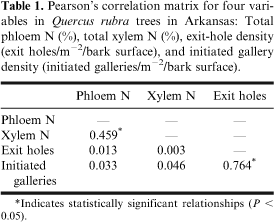
All statistical analyses were conducted in JMP 9.0 (SAS Institute Inc. 2010). Pearson's pairwise correlations were utilized to examine relationships among phloem N, xylem N, infestation, and colonization. Phloem and xylem N varied positively together (see Table 1) and thus were added together for total vascular tissue N in subsequent analysis. Stepwise multiple linear regression was used to determine whether potential predictors (tree age, DBH, site, cohort, or season) were significantly related to variation in vascular tissue N. All predictors with nonsignificant partial F tests were removed from the final model. Residual plots were checked for violations of model assumptions. Statistical significance was set at P ≤ 0.05 and errors are presented as one standard error from the mean.
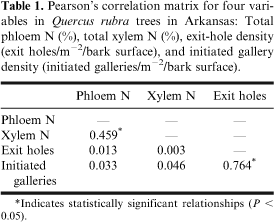
* Indicates statistically significant relationships (P < 0.05).
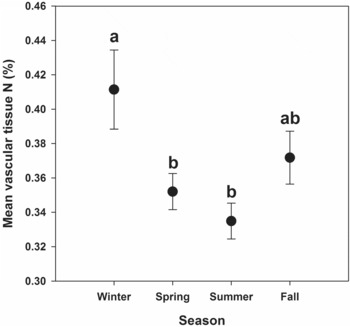
Phloem and xylem N ranged from 0.15% to 0.41% (mean 0.22% ± 0.01%) and 0.07% to 0.24% (mean 0.14% ± 0.01%), respectively. Exit hole and initiated gallery densities per m2 bark surface ranged from 0.08 to 83.06 (mean 12.99 ± 2.34) and from 0.43 to 257.53 (mean 52.20 ± 7.47), respectively. Phloem N and exit-hole density were significantly positively correlated with xylem N and initiated gallery density, respectively, although no other relationships among these four variables were significant (Table 1). Vascular tissue N content varied significantly by season (F 3,69 = 4.71, P = 0.005; Fig. 1); trees sampled during winter had greater vascular tissue N than did trees sampled during spring or summer, and trees sampled during fall were not different from trees sampled during other seasons (Fig. 1).

Vascular tissue N of Q. rubra trees did not vary with colonization (initiated phloem gallery density) or infestation levels (exit-hole density) of E. rufulus, suggesting that there was no relationship between vascular tissue N and colonization or infestation. Though not revealed through this study, nutrition still may have been important in rendering Q. rubra trees susceptible and (or) suitable as hosts for E. rufulus. Another wood feeding beetle, Anobium punctatum (De Geer) (Anobiidae), utilized soluble N to a greater extent than insoluble N during larval growth and development (Baker et al. Reference Baker, Laidlaw and Smith1970), and soluble N may become increasingly available within woody tissues during soil moisture deficit (White Reference White1984). A more complete investigation should include analysis of soluble N available in host tissue and its use by E. rufulus during larval development.
Timing variables were apparently important for vascular tissue N content, which varied seasonally (Fig. 1), which is consistent with increased concentration of N storage compounds during dormant months (Pallardy Reference Pallardy2008). Xylem and phloem N contents also increased together, likely due to the close proximity of these tissues, solute exchange between them, and the high degree of N mobility among plant organs (Reference PallardyPallardy 2008).
We thank Larry Galligan, Geoff Gardner, Sam Green, Matt McCall, Jarrett Bates, and Ace Lynn-Miller for field and laboratory assistance. Support was provided by the Arkansas Agricultural Experiment Station, and grants from the United States Department of Agriculture, Forest Service, Southern Research Station, Asheville, North Carolina, the United States Department of Agriculture, Forest Service Special Technology Development Program, and the Forest Health Monitoring Program, Atlanta, Georgia.