1. Introduction
With the recent rapid growth of the Arabic language across social media platforms along with the challenging morphological and high inflectional nature of Modern Standard Arabic (MSA) and Dialectal Arabic (DA), Arabic Sentiment Analysis (ASA) is gaining an increased interest from the Natural Language Processing (NLP) research community. According to the used features, existing ASA systems can be classified into either (a) hand-crafted-based systems where SA models employ linguistic and lexical features usually generated by morphological analysers and semantic resources (Abdulla et al. Reference Abdulla, Ahmed, Shehab and Al-Ayyoub2013; Sayadi et al. Reference Sayadi, Liwicki, Ingold and Bui2016; Alomari et al. Reference Alomari, ElSherif and Shaalan2017; El-Beltagy, Kalamawy, and Soliman Reference El-Beltagy, Kalamawy and Soliman2017) or (b) text embeddings-based systems which adopt text distributed representations the so-called word/sentence embeddings, where the sentence embeddings are composed out of its constituent word embedding vectors using one of the composition models (Altowayan and Tao Reference Altowayan and Tao2016; Dahou et al. Reference Dahou, Xiong, Zhou, Haddoud and Duan2016; Gridach, Haddad, and Mulki Reference Gridach, Haddad and Mulki2017; Medhaffar et al. Reference Medhaffar, Bougares, Esteve and Hadrich-Belguith2017).
Composition models aim to construct phrase/sentence embeddings based on its constituent word embeddings and structural information (Gormley, Yu, and Dredze Reference Gormley, Yu and Dredze2015). Two main types of these models can be recognised: (a) ordered or syntactic models where the order and linguistic/grammatical structure of the input words do count while constructing the phrase/sentence vector and (b) unordered models in which the word embeddings are combined irrespective of their order using algebraic operations. Sum of word embeddings (SOWE), average (Avg), minimum (Min), maximum (Max) and multiplication (Mul) functions are examples of such models (Mitchell and Lapata Reference Mitchell and Lapata2010).
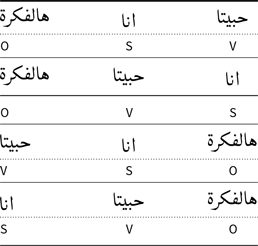
Based on the theory ‘you shall know a word by the company it keeps’ (Firth Reference Firth1957), context words along side their syntactic properties were considered essential to build effective word embeddings able to infer the semantic/syntactic similarities among words, phrases, or sentences. Consequently, most of the recently developed SA systems adopted recursive neural networks (RecNNs) or long, short-term memory neural models (LSTMs) in which ordered composition models are employed to grasp the syntactic and linguistic relations between the words (Socher et al. Reference Socher, Perelygin, Wu, Chuang, Manning, Ng and Potts2013; Al Sallab et al. Reference Al Sallab, Hajj, Badaro, Baly, El Hajj and Shaban2015). These systems usually require more training time to learn words’ order-aware embeddings due to the high computational complexity consumed at each layer of the model (Iyyer et al. Reference Iyyer, Manjunatha, Boyd-Graber and Daumé2015). However, the embeddings resulting from ordered compositionality might not be sufficient to handle the Arabic dialects which have a free word order and varying syntactic/grammatical nature (Brustad Reference Brustad2000; Chiang et al. Reference Chiang, Diab, Habash, Rambow and Shareef2006). While MSA can be described as a Verb-Subject-Object (VSO) or Subject-Verb-Object (SVO) language, Arabic dialects go beyond that; for instance, the dialectal (Levantine) sentence investigated in Table 1 refers to the meaning ‘I liked this idea’, can be represented by several word orders: VSO, SVO, OSV and OVS; yet, retains the meaning and the sentiment.
Free word order of dialectal Arabic

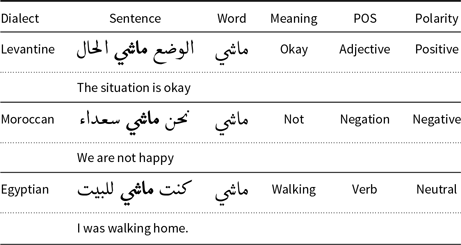
Syntactic differences across the Arabic dialects

On the other hand, Arabic dialects show phonological, morphological, lexical and syntactic differences such that the same word might infer different syntactic information across several Arabic dialects (Brustad Reference Brustad2000). For example, Table 2 shows how the word ‘ ’ has several part-of-speech (POS) tags, multiple meanings and different sentiments across three Arabic dialects.
To handle the informality of DA, unordered composition models can form an efficient replacement of the syntactic ones, as they construct sentence/phrase embeddings, regardless of the order and the syntax of the contextual words. Nevertheless, it should be noted that for the sentiment analysis task, sentence/phrase embeddings, which are merely composed and learned based on the context words, do not always infer the accurate sentiment. This is usually encountered when words of opposite sentiments are mentioned within identical contexts. Hence, opposite words will be mapped close to each other in the embedding space. To clarify that, both sentences in Examples 1 and 2 contain the same context words, organised in the same order; yet, the first sentence implies a positive polarity while the second has a negative sentiment; where the words ‘ ’ (interesting) and ‘
 ’ (boring) are antonyms.
Example 1. 
This movie was incredibly interesting
Example 2. 
This movie was incredibly boring
One way to address this issue is to learn the embeddings from sentiment-annotated corpora such that the sentiment information is incorporated along with the contextual data within the composed embeddings during the training phase. This was examined with the English language in Tang et al. (Reference Tang, Wei, Yang, Zhou, Liu and Qin2014), where the authors presented sentiment-specific word embeddings (SSWE) composed by Min, Max and Avg unordered composition functions and learned within a simple neural model. The learned embedding vectors were, then, fed to classical supervised classifiers, where a better sentiment classification could be achieved compared to word2vec (Mikolov et al. Reference Mikolov, Sutskever, Chen, Corrado and Dean2013) and hand-crafted features-based systems.
In Iyyer et al. (Reference Iyyer, Manjunatha, Boyd-Graber and Daumé2015), an English SA model called deep averaging neural network (DAN) was presented. DAN was implemented as a neural network with two hidden layers. Based on the assumption that unordered composition functions can efficiently encode sentiment within the composed embeddings, DAN learned and produced n-gram embedding features for the SA task through pairing between the Avg unordered composition function and supervised learning. The experimental study indicated the ability of the embeddings learned by DAN to rival those resulting from ordered syntactic models. Where DAN achieved a comparable performance against RecNNs and CNNs-Multi Channel (CNN-MC) models in which both semantic and syntactic information were encoded using ordered composition functions.
Recently, some ASA systems considered the syntactic information while composing the embeddings for MSA (Al Sallab et al. Reference Al Sallab, Hajj, Badaro, Baly, El Hajj and Shaban2015), while other SA models used pretrained and unsupervised word or document (sentence) embeddings to recognise the sentiment of MSA/DA contents (Altowayan and Tao Reference Altowayan and Tao2016; Gridach et al. Reference Gridach, Haddad and Mulki2017). However, mining the sentiment of DA using syntax-aware, ordered embeddings might be ineffective especially with the drastic differences between Eastern and Western Arabic dialects (Zaidan and Callison-Burch Reference Zaidan and Callison-Burch2014). In addition, for the SA task, the embeddings learned from unlabeled data are not as discriminating as those learned with the sentiment information integrated in the embedding vectors (Tang et al. Reference Tang, Wei, Yang, Zhou, Liu and Qin2014). This evokes the need to provide a sentiment-specific, dialect-independent embeddings with which the gap resulting from the differences among Arabic dialects can be bridged. To achieve that, the embeddings, to be used as sentiment features, should be composed in a way that ignores the words’ order and the syntactic/contextual regularities and focuses on the semantic and sentiment information.
Inspired by Iyyer et al. (Reference Iyyer, Manjunatha, Boyd-Graber and Daumé2015), we hypothesise that a DA sentence, with a free word order and various syntax, can be better represented if their constituent word embedding vectors are composed using an unordered composition function. On the other hand, motivated by Tang et al. (Reference Tang, Wei, Yang, Zhou, Liu and Qin2014), we assume that these composed embedding features can be more expressive for the SA task if they are learned considering the sentiment labels of the input data. Therefore, this study aims to present a SA framework (Tw-StAR) whose features are n-gram embeddings learned from labeled data (sentiment-specific) and composed via the additive unordered composition function (syntax-ignorant) SOWE whose efficiency to capture the semantic information was proved in White et al. (Reference White, Togneri, Liu and Bennamoun2015). The embeddings composition and the sentiment learning processes were conducted within Tw-StAR which was constructed as a shallow feed-forward neural network of a single hidden layer. The contributions of this study can be described as follows:
-
1. According to Iyyer et al. (Reference Iyyer, Manjunatha, Boyd-Graber and Daumé2015), Shen et al. (Reference Shen, Wang, Wang, Min, Su, Zhang, Li, Henao and Carin2015), for certain NLP tasks, achieving a good performance does not necessarily require using sophisticated models; as much simpler word embeddings-based architectures can provide a competent or even better performance compared to recurrence or convolutions-based models. Moreover, the powerful performance of deep neural models is not only attributed to the depth factor but also to other factors such as the recently developed training techniques that matches the properties of the building units used in deep models (Ba and Caruana Reference Ba and Caruana2014). Furthermore, in various scenarios where supervised learning is preferred to learn the features, shallow neural nets exhibit better memorisation relative to deep models (Krueger et al. Reference Krueger, Ballas, Jastrzebski, Arpit, Kanwal, Maharaj, Bengio, Fischer and Courville2017). Consequently, in contrast to previous studies, that composed unordered embeddings within deep neural models (Iyyer et al. Reference Iyyer, Manjunatha, Boyd-Graber and Daumé2015), the embeddings introduced here are generated and learned within a shallow feed-forward neural model; as we are seeking to investigate whether SA of DA can be performed using less training time through employing less complicated neural architectures.
-
2. Our Tw-StAR model and SSWE model, proposed in Tang et al. (Reference Tang, Wei, Yang, Zhou, Liu and Qin2014), are both sentiment informed. This means that the polarity labels are involved in the training, yielding sentiment-specific embeddings. However, unlike SSWE which further seeks to incorporate syntactic alongside sentiment regularities within the learned embeddings, Tw-StAR assumes that the syntactic information cannot be relied on DA input data. Therefore, while SSWE was trained using the so-called corrupted n-grams (missing a word) (Tang et al. Reference Tang, Wei, Yang, Zhou, Liu and Qin2014) together with original ones to learn syntactic contextual embeddings, we fed non-corrupted, whole and original input n-grams to Tw-StAR, such that the syntactic contexts regularities were totally ignored. Hence, Tw-StAR learns and produces syntax-ignorant, semantic-aware and sentiment-specific n-gram embeddings, whereas SSWE deduces syntactic-aware and sentiment-specific embeddings.
-
3. Based on the outperformance of SOWE in sentence semantic similarity and considering its low computation complexity and ability to capture and encode semantic and synonymous information in the resulting composed embeddings (White et al. Reference White, Togneri, Liu and Bennamoun2015), we assume that SOWE can be an effective replacement of Avg composition function used in Iyyer et al. (Reference Iyyer, Manjunatha, Boyd-Graber and Daumé2015). Within this scope, we provided a comparison between the sentiment classification performances yielded from n-gram embeddings composed by SOWE and Avg functions, respectively.
-
4. Due to the limited work on ASA, especially for under-represented Arabic dialects, it was not always possible to compare our shallow model with deep neural SA baselines. Therefore, we developed our own deep neural models using CNNs and LSTMs as building units and applied them to mine the sentiment in the tackled datasets. Consequently, Tw-StAR could be evaluated, in terms of the consumed training time and the achieved classification metrics against more complicated and deeper neural models.
2. Arabic sentiment analysis
ASA, in general, adopt one of two feature types: (a) hand-crafted features that are generated with the assistance of morphological analysers, NLP techniques and lexical resources or (b) text embedding features which are learned automatically from the text itself through unsupervised/supervised learning strategies, such that the usage of words besides the words’ semantic, syntactic and synonymous relations can be incorporated within the produced features.
2.1 Hand-crafted features-based models
The most common features used in hand-crafted features-based models are bag-of-words and n-gram schemes in addition to various linguistic/stylistic features usually extracted by morphological analysers (Abdulla et al. Reference Abdulla, Ahmed, Shehab and Al-Ayyoub2013; Sayadi et al. Reference Sayadi, Liwicki, Ingold and Bui2016; Alomari, ElSherif, and Shaalan Reference Alomari, ElSherif and Shaalan2017; Elouardighi et al. Reference Elouardighi, Maghfour, Hammia and Aazi2017). In addition, for a better sentiment classification performance, some SA systems, the so-called hybrid, tend to use a combination of linguistic and lexicon-derived features (El-Beltagy et al. Reference El-Beltagy, Kalamawy and Soliman2017).
N-grams features refer to a sequence of adjoining N items collected from a given text. Extracting n-grams can be thought of as exploring a large piece of text through a window of a fixed size (Piryani et al. Reference Piryani, Madhavi and Singh2017).
Several combinations of n-gram features were used by Sayadi et al. (Reference Sayadi, Liwicki, Ingold and Bui2016) to perform SA on MSA/Tunisian tweets. The produced features were reduced using information gain (IG) method which can extract the most prominent features with respect to the class attribute. Later, six different classifiers such as support vector machines (SVMs), Naïve Bayes (NB), K-nearest neighbour (KNN), random fields (RF) and decision trees (DTs) were trained with the selected features. Two classification types were performed: binary classification for positive/negative tweets and multi-class classification with neutral tweets considered. The best performance for binary classification was achieved by SVM with an accuracy of 71.1% and an F-measure of 63%.
Aiming to focus on the most informative n-gram features, weighting schemes such as term frequency/term frequency-inverse document frequency (TF/TF-IDF) are usually used. This was examined in Elouardighi et al. (Reference Elouardighi, Maghfour, Hammia and Aazi2017), where TF/TF-IDF was employed along with combinations of n-gram features to train SVM and NB supervised classifiers. Features reduction was conducted using the score ‘Between Group to within Group Sum of Squares’ (BSS/WSS) strategy. To evaluate the proposed model, it was applied on an MSA/Moroccan dataset of Facebook comments. The best performance was achieved when unigrams and bigrams were both adopted with TF-IDF weighting scheme, achieving an accuracy of 78%.
In Alomari et al. (Reference Alomari, ElSherif and Shaalan2017), high-level n-grams were used to classify the sentiment of MSA/Jordanian tweets. With SVM and NB used as classifiers, the authors investigated the impact of stemming/light stemming on the classification performance. It was noted that for bigram training features, which were optimised and reduced by stemming and TF-IDF, SVM was the best performing classifier, as it outperformed NB with an accuracy of 88.7% compared to 81.4%.
Within a lexicon-based SA framework, Karmani (Reference Karmani2017) generated linguistic features to mine the sentiment of Tunisian customers’ reviews. To produce the linguistic features, the author developed a Tunisian Arabic morphological analyser along with a transliteration machine to handle Arabizi.Footnote a In addition, a Tunisian version of the SentiWordNet lexicon was used. The model was applied on a manually collected corpus (TAC) which combined positive, negative and neutral tweets. The binary classification accuracy of the used Tunisian lexicon was 72.1% considering positive/negative tweets.
A comparison between a supervised and a lexicon-based SA models was performed by Abdulla et al. (Reference Abdulla, Ahmed, Shehab and Al-Ayyoub2013). Both models were applied on MSA/Jordanian tweets. Root stemming and light stemming were conducted to enrich the bag-of-words features in the supervised model and to increase the lexicon size in the lexicon-based model. The models were evaluated using a dataset called ArTwitter containing positive/negative tweets. The experimental study indicated the outperformance of the supervised model as it achieved an accuracy of 87.2% using SVM, compared to 59.6% scored by the lexicon-based model.
Despite the good performance achieved by these models, hand-crafted feature generation remains a labor-intensive task as it requires using several NLP techniques such as sentence parsing and POS tagging for which language-specific or dialect-specific morphological tools need to be developed (Piryani et al. Reference Piryani, Madhavi and Singh2017). On the other hand, lexicon-derived features generated using a certain dialectal lexicon might not be efficient for other datasets even if they are used for the same dialect. This is due to the fact that most lexicons are corpus-based which makes them domain-specific and corpus-specific while high coverage and large-scale dialectal lexicons are, relatively, difficult to build and compile (Abdulla et al. Reference Abdulla, Ahmed, Shehab and Al-Ayyoub2013). Therefore, many recent SA systems replaced the hand-crafted features with word/document embeddings to be used either to train ML classifiers or to enrich sentiment lexicons.
2.2 Text embedding feature-based models
The recently developed ASA systems have used text embeddings to represent MSA/DA textual content. Distributed text representations or text embeddings can be divided into two main types:
-
Word embeddings: in which every word in the corpus is mapped to a real-valued low-dimensional vector in the embedding space using one of the word mapping algorithms such as word2vec (Mikolov et al. Reference Mikolov, Sutskever, Chen, Corrado and Dean2013; Pennington et al. Reference Pennington, Socher and Manning2014).
-
Document embeddings: through which continuous representations of larger blocks of text such as sentences, paragraphs or whole documents are learned using a document mapping algorithm such as doc2vec (Le and Mikolov Reference Le and Mikolov2014).
In a successful attempt to replace the hand-crafted features with word embeddings, the authors in Altowayan and Tao (Reference Altowayan and Tao2016) generated their own Arabic word embeddings through training Continuous Bag of Words (CBOW) algorithm from Mikolov et al. (Reference Mikolov, Sutskever, Chen, Corrado and Dean2013) using an Arabic corpus of 190 million words. The authors indicated that the produced embeddings could handle dialects efficiently as it mapped different writing shapes of dialectal words. To evaluate the generated embeddings, they were used to train several binary classifiers to perform subjectivity and sentiment classification for a combination of twitter datasets: ASTD (Nabil, Aly, and Atiya Reference Nabil, Aly and Atiya2015), ArTwitter (Abdulla et al. Reference Abdulla, Ahmed, Shehab and Al-Ayyoub2013) and QCRI (Mourad and Darwish Reference Mourad and Darwish2013); in addition to other two datasets representing book reviews: LABR (Aly and Atiya et al. Reference Aly and Atiya2013) and MSA news articles obtained from Banea, Mihalcea, and Wiebe (Reference Banea, Mihalcea and Wiebe2010). The model’s performance was slightly better than Mourad and Darwish (Reference Mourad and Darwish2013) in subjectivity classification, while for the polarity classification of the twitter datasets, the best metric values were scored using Nu-SVM classifier with an accuracy of 80.2% and an F-measure of 79.6%.
To improve the compositionality of the constructed embeddings, a study by Dahou et al. (Reference Dahou, Xiong, Zhou, Haddoud and Duan2016) introduced a CNN-based deep learning SA model. The model was trained with word embeddings learned from a corpus of 3.4 billion Arabic words using CBOW and Skip-Gram (SG) (Mikolov et al. Reference Mikolov, Sutskever, Chen, Corrado and Dean2013). Using CNN as a building unit, a neural model with one non-static channel and one convolutional layer was developed. Multiple filter window sizes were adopted to perform the convolutional operation while a max-overtime pooling layer was utilised to capture the most relevant global features (Collobert et al. Reference Collobert, Weston, Bottou, Karlen, Kavukcuoglu and Kuksa2011). The model was applied on several datasets such as ASTD (Nabil et al. Reference Nabil, Aly and Atiya2015) and ArTwitter (Abdulla et al. Reference Abdulla, Ahmed, Shehab and Al-Ayyoub2013). The results revealed that the performance of the presented model mostly outperformed all the state-of-the-art systems where for ArTwitter, the achieved accuracy was 85.0%.
The idea of including Arabic pre-trained word embeddings in a deep neural SA model was introduced by Gridach et al. (Reference Gridach, Haddad and Mulki2017). The authors used word embeddings from Zahran et al. (Reference Zahran, Magooda, Mahgoub, Raafat, Rashwan and Atyia2015) which were previously trained with MSA/Egyptian corpora using Glove, SG and CBOW algorithms. These embeddings were employed to initialise the input word embeddings training features of the proposed CNN-ASAWR model. CNN-ASAWR was developed as a variant of Collobert et al. (Reference Collobert, Weston, Bottou, Karlen, Kavukcuoglu and Kuksa2011) system and customised to conduct SA on two MSA/dialectal datasets: ASTD (Nabil et al. Reference Nabil, Aly and Atiya2015) and SemEval-2017 (Rosenthal et al. Reference Rosenthal, Farra and Nakov2017). The results showed that using pre-trained word embeddings led to better evaluation measures compared to the baseline systems. In ASTD dataset, for instance, the best F-measure scored by CNN-ASAWR was 72.14% compared to 62.60% achieved by Nabil et al. (Reference Nabil, Aly and Atiya2015), while for SemEval, an F-measure of 63% is achieved against 61% scored by the system of El-Beltagy et al. (Reference El-Beltagy, Kalamawy and Soliman2017).
One of the pioneering studies towards leveraging document or sentence embeddings in ASA was conducted by Medhaffar et al. (Reference Medhaffar, Bougares, Esteve and Hadrich-Belguith2017), where doc2vec algorithm was used to provide sentence feature vectors representing a Tunisian corpus. The proposed model was evaluated using a combination of publicly available MSA/DA datasets: OCA (Rushdi Saleh et al. Reference Rushdi Saleh, Teresa Martin Valdivia, Alfonso Urena-Lopez and Perea Ortega2011), LABR (Aly and Atiya et al. Reference Aly and Atiya2013) and a manually annotated Tunisian Sentiment Analysis Corpus (TSAC) obtained from Facebook comments about popular TV shows. Each comment was represented by a document vector which was used later to train SVM, Bernoulli NB (BNB) and multilayer perceptron (MLP) classifiers. The best results were scored by MLP classifier when TSAC corpus was solely used as a training set where it achieved an accuracy equals to 78% and an F-measure of 78%.
As each deep neural model has specific merits, usually related to its building unit, the authors in Al-Azani and El-Alfy (Reference Al-Azani and El-Alfy2017) investigated using various configurations of deep learning models to perform SA of Arabic tweets. The examined models were built either using a separate/stacked units of CNN, LSTM or by cascading CNN and LSTM within a single model. All the models were trained with word embedding features provided by word2vec techniques: CBOW and skip-gram with static and non-static word initialisation enabled. To evaluate the different model variants, ASTD dataset from Nabil et al. (Reference Nabil, Aly and Atiya2015) and ArTwitter by Abdulla et al. (Reference Abdulla, Ahmed, Shehab and Al-Ayyoub2013) were used. The results indicated that updating the word embeddings during learning achieved the best results in most model configurations. In addition, while LSTM outperformed CNN in general, combined LSTMs architecture was the best-performing model achieving an accuracy of 87.2% for ArTwitter dataset.
In the above-mentioned studies, it could be observed that the used word/document embeddings were mostly context-aware as they have been generated via context-based algorithms such as SG and CBOW (Mikolov et al. Reference Mikolov, Sutskever, Chen, Corrado and Dean2013). This implicitly involved relying on the word order and context/syntactic nature (Mikolov et al. Reference Mikolov, Sutskever, Chen, Corrado and Dean2013), which might not always produce expressive features especially for DA where neither fixed word order nor syntactic rules do exist. Moreover, with the proposed systems being evaluated using mixed MSA-DA datasets, their ability to handle the DA-dominated or pure dialectal contents remains inconclusive. Therefore, we believe that our syntax-ignorant embeddings are crucial to handle the dialectal content as they cope with DA specifications, while their efficiency for SA against context-based techniques could be assessed through the exploration of the spatial relations among DA words in the embeddings space.
On the other hand, while the state-of-the-art employed different deep learning architectures, none of which provided all the needed metrics. This makes it a bit difficult to compare these systems with each other, let alone the evaluation of our shallow model against them. Especially that, a sentiment classifier performance cannot be only evaluated according to the achieved evaluation measures but with regard to other implementation details such as the architecture complexity, computation overhead and the consumed training time. For this purpose, we had to develop deep architectures to be applied on the tackled datasets and thus, we could obtain a comprehensive evaluation of the proposed shallow model Tw-StAR against more complicated deeper models in terms of the achieved evaluation measures and the consumed training time.
3. Tw-StAR model description
As seeking to answer the question: Can a shallow neural model, trained with embeddings specifically formulated to target the dialectal content, rival more complicated neural architectures? Tw-StAR model was implemented as a feed-forward neural network in which sentiment-specific, syntax-ignorant n-grams embeddings are composed via SOWE function and learned in a supervised manner. The generated n-gram embeddings were, then, employed as discriminating features to predict the positive/negative sentiment of DA contents.
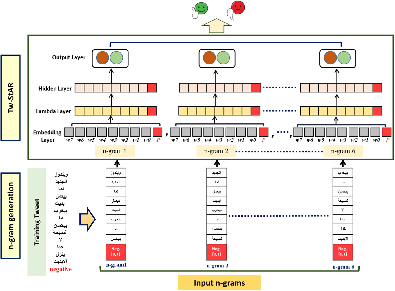
As it is shown in Figure 1, given the input negative training tweet “


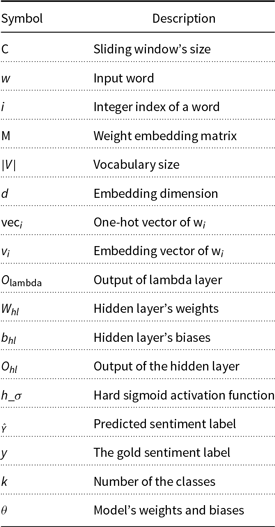
 ” (upon update, the new version of Windows makes things worse rather than better; as an advice, do not update your system), a sequence of six n-grams is generated by going through the tweet using a fixed-size sliding window. Having the n-grams generated, each of which is associated with the polarity [0, 1] which represents the negative polarity of the previous tweet. Later, n-grams are fed to Tw-StAR model where the correspondent embeddings for their constituent words are constructed at the embeddings layer, composed and formulated as n-gram embeddings at Lambda layer and learned as sentiment features while being forwarded through Tw-StAR layers. Finally, n-gram embeddings are exploited, at the output layer, to recognise the sentiment of the input tweet. Below is a detailed description of each layer, where the model’s notations are listed in Table 3.
The embedding layer is responsible for projecting words in the input into their corresponding dense vector representations. Given the input sentences, in order to handle their varying lengths, each sentence S of l words was formulated as a sequence of fixed-length n-grams generated using a sliding window of a specific size C. Whole n-grams were fed to the embedding layer of our model such that each n-gram is accompanied with the sentiment label of the sentence from which it was derived. Having the n-grams prepared and accompanied with the vector representing their relevant sentiment label ([1, 0] for positive and [0, 1] for negative), their constituent words were mapped into the corresponding embeddings based on the embeddings weight matrix
 $\textit{M}\in \textit{R}^{{|V|}\times\textit {d}}$
where
 $|V|$
is the vocabulary size and d denotes the embeddings dimension.
Tw-StAR neural sentiment analysis model.

Notations used of Tw-StAR model

The weights of the embedding matrix M were initialised using Glorot uniform initialisation (Glorot and Bengio Reference Glorot and Bengio2010), then optimised while training the model. It should be noted that we could not use pretrained word embeddings for initialisation, as the available Arabic pretrained word embeddings from Zahran et al. (Reference Zahran, Magooda, Mahgoub, Raafat, Rashwan and Atyia2015) and Al-Rfou, Perozzi, and Skiena (Reference Al-Rfou, Perozzi and Skiena2013) were generated using MSA/Egyptian corpora, which can lead to out-of-vocabulary (OOV) issues, especially for the Tunisian and Moroccan contents, where less common words with MSA/Egyptian do exist. Thus, for a single fixed-length n-gram containing a sequence of words
 $\{{w_{i}, w_{i+\mathit{1}}, w_{i+\mathit{2}} , ..., w_{i+C-\mathit{1}}}\}$
, each word
 ${w_{i}}$
is represented by a unique integer index
 $\textit{i} \in \text{[0,V]}$
and stored as a one-hot vector
 ${{\rm vec}_{i}}$
whose values are zero in all positions except at the i-th index. To obtain the embedding vector
 ${v}_{{i}}$
of a word
 ${w}_{i}$
, its one-hot vector
 ${{\rm vec}_{i}}$
is multiplied by the embedding matrix M as in Equation (1)
 \begin{equation} v_{{i}} ={{\rm vec}_{i}} * M \in R ^{1\times d} \end{equation}
As each row of the embedding matrix M denotes the dense embeddings of a specific word in the vocabulary, multiplying the one-hot vector of each word in the input by the embedding matrix M will essentially select one of M rows that corresponds to the embeddings of that word.
At the next linear layer Lambda, the resulting word embeddings generated for each word of the input n-gram were combined using the compositional model SOWE. Hence, the output of lambda layer is a single embeddings vector
 $O_{\rm lambda} \in {R}^{1\times {{|d|}}}$
, resulting from the element-wise sum of the embeddings vectors produced by the embedding layer and correspond to the input words that belong to a single n-gram and contained in a window of a fixed-size C:
 \begin{equation}{O_{\rm lambda}}=\sum\limits_{i=1}^C {v_{i}} \in R^{1\times d} \end{equation}
In the subsequent hidden layer (hl), the output from the previous layer
 ${O_{\rm lambda}}$
is subjected to a linear transformation using the weights matrix
 ${W_{hl}} \in R^{d\times2}$
and biases
 ${b_{hl}} \in R^{1\times2}$
:
 \begin{equation}{O_{hl}}= f ({O_{\rm lambda}} * {W_{hl}} + {b_{hl}}) \in R ^{1\times 2} \end{equation}
Where
 ${W_{hl}}$
and
 ${b_{hl}}$
form the model’s parameters that are learned and optimised during the training process, and f refers to the activation function that introduces non-linear discriminating features to our model. Here we used Hard sigmoid activation function
 ${h\_\sigma}$
(Courbariaux et al. Reference Courbariaux, Hubara, Soudry, El-Yaniv and Bengio2016), which is identified in Equation (4). Hard sigmoid is an approximation of the standard sigmoid activation function; it is defined as a piece-wise function whose output is very similar to the traditional sigmoid; however, it is computationally cheaper. This leads to a smarter model with the learning process accelerated in each iteration (Gulcehre et al. Reference Gulcehre, Moczulski, Denil and Bengio2016).
 \begin{equation} h\_\sigma(x) = {\rm clip}((x + 1)/2, 0, 1) = {\rm max}(0, {\rm min}(1, (x + 1)/2)) \end{equation}
where clipping bounds are
 $-2.5$
and 2.5 and its derivative is given as below:
 \begin{equation}\hat {h\_\sigma}(x) = \begin{cases} {0} &\quad{\rm if} \quad{x \lt -2.5} \quad{\rm or} \quad {x > 2.5}\\ {0.2} &\quad{\rm otherwise} \end{cases} \end{equation}
Finally, the output
 ${O_{hl}}$
resulting from the hidden layer is forwarded into the output layer (Ol), where a softmax function is applied to induce the estimated probabilities for each output label (positive/negative) of a specific n-gram. Where each n-gram is accompanied with the predicted two-dimensional label [1, 0] denoting positive or [0, 1] indicating negative.
 \begin{equation}\hat{y}={\rm softmax}({O_{hl}}) \in R^{1\times 2} \end{equation}
Softmax selects the maximum score among the two predicted conditional probabilities to denote positive or negative polarity of an input n-gram, where the distribution of the form [1, 0] was assigned for positive, while [0, 1] distribution form was adopted for negative. Thus, if the gold sentiment polarity of an n-gram is positive, the predicted positive score should be higher than the negative score, while if the gold sentiment polarity of a word sequence is negative, its positive score should be smaller than the negative score. Then, to decide the polarity of the whole sentence, the predicted positive scores and negative scores of n-grams are summed, then each of which is divided by the number of the n-grams contained in this sentence resulting in two values representing the potential positive and negative scores of the input sentence. The final sentence polarity is, thus, decided according to the greater among these two values. Cross-entropy loss between gold sentiment distribution and predicted distribution was adopted such that the loss function of the model is:
 \begin{equation}J(\theta) =- \sum\limits_{k=\{0,1\}} {y_{k}} \log \hat{y}_{k} \end{equation}
where
 $\textit{y} \in \textit{R}^{2}$
is the gold sentiment value represented by a one-hot vector,
 $\hat{y}$
is the sentiment predicted by the model, while
 $\theta$
refers to the parameters (weights and biases) of the model to be learned and optimised during the training process.
4. Training details and model’s parameters
The key hyperparameters of the proposed model are the sliding window size C which defines the n-gram scheme to be adopted and the embeddings dimension d. We have selected both parameter values empirically during the model tuning period. According to Socher et al. (Reference Socher, Perelygin, Wu, Chuang, Manning, Ng and Potts2013), narrower windows lead to better performance in syntactic tests, while wider ones score a better performance in semantic tests. Therefore, we have tested different quite large values of the sliding window size C to select the size that achieves the best evaluation measures. Similarly, the emdeddings dimension size was selected empirically among several examined values.
For efficient training, Glorot uniform initialisation (Glorot and Bengio Reference Glorot and Bengio2010) was used to set the weights of the embeddings layer. Glorot initialisation makes sure the weights are ‘just right’ across the model’s layers, keeping the signal in a reasonable range of values, through avoiding too massive and too tiny weight values. In addition, back-propagation algorithm with Adaptive Moment estimation (Adam) and stochastic optimisation method (Kingma and Ba Reference Kingma and Ba2014) were used for tuning the model during the training phase. Adam optimiser combines the early optimisation speed of Adagrad (Duchi, Hazan, and Singer Reference Duchi, Hazan and Singer2011) with the better later convergence of various other optimisation methods such as Adadelta (Zeiler Reference Zeiler2012) and RMSprop (Tieleman and Hinton Reference Tieleman and Hinton2012).
The over-fitting issue was handled using the dropout regularization mechanism, where the value of the dropout parameter was selected empirically during the model’s tuning period. This is done through calculating learning rates and storing momentum changes for each model’s parameter separately.
5. Datasets
Tw-StAR was evaluated using MSA/DA datasets harvested from social media platforms and annotated for positive/negative polarities. We can distinguish between Western (Tunisian, Moroccan) and Eastern (Jordanian, Gulf) dialects as follows:
-
Arabic Jordanian General Tweets (AJGT): A small-sized dataset composed of 1,800 positive/negative social Jordanian tweets obtained by Alomari et al. (Reference Alomari, ElSherif and Shaalan2017).
-
Arabic Twitter Dataset (ArTwitter): A small-sized political/social dataset collected and made publicly available by Abdulla et al. (Reference Abdulla, Ahmed, Shehab and Al-Ayyoub2013), it combines 2000 positive/negative tweets mostly written in the Jordanian dialect. After reducing blank entries, a dataset of 1979 tweets was used.
-
Tunisian Election Corpus (TEC): A medium-sized political dataset of 5521 positive, negative and neutral tweets collected by Sayadi et al. (Reference Sayadi, Liwicki, Ingold and Bui2016) during the Tunisian elections period. It combines MSA/Tunisian dialect where Tunisian tweets form the majority of the data. Here, we used the reduced version of this dataset having 3043 positive/negative tweets.
-
TSAC: A large-sized media/social dataset of 9976 positive/negative Facebook comments provided by Medhaffar et al. (Reference Medhaffar, Bougares, Esteve and Hadrich-Belguith2017). In this study, we filtered the Arabizi instances out of this dataset such that 7366 comments were used.
-
Moroccan Election Corpus (MEC): Refers to a large-sized social/political dataset of 10,253 positive/negative tweets collected by Elouardighi et al. (Reference Elouardighi, Maghfour, Hammia and Aazi2017) during the Moroccan elections in 2016.
-
Jordanina Egyptian Gulf (JEG): A medium-sized multiple domains dataset investigated in Altowayan and Tao (Reference Altowayan and Tao2016). It combines 4294 positive/negative tweets from three datasets of MSA and dialectal content including: (a) Jordanian: Artwitter (Abdulla et al. Reference Abdulla, Ahmed, Shehab and Al-Ayyoub2013), (b) Egyptian: ASTD (Nabil et al. Reference Nabil, Aly and Atiya2015) and (c) Gulf: QCRI (Mourad and Darwish Reference Mourad and Darwish2013).
-
Tweets Emoji Arabic Dataset (TEAD): A large scale dataset combines tweets from multiple domains.Footnote b It is composed of 555,924 positive/negative tweets written in several Eastern and Western Arabic dialects.
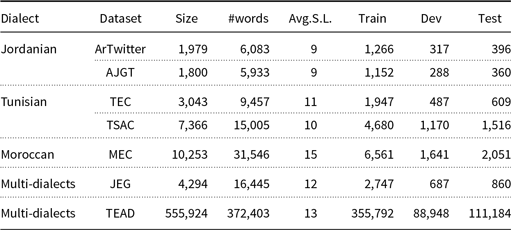
Each dataset was divided into a training set to train the model, dev set for tuning the parameters and a test set for evaluation. The detailed statistics of these sets are reviewed in Table 4, where Train, Dev, Avg.S.L. refer to the training, developing and average lengths of sentences, respectively.
Statistics of the used datasets

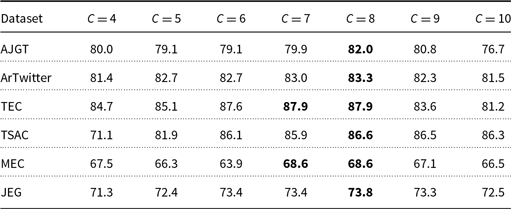
F-measure values (%) obtained with dev sets for different window sizes

Boldface refers to the best F-measure values achieved within every dataset for each value of the window size C. For C = 8, F-measure were the best (highest) in all datasets. Therefore, C = 8 was adopted in the experiments.
6. Results and discussion
6.1 Hyper parameters adjustment of Tw-StAR model
The hyper parameters (C, d) of Tw-StAR were assigned empirically. Among several window sizes ranging from 4 to 10, a window size value of 8 was adopted as it produced the best F-measure in all datasets using the validation Dev dataset (see Table 5). Consequently, each input sentence is represented by a set of 8-grams to be fed to the model. Similarly, upon examining three embedding dimension sizes equal to 50, 100 and 150, and several dropout rates ranging from 0.2 to 0.5,
 $d=100$
and dropout=0.2 were adopted, since these values scored the best F-measure during the model’s tuning period.
6.2 Syntax-ignorant n-gram embeddings evaluation
The efficiency of our n-gram embeddings, composed by SOWE, was evaluated against word embeddings (word2vec) and document embeddings (doc2vec). To conduct a fair comparison, word2vec (Mikolov et al. Reference Mikolov, Sutskever, Chen, Corrado and Dean2013) and doc2vec (PV-DBoW/PV-DM) (Le and Mikolov Reference Le and Mikolov2014) algorithms were trained on each of the studied datasets with sentiment labels included in the training process. In addition, the training parameters such as the window size and embedding dimensions were unified across the evaluated embedding methods: word2vec, doc2vec (PV-DBoW/PV-DM) and Tw-StAR. It should be noted that, within doc2vec we can recognise two mapping methods: (a) distributed bag of words (DBoW) that learns and composes the sentence embeddings regardless of the order of words and (b) distributed memory (DM) that follows the CBOW mechanism, as it considers the words’ order while learning the sentence embeddings vector (Le and Mikolov Reference Le and Mikolov2014).
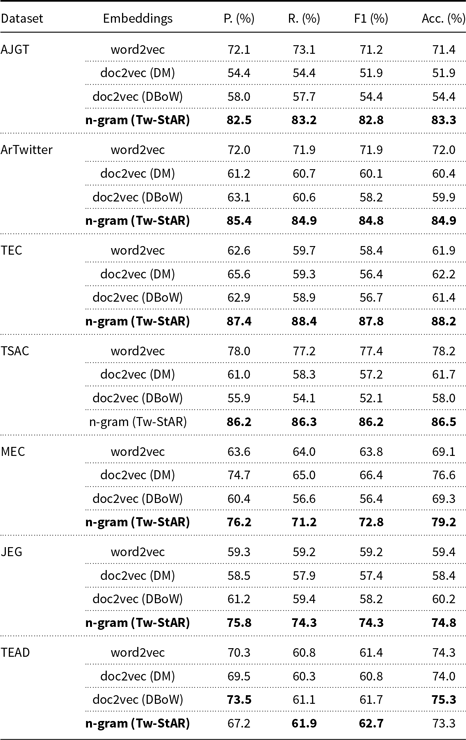
Having the word embeddings, document embeddings and n-gram embeddings generated for each of the studied corpora, they were used one by one as features to train Tw-StAR on recognising the sentiment embedded in the datasets in Table 4. To train our model with word2vec and doc2vec embeddings, the embedding layer in Tw-StAR was replaced with the embeddings produced by word2vec and both variants of doc2vec, respectively. These embeddings were then passed through the shallow architecture of Tw-StAR. Table 6 lists the the sentiment classification performances achieved using n-grams by SOWE, word vectors by word2vec and sentence vectors by doc2vec (PV-DBoW/PV-DM) for all datasets.
Tw-StAR performances for n-gram, word2vec and doc2vec embeddings

Boldface indicates the best performance (highest values of evaluation measures) and the best performing embeddings among word2vec, doc2vec (DM), doc2vec (DBoW) and n-gram (Tw-StAR).
The results in Table 6 suggest the outperformance of the proposed embeddings over those generated by word2vec and doc2vec models with a significant margin in F-measure values for most datasets. The best F-measure value was achieved for TEC dataset with a value of 87.8% compared to 58.4%, 56.4% and 56.7% scored by word2vec, doc2vec (PV-DM) and doc2vec (PV-DBoW), respectively. This could be explained by the ability of SOWE to accurately capture the semantic information along with the synonymous relations among words coping with the claim stated in White et al. (Reference White, Togneri, Liu and Bennamoun2015). This was further emphasised through examples from the visualisation maps provided in Section 6.3. In addition, for JEG dataset that combines three different dialects, the F-measure obtained using n-gram embeddings increased by 15.1%, 16.9% and 16.1% compared to word2vec, doc2vec (PV-DM) and doc2vec (PV-DBoW), respectively. This indicates how the proposed embeddings can address the differences among various dialects through ignoring the syntactic structure and word order, and focusing on the semantic relations based on the ability of SOWE to efficiently enrich the composed n-gram embeddings with semantic/synonymous regularities.
On the other hand, it can be seen from Table 6 that for datasets, having an MSA-dominated content such as MEC, doc2vec (PV-DM), which takes words’ order into account, performed significantly better than word2vec and doc2vec (PV-DBoW). Indeed, the achieved accuracy for MEC dataset with the embeddings learned by doc2vec (PV-DM) was 76.6% compared to 69.1% and 69.3% scored by word2vec and doc2vec (PV-DBoW), respectively.
6.3 Syntax-ignorant n-gram embeddings visualisation
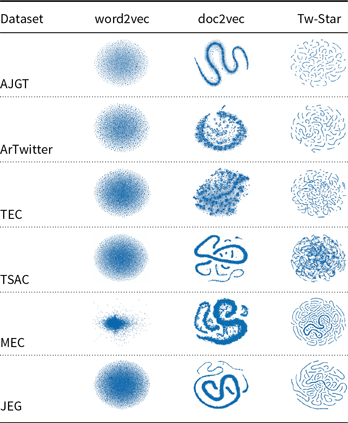
Aiming to inspect the performance of the n-gram embeddings thoroughly, we visualised text vectors learned by Tw-StAR and compared them towards word vectors generated by word2vec and paragraph vectors learned via doc2vec (PV-DBoW). This was done by projecting the embedding vectors into a two-dimensional space using the t-distributed stochastic neighbour embedding (t-SNE) technique (van der Maaten and Hinton Reference van der Maaten and Hinton2008).
From the figures reviewed in Table 7, a clustering behaviour of the words that compose n-grams or document embeddings could be observed in both Tw-StAR and doc2vec (PV-DBoW) models. In word2vec model, however, word vectors tend to spread sparsely in the embeddings space. This was reflected on the performance of the embeddings as being discriminating features for the SA task. To clarify that, considering TSAC dataset, we have noticed that pure Tunisian dialectal words such as “ ” (we love you), “
 ” (we like it), “
 ” (good), “
 ” (we praise you), which bear positive sentiments, were mapped by Tw-StAR model close to each other in the embeddings space. However, when looking to the representations created for the same dataset by doc2vec (PV-DBoW), we have come through the words “
 ” (we love you), “
 ” (magnificent) and “
 ” (excellent), which all refer to a positive sentiment, yet, they are mapped close to the negative words “
 ” (dull), “
 ” (how boring) and “
 ” (a dirty man) in the embeddings space.
t-SNE visualisation of word vectors learned by word2vec/doc2vec against word vectors learned by Tw-StAR

6.4 SOWE composition function evaluation
According to White et al. (Reference White, Togneri, Liu and Bennamoun2015), in the context of sentence semantic similarity, SOWE was proved to be the best-performing composition function in expressing and encoding the semantic information within the phrase/paragraph embedding vectors. Based on that, we investigated how SOWE would perform for the sentiment analysis task compared to another unordered composition function: Avg, which was used in Iyyer et al. (Reference Iyyer, Manjunatha, Boyd-Graber and Daumé2015). For this purpose, we composed our n-gram embeddings first by SOWE then via Avg function such that both embedding variants were used to train Tw-StAR model.
Table 8 reviews the performances resulting from training Tw-StAR with embeddings composed by SOWE and Avg functions for the studied datasets.
AVG, SOWE impact on SA of the dialectal datasets

Boldface indicates the best performance (F-measure, Accuracy) achieved by either SOWE or AVG functions for each dataset.
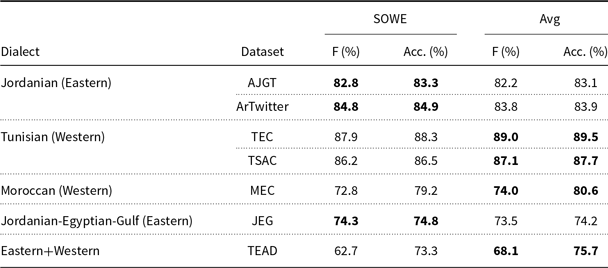
Considering the results shown in Table 8, we can observe that for the Eastern dialect datasets: AJGT, ArTwitter and JEG, SOWE produced more expressive features than the Avg function. However, for the Western dialect datasets, Avg could slightly outperform SOWE as the achieved F-measure values were 89.0%, 87.1% and 74.0% compared to 87.9%, 86.2% and 72.8% for TEC, TSAC and MEC datasets, respectively. This could be attributed to the nature of the Western dialects where many transliterated words derived from French, Spanish and Tamazight languages do exist (Zaidan and Callison-Burch Reference Zaidan and Callison-Burch2014). Being transliterated, these words are usually written in different writing styles which makes SOWE missing the synonymous relations among such words bearing same or close sentiments, and hence leads to less expressive embedding features compared to Avg.
6.5 Tw-StAR shallow architecture evaluation
Through the proposed model, we are seeking to obtain an efficient sentiment classification performance using a less complicated architecture and with the least time overhead. Therefore, Tw-StAR was designed as a shallow feed-forward neural network with one hidden layer. The ability of Tw-StAR to rival deep neural models was examined by feeding our n-gram embeddings to train two deep neural models having the building units: CNN and LSTM, in addition to the DAN model developed in Iyyer et al. (Reference Iyyer, Manjunatha, Boyd-Graber and Daumé2015) and described in Section 1. The CNN-based model was cloned from Kim (Reference Kim2014), while LSTM-based model was developed with several depths (2,3,4,5) formulated by stacking LSTM layers. Within these architectures, two type of experiments were conducted:
-
The first experiment involved using training embeddings composed by SOWE composition function.
-
The second experiment, however, employed n-gram embeddings composed via Avg composition function.
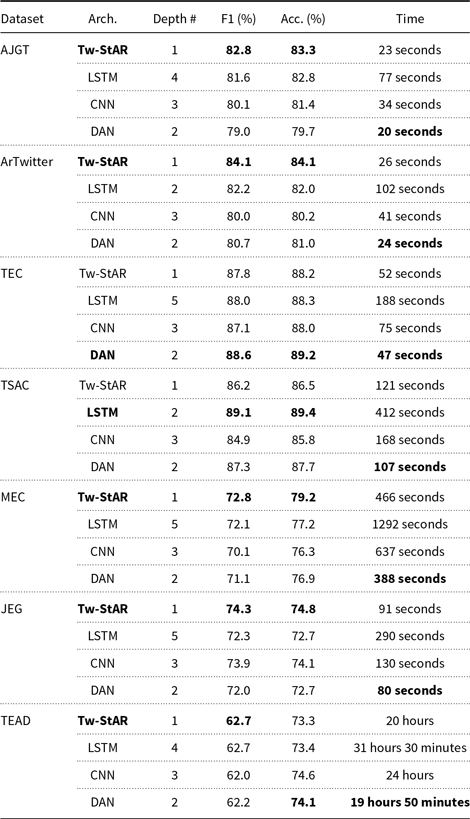
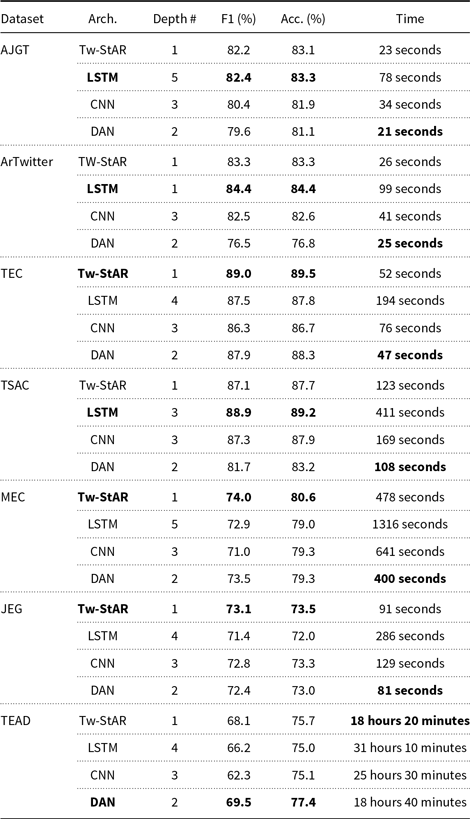
Thus, the efficiency of the shallow Tw-StAR model was determined through conducting a comparison between the sentiment classification performances yielding from the previous shallow/deep SA models for SOWE and AVG compositionalities. Tables 9 and 10 summarise the obtained results, where (Arch.) and (Time) refer to the adopted model architecture and the consumed training time, respectively. It should be noted that, for LSTM-based model, we selected the best performances achieved by various depths. In addition, DAN system in Table 9 was trained with embeddings composed by SOWE and not by AVG as in Iyyer et al. (Reference Iyyer, Manjunatha, Boyd-Graber and Daumé2015), while its 2-hidden layers deep architecture was retained.
Tw-StAR versus CNN, LSTM and DAN deep models with SOWE function

Boldface refers to the best performance (highest values of F1 and Accuracy) and the best training time (least values of Time) achieved by the different architectures (LSTM, CNN, DAN and Tw-StAR).
As it can be seen from Table 9, in AJGT, ArTwitter and JEG datasets, Tw-StAR outperformed LSTM-based, CNN-based and DAN deep models, whereas it achieved a slightly better F-measure for MEC and TEAD datasets. A comparable performance, however, was observed for TEC and TSAC, where LSTM-based model was the best-performing system for these datasets. This could be attributed to the efficiency of SOWE in producing more discriminating features for Eastern dialect datasets such as AJGT, ArTwitter and JEG compared to Western dialect collections. However, in general, we cannot ignore the ability of Tw-StAR to be an efficient replacement of more complicated deep models. Especially that, for most datasets, Tw-StAR managed to provide a quite good sentiment classification performance with fewer parameters and much faster training time compared to LSTM-based, CNN-based and DAN deep models.
Similarly, the results listed in Table 10 show the competent performance achieved by Tw-StAR compared to the other models where it scored the best F-measure values for TEC, MEC and JEG datasets, whereas comparable performances were obtained for AJGT, ArTwitter, TSAC and TEAD datasets.
Tw-StAR versus CNN, LSTM and DAN deep models with Avg function

Boldface refers to the best performance (highest values of F1 and Accuracy) and the best training time (least values of Time) achieved by the different architectures (LSTM, CNN, DAN and Tw-StAR).
6.6 Tw-StAR training time evaluation
Besides the competent performance of the our shallow model Tw-StAR against more complicated deep architectures, Tw-StAR could accomplish the training phase consuming less time compared to LSTM-based and CNN-based models. This is reviewed in Tables 9 and 10 as we can see that, in AJGT dataset, it took 23 seconds to train the features composed by SOWE (Table 9), while LSTM and CNN models consumed 77 seconds and 34 seconds, respectively. Similar behaviour could be observed in Table 10.
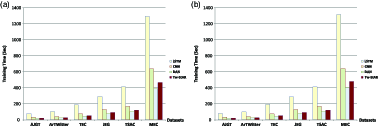
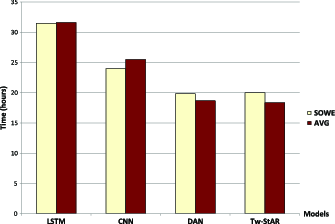
This could be explained by the high computational complexity consumed at each layer of the LSTM model, where at every time step, in addition to the recurrent input, if the input is already yielded from an LSTM layer (in the case of stacked LSTMs), the current LSTM, then, can create a more complex feature representation of the current input (Al-Azani and El-Alfy Reference Al-Azani and El-Alfy2017); which, in turn, raises the time overhead. In addition, the learning mechanism adopted by the CNN-based model involves detecting multiple feature patterns through using various kernel sizes then concatenating their outputs at each convolution (Kim Reference Kim2014); consequently, more time is required for training compared to that needed by Tw-StAR. The training time consumed across the studied models: CNN, LSTM, DAN and Tw-StAR is illustrated in Figure 2 for SOWE (Figure 2(a)) and Avg (Figure 2(b)) composition functions, respectively.
Training time across all architectures for SOWE and Avg functions. (a) Training time with SOWE. (b) Training time with Avg.

Training time consumed by all models for SOWE, Avg in TEAD.

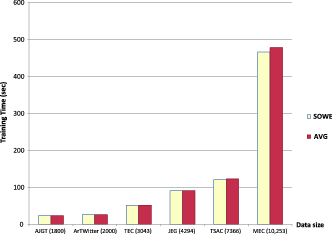
On the other hand, considering Figure 2(a) and (b), it could be noted that the 2-hidden layer deep model (DAN) proposed by Iyyer et al. (Reference Iyyer, Manjunatha, Boyd-Graber and Daumé2015) achieved the best training time among all the model architectures for both SOWE and Avg composition functions. However, when exploring the training time values recorded for Tw-StAR model and those of DAN’s, we can see that the latter is consuming slightly less time compared to Tw-STAR as DAN needed a training time less by 3, 2, 5 and 11 seconds for AJGT, ArTwitter, TEC and JEG datasets, respectively. In addition, for large-sized datasets such as MEC and TSAC, although this time difference increases, yet, it does not exceeds 78 seconds and it is compensated by the better sentiment classification performance achieved by Tw-StAR for these datasets (see Tables 9 and 10). Similarly, for the large-scaled dataset, TEAD, DAN and Tw-StAR consumed quite same training time and were of the least time overhead among the studied architectures, as it can be seen from Figure 3, where the comparison was done for both SOWE and Avg composition functions. This reflects the ability of less complicated models such as Tw-StAR and DAN to maintain a robust performance overhead while handling different sizes of datasets. In the same context, for Tw-StAR model, although learning features composed by Avg require a little bit more time than those composed by SOWE for large-sized datasets, the time needed to train the model with both feature variants increases according to the size of the input data as it can be seen from Figure 4.
Training time consumed by Tw-StAR for SOWE, Avg due to data size.

6.7 Tw-StAR model versus baseline systems
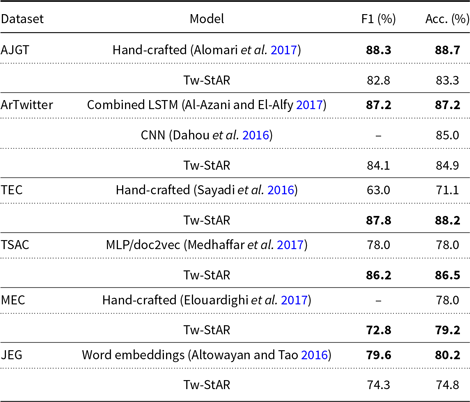
The performances obtained by Tw-StAR using SOWE composition function were further compared against the baseline systems that tackled the same datasets (see Table 11).
Tw-StAR versus baseline models

Boldface highlights the best performance in terms of F1 and Accuracy achieved by the baseline systems orTw-StAR for each dataset.
Due to the lack of embeddings-based Arabic SA systems, we had to compare with the available hand-crafted baseline models: Alomari et al. (Reference Alomari, ElSherif and Shaalan2017), Sayadi et al. (Reference Sayadi, Liwicki, Ingold and Bui2016), Elouardighi et al. (Reference Elouardighi, Maghfour, Hammia and Aazi2017) for AJGT, TEC and MEC, while for the datasets: ArTwitter, JEG and TSAC embedding-based baseline models were provided by Al-Azani and El-Alfy (Reference Al-Azani and El-Alfy2017), Altowayan and Tao (Reference Altowayan and Tao2016), Medhaffar et al. (Reference Medhaffar, Bougares, Esteve and Hadrich-Belguith2017). Compared to the state-of-the-art applied on the investigated datasets (see Table 4), our results showed that Tw-StAR trained with syntax-ignorant n-gram embeddings could improve the classification performance over the baseline systems in most of the datasets.
As we can see in Table 11, with Tw-StAR applied, the accuracy values increased by 17.1%, 8.3% and 1.2% for TEC, TSAC and MEC datasets, respectively. Here, we can notice that the less accuracy increment was reported in MSA/Moroccan MEC dataset; this defines the proposed embeddings as expressive features of pure dialectal content more than they are for MSA ones; as the free word order and varying syntactic structure of dialects can be better handled by SOWE. Moreover, for ArTwitter dataset, a competent performance was achieved by Tw-StAR against complicated neural architectures such as CNNs adopted by Dahou et al. (Reference Dahou, Xiong, Zhou, Haddoud and Duan2016) and combined LSTMs used in Al-Azani and El-Alfy (Reference Al-Azani and El-Alfy2017), where the accuracy decreased by 0.1% and 2.3% compared to Dahou et al. (Reference Dahou, Xiong, Zhou, Haddoud and Duan2016) and Al-Azani and El-Alfy (Reference Al-Azani and El-Alfy2017), respectively. Consequently, a shallow neural model such as Tw-StAR trained with embeddings specifically composed to target the Arabic dialectal content can rival much more complicated neural architectures. In addition, for JEG dataset that contains three different dialects, although Tw-StAR could not outperform the baseline system, a satisfying performance was achieved without the need for a huge external knowledge resources such as the training corpus used by Altowayan and Tao (Reference Altowayan and Tao2016) to provide their own word embeddings.
7. Conclusion
In this paper, we introduced syntax-ignorant, n-gram embeddings to be used as discriminating features in the context of sentiment analysis of Arabic dialects. The presented model TwStAR trained with these embeddings could classify the sentiment of several dialects better than most baseline systems and deep complicated architectures. Being composed via SOWE function, our embeddings emphasized the efficiency of using unordered additive composition model in the SA task as the performances produced by n-gram embeddings were better than those learned via word2vec and doc2vec (PV-DM/PV-DBoW) models. Based on the visualisation of the word embeddings learned by Tw-StAR, word2vec and doc2vec (PV-DBoW) models, it was possible to deduce that several words of close sentiments were better mapped using Tw-StAR model. Moreover, another comparison between SOWE and Avg for the SA task of Eastern and Western Arabic dialectal content showed that the sentiment of Eastern dialects was better expressed by SOWE-composed features, while the features formulated by Avg led to a slightly better sentiment classification performance for Western dialect datasets. At the implementation level, it was revealed that, a shallow neural model such as Tw-StAR, trained with unordered embeddings, can address the varying syntax structure and free word order issues of DA yielding a competent performance with much more complicated deep learning architectures. This was emphasised by evaluating Tw-StAR performance against deep SA models having the building units: LSTM and CNN, where Tw-StAR rivalled and sometimes overcome these models. In addition, compared to LSTM/CNN-based models, Tw-StAR consumed less training time in all datasets. In contrast, compared to DAN system (Iyyer et al. Reference Iyyer, Manjunatha, Boyd-Graber and Daumé2015), our shallow model consumed quite similar training time for the large-scaled dataset TEAD indicating that less complicated architectures with unordered composed embedding features can handle the increased size of training data exhibiting a reduced time overhead. A natural future step would involve examining whether the proposed embeddings can be employed in SA of informal social media posts written in other languages. Furthermore, a multi-dialectal lexicon would be constructed based on the distances among the presented word embedding vectors learned via Tw-StAR and visualised by t-SNE tool.