Introduction
Many feline species exhibit considerable morphological and ecological similarity (Davies et al. Reference Davies, Meiri, Barraclough and Gittleman2007, Donadio & Buskirk Reference Donadio and Buskirk2006) and some of them live in sympatry throughout the Neotropical region (Sunquist & Sunquist Reference Sunquist and Sunquist2002). As a consequence of their similarities, these species can use the same resources simultaneously and, therefore, may potentially engage in negative interactions such as exploitation or interference competition and intraguild predation (Palomares & Caro Reference Palomares and Caro1999). Interactions between feline species produce significant effects on their coexistence within their assemblages, but also on the structure and composition of the communities they are a part of (Linnell & Strand Reference Linnell and Strand2000, Palomares & Caro Reference Palomares and Caro1999).
In general, intraguild interactions are more intense when the species involved have similar diets and predation habits, as well as comparable body-size and morphology (Donadio & Buskirk Reference Donadio and Buskirk2006). In Neotropical feline assemblages, competition is usually highest between large-sized [top predators, i.e. Puma concolor (Linnaeus) and Panthera onca (Linnaeus)] and medium-sized species [mesopredators such as Leopardus tigrinus (Schreber), L. wiedii (Schinz), Puma yagouaroundi (E. Geoffroy) and L. pardalis (Linnaeus) (de Oliveira et al. Reference De Oliveira, Tortato, Silveira, Kasper, Mazim, Lucherini, Jácomo, Soares, Marquez, Sunquist, Macdonal and Loveridge2010, Di Bitetti et al. Reference Di Bitetti, De Angelo, Di Blanco and Paviolo2010, Oliveira-Santos et al. Reference Oliveira-Santos, Graipel, Tortato, Zucco, Cáceres and Goulart2012)]. Interactions between these species may even take their most extreme form when top predators limit mesopredators (Linnell & Strand Reference Linnell and Strand2000, Ritchie & Johnson Reference Ritchie and Johnson2009), affecting their abundance and activity patterns (Di Bitetti et al. Reference Di Bitetti, De Angelo, Di Blanco and Paviolo2010, Oliveira-Santos et al. Reference Oliveira-Santos, Graipel, Tortato, Zucco, Cáceres and Goulart2012).
Feline species can express different mechanisms which prevent or minimize interspecies interactions, thereby facilitating their coexistence. One of these mechanisms is niche separation, mostly in the feeding and spatial axes (Schoener Reference Schoener1974). However, temporal segregation has also been proposed as a strategy for sympatric species to coexist (Kronfeld-Schor & Dayan Reference Kronfeld-Schor and Dayan2003), particularly when interference competition and intraguild predation are important selective pressures (Carothers & Jaksic Reference Carothers and Jaksic1984). Researchers have recorded differences in the periods of maximum activity between P. concolor and P. onca (Ávila-Nájera et al. Reference Ávila-Nájera, Chávez, Lazcano-Barrero, Mendoza and Pérez-Elizalde2016, Hernández-SaintMartín et al. Reference Hernández-Saintmartín, Rosas-Rosas, Palacio-Núñez, Tarango-Arambula, Clemente-Sánchez and Hoogesteijn2013, Monroy-Vilchis et al. Reference Monroy-Vilchis, Rodríguez-Soto, Zarco-González and Urios2009, Romero-Muñoz et al. Reference Romero-Muñoz, Maffei, Cuellar and Noss2010) and between smaller species (Di Bitetti et al. Reference Di Bitetti, De Angelo, Di Blanco and Paviolo2010, Oliveira-Santos et al. Reference Oliveira-Santos, Graipel, Tortato, Zucco, Cáceres and Goulart2012, Pérez-Irineo & Santos-Moreno Reference Pérez-Irineo and Santos-Moreno2016). Conversely, other studies have found similarities in the activity patterns of these species (Harmsen et al. Reference Harmsen, Foster, Silver, Ostro and Doncaster2009, Scognamillo et al. Reference Scognamillo, Maxit, Sunquist and Polisar2003) including high overlaps when they are sympatric (Foster et al. Reference Foster, Sarmento, Torres, Jácomo, Negroes, Fonseca and Silveira2013, Pérez-Irineo et al. Reference Pérez-Irineo, Santos-Moreno and Hernández-Sánchez2017, Porfirio et al. Reference Porfirio, Sarmento, Foster and Fonseca2017).
Alternatively, feline activity can be determined to a large extent by the activity of their prey, rather than by mutual evasion (Emmons Reference Emmons1987, Karanth & Sunquist Reference Karanth and Sunquist2000, Scognamillo et al. Reference Scognamillo, Maxit, Sunquist and Polisar2003). Most of the studies evaluating interactions between Neotropical felines and their prey have found significant temporal overlaps (Azevedo et al. Reference Azevedo, Lemos, Freitas-Junior, Rocha and Azevedo2018, Foster et al. Reference Foster, Sarmento, Torres, Jácomo, Negroes, Fonseca and Silveira2013, Gutiérrez-González & López-González Reference Gutiérrez-González and López-González2017, Porfirio et al. Reference Porfirio, Foster, Fonseca and Sarmento2016, Reference Porfirio, Sarmento, Foster and Fonseca2017). These investigations have suggested that felids can adjust their activity to increase the probability of encounters with their prey, minimizing the energetic costs of foraging (Foster et al. Reference Foster, Sarmento, Torres, Jácomo, Negroes, Fonseca and Silveira2013, Harmsen et al. Reference Harmsen, Foster, Silver, Ostro and Doncaster2011, Porfirio et al. Reference Porfirio, Foster, Fonseca and Sarmento2016). But they can also choose prey with different activity patterns to minimize exploitation competition (Romero-Muñoz et al. Reference Romero-Muñoz, Maffei, Cuellar and Noss2010, Scognamillo et al. Reference Scognamillo, Maxit, Sunquist and Polisar2003).
The tropical forests of south-western Mexico are inhabited by three mesopredator felines (L. wiedii, L. pardalis and P. yagouaroundi) and two top predators (P. concolor and P. onca). However, the temporal activity overlap between these species and their main prey has hardly been studied in the region (Pérez-Irineo & Santos-Moreno Reference Pérez-Irineo and Santos-Moreno2016) despite being relevant to understanding the mechanisms and factors which allow their coexistence. In this study, we estimated and compared the activity patterns of the five mentioned feline species and their main prey, as well as the seasonal variation of these activity patterns in two types of vegetation in south-west Mexico. We expected to find significant differences between the activity patterns of the felids reflecting mechanisms to avoid negative interactions given that temporal segregation facilitates coexistence (Kronfeld-Schor & Dayan Reference Kronfeld-Schor and Dayan2003). Otherwise, we expected that these predators would adjust their activities with their prey species, minimizing competition by choosing prey with different activity patterns (Romero-Muñoz et al. Reference Romero-Muñoz, Maffei, Cuellar and Noss2010).
Methods
Study area
The study was conducted in the community of San Isidro Yólox in the Sierra Norte region of the State of Oaxaca, in Mexico (17°38′0.51′′N, 96°25′2.56′′W), within a priority region for conservation (Región Terrestre Prioritaria Sierras del Norte de Oaxaca-Mixe; RTP-130; Arriaga et al. Reference Arriaga, Espinoza-Rodríguez, Aguilar-Zúñiga, Martínez-Romero, Gómez-Mendoza and Loa2000). Climate in the area is humid-warm (Am) and humid-temperate C(m), with mean annual temperatures of 22–26°C and 16–20°C, respectively. Yearly precipitation ranges between 2500–4000 mm (Trejo Reference Trejo, García-Mendoza, Ordóñez and Briones-Salas2004), mostly concentrated in a wet season from July to January, while the dry season is from February to June. The main vegetation types in the area are medium tropical forest and cloud forest. The former includes agricultural plots, cattle grazing areas, secondary growth areas (formerly used for agriculture) and small human settlements (<150 habitants). The cloud forest has a low level of fragmentation and human intervention. This region has the best conserved cloud forests of Mexico (Arriaga et al. Reference Arriaga, Espinoza-Rodríguez, Aguilar-Zúñiga, Martínez-Romero, Gómez-Mendoza and Loa2000).
Sampling
We used camera traps to record the activity of felids and their prey from July 2014 to June 2015. We placed 22 permanent camera trap stations in each vegetation type, separated by an average distance of 500 m between each other. We used two different models of cameras: Bushnell Trophy Cam™ and Moultrie 990i Digital Game Camera. The traps remained active 24 h day−1 with a delay period between pictures of 10 s. Traps were placed at 20–30 cm above the ground in areas close to cattle grazing plots, river margins or along trails within the forest, and no attractants were used. Stations were checked monthly to replace batteries or malfunctioning traps.
Prey species
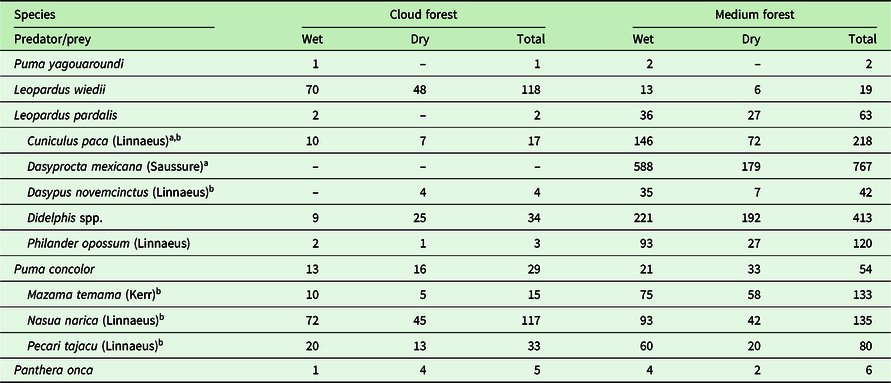
We selected the most important prey species in terms of frequency of occurrence and proportion of the biomass consumed in the diet of each predator, according to published literature (Table 1). We only included prey information for L. pardalis (de Oliveira et al. Reference De Oliveira, Tortato, Silveira, Kasper, Mazim, Lucherini, Jácomo, Soares, Marquez, Sunquist, Macdonal and Loveridge2010, Sunquist & Sunquist Reference Sunquist and Sunquist2002), and P. concolor and P. onca (Ávila-Nájera et al. Reference Ávila-Nájera, Palomares, Chávez, Tigar and Mendoza2018, Foster et al. Reference Foster, Harmsen, Valdes, Pomilla and Doncaster2010, Novack et al. Reference Novack, Main, Sunquist and Labisky2005, Weckel et al. Reference Weckel, Giuliano and Silver2006). Prey for L. wiedii and P. yagouaroundi were not included because they are mainly small-sized mammals and birds which could not be identified to the species level with the traps due to their body size (<200 g).
Felids and their main prey species, showing the number of independent records for each season (wet and dry) and vegetation type in the Sierra Norte of Oaxaca, Mexico.

a Additional prey species considered for P. concolor.
b Prey considered for P. onca.
Data analysis
We compiled the date and time of the photographs captured by the camera traps in a database. We used this information to analyse the activity of each species of our interest. To avoid problems of autocorrelation, independent records represented pictures of a recognizable species or individual taken in a sampling station at least 1 h apart from another (Romero-Muñoz et al. Reference Romero-Muñoz, Maffei, Cuellar and Noss2010). For analyses, we only considered the first record per hour per station to avoid data pseudoreplication (Di Bitetti et al. Reference Di Bitetti, De Angelo, Di Blanco and Paviolo2010). For gregarious species, we considered each individual captured in a picture as an independent record (Monroy-Vilchis et al. Reference Monroy-Vilchis, Zarco-González, Rodríguez-Soto, Soria-Díaz and Urios2011). We analysed the activity patterns for all the species with a minimum of 11 independent records throughout our study period (Monroy-Vilchis et al. Reference Monroy-Vilchis, Zarco-González, Rodríguez-Soto, Soria-Díaz and Urios2011).
We retrieved the time at sunrise and sunset corresponding to each date with independent records, and the geographic location of the camera traps. We also calculated the average time at sunrise and sunset per season for the study period. We then transformed the time of each independent record to solar hours following Foster et al. (Reference Foster, Sarmento, Torres, Jácomo, Negroes, Fonseca and Silveira2013), to compensate for time-zone and daylight savings time, and allow the comparison between seasons and vegetation types.
We estimated the activity patterns of felids and their prey per season and vegetation type using the kernel density method (Ridout & Linkie, Reference Ridout and Linkie2009). We classified the activity pattern of each species as diurnal, nocturnal, crepuscular, or cathemeral depending on the proportion of activity occurring per period, calculated by integrating the areas under the curve for each respective period (Foster et al. Reference Foster, Sarmento, Torres, Jácomo, Negroes, Fonseca and Silveira2013, Linkie & Ridout Reference Linkie and Ridout2011). Species with activity mainly between 1h after sunrise and 1h before sunset were considered diurnal. Those with activity mostly between 1h after sunset and 1h before sunrise were classified as nocturnal. Crepuscular species were mainly active 1h before and 1h after sunrise and sunset, and cathemeral species were those with intermittent activity during the day and night (Foster et al. Reference Foster, Sarmento, Torres, Jácomo, Negroes, Fonseca and Silveira2013). This classification corresponds to the probability of observing the species during that period of time (Foster et al. Reference Foster, Sarmento, Torres, Jácomo, Negroes, Fonseca and Silveira2013, Linkie & Ridout Reference Linkie and Ridout2011).
Because activity data have a circular distribution (Romero-Muñoz et al. Reference Romero-Muñoz, Maffei, Cuellar and Noss2010), we compared the differences in species activity patterns between seasons using methods from circular statistics. When we found no significant seasonal differences, we grouped the data per vegetation type and compared them. Whenever there were no variations in activity between vegetation types, we obtained an overall pattern for the species for the whole study period. The comparisons were done with the non-parametric Mardia–Watson–Wheeler (W) and Watson (U 2 ) tests. The latter was used when the number of records was higher than 5 but less than 10 (Zar Reference Zar1999). The significance level used for the statistical tests was P ≤ 0.05.
To assess the overlap between activity patterns for each pair of species (predator-predator and predator-prey) per season and vegetation type, we estimated an overlap coefficient (Δ). This coefficient is defined as the area under the curve resulting from taking the minimum of the two density functions being compared at each time point (Linkie & Ridout Reference Linkie and Ridout2011) and takes values from zero (no overlap) to one (complete overlap) (Ridout & Linkie Reference Ridout and Linkie2009). We used estimator
 ${\widehat \Delta _1}$
to obtain the overlap coefficient because it is recommended for small sample sizes (Ridout & Linkie Reference Ridout and Linkie2009). We calculated 95% confidence intervals (CI) for the coefficient from 10 000 bootstrap replications (Meredith & Ridout Reference Meredith and Ridout2017). Activity overlap was classified in three levels (Monterroso et al. Reference Monterroso, Alves and Ferreras2014): low (
${\widehat \Delta _1}$
≤ percentile 50), moderate (percentile 50 <
${\widehat \Delta _1}$
≤ percentile 75) and high (
${\widehat \Delta _1}$
> percentile 75). We also compared differences in the activity patterns for each pair of species using circular statistics, since the overlap coefficient does not define a threshold value to identify significant differences between two pairs of activity patterns (Monterroso et al. Reference Monterroso, Alves and Ferreras2014). All the analyses were done in the R platform (R Core Team 2016) using the packages Suncalc (Agafonkin & Thieurmel Reference Agafonkin and Thieurmel2018), SolaR (Perpiñán Reference Perpiñán2016), Overlap (Meredith & Ridout Reference Meredith and Ridout2017) and Circular (Agostinelli & Lund Reference Agostinelli and Lund2013).
Results
We obtained 2430 independent records for five feline species including three mesopredators (L. wiedii, L. pardalis, and P. yagouaroundi), two top predators (P. concolor and P. onca), and eight prey species for a total sampling effort of 12 800 trap-days. The highest percentage of records was obtained in the medium forest during the rainy season (57%; Table 1). We excluded from our analyses the activity patterns of L. pardalis, Dasypus novemcinctus, and Philander opossum in the cloud forest because of low sample sizes (Table 1). For the same reason, the activity patterns of P. onca were only compared between vegetation types.
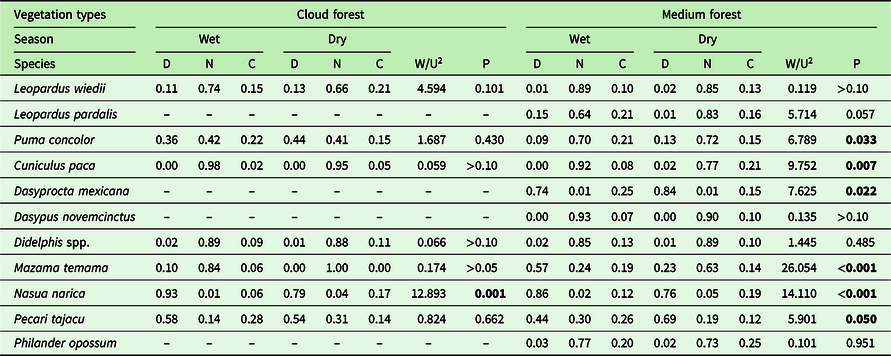
We found no significant seasonal differences in feline activity patterns in either of the vegetation types (Table 2) with the exception of P. concolor, which showed different seasonal patterns in the medium forest (W = 6.789, P = 0.033). This species was predominantly nocturnal but showed increased crepuscular activity in the rainy season compared with the dry season. Leopardus pardalis was predominantly nocturnal in the medium forest while P. concolor was cathemeral in the cloud forest. We found no significant differences in the activity patterns between vegetation types for L. wiedii nor P. onca (W = 4.680, P = 0.096; U 2 = 0.103, P > 0.10, respectively). Leopardus wiedii was predominantly nocturnal with its activity peaking around midnight and P. onca was cathemeral, although with more diurnal than nocturnal activity.
Proportion of the activity observed in each period (D = diurnal; N = nocturnal; C = crepuscular) based on density kernels, for both seasons (Wet and Dry) and vegetation types in the study site. W/U2 = value of the test statistic; P = significance level for the test (significant differences in bold).

The overlap coefficients for feline activity varied between seasons and vegetation types (Table 3). In the medium forest, activity patterns for mid-sized species showed a high overlap with no significant differences between species. In the cloud forest, the large-sized species had similar activity patterns but showed a low level of overlap. In the relationship between top- and mesopredators, the activity pattern of L. wiedii overlapped moderately and was significantly different to P. concolor in the cloud forest (
${\widehat \Delta _1}$
= 0.66, 0.52–0.82; W = 9.501, P = 0.009) and to P. onca in the study area altogether (
${\widehat \Delta _1}$
= 0.61, 0.39–0.81; W = 6.938, P = 0.031). Conversely, in the medium forest, the activity patterns of L. wiedii and P. concolor did not differ significantly (Table 3). In the medium forest, L. pardalis also showed a high overlap with P. concolor and a moderate overlap with P. onca, with no statistical differences between their activity patterns (Table 3).
Overlap coefficients (
${\widehat \Delta _1}$
) between predator activity patterns in the study site. Values for the cloud forest are shown above the diagonal and for the medium forest in the lower half. 95% confidence intervals are shown in parentheses.

a Significant difference (P ≤ 0.050).
b Overlap for the wet and dry seasons.
Regarding prey species, the activity of N. narica was significantly different between seasons in the cloud forest (W = 12.893, P = 0.001). This species was diurnal in both seasons but with greater activity in the first half of the day during the rainy season than in the dry season. The activity patterns of C. paca, D. mexicana, M. temama, N. narica, and P. tajacu also varied between seasons in the medium forest (Table 2). In both vegetation types, C. paca and M. temama were active at night. Pecari tajacu was mostly diurnal in the cloud forest while, in the medium forest, D. novemcinctus was nocturnal and P. opossum was predominantly nocturnal with activity peaks at the beginning and middle of the night. Variation in the activity patterns of Didelphis spp. (two species have been recorded in the study area, D. marsupialis and D. virginiana) were not significant between seasons (Table 2) nor vegetation types (W = 0.219, P = 0.896). This species was active through the whole night in the study area.
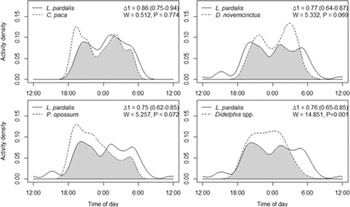
The activity patterns of felines and their corresponding prey species were similar with a high overlap, although this pattern varied with season and vegetation type. Activity pattern of L. pardalis showed no statistical difference with C. paca during the dry season and with D. novemcinctus and P. opossum in either season in the medium forest (Figure 1). Activity overlap between L. pardalis and Didelphis spp. was also high but their patterns varied significantly. Oppositely, this feline had little coincidence with the periods of activity of D. mexicana during the rainy (
${\widehat \Delta _1}$
= 0.30, 0.19–0.42; W = 51.958, P < 0.001) and dry seasons (
${\widehat \Delta _1}$
= 0.10, 0.06–0.17; W = 58.238, P < 0.001).
Overlap between the activity patterns for Leopardus pardalis and its main prey species in the medium forest of the Sierra Norte region in Oaxaca, Mexico. The overlap is indicated with the shaded area. The values shown correspond to the overlap coefficient (
${\widehat \Delta _1}$
) and the statistical test comparing activity patterns between species.

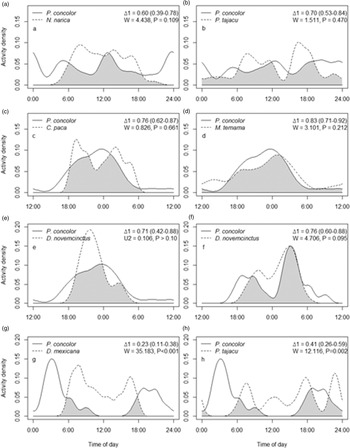
We observed moderate overlap with no significant differences between the activity of P. concolor and N. narica during the dry season and with P. tajacu in both seasons in the cloud forest (Figure 2a, b). The activity of P. concolor also overlapped considerably with C. paca and M. temama with no significant differences in the dry season of the medium forest (Figure 2c, d). Similarly, activity overlap between P. concolor and D. novemcinctus was moderate and high during the dry and rainy seasons, respectively, with no significant differences between them (Figure 2e, f). In general, the activity of this predator showed low overlap with D. mexicana, P. tajacu, and N. narica in the medium forest, although their patterns overlapped considerably in the crepuscular period during the rainy season (Figure 2g, h).
Overlap between the activity patterns of Puma concolor and its main prey species in the cloud forest (a, b) and during the dry (c, d, e) and wet (f, g, h) season in the medium forest of the Sierra Norte region of Oaxaca, Mexico. The overlap is indicated with the shaded area. The values shown correspond to the overlap coefficient (
${\widehat \Delta _1}$
) and the statistical test comparing activity patterns between species.

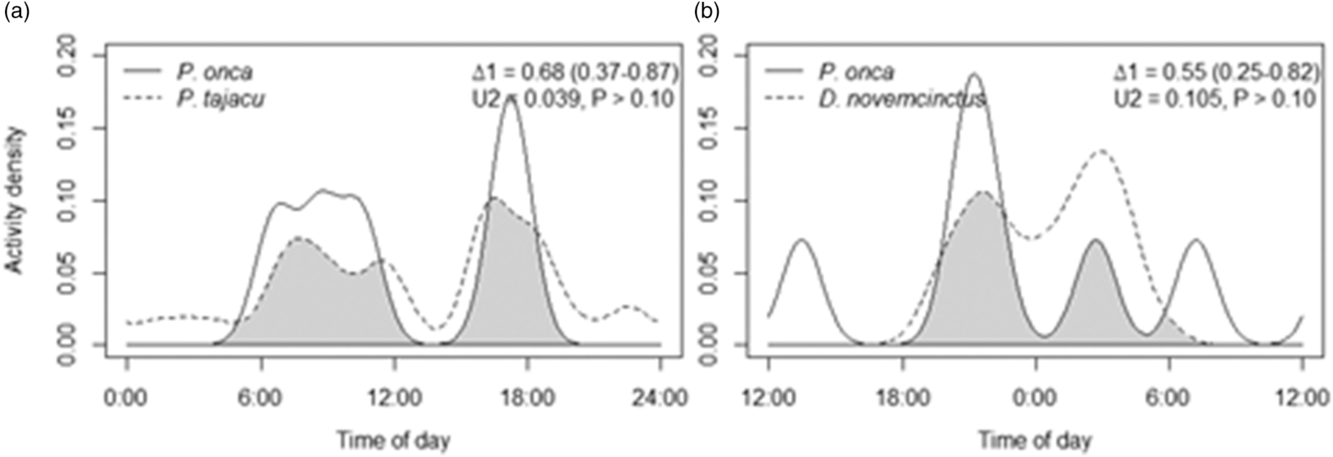
The activity patterns of P. onca was compared only with prey species with activity patterns that did not vary significantly between seasons in both vegetation types. Panthera onca overlapped significantly and without significant difference with that of P. tajacu in the cloud forest and D. novemcinctus in the medium forest (Figure 3a, b). In the cloud forest, P. onca showed low overlap and significant differences with C. paca (
${\widehat \Delta _1}$
= 0.02, 0.01-0.05; U
2
= 0.329, P < 0.01) and M. temama (
${\widehat \Delta _1}$
= 0.08, 0.01-0.28; U
2
= 0.255, P < 0.05).
Overlap between the activity patterns of Panthera onca and its main prey species in the cloud forest (a) and the medium forest (b) in the Sierra Norte region of Oaxaca, Mexico. The overlap is indicated with the shaded area. The values shown correspond to the overlap coefficient (
${\widehat \Delta _1}$
) and the statistical test comparing activity patterns between species.

Discussion
The differentiation of activity patterns has been proposed as a strategy to minimize interference competition and the risk of intraguild predation between sympatric carnivores (Carothers & Jaksic Reference Carothers and Jaksic1984, Kronfeld-Schor & Dayan Reference Kronfeld-Schor and Dayan2003). However, in our study we did not observe pronounced temporal segregation between the most similar species (morphologically): L. wiedii and L. pardalis, and P. concolor and P. onca. This result agrees with most studies, which evaluate the temporal interaction between medium-sized (Pérez-Irineo et al. Reference Pérez-Irineo, Santos-Moreno and Hernández-Sánchez2017) and large neotropical felines (Foster et al. Reference Foster, Sarmento, Torres, Jácomo, Negroes, Fonseca and Silveira2013, Gutiérrez-González & López-González Reference Gutiérrez-González and López-González2017, Harmsen et al. Reference Harmsen, Foster, Silver, Ostro and Doncaster2009, Porfirio et al. Reference Porfirio, Sarmento, Foster and Fonseca2017, Scognamillo et al. Reference Scognamillo, Maxit, Sunquist and Polisar2003). Some authors have suggested that temporal segregation is uncommon between potential competitors (Palomares & Caro Reference Palomares and Caro1999, Schoener Reference Schoener1974), possibly due to constraints in the biological clock of the species and the costs of shifting from one circadian cycle to another (Kronfeld-Schor & Dayan Reference Kronfeld-Schor and Dayan2003). Therefore, it is possible that these intrinsic limitations explain the lack of segregation observed in the feline assemblage of the Sierra Norte of Oaxaca.
Both species of Leopardus in our study had highly overlapping, predominantly nocturnal activity patterns, with no significant differences in the medium forest. Studies in different regions of South America have recorded the same pattern for both species (Di Bitetti et al. Reference Di Bitetti, De Angelo, Di Blanco and Paviolo2010, Gómez et al. Reference Gómez, Wallace, Ayala and Tejada2005, Oliveira-Santos et al. Reference Oliveira-Santos, Graipel, Tortato, Zucco, Cáceres and Goulart2012). In contrast, reports from areas like Los Chimalapas in Oaxaca, Mexico, show a high proportion of diurnal activity for L. pardalis, which differed significantly from the activity of L. wiedii (Pérez-Irineo & Santos-Moreno Reference Pérez-Irineo and Santos-Moreno2016). Differences in the activity patterns between mid-sized felids may be caused by antagonistic interactions, where L. pardalis exerts a strong influence over smaller species (de Oliveira et al. Reference De Oliveira, Tortato, Silveira, Kasper, Mazim, Lucherini, Jácomo, Soares, Marquez, Sunquist, Macdonal and Loveridge2010, Massara et al. Reference Massara, Paschoal, Bailey and Doherty2016, Oliveira-Santos et al. Reference Oliveira-Santos, Graipel, Tortato, Zucco, Cáceres and Goulart2012). However, L. wiedii showed a similar activity pattern in both vegetation types, despite the ocelot being practically absent in the cloud forest, suggesting that L. pardalis does not affect its activity in our study site. Besides, ocelot density is much lower than density of margays in the Sierra Norte of Oaxaca (Pérez-Irineo et al. Reference Pérez-Irineo, Santos-Moreno and Hernández-Sánchez2017), so encounters between them are likely occasional resulting in low interspecific competition, making temporal segregation unnecessary.
Large-sized felines also showed similarity in their activity patterns in the study area. Puma concolor and P. onca were cathemeral and equally active during the day and night, although the puma only exhibited this behavior in the cloud forest. This pattern is similar to descriptions from other tropical areas in Mexico (Ávila-Nájera et al. Reference Ávila-Nájera, Chávez, Lazcano-Barrero, Mendoza and Pérez-Elizalde2016, Hernández-SaintMartín et al. Reference Hernández-Saintmartín, Rosas-Rosas, Palacio-Núñez, Tarango-Arambula, Clemente-Sánchez and Hoogesteijn2013) and Bolivia (Gómez et al. Reference Gómez, Wallace, Ayala and Tejada2005, Romero-Muñoz et al. Reference Romero-Muñoz, Maffei, Cuellar and Noss2010), from Misiones, Argentina (Di Bitetti et al. Reference Di Bitetti, De Angelo, Di Blanco and Paviolo2010) and the Brazilian Pantanal (Porfirio et al. Reference Porfirio, Sarmento, Foster and Fonseca2017). These predators showed temporal overlap in the cloud forest, although to a lesser extent than in other studies (Foster et al. Reference Foster, Sarmento, Torres, Jácomo, Negroes, Fonseca and Silveira2013, Gutiérrez-González & López-González Reference Gutiérrez-González and López-González2017, Porfirio et al. Reference Porfirio, Sarmento, Foster and Fonseca2017). Conversely, other authors have recorded different activity periods and peaks for P. concolor and P. onca, mostly in temperate areas (Monroy-Vilchis et al. Reference Monroy-Vilchis, Rodríguez-Soto, Zarco-González and Urios2009) or tropical areas with marked seasonality (Ávila-Nájera et al. Reference Ávila-Nájera, Chávez, Lazcano-Barrero, Mendoza and Pérez-Elizalde2016, Di Bitetti et al. Reference Di Bitetti, De Angelo, Di Blanco and Paviolo2010, Hernández-SaintMartín et al. Reference Hernández-Saintmartín, Rosas-Rosas, Palacio-Núñez, Tarango-Arambula, Clemente-Sánchez and Hoogesteijn2013, Romero-Muñoz et al. Reference Romero-Muñoz, Maffei, Cuellar and Noss2010). These studies suggest that felines segregate their activity as an evasion strategy and a mechanism for coexistence (Ávila-Nájera et al. Reference Ávila-Nájera, Chávez, Lazcano-Barrero, Mendoza and Pérez-Elizalde2016, Romero-Muñoz et al. Reference Romero-Muñoz, Maffei, Cuellar and Noss2010). However, our data indicate no temporal competitive effect between these species, although this must be taken with caution since the low number of photographic records for the jaguar prevented a more reliable analysis.
In accordance with the hypothesis that large predators can control others of smaller size through intraguild interactions (Linnell & Strand Reference Linnell and Strand2000, Ritchie & Johnson Reference Ritchie and Johnson2009), we observed that the presence of P. concolor and P. onca seemingly affects L. wiedii. Activity patterns of the latter differed significantly in the level of nocturnal activity with the puma in the cloud forest and with the jaguar in the whole study area. In the assemblage of felids from the Atlantic forest of Brazil, L. tigrinus also had a distinct activity pattern in sites with the presence of L. pardalis and P. concolor (Oliveira-Santos et al. Reference Oliveira-Santos, Graipel, Tortato, Zucco, Cáceres and Goulart2012). It is probable that the margay occupies a subordinate position in interspecific interactions with top predators and shows temporal evasion to minimize the encounter rate with them. However, L. wiedii is generally nocturnal (Sunquist & Sunquist Reference Sunquist and Sunquist2002; although see Di Bitetti et al. Reference Di Bitetti, De Angelo, Di Blanco and Paviolo2010) and this behavior may be related to the activity of its prey. Leopardus wiedii mainly consumes small mammals (rodents) which are mostly active at night (Emmons Reference Emmons1987, Sunquist & Sunquist Reference Sunquist and Sunquist2002). In our study, we obtained a high number of photographic records of mice (n > 700) and, although it was not possible to analyze this set of data because we couldn’t identify the species, most of them were recorded during the periods of maximum activity of the margay.
In contrast, we recorded a relatively high overlap between the activity patterns of L. pardalis and top-predators in the medium forest. These results suggest that the periods of activity of ocelots are not constrained by P. concolor and P. onca. Accordingly, other studies have shown that L. pardalis presents an activity pattern similar to pumas and jaguars and that this species doesn’t seem to express a strategy to prevent competition, at least not in the temporal axis (Di Bitetti et al. Reference Di Bitetti, De Angelo, Di Blanco and Paviolo2010, Harmsen et al. Reference Harmsen, Foster, Silver, Ostro and Doncaster2011, Porfirio et al. Reference Porfirio, Foster, Fonseca and Sarmento2016). Leopardus pardalis presents potentially high behavioral plasticity (Sunquist & Sunquist Reference Sunquist and Sunquist2002), thus facilitating its coexistence in Neotropical felid assemblages like in south-eastern Peru, in the Green Corridor of Misiones, Argentina (Di Bitetti et al. Reference Di Bitetti, De Angelo, Di Blanco and Paviolo2010, Emmons Reference Emmons1987) and in the Sierra Norte of Oaxaca, Mexico.
Overall, we consider that the coexistence of these Neotropical predators in the Sierra Norte of Oaxaca is not mediated by the temporal segregation of their activities but, rather, by the selection of different prey with different activity patterns. It has been suggested that the activity patterns of felids are determined to a great extent by those of their main prey species, rather than by intraguild evasion (Emmons Reference Emmons1987, Karanth & Sunquist Reference Karanth and Sunquist2000, Scognamillo et al. Reference Scognamillo, Maxit, Sunquist and Polisar2003). Other studies have reported considerable overlap in the periods of activity of predators and their prey in different Neotropical regions (Azevedo et al. Reference Azevedo, Lemos, Freitas-Junior, Rocha and Azevedo2018, Foster et al. Reference Foster, Sarmento, Torres, Jácomo, Negroes, Fonseca and Silveira2013, Gutiérrez-González & López-González Reference Gutiérrez-González and López-González2017, Porfirio et al. Reference Porfirio, Foster, Fonseca and Sarmento2016, Reference Porfirio, Sarmento, Foster and Fonseca2017), coinciding with our observations. Leopardus pardalis showed high overlap with the periods of activity of C. paca, D. novemcinctus, and P. opossum in the medium forest, particularly during the peaks of activity of these species. Similar observations of the activity patterns of pacas and other mammals such as Thrichomys pachyurus, Myoprocta pratti, and Sylvilagus brasiliensis have been reported in other regions like Pantanal in Brazil and in eastern Ecuador (Porfirio et al. Reference Porfirio, Foster, Fonseca and Sarmento2016, Salvador & Espinosa Reference Salvador and Espinosa2015).
In the cloud forest, large-sized predators moderately synchronized their activity with P. tajacu, a species which is part of their diet in the study region but which represents a relatively low proportion of their consumed biomass (unpubl. data). Although both P. concolor and P. onca coincide temporally with collared peccaries, pumas often prefer young individuals whereas jaguars hunt mainly adults (Foster et al. Reference Foster, Harmsen, Valdes, Pomilla and Doncaster2010, Scognamillo et al. Reference Scognamillo, Maxit, Sunquist and Polisar2003), so the selection of different sizes of this ungulate might reduce competition between both predators. Similarly, the diurnal and crepuscular activity of P. concolor during the dry season coincided with the pattern observed for N. narica, probably owing to the high detectability and predictability of the prey (Emmons Reference Emmons1987, Karanth & Sunquist Reference Karanth and Sunquist2000, Sunquist & Sunquist Reference Sunquist, Sunquist and Gittleman1989).
On the other hand, the activity patterns of P. concolor differed seasonally in the medium forest of the study area; a result rarely reported in other Neotropical regions (Romero-Muñoz et al. Reference Romero-Muñoz, Maffei, Cuellar and Noss2010, Scognamillo et al. Reference Scognamillo, Maxit, Sunquist and Polisar2003). This differentiation is probably associated with seasonal variation in the patterns of activity of its main prey. In the rainy season, ~20% of the activity of D. mexicana and P. tajacu was crepuscular as observed for P. concolor. The overall temporal overlap between pumas and these prey was low, however, crepuscular activity is probably important for hunting (Romero-Muñoz et al. Reference Romero-Muñoz, Maffei, Cuellar and Noss2010). Besides, we suppose that hunting may also occur when prey are inactive because they are more vulnerable than in other periods (Foster et al. Reference Foster, Sarmento, Torres, Jácomo, Negroes, Fonseca and Silveira2013, Harmsen et al. Reference Harmsen, Foster, Silver, Ostro and Doncaster2011, Sunquist & Sunquist Reference Sunquist, Sunquist and Gittleman1989) and may allow pumas to reduce the risk of injury, for example from the aggressive responses of collared-peccaries (Azevedo et al. Reference Azevedo, Lemos, Freitas-Junior, Rocha and Azevedo2018).
In contrast, C. paca and M. temama were predominantly nocturnal in the dry season, overlapping highly with the activity of P. concolor, as recorded in other tropical forests (Ávila-Nájera et al. Reference Ávila-Nájera, Chávez, Lazcano-Barrero, Mendoza and Pérez-Elizalde2016, Harmsen et al. Reference Harmsen, Foster, Silver, Ostro and Doncaster2011). Cervids and some large rodents are the preferred prey for pumas in different Neotropical regions (Foster et al. Reference Foster, Harmsen, Valdes, Pomilla and Doncaster2010, Monroy-Vilchis et al. Reference Monroy-Vilchis, Rodríguez-Soto, Zarco-González and Urios2009, Novack et al. Reference Novack, Main, Sunquist and Labisky2005), as well as in the area studied (unpubl. data). This suggests that this predator may adjust its activities to maximize the encounter rate with its main prey and minimize the energy costs of hunting (Foster et al. Reference Foster, Sarmento, Torres, Jácomo, Negroes, Fonseca and Silveira2013, Harmsen et al. Reference Harmsen, Foster, Silver, Ostro and Doncaster2011).
There is evidence that P. concolor consumes D. novemcinctus in a low proportion because of a low capacity to detect it and since it selects large-sized individuals, which are more profitable (Ávila-Nájera et al. Reference Ávila-Nájera, Palomares, Chávez, Tigar and Mendoza2018, Foster et al. Reference Foster, Harmsen, Valdes, Pomilla and Doncaster2010, Novack et al. Reference Novack, Main, Sunquist and Labisky2005). Yet, we observed a moderate activity overlap (with no significant differences) between these species in the medium forest. The overlap values we observed were similar to results from the ecological reserve of El Edén in Quintana Roo, Mexico (Δ1 = 0.74, Ávila-Nájera et al. Reference Ávila-Nájera, Chávez, Lazcano-Barrero, Mendoza and Pérez-Elizalde2016) and in the region of Triángulo Mineiro in Brazil (
${\widehat \Delta _1}$
= 0.76, Azevedo et al. Reference Azevedo, Lemos, Freitas-Junior, Rocha and Azevedo2018). Surprisingly, the activity patterns of P. concolor and D. novemcinctus overlapped notably in their activity peaks during the rainy season. These results could imply that pumas also modify their activity opportunistically when alternative prey species are active (Harmsen et al. Reference Harmsen, Foster, Silver, Ostro and Doncaster2011). Other studies highlight that the level of nocturnal activity of felids like pumas can reflect the search for small-sized nocturnal prey which are harder to find (Karanth & Sunquist, Reference Karanth and Sunquist2000, Scognamillo et al. Reference Scognamillo, Maxit, Sunquist and Polisar2003), an idea supported by our data. In contrast to P. concolor, D. novemcinctus is considered one of the main prey species in the diet of P. onca (Foster et al. Reference Foster, Harmsen, Valdes, Pomilla and Doncaster2010, Novack et al. Reference Novack, Main, Sunquist and Labisky2005, Weckel et al. Reference Weckel, Giuliano and Silver2006). Expectedly, the activity patterns of jaguars and armadillos were similar in the medium forest. This temporal overlap, particularly during their activity peaks, is consistent with predictions of the optimal foraging theory, which assumes that predators adjust their activity to reduce the energy costs of searching for and manipulating their prey (Sunquist & Sunquist Reference Sunquist, Sunquist and Gittleman1989).
In conclusion, temporal segregation of activities does not seem an important mechanism to allow the coexistence of sympatric felid species in the Sierra Norte of Oaxaca. Our results suggest that the activity patterns of these predators are determined mostly by their main prey species (although also influenced by alternative prey), and that they are able to coexist by selecting prey with different activity patterns which vary seasonally and between vegetation types. Moreover, we believe that the diversity and availability of prey, habitat heterogeneity, mild seasonality, and the good quality of both the environments studied (particularly the cloud forest) could have also contributed to allow temporal overlap of felid activities and the overall coexistence of the predator species studied. However, constant anthropogenic disturbance could modify the patterns observed in this feline community, deriving in negative interspecific interactions. Future research analyzing the spatial and feeding components of the assemblage, as well as the consequences of the anthropic changes could help understand other mechanisms for coexistence and our overall understanding of the interactions between these predators.
Acknowledgements
We thank the community of San Pedro Yólox for the permission to conduct this study; the Mexican National Council for Science and Technology (CONACyT) for the studentship granted to the first author; the Instituto Politécnico Nacional de México for financial support through projects SIP-20141162 and SIP-20151481 assigned to A. Santos-Moreno; and to G. Galindo-González, G. Pérez-Irineo, L. Martínez, C. Benítez, V. Villalobos and E. Caballero for their collaboration during fieldwork.