Young adult alcohol involvement is a concern given the risk for associated short-term consequences (e.g., injury, risky sexual behavior, and interpersonal conflict; Wechsler, Lee, Kuo, & Lee, Reference Wechsler, Lee, Kuo and Lee2000) and the long-term risk for the development of alcohol use disorders (AUDs; O'Neill, Parra, & Sher, Reference O'Neill, Parra and Sher2001). Multiple streams of evidence suggest that alcohol involvement should be considered within a developmental context (Masten, Faden, Zucker, & Spear, Reference Masten, Faden, Zucker and Spear2008; Sher & Gotham, Reference Sher and Gotham1999), including clear evidence of age-related changes in alcohol involvement. The current study aimed to characterize the developmental phenomenon of “maturing out,” which refers to age-related declines in alcohol involvement that begin in young adulthood. This objective is important, given the potential for gaining insights into the etiological processes that drive maturing out and the practical implications of these declines.
A great deal of research has focused on characterizing the developmental phenomenon of maturing out. Some of this work has focused on demonstrating age-related changes in average rates of alcohol involvement from adolescence to adulthood. For indices ranging from alcohol use to AUD symptomatology, studies have shown that alcohol involvement increases during adolescence, peaks around ages 20 to 22, and then steadily declines thereafter (e.g., Chen & Kandel, Reference Chen and Kandel1995; Harford, Grant, Yi, & Chen, Reference Harford, Grant, Yi and Chen2005; Johnston, O'Malley, Bachman, & Schulenberg, Reference Johnston, O'Malley, Bachman and Schulenberg2007a, Reference Johnston, O'Malley, Bachman and Schulenberg2007b). Moving beyond average changes, other studies have addressed heterogeneity by identifying subgroups with different patterns of age-related changes (e.g., Caswell, Pledger, & Pratap, 2002; Jackson & Sher, Reference Jackson and Sher2005). These studies commonly identify a subgroup that follows the prototypic maturing out pattern described above, but they also commonly identify a “chronic” subgroup that persists at high levels of alcohol involvement beyond young adulthood and two low-risk groups that persist as light drinkers and abstainers, respectively.
Regarding differences across indices of alcohol involvement, previous research on maturing out suggests that age-related declines are steeper for indicators of excessive or problematic alcohol use (e.g., binge drinking and AUD diagnoses) than for less extreme indicators (e.g., drinking frequency and drinking quantity; Caswell et al., 2002; Jackson & Sher, Reference Jackson and Sher2005; Johnston et al., Reference Johnston, O'Malley, Bachman and Schulenberg2007b; see also figures 3, 4, and 5 in Masten et al., Reference Masten, Faden, Zucker and Spear2008). This suggests that maturing out may primarily reflect declines in problematic drinking rather than declines in drinking per se. It is important that this also suggests that maturing out may primarily occur among the types of drinkers who display relatively problematic initial patterns of drinking (e.g., frequent binge drinkers and those with AUD symptoms). However, this hypothesis has never been directly tested.
Previous research on maturing out has yet to directly address this question because different drinking-related indices (e.g., drinking frequency, binge drinking, and drinking consequences) have typically been studied in separate models, thus requiring a conceptual synthesis of findings across different studies or different analyses in order to infer which types of drinkers are most likely to mature out. However, although this question has not been directly tested, it is important. If maturing out primarily affects relatively high-risk initial drinkers (as suggested above), this could provide insight into the etiological processes that drive maturing out and would perhaps suggest that maturing out should be viewed as a subgroup-specific process rather than a general developmental phenomenon. Further, this would suggest that an understanding of the causes of maturing out may be useful for tailoring clinical interventions to young adult problem drinkers, whereas maturing out would likely have less clinical relevance if declines occurred primarily among individuals who were already low-risk drinkers. Thus, the first question addressed by the current study was whether maturing out occurs primarily among initial high-risk drinkers.
Again related to previous research typically studying different drinking-related indices in separate models, previous research is also limited in the extent to which it has identified the types of drinking patterns that are commonly adopted among individuals who have matured out. Those who mature out may subsequently abstain, they may continue to drink but at more moderate levels, or they may continue to drink at high levels but with fewer drinking-related problems (e.g., fewer AUD symptoms). These alternative outcomes hold different implications regarding the etiological factors that likely drive maturing out and regarding the extent to which risk for drinking-related problems persists following maturing out. Thus, the second question addressed by the current study was whether certain patterns of drinking behaviors are more common than others following maturing out.
The above two questions can be directly addressed through an analytic approach that integrates typological and longitudinal methodology. This approach involves the classification of individuals into groups (typological) and the analysis of transitions that are made among these groups over time (longitudinal; Jackson, O'Neill, & Sher, Reference Jackson, O'Neill and Sher2006). This type of an integrative approach can advance previous research by offering a richer characterization of the age-related changes that typify maturing out. To our knowledge, only one study has applied this type of approach to the investigation of maturing out of alcohol involvement. Using latent transition analysis (LTA), Jackson, Sher, Gotham, and Wood (Reference Jackson, Sher, Gotham and Wood2001) classified participants into four “drinking statuses,” based on alcohol consumption and subjective intoxication, and then characterized their transitions among theses statuses from ages 18 to 24. Regarding the two questions discussed above, although Jackson et al. did not empirically test these specific questions, their descriptive results suggested that (a) declines were more likely for those initially classified into heavier-intoxication statuses and (b) declines typically resulted in transitions to lower intoxication statuses rather than abstinence.
Although Jackson et al. (Reference Jackson, Sher, Gotham and Wood2001) made an important contribution to research on developmental changes in alcohol involvement, the present study's LTA analysis extends their work in important ways. First, Jackson et al. studied an age span that is primarily associated with age-related increases in alcohol involvement (ages 18 to 24). Thus, the declines shown in their study may not capture the more typical declines of maturing out. In contrast, the current study characterized transitions from late adolescence (a period of peaking alcohol involvement) to young adulthood (a period of normative decline) and also characterized later transitions from young adulthood to adulthood. Second, we based our drinking status classifications upon a more comprehensive set of indicators, including drinking frequency, drinking quantity, binge drinking, and AUD symptoms. Of particular importance, our inclusion of AUD symptoms enhanced the clinical relevance of our findings by indicating the likelihood of clinically significant drinking problems within each drinking status. Third, because Jackson et al. did not statistically test whether those who were more alcohol involved were more likely to decline in drinking or whether declines resulted in moderation of drinking more often than abstinence, the current study is the first to empirically evaluate these questions. Based on prior literature and Jackson et al.'s findings, we hypothesized that maturing out transitions (a) would be significantly more common among those with more problematic initial drinking statuses and (b) would result in declines to lower risk drinking significantly more often than declines to abstinence.
Predictors of Drinking Status Transitions: Familial Alcoholism and Gender
Familial alcoholism
Family history of alcohol disorders is a robust predictor of alcohol involvement (for a review, see Chassin et al., in press). However, there have been mixed results from the few studies that have investigated its effects on age-related declines in alcohol involvement during young adulthood (i.e., maturing out). In Jackson et al.'s (Reference Jackson, Sher, Gotham and Wood2001) LTA study spanning ages 18 to 24 (described above), familial alcoholism predicted a decreased likelihood of declining from the high-intoxication drinking status. In addition, Jackson, Sher, and Wood (Reference Jackson, Sher and Wood2000) found more familial alcoholism in a group with chronic AUDs than in a group with AUDs that remitted during young adulthood. However, other studies have found that, although familial alcoholism predicted greater initial escalation in various indicators of alcohol involvement, it was unrelated to the likelihood of later declines (Jackson & Sher, Reference Jackson and Sher2005; Warner, White, & Johnson, Reference Warner, White and Johnson2007). The current study thus tested whether parental alcoholism predicted the likelihood of transitioning to less problematic drinking statuses (i.e., maturing out) between late adolescence and adulthood.
Gender
Males show not only greater initial escalation than females in various indicators of alcohol involvement but also less dramatic declines over the course of young adulthood (i.e., less maturing out). For example, in Jackson et al.'s (Reference Jackson, Sher, Gotham and Wood2001) LTA study spanning ages 18 to 24, males were less likely than females to decline from the high-intoxication drinking status. Other studies have shown that males either declined less than females or persisted longer than females before declining (Bartholow, Sher, & Krull, Reference Bartholow, Sher and Krull2003; Harford et al., Reference Harford, Grant, Yi and Chen2005; Marmorstein, Reference Marmorstein2009; Wells, Horwood, & Fergusson, Reference Wells, Horwood and Fergusson2006; see also figure 3 in Masten et al., Reference Masten, Faden, Zucker and Spear2008). Finally, some studies have found more males among groups with chronically high levels of alcohol involvement than among groups with alcohol involvement that declined during young adulthood (Jackson & Sher, Reference Jackson and Sher2005; Schulenberg, Wadsworth, O'Malley, Bachman, & Johnston, Reference Schulenberg, Wadsworth, O'Malley, Bachman and Johnston1996). However, other studies have found gender to be unrelated to the likelihood of young adult declines in alcohol involvement (Chassin, Flora, & King, Reference Chassin, Flora and King2004; Tanner et al., Reference Tanner, Reinherz, Beardslee, Fitzmaurice, Leis and Berger2007; Warner et al., Reference Warner, White and Johnson2007). The current study thus tested whether gender predicted the likelihood of transitioning to less problematic drinking statuses (i.e., maturing out) between late adolescence and adulthood.
Method
Participants
Participants were from a larger ongoing longitudinal study of familial alcoholism (Chassin & Barrera, Reference Chassin and Barrera1993; Chassin et al., Reference Chassin, Flora and King2004; Chassin, Pitts, DeLucia, & Todd, Reference Chassin, Pitts, DeLucia and Todd1999; Chassin, Rogosch, & Barrera, Reference Chassin, Rogosch and Barrera1991). At Wave 1, the total sample (N = 454) ranged from ages 11 to 15 (M = 12.7, SD = 1.45) and consisted of 246 children of alcoholics (COAs) and 208 demographically matched non-COAs. Data were collected annually from Wave 1 to Wave 3, and then at 5-year intervals from Wave 3 to Wave 6. Full-biological siblings were included as additional participants at Waves 4 (n = 327), 5 (n = 346), and 6 (n = 349) if they were within the same age range as the original participants. Sample retention was excellent, with 90% of original participants retained at Wave 4 (N = 407), 91% of original participants and previously recruited siblings retained at Wave 5 (N = 708), and 90% (N = 737) of living original participants and previously recruited siblings retained at Wave 6. Retention was unbiased by gender but was slightly poorer for COAs than for non-COAs at Waves 4 and 5, but not 6.
The current sample included all original adolescents and siblings who were interviewed at Wave 4, Wave 5, or Wave 6 (N = 844). This sample ranged in age from 17 to 27 at Wave 4 (M = 21.1, SD = 2.3), from 22 to 33 at Wave 5 (M = 26.6, SD = 2.6), and from 27 to 40 at Wave 6 (M = 32.9; SD = 2.7). In addition, 51% were COAs, 53% were male, 71% were non-Hispanic Caucasian, 27% were Hispanic, and 29% had graduated college by Wave 6. For analyses, data from Waves 4, 5, and 6 were restructured into three longitudinal age bands: 17 to 22 (age band 1), 23 to 28 (age band 2), and 29 to 40 (age band 3). These age bands were chosen on the basis of previous epidemiologic studies (e.g., Chen & Kandel, Reference Chen and Kandel1995; Harford et al., Reference Harford, Grant, Yi and Chen2005; Johnston et al., Reference Johnston, O'Malley, Bachman and Schulenberg2007b), which have shown that ages 17 to 22 (age band 1) are associated with increasing and peaking alcohol involvement, ages 23 to 28 (age band 2) are associated with decreasing alcohol involvement (i.e., maturing out), and ages 29 to 40 (age band 3) are associated with relative stabilization of alcohol involvement. Prior to constructing these age bands, the above pattern of age-related changes from epidemiologic studies was confirmed in the current sample in the age-specific means for each of the current study's alcohol-related variables (see Measures Section). Further, a variety of alternative age bands were initially constructed, but we found that they showed similar patterns of drinking-related changes and similar overall levels of missing data, so our initial age bands were retained. We refer to age bands 1, 2, and 3 as late adolescence, young adulthood, and adulthood, respectively. Note that, although these terms are often used to describe developmental stages characterized by specific social–contextual circumstances and although opinions vary regarding the specific age ranges of these stages, we use them simply as terms to refer to our three age bands and the age ranges that they roughly represent.Footnote 1
Missing data
Of the current sample, 52.0% (n = 439) had data for Waves 4, 5, and 6 that fit into all three age bands (late adolescence, young adulthood, and adulthood). The remaining 48.0% (n = 409) were missing data for at least one age band either owing to attrition (although data loss from attrition was minimal; see above) or owing to having measurements at ages that did not fit into each of the three age bands. For example, participants who were already older than age 22 at Wave 4 had no data that fit into age band 1. Thus, they were treated as missing at age band 1 and their Wave 4 data were instead used for age band 2. When participants had two waves of data fitting into the same age band, we chose the wave at which the participant was closest to the age band's midpoint age. To more specifically characterize the 48% of the current sample with some missing data, 36.7% of the current sample (n = 310) had data that fit two of the three age bands, and 11.3% (n = 95) had data that fit one of the three age bands. In addition, 69.0% (n = 582) of the current sample had data that fit age band 1, 85.2% (n = 719) had data that fit age band 2, and 86.6% (n = 731) had data that fit age band 3. Analyses used full information maximum likelihood estimation to include participants with one or two missing age bands.
Regarding potential bias resulting from missingness, age band 1 (i.e., late adolescent) missingness was not related to gender, COA status, or AUD symptoms at age bands 2 or 3 but was associated with lower age band 2 and 3 drinking frequency (rs = –.10 and –.08, and ps = .01 and .03, respectively), lower age band 2 and 3 binge drinking frequency (rs = –.08 and –.12, ps = .03 and .001, respectively), and lower drinking quantity only at age band 3 (r = –.09, p = .01). Age band 2 (i.e., young adult) missingness was not related to gender, COA status, or any of the drinking-related outcomes at age bands 1 or 3. Finally, age band 3 (i.e., adult) missingness was not related to AUD symptoms or drinking quantity at age bands 1 or 2; but it was associated with parental alcoholism (r = .08, p = .01), male gender (r = .09, p = .01), and higher drinking frequency and binge drinking frequency only at age band 2 (both rs = .09 and both ps = .02). However, all significant effects of missingness were small in magnitude (Cohen, Reference Cohen1992) and thus likely had little biasing impact on analyses.
Recruitment
For details of sample recruitment, see Chassin, Barrera, Bech, and Kossak-Fuller (Reference Chassin, Barrera, Bech and Kossak-Fuller1992). COA families were recruited using court records of driving under the influence arrests, health-maintenance organization wellness questionnaires, and community telephone screenings. Computerized structured interviews were used to confirm parental lifetime alcohol abuse or dependence. Reverse directories were used to locate potential non-COA families in the same neighborhoods as COA families, and telephone screening was used to match non-COA families to COA families on ethnicity, family structure, adolescent's age, and socioeconomic status. Computerized structured interviews were used to confirm that neither parent in potential non-COA families met lifetime criteria for alcohol abuse or dependence (see Measures section below).
The details of sample representativeness can be found in Chassin et al. (Reference Chassin, Rogosch and Barrera1991, Reference Chassin, Barrera, Bech and Kossak-Fuller1992). Recruited participants did not differ from nonrecruited potential participants on alcoholism indicators from archival records. Further, the alcoholic parents had rates of other psychopathology similar to those of a community-dwelling alcoholic sample (Helzer & Pryzbeck, Reference Helzer and Pryzbeck1988). However, recruited participants were less likely than nonrecruited potential participants to be Hispanic and to be married.
Procedure
At each wave, data were typically collected via in-person interviews and entered into laptop computers by trained project personnel. Family members were typically interviewed simultaneously and in separate rooms to avoid contamination and to increase privacy. Telephone interviews were used for participants who had relocated out of state. Confidentiality was reinforced with a Department of Health and Human Services Certificate of Confidentiality. Interviews typically lasted 1–3 hr, and participants were paid up to $70 for each interview.
Measures
As described below, we created observed indicators of latent drinking statuses from measures of drinking frequency, drinking quantity, frequency of binge drinking, and AUD symptoms. This was done using cutoff values that were chosen on substantive grounds, although we also tested various other combinations of alternative cutoff values (see below) and confirmed that these produced very similar results with regard to the latent statuses produced by our latent class models (described later).
Drinking frequency
At Waves 4, 5, and 6, two items asked participants how frequently in the past year they drank hard liquor and beer or wine, respectively. Response options for both items ranged from 0 (never) to 7 (every day). The highest score from these two items was used as a measure of overall drinking frequency. This strategy was chosen as an alternative to summing the two drinking frequency variables in order to avoid overestimating drinking frequency for participants who tended to drink both hard liquor and beer or wine in a single drinking occasion. This was especially important for the current study because this type of overestimation would likely confound our measures of drinking frequency and drinking quantity. Final analyses used a trichotomous indicator of overall drinking frequency that classified participants as nondrinkers, less than weekly drinkers, or weekly or more drinkers. As described above, to ensure that our findings were not confined to one set of cutoff values, we tested a variety of other cutoffs, including an alternative drinking frequency trichotomization of nondrinkers, less than monthly drinkers, or monthly or more drinkers, with no substantive changes in findings.
Drinking quantity
At Waves 4, 5, and 6, two items asked participants how much hard liquor and beer or wine they drank, respectively, on a typical drinking occasion. Response options for both items ranged from 1 (one drink) to 8 (nine or more drinks). Nondrinkers were assigned a value of 0 for both items. The sum of these two items was used as a measure of overall drinking quantity. Final analyses used a trichotomous indicator of overall drinking quantity that classified participants as nondrinkers (overall drinking quantity = 0 drinks), nonbinge drinkers (overall drinking quantity = 1–4 drinks), or binge drinkers (overall drinking quantity = 5 or more drinks). As described above, to ensure that our findings were not confined to one set of cutoff values, we tested a variety of other cutoffs, including an alternative drinking quantity trichotomization of low-, moderate-, and high-quantity tertiles, with no substantive changes in findings.
Frequency of binge drinking
At Waves 4, 5, and 6, one item asked participants how frequently over the past year they drank 5 or more drinks in one sitting, with response options ranging from 0 (never) to 7 (every day). Final analyses used a trichotomous indicator of binge drinking that classified participants as non-binge drinkers, less than weekly binge drinkers, or weekly or more binge drinkers. As described above, to ensure that our findings were not confined to one set of cutoff values, we tested a variety of other cutoffs including an alternative trichotomization of nonbinge drinkers, less than monthly binge drinkers, or monthly or more binge drinkers, with no substantive changes in findings.
AUD symptoms
The proposed DSM-5 (American Psychiatric Association, 2010) includes 11 symptoms of AUD (a single disorder proposed to replace the current system of separate alcohol abuse and alcohol dependence disorders). Using dichotomous (yes or no) items from Waves 4, 5, and 6 that assessed past-year drinking consequences and past-year DSM-III-R (American Psychiatric Association, 1987), alcohol dependence symptoms, we were able to assess 9 of the 11 proposed past-year DSM-5 AUD symptoms. These 9 symptoms were alcohol-related failures in major role obligations; alcohol use in physically hazardous situations; social or interpersonal alcohol-related problems; alcohol tolerance; alcohol withdrawal; alcohol use in larger amounts or over longer periods of time than expected; persistent desire or unsuccessful efforts to control alcohol use; much time spent obtaining, using, or recovering from alcohol use; and alcohol cravings. Consistent with the proposed diagnostic threshold for a DSM-5 AUD, final analyses used a dichotomous indicator that classified participants as having fewer than 2, or 2 or more of these 9 symptoms. As described above, to ensure that our findings were not confined to one set of cutoff values, we tested a variety of other cutoffs, including an alternative dichotomization of fewer than 3, or 3 or more AUD symptoms and an alternative trichotomization of 0, 1, or 2 or more AUD symptoms, with no substantive changes in findings.
Regarding the validity of these nine symptoms as indicators of a global AUD construct, single-factor confirmatory factor analysis models supported a unitary factor structure at each of the three age bands (all comparative fit indexes ≥ 0.99, all root mean square error of approximations ≤ 0.04, standardized factor loadings = 0.73–0.96). One previous study with a different subsample of the larger parent project has shown these symptoms to relate to genetic risk (µ-opioid receptor M1 variation), parental alcoholism, and peer drinking with genetic moderation (Chassin et al., Reference Chassin, Lee, Cho, Wang, Agrawal and Sher2012). Regarding convergent validity, across the three age bands, the dichotomous indicator used for final analyses (see above) was strongly correlated with DSM-III-R alcohol diagnoses (both dependence only and abuse or dependence; rs = .53–.57, all ps < .001). These DSM-III-R diagnostic variables are derived from the computerized version of the Diagnostic Interview Schedule (DIS-III), which has excellent reliability (see Parental Alcoholism Section) and has been used widely including numerous times in the larger project (e.g., Chassin et al., Reference Chassin, Pitts, DeLucia and Todd1999, Reference Chassin, Flora and King2004).
Parental alcoholism
At Wave 1, when participants were on average 12.7 years of age (SD age = 1.45), both parents' lifetime alcoholism diagnoses (abuse or dependence) were obtained using criteria from DSM-III (American Psychiatric Association, 1980) and the DIS-III (Robins, Helzer, Croughan, & Ratcliff, Reference Robins, Helzer, Croughan and Ratcliff1981; Robins, Helzer, Ratcliff, & Seyfried, Reference Robins, Helzer, Ratcliff and Seyfried1982). The DIS was designed to permit administration by lay interviewers in large epidemiological studies. Initial evaluation studies compared diagnoses obtained by lay interviewers using the DIS to those obtained by psychiatrists who could also ask supplemental questions (Robins et al., Reference Robins, Helzer, Croughan and Ratcliff1981, Reference Robins, Helzer, Ratcliff and Seyfried1982). Alcohol abuse/dependence had one of the highest levels of agreement (κ = 0.86) and had excellent sensitivity (κ = 0.86) and specificity (κ = 0.98). For noninterviewed parents, alcoholism diagnoses were established using Family History Research Diagnostic Criteria (Endicott, Anderson, & Spitzer, Reference Endicott, Anderson and Spitzer1975) on the basis of spousal reports. Participants who were classified as COAs had to have at least one biological and custodial parent with a lifetime alcohol abuse or dependence diagnosis, and participants who were classified as non-COAs had to have no biological or custodial parents with lifetime alcohol abuse or dependence diagnoses.
The COA selection criteria that the alcoholic parent had to be both a biological and a custodial parent was used to ensure that COAs had the possibility of being exposed to risk through both biologically and environmentally mediated pathways. Lifetime (rather than current) diagnoses were chosen because some of the risk pathways associated with parental alcoholism are genetically mediated (Brown et al., Reference Brown, McGue, Maggs, Schulenberg, Hingson and Swartzwelder2008; Kendler, Schmitt, Aggen, & Prescott, Reference Kendler, Schmitt, Aggen and Prescott2008). Thus, parental remission of alcoholism does not necessarily eliminate risk in offspring (DeLucia, Belz, & Chassin, Reference DeLucia, Belz and Chassin2001; Hussong et al., Reference Hussong, Cai, Curran, Flora, Chassin and Zucker2008). This definition of parental alcoholism has significantly predicted a wide range of outcomes in the larger project, including adolescent externalizing symptoms, internalizing symptoms, and substance use; young adult substance use disorders; and developmental trajectories of substance use and substance use disorders from adolescence to adulthood (e.g., Chassin et al., Reference Chassin, Rogosch and Barrera1991, Reference Chassin, Pitts, DeLucia and Todd1999, Reference Chassin, Flora and King2004). Moreover, to ensure that the current findings were not confined to one definition of parental alcoholism, we calculated two alternative variables where alcoholic parents either (a) met past-year diagnoses at Wave 1 or (b) remained custodial parents across Waves 1 through 3 (i.e., at least through adolescence; 84% of original COAs). We then correlated our parental alcoholism variable and these alternative parental alcoholism variables with our drinking-related variables (described above). We found extremely similar correlations across parental alcoholism variables, and no correlations for the alternative variables differed significantly from those produced by our original parental alcoholism variable.
Analyses and Results
Both latent class analysis (LCA) and LTA models use observed indicators (i.e., measured variables) to identify distinct latent statuses (i.e., latent classes or groups) of individuals within an overall sample. However, LCA models typically identify latent statuses at a single time point, whereas LTA models identify latent statuses at multiple time points in order to characterize the transitions that are made among these statuses over time. For the current study, both LCA and LTA models were estimated using Mplus version 5.21 (Muthén & Muthén, Reference Muthén and Muthén1998–2007). All models used full information maximum likelihood estimation in order to include participants with incomplete data. The clustering of participants within families in our data would have likely produced minimal bias because design effects were small (range = 1.07–1.22 across our age bands and drinking-related variables; for simulations of the impact of design effects, see table 2 of Muthén & Satorra, Reference Muthén and Satorra1995). Nevertheless, to more appropriately model this data clustering, all models used a robust sandwich estimator (i.e., Mplus option TYPE = COMPLEX) to obtain adjusted standard errors and chi-square statistics.
For LTA models, global fit was evaluated using a parametric bootstrap estimated Pearson chi-square (χ2) distribution, given problems associated with the theoretical χ2 distribution when data are sparse (Collins, Fidler, Wugalter, & Long, Reference Collins, Fidler, Wugalter and Long1993; Langeheine, Pannekoek, & van de Pol, Reference Langeheine, Pannekoek and van de Pol1996). Prior to testing questions of substantive interest, measurement invariance was evaluated both over time (i.e., across age bands) and between groups (males vs. females; COAs vs. non-COAs) through likelihood ratio (ΔL 2) nested model tests of item-response probability constraints. The ΔL 2 nested model tests were also used for omnibus tests of substantive interest when comparing groups on latent status prevalences and transitional probabilities. Finally, more specific tests of substantive interest (e.g., comparisons among transitional probabilities) were carried out using Wald χ2 tests of equality constraints among model parameters (Muthén & Muthén, Reference Muthén and Muthén1998–2007). Our general strategy was to conduct omnibus tests of multiple constraints and to conduct more specific follow-up tests only following a significant omnibus test. In addition, specific follow-up tests were grouped into families, and we addressed family-wise alpha (α) inflation by calculating adjusted p values (p adj) for each follow-up test based on modified Bonferroni adjustments (Holm, Reference Holm1979; McDonald, Seifert, Lorenzet, Givens, & Jaccard, Reference McDonald, Seifert, Lorenzet, Givens and Jaccard2002).Footnote 2 This adjustment adequately controls Type 1 error rates while offering greater statistical power than the traditional Bonferroni method (McDonald et al., Reference McDonald, Seifert, Lorenzet, Givens and Jaccard2002).
Preliminary model building with LCA
As part of a recommended model-building strategy for LTA models (Nylund, Asparouhov, & Muthén, Reference Nylund, Asparouhov and Muthén2007), preliminary LCA models were estimated at each of the three age bands (late adolescence, young adulthood, and adulthood). In order to capture a broad range of severity of alcohol involvement, observed indicators of latent drinking statuses included drinking frequency, drinking quantity, frequency of binge drinking, and AUD symptoms. We created observed indicators by dichotomizing or trichotomizing the original variables using cutoff values that were chosen on substantive grounds (see Measures section for details). We categorized the original variables to maximize clinical relevance of the drinking statuses and to avoid analytic complexity that would result from modeling the original variables as zero-inflated counts. At each age band, we compared LCA models specifying different numbers of latent statuses (ranging from two to six) based on both relative fit indices (e.g., Bayesian information criterion; Schwartz, Reference Schwartz1978) and the substantive interpretability of the resulting latent statuses (as recommended by Lanza & Collins, Reference Lanza and Collins2008; Nylund et al., Reference Nylund, Asparouhov and Muthén2007). Across age bands, relative fit indices consistently supported models specifying four latent statuses, and these models consistently produced the most parsimonious and interpretable statuses (see below for a description of the latent statuses).
LTA
Based on the above LCA models, an LTA model was estimated that used the same observed indicators and specified four latent drinking statuses at all three age bands (late adolescence, young adulthood, and adulthood). Item-response probabilities were constrained to be equal across the three age bands (i.e., measurement invariance over time), but transitional probabilities were freed to vary. This model was not rejected according to the parametric bootstrap estimated p value of its Pearson χ2 statistic of overall model fit, χ2 (157373) = 4214.82, p = .058. The marginal significance of this test was likely due to the model's assumption of time-invariant item-response probabilities, given that a likelihood ratio test showed significantly better fit when item-response probabilities were freed to vary across age bands, ΔL 2 (56) = 119.25, p < .001. However, because the differences in item-response probabilities across age bands appeared small and substantively unimportant, we chose to retain our initial constraints on item-response probabilities in order to preserve the interpretability of results.Footnote 3
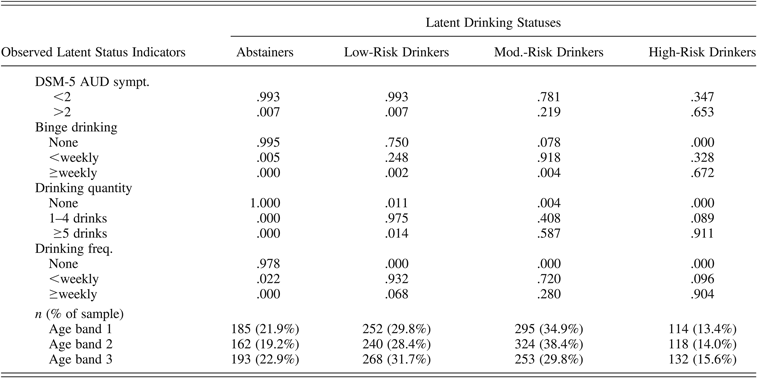
Table 1 presents this LTA model's item-response probabilities, which characterize the four latent drinking statuses by showing the probabilities of different values on observed indicators for members of each latent status. As indicated by these item-response probabilities, the resulting four latent statuses were highly similar to those produced by the preliminary LCA models described above, and they reflected four substantively distinct and meaningful groups: abstainers, who were extremely unlikely to engage in any form of alcohol involvement; low-risk drinkers, who tended to drink less than weekly and were at low risk for either binge drinking or having two or more DSM-5 AUD symptoms; moderate-risk drinkers, who tended to binge drink less than weekly and were at moderate risk (21.9%) for having two or more DSM-5 AUD symptoms; and high-risk drinkers, who tended to binge drink at least weekly and were at high risk (65.3%) for having two or more DSM-5 AUD symptoms.
Item-response probabilities for the four latent drinking statuses from the latent transition analysis model

Note: These item-response probabilities characterize the latent drinking statuses by showing the probabilities of different values on observed indicators for members of each status. Only one set of item-response probabilities is presented because item-response probabilities were constrained to be equal across the three age bands. For each status, n reflects the model-estimated status size and the percentage reflects the model-estimated prevalence relative to the overall sample. AUD, alcohol use disorder.
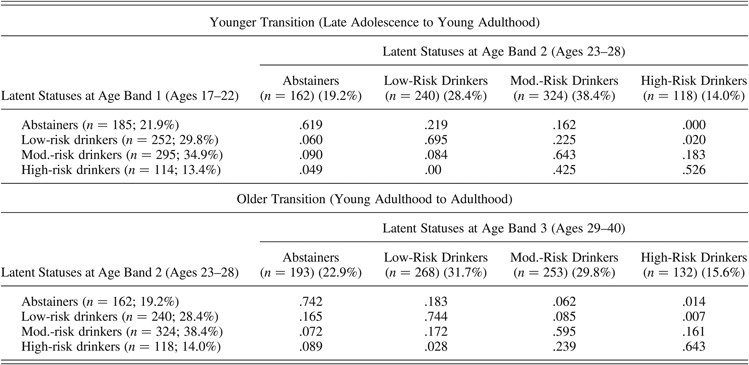
Table 2 presents transitional probabilities from this LTA model, which characterize the likelihood of specific transitions among the four latent drinking statuses both between age bands 1 and 2 (late adolescence to young adulthood), and between age bands 2 and 3 (young adulthood to adulthood). We tested differences among transitional probabilities using Wald χ2 tests of equality constraints and conducted specific follow-up tests only when initial omnibus tests were significant. Testing was primarily aimed at evaluating the following two hypotheses: (a) declining transitions (i.e., maturing out) will be more common among those in higher risk initial drinking statuses and (b) declining transitions will result in lower risk drinking more often than abstinence.
Transitional probabilities from the latent transition analysis model
Note: These transitional probabilities characterize the likelihood of specific transitions among the four latent drinking statuses between late adolescence and young adulthood and between young adulthood and adulthood. Probabilities on the diagonals reflect stability, probabilities below the diagonals reflect declines (i.e., maturing out), and probabilities above the diagonals reflect escalation. For each status, n reflects the model-estimated status size and the percentage reflects the model-estimated prevalence relative to the overall sample.
Comparing rates of maturing out from different initial drinking statuses
Two omnibus tests were conducted for the younger transition (late adolescence to young adulthood) and the older transition (young adulthood to adulthood), respectively, to test whether or not declining transitions were equally likely across different initial drinking statuses (see Table 2 for transitional probabilities). Specifically, these tests evaluated constraints that equated (a) declines from low-risk drinking to abstinence, (b) declines from moderate-risk drinking to low-risk drinking or abstinence, and (c) declines from high-risk drinking to moderate-risk drinking, low-risk drinking, or abstinence. The omnibus tests rejected these constraints during both the younger and the older transitions, χ2 (2) = 28.312, p < .001; χ2 (2) = 6.728, p = .03, respectively. Thus, separately for both transitions, we conducted a family of three specific follow-up tests with modified Bonferroni-adjusted p values.
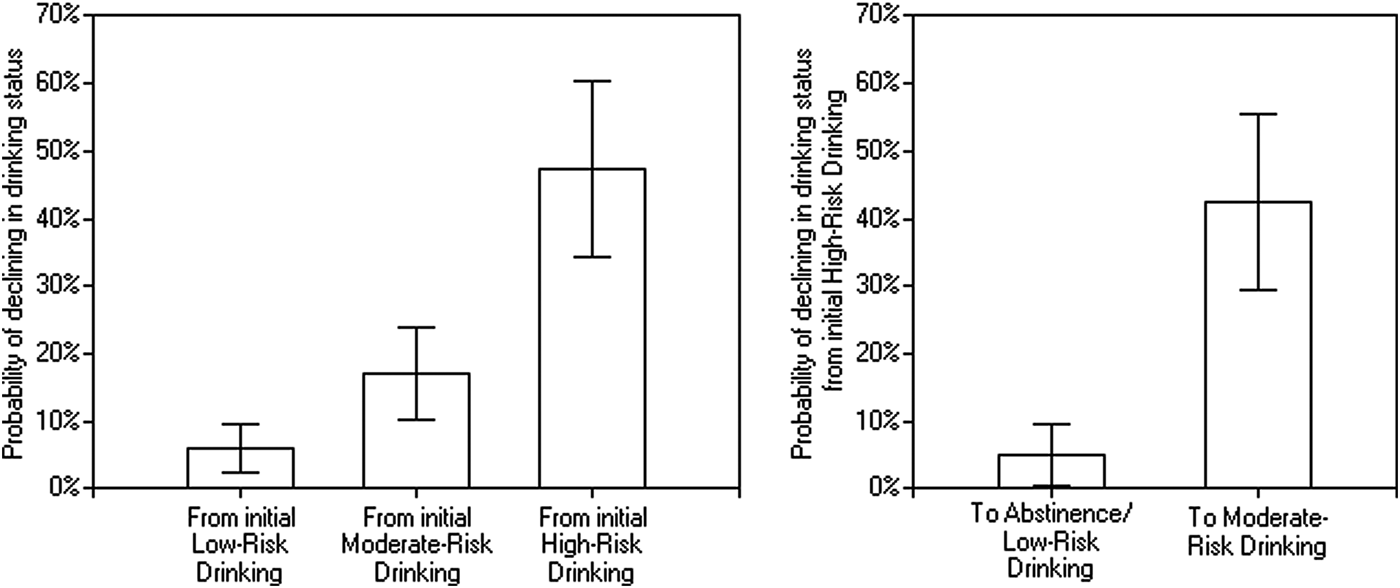
During the younger transition, specific follow-up tests consistently supported the hypothesis that declines would be more common among those in higher risk initial drinking statuses. Specifically, moderate-risk drinkers declined more often than did low-risk drinkers, χ2 (1) = 5.47, p = .02, p adj = .02, and high-risk drinkers declined more often than did both low-risk drinkers, χ2 (1) = 24.88, p < .001, p adj < .001, and moderate-risk drinkers, χ2 (1) = 7.12, p = .008, p adj = .02. For a graphical depiction of these results, see the left panel of Figure 1. Additional tests aimed at further characterizing these differences showed that low-risk drinkers were actually more likely to escalate than they were to decline, χ2 (1) = 10.32, p = .001, whereas moderate-risk drinkers declined about as often as they escalated, χ2 (1) = 0.02, p = .89. The extent of declines among high-risk drinkers is evidenced by their declining about as often as they stayed in the same status, χ2 (1) = 0.10, p = .75, whereas the other three statuses stayed the same more often than they changed status in any direction (declining or escalating): abstainers, χ2 (1) = 5.09, p = .02; low-risk drinkers, χ2 (1) = 14.33, p < .001; moderate-risk drinkers, χ2 (1) = 7.12, p = .008.
Graphical depictions of key findings during the transition from late adolescence to young adulthood (age band 1 to 2). Vertical bars show 95% confidence intervals of transitional probabilities.
In contrast, during the older transition, although a similar pattern of transitional probabilities was observed (see Table 2), specific follow-up tests provided little evidence for significantly different rates of decline across different initial drinking statuses. Specifically, moderate-risk drinkers did not decline significantly more often than did low-risk drinkers, χ2 (1) = 2.31, p = .13, p adj = .26, and high-risk drinkers did not decline significantly more often than did moderate-risk drinkers, χ2 (1) = 1.68, p = .20, p adj = .20. However, high-risk drinkers did decline marginally significantly more often than did low-risk drinkers, χ2 (1) = 5.62, p = .02, p adj = .05. Additional tests aimed at further characterizing these results showed that both low-risk drinkers and moderate-risk drinkers were about as likely to decline as they were to escalate, χ2 (1) = 0.39, p = .53; χ2 (1) = 2.45, p = .12, respectively. In addition, whereas high-risk drinkers stood out in the younger transition as declining about as often as they stayed in the same status, in the older transition all four initial statuses stayed in the same status more often than they changed statuses: abstainers, χ2 (1) = 31.26, p < .001; low-risk drinkers, χ2 (1) = 20.83, p < .001; moderate-risk drinkers, χ2 (1) = 3.29, p = .07; high-risk drinkers, χ2 (1) = 3.82, p = .05. Thus, at this later transition, there appeared to be less dramatic differences in maturing out across different initial drinking statuses, partly owing to greater temporal stability among high-risk drinkers.
Comparing rates of maturing out to different drinking statuses
Two omnibus tests were conducted for the younger transition (late adolescence to young adulthood) and the older transition (young adulthood to adulthood), respectively, to test whether declines to certain drinking statuses were more likely than declines to others (see Table 2 for transitional probabilities). Specifically, these tests evaluated constraints that equated the two possible types of declines from moderate-risk drinking (to low-risk drinking and to abstinence) and also equated the three possible types of declines from high-risk drinking (to moderate-risk drinking, to low-risk drinking, and to abstinence). The omnibus tests rejected these constraints during both the younger and the older transitions, χ2 (3) = 35.82, p < .001, and χ2 (3) = 12.34, p = .006, respectively. Thus, separately for both transitions, we conducted a family of four specific follow-up tests with modified Bonferroni-adjusted p values.
During the younger transition, consistent with hypotheses, specific follow-up tests showed that high-risk drinkers became moderate-risk drinkers more often than they became abstainers, χ2 (1) = 17.41, p < .001, p adj < .001, more often than they became low-risk drinkers, χ2 (1) = 28.13, p < .001, p adj < .001, and more often than they became either abstainers or low-risk drinkers combined, χ2 (1) = 17.41, p < .001, p adj < .001. For a graphical depiction of these results, see the right panel of Figure 1. In contrast, inconsistent with hypotheses, follow-up tests showed that moderate-risk drinkers became low-risk drinkers about as often as they became abstainers, χ2 (1) = 0.02, p = .90, p adj = .90.
During the older transition, follow-up tests again showed that high-risk drinkers became moderate-risk drinkers more often than they became low-risk drinkers, χ2 (1) = 6.91, p = .009, p adj = .04. However, unlike the younger transition, they did not become moderate-risk drinkers significantly more often than they became abstainers, χ2 (1) = 3.27, p = .07, p adj = .14, or significantly more often than they became either abstainers or low-risk drinkers combined, χ2 (1) = 1.80, p < .18, p adj < .18. Finally, moderate-risk drinkers became low-risk drinkers marginally more often than they became abstainers, χ2 (1) = 5.06, p = .03, p adj = .08.
LTA with subgroups: Effects of parental alcoholism and gender
Two multiple group LTA models (see Muthén & Muthén, Reference Muthén and Muthén1998–2007) were estimated in order to test differences between COAs (n = 425) and non-COAs (n = 419) and between males (n = 446) and females (n = 398), respectively. Effects of parental alcoholism and gender were modeled on latent drinking status prevalences at all three age bands and on both sets of latent drinking status transitions across the age bands. These models used the same observed indicators from our earlier LTA model and specified four latent drinking statuses at each age band. Likelihood ratio tests showed no significant reduction in model fit when item-response probabilities were constrained to be equal between subgroups for either the parental alcoholism LTA model, ΔL 2 (28) = 30.90, p = .32, or the gender LTA model, ΔL 2 (28) = 37.09, p = .12, thus supporting between-group measurement invariance for both models. Because we retained these constraints in our final models, the item-response probabilities were nearly identical to those from our earlier LTA model (see Table 1) and thus are not presented.
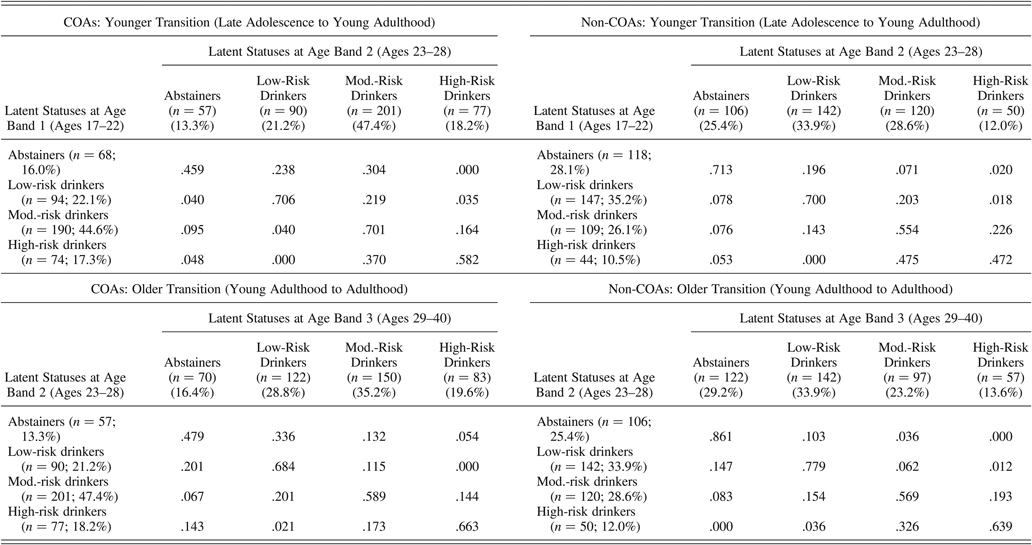
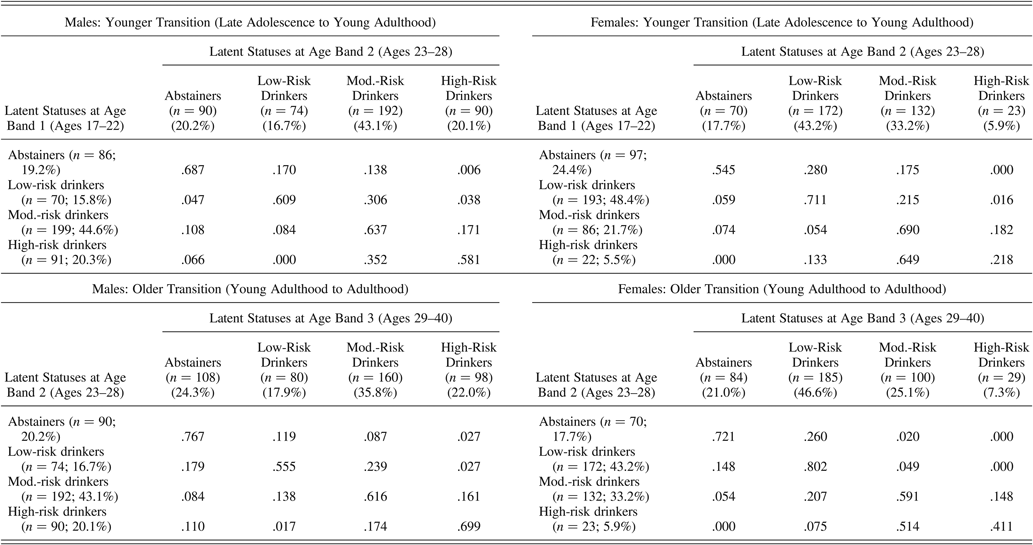
Table 3 presents latent drinking status prevalences and transitional probabilities separately for COAs and non-COAs based on the parental alcoholism LTA model. Table 4 presents analogous results separately for males and females based on the gender LTA model. Likelihood ratio tests showed that these models fit the data significantly better than did nested models that constrained latent drinking status prevalences and transitional probabilities to be equal between subgroups (i.e., models assuming no effects of gender and parental alcoholism), ΔL 2 (27) = 97.55, p < .001, and ΔL 2 (27) = 160.58, p < .001, respectively. Given this evidence for global subgroup differences from these omnibus tests, we then tested specific subgroup differences in both latent drinking status prevalences and declining transitional probabilities (i.e., maturing out) using Wald χ2 tests of equality constraints. Because effects of parental alcoholism and gender were tested separately and without controlling for age, it is important to note that parental alcoholism and gender were not significantly related to one another (r = .017, p = .61) or to age at age band 1, 2, or 3 (parental alcoholism: ts = 0.03, –0.82, and 0.75, and ps = .98, .41, and .46, respectively; gender: ts = 0.73, 1.29, and 1.16, ps = .47, .20, and .25, respectively).
Transitional probabilities from the multiple group latent transition analysis model testing effects of parental alcoholism
Note: These transitional probabilities characterize the likelihood of specific transitions among the four latent drinking statuses separately for children of alcoholics (COAs) and non-COAs between late adolescence and young adulthood and between young adulthood and adulthood. Probabilities on the diagonals reflect stability, probabilities below the diagonals reflect declines (i.e., maturing out), and probabilities above the diagonals reflect escalation. For each status, n reflects the model-estimated status size and the percentage reflects the model-estimated prevalence relative to the overall subgroup.
Transitional probabilities from the multiple group latent transition analysis model testing effects of gender
Note: These transitional probabilities characterize the likelihood of specific transitions among the four latent drinking statuses separately for males and females between late adolescence and young adulthood and between young adulthood and adulthood. Probabilities on the diagonals reflect stability, probabilities below the diagonals reflect declines (i.e., maturing out), and probabilities above the diagonals reflect escalation. For each status, n reflects the model-estimated status size and the percentage reflects the model-estimated prevalence relative to the overall subgroup.
Comparisons between COAs and non-COAs
A family of 12 specific tests (with modified Bonferroni-adjusted p values) compared COAs and non-COAs on latent drinking status prevalences at each of the three age bands (late adolescence, young adulthood, and adulthood; see Table 3 for status prevalences). COAs were less likely than non-COAs to be abstainers across age bands 1, 2, and 3, χ2 (1) = 9.03, p = .003, p adj = .01; χ2 (1) = 9.69, p = .002, p adj = .02; χ2 (1) = 11.17, p < .001, p adj = .01, respectively, and to be low-risk drinkers at age bands 1 and 2 but not 3, χ2 (1) = 9.41, p = .002, p adj = .02; χ2 (1) = 10.11, p = .002, p adj = .009; χ2 (1) = 1.28, p = .26, p adj = .26, respectively. In contrast, COAs were more likely than non-COAs to be moderate-risk drinkers at age bands 1 and 2 and with marginal significance at age band 3, χ2 (1) = 15.31, p < .001, p adj = .001; χ2 (1) = 16.52, p < .001, p adj < .001; χ2 (1) = 6.66, p = .001, p adj = .09, respectively. Finally, although COAs appeared more likely than non-COAs to be high-risk drinkers, these differences were not significant across age bands 1, 2, or 3, χ2 (1) = 4.20, p = .04, p adj = .16; χ2 (1) = 3.65, p = .056, p adj = .17; χ2 (1) = 2.87, p = .09, p adj = .18, respectively.
A family of eight specific tests (with modified Bonferroni-adjusted p values) compared COAs and non-COAs on transitional probabilities during the younger transition (see Table 3 for transitional probabilities) and found no differences between COAs and non-COAs in overall declines from a given initial drinking status (e.g., from high-risk drinking to any other status) or in more specific declines from one status to another (e.g., from high- to moderate-risk drinking). During the older transition, an analogous family of eight tests found only that more COAs than non-COAs declined specifically from high-risk drinking to abstinence, χ2 (1) = 7.55, p = .006, p adj = .048. Finally, although not planned a priori, more COAs than non-COAs escalated from abstinence overall (i.e., to any other drinking status) during both the younger and the older transitions χ2 (1) = 6.15, p = .01; χ2 (1) = 19.95, p < .001, respectively.
Comparisons between males and females
A family of 12 specific tests (with modified Bonferroni-adjusted p values) compared males and females on latent drinking status prevalences at each of the three age bands (late adolescence, young adulthood, and adulthood; see Table 4 for status prevalences). Males and females did not differ in their likelihood of being abstainers across age bands 1, 2, and 3, χ2 (1) = 2.10, p = .15, p adj = .44; χ2 (1) = 0.60, p = .44, p adj = .88; χ2 (1) = 0.15, p = .70, p adj = .70, respectively, but males were less likely than females to be low-risk drinkers across age bands 1, 2, and 3, χ2 (1) = 57.72, p < .001, p adj < .001; χ2 (1) = 43.87, p < .001, p adj < .001; χ2 (1) = 14.99, p < .001, p adj < .001, respectively. In contrast, males were more likely than females to be moderate-risk drinkers at age band 1, but not at age band 2, and with marginal significance at age band 3, χ2 (1) = 22.75, p < .001, p adj < .001; χ2 (1) = 3.98, p = .046, p adj = .18; χ2 (1) = 6.34, p = .01, p adj = .06, respectively. Finally, males were more likely than females to be high-risk drinkers across age bands 1, 2, and 3, χ2 (1) = 20.03, p < .001, p adj < .001; χ2 (1) = 19.54, p < .001, p adj < .001; χ2 (1) = 21.54, p < .001, p adj < .001, respectively.
Two families of eight specific tests analogous to those used for parental alcoholism (see above) compared males and females on transitional probabilities during the younger and older transitions, respectively (see Table 4 for transitional probabilities). However, these tests revealed no significant gender differences.
Discussion
Previous research has shown that there is a developmental process of maturing out of alcohol involvement that begins in young adulthood. However, the precise nature of the changes in drinking behaviors that best characterize maturing out has remained unclear. Thus, the present study aimed to provide a richer characterization of the age-related changes that typify maturing out. We used LTA, which holds advantages for this purpose given its integration of typological and longitudinal methodology. Through this technique, we empirically identified four substantively distinct and meaningful latent drinking statuses across three time points spanning from late adolescence to adulthood: abstainers, low-risk drinkers who typically drank less than weekly and were at low risk for binging and AUD symptomatology, moderate-risk drinkers who typically binged less than weekly and were at moderate risk for AUD symptomatology, and high-risk drinkers who typically binged at least weekly and were at high risk for AUD symptomatology. The current study focused on transitions among these latent drinking statuses over time with particular interest in whether maturing out transitions (a) were more common among those in higher risk initial drinking statuses and (b) resulted in declines to lower risk drinking more often than declines to abstinence.
Who matures out and how do they change?
During the developmental transition commonly associated with maturing out (late adolescence to young adulthood), results consistently showed that maturing out (i.e., declines to lower risk drinking statuses) was more likely for those classified in higher risk initial drinking statuses. High-risk drinkers showed the most maturing out by far with nearly half (47.4%) declining to a lower risk drinking status, whereas only a small percent of moderate-risk drinkers (17.4%) and low-risk drinkers (6.0%) declined. Thus, the phenomenon thought of as maturing out might be better viewed as a subgroup-specific process occurring primarily among high-risk drinkers as opposed to a normative developmental process that occurs across most individuals. However, although our results showed that high-risk drinkers were most likely to decline, very few of them became abstainers or low-risk drinkers (4.9%). Instead, they primarily declined to moderate-risk drinking (42.5%). These results suggest that maturing out is best viewed as a diminution rather than an elimination of risky drinking.
It is important to note that our evidence for the greatest maturing out among initial high-risk drinkers was not likely caused by regression to the mean. Measurement error in initial assessments is considered a primary source of regression to the mean (Finney, Reference Finney2008), and LTA accounts for measurement error through latent variable modeling with multiple observed indicators. Further, our study avoided other methodological factors that contribute to regression to the mean such as using baseline risk factors as participant inclusion criteria and assessing baseline severity over a limited time period (e.g., using past-month drinking items as opposed to our past-year items; see Finney, Reference Finney2008). Given that high-risk drinkers declined primarily to moderate-risk drinking, it could also be argued that their declines represent a relatively minor shift along the continuum of alcohol involvement relative to other potential declining transitions. However, note that the item-response probabilities of the four latent statuses (see Table 1) suggest that the transition from high- to moderate-risk drinking was quite substantial. For instance, this transition involved decreases from a high likelihood of experiencing two or more AUD symptoms (65%) to a moderate likelihood of experiencing two or more AUD symptoms (22%), and it involved decreases from a high likelihood of greater than weekly binge drinking (67%) to a very low likelihood of greater than weekly binge drinking (<1%). Thus, we conclude that the transition from high- to moderate-risk drinking appears to represent a substantial and meaningful shift in alcohol involvement and is at least as substantial as other declining transitions between adjacent statuses (e.g., moderate- to low-risk drinking).
The present study is the first to statistically demonstrate this characterization of maturing out. However, although not statistically tested, Jackson et al.'s (Reference Jackson, Sher, Gotham and Wood2001) LTA study suggested that those initially in higher intoxication drinking statuses were more likely to mature out, and that maturing out primarily resulted in declines to lower intoxication drinking statuses rather than abstinence. The convergence of our findings with Jackson et al.'s is particularly noteworthy given that their study spanned a much more limited and younger age range (ages 18–24) and given that their drinking statuses were primarily differentiated on reports of subjective intoxication, whereas our drinking statuses were primarily differentiated on binge drinking and diagnostic symptoms. Our findings are also consistent with indirect evidence synthesized from multiple previous studies on age-related changes in alcohol involvement, which suggest that maturing out produces greater declines for more problematic aspects of drinking (Caswell et al., 2002; Jackson & Sher, Reference Jackson and Sher2005; Johnston et al., Reference Johnston, O'Malley, Bachman and Schulenberg2007b; see also figures 4 and 5 in Masten et al., Reference Masten, Faden, Zucker and Spear2008).
Potential implications for etiological influences on maturing out
Our finding that declines primarily occurred among initial high-risk drinkers suggests that maturing out is not a universal phenomenon that occurs uniformly across individuals. To understand why maturing out may primarily occur among initial high-risk drinkers, it is important to consider the etiological influences that likely drive maturing out. Previous research has suggested that these etiological influences include social–contextual changes in young adulthood such as the adoption of adult roles (e.g., marriage, parenthood, and employment; Gotham, Sher, & Wood, Reference Gotham, Sher and Wood2003; Lee, Chassin, & MacKinnon, Reference Lee, Chassin and MacKinnon2010; Staff et al., Reference Staff, Schulenberg, Maslowsky, Bachman, O'Malley and Maggs2010) as well as young adult developmental changes in personality (Littlefield, Sher, & Wood, Reference Littlefield, Sher and Wood2009) and cognitive control systems of the brain (Steinberg, Reference Steinberg2007). Thus, maturing out appears to be driven both by new social contexts that increase motivation for behavioral change and by the development of self-regulatory abilities that increase capability for behavioral change. Our findings contribute to this conceptualization by suggesting that these etiological processes may not affect all individuals equally and instead may primarily affect the drinking behaviors of relatively high-risk initial drinkers. This may be because initial high-risk drinkers experience more drinking-related consequences (perhaps in their young adult roles), and therefore they have greater motivation to utilize their emerging self-regulatory capabilities toward changing their drinking behaviors. This interpretation is consistent with role socialization theory, which suggests that, when preexisting behaviors conflict with the demands of a new role, individuals must either reduce their problem behaviors or leave the role (Yamaguchi & Kandel, Reference Yamaguchi and Kandel1985). Future research should evaluate this interpretation of our findings by testing (a) whether effects of young adult role transitions on maturing out are stronger for higher risk initial drinkers, (b) whether this is because higher risk initial drinkers experience greater initial role impairment, and (c) whether their behavior change in response to role impairment is facilitated by increased self-regulatory abilities. Of course, an alternative (but not mutually exclusive) explanation for greater declines among higher risk initial drinkers is that they are more likely to receive treatment owing to the relatively consequential nature of their alcohol involvement. Post hoc analyses (not presented here) showed no evidence of this in the current data, but larger samples would provide more powerful tests. Each of these alternative explanations should be considered in future research.
One strength of the current study was a test of transitions during two different developmental periods. It is important to note that the pattern of greater declines among higher hisk initial drinkers was found only during the younger transition between late adolescence and young adulthood, which is the normative developmental period of maturing out. In the older transition from young adulthood to adulthood, there was greater stability among these high-risk drinkers. These findings suggest some developmental specificity to the processes of maturing out. The assumption of adult roles and the development of cognitive control abilities that occur during the transition from late adolescence to young adulthood likely create greater potential for change in alcohol involvement compared to later ages when there are less substantial and widespread changes in these etiological factors (Bachman, Wadsworth, O'Malley, Johnston, & Schulenberg, Reference Bachman, Wadsworth, O'Malley, Johnston and Schulenberg1997; Casey, Tottenham, Liston, & Durston, Reference Casey, Tottenham, Liston and Durston2005; Roberts, Walton, & Viechtbauer, Reference Roberts, Walton and Viechtbauer2006). By demonstrating the uniqueness of the maturing out period, the present study illustrates the utility of viewing problem drinking from a developmental perspective.
Clinical implications
Another strength of the current study was our use of DSM-5 AUD symptoms in our identification of latent drinking statuses, which is particularly informative when considering the clinical implications of our findings. For instance, given that high-risk drinkers were at high risk for meeting the proposed DSM-5 diagnostic threshold for AUD (i.e, having two or more AUD symptoms), their declines during the normative developmental period for maturing out may indicate this period's potential for remission of clinically significant forms of alcohol involvement. However, because high-risk drinkers typically declined only to moderate-risk drinking, their maturing out is characterized by a substantial but nonetheless incomplete decline in risky drinking. In other words, their maturing out does not necessarily mean they are no longer at any risk; in many cases, there may be continuing reason for clinical concern.
Of course, if motivation for their declines from high- to moderate-risk drinking is driven by social–contextual changes and increased self-regulatory abilities (as suggested above), this might present opportunities that could be harnessed in a clinical setting in order to help young adults achieve greater changes in drinking behaviors than they could achieve on their own. For instance, motivation to reduce drinking in response to new social roles (e.g., marriage) could be very useful within the context of a motivational interviewing approach to treatment (Miller & Rollnick, Reference Miller and Rollnick2002). Thus, the normative developmental period for maturing out may hold unique potential for clinical interventions to converge with naturally occurring etiological processes and thereby produce particularly dramatic and lasting reductions in problem drinking. Clinical research should therefore investigate the possibility that treatment effects are enhanced among young adults who have recently experienced social–contextual or developmental changes thought to be associated with maturing out.
Subgroup comparisons: Effects of parental alcoholism and gender
Consistent with previous research, familial alcoholism and male gender predicted membership in more higher-risk drinking statuses. However, our results failed to replicate Jackson et al.'s (Reference Jackson, Sher, Gotham and Wood2001) LTA findings that familial alcoholism and male gender also predicted less maturing out. This may be due to limited statistical power, given that our transitional probabilities often appeared consistent with Jackson et al.'s, but our statistical tests were generally nonsignificant. Alternatively, Jackson et al. may have found stronger effects of parental alcoholism and gender on maturing out because their sample included only college students. In Jackson et al.'s college student sample, more low-risk individuals (e.g., non-COAs and females) might have experienced initial college-driven increases in alcohol involvement, and thus they might have also experienced greater declines once the environmental influence of college was removed (e.g., upon graduation). Consistent with Schulenberg et al.'s (Reference Schulenberg, Maggs, Long, Sher, Gotham and Baer2001) notion of college drinking as a developmental disturbance, this illustrates the point that the associations of long-term risk factors (e.g., familial alcoholism and gender) with alcohol involvement likely vary across development owing to changing rates of context-driven alcohol involvement among otherwise low-risk individuals (Jackson et al., Reference Jackson, Sher, Gotham and Wood2001).
One significant effect of parental alcoholism was that more COAs than non-COAs declined from high-risk drinking into abstinence during the older transition, perhaps indicating differences between these groups in the mechanisms that drive maturing out. For example, high-risk drinking COAs may be more likely than high-risk drinking non-COAs to receive treatment, and treatment may increase the likelihood of decreasing to abstinence rather than merely decreasing to a lower risk pattern of use. However, post hoc analyses among initial high-risk drinkers (separately for the younger and older transitions) revealed that, although COAs were more likely than non-COAs to receive treatment during a given transition, treatment did not significantly differentiate declines to abstinence from declines to other statuses (low- or moderate-risk drinking combined).Footnote 4 Alternatively, given COAs' familial risk, they may more often believe that abstinence is necessary to maintain recovery from high-risk drinking. This is consistent with previous research showing that drinking restraint and concerns about drinking are elevated among COAs and prospectively predict reduced drinking among COAs (Chassin & Barrera, Reference Chassin and Barrera1993; Haller & Chassin, Reference Haller and Chassin2010; Trim & Chassin, Reference Trim and Chassin2004). Thus, drinking restraint may operate as a mechanism of maturing out to abstinence especially for those with familial risk for alcohol problems.
Finally, we also found that COAs were less likely than non-COAs to maintain initial abstinence over time. This greater tendency toward escalating alcohol involvement among COAs is particularly noteworthy given that it was observed during a developmental period that is commonly associated with normative declines. This suggests that the risk associated with parental alcoholism not only manifests early in development (e.g., adolescence) but also poses risks for escalating alcohol involvement during later developmental stages (e.g., young adulthood and adulthood).
Limitations and conclusions
Although the current study advanced prior research on maturing out through (a) employing a typological and longitudinal analytic approach, (b) utilizing indicators representing a broad range of drinking severity, (c) characterizing drinking transitions over a long period spanning late adolescence to adulthood, and (d) conducting significance tests to directly test the hypotheses of interest, it has limitations that should be noted. First, although our total sample size was large, statistical power may have been limited in some cases because of the relatively small subgroups that were compared in specific hypothesis tests. This may explain our failure to detect the apparent moderating effects of parental alcoholism and gender on maturing out transitions, and it precluded us from testing effects of contextual transitions such as marriage and college attendance owing to the smaller and less balanced subgroups that these tests would involve. Second, our sample overrepresents high-risk individuals, so findings may not generalize to other populations. Third, our sample was limited primarily to Hispanic and non-Hispanic Caucasian participants, so findings may not generalize to individuals of other races and ethnicities. Fourth, our items measured use of both beer and wine (rather than measuring them with separate items), and this may have reduced precision.
Despite these limitations, the current study contributed in important ways to an empirical understanding of maturing out of alcohol involvement. The findings show not only that maturing out is more common among those initially engaged in highly risky drinking behaviors but also that these individuals reduce rather than eliminate their risky drinking. These findings have important implications for the etiological processes that may drive maturing out, as well as important clinical implications, and they demonstrate the utility of viewing alcohol involvement within a developmental perspective.