Introduction
One of the major demographic changes in the world in the last 50 years has been an increase in older persons. In the African region, for example, the population aged 60 and above has increased from 12 million in 1950 (Economic Commission for Africa 2007) to about 60 million in 2012 (United Nations Fund for Population Activities and Help Age International (UNFPA and HAI) 2012). In Uganda, just over 1.3 million (4%) of the country's population in 2012 were aged 60 and above (Uganda Bureau of Statistics (UBOS 2012)). Increasing numbers of older persons is associated with the tendency for more people to live alone and increased loneliness in later life (United Nations Department of Economic and Social Affairs (UNDESA) 2007).
Owing to a lack of a nation-wide formal old-age social protection system in Uganda, older persons who live alone face multiple problems. For example, lack of a household companion or helper implies difficulty in accessing safe water owing to long distances to water sources. It also implies inability to repair the semi-permanent and makeshift structures in which elderly people live. Most of these structures are comprised of walls, floors and roofs that have cracks which expose inhabitants to coldness and harmful insects (Ministry of Gender, Labour and Social Development (MoGLSD) 2009). In the event of sickness, older persons in solitary living are hardly encouraged to seek health care. In situations of conflicts and emergencies, the able-bodied may evacuate to safer locations but older persons living alone tend to be left behind where they become victims of man-made and natural disasters (MoGLSD 2012). These and other implications of solitary living gradually translate into worry and feelings of loneliness. Although loneliness may occur in all age groups, this phenomenon is more peculiar to older people (Hazer and Boylu Reference Hazer and Boylu2010). Loneliness among Ugandan older persons is becoming an area of great concern in light of the gradual weakening of the extended family as a source of support for them. There is rising concern about the psycho-social health of older persons in general and those who experience loneliness in particular (MoGLSD 2012).
Loneliness is thought to be a crucial factor in the lives of older persons (Nahemow Reference Nahemow1979) and several studies point to a link between loneliness and the quality of life (El-Mansoury et al. Reference El-Mansoury, Taal, Abdel-Nasser, Riemsma, Mahfouz, Mahmoud and Rasker2008; Hacihasanoglu, Yildirim and Karakurt Reference Hacihasanoglu, Yildirim and Karakurt2011; Holmén and Furukawa Reference Holmén and Furukawa2002). Partly as a result of this phenomenon, interest in later-life loneliness research is gradually rising in less-developed areas. For example, in Africa, studies have been conducted among elderly people in Kenya in which 60 per cent of elderly persons in Dagoretti Division, Nairobi were found to be lonely (Waweru et al. Reference Waweru, Kabiru, Mbithi and Some2003). One-fifth of older persons in Botswana live in relative isolation; invalidating the view that elderly Africans are always supported by their extended family (Clausen et al. Reference Clausen, Wilson, Molebatsi and Holmboe-Ottesen2007).
Although social isolation and loneliness may not necessarily be synonymous, the former may be a precondition for the latter (Nahemow Reference Nahemow1979) since loneliness arises, in part, out of a limited opportunity for interaction. Social isolation has been established among older persons in Zambia where more than 50 per cent are reported to be lonely (Mapoma and Masaiti Reference Mapoma and Masaiti2012). Qualitative investigations have established the prevalence of loneliness among the older persons of Kwahu in Ghana (Van Der Geest Reference Van Der Geest2004).
Conceptual and theoretical difficulties arise in defining loneliness and definitions vary between researchers. Some scholars conceptualise loneliness as the subjective evaluation of the nature, quality and quantity of an individual's overall level of social interaction and engagement. Loneliness is described as the state where the individual's quantity and/or quality of social relationships is below the desired level (Victor et al. Reference Victor, Scambler, Marston, Bond and Bowling2006). Loneliness is described as a feeling of isolation irrespective of whether a person is physically isolated from other individuals or not (Hazer and Boylu Reference Hazer and Boylu2010). Victor et al. (Reference Victor, Scambler, Bond and Bowling2000) have made a distinction between being alone, living alone and social isolation. It is stated that being alone relates to time spent alone while living alone refers to a description of household living arrangement. These terms are differentiated from social isolation which is described as the level of individual or group integration into the wider social environment. In spite of differing theoretical orientations, three points of agreement in the way scholars view loneliness may be discerned, namely loneliness results from deficiencies in a person's social relationships, is a subjective experience and is as unpleasant as it is distressing (Peplau and Perlman Reference Peplau and Perlman1982).
Peplau and Perlman (Reference Peplau and Perlman1982) further posit that social scientists have only recently begun investigating loneliness, the study of which having only expanded rapidly in the 1970s. Two factors are cited as having delayed attention to loneliness research. First, the reluctance of people to admit being lonely owing to the embarrassment associated with it. This stigma is said to have had a spill-over effect to loneliness researchers. Second, unlike some aspects of reality that are understood using experimental research method, loneliness lacked appropriate laboratory study approaches, thus requiring use of other methods. Loneliness research is now gaining momentum within the social sciences. The rising interest in the subject matter is attributed to the need for social scientists to understand the loneliness puzzle, concerns over the widespread nature and social effects of the challenge, and the necessity of designing mechanisms to overcome its consequences (Peplau and Perlman Reference Peplau and Perlman1982).
In line with rising interest in loneliness research, there is now a body of knowledge of loneliness within the context of its prevalence, associated risk factors and consequences. Spatial and temporal variations in loneliness prevalence have been established. In South Africa, loneliness is reported to be a multifaceted phenomenon influenced by socio-economic environment (Roos and Klopper Reference Roos and Klopper2010). Among older persons in Zambia, age is one of the predictors of loneliness, with those aged 70–79 being more likely to feel lonely than those aged 60–69 (Mapoma and Masaiti Reference Mapoma and Masaiti2012). Marital status and education are also significant determinants of being lonely. Similarly, place of residence (whether one stays in urban or rural areas) strongly determines one's being lonely among Zambia's elderly. The authors posit that in fact residence had a stronger effect on selected social isolation indicators than other predictors.
In Uganda, issues of older persons, including loneliness in later life, are a matter of concern for a wide cross-section of stakeholders. The breakdown of community resource systems has led to isolation of older persons and, as a result, they suffer from stigma, physical and mental abuse, discrimination and neglect (MoGLSD 2009). This has necessitated the formulation of a National Policy for Older Persons which, among others, prioritises interventions that address old-age health including psycho-social support and care of older persons.
Past studies have indicated that loneliness among the aged Baganda of Uganda is associated with marital status, living arrangement and health status (Nahemow Reference Nahemow1979). The author claims that the likelihood of feelings of loneliness was greatest among the widowed, persons separated from their kin and individuals in poor health. Regarding living arrangement, 72 per cent of those living alone reported being lonely, in contrast to 90 per cent of those living with a spouse and/or offspring who reported never feeling lonely.
Spatial and temporal variations in loneliness prevalence have also been established in non-African countries. For example, while a prevalence of 7 per cent was observed in Great Britain (Victor et al. Reference Victor, Scambler, Bowling and Bond2005), a level of 19.3 per cent was established among adults aged 65 in the United States of America (USA) (Theeke Reference Theeke2009). Higher prevalences of 37 and 39 per cent have been established among the Finnish elderly (Savikko et al. Reference Savikko, Routasalo, Tilvis, Strandberg and Pitkälä2005; Tilvis et al. Reference Tilvis, Routasalo, Karppinen, Strandberg, Kautiainen and Pitkälä2011).
Prior studies have indicated that marital status is one of the strongest predictors of later-life loneliness (McMunn et al. Reference McMunn, Nazroo, Wahrendorf, Breeze and Zaninotto2009; Victor et al. Reference Victor, Scambler, Bowling and Bond2005). In a British study of loneliness in later life, widowed, divorced and single persons were more likely to be lonely than those who were married (Victor et al. Reference Victor, Scambler, Bowling and Bond2005). Similarly, single or widowed elderly persons in Ankara, Turkey felt more lonely than their married counterparts (Hazer and Boylu Reference Hazer and Boylu2010). Widowed and divorced elderly in Erzincan, Turkey also had significantly high scores of loneliness than their married or single counterparts (Hacihasanoglu, Yildirim and Karakurt Reference Hacihasanoglu, Yildirim and Karakurt2011).
In addition to marital status, Savikko et al. (Reference Savikko, Routasalo, Tilvis, Strandberg and Pitkälä2005) indicated that loneliness varied by place of residence; the challenge being more common among older persons living in rural areas than those residing in big or small cities. Female gender, high age functional status, poor income, living alone and poor health predicted loneliness in aged populations. Functional status and poor income were among the most powerful predictors of loneliness. Other studies have shown that loneliness also varies by living arrangement. For example, those living with their spouses or with their children and spouse were found to feel less lonely than those living with their children or with their relatives (Hacihasanoglu, Yildirim and Karakurt Reference Hacihasanoglu, Yildirim and Karakurt2011). The study also indicated that living alone increased loneliness. There are studies which have gone further to investigate the subjective causes of later-life loneliness as evaluated by elderly people themselves (Savikko et al. Reference Savikko, Routasalo, Tilvis, Strandberg and Pitkälä2005). Reported own sickness, death of spouse, family matters, meaningless life, lack of a friend, absence of relative and living conditions were causes of feeling lonely.
In Uganda, studies on the challenges of older persons have been conducted, but most of them have concentrated on HIV/AIDS (Ntozi and Nakayiwa Reference Ntozi and Nakayiwa1999; Scholten et al. Reference Scholten, Mugisha, Seeley, Kinyanda, Nakubukwa, Kowal and Boerma2011; Ssengonzi Reference Ssengonzi2007). Many of these studies have yielded rich data on the adverse effects of the HIV/AIDS pandemic but have generated comparatively fewer results on loneliness. Paucity of information regarding the risk factors of loneliness is particularly rife. For example, non-demographic factors such as shelter conditions, ownership of media facilities and social protection status have hardly been considered and incorporated into models that predict loneliness in Uganda. Most prior studies have focused largely on the traditional demographic factors only, such as age, sex and marital status.
Our study therefore contributes to the current knowledge base on loneliness by providing evidence for diverse risk factors of later-life loneliness in Uganda. Given that previous studies have indicated that loneliness is linked to health challenges (Holmén and Furukawa Reference Holmén and Furukawa2002; Russell Reference Russell2009), knowledge of these risk factors could lead to the development of preventive interventions. This study further makes contribution to the existing loneliness knowledge base through presenting findings of older persons' own suggestions for mitigating their loneliness.
Data and methods
The paper uses primary data from a large study on ‘Determinants of Value and Challenges of Older Persons in Uganda’ that was conducted in April 2012. The study was largely a quantitative investigation with a small component of qualitative analysis. Loneliness was one of the later-life challenges studied; the others being housing, nutrition, sight, hearing and mobility constraints. In the study, stratification was used to select four districts from four strata that comprise the major national zones of the country, namely Central, Eastern, Northern and Western regions. Using simple random sampling, Mukono, Tororo, Lira and Kisoro districts, respectively, were selected from the four regions. In addition, the city of Kampala was purposively selected as the fifth regional stratum to represent the urban sector.
From each of the four rural districts, one sub-county was randomly selected and one municipality was similarly randomly chosen from the Kampala urban region. The randomly selected sub-counties were Nyakabande, Kisoko, Adekokwok and Goma from Kisoro, Tororo, Lira and Mukono districts, respectively. Makindye Municipality was the municipality randomly selected from the Kampala urban region. A probability sampling approach was adopted to ensure ultimate national representativeness of results.
The Kish method of sample size determination (Kish Reference Kish1965) was used to select 605 males and females aged 60 and above. Working with parish local leaders, a listing of households having older persons in the selected parishes was compiled. In line with the principles of simple random sampling (Ranjit Reference Ranjit2005), the desired number of households were subsequently randomly selected from this listing. Age was the inclusion/exclusion criterion and any older person aged 60 and above from the selected household was eligible for inclusion in the study. In the event that a person proved to be aged below 60, he or she was dropped from the study. Age of 60 years was adopted since this benchmark is widely used in defining older persons (UNFPA and HAI 2012) and because categorisation of older persons in Uganda similarly follows this chronological cut-off (MoGLSD 2009).
An interviewer-administered questionnaire was one of the three instruments used to collect data. This tool, which was used in the larger study, contained two questions that directly sought information on loneliness. The first one, which required respondents to evaluate how they felt in terms of loneliness, was: ‘overall, are there times when you have a feeling of loneliness?’ The response options were either ‘yes' or ‘no’. To ensure uniformity of asking and understanding across the ethnic-linguistic divide, this question was translated into Luo, Jophadhola, Urufumbira and Luganda, the four local languages commonly spoken in the selected districts. For those who responded in the affirmative, a second open-ended question was asked, namely ‘what do you think needs to be done to reduce this loneliness?’ This question was similarly translated into the four main local languages.
Persons who possessed a minimum of Advanced Level of education were recruited and trained in the principles and practice of collecting the required data. After training, pre-testing of the instrument was carried out, the results of which were used to further improve the quality of the instrument. Interviewers were subsequently assigned zones from which to collect data. Each respondent was informed that participation in the study was purely voluntary and interviews were only conducted with older persons who consented. Quality control measures, including on-spot field visits, were taken during and after data collection to improve completeness, accuracy and consistency of responses.
The second instrument was a focus group discussion (FGD) guide which contained questions on later-life challenges in general and loneliness in particular. The participants who were required to discuss the prevalence and socio-demographic determinants of loneliness were males and females aged 60 and above. Two FGDs per district were conducted; one for males and the other for females. The composition of each FGD was stratified to reflect varying characteristics. Participating older persons were selected according to three age categories, namely persons aged 60–69, 70–79 and 80+. A fourth category was comprised of retired civil servants. Two older persons were selected for each of the four categories giving a total of eight older persons for each FGD and, therefore, an overall sample size of 80 older persons for the five districts. General issues pertaining to old age and those specific to loneliness were discussed. The topics were designed in such a way that participants articulated issues affecting older persons in general rather than reflected on their own personal challenges.
Working with the village community leaders, eligible older persons were identified and invited to come for the discussion on a specified date and time and at a designated venue. The venue had to be easily accessible considering that some of the elderly people had mobility challenges. The study setting was comprised of a relaxed atmosphere in which the older people freely expressed their views. The discussions were taped and summary notes taken during the interface. Taped discussions conducted in local languages were later translated for the Principal Researcher.
The third instrument was a key informant interview guide. Informants were asked to talk about loneliness as one of the later-life challenges. Overall, 12 key informants were interviewed. The selected key informants included District Health Officers, District Population Officers, National Social Security Fund Officers, Government Line Ministry Commissioners and village community leaders.
The EPIDATA data entry program was used to capture quantitative data generated by the interviewer-administered questionnaire. The data were subsequently exported to the STATA program for univariate, bivariate and multivariate analysis. Univariate analysis involved running frequencies and computing percentage distributions by socio-demographic characteristics. Univariate analysis was also applied to the open-ended question that sought older persons' views on reducing loneliness. To establish the association between dependent and independent variables and to examine the prevalence of loneliness, cross-tabulations were performed at the bivariate analysis level.
Owing to the dichotomous nature of the dependent variable (‘lonely feeling’ or ‘no lonely feeling’), binary logistic regression was used to predict lonely feeling at the multivariate analysis level. This model is expressed as:
 $${\rm logit}\left[ {\,p\left( X \right)} \right] = {\rm log}\Big[\displaystyle{{\,p(X)} \over {1 - p(X)}} \Big]\; = {\rm \alpha} + {\rm \beta} _1 x _1 + {\rm \beta} _2 x _2 + {\rm \beta}_3 x_3 + \ldots + {\rm \beta} _x x_k, $$
where α is the intercept and β1, β2, β3, etc., are the regression coefficients of independent variables, x 1, x 2, x 3, etc., respectively. The independent variables, x 1 … x k, were age, sex, residence, education, marital status, child out-migration status, limb joint health status, radio ownership, television ownership, possession of mobile phone, ownership of any means of transport, land ownership, possession of domestic animals, social protection status, type of fuel for cooking, material of shelter floor, material of shelter roof and material of shelter walls.
The voice data were transcribed and entered into Microsoft Excel. Thematic analysis (Patton Reference Patton2002; Taylor-Powell and Renner Reference Taylor-Powell and Renner2003) was performed to study the qualitative data. The ideas expressed in each of the FGDs and the data provided in the key informant interviews were systematically examined. Ultimately ideas from all FGDs and key informant interviews were analysed to determine the emerging information pattern regarding the subject of loneliness in later life. The emerging patterns from qualitative and quantitative analyses are presented in tandem in the Discussion section of the paper.
Results
Response rate
Interviewers physically moved to the homes of the older people where face-to-face interviews were conducted with each of the eligible respondents. All those approached agreed to participate in both quantitative and qualitative studies (owing to good rapport established between community leaders and interviewers, on the one hand, and the older persons, on the other). This universal acceptance was better than a similarly high 98 per cent household response rate observed in the 2005 Uganda Demographic and Health Survey (UBOS 2006). However, of the 605 older persons interviewed in our study, 576 of them responded to the question on loneliness, giving a response rate to this question of 95.2 per cent. This rate is also better than the 93.1 per cent individual interview completion rate for persons interviewed in the 2005 Uganda Demographic and Health Survey. In our study, interview fatigue could have put off the 29 older persons who did not respond, considering that the two questions on loneliness were located in the last section of the long questionnaire. Regarding qualitative data generation, all older persons invited for FGDs accepted our invitation and most actively participated in the deliberations.
Socio-demographic characteristics of respondents
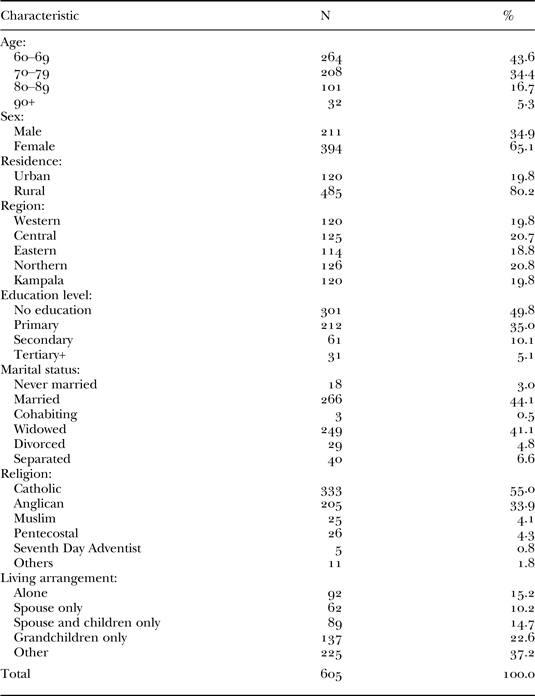
Table 1 displays the distribution of respondents by socio-demographic characteristics. The table indicates that, as expected, the percentage of older persons decreased with increasing age. Not surprising, almost two-thirds of the older persons found in the sampled households were females (65%), leaving only 35 per cent as males because of the higher female life expectancy relative to males. Four-fifths of the respondents were living in rural areas while the rest were staying in Kampala, the area purposively selected as an urban environment.
Distribution of respondents by selected socio-demographic characteristics

Table 1 further shows that half of the respondents had never attended school and thus did not have any formal education. Just over one-third (35%) had attained a primary level of education, 10 per cent had a secondary level of education while the percentage of those with tertiary and higher levels of education was only 5 per cent. Interestingly, these distributions of the sample are close to what is happening in the national population: high percentages being in rural areas and low percentages having been in school, especially beyond primary school (UBOS 2005).
Although 44 per cent of the respondents were married, the overall level of widowhood was high. Slightly over two-fifths (41%) were widowed. This is expected given that age-specific mortality increases as individuals gradually reach advanced age (Kpedekpo Reference Kpedekpo1982). Unexpectedly, among the older persons interviewed, close to 3 per cent of them belonged to the never-married category, which is contrary to what was expected of this overwhelmingly rural sample, where marriage used to be universal due to the required traditions in Africa (Ntozi and Kabera, Reference Ntozi and Kabera1991). Similarly, high fertility in sub-Saharan Africa has been attributed to deep-rooted socio-cultural factors (Caldwell and Caldwell Reference Caldwell and Caldwell1987) and these tend to be more pervasive in rural than urban areas. Studies have further indicated that the higher the proportion of a country's population living in rural areas, the more likely it is that women in that country will marry before age 20 (Singh and Samara Reference Singh and Samara1996).
The largest percentage of respondents belonged to Catholic and Anglican religious affiliations (55 and 34%, respectively). According to Table 1, membership of other religions exists though in much smaller proportions. In comparison with living with a spouse only (10%), a higher proportion (15%) of older persons were living alone. Over one-fifth were living with grandchildren alone (23%). Table 1 indicates that 37 per cent of respondents belonged to the ‘other’ living arrangement category which was comprised of older persons who neither lived alone, resided with a spouse alone, exclusively stayed with grandchildren nor lived with spouse and children only. This group included those who lived with a house maid, stayed with a spouse and grandchildren or simply resided with friends.
Prevalence of loneliness
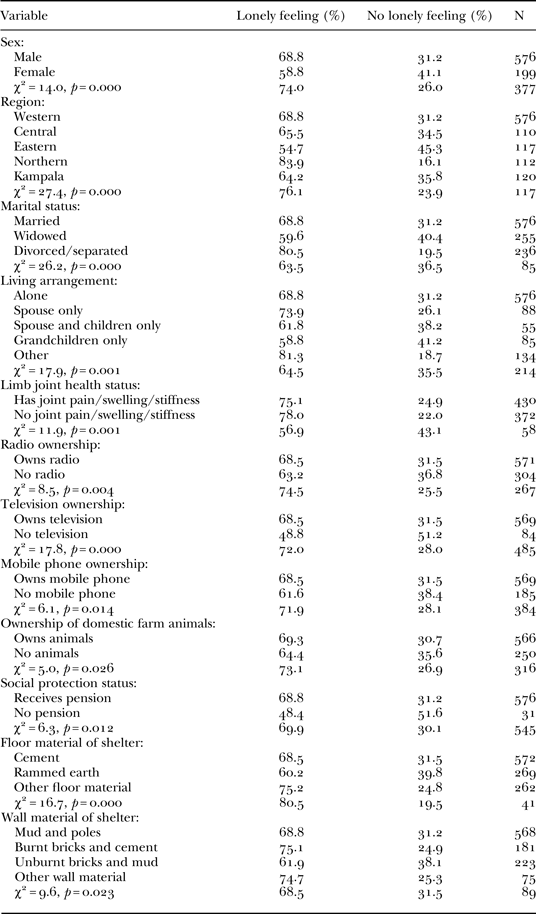
As mentioned earlier, respondents were asked to self-evaluate their feeling of loneliness. Table 2 shows the percentage of respondents who said they sometimes felt lonely and summarises the results of loneliness by background factors. Close to seven in ten reported that they sometimes felt lonely. Some participants in FGDs corroborated the quantitative result, indicating that loneliness among the aged was indeed high; as one participant put it:
Loneliness is terrible these days. For example, personally I am now living with only my wife since all our children have gone away; some to town and others to form their own families. To get someone's child to come and stay with today, whether relative or house maid, is not easy. Loneliness has increased and old people are having it rough. Whenever I go to visit my fellow elder brother, he is very happy. He often says: ‘since the other day, you are the only one who has come here’. (Male FGD, Tororo district)
Percentages of older persons by loneliness and selected variables
Table 2 also displays differences in feelings of loneliness between sexes – a higher percentage of females than males (74 and 59%, respectively) reported sometimes feeling lonely, perhaps because males tend to be more outgoing (e.g. as part of drinking joints) than females who are culturally limited from being outgoing (e.g. being part of a drinking joint could be misinterpreted as going there to look for men). Some FGD participants attributed higher female loneliness to age differences between spouses and potential animosity between the children and their father's new wife. One participant, for example, had this to say:
There may be a general difference in perception of issues and general outlook to life between young women who get married to older men. In addition, the children of a deceased woman may harass their father's new wife since she may be seen as one who may potentially lay claim to their household property. The children may in fact chase the new woman out of the home which may cause her to develop depression and heightened loneliness. (Male FGD, Mukono district)
Although the results in Table 2 and views from some FGD participants point to higher feelings of loneliness among females than males, most participants in FGDs stated that men were more likely to feel lonely than their female counterparts. It would appear the brain-storming opportunity available to FGD participants influenced deeper reflection and converging conclusions on the subject matter. These participants focused on individual-level attributes of women who were described as being more involved in household-level activities that keep them busy. Women were also perceived as being more socialising at the household level than their male counterparts. One participant had this to say:
Abassajja be basing okubba n'ebizibu. Omukkazzi ayina by'akola niyewaala okuba n'ekiwuubaalo; omuddo nagukolakola, enyumba nagisimuula, abantu nabakokonya. Naye gwe omussajja nobakokokonyaki? Omukkazzi ayinzakuyita omwana owomulirano nalya naye, omussajj atasobora kikora [loosely translated to mean: Men have more problems. A woman can engage in household activities such as weeding and house-cleaning, which keep her occupied. She can invite a child from a neighbouring household and share a meal but a man is unlikely to do the same]. (Male FGD, Mukono district)
It is further shown that 84 and 76 per cent of older persons who were living in the Eastern and Kampala regions, respectively, reported feeling lonely sometimes. The corresponding percentages for the Central, Northern and Western regions were 55, 64 and 66 per cent, respectively. Urban alienation and anomie that are associated with urban areas (Fischer Reference Fischer1975) could explain the high percentage of loneliness in the urbanised Kampala region. The association between loneliness and region was highly significant (p = 0.000).
Table 2 shows that widowed older persons had the highest level of loneliness (81%) while the corresponding levels for the divorced/separated and married were 64 and 60 per cent, respectively. The table further shows that loneliness had a statistically significant association with living arrangement. The lowest percentage of lonely older persons existed among those living with spouses and children (59%) while the highest corresponded with those residing with grandchildren (81%). This result is surprising considering that grandchildren would, to the contrary, be expected to offer companionship to their grandparents. A plausible explanation for this unexpected result could be structural constraints on social interaction that living with grandchildren places on older persons. It is likely that the age gap, coupled with the pressure of grandchild care-giving, could exacerbate the grandparents' loneliness. Interestingly, although overall 69 per cent reported sometimes feeling lonely, only 15 per cent of older persons live alone. This may indicate that living alone is not necessarily synonymous with feeling lonely and co-residence does not necessarily eliminate later-life loneliness, especially when wide age and social gaps exist between the co-residents.
The percentage of those who sometimes felt lonely was higher among those who had joint constraints (78%) than those without this health challenge (57%). Mobility of persons who had joint pain, swelling or stiffness may have been restricted; a situation which curtailed socialisation and thus contributed to higher levels of loneliness. The association between loneliness and limb joint health status was statistically significant (p = 0.001).
Results indicate that the percentage of those who sometimes felt lonely was higher among those who did not own a radio, television and mobile phone (75, 72 and 72%, respectively) than among those who owned these facilities (63, 49 and 62%, respectively). Loneliness had a statistically significant association with ownership of radio (p = 0.004), television (p = 0.000) and mobile phone (p = 0.014). Loneliness was also associated with ownership of domestic farm animals. Whereas 64 per cent of older persons who owned domestic animals felt lonely, the corresponding figure among those who did not own domestic livestock was 73 per cent. The association between ownership of domestic animals and loneliness was statistically significant (p = 0.026).
Information about older persons' work environment before they attained age 60 was sought. Respondents who reported having worked in the public or private sector were asked whether they were receiving their retirement benefits. Seven out of ten of those who were not receiving pension funds sometimes felt lonely while the corresponding figure among those who were receiving the funds was 48 per cent. The association between social protection status and loneliness was statistically significant (p = 0.012).
Table 2 further indicates that loneliness was associated with shelter conditions. Whereas the percentage of lonely older persons staying in houses having cement floors was only 60 per cent, the corresponding figure for those staying in structures with rammed earth floors was just over 75 per cent. The highest percentage was among those staying in houses having other floor materials such as loose soil or stone (81%), which were temporary and of weak structure that perhaps scared the elderly people at night if they were afraid of attack by wild animals. Similarly, whereas only 62 per cent of older persons who were staying in houses with burnt bricks and cement felt lonely, the corresponding figure for those staying in structures with mud and poles was over 75 per cent. This was perhaps because permanent houses made the older people more comfortable and safer, which could be related to less loneliness. Secondly, if they are living in permanent houses, other people like relatives and friends are more willing to come and stay with them than when their shelter is temporary. Loneliness had a statistically significant association with shelter floor material (p = 0.000) and shelter wall material (p = 0.023).
Predictors of loneliness
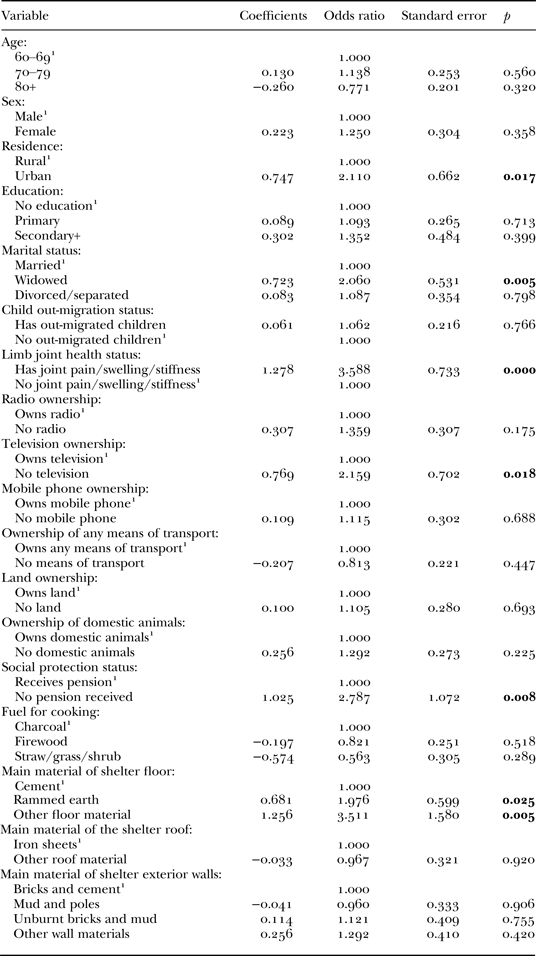
Prior to the study, loneliness was considered to be associated with living in a rural or urban area. Binary logistic regression results indicate that indeed place of residence predicted loneliness (Table 3). In comparison with a rural area, older persons residing in the urban environment were twice as likely to feel lonely (odds ratio (OR) = 2.1; p = 0.017). Some informants in FGDs also felt that loneliness was higher in urban than rural areas and partly attributed this to the tendency for urban residents to live an indifferent lifestyle. ‘The urban elderly hardly know each other and many of them live in houses that are separated by walls', said a participant in a Kampala FGD. Similar views were held by informants in Tororo district, as one of them put it:
Urban elderly have very few friends whereas older persons in villages, on top of having friends, have their own relatives who check on them. By end of the day, two or three people will have checked on an elderly person which is not the case in towns. Each person in town minds his/her own business. A townsman/woman does not even know that his neighbour is sick! By the way in town, people hardly assist each other and rarely do they socialise over meals. For example, if one buys a bunch of bananas, this is exclusively for their immediate family and rarely do they think of sharing it with a neighbour as is the case in a rural area. (Female FGD, Tororo district)
Results of logistic regression of factors influencing later-life loneliness
Note: 1. Reference category. Figures in bold are significant p values (p ≤ 0.05).
Notwithstanding the popular view that the level of loneliness was higher in the urban environment than rural areas, some participants felt that the opposite was true. These argued that loneliness was likely to be higher in rural areas than in the urban environment. Differentials in spatial and media dynamics were cited as some of the causes for higher loneliness in the rural areas. One elderly participant had this to say:
The physical distance between homesteads in which the rural elderly live is longer than that between houses in which the urban older persons reside. Additionally, there is hardly any presence of television and radio in rural homesteads that would otherwise keep the elderly entertained and thus prevented from developing lonely feelings. (Male FGD, Mukono district)
It is interesting to note that opinion was divided on the narratives regarding level of loneliness between participants in the rural FGDs and urban FGDs. For example, whereas female FGD participants in Tororo (a rural district) largely thought loneliness was more prevalent in urban areas than rural regions (as cited earlier), their male counterparts held a contrasting view, as one of them put it:
Loneliness is higher in the rural area. An older person in urban community may not feel so much suffering. Basic utilities such as water and electricity abound in urban centres but are largely lacking in rural regions. In addition, charitable organisations may assist urban dwellers. Urban residents may also have more opportunities to influence visits. In town I see urbanites who are lively. When a townsman sees a collection of people, he will be happy. But in the rural area, one may be alone there! (Male FGD, Tororo district)
Opinion was also divided between and among FGD participants in Kampala, an urban region. Whereas some female participants felt that loneliness was higher among older persons in the rural areas than those in the urban setting, other participants thought what mattered was not place of residence but the social support available to individuals. There were male participants who also argued that urban residents were less likely to be lonely than their rural counterparts. Availability of sources of information and entertainment were cited as the causal factor, as one of the participants put it:
City life is characterized by entertainment facilities such as radio, television and music systems. These drive away boredom and reduce loneliness. (Male FGD, Kampala district)
This view was, however, contested by fellow participants in the discussion group. One of them had this to say:
Absence of loneliness is not just about being entertained. It is also about being visited. Here in the city, an older person may have adult offspring working and residing elsewhere in the city but the children may visit their parent only once in a long period of time or even never visit at all. Furthermore, urban older persons just stay in homesteads separated by perimeter fences and rarely visit each other. In contrast, older persons in rural areas tend to exchange visits regularly and have solidarity which is lacking here in the city. (Male FGD, Kampala district)
The narratives presented above clearly indicate divided opinion about loneliness in urban/rural areas between and among participants in urban FGDs and rural FGDs. It appears, however, that the underlying socio-economic variables rather than place of residence per se may be at the centre of the reported loneliness differentials. This seems to point to further investigation of loneliness differentials by place of residence.
Results show that marital status predicts loneliness (Table 3). Widowed older persons were twice as likely to be lonely than those who were married (OR = 2.1; p = 0.005). Some elderly participating in FGDs also concurred with the view that loneliness was likely to be higher among the widowed. ‘If you are a widow aged 80 years and above, do you expect to easily get another spouse?’, asked a male participant in Mukono district FGD.
Findings indicate that older persons who reported having pain, swelling or stiffness of the arms or feet were three and half times more likely to be lonely (OR = 3.6; p = 0.000) than their counterparts who did not report similar health challenges. Older persons who did not own a television set (OR = 2.2; p = 0.018) were twice as likely to be lonely than their counterparts who possessed the media facility. Results indicate that in comparison with older persons who were receiving retirement benefits, the elderly who did not receive pension funds (OR = 2.8; p = 0.008) were almost three times more likely to be lonely.
Findings of association between housing conditions and loneliness indicate that in comparison with older persons staying in houses with cement floors, the elderly who were staying in houses with rammed earth floors and other floor material were twice and three and half times more likely to be lonely (OR = 2.0; p = 0.025 and OR = 3.5; p = 0.005, respectively). This is perhaps because housing is not merely a physical shelter but also an environment that may play a role in a person's physical, mental and emotional wellbeing. Qualitative data appeared to indicate that quality of housing, poverty and loneliness were intertwined, as one FGD participant put it:
Most of the elderly live in houses whose floors are not good. The floors harbor fleas and the houses are small and often leak. Today's grandchildren tend to isolate their grandparents and are not so helpful in fixing weak shelters. The elderly do not have money with which to repair weak structures which are so weak they can collapse on an older person any time. In fact recently a mud wall collapsed on one of the elderly women in our village. Termites had clawed their way through the weak floor and eaten up the wattle walls. The woman died and even rats ate some of her body parts. Yes, rats ate! This was evident from disfigured nose and eyes. Since the deceased was living alone, the neighbours did not know of the unfortunate event until flies were seen moving over the homestead. (Male FGD, Tororo district)
Mitigating loneliness
Loneliness is both a social and a health challenge, impacting adversely on the lives of older persons. Therefore, reducing the level of loneliness can make a difference in the quality of life of older persons. Older persons who reported that they at times felt lonely were asked what they considered to be solutions to the problem. Just over one-third of them (34%) thought the challenge could be alleviated through access to start-up capital (Figure 1). There was a feeling that start-up capital could facilitate business and enable the elderly to be preoccupied with work which would in turn reduce the challenge of loneliness. This is perhaps expected considering that the majority of the older persons in this study were of low socio-economic status with limited opportunity for securing bank credit. This is corroborated in Uganda's National Plan of Action for Older Persons, as indicated by the statement:
The majority of older persons live in rural areas where poverty is rife and economic opportunities are limited. They work in the agricultural sector, which is characterised by fluctuations in produce prices, irregular income and low returns to labour. About 85 per cent of the active older persons are engaged in crop farming with no social security, rendering them totally vulnerable. Older persons are often denied credit by financial institutions due to the misconception that they are risky borrowers. (MoGLSD 2012)
Figure 1 further shows that slightly under a quarter of the older persons (24%) expressed the need for counselling and companionship. There were older persons who thought that access to radio could mitigate loneliness. These thought that in the event of no one to talk to, they would listen in to desired radio programmes and at least feel the ‘presence’ of other human beings, albeit remotely.
Percentages of older persons by suggested measures for mitigating loneliness.
Kinship and friendship was thought to be a way of mitigating loneliness among 11 per cent of the elderly. An equal percentage thought loneliness could be mitigated through prayer. Some elderly felt they were still strong enough to engage in economic activity which would alleviate their loneliness. These argued that such involvement would keep them busy and provide safeguards against having an inactive lifestyle. Having a job would also make them self-reliant and reduce dependence on friends and family. For example, a male participant in Kampala district FGD had this to say:
Ndowooza, waribadde ebikolwa eri kutumbula embera z'abakkadde. Abakkadde betaga obuyambi babeko bye bakola; batandike business ezitambula, bafune amanyi ate betegekere engeri yo kweyimirizawo [translated to mean: There is need for arrangements for improving the quality of life of the elderly. Older persons need to be supported to engage in gainful activities, start viable business and acquire capacity to become self-reliant]. (Male FGD, Kampala district)
Only 6 per cent of the elderly felt that access to food and alcohol was the solution to loneliness. Some felt that taking alcohol could enable them socialise with their age-mates in addition to experiencing better sleep and fewer thoughts about isolation and loneliness.
Discussion
With seven in ten older persons reporting they feel lonely, the level of loneliness among elderly Ugandans is high. Lower prevalence levels occur elsewhere, such as 7 per cent in Britain (Victor et al. Reference Victor, Scambler, Bowling and Bond2005), 19 per cent in the USA (Theeke Reference Theeke2009) and 39 per cent in Finland (Savikko et al. Reference Savikko, Routasalo, Tilvis, Strandberg and Pitkälä2005). Deprivation and limited capacity for affording basic items such as media facilities could be some of the factors that explain the high prevalence of loneliness in our study area. This explanation is plausible considering that 34 per cent of the elderly expressed the need to access start-up capital as a way of mitigating later-life challenges. Also 17 per cent of the elderly expressed the desire to own a radio which they thought would fill the social gap. In rural Uganda, absence of such basic items may be compounded by irregular and low electric power supply (13.9% in Uganda; UBOS 2014) to run radios, televisions and computers, resulting in heightened feelings of loneliness when night darkness sets in. In contrast, the running of media facilities in more developed countries is guaranteed given the higher electrification rate (99.7% of the 2009 population of Norway; United Nations Development Programme (UNDP) 2013). Furthermore, the higher access to computers in very high human development countries (96.2 per 100 people in Switzerland compared to only 1.7 per 100 in Uganda; UNDP 2013), could imply higher usage of electronic media. Indeed as UNDP indicates, there is a higher percentage of internet users in very high human development nations than low human development countries (83.0 per 100 people in New Zealand compared to 12.5 per 100 in Uganda; UNDP 2013). Overall, the higher usage of the internet and other media in very high human development countries could make the population, older persons included, remain socially active and thus feel less lonely.
Analysis of quantitative data shows that place of residence predicts loneliness. Older persons residing in the urban area were more likely to be lonely than their counterparts staying in the rural environment. The lower likelihood of ‘rural loneliness' could be attributed to various factors. Firstly, the greater land availability in rural areas could have been a source of preoccupation since some elderly may have spent part of their time carrying out basic land-based subsistence activities.
Secondly, in comparison with the urban elderly, there could be a greater sense of identity, togetherness and belonging among rural folks. Some focus group participants expressed firm views indicating that the level of socialisation is higher in rural than urban Uganda. Some indicated that the traditional spirit of sharing and socialising breaks down with urbanisation. Oppong (Reference Oppong2006) similarly observes that social transformation has tended to result in adverse effects on the traditional familial role and respect for the elderly.
Thirdly, the lower loneliness could be associated with spatial differentials in the prevalence of domestic animals. Older persons staying in rural areas (with a higher prevalence of domestic animals) could have been more preoccupied with livestock management; a situation that probably made them feel less lonely than their counterparts residing in the urban environment (with a lower prevalence of domestic animals). This is consistent with other studies which indicate that possession of animals may have a reducing effect on loneliness. For example, Friedmann and Son (Reference Friedmann and Son2009) posit that animals provide human companionship and decrease loneliness and social isolation. Some studies have also indicated that cattle alleviate stress experiences; and positive cattle–human interactions exist especially when food is offered during the interactions (Raussi Reference Raussi2003). It is said that the more time the animal herder can spend in positive contact with cattle, the easier and safer the human–cattle interactions are.
An example of human–animal interaction in Uganda is that of the Bahima of south-western Uganda. This group of pastoralists are known to be close to their long-horned cows, which they massage at the horn base and around the ears in a process known as okwagaaga. Over time, this action has established close and cordial relationships between the Bahima and their cows (Wurzinger et al. Reference Wurzinger, Ndumu, Okeyo and Solkner2008). The Bahima also communicate with their cows which sometimes respond and, in that way, the cows are companions and make their elderly masters less lonely. Similarly, other elderly pastoralists find solace in goats and sheep. Other studies have also shown that early handling of lambs decreased the distance between the animals and human beings. Markowitz et al. (Reference Markowitz, Dally, Gursky and Price1998) indicated that lambs handled at a tender age spent significantly more time in close proximity to the herder.
Pets have also been noted for their effect on reducing loneliness. In a study of loneliness and pet ownership, women living entirely alone were significantly more lonely than those living with pets only, with both other people and pets, and with other people but without pets (Zasloff and Kidd Reference Zasloff and Kidd1994). These findings indicated that having a pet could help to diminish feelings of loneliness, particularly for women living alone, and compensate for the absence of human companionship. Other studies have shown that pets can be good companions to the extent that animals can act like family and friends (Beck and Katcher Reference Beck and Katcher1996).
Overall, the higher level of loneliness among urban older persons is consistent with results from studies conducted elsewhere. For example Jones, Victor and Vetter (Reference Jones, Victor and Vetter1985) showed that subjects in the urban area felt lonelier than those who lived in the rural environment. In our study, some findings from qualitative inquiry, however, indicated loneliness could be higher among rural dwellers than urban residents. The lower prevalence of media facilities and longer spatial distances between homesteads were cited as prime factors that influenced higher loneliness in rural areas in comparison with the urban environment. Variations in socio-economic conditions, rather than rural–urban residence per se, could be central in explaining rural–urban differentials in perceptions about loneliness. The tendency to consider loneliness being higher in a counterpart place of residence could, however, also be associated with the stigma with which the challenge is sometimes associated. As Theeke (Reference Theeke2009) has observed, since loneliness is associated with stigma, it may be under-reported and the prevalence may actually be higher.
Previous studies have shown that living in the rural area also predicted social loneliness in Ireland (Drennan et al. Reference Drennan, Treacy, Butler, Byrne, Fealy, Frazer and Irving2008). The prediction was thought to be associated with variations in patterns of social interactions. It is argued that older persons staying in rural areas may have had fewer daily interactions than their urban counterparts. The low population density and scarce public transport could have contributed to the exacerbation of social isolation and loneliness among the Irish rural folks. Savikko et al. (Reference Savikko, Routasalo, Tilvis, Strandberg and Pitkälä2005) also claim that constant rural out-migration could explain higher loneliness among elderly people in rural areas than their counterparts in the urban environment. This migration is considered to lead to disintegration of small rural communities as the young people move to cities and the older people are left behind. Overall, the qualitative results of our study seem to indicate that later-life loneliness is a tenacious challenge in both urban and rural Uganda, much as quantitative findings show higher likelihood among urban elderly. This calls for further investigation on the subject of spatial loneliness differentials in the country.
Our findings further indicate that widowhood was significantly associated with loneliness. Widowed older persons were more likely to be lonely than those who were married, divorced or separated. This was perhaps because the percentage of widowed older persons who live alone is high and on the rise (UNDESA 2007). The chances of re-marrying and thus having a companion are low at advanced age than at a younger age. As UNDESA (2007) has further observed, more and more people live alone in later life; a situation that may predispose them to other challenges, loneliness included. The results bear similarity with the findings of a related investigation by Victor et al. (Reference Victor, Scambler, Bowling and Bond2005) which showed that, in comparison with married persons, loneliness was higher among single, divorced and widowed older persons.
Limb joint health status also predicted later-life loneliness. Older persons having difficulties with their limbs (such as arm or foot joint pain, swelling and stiffness) were more likely to be lonely than those without such health challenges. This was perhaps expected since joint ill-health negatively affects physical movement beyond older persons' place of residence. A similar result was found in Maryland, USA, where health barriers contributed to loneliness among older persons of low income (Cohen-Mansfield and Parpura-Gill Reference Cohen-Mansfield and Parpura-Gill2007). The authors reported that reduced mobility was important in predicting loneliness in populations of older persons. Jones, Victor and Vetter (Reference Jones, Victor and Vetter1985) also showed that feelings of loneliness were consistently associated with general disability such as difficulty in hearing, seeing and mobility. Studies have also found that specifics of a disease play a role in the feelings of loneliness of older persons. For example, greater feelings of loneliness were found among persons with diseases such as arthritis (Penninx et al. Reference Penninx, Van Tilburg, Kriegsman, Boeke, Deeg and van Eijk1999). Similarly, a study of Georgian older persons found that centenarians in relatively good physical health were less likely to be lonely than their counterparts of lower health status (Martin, Hagberg and Poon Reference Martin, Hagberg and Poon1997).
Our findings have indicated that loneliness was associated with ownership of media facilities. Elderly people who did not own a television set were more likely to be lonely than their counterparts who possessed such a facility. This is perhaps not surprising considering that since advanced age restricts physical movement away from the home, availability and access to media could be one way of keeping older people preoccupied. Television plays a double role of facilitating hearing and seeing messages unlike radio whose benefit is restricted to hearing. Mitigation of loneliness is therefore likely to be better with a television than with a radio. This could explain why a significant association of loneliness existed with ownership of a television and not with possession of a radio. The finding of the importance of television ownership dovetails with the work done on social contact, loneliness and mass media (Davis and Kraus Reference Davis and Kraus1989). The latter study supported the hypothesis that persons with little social contact or greater loneliness would be more likely to utilise mass media to compensate for social impoverishment.
Our study further shows that social protection status predicted loneliness. Older persons without old-age benefits were more likely to be lonely than their counterparts who were receiving pension funds. The absence of old-age benefits could have impacted negatively on older persons' overall lifestyle. As expected, limitations of funds are likely to have adversely affected accessibility and affordability of social services and socialisation. Studies elsewhere have established the existence of the effects of retirement benefits on the general health of older persons. For example, government retirement social security arrangements in Europe are said to have led to a decrease in the probability of reporting bad health and some improvement in the health index (Coe and Zamarro Reference Coe and Zamarro2011).
The nature of the main floor material of the shelter in which the older person resided predicted loneliness. In comparison with older persons staying in houses with cement floors, those who were staying in houses with rammed earth floors and other poor floor material were more likely to be lonely. This is probably because housing is not only a physical shelter but also plays a significant role in a person's physical, mental and emotional health conditions. A study on housing conditions and quality of life of the urban poor in Malaysia also established a statistically significant association between housing conditions and overall quality of life (Zainal et al. Reference Zainal, Kaur, Ahmad and Khalili2012). The Malaysian study showed that all respondents reported the existence of floors in a dilapidated state. Cross-tabulation of overall house condition with physical health condition indicated that only 1 per cent of respondents who were satisfied with their housing condition sought hospital treatment as compared to 9 per cent who were not satisfied with their shelter condition.
Limitations
An approach of estimating loneliness through asking several indirect questions could probably have produced better results. As mentioned earlier, this was not possible since the data used for this paper were collected in a larger, more general study that did not focus entirely on issues pertaining to loneliness. Richer data could have been collected if respondents had been asked to rate their quality of social relationships on a scale of loneliness, rather than respond to one general question. Furthermore, while we were able to estimate the level and examine factors of loneliness, we were unable to assess the economic and health implications of this later-life challenge. Lastly, more insight into issues of loneliness could have been registered with a study design that engaged more with interpretive approaches and provided more in-depth qualitative data analysis. This points to the need for incorporating these issues in future studies on loneliness in Uganda.
Conclusions and implications
Quantitative data analysis has indicated that older persons residing in the urban area were more likely to be lonely than their rural counterparts. This may call for the design of age-friendly urban programmes including institutionalisation of associations and fora for older persons' regular meetings. The MoGLSD, Uganda's Lead Agency on issues of older persons, may consider initiating and strengthening rural community socialisation as a way of mitigating loneliness among rural older persons.
The higher likelihood of loneliness among widowed older persons than divorced/separated elderly calls for availing widowed older persons with opportunities that mitigate loneliness. These may, for example, include the initiation of programmes that encourage and facilitate the participation of widowed older persons in gainful work as they grow older, according to their individual needs, preferences and capacities.
Our findings have shown that the lack of social protection funds is associated with later-life loneliness. This may point to the need for establishing a Special Old Age Fund in Uganda. This fund would supplement the current Social Assistance Grants for Empowerment arrangement that is largely donor-funded. This fund can be realised through factoring ageing issues into tax reforms in internally generated revenue. The generated fund can then empower older persons and enable them to afford basic necessities, including media equipment and decent housing that have been found to be associated with loneliness. This requires collaboration between the national tax body, the Uganda Revenue Authority, and relevant sector ministries, particularly the MoGLSD, Ministry of Public Service and Ministry of Finance, Planning and Economic Development.
This study has further found that older persons with limb joint ill-health were more likely to be lonely than those without similar health challenges. This calls for addressing age-specific health challenges that limit older persons' movement and socialisation. Interventions that address geriatric conditions such as anti-rheumatoid services could go a long away in mitigating later-life loneliness. A decentralised health-care system in which older persons are managed at or near their homes may also be considered, given that they also have mobility difficulties that would mitigate against travelling to the distant national, regional or district health centres.
Acknowledgement
The study was approved by the Uganda National Council for Science and Technology in October 2011.