Introduction
Organic horticulture in Italy, which is spread over roughly 12,500 ha, accounts for 1.3% of the total area under organic cultivation in the country (approximately 1 million ha). If organic potato and pea are included, then the total area rises to roughly 17,000 ha1.
In the framework of Italian vegetable production, carrot (Daucus carota L.) constitutes one of the most representative crops. Italy ranks third among European nations in terms of land devoted to carrot cultivation (after the United Kingdom and France), the crop being grown in Italy on an overall area >10,000 ha yr−1, with an average yield of roughly 50 t ha−1. However, the area devoted to organic carrot cultivation plus that under conversion to organic is currently limited to c. 400 ha1. The most important region for this crop is Abruzzo, which features a vast area (Fucino plateau) under carrot cultivation (roughly 2500 ha yr−1), grown mainly to be sold as fresh produce, only 10% of the production being sold to industry2. Abruzzo carrot gives an excellent yield (on average 60–70 t ha−1, for an overall gross saleable production of 10–15 million € yr−1), and excellent product quality, as it is rich in vitamins (in particular ascorbic acid) and mineral elementsReference Cianfarra, Aratari, Belmaggio, Recinelli and Tucceri2.
The most severe threat that has long created difficulties for carrot growers is that of weeds. This crop has poor ability to compete with weeds, for two main reasons. First, its seeds have very low vigor and thus extremely slow emergenceReference Melander, Heisel and Jørgensen3; second, due to its growth typology, the hypogeal part (the taproot) is preferred as the photosynthetate sink during the productive cycle, at the expense of the above-ground portion (stem and leaves). As a result, a carrot canopy can only achieve a very scanty ground coverReference Fogelberg and Gustavsson4. Furthermore, since this crop completes its cycle during the spring–summer period, it is severely affected by competition from warm-season weeds. Greenhouse trials carried out to test the competitive ability of carrot against Chenopodium album L. (one of the typical weeds infesting carrot crops in Italy and elsewhere) showed that in comparison to carrot, the weed adapts more successfully to variations in environmental conditions, in particular plant density and available nutrientsReference Li and Watkinson5.
In order to provide the sensitive carrot crop with an initial competitive advantage, researchers have focused attention on preventive control strategies. For example, a three-year rotation of carrot–barley–onion allowed an appreciable reduction in weed density as compared to carrot monoculture, thereby also giving a better yield and more satisfactory product quality, due also to the decrease in population of the nematode Meloidogyne hapla ChitwoodReference Leroux, Benoit and Banville6.
Experiments with soil disinfection have shown that this technique not only has a containing effect on the population of soil-borne pathogens, but it can per se constitute a means of preventive weed control. Soil solarization (i.e., prolonged solar heating of plastic mulch-covered soil during the warmest season) carried out prior to the sowing of carrot or string bean (Phaseolus vulgaris L.) can increase yield by reducing Cyperus rotundus L. emergenceReference Ricci, De Almeida, Ribeiro, De Aquino, Pereira, De Polli, Reis and Eklund7. Steam soil disinfection also offers a possible solution for weed control in vegetable crops that have very slow germination and early growthReference Melander, Heisel and Jørgensen3, Reference Peruzzi, Borelli, Mazzoncini, Raffaelli, Ginanni and Bàrberi8–Reference Peruzzi, Borelli, Mazzoncini, Raffaelli, Ginanni and Bàrberi9. Many such crops, including carrot, have notably heat-tolerant seeds, so that sowing and treatment operations could be performed at the same timeReference Melander, Jørgensen and Elsgaard10.
However, because of the poor competitive ability of carrot, post-emergence treatments are considered crucial in order to ensure effective weed control in this crop. Carrot growers in the Fucino plateau have traditionally based weed control on herbicide application. This approach contrasts with the need to enhance product quality, as consumers today are increasingly aware of environmental and health-related issues and demand that food quality should not be limited to aesthetic and nutritional values, but should also concern the safety and wholesomeness of the product itself.
One of the main technical constraints to organic carrot growing is the very limited range of truly effective alternative direct weed control means capable of replacing chemical herbicides. However recent research has drawn attention to some equipment that could possibly be used successfully for non-chemical weed control in carrot. Several studies performed in Sweden tested a rotary brush on a vertical axis for intra-row weedingReference Fogelberg and Gustavsson4, Reference Ascard and Mattsson11–Reference Fogelberg and Kritz14. This machine achieved good results as the treatment proved to be very selective (with percent weed infestation reduced by 35–80%, depending on weed growth stage). In the Swedish studies, direct control was also integrated with a preventive strategy consisting of night-time soil tillage (giving weed reduction percentages ranging between 14 and 25%). Other research conducted in Hungary focused on a comparison among various weed control systems using a number of different treatment combinations. The effectiveness of the brush weeder was confirmed, but it was also pointed out that hand weeding is indispensable in a carrot crop for intra-row weed controlReference Radics, Gàl and Pusztai15, Reference Gàl, Pusztai and Radics16.
A possible future evolution of non-chemical control could consist in the development of an automated system capable of distinguishing the crop from the weeds. Trials of this type have been performed at the University of Aberdeen (UK), where a special method of digital image analysis has been developed. Results showed that this form of artificial intelligence was able to discriminate (with up to 75% efficacy) carrot plants from those of two weed species: Lolium perenne L. and C. album Reference Aitkenhead, Dalgetty, Mullins, McDonald and Strachan17.
Overall, it is clear that a successful weed control strategy must include preventive, cultural and also direct methodsReference Bàrberi18, Reference Hatcher and Melander19. In particular, such a strategy should seek to improve intra-row weed control—which is at present the main limitation of direct mechanical means—in order to reduce the number of hours required for hand weeding. Trials on sugar beet in Denmark demonstrated a considerable reduction in the number of man-hours required for hand weeding if mechanical operating machines with spring tines, capable of performing selective intra-row weed control, were utilized in combination with manual weeding. Thus in the Danish experiment, the number of labor hours per hectare was reduced from 150 to less than 10Reference Melander20. When planning an integrated weed control strategy in organic carrot, local conditions such as farm structure and size, availability of equipment, traditional agricultural techniques, propensity of farmers to innovation and risk, and so forth, should also be taken into consideration.
In this framework, with the cooperation and funding of ARSSA Abruzzo (the regional agricultural extension service), since 2000 we have been engaged in a project to develop several operating machines, either purposely designed or modified from existing machinery, with the aim of proposing an improved weed control strategy in organic carrot. We thus developed an alternative crop management system specifically designed for the conditions of organic vegetable growers in the Fucino plateau.
Materials and Methods
Trials involving physical weed control in an organic carrot crop were conducted over 4 years, from 2000 to 2003, on two organic farms located in the municipality of Avezzano (Province of L'Aquila, Region Abruzzo). In the first year, a conventional cropping system was compared with an organic system, but the same sowing typology (band sowing) was adopted in both cases. In the remaining years, the comparison was performed on organic cropping systems with different sowing typologies. More specifically, the comparison was performed between the standard system used on organic farms in the area (henceforth denoted as the ‘standard’ system), with band sowing, and an innovative organic system in which the crop was spatially arranged in single rows. In addition, in 2001 and 2002, a farm where early sowing had been carried out was compared with a late-sowing farm, while in 2003 the experiment was performed only on the early sowing farms, hence conducting a comparison between the two different organic systems both involving early sowing.
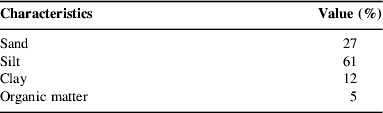
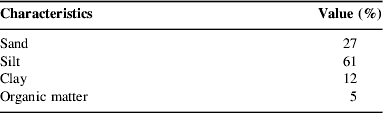
All farms adopted a vegetable crop sequence extending over a number of years, planting the typical vegetable crops of the area such as potato, chicory and fennel as well as carrot. The same tillage operations and fertilizer treatments were adopted in all the trials: application of manure (50–100 m3 ha−1 dairy manure), followed by plowing or deep tillage (at c. 40 cm depth) at the beginning of autumn, and numerous soil and seedbed preparation operations (grubbing, rotary hoeing and PTO-powered rotary harrowing). In the study area, soils are silty and have uniform properties, average values of which are shown in Table 1.
Mean soil characteristics in the experimental farms.
The crop was sprinkle irrigated with the use of a mobile unit composed of aluminum pipes to which the nozzles were fixed; the unit was connected to a motor pump powered by a fixed point tractor, which drew water from a purposely drilled well.
The trials included a comparison between two different sowing typologies: the standard system with five bands coppa −1, the bands being 7 cm wide and spaced 30 cm apart, and an innovative typology with ten rows coppa −1, the rows being spaced 18 cm apart. The coppa represents the traditional unit of surface measurement in the area, equal to a strip of land 2 m wide and 250 m long. Both typologies formed part of the same organic farming system. The ten-row spatial arrangement allowed the use of the innovative precision hoeing machine, while a conventional hoeing machine was adopted in the standard system. A randomized block design with four replications was adopted, each plot measuring 100 m2 (2×50 m).
The initial sowing density for both typologies was 2,500,000 seeds ha−1. Sowing was generally carried out within the third week of April, but in 2001 and 2002 a late sowing, i.e., at the end of May, was also performed. Two different F1 carrot hybrids were utilized: ‘Nandor’ in the first 3 years and ‘Maestro’ in 2003. The latter is an earlier hybrid with a more developed leaf structure, which facilitates mechanical harvesting.
Harvesting was carried out mechanically with specially designed self-propelled equipment operating on a single row.
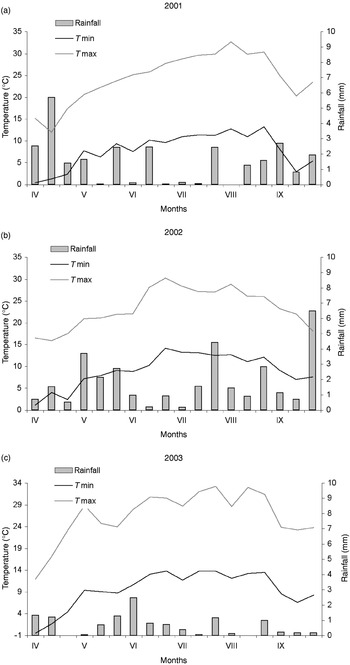
Total seasonal (April–September) rainfall and temperature followed the average of the area during 2001 and 2002 (27.2 versus 33.2 mm rainfall and 7.9/9.1 versus 24.4/23.4°C min/max temperature respectively), while 2003 was particularly warm and dry (11.9 mm rainfall and 9.6/26.5 min/max temperature) (Fig. 1).
Mean decadic minimum and maximum temperature (Tmin and Tmax) and total decadic rainfall registered during the 2001 (top panel), 2002 (middle panel) and 2003 (bottom panel) growing season in the Fucino plateau (data from ARSSA Meteorological Center of Scerni).

Weed management systems and operating machines
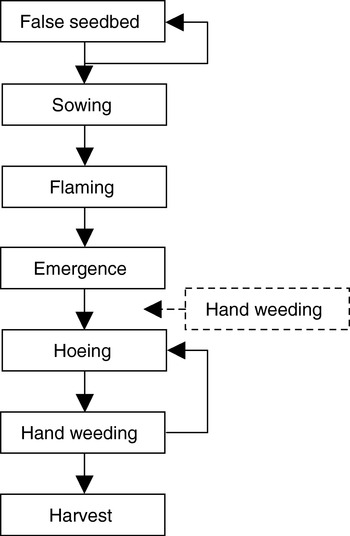
Weed management in organic carrot required a complex strategy that was refined and improved from year to year, building on the experience gradually acquired. Improvements were likewise made on the operating machines. During the first year, tests were performed to assess the feasibility of physical weed control, identifying the suitable machines and their manner of utilization; thereafter (2001–2003), weed management was carried out with a system that included, in sequence, the following techniques (Fig. 2): (1) false seedbed with a spring-tine harrow, (2) pre-emergence flame weeding, (3) precision hoeing, (4) hand weeding. Flame weeding was used as the last pre-emergence treatment to avoid further soil disturbance which could have led to weed emergence flushes early in the carrot growing season, thereby partially counteracting the positive effect of the false seedbed technique. Intra-row hand weeding was performed to complement hoeing either before or after the mechanical treatment, and it was generally carried out when weeds had reached the four true leaves stage.
Scheme of the physical weed management strategy adopted on organic carrot in the Fucino plateau.

Some exceptions to the above-mentioned four-step strategy were occasionally introduced. For example, in the late sowing standard system in 2002 the spring-tine harrow was replaced by a PTO-powered rotary harrow, as the owner of the farm considered the latter implement to be more suitable for false-seedbed operations in his soil type. In 2003 two passes were made with the spring-tine harrow rather than just one, as the first pass was not sufficiently effective in stimulating weed emergence.
All the pieces of equipment were purposely designed for carrot growing in the Fucino area, and had a working width of 2 m, corresponding to that of the ‘coppa’. All physical weed control treatments were carried out by coupling the operating machines to a 2WD 48 kW tractor with a 2.1 m track gauge, making it possible to work by ‘straddling’ the strip.
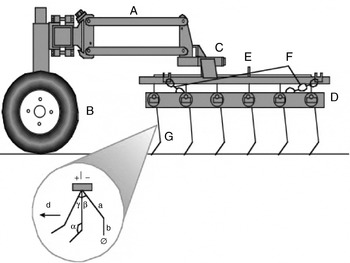
The spring-tine harrow (Fig. 3) is the operating machine that was utilized for the false seedbed technique. Shallow soil tillage performed by this machine eliminates weeds already emerged in the field and at the same time stimulates the emergence of new weeds that will subsequently be eliminated by flame weeding before crop emergence. This method is designed to gradually reduce the soil seedbank population, with the aim of decreasing weed emergence during the crop growing cycle. The spring-tine harrow is a semi-mounted operating machine with the same working width as the above-described strip. It consists of two frames having identical working width (main and secondary, elastically connected by chains inserted in special U-shaped supports) bearing the working tools: six lines of 6 mm diameter J-shaped special steel spring-tines. The spring-tines are made up of two parts: a 25 cm long vertical segment and a second shorter, 11 cm long segment (sloping at an angle of 135° with respect to the vertical segment)Reference Peruzzi, Raffaelli, Ginanni and Borelli21–Reference Peruzzi, Ginanni, Raffaelli and Fontanelli23. This machine is regulated by a lever that can modify the slope of the tines and consequently the aggressiveness of treatment (negative angle values=least aggressive, positive angle values=more aggressive). In this trial the spring-tine harrow was set to the most aggressive regulationReference Bàrberi, Silvestri, Peruzzi and Raffaelli24 and was used for non-selective pre-sowing treatment, at a driving speed between 4 and 8 km h−1.
Diagram of the spring-tine harrow: (A) main frame; (B) supporting wheel; (C) U-shaped support; (D) modular secondary frame; (E) tine slope regulation lever; (F) chains; (G) spring-tines. Detail: (d) working direction; (a)=25 cm (b)=11 cm; Ø=6 mm; α=135°; β=45°; γ=15°.

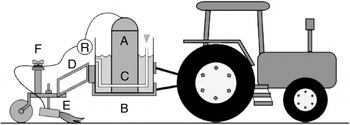
After false seedbed operations and prior to crop emergence, a pass with a flame weeder was carried out over the entire area. This operating machine kills weeds by using an open flame (fueled by Liquefied Petroleum Gas, LPG) that disrupts plant cells consequent to a strong and sudden increase in temperature. This treatment has the advantage of eliminating weeds without stimulating new emergence because the soil remains undisturbed. The flamer was equipped with four 50 cm wide rod burners, for a total working width of 2 m (Fig. 4)Reference Peruzzi, Raffaelli, Ginanni and Borelli21–Reference Peruzzi, Ginanni, Raffaelli and Fontanelli23. The burners were set at 10 cm from the soil and at a 45° slope, based on previous experimental evidenceReference Peruzzi, Di Ciolo and Raffaelli25, Reference Raffaelli and Peruzzi26. Mean working speed was about 3 km h−1 with LPG pressure from 0.2 to 0.3 MPa.
Illustration of the flamer: (A) LPG tank; (B) water-containing hopper; (C) heat exchanger; (D) articulated parallelogram; (E) burner; (F) shelf on which the inflow LPG control system is located; (R) pressure regulator and manometer.

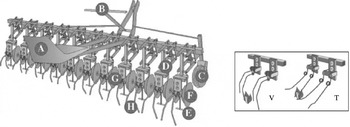
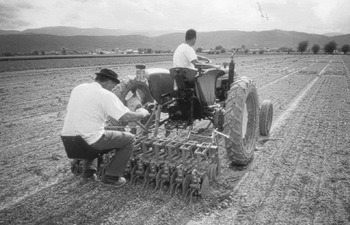
An 11-element precision hoe (Figs. 5 and 6) was utilized several times during each year of the trial for post-emergence inter- and intra-row weed controlReference Peruzzi, Raffaelli, Ginanni and Borelli21–Reference Peruzzi, Ginanni, Raffaelli and Fontanelli23 in the innovative, single row system. This machine, in the final optimized version used in 2002 and 2003, was equipped with rigid elements bearing a 9 cm wide horizontal blade (replacing the goose-foot push rod characterizing the first version), pairs of concave discs, and two alternative kinds of elastic tines (torsion weeders and vibrating tines, not used in 2001) designed to perform selective weed control in the crop row. The vibrating tines, which work in vertical position, have their longer segment bent at several points in order to till very close to the crop row. The torsion weeders, on the other hand, work in horizontal position; a torsion spring enables the tines to flex when they meet a fairly developed plant (generally a crop plant but it could also be a large weed) that opposes resistance to the implement. The position of both tools can be modified according to the treatment aggressiveness required. Treatment becomes more intense when the tines are positioned close to the row cropReference Melander20. The working speed of the hoe was c. 2 km h−1. A back-seated operator can adjust the actual position of the working tools by operating a steering handle. The hand guidance system might be replaced in the future by less labor-demanding guidance systems based upon electronic, optical or hydraulic applications, allowing to perform precision hoeing without the need of a back-seated operator.
Illustration of the 2002 version of the precision hoe: (A) seat; (B) steering handle; (C) directional wheel; (D) articulated parallelogram; (E) tine with blade tool; (F) side discs; (G) support wheel; (H) tools for intra-row weeding (in the right-hand side picture, vibrating tines (V) and torsion weeders (T) are shown in detail).

Precision hoe (equipped with vibrating teeth) at work, performing early post-emergence treatment in organic carrot in 2002.

Experimental assessments
During the trials, four different types of assessments were performed, on: (a) machine operative characteristics, (b) weeds, (c) crop yield and yield quality, and (d) crop economy.
Machine operative characteristics
During the trials, all data concerning the operative performance of the weed management systems and machinery used for physical weed control were recorded: working depth, working speed (this value being used, together with working width, for calculation of operative capacity and operating time), engine load, LPG working pressure, fuel and LPG consumption.
Weeds
Numerous weed parameters were recorded at repeated intervals. Weed density was measured before and after each physical weed control treatments on three 25×30 cm sampling areas plot−1. At harvest, weed samples were collected from a 2 m2 area plot−1. Samples were then oven dried until constant weight, in order to assess dry biomass of weeds.
Crop yield and yield quality
For measurement of crop production parameters, the density of carrot plants was measured before and after each treatment (along 50 cm of row in each of 5 samples plot−1). In addition, at harvest, measurements were performed on a 2 m2 area plot−1 to evaluate overall root production (weight and number) and the relative percentage distribution of roots in each marketable produce class (extra, first category, second category, ungraded), as required by EU Regulation no. 730 of 199927.
Crop economy
In each trial year, crop gross margin (not including land costs) was calculated by subtracting costs from gross salable production. Costs were defined as tillage and seedbed preparation costs (plowing, grubbing, rotary hoeing, PTO-powered rotary harrowing), cost of fertilizer (manure and spreading operations), sowing (purchase of raw material and sowing operations), weed management (treatment with the operating machines for physical weed control as well as cost of labor for hand weeding), and mechanical harvesting. The mean market price of organic carrot in the Fucino plateau for each trial year and each class of marketable produce27 was communicated by ARSSA Abruzzo. Estimate of the costs of cultural practices (except that of physical weed control) were based on the price lists of local work contractors. Costs for utilization of the equipment needed for physical weed control were calculated by means of standard procedures for calculation of operating costsReference Cera28, Reference Sartori29. Labor costs were 10 € h−1.
Statistical analysis
Analysis of variance (ANOVA) was carried out on each measured parameter (except operative characteristics of the machines) according to a randomized complete block design with four replicates. Treatment means were compared by a protected LSD test at P⩽0.05.
Results
Machine operative characteristics
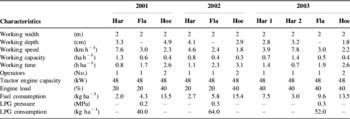
Technical data collected on machine operative characteristics in 2001, 2002 and 2003 are shown in Table 2.
Operative characteristics of the machines used for physical weed control in organic carrot in the years 2001, 2002 and 2003.

Har=harrowing (1, 2=first or second pass), Fla=flame weeding; Hoe=hoeing.
Data refer to innovative system.
The working depth of the spring-tine harrow during the 3-year period varied between 3 and 4 cm. A greater working depth was achieved in 2002, consequent to use of a more aggressive tine adjustment. Working speed varied as a function of soil conditions, and was higher in optimum moisture conditions. Thus speed was elevated in 2001 (7.6 km h−1) and more restrained in 2002 (4.6 km h−1), while in 2003 one pass was performed at moderate speed (c. 4 km h−1) and a second at higher speed (c. 8 km h−1).
Flame weeder speed and working capacity showed no significant variation during the trial years. Working pressure of LPG was more contained in 2001 (0.2 MPa) as compared to the subsequent 2 years (0.3 MPa). This increase in pressure accounts for the higher LPG consumption (+45% on average) during the last 2 years, given that working speed remained substantially unchanged over the 3-year period. It should be noted that LPG consumption is correlated with the two above cited factors: positively with working pressure and negatively with working speed. Greater working pressure was required when more strongly developed weeds were encountered. LPG is liquid in the tanks placed in the hopper, but it naturally evaporates and it is then used as a gas to the burners. This passage requires heating the tanks by a heat exchanger and it is the safest system that can be used in flaming machines.
Finally, the optimized version of the precision hoeing machine allowed an appreciable reduction (−52% on average) in working depth as compared to 2001. Working speed, on the other hand, underwent no marked variation during the 3-year trial period; consequently, working capacity and fuel consumption remained virtually unchanged. In 2003, in the innovative system a third pass of precision hoeing was performed, due to the elevated weed density which may have been due to the presence of viable seeds in insufficiently mature manure.
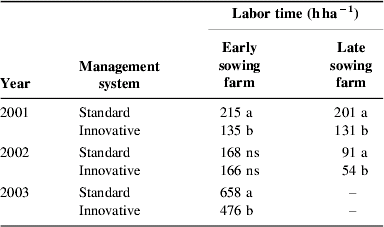
Total labor employed over the trial years varied considerably. As shown in Table 3, a greater quantity of labor was required in 2003, as unsuccessful false seedbed operations resulted in high weed density during the crop cycle, leading to a greater requirement of hand weeding. However, the innovative system consistently allowed a notable savings on labor time (on average, −28% during the 3-year period). In 2002 the difference between the two systems in terms of the number of labor hours required for hand weeding was virtually nil for the early sowing farm (Farm 1: 168 and 166 h ha−1 for the standard and the innovative systems respectively). In contrast, on the late sowing farm (Farm 2) labor time was on average 40% lower in the innovative system than in the standard system (91 versus 54 h ha−1) (Table 3). This was mainly due to the fact that on Farm 2, hand weeding was performed prior to hoeing in order to remove the larger weeds and maximize the efficacy of hoeing operations. This strategy was not adopted on Farm 1, where the presence of weeds in an advanced stage of development noticeably reduced the effectiveness of the operation. In addition, in the standard system of Farm 2, the false seedbed technique was performed by means of a rotary harrow (instead of the spring-tine harrow), which caused pronounced soil disturbance, thereby creating the ideal conditions for prolonged weed emergence throughout the growing cycle, which increased the difference between the two weed management systems. In the innovative system, pre-hoeing hand weeding was also adopted in 2003 for the second and third hoeing passes, allowing a considerable reduction in total hours needed for hand weeding as compared to standard system (−77% on average).
Labor time required for physical weed control in carrot grown with the two management systems on two organic farms of the Fucino plateau in the period 2001–2003. In each column and year, means labeled with different letters are significantly different at P⩽0.05 (LSD test); ns=not significant.
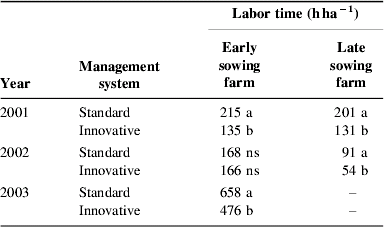
The percentage of labor time needed for mechanical operations out of total working hours was fairly limited in the 2001–2003 3-year period, as almost all labor was associated with hand weeding. This percentage varied considerably (from 3% to c. 12%) depending on the year and the strategy adopted, and was generally higher in the innovative system and in years characterized by lower weed competition (2001–2002).
The marked difference in labor required for hand weeding in the various trial years is attributable to different weed emergence patterns from year to year. In particular, the final trial year was characterized by massive weed growth after crop emergence.
Weeds
In 2001, weeds consisted mainly of Amaranthus spp. L. and C. album, which together accounted for 90–95% of the overall weed community. Among other weeds, only Echinochloa crus-galli (L.) P. Beauv. achieved a noteworthy density.
In contrast, in 2002 the weed community was more differentiated and complex. On the early sowing farm, initially the main weeds were: C. album, accounting for 48% of relative density, some crucifers (Diplotaxis erucoides (L.) D.C., and Sinapis arvensis L.) accounting for 38% and Amaranthus spp. accounting for 7%. Subsequently, other weeds became dominant, such as Polygonum aviculare L. (up to a maximum relative density of 29%) or Mercurialis annua L. (up to 27%). On the late sowing farm, crucifers (especially D. erucoides) initially had the highest density (34%), closely followed by Polygonum lapathifolium L. (16%), C. album (12%) and Cuscuta campestris Yuncker (11%). During the carrot growing cycle, the weed community composition shifted in favor of crucifers, which at some point achieved a relative density >80%.
In 2003, the main weeds present initially consisted of two Chenopodiaceae (C. album and Atriplex latifolia Wahlenb.) plus D. erucoides (77 and 10% of relative density respectively). Subsequently, perhaps as a result of a rise in temperature, considerable populations of P. lapathifolium and Amaranthus spp. were also recorded. During the growing cycle, Chenopodiaceae, together with Amaranthus spp. and P. lapathifolium, were the most widespread weeds, often representing almost the totality of weeds present in the field.
The highest initial absolute density of weeds was recorded in 2001 (233 weeds m−2 on Farm 1 and 184 weeds m−2 on Farm 2). By harvest time, however, use of mechanical weed control and hand weeding allowed a 96% reduction in weed density on Farm 1 and 97% on Farm 2.
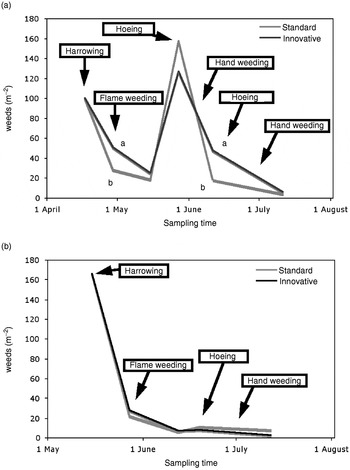
In 2002, on the early sowing farm (Fig. 7a) mean initial weed density (100 weeds m−2) was lower than in the previous year (−57%). Preventive weed management operations (harrowing and flame weeding) substantially reduced total weed density both in the standard and the innovative system (respectively −81 and −75%), but densities then rose to higher than initial values (+57% in the standard and +27% in the innovative system) as a result of massive weed emergence occurring prior to the first hoeing operation. However, the two hoeing operations almost completely eliminated weeds (−96 and −94% of total initial densities in the standard and innovative system respectively). It should be noted that the first precision hoeing pass in the 10-row system was not very effective (62% reduction), mainly due to the presence of very large weeds.
Pattern of weed development during the 2002 season in organic carrot grown according to the standard and innovative management systems, on the early sowing (a) and late-sowing (b) farms. Different letters indicate significant differences for P⩽0.05 (LSD test).

In 2002, initial weed density was 66% higher on the late sowing farm (166 weeds m−2) than on the early sowing farm, but the two preventive weed management treatments reduced weed presence by 96% in both systems (Fig. 7b). In addition, lower levels of subsequent weed emergence were recorded after flame weeding, and precision hoeing achieved greater efficacy in the 10-row innovative system (75% weed control) thanks to prior hand weeding. Taken together, these operations gave final results similar to those of the early sowing farm, but with decidedly fewer (−57%) labor hours (Table 3).
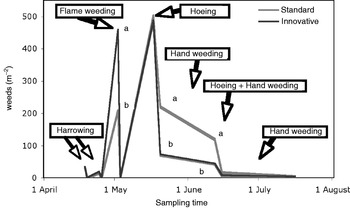
In 2003 (Fig. 8), because of a particularly cold and dry spring, initial weed density was very low (only 35 weeds m−2). The first pass with the spring-tine harrow reduced weed density by roughly 97%, but it did not stimulate the emergence of new weeds. Thus after 6 days, a mean value of only 19 weeds m−2 was recorded. Due to the failure of the first preventive operation, a second pass with the spring-tine harrow was performed. Weed density was again reduced to virtually nil. However, massive weed emergence occurred after crop sowing, partly due to the stimulus inherent in sowing operations and partly to a temperature rise. Weed density was particularly high in the innovative system (+119% as compared to the standard system). This was probably attributable to the greater volume of soil disturbed by the 10-row seeder compared to the 5-band seeder. However, this effect should not necessarily be regarded as negative, since flame weeding prior to crop emergence once again reduced weed density to virtually nil. Even so, substantial weed emergence recurred, and the mean weed density by the time of the first hoeing was roughly 500 weeds m−2. In the innovative system, precision hoeing, which achieved 85% efficacy, restored weed density to acceptable levels, while in the standard system hoeing achieved no more than 56% reduction. This difference was likely due to the fact that the 10-row spatial arrangement, composed of individual rows, allowed more successful intra-row weed control. Subsequently, weed density was gradually reduced as a result of additional hoeing and three hand-weeding operations. It should be pointed out that in the innovative system the number of weeds remained significantly lower until the end of the crop cycle. This allowed a notable savings (28%) on labor time as compared to the 5-band, standard sowing system.
Pattern of weed development during the 2003 season in organic carrot grown according to the standard and innovative management systems in the early sowing farm. Different letters indicate significant differences for P⩽0.05 (LSD test).

No significant differences were observed in the total percent reduction of intra-row weeds in 2002 and 2003 in the innovative system when comparing use of the torsion weeder with that of vibrating tines (data not shown). Intra-row weed reduction was on average 72% in 2002 and 78% in 2003 (this kind of intervention is mostly effective when performed on seedlings).
Crop yield and yield quality
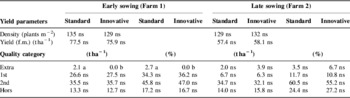
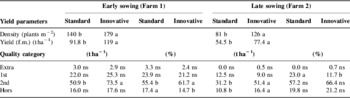
In 2001 no significant differences between the two physical weed management systems were recorded on either of the two farms, with the exception of extra category carrots on Farm 1, which were only produced with the standard system (Table 4). Total production was decidedly lower for late sowing (−25%) as compared to early sowing, but the latter was associated with a smaller root mass in the extra category (−66%).
Yield parameters and biomass and percent distribution of roots among commercial quality categories in organic carrot grown with the standard and innovative management systems in the early and late-sowing farms in 2001. For the same line and character, means labeled with different letters are significantly different at P⩽0.05 (LSD test), ns=not significant.

f.m.=fresh matter.
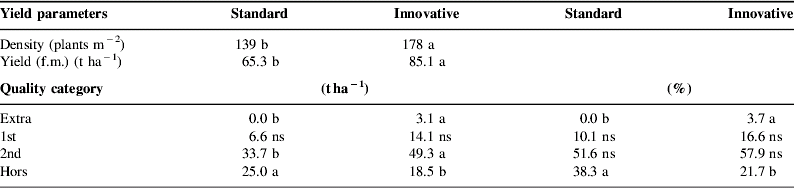
In the years 2002 and 2003 carrot showed the same production trend. The innovative system had a higher mean density of carrot plants (+28% on Farm 1 both in 2002 and 2003; +55% on Farm 2 in 2002) and a higher root yield (+30% on Farm 1 in 2002 and 2003; +42% on Farm 2 in 2002). In 2002, late sowing again gave a lower carrot yield (−37%) compared to early sowing (Table 5). In 2003 (in which only early sowing was taken into account), carrot yield was somewhat lower compared to the previous year, due to drought which affected the crop throughout the entire cycle (Fig. 1). The higher yield of the innovative system in the 2-year period 2002–2003 was mainly attributable to higher 2nd category root yield, and, only for 2003, also to higher extra carrot root yield (Table 6). The higher yields recorded in the two-year period 2002–2003 in the innovative system may be ascribed to the increased effectiveness of precision hoeing, which allowed better intra-row weed control through the use of spring-tines.
Yield parameters and biomass and percent distribution of roots among quality commercial categories in organic carrot grown with the standard and innovative management systems in the early and late-sowing farms in 2002. For the same line and character, means labeled with different letters are significantly different at P⩽0.05 (LSD test), ns=not significant.

f.m.=fresh matter.
Yield parameters and biomass and percent distribution of roots among commercial quality categories in organic carrot grown with the standard and innovative management systems in 2003 (early sowing farm). For the same line and character, means labeled with different letters are significantly different at P⩽0.05 (LSD test), ns=not significant.
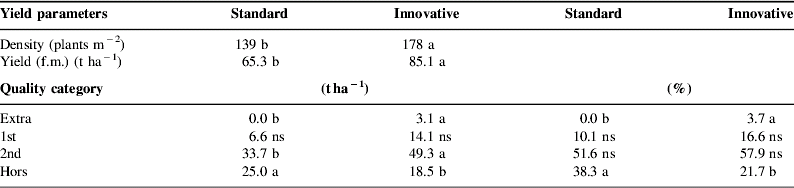
f.m.=fresh matter.
Crop economy
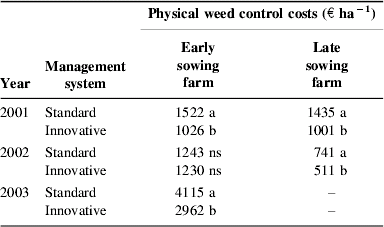
As shown in Table 7, actual physical weed control costs varied considerably upon year, farm and management system. However, in all but one case, use of the innovative system resulted in significantly lower costs, ranging from 121 to 1153 € ha−1 (average: 416 € ha−1). In 2003, because of the massive weed growth that occurred mainly after crop sowing, a large quantity of labor was required for hand weeding. As a result, costs escalated in comparison to the previous years. Despite this, the innovative system still allowed a savings of c. 1000 € ha−1. Furthermore, the 10-row innovative system also allowed significant savings in 2001 (roughly 500 € ha−1), and on the late-sowing farm in 2002 (roughly 250 € ha−1), while on the early sowing farm the estimated cost was virtually the same for both systems.
Physical weed control costs in carrot grown with the standard and innovative system on two organic farms in the Fucino plateau in the period 2001–2003. For the same farm and year, values labeled with different letters are significantly different at P⩽0.05 (LSD test).

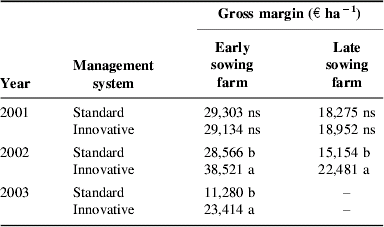
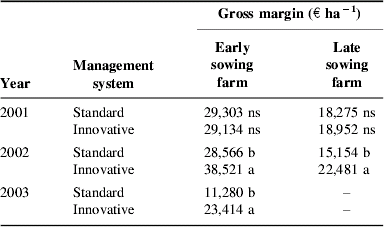
The estimated gross margin is in accordance with the yield data obtained for the two management systems (Table 8). In 2001 no significant differences between the two systems were recorded, while in the two subsequent years the innovative system, which achieved more effective weed control and higher yields, gave an appreciably higher gross margin (on average c. +40% in 2002 and c. +100% in 2003), ranging from 22,481 to 38,521 € ha−1.
Estimate of gross margin obtained from organic carrot in two farms in the 2001–2003 period. For the same farm and year, values labeled with different letters are significantly different at P⩽0.05 (LSD test).
Discussion
The data obtained in this research demonstrate that an appropriate physical weed management strategy can effectively reduce weed density, limit the hours of labor required for hand weeding and at the same time guarantee very satisfactory production, in terms of yield, quality and gross margin. However, these results could not have been obtained if direct post-emergence intervention had been the only means adopted. For example, false seedbed plus flaming (stale seedbed technique) proved to be the key operation of the entire strategy, being essential for the successful outcome of the subsequent weed control operations. The crucial importance of the stale seedbed technique is clearly shown by many of the data recorded in the 3-year period, but it is strikingly synthesized by the higher labor requirement needed for hand-weeding in 2003, i.e., the year in which the false seedbed technique was rather ineffective. This failure was mainly attributable to an adverse weather pattern: a dry and rather cold spring delayed peak weed emergence, so that maximum weed seedling density was recorded after crop emergence (in parallel with an increase in average air temperature). Such conditions were extremely unfavorable for the subsequent hoeing operations. In 2001 and 2002, on the other hand, the false seedbed technique very well stimulated weed emergence (from 100 to >200 weeds m−2), and the efficiency of the operating machines, which was consistently higher (from 46 to 87%), succeeded in achieving a marked reduction in weed density. This demonstrates that application of preventive weed management methods is of utmost importance in the case of poorly competitive cropsReference Bàrberi18.
In several studies which included the use of different preventive methods, variable results were likewise obtained. FogelbergReference Fogelberg13 utilized night-time soil cultivation on carrot, reducing weed emergence from 15 to 25%, but this control percentage was enhanced by means of post-emergence brush weeding. MelanderReference Melander30 adopted the same combination of operations on onion (Allium cepa L.) and kale (Brassica oleracea L. var. acephala DC. subvar. laciniata L.), obtaining up to 90% weed reduction in trials designed to reduce the labor requirements for intra-row hand weeding.
With regard to post-emergence treatments, it is important to note the high weeding effectiveness of the 11-tine precision hoe (which achieved up to 90% control). This implement allowed a marked labor saving in the innovative system as compared to the standard system. This saving was mainly due to the ability of this machine to work also along the crop row, thanks to its pair of spring tines. However, the effectiveness of precision hoeing was considerably improved by timely hand weeding performed immediately prior to the hoeing operation itself. Hand weeding eliminated larger weeds, which thus no longer interfered with the action of the spring-tines, as the selective weed removal along the row performed by the spring-tines is unable to eliminate adult weeds and can only uproot or cover weeds in the cotyledon or seedling stage. Intra-row weed reduction levels averaged 74% both for the torsion weeder and the vibrating spring-tines. Similar levels of intra-row weed reduction were obtained in Fogelberg and Kritz's trialsReference Fogelberg and Kritz14, in which a brush weeder equipped with brushes rotating on a vertical axis achieved a mean control efficiency of 89%, this value being obtained on weeds at the stage of two true leaves. Weed control decreased to 35% when weeds were at the 6 to 8 true leaves stage.
It is worth noting that use of torsion weeders and vibrating tines was possible only with the adoption of the single-row crop spatial arrangement, which in the innovative system replaced the traditional band-sown crop. Numerous studies have tested new crop spatial arrangements in order to facilitate the action of operating machines adopted for post-emergence physical weed control, for example on pigeon beanReference Bàrberi, Belloni, Cerrai, Fontanelli, Moonen and Raffaelli31 (Vicia faba L. var. minor), vining peaReference Ascard, Olstedt and Bengtsson32 (Pisum sativum L.) and winter wheatReference Rasmussen33 (Triticum aestivum L.), obtaining good weed reduction percentages with the aid of hoeing machines that could not otherwise be utilized. As such, crop spatial arrangement is to be considered one of the options available for ‘cultural’ weed management, which, alongside with preventive and direct methods, should always be represented in any weed management strategy set forth in organic agricultureReference Bàrberi18.
At present, despite the effectiveness of innovative machinery, hand weeding operations can be reduced but not completely eliminated in organic vegetable cropping. The importance of hand weeding is also underlined in the multi-year trials on physical weed control in carrot undertaken by RadicsReference Radics, Gàl and Pusztai15 and GàlReference Gàl, Pusztai and Radics16. On the other hand, it should not be overlooked that hand weeding may constitute a danger for the crop, as it may frequently result in inadvertently uprooting crop plants. In the standard crop spatial arrangement, carrots are sown randomly within the band, thus increasing the risk of accidental uprooting. This may explain why, at harvest, carrot plant density was on average higher in the innovative system, where precision single-row sowing facilitated identification of the crop.
Carrot showed good resistance to the use of torsion weeders and vibrating tines, confirming the excellent anchorage characteristics of this cropReference Fogelberg and Gustavsson4. The slightly higher root commercial quality obtained with the innovative system is possibly attributable to the fact that the single rows, together with precision sowing, lead to a more rational arrangement of the space available to the crop, giving the tap root greater room for both downward and lateral growthReference Franceschetti, Belletti, Quagliotti, Bianco and Pimpini34. In the past, the single row arrangement was the normal crop typology used by farmers in Fucino plateau, but the band system gradually became more widespread because it facilitated chemical weed control. Consequently, the single-row spatial arrangement of carrot is now considered by local farmers as a form of ‘return to the past’, and even producers who engage in organic farming generally prefer to maintain the band typology, which however is not suitable for physical weed control. Ongoing extension activities that we are conducting in collaboration with ARSSA Abruzzo would hopefully change this irrational attitude.
It is also important to underline that residues are generally incorporated in the soil by primary and secondary tillage, thus this kind of weed management system (after stale seedbed technique) is actually a ‘clean tillage’ system, but, at the same time, it is perfectly suitable to organic agriculture, and applicable to a large range of vegetables, both sown (e.g., spinach, Spinacia oleracea L.) and transplanted (e.g., chicory, Cichorium intybus L.; fennel, Foeniculum vulgare Mill.; tomato, Lycopersicon esculentum Mill.; and cabbage, B. oleracea L.).
Conclusions
Results of this study clearly demonstrate that organic carrot growing in the Fucino plateau can be successfully conducted, despite the crop being very sensitive to weed competition. In our trials, physical weed control operations, whose effectiveness was improved year after year through increasingly optimized techniques, consistently allowed good weed control. Use of the innovative organic system, in which carrot is sown in 10 single rows, resulted in the greatest effectiveness of mechanical treatments, as this management system allowed substantial intra-crop weed control as well. Furthermore, this system not only had lower overall costs (due to more limited use of labor for hand weeding), but it also achieved a higher root yield and consequently a higher crop gross margin. These results also show that there is not necessarily a correspondence between the complexity of measures that must be deployed in an effective organic weed management strategy (based on sound integration among preventive, cultural and direct methods) and the complexity and cost of technical solutions (tactics) included in such strategy. The best investment for organic farmers is always that on the knowledge (weed biology and ecology, crop/weed interactions, technical innovations) that they need to build up a strategy fine-tuned to their specific cropping situation. On the economic side, at present, considering the very high market value of organic carrots, use of the innovative weed management system can turn into an expected potential gross margin for the farmer of up to c. 40,000 € ha−1. These motivations would certainly be sufficient to justify adoption of the innovative system, but this new management approach—for reasons related to tradition—is not yet favorably received by Abruzzi farmers. However, results of these trials are beginning to ‘break through’ farmers’ resistance to innovation, which is rather common in the study area.
Acknowledgements
We express sincere thanks to Roberta Del Sarto of DAGA and Paolo Gronchi, Claudio Marchi, Giovanni Melai, Alessandro Pannocchia, Calogero Plaia and Silvano Toniolo of CIRAA ‘E. Avanzi’ (University of Pisa), for their valuable contribution to this research. Sincere thanks also to the organic farmers of the Fucino plateau that hosted the trials (Mr Mancinelli, Alfonsi, and Scafati) and to the technicians and officials of ARSSA Abruzzo (Avezzano), Domenico Casaccia and Ernesto Recinelli, without whose funding and assistance this research project would not have been possible.